READY TO SELL Facial Steamers ONLINE?
Get a store built for you in 5 days, plus training and support to help you start, run, and grow your Alternative business.

A practical UK guide to sourcing, checking and selling facial steamers online, with supplier questions, electrical safety checks, a worked cost example, customer rights and a 30-day launch plan.


A facial steamer is a powered beauty device that heats water and directs vapour to the face. That makes it different from a towel, mask or cosmetic: customers need to understand what they are buying, how to use it, and who is responsible if the electrical product is unsafe. A promising photograph alone is not enough to build a reliable online offer.
This guide takes you from a product idea to a small, evidence-led launch. It covers customer research, steamer types, supplier checks, product testing, UK electrical and online-selling responsibilities, pricing, photographs, fulfilment, promotion and a 30-day plan. It is written for a new seller, not as a substitute for product-specific compliance advice. The rules depend on your role, product design, destination market and claims. Check the current official guidance before placing equipment on the market.
You do not need a large catalogue to start. You do need a traceable product, reliable instructions, safe packaging, clear customer information and a price that still works after fees, delivery and returns.
Start with one model, a supplier you can trace and a sample you can inspect. Write down the questions buyers ask before committing to a larger order.
Begin with the shopping problem you want to solve, rather than the device specification. People may look for facial steamers since they want a home spa accessory, a gift, a compact travel product or a device that fits into a simple self-care routine. Those are possible buyer contexts, not proof of demand. Do not assume every buyer wants the same size, price or feature set.
Write down one primary buyer and one buying occasion. For example, your first test might focus on adults buying a compact home-use device as a gift. Another might focus on customers already shopping for beauty accessories who want an easy-to-store tabletop unit. A narrow first audience makes it easier to choose product dimensions, write a useful page and select a sensible set of photographs.
Ask potential buyers about past behaviour. Useful questions include: What beauty devices have you bought recently? Where did you buy them? What helped you trust the listing? What information did you look for about cleaning, storage, warranty or safety? What made you return or avoid a product? What did you pay for the last comparable device? A question such as “Would you buy my idea?” tends to produce polite encouragement rather than useful evidence.
Keep the research focused on purchase decisions. A short conversation or survey can record the product type viewed, device size, stated budget, reason for buying, channel used and missing information. Avoid gathering personal health details. You are researching retail choices, not diagnosing skin conditions or providing treatment advice.
Compare a few concept cards rather than asking about an abstract product. One card might show a compact tabletop steamer with a simple water reservoir. Another could show a travel-size unit with a carry pouch. A third could show a larger device with adjustable settings, if that feature is confirmed on an actual supplier sample. Give each card a plausible price range and note which details are verified and which remain assumptions.
Ask what the customer would need to know before ordering. Some may prioritise clear operating instructions. Others may ask about plug type, product dimensions, noise, cleaning, storage, the returns process or the manufacturer’s warranty. Those answers can guide your first listing and help you identify questions to send to suppliers.
Search results and marketplace listings can help you see the language customers use. Search phrases may include “facial steamer”, “face steamer”, “home facial steamer”, “portable facial steamer” and “facial sauna”. Record the wording and questions that appear repeatedly. Do not assume the search volume translates into sales for a new shop.
Look at review patterns on comparable products. Group comments into themes such as unclear instructions, leaks, difficult cleaning, damaged parcels, product size, steam output and customer service. A few reviews cannot establish defect rates, and reviews may describe different models or batches. Use recurring concerns to build supplier questions and quality checks, not to make unsupported claims about competing products.
Check seasonality and gifting carefully. Beauty devices may be promoted around Christmas, Mother’s Day or other gift occasions, but a seasonal spike can leave you with unsold stock. A launch plan should work for ordinary months and campaign dates. If gifting is central, confirm gift packaging and dispatch capacity before including it in the offer.
A demand test should help you decide what to do next, including whether to stop. You could show a product concept to a small group of likely buyers, compare two honest product-page drafts, or collect sign-ups for an update when you can legally and operationally supply the product. State clearly when an item is not yet available. Do not accept payment for stock you cannot fulfil on the terms you have promised.
Set a decision rule before you start. For example, you might require a minimum number of qualified responses, a clear preference for one format and evidence that the price is within a workable range. The number should reflect your audience and budget; there is no universal conversion benchmark that proves a product will succeed. Keep the test small enough that a weak response does not force a large stock order.
Separate interest from a purchase. A like, survey response or email sign-up is not the same as a completed order, repeat purchase or profitable customer. Your early evidence can help choose a sample; it cannot remove product-safety duties or prove that a listing will rank in search.
The word “facial steamer” can describe products with different power sources, shapes, controls and intended use. Start by identifying the exact model and its supplied components. The unit, charger or mains lead, reservoir, nozzle, packaging, manual and product label all matter. Do not build a page from a supplier’s category image if it may show a different variant.
A mains-powered tabletop steamer may have a reservoir and a shaped outlet. It can be easier to demonstrate in a home-use setting, but its electrical safety, plug, cable, stability, heat handling, packaging and instructions need careful review. Confirm the rated voltage, frequency, input, plug type and intended destination market from the product documentation. Do not rely on a marketplace photograph of a plug.
A compact or travel-size device may be sold with a smaller water capacity or USB power arrangement. Confirm whether the device itself heats water or whether the power connection serves another function. Check what supply equipment is included and whether it is suitable for the claimed use. A USB connector alone does not demonstrate that a power adapter is supplied or appropriate.
Some product pages combine steaming with features such as a timer, adjustable output, aromatherapy tray or other accessories. These features add product questions and sometimes compatibility concerns. List only what is present on the exact model you have inspected. If an accessory is optional, say so. If a setting changes the operation, get the manufacturer’s clear instructions and test that setting on the supplied sample.
A starter range might contain one carefully selected model and one accessory that makes a clear difference, such as a compatible storage pouch. A second colour is a stock-keeping choice, not automatically a second product benefit. More variants increase the chance of picking errors, duplicated product records, slow-moving stock and confusing comparison pages.
| Range decision | What to verify before listing | Why it matters |
|---|---|---|
| Power source | Exact rating, supplied cable or adapter, plug type and destination market | A customer must know what is included and whether it suits the intended market |
| Water reservoir | Capacity stated by the maker, how it is filled and any stated cleaning instructions | Capacity affects dimensions, set-up and the customer’s expectations |
| Controls | Every button, setting, indicator and automatic function on the actual sample | A listing must not promise a feature that the selected unit lacks |
| Nozzle or outlet | Shape, adjustment, moving parts and any handling cautions in the instructions | Photos and copy should match the product and its directions |
| Accessories | Exact contents, compatibility and whether each item is included in the box | Prevents a customer expecting a component that is sold separately |
| Packaging | Retail carton, protective inserts, tamper seals and parcel dimensions | Affects storage, delivery cost, damage prevention and presentation |
| Documentation | Model identity, manufacturer details, safety information and current conformity records | Helps establish traceability and supports responsible sourcing |
Do not give a product a “premium”, “professional” or “clinical” label just to justify a higher price. Those words can change customer expectations and may imply a level of quality or performance you cannot substantiate. Instead, describe verifiable details: dimensions, included accessories, control layout, finish, power information and warranty terms supplied by the responsible business.
A bundle should solve a real customer need. A steamer with a compatible storage pouch could be a tidy offer if the pouch actually fits the device and protects it as described. A bundle of unrelated skincare items may create separate ingredient, labelling, claims and fulfilment questions. Do not include a cosmetic or scented oil simply on a supplier’s suggestion; verify compatibility and the legal responsibilities for that separate product.
Use a range matrix before you commit. Record the model, supplier code, variant, stated dimensions, weight, rating, package contents, manual version, product label, document status, sample results, unit quotation, minimum order quantity, lead time, warranty information, approved claims and product-page date. Keep a record of which source confirmed each fact. If a supplier changes the model or factory, treat it as a change that may require fresh verification.
Possible routes include a UK wholesaler, an authorised distributor, a manufacturer, a sourcing agent or a private-label supplier. The cheapest unit quote is not the same as the lowest-risk offer. Your role can affect your obligations: importing products from outside the UK, selling under your own brand, changing product design or labels, or making product-specific claims may carry responsibilities beyond reselling an unchanged product from a UK supplier.
Ask the supplier to identify the exact legal business responsible for manufacturing and supplying the device. Request its registered business details, full product model, factory or production site, and the name and address that will appear on the product or accompanying documentation. Check that the invoice, carton, manual, test paperwork and product label refer to the same model and supplier. If the documents show a similar name or a different model, ask for a written explanation and corrected records before ordering.
Request the product-specific declaration of conformity and supporting technical information applicable to the destination market and exact model. Ask which regulations and standards the supplier assessed, who completed the assessment, when it was completed, and whether the documents cover the same power supply, plug, construction, accessories and manual version as the sample. A certificate image without a clear product identity or issuing context is not enough to show that your exact item has been assessed.
Do not treat a CE or UKCA logo shown in a catalogue as proof. Great Britain currently recognises CE or UKCA marking for many regulated products under the relevant rules; product and destination details matter, and Northern Ireland has different arrangements. Check current official guidance for your situation. The supplier should explain the conformity route and provide documents you can verify. Never add a mark to a product, package or page on a supplier’s assurance that “all our items have it”.
Ask about electromagnetic compatibility and restricted substances where they apply to the model. Electrical product compliance may involve more than one set of rules. Request the documents that support the product’s conformity; do not assume one certificate covers every legal requirement. A supplier’s willingness to send clear, traceable information is useful. It does not remove your duty to check your role and obligations.
Ask for the operating instructions in English for products supplied in the UK and inspect them for clarity. They should match the actual unit and cover the maker’s stated set-up, operating, cleaning, storage, warnings, disposal and support information. Look for safety instructions that explain the conditions of use, including any warning about water, heat, electrical parts, keeping the unit away from unintended exposure, and what to do if the product is damaged. Do not invent technical directions if the manual is incomplete; ask the manufacturer to resolve the gap.
A supplier questionnaire can make this practical:
Request written answers with the quotation. Record dates and names. A supplier may be helpful and trustworthy yet still misunderstand the legal requirements that apply to your business. If an answer relies on “we have sold millions”, ask for the underlying model-specific evidence. If a supplier refuses to share enough information to identify the product and its compliance route, choose another source.
Buy a sample through the normal route if you can, including the retail box and instructions. Inspect it as a product a customer would receive. Photograph the seal, label, model number, plug, cable, reservoir, controls, carton and included paperwork. Compare these items with the supplier’s documents and your written quote.
Create a sample checklist that is repeatable. Record whether the packaging identifies the same model as the invoice and documents; whether the item arrived with all components; whether the enclosure is intact; whether the cable, plug and reservoir appear undamaged; whether the device sits stably on the surface intended by the manufacturer; and whether every control behaves as the instructions describe. Disassemble or modify an electrical device only if you are qualified and the supplier authorises it.
If the unit is meant to heat water, follow the manufacturer’s written operating instructions exactly during a controlled sample check. Do not test an unknown product contrary to its manual or near water sources where the setup could create a hazard. Keep the test area clear, follow all cautions, and stop if the unit behaves unexpectedly, leaks, smells unusual, makes a concerning noise, becomes damaged or shows any sign of unsafe operation. Do not continue testing a suspect unit; contact the supplier and retain the evidence.
Check how easy it is to understand the instructions without supplier assistance. Can a first-time buyer identify what is in the box, set the unit up, understand the controls, clean it as directed and find support details? Any uncertainty is a product-page or supplier issue to resolve before sale. Ask a few people unfamiliar with the product to locate important information in the supplied manual; observe where they pause, rather than coaching them.
Use multiple samples when you can afford them, especially if the device is an imported or own-brand product. A single unit can reveal obvious problems but cannot demonstrate consistent batch quality. Agree an inspection and non-conformance process before placing a larger order. Keep sample records tied to a model, date and supplier quotation.
The sample should inform your photography too. Do not photograph a different model, substitute a cleaner-looking unit in a way that changes the product, or add accessories that are not included without labelling them as separate props. Make sure product images show a realistic scale and the actual controls. A photo is part of your product description.
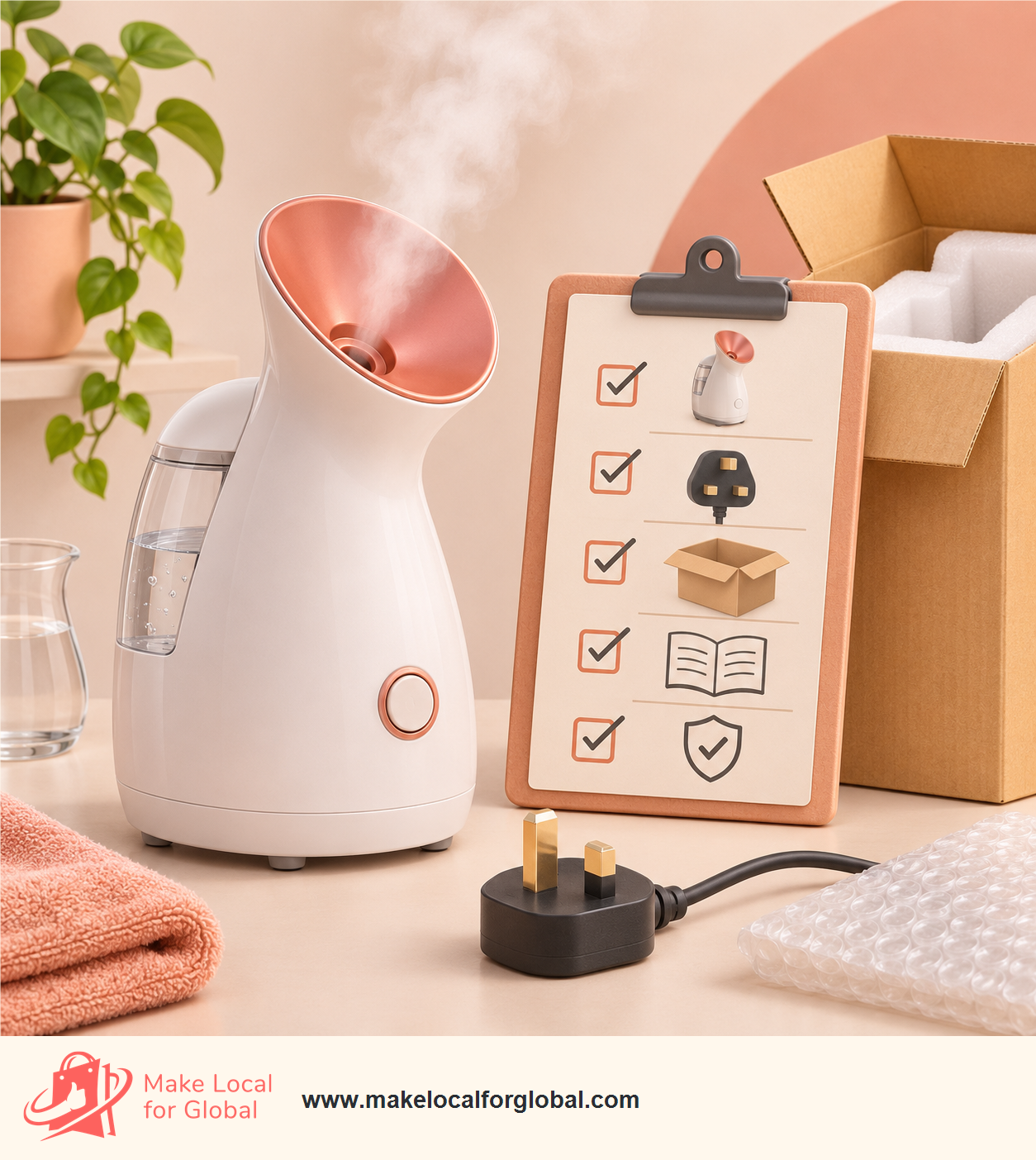
Facial steamers are electrical goods. Before you list or import them, identify where you will sell, what role your business takes and which regulations apply to the exact model. A seller who resells an unchanged product sourced from a UK distributor may have a different set of responsibilities from a business that imports from outside the UK or places the device on the market under its own brand. A private-label seller may be treated as the manufacturer for some obligations.
For Great Britain, the Electrical Equipment (Safety) Regulations 2016 set safety requirements for electrical equipment within their scope. Official guidance describes manufacturer, authorised representative, importer and distributor duties. It includes requirements covering product safety, conformity assessment, technical documentation, marking and product identification. Check the current guidance and the product’s voltage, intended use and route to market with a competent compliance professional where needed.
The conformity mark alone does not establish compliance. Depending on the product and market, either CE or UKCA marking may be recognised in Great Britain under current rules. Northern Ireland has separate rules and may require CE or CE plus UKNI in particular circumstances. Do not use a blanket “UKCA required” or “CE always enough” statement. Check official product-specific guidance at the time you source and sell.
Other rules may apply to electrical and electronic equipment, including electromagnetic compatibility and restrictions on hazardous substances. If you are the producer under relevant WEEE rules—for example, if you make and sell equipment under your own brand or sell electrical goods into the UK from abroad—you may have producer responsibilities. Retailers and distributors have duties concerning take-back or an alternative route for customers to dispose of old household electrical goods when they buy a new equivalent product. The rules apply to online sellers too.
Keep traceability information. Store the supplier invoice, model and batch identifiers, product and packaging photographs, declaration of conformity, test report references, English manual, product listing version and any safety correspondence together. Record which supplier provided each item and when. If a customer reports a fault, this can help you identify whether other units from that model or batch may be affected.
Agree a process for suspected safety incidents before launch. Pause sales of the affected model if evidence suggests there may be a risk, preserve the product and customer record appropriately, contact the manufacturer or importer, and follow the instructions of the relevant market surveillance authority. Do not quietly relist a changed unit under the same product page if it is materially different. A safety complaint needs a clear, documented response.
This is a practical orientation, not a complete compliance checklist. Requirements may vary by product specification, business role, destination market and changes to the rules. If you import or private-label the unit, get advice before committing to a production order.
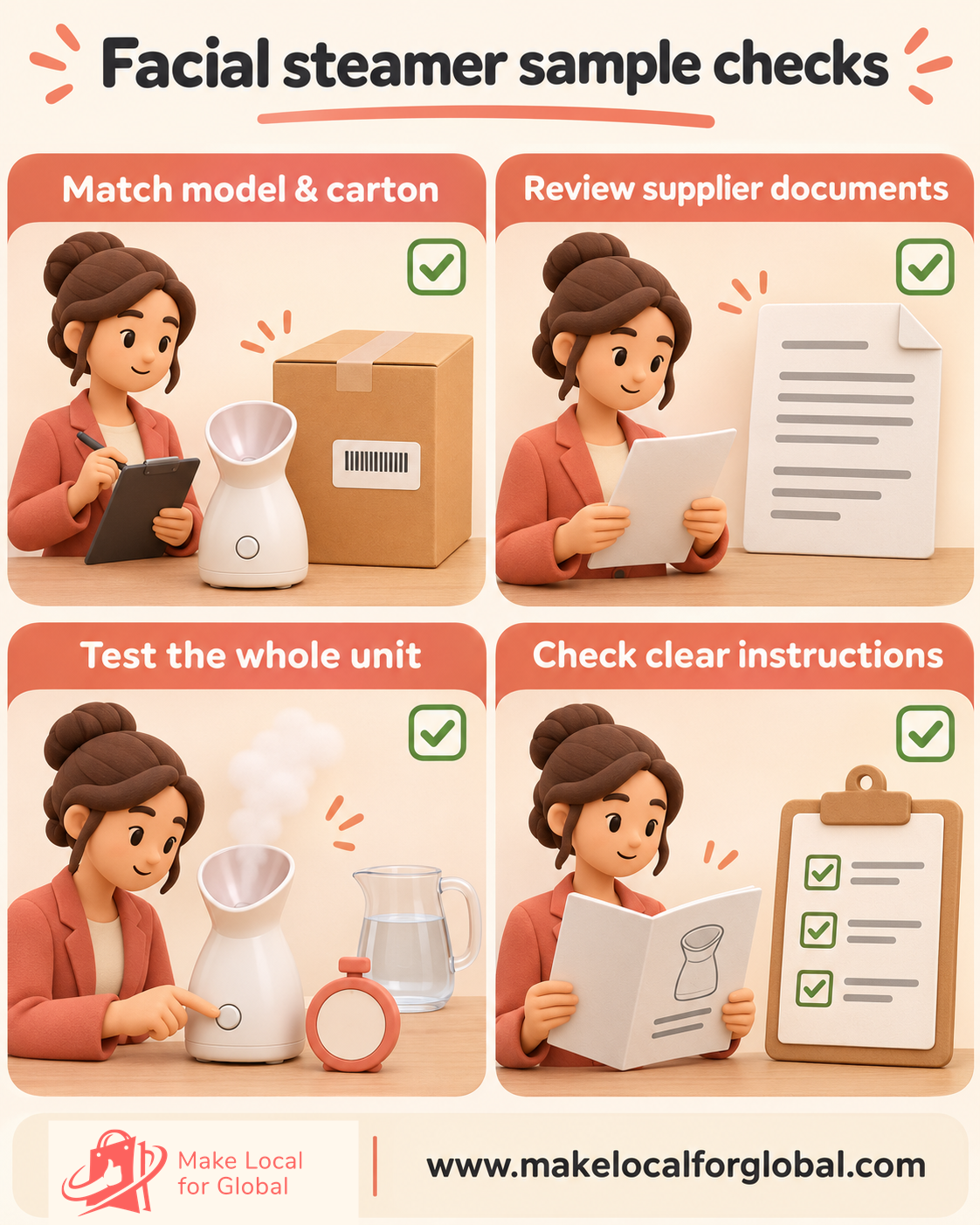
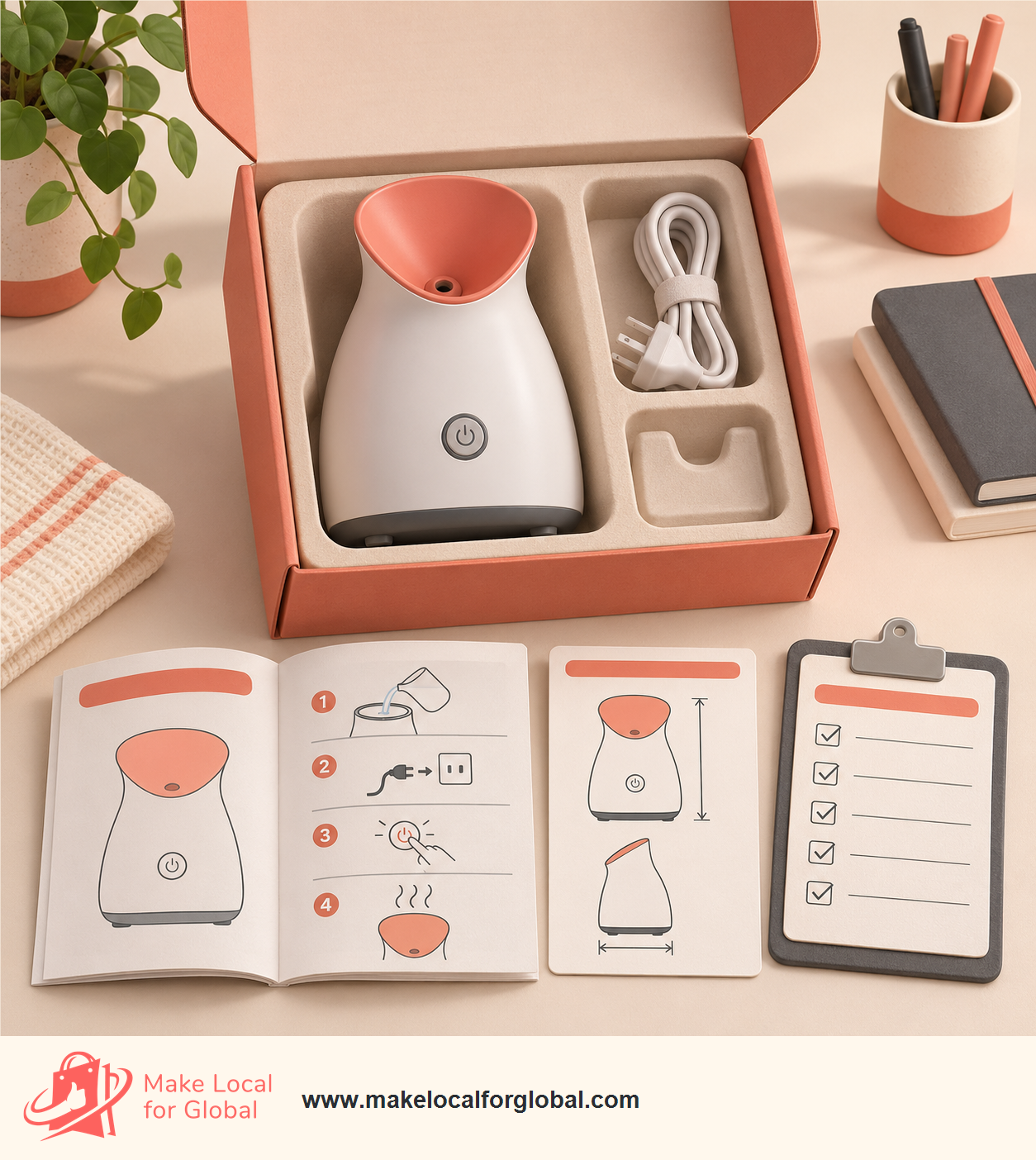
A buyer should be able to identify the item and understand what arrives. Show the exact product name, model or variant where appropriate, dimensions, weight if useful, package contents, power information as stated by the manufacturer, warranty route, delivery expectations, returns information and customer-support contact. If a power adapter is not supplied, say so clearly. If a pouch appears only in a photograph but is not included, label the photo or remove the pouch.
Use plain language. Explain the controls and cleaning only in terms confirmed by the manual. Do not write operational instructions from memory or supplier marketing snippets. Make claims such as “safe for every skin type”, “opens pores”, “detoxifies”, “treats acne”, “improves circulation” or “medical-grade” only when product-specific evidence and regulatory advice support them. A cosmetic or medical claim can change how a product is interpreted; avoid presenting a home appliance as a treatment.
Promise a particular result, such as clearer skin, only when the claim is properly substantiated and lawful for the relevant market. A disclaimer does not fix an unsupported headline. Use factual descriptions of product design and supplied features. If the manufacturer has an approved claim list, check that it covers your exact variant and that you are not broadening the meaning through your copy or images.
Write warnings and limitations where customers can see them before purchase. Do not bury important information in a downloadable manual alone. Make sure the product page, checkout, confirmation email and printed instructions do not contradict one another. A model number or power rating that differs across the listing and carton erodes trust and can create confusion when customers seek help.
The supplier’s unit price is only one part of the cost. Add inbound freight and import charges where applicable, packaging, fulfilment, payment and platform fees, expected damage or replacement allowance, customer acquisition and the time needed to inspect and dispatch an order. Keep one-off launch expenses separate from per-order costs, then make clear how many units those one-off costs are spread across.
Use this illustrative example to understand the structure, not as a recommended market price or a forecast. It assumes a non-VAT-registered seller, a single unit sold for £34.99, a standard parcel, and example fees that you must replace with your own supplier, carrier and platform quotes.
| Per-order item | Example amount |
|---|---|
| Facial steamer purchase cost | £8.50 |
| Inbound freight allocated per unit | £1.10 |
| Outer packaging and protective fill | £0.85 |
| Delivery paid by the seller | £3.60 |
| Payment fee estimate (2.9% of £34.99 plus £0.30) | £1.31 |
| Returns, damage or replacement allowance | £1.00 |
| Marketing cost allocated to this order | £3.00 |
| Total example variable cost | £19.36 |
| Example selling price | £34.99 |
| Amount left before fixed overheads, income tax and other costs | £15.63 |
The arithmetic is £8.50 + £1.10 + £0.85 + £3.60 + £1.31 + £1.00 + £3.00 = £19.36. The difference between £34.99 and £19.36 is £15.63. This is not net profit. It does not account for your time, website plan, insurance, accounting, professional compliance advice, storage, product photography, unsold stock, one-off setup or every tax obligation. Replace every example with a current quotation or measured business figure.
If you are VAT registered, do not treat the full customer price as revenue available to cover costs. Work out the relevant VAT treatment for your product and transaction and calculate fees on the basis charged by the provider. If you are not registered, use the actual VAT-inclusive costs you pay where you cannot recover input VAT. Do not assume a price calculator handles your specific tax position. Ask a qualified adviser when the correct treatment is uncertain.
Check the effect of a return. In this example, the allowance is an average planning figure, not a fee that can be charged to an individual customer. Some returned goods may not be resellable as new; a faulty product can create replacement and shipping costs; a customer may have statutory cancellation rights. Review actual returns data as soon as you have it and update the model. Label a refundable deposit, testing charge or restocking amount as “non-refundable” only when the terms are lawful for that transaction.
Test two or three possible prices against the same cost structure. A price that looks competitive may leave too little to pay for safe sourcing, customer service and a replacement unit. A higher price may be workable only if buyers understand the offer and the support you provide. Compare equivalent products by model, power source, accessories, warranty, shipping and evidence, rather than by headline price alone.
Use the B2C Pricing Lab to compare a price with fulfilment, selling fees, promotion and returns assumptions. Read how to price a physical product in the UK and how to price your product without guessing. Treat a model as a decision aid: the results depend on the figures you provide.
A supplier may quote a low unit price only for a large order. Compare the full cash requirement: samples, deposit, balance payment, freight, duties and taxes, inspection, labels, packaging, storage and the cash you need to refund or replace orders. A low per-unit cost can still create an unaffordable commitment if the minimum order ties up money before sales arrive.
Ask whether the order can be split by production batch or colour, and whether you can reorder at the same specification. Confirm what happens if a delivery is late or fails inspection. Do not assume a supplier’s online trade terms protect you in the same way as the consumer policies you need to offer to buyers. Have the commercial contract reviewed if the order is material to your business.
For a first test, consider a small order from a traceable UK supplier if the products and records meet your requirements. A UK address is not automatic proof of compliance, and imported items stocked in the UK may still bring importer or producer duties. Ask who is legally responsible and keep the records that answer that question.
A useful product page needs more than a glossy hero image. Use the exact model you intend to sell and create a small, consistent set of images:
Do not put tiny instructions into an image. Customers may view it on a phone, search engines may not read the text, and the image cannot replace the accessible product description. Write meaningful alternative text for images that explain content, such as “Compact white facial steamer beside its water reservoir and English instructions”. Avoid repeating the same phrase across every image. A decorative image can have empty alt text where appropriate.
Keep the image honest. Do not add a second device, a premium adapter or a branded accessory that the customer will not receive. Do not alter the product to make its design appear different. If you use a lifestyle setting, keep the product itself accurate and avoid suggesting medical or guaranteed results. A product comparison graphic should use confirmed facts and identify where model details come from.
Prepare product copy from a verified fact sheet. Begin with the item identity and the main practical details. Explain what is included, how the customer can find the manufacturer’s instructions, which market the device is intended for, what power equipment is supplied, the warranty route and how to get help. Use short paragraphs, descriptive subheadings and scannable bullets. Keep the exact model and wording consistent across the title, variant selector, images, checkout and dispatch note.
For search visibility, use one clear page topic. A title such as “Facial Steamer Model X: Size, Features and What’s Included” is more specific than “Amazing Spa Magic at Home”. Describe the product naturally using terms buyers may search, but do not repeat the same keyword in every sentence. A helpful guide can target “how to sell facial steamers online”; an individual product page should focus on the specific device and buyer questions, so the two pages do not compete for identical intent.
Write a short meta description that accurately summarises the page. Search engines may choose a different snippet, so do not rely on a promise that the exact text will always appear. Include useful related pages where they help the reader, such as your shipping, warranty, returns and safety information. Make sure product structured data and availability are accurate if your platform outputs them.
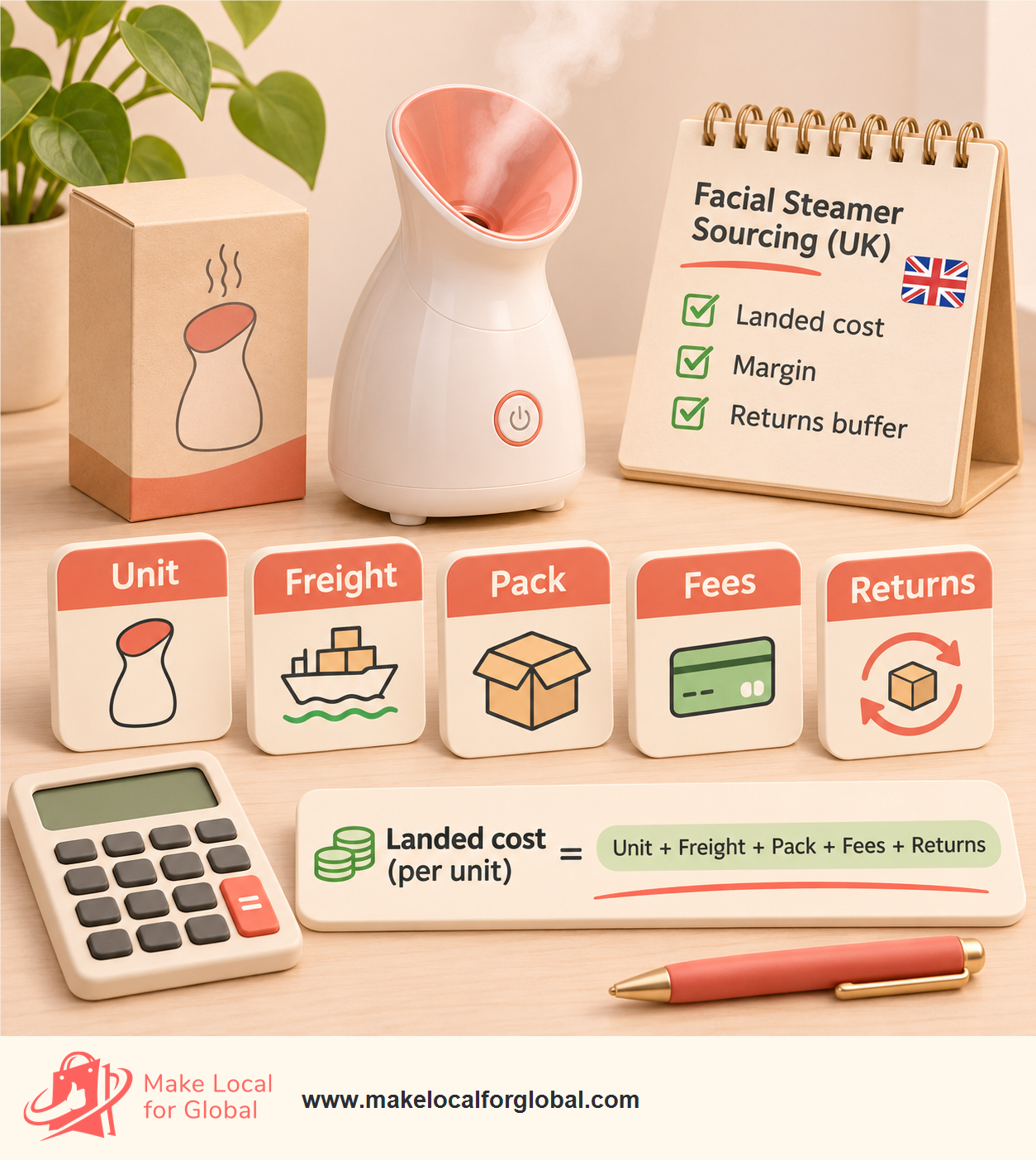
Compare landed product cost, fulfilment, payment fees and returns with your own figures before choosing a selling price.
A marketplace can provide existing buyer traffic and a ready-made checkout, but you must follow its product, safety, image and returns policies. A marketplace listing competes directly beside similar products and may constrain how you present the brand. Read the current rules for the category before preparing your stock. Never assume that a listing passing platform review is proof of legal compliance.
A store you control gives you more freedom over product education, comparison pages, customer support and repeat-purchase marketing. It means you must attract visitors, maintain the store, handle customer data lawfully and make your selling terms clear. A simple standalone store can work when your first range is narrow and your product information is ready. See the Make Local for Global plan options when you are ready to compare store set-up routes.
Social media can help you demonstrate the size, appearance and packaging of a product, but a short video is not a replacement for a complete product page. Add captions, avoid unsupported performance claims and show the item accurately. Send interested buyers to a page that includes model details, contents, delivery, returns and support information.
If you hold stock, choose a storage location that keeps cartons dry and allows you to trace stock by model and batch. Count units in and out. Store product documentation with the corresponding stock record. Keep suspect or returned items separate until you know whether they can be resold. Do not send a unit with damage, missing instructions or an unresolved safety complaint.
If a third party fulfils orders, confirm who stores the stock, what checks they perform, how they record batch identifiers, when they notify you of damaged returns and how quickly they can stop dispatching a suspect product. Ask them to photograph and report packaging damage. A fulfilment partner cannot make an unsafe product safe; the responsible business needs a process for deciding what to do.
Use the manufacturer’s packaging where appropriate, then add outer protection that prevents the retail box from being crushed or the product from moving around. Check the packed parcel on the carrier’s size and weight scale, not by eye. The device, cable, accessories and instructions should remain together. If the product uses a fragile reservoir, inspect the packaging design and transit condition carefully.
Agree with your carrier whether the device or any included component has restrictions. Do not assume every courier accepts every battery, liquid or electrical item in every service. A facial steamer may not include a battery, but variants can differ. Confirm the exact contents and destination before dispatch, especially for international sales.
Use a clear dispatch record and keep proof of postage. Include a packing slip only if it helps the customer. Place technical safety advice on a marketing insert only after it has been approved and checked against the official instructions. The product manual remains the authoritative source for operation.
Set a return workflow. Record the order, customer’s report, model and batch where available, packaging condition and whether the return suggests a possible safety issue. Follow your legal obligations for distance selling and faulty goods. Do not promise “no returns on electrical beauty devices” as a blanket rule. The right depends on the circumstances and current consumer law.
Online sellers must provide required pre-contract information, including business details, product characteristics, total price, delivery arrangements and information about cancellation rights where they apply. Keep this information accessible before purchase and provide a durable order confirmation. Government guidance explains online and distance selling and the cancellation rules. Check it for the current requirements that apply to your business.
Customers buying online generally have a 14-day period after delivery to tell the seller they wish to cancel, subject to exceptions and the facts of the case. The customer then usually has another 14 days to return the goods. Special rules can apply; do not make assumptions about a sealed product or hygiene exception. The actual exception list and circumstances matter, and a steamer is not automatically exempt solely on the basis that it is a beauty product. Give accurate cancellation information and follow the current official guidance.
The Consumer Rights Act 2015 applies to goods sold to consumers. Goods must meet the relevant standards for quality, fitness for purpose and description. A customer’s legal rights are not replaced by a supplier warranty. If a product is faulty, respond quickly, keep the communication factual, and follow the law. A warranty can provide additional rights or a route to support; it cannot remove statutory rights.
Write a plain-language FAQ based on actual customer questions. Useful questions may include:
Answer from verified records. If you do not know, ask the supplier before adding a claim. Link to full returns and delivery terms rather than squeezing every detail into a short FAQ. Keep the answers consistent with the manufacturer’s manual and current consumer information.
Provide a support route that a real person checks. Decide who answers questions, how often, and how product-safety messages are escalated. A customer asking about a fault should not receive an automated beauty tip. Keep a simple log of recurring questions; they may reveal a missing listing detail or a product issue.
Start with an informative product page and a small number of useful supporting pieces. A comparison guide can explain the difference between product formats or what to check before ordering, using verified facts. A short video can show the exact dimensions and box contents. A customer email can follow up with set-up information drawn from the manufacturer’s instructions, not medical advice.
Use educational keywords naturally. Potential search topics include “facial steamer buying guide”, “what to check before buying a facial steamer”, “facial steamer dimensions”, and “facial steamer cleaning instructions”. Only publish cleaning or use directions that match the exact product manual. If a topic needs technical or health expertise, get suitable review rather than filling the gap with guesswork.
Do not promise that a steamer will clear acne, remove toxins, open pores or treat a skin condition. Search phrases that contain those terms are not permission to make the claim. Do not imply that steam is safe or suitable for every person. Direct customers to the manufacturer’s warnings and a qualified healthcare professional for personal medical questions. Keep sales content focused on the product’s verified construction, package contents and supported use.
Use advertising that matches the page. If an image shows an accessory, make clear whether it is included. If an influencer, affiliate or customer receives a commission or a free item, disclose the relationship in the way required by current advertising standards. Keep copies of the approved advert, landing page and campaign dates. Check current guidance for the market and platform you use.
A small launch can start with a few product-page visitors from an existing audience or a measured campaign. Decide in advance what you will track: qualified visits, add-to-cart rate, completed orders, questions, refunds, damage reports and contribution after variable costs. Avoid focusing only on views or likes. Review a meaningful number of observations before changing the price or deciding that the product has failed.
List one-off and recurring costs separately. One-off costs could include compliance advice, sample purchases, product photographs, initial packaging artwork and store setup. Recurring costs could include stock, fulfilment, payment fees, marketplace commission, website subscription, insurance, accounting, customer support and marketing. Some costs apply to every order; others apply whether or not you sell a unit.
A break-even estimate can help you decide how much stock to risk. Suppose the one-off launch expense is £450 and the contribution available from each completed sale after the example variable costs is £15.63. Dividing £450 by £15.63 gives about 29 sales to recover that one-off expense, before fixed overheads, tax, chargebacks, unexpected replacements or the cost of your own time. If your real contribution is lower, the number rises. It is a planning illustration, not a sales forecast.
Do not order inventory on the strength of a volume discount alone. Calculate how long the stock might take to sell at a cautious, evidence-based pace. Consider storage, model changes, unsold units and capital tied up in stock. If you sell only a few units per month, a large order may occupy cash that you need for customer service and compliant sourcing.
Update your figures when you receive the actual supplier invoice, carrier invoice and platform statement. A fee table from last year may no longer match your current contract. Record whether each amount includes VAT, how you allocated freight, and what basis you used for returns. Distinguish measured costs from estimates. That makes the next pricing decision more useful.
If the price does not work, do not immediately remove the cost of safe packaging or the returns reserve. Review the supplier, product specification, shipping route, channel fees, offer and customer value. A device that cannot be sold at a price customers will accept and meet your obligations may not be the right first product. Walking away is a valid business decision.
Choose one customer and one buying occasion. List the facts the buyer needs before ordering and the assumptions you still need to test. Review comparable products for language, packaging, price and customer questions. Draft a short research form and speak with a small number of people who have bought similar devices. Record actual behaviour rather than only opinions.
Set a spending limit for research and samples. Write a decision rule for choosing whether to proceed. Decide what evidence would make you pause: unclear documents, a sample that does not match its paperwork, a supplier unable to identify the responsible manufacturer, a price that leaves too little contribution or buyers who consistently expect something you cannot verify.
Send the same focused questions to several suppliers so that answers are comparable. Ask for exact model identity, destination-market records, instructions, batch traceability, warranty process, dimensions, package contents and commercial terms. Keep supplier replies with the quotation. Do not treat an attractive trade listing as an answer to a safety or compliance question.
Compare each supplier on documentation, response quality, product clarity, minimum order, delivery time, return support and total cost. A simple scorecard can help, but do not let a numeric score hide a serious gap. Mark unresolved safety or legal questions as blockers rather than averaging them against a low price.
Order the sample, document what arrives and compare the model, label, plug, accessories, packaging and instructions with the supplier records. Carry out only the checks permitted by the manual. Record any unexpected behaviour and ask the supplier to resolve it before a stock decision.
Build the full per-order cost with current quotes. Include inbound freight, customs charges where relevant, protective packaging, delivery, fees, returns, promotion and tax assumptions. Compare at least three price points. Ask whether the product page and support experience make the customer value understandable at each price. Do not set a launch price from a competitor screenshot alone.
Photograph the actual sample. Write the product title, verified features, contents, dimensions, power details, delivery and returns information. Add accurate alternative text to the images. Create a simple comparison table only if the differences are substantiated. Check that the product page, packaging and manual refer to the same model and variant.
Choose a dispatch method and confirm the carrier’s terms. Pack a sample parcel and measure it. Record how long it takes to inspect, pack and label. Make sure a customer can contact you and that the person monitoring support knows how to escalate a safety complaint. Review the order confirmation and returns flow.
Publish only when supplier verification, product information, images, pricing, stock status, delivery and support are ready. Start with a controlled quantity or an honest preorder only if you can meet the promised dates and terms. Do not hide a stock delay behind a generic dispatch message.
Review questions and completed orders at a set time each week. Note where a customer hesitates, which information they request, what it costs to acquire an order and whether the variable contribution is close to the model. Keep safety reports separate from ordinary sales feedback. If a complaint may indicate a product risk, act on that quickly rather than waiting for the marketing review.
At the end of the month, choose one of three actions: continue with the same offer, make one supported change and retest, or stop. Do not make several changes at once; you will not know what affected the result. A small launch is useful when it produces better evidence without creating a large stock or safety risk.
Choosing by the cheapest unit price. The total order cost, product records, sample quality, minimum quantity and support terms matter as much as the quote. A low price from an unverifiable supplier can create a much larger business problem.
Confusing a logo with proof. A mark printed on a box or screenshot does not itself demonstrate that the exact model complies. Ask for supporting information, match it to the product and check the current rules for the destination market.
Listing before the sample arrives. Product pages built from catalogues can inherit incorrect dimensions, features, accessories and instructions. Inspect what customers will actually receive and update the page if the sample differs.
Adding a feature that is not included. If the listing image shows a pouch, adapter or spare part, buyers may reasonably expect it. Label props clearly or remove them from the product photograph.
Making beauty or health promises. Do not claim a device treats a condition or guarantees a result on a supplier’s use of that language. Use only substantiated, permitted product claims and get appropriate advice.
Ignoring cleaning, storage and warnings. A buyer should be able to find the manufacturer’s instructions and support details. Do not invent use advice; seek a corrected manual if it is unclear.
Pricing on the purchase cost alone. Add freight, packing, delivery, fees, returns, promotion and other costs. Include tax correctly for your circumstances and revisit assumptions when actual invoices arrive.
Assuming beauty devices cannot be returned. Online cancellation rights and faulty-goods protections depend on the law and facts. Do not use a blanket no-return rule in place of current consumer guidance.
Ordering too much stock too early. A large minimum order can trap cash in a product you have not validated. Start with a manageable test where your sourcing route and compliance duties allow it.
Leaving no plan for a safety complaint. Decide how to capture the model and batch, pause a listing, contact the supplier and respond to the customer. Keep records together and act quickly when a report suggests a risk.
You can explore the category, but selling a powered device requires more preparation than choosing a decorative accessory. Identify your role in the supply chain, verify the exact model and applicable records, inspect a sample, prepare accurate product information and understand delivery, returns and support requirements. If the supplier cannot answer basic product questions, do not proceed to a large order.
The applicable marking depends on the product and destination market. In Great Britain, current rules allow CE or UKCA for many regulated goods, and Northern Ireland has separate arrangements. A logo alone is not proof of conformity. Match the mark and supporting documentation to the exact model and seek competent advice when your supplier, role or route to market is unclear.
Possibly, but importing or private-labelling electrical equipment can bring substantial responsibilities. A business that sells a device under its own name may be treated as the manufacturer for some requirements. Confirm the current electrical safety, conformity, labelling, technical documentation, RoHS and WEEE obligations that apply to your product and business before placing an order.
Start with the exact model, manufacturer, factory, destination-market documentation, English instructions, test records, batch identification, plug and power details, package contents, minimum order, lead time, warranty and incident process. Ask whether any component, supplier, manual or model has changed since the tests were carried out. Keep replies in writing.
Yes, a sample is a sensible first step, but one sample does not prove every production unit is consistent. Check that the item matches its model records and instructions; inspect the packaging, cable, plug, reservoir and controls; and use it only as the manufacturer directs. For larger orders, agree an inspection process and batch traceability with the supplier.
Describe the exact model, dimensions, contents, power information, included accessories, delivery, warranty route and customer support. Link or provide the manufacturer’s instructions where appropriate. Use current, accurate images and explain anything that is not included. Use medical or skincare result claims only when specific evidence and advice support them.
Do not make treatment or guaranteed-result claims without appropriate evidence and regulatory advice. Supplier marketing text may not be suitable for your own advertising. Keep the page focused on substantiated device features, accurate contents and manufacturer-provided directions. Refer personal health questions to a qualified healthcare professional.
There is no single start-up figure. You may need to pay for samples, product verification, initial stock, freight, packaging, store fees, photography, insurance, fulfilment and marketing. The worked example above shows one way to think about per-order costs, but the figures are illustrative. Use current quotes and plan for unexpected replacements and returns.
It depends on supplier terms, your cash, storage and evidence of demand. Begin with the smallest commercially workable quantity that lets you inspect and fulfil orders responsibly. Do not let a volume discount drive the decision. Estimate how long stock may take to sell and keep enough cash available for customer support, returns and replacement units.
A marketplace may make checkout and discovery easier, but it does not remove your responsibilities for safe, accurately described products. Read the category rules, provide any requested documentation and keep the listing, images and stock records accurate. Compare platform fees, advertising costs and your ability to provide support.
Online customers have, in most cases, a limited time to cancel after delivery, and other rights apply if the product is faulty or not as described. The exact rules and exceptions depend on the circumstances. Do not assume a beauty device is automatically excluded. Give the required pre-contract information and check current official guidance on cancellation and refunds.
Respond quickly, record the exact model and any batch details available, and ask what happened without encouraging the customer to keep using a suspect device. Follow your returns and legal obligations. Contact the supplier or responsible manufacturer and preserve relevant evidence. If the report may indicate a safety risk, consider pausing sales during your investigation and follow official advice.
Use photographs of the exact unit, identify what is included, show the dimensions and power information, link clear instructions, explain delivery and returns, and provide a real support route. Keep the model and variant consistent across every page. Do not use unsupported marks, claims or testimonials.
Prepare a product hero image, a scale and dimension view, detail photographs of the actual controls and reservoir, a box-contents image, a packaging image and a simple comparison or quality-check infographic. Keep text in images short and readable, then repeat key information in accessible page copy. Do not display components or results that buyers will not receive.
Stop or pause when documents do not match the product, the supplier cannot resolve a material gap, the sample behaves unexpectedly, a product change makes earlier records unreliable, or customer reports suggest a possible safety issue. Protect the customer first, retain records and seek advice from the responsible supplier or relevant authority before resuming sales.
Write down one buyer, one exact product type and the questions a careful customer would ask. Use those questions to compare suppliers and request one sample. Do not order stock until the product identity, documentation, use information, fulfilment cost and returns plan are clear.
Selling facial steamers online can be a useful learning project when you treat sourcing, safety information, customer questions and pricing as part of the product. Keep the first range small, test the actual sample, store the supporting records and make every claim match evidence for the precise model. The right first order is the one your business can verify, explain, deliver and support.
Use the Product To Sell guides to explore other product ideas, then compare your store options when your offer is ready. If you want help setting up a small online store, contact Make Local for Global.
Once your supplier, product records, fulfilment and support route are clear, prepare a focused online store with accurate listings and policies.
These pages explain general requirements. Check the latest guidance for the specific product, market and role you take in the supply chain.
PREFERRED SOURCE
Like what you’re reading? Add Make Local for Global as a preferred source on Google to see more of our articles when you search.

Build your online presence without having to figure out everything yourself.