

READY TO SELL Foot scrubs ONLINE?
Get a store built for you in 5 days, plus training and support to help you start, run, and grow your Alternative business.

Plan a foot scrub business with a focused product range, supplier checks, Great Britain cosmetics guidance, packaging tests and a worked order-cost example.


Selling foot scrubs online can begin with a jar, a label and a product photograph. A reliable shop needs more than an appealing scent or texture. You need a clear product type, a supplier or manufacturing route you can trace, evidence for every claim, packaging that survives delivery, and a price that covers the complete order.
First decide what “foot scrub” means in your catalogue. A wash-off scrub applied to skin is usually a cosmetic product. A pumice stone, foot brush or file is a physical tool with a different compliance route. This article explains how to choose one starting range, test it, write a useful listing, calculate costs and plan a small launch. The rules below focus on Great Britain; Northern Ireland and overseas sales need a separate check.
Give buyers a clear route from product details to checkout with a website organised around your first range.
A scrub formula is applied to the skin and rinsed away. It may use particles such as sugar or salt, or another exfoliating approach. If its purpose is to clean, perfume or care for the skin, it is likely to fall within the cosmetic product rules. Confirm classification from the formulation, intended use, packaging and marketing claims before sourcing or selling.
A foot-care tool is a separate product. Pumice stones, foot files, brushes and reusable scrubbers are not cosmetic formulas simply because they appear in the same routine. Their materials, edges, grip, cleaning instructions, breakage risk and warnings call for different checks. A mixed gift set combines product types, so assess each item and the way the set is marketed.
Write an internal product description in one sentence. For example: “A sealed 200 g rinse-off sugar scrub made by a contract manufacturer for adults who want a simple at-home foot-care routine.” This identifies format, size, manufacturing model and intended buyer. It helps you ask focused questions of suppliers and stops the listing from drifting into unverified health promises.
Do not launch a formula and a tool range at once unless you have time to research both. Starting with one route makes it easier to compare samples, build accurate product pages and set up stock records. If buyers ask for a complementary item, assess it later as a separate product with its own evidence and costs.
“Anyone with feet” is too broad to guide a first range. Pick a customer group you can describe in practical terms: people buying a small self-care gift, customers who prefer fragrance-free products, shoppers seeking a travel-size format, or buyers looking for a simple bathroom routine. These are hypotheses to test, not proven market segments.
Look at the buyer’s reason for shopping. A gift purchase may need neat presentation and clear ingredient information. A personal-use customer may care more about jar opening, texture, fragrance, storage and how easily the product rinses away. A travel buyer may prefer a smaller sealed pack that meets carrier or destination rules. The same scrub can serve more than one occasion, but the listing should make its main fit clear.
Test assumptions before placing a large order. Speak with a small group of likely buyers and ask what they currently purchase, what confuses them, and what product information they need before checkout. Show a rough range board with two or three concepts and ask which one they would inspect first. Ask what would stop them buying. A polite “looks nice” is weak evidence; a specific objection about jar size, fragrance or price gives you something to investigate.
Review public customer questions and product reviews as research material, not as a reliable count of demand. Note repeated requests about ingredients, scent strength, texture, packaging or use instructions. Do not copy another brand’s wording or treat its claims as proof. Turn questions into details your supplier must substantiate.
Run a low-cost demand test before buying deep stock. You could show a clearly labelled concept page, ask an existing audience to join a launch list, or invite feedback on two packaging mock-ups. Do not take payment for stock you cannot supply. Record who saw the test, the exact question asked and the response. Small tests help you choose the next step; they cannot guarantee future orders.
For a formula, choose among a small number of formats that you can describe and fulfil consistently. A single scrub in one jar size is simplest to explain. A second size can serve a gift or trial use, but it adds another label, stock count, product record and packaging combination. Scent variants expand choice, yet each formula or fragrance combination may need its own safety, notification and record work.
For tools, compare material, shape, handle, surface, cleaning instructions and storage. A flat pumice stone, a handled brush and a replaceable file head suit different preferences. Request samples and check the product in dry and wet conditions. Look for splinters, sharp burrs, loose parts, awkward grips and instructions that are missing or unclear. Do not claim a tool is suitable for a medical condition or every skin type without appropriate evidence and review.
Use entry, core and premium structures only when the options have a clear purpose. An entry product might be a single small jar; a core option could be a standard jar; a premium offer might pair two products in a gift box. The higher price needs a visible reason such as more contents or gift-ready packaging. Avoid a “premium” label that describes presentation alone when the buyer cannot tell what has changed.
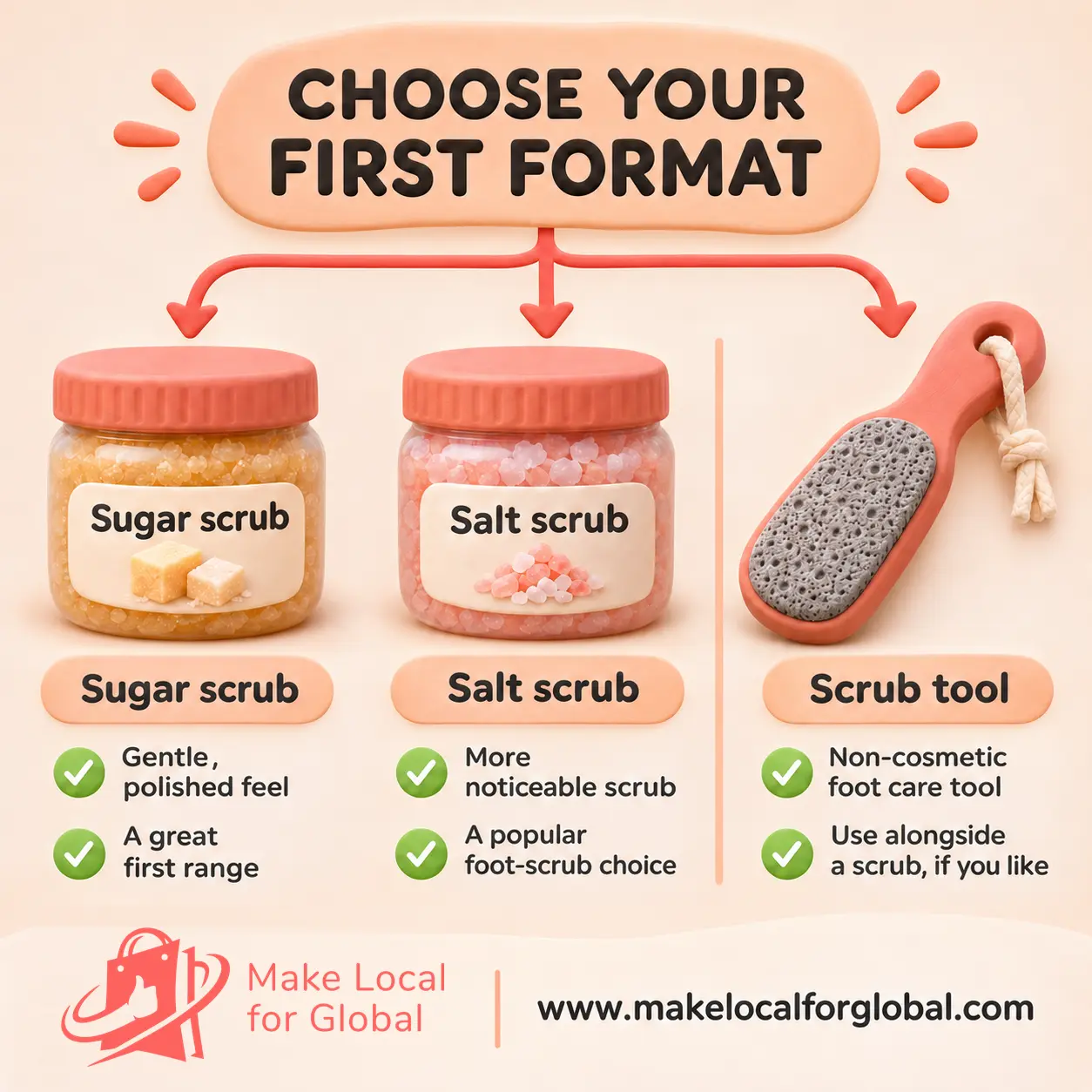
Build the first range from buyer decisions rather than a supplier’s entire catalogue. Ask what each additional scent, size or tool helps the buyer choose. If two products differ only in a colour that is not visible online, they may not justify separate stock at launch. A short range can still feel considered when names, photos and specifications make each choice easy to compare.
Make a product matrix before ordering. Record each proposed SKU, format, size, ingredient or material set, buyer use, supplier, minimum order, compliance work, packaging and expected delivery band. Remove any SKU with unknown formulation records, unclear ownership of the safety file, unreliable supply or a claim you cannot support. This exercise can prevent a catalogue from growing faster than your working capital and review capacity.
Common options include buying finished branded goods for resale, private label with your brand on a manufacturer’s existing product, commissioning a custom formula, or making the product yourself. These routes differ in upfront cost, control, lead time, documentation and legal responsibility. A supplier’s promise to “handle compliance” is not enough; ask what it covers and which business is named as the Responsible Person for Great Britain.
For finished resale, request the exact product identity, current label artwork, ingredient list, batch traceability information, market permissions, storage conditions and evidence that the required assessment and notification are in place. Confirm whether changing the product name, label, package or promotional claims affects the existing assessment. Keep written answers linked to the exact product and version.
For private label, ask who owns and maintains the Product Information File, who arranges the safety assessment, who submits the notification, who approves label changes and who reports serious adverse effects. Confirm which tasks remain yours if you apply your own brand. In Great Britain, a distributor that labels a cosmetic as its own can become the Responsible Person under government guidance. Get specialist advice before assuming a factory’s name covers your brand.
For a custom formula, agree the formula specification, testing plan, production controls, batch codes, stability evidence, packaging compatibility and change-control process in writing. Ask whether substitutions can be made without your prior approval. A change to a fragrance, colourant, preservative, base oil or jar liner may affect safety or product performance. Retain approved samples and dated records so future deliveries can be compared with the version you accepted.
Making a cosmetic at home adds responsibilities around ingredient sourcing, measuring, hygiene, equipment, records, repeatability, storage and assessment. A clean kitchen does not establish cosmetic good manufacturing practice. Do not produce a formula for sale until the responsible party has the required safety assessment and manufacturing controls. If you lack the relevant technical experience, a qualified cosmetic safety assessor and experienced manufacturer should review the plan before you spend on ingredients or packaging.
Compare suppliers using the same questions. Ask for minimum order quantity, sample fees, lead time, payment terms, country of manufacture, delivery terms, batch size, shelf-life information, returns handling, product-change notices and a named contact for a safety issue. Verify the company’s legal name and address. Save quotations with dates because prices, order minimums and lead times can change.
For a cosmetic formula, request the full ingredient list using the required naming convention for the label, product specification, batch and traceability method, safety assessment status, PIF access or confirmation of who keeps it, and proof of the applicable notification. You may not receive confidential formula percentages, but the responsible parties still need enough accurate information to meet their duties. Ask what documents you can inspect and how they will be kept current.
Ask whether the product was assessed for the exact formula, package and intended use you will sell. A safety report for a similar scent or a different jar is not automatically evidence for your SKU. Confirm the intended user, application method, warnings and disposal instructions. Keep the supplier’s version number and date in your own product folder.
For a tool, obtain material specifications, manufacturer identification, instructions, relevant warnings, batch or model reference, and any conformity information that applies. The legal route varies by item, so do not add a CE or UKCA mark unless a specific rule requires it and the manufacturer has completed the applicable assessment. Keep supplier invoices and a record of where each batch went.
Check document consistency. The supplier quote, sample jar, finished label, invoice and product file should identify the same product version. Look for changes in weight, ingredient order, fragrance name, claims, country of origin and packaging. Ask for a corrected document if details conflict. Do not edit supplier paperwork yourself to make it match.
Agree what happens if the manufacturer changes a raw material or cannot supply a component. Require notice before a substitution, production pause or label revision. Define whether you must approve the change and what updated assessment or notification is needed. A supplier may make a commercial change that seems minor but affects a claim, texture, fragrance, stability or customer expectation.
Assess samples in a controlled, repeatable way. Record the sample code, date received, packaging condition, appearance, scent, texture, opening method, dispensing, resealing and any change after storage. Follow the manufacturer’s instructions. Do not use a sample on customers or present informal handling notes as a formal safety or efficacy test.
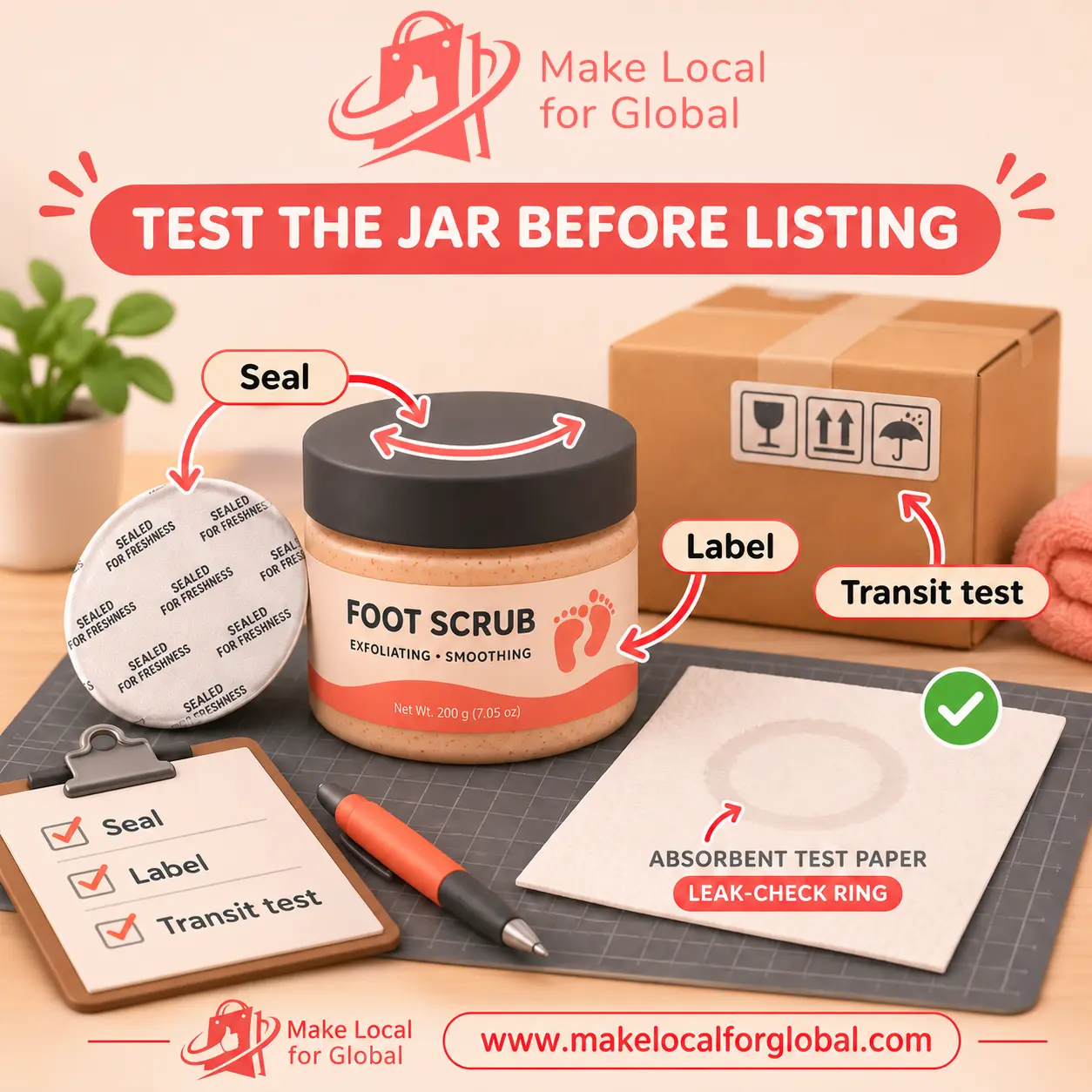
For a jar formula, check that the lid closes securely, the inner seal is present when specified, the label remains readable, the scoop or spatula fits if included, and the product does not leak when packed as intended. Store one sample under the conditions recommended by the manufacturer and observe changes only within an agreed test plan. Do not invent a shelf life from a few weeks of observation; stability claims need suitable evidence.
For a scrub tool, examine the surface and edges under good light, check the handle or cord connection, and assess grip without making clinical claims. If intended for wet use, follow the instructions for that purpose and check whether the materials change after cleaning. Ask the supplier how the item should be dried and stored. Reject samples with cracks, sharp points, loose parts or a strong unexplained odour.
Test the customer’s unboxing and first-use information. Give a sample, label and page draft to someone unfamiliar with the product. Ask them to tell you what the product is, how much they will receive, how they should use and store it, which warnings apply, and who to contact with a concern. Note where they hesitate. If they cannot find the answer, improve the wording or layout before launch.
Use an objective sample scorecard with pass, question or fail for each check. Keep photos of packaging defects and link notes to the supplier sample reference. A scorecard helps compare two manufacturers without relying on memory or the strongest fragrance. It does not replace the cosmetic safety assessment, laboratory testing or any legal conformity process required for a product.
In Great Britain, a cosmetic product made available to consumers must have a Responsible Person established at a UK address. The Responsible Person can be a manufacturer, importer, distributor that brands the product as its own, or an appointed person. The official guidance says a mail-forwarding service or PO box does not count as a UK-established address. Identify the person for each product and confirm their responsibilities before listing it.
The Responsible Person must keep a Product Information File in English. It includes a product description, safety report, good manufacturing practice information and evidence for the product’s effects. The PIF must be retained for ten years after the last batch was made available. Before sale, a qualified safety assessor must review the product and complete the safety assessment. Read the current GOV.UK cosmetics guidance for Great Britain and ask a qualified adviser about your own role.
Before a cosmetic is made available in Great Britain, the Responsible Person must notify the Office for Product Safety and Standards through the Submit Cosmetic Product Notifications service. Treat each formula, variant or change according to the current notification rules; do not assume one notification covers every scent or size. Confirm who submitted it and retain evidence that relates to the product you intend to sell.
Cosmetic manufacturing must follow good manufacturing practice. The government guidance describes controls for staff, premises, equipment, contamination prevention, supply-chain records, batch identification, storage, shipment, complaints and documentation. ISO 22716 is one way to demonstrate good practice, but the guidance says it is not the only route. A seller who buys finished goods should still ask how the manufacturer controls production and handles a batch issue.
Northern Ireland has a separate route. Great Britain’s guidance explicitly says it does not cover making cosmetic products available in Northern Ireland, where the Responsible Person must be established in Northern Ireland or the EU under the guidance. If you intend to sell there, read the current linked Northern Ireland technical guidance and confirm the applicable notification and labelling process. A product ready for Great Britain is not automatically ready for every UK destination.
If you import a cosmetic, do not assume the overseas maker has completed UK obligations for your business. Ask a specialist to establish who is the importer, Responsible Person and notification holder in the intended market. Check the formula against current ingredient restrictions and make sure the safety documentation reflects the actual product and its packaging. Hold stock until those questions are resolved.
Keep a dated compliance checklist per SKU: market, product classification, Responsible Person, safety report status, PIF holder, notification reference, label proof, claim evidence, batch method and contact for adverse reports. Revisit it when a formula, supplier, label, package, marketing claim or destination changes. A spreadsheet can track the work, but it cannot replace professional assessment.
Cosmetic labelling must be clear and easy to read. Great Britain’s official guidance lists the Responsible Person name and address, country of origin for imported products, net weight or volume, date information, precautions, identification such as a batch number, product function and ingredients. Some information may be placed on a leaflet where the package cannot hold it, subject to the rules and required symbol. Check the current text and have the label reviewed before printing.
The ingredient list is more than a marketing panel. It lets a customer check the contents against known allergies or sensitivities. Keep the website information consistent with the physical label and the approved formula. Do not rewrite ingredient names into casual descriptions that make the contents unclear. If a supplier updates the formula, stop and reconcile the label, online page and product file before selling the new batch.
Keep product claims within the evidence. Claims such as “softens”, “smooths”, “removes hard skin”, “antifungal”, “heals cracks”, “improves circulation” or “safe for diabetics” can carry very different meanings. A cosmetic claim must not imply a function the product does not have, and medical-style claims can change how the product is classified or regulated. Ask a qualified assessor or regulatory adviser to review wording that suggests treatment, prevention or a physiological effect.
Be cautious with “natural”, “organic”, “clean”, “non-toxic”, “hypoallergenic”, “vegan” and “sustainable”. Customers may interpret these terms as factual promises. Define what you mean, keep evidence and check any applicable certification or advertising rules. Do not imply that a product is risk-free because it contains familiar ingredients or lacks a particular ingredient.
Show how to use the product using approved instructions. State whether the formula is for external use, where it should be applied, how to rinse it, whether wet floors can become slippery, and any precautions supplied by the safety assessment. Do not recommend use on broken or irritated skin unless the manufacturer’s assessed instructions permit it. Do not give medical advice in customer support.
Do not make a jar look edible or present it beside food in a way that could confuse a child. The Great Britain guidance says cosmetic presentation must not be mistaken for food. Keep imagery, colour, shape and product names appropriate for a body-care item, and retain warnings and usage directions where they can be found.
Assign every item a shop SKU and record the manufacturer’s batch code, receipt date, quantity, label version and orders dispatched. If you make a set from several products, record the contents and batch references for each component. Keep invoices, safety documents, notification confirmations, sample notes and customer complaints in a controlled product folder with clear access rights.
Set a simple complaint form for your own use. Capture order number, product name, batch code, date reported, issue, photos if the customer is comfortable sharing them, response and action taken. Avoid asking for personal health information beyond what is needed to handle a safety report. Store any sensitive details securely and limit access.
If a customer reports a reaction, respond calmly, stop them using the product and direct them to appropriate medical help if the situation calls for it. Follow the Responsible Person’s process for recording and escalating the event. Great Britain guidance requires serious undesirable effects that affect normal day-to-day tasks to be reported to OPSS. The Responsible Person should investigate and identify whether stock needs to be held, withdrawn or recalled.
Agree in advance who can pause sales and who contacts the manufacturer, Responsible Person, marketplace and customers. Keep a list of affected batches and a template for clear updates. Do not wait until a serious report arrives to discover that nobody knows where the batch records are. A short tabletop exercise with a hypothetical disputed batch can reveal missing contacts and unclear responsibilities.
For tools, maintain supplier and batch records and a process to investigate breakage, sharp edges or missing instructions. A complaint may concern the product itself, packaging, a use claim or delivery damage. Note the distinction and pass a safety concern to the manufacturer or importer promptly. Do not dismiss repeated reports as isolated without checking the affected product and stock.
Choose a container that matches the formula, intended use and manufacturer’s compatibility evidence. The supplier should confirm that the jar, closure, liner, label adhesive and product work together over the stated shelf life. A beautiful glass jar may add weight and breakage risk. A plastic tub may be lighter but still needs a closure that stays secure and a material suitable for the formula. Do not select packaging on appearance alone.
Run a transit trial using the actual filled jar and the parcel format you will sell. Confirm the lid stays closed, the seal remains intact, the label is readable, and leakage does not reach other contents. Use an absorbent test sheet and a recorded check after the parcel has been handled through a realistic route. This is a practical internal check, not a formal certification. Ask the manufacturer to advise if temperature or pressure changes could affect the formula.
Weigh and measure the packed parcel with the shipping label and inserts. Check the carrier’s current service rules for dimensions, weight, prohibited contents and compensation. Rates and size bands change, so use a current quote rather than an old spreadsheet. If you ship internationally, check customs descriptions, import rules, product restrictions and any language or label requirements before enabling the destination at checkout.
Store stock according to supplier instructions and use a clear first-in, first-out process when appropriate. Protect jars from heat, freezing, sunlight, damp and accidental opening. Keep customer returns separate from saleable stock until they have been assessed under the applicable product and hygiene rules. Do not put a returned or damaged cosmetic back into stock simply because the outer box looks intact.
Make sustainability statements precise. Describe the confirmed material and local disposal route if you have supplier evidence. “Recyclable” can depend on the material combination and local collection service. If a jar, liner, label and shrink band have different disposal routes, explain them separately. Avoid broad environmental claims that cannot be supported for the full package.
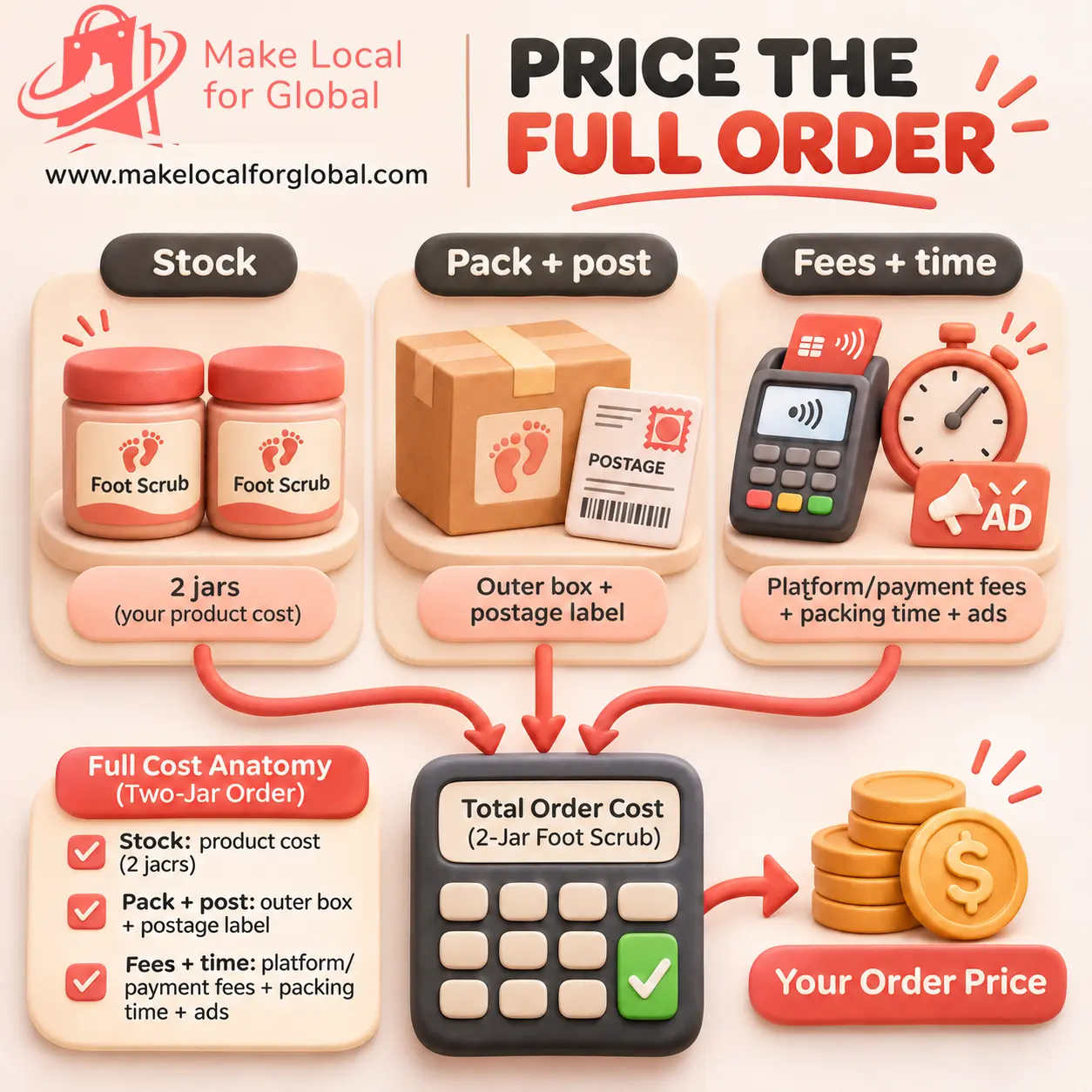
A low unit price does not show whether an online order contributes enough to the business. Include the formula or tool, freight into your stock, jar or retail packaging, outer mailer, label, payment fees, marketplace charges, postage, packing time, returns or damage allowance, marketing and fixed overheads. Keep stock purchases separate from costs that occur each time an order is sent.
The following example is hypothetical and assumes a non-VAT-registered UK seller. It uses invented figures to demonstrate arithmetic only. Replace every line with your own supplier quote, measured parcel, current payment rate and labour cost. A VAT-registered seller needs a calculation that separates output VAT, recoverable input VAT and the correct treatment of each cost.
| Two-jar order item | Illustrative amount |
|---|---|
| Product cost, two jars | £5.00 |
| Inbound freight share | £0.60 |
| Outer box, seal and insert | £1.10 |
| Outbound postage | £2.80 |
| Payment and marketplace fees | £0.75 |
| Packing labour, 10 minutes at £12/hour | £2.00 |
| Damage and return allowance | £0.45 |
| Customer acquisition allowance | £2.00 |
| Estimated direct order costs | £14.70 |
| Customer pays for products and delivery | £19.00 |
| Contribution before fixed overheads and tax | £4.30 |
Illustrative figures only. They do not represent a supplier quote, recommended retail price or forecast.
The arithmetic is £5.00 + £0.60 + £1.10 + £2.80 + £0.75 + £2.00 + £0.45 + £2.00 = £14.70. With £19.00 received, £19.00 − £14.70 = £4.30 contribution before fixed overheads and tax. This is not net profit. The owner may still need to cover website costs, insurance, accounting, photography, unsold stock, tax and time spent on sourcing or customer service.
Run a low, likely and high-cost version. Increase postage to the next band, use a more protective box, set customer acquisition cost to zero for organic orders and then to a paid test amount, and account for a replacement parcel. If the order only works under the most favourable assumption, reconsider the bundle, delivery charge, supplier quantity or channel.
Compare single-jar and two-jar orders. A bundle may spread a fixed postage charge over more products, but it can increase weight, box size and handling time. Calculate the contribution after discount, not before it. Set a free-delivery threshold only after checking the exact basket near that threshold. Record each assumption and date, then update it when a carrier or supplier changes terms.
Start from the cost to serve a typical order and the price customers can understand. If similar shops sell at a lower price, investigate differences in quantity, packaging, ingredient records, brand, shipping and sales channel. A competitor’s price does not reveal their costs or sales volume. It is a comparison point, not proof that your product can profit at the same amount.
Separate product revenue from delivery money. If the customer pays £15 for a jar and £3.50 for delivery, the total charged is £18.50 before the tax treatment that applies. Delivery money may cover only part of postage and packing. Record product price, delivery charged, fees and fulfilment costs in separate rows so an apparently popular product does not hide a loss on each order.
For a bundle, show the contents and the reason it exists. A “two scent discovery set” should state the weight and fragrance of each jar. A gift set should show the box, card and any item not included. Do not use a discount percentage that compares unlike products or a crossed-out price that was never genuinely charged.
Set a review date for prices. Check supplier invoices, packaging costs, payment and marketplace fees, carrier tariffs, refund rates and labour time. Raise or lower a price only after understanding the effect on contribution and conversion. If a label or package change creates a new compliance cost, include it before ordering new stock.
Give the product page a clear, accurate title such as “Citrus Foot Scrub, 200 g” only if the name, fragrance and quantity match the product. The opening lines should state what it is, the amount supplied, the format and the intended use. Follow with ingredients, directions, precautions, storage, dispatch, returns information and a way to contact you.
Use a product information panel with exact details. State the net weight, ingredient list, scent description, packaging type, batch or date details required by the label and warnings from the approved assessment. If the jar has a seal or applicator, say whether it is included. Do not bury a restriction or allergy-related detail in a collapsible area where a buyer may miss it.
Use several images for different purposes: a clean pack shot, a scale or hand for size context, the opened jar if the formula can be shown safely, the label and ingredients, included items, and a packaging view. Generated images can help explain a concept, but do not present them as a photograph of the exact jar or proof of use. Mark a visual as illustrative where needed. Keep the actual label legible in at least one image.
Write alt text that describes what the image communicates. “Foot scrub jar beside its ingredient label and a wooden scoop” is useful if that is what appears. Avoid adding a string of search phrases. If an image is purely decorative and adds no information, use the appropriate empty alt value rather than repeating the page title.
Answer pre-purchase questions close to the buy button. Is the product a cosmetic formula or a reusable tool? How much arrives? What is the scent? How should it be stored? Where can the buyer find the full ingredients? How long does dispatch take? Does the delivery price change by destination? Clear information helps customers choose and gives your support team fewer preventable messages.
Keep page claims consistent with the packaging. If the jar says “rinse off” and the listing says “leave on overnight”, stop and correct the mismatch. Use a change log when you update the formula, photos, label, claims or stock. This helps customer service identify what a particular buyer received.
Before a distance order is placed, UK sellers need to provide required information such as business identity and contact details, a description, total price including taxes, payment methods and delivery arrangements. The government’s distance selling guidance explains that customers normally need to be told about a 14-day cancellation period after delivery. Provide the contract information in a format the customer can keep.
The GOV.UK returns and refunds guidance says online buyers have a limited period to cancel in many cases and describes how refunds and return delivery work. It lists sealed goods that cannot be returned for health or hygiene reasons once opened as an exception, but do not assume every scrub or tool qualifies. The exact product, seal, reason and circumstances matter. Get advice before writing a hygiene exclusion into your policy.
Your published policy cannot remove rights for faulty, misdescribed or unsuitable goods. Explain the route for a customer who receives a leaking jar, wrong scent, broken tool or parcel that never arrives. Give a realistic dispatch estimate, describe tracked and untracked delivery clearly, and state what information helps you investigate. Keep customer communications polite and factual.
Check platform and carrier terms separately. A marketplace may impose extra requirements for cosmetics, claims, shipping or returns. A carrier may restrict liquids, aerosols or hazardous materials. Confirm the exact formula and pack type with the carrier before enabling a service, particularly for international delivery. A product’s online classification does not settle its carrier acceptance.
Your own ecommerce site gives control over the product information, navigation, bundles and customer experience. It requires you to bring shoppers to the site, handle updates and maintain secure checkout. A marketplace can offer an existing audience and familiar order flow, but fees and policies apply. Social media can show the brand and answer questions; keep full product and compliance information on a page you control.
Compare channels using the entire operating cost. Include listing charges, transaction percentage, payment processing, shipping labels, advertising, customer support time, data access and the work needed to update inventory. Read the current platform terms; fees and policies change. Do not open several storefronts before you have a process to keep prices, stock and claims consistent.
Start with one sales route and test the order process end to end. Place a test order, confirm the receipt email, fulfilment notification, stock deduction, refund flow and mobile product page. Check how a customer finds the ingredient list and returns policy. Add a second sales channel after you can keep the same details accurate across both.
Build content around questions customers ask: how to choose between scrub formats, what to check on a cosmetic label, how a gift set is packed, or what belongs in a foot-care routine. Keep advice within the product’s assessed instructions and avoid medical claims. Link to related shop pages where they solve the next choice. Our guide to selling foot massagers online covers a separate foot-care product with different specifications and safety checks.
A small email list can support a launch when people give valid consent. Offer a clear reason to subscribe, explain what messages they will receive and make unsubscribing easy. Do not automatically enrol every buyer in promotional emails. Check current privacy and electronic marketing requirements and use a platform that stores permissions and preferences clearly.
Write down the process from order to dispatch: review payment, check address, select the exact SKU and batch, inspect the outer container, pack, weigh, print the correct label, update stock and send the dispatch message. Use a checklist when orders look similar. A second person should be able to follow the same steps without relying on verbal instructions.
Keep product stock separate from samples, damaged stock, returns and items awaiting review. Label every shelf or bin. Store cosmetics according to the manufacturer’s conditions, and do not place jars in a sunny window, damp garage or hot delivery area. Use batch references in pick records so you can trace an order if a customer reports a problem later.
Set a dispatch window that you can meet through busy periods. If a supply delay affects paid orders, contact customers early with accurate options. Do not mark an order dispatched before it has been handed to the carrier. Keep postage receipts and tracking details according to your service and record process.
Measure fulfilment time from a small batch of realistic orders. Record errors, packing time, label waste, damaged parcels and messages that ask the same question. A revised bin label or better product photo may reduce mistakes more than new software. Change one part at a time and review the result.
Internal links should help the reader answer a related question. A scrub formula and bath salts can sit in a wider bath and body range, so link naturally to our article on selling bath salts online when comparing product documentation, packaging or gift sets. Keep the anchor descriptive so a reader knows what the next page covers.
Links to foot massagers should clarify that they are a different product and not part of the cosmetic safety process. A page about reusable tools may be relevant if your reader is assessing add-on items. Avoid repeating the same link in every section or linking a phrase that does not match the destination.
For your own shop, connect product pages to shipping, returns, ingredients, contact details and relevant care instructions. Use breadcrumbs and category pages to help shoppers move between products. Review links on mobile and confirm that each one opens the intended page. A broken internal link can stop a buyer from finding a crucial product detail.
Set up a product page that explains what is included, what it costs to deliver and what the customer should expect.
Use language buyers may search, but keep every phrase accurate. Possible topics include “foot scrub ingredients explained”, “how to compare foot scrub textures”, “gift set size guide” and “how to store a rinse-off scrub”. These are content ideas, not evidence of search volume. Check real search data in your analytics and search tools before investing heavily in a topic.
Photograph the packaging, label and product scale in clear light. Show the actual jar and the quantity supplied. A lifestyle image can help with mood, but it cannot replace ingredient, directions, size and warning information. If you use a generated scene, label it as illustrative and do not show an invented ingredient list or clinical result.
Test one channel and one message at a time. You might compare a gift-focused product photo with a texture-focused photo, or test a bundle page with an individual item page. Keep the audience, budget, dates and creative version in a simple record. Do not treat a handful of clicks as proof of a profitable product. Compare customer acquisition cost with contribution, not revenue alone.
Ask partners or creators to describe what they actually received. Supply the approved label information and a list of claims they must avoid. Do not ask for a positive review or offer a benefit tied to favourable wording. If you receive a gifted placement or paid endorsement, disclose the relationship according to current advertising guidance.
Use customer questions as a source for useful content. If several people ask whether the jar is suitable for travel, confirm the answer with the supplier and carrier before publishing. If they ask about fragrance or allergens, make the ingredient information easier to find. Publish an answer only when you have a reliable source.
Track visits, add-to-basket actions, completed orders, average basket value, contribution per order, acquisition cost, returns, damage, complaints and fulfilment time. Keep cosmetic formulas and tools separate in the report. Their stock, compliance work, shipping and return patterns differ. A single store-wide conversion rate may hide a problem with one product page.
Record the question each measure answers. If page views are high and orders low, inspect product clarity, price, trust signals and delivery cost. If buyers add to basket and leave at checkout, check surprise shipping charges or payment friction. If orders are good but contribution is weak, revisit discounting, acquisition and pack time. Use the pattern to choose one change rather than rewriting the whole shop.
Review feedback by product and batch. A leak report may point to a closure or packing issue. Repeated questions about scent could point to weak descriptions. A tool breaking at the same joint may call for supplier investigation. Keep the date, batch and action with each report so a trend is not lost in a general star rating.
Set a review date after enough orders or time has passed to learn something. Do not change price, product name, photos, packaging and shipping in the same afternoon if you want to know which change mattered. Keep a note of the prior version and the result you expect. The first months are for gathering real operating evidence.

Days 1–5: define the product and buyer. Decide whether the first SKU is a cosmetic formula or physical tool. Write the one-sentence customer statement and list the questions a buyer needs answered. Talk to potential customers and collect objections without implying that their comments prove demand. Set a limit on the amount of stock you can afford to test.
Days 6–10: contact suppliers. Request samples, full product identity, ingredients or materials, batch records, label and claims evidence, minimum quantities, lead time and written responsibility for safety tasks. For a formula, ask about the Responsible Person, safety assessment, PIF and notification for Great Britain. Do not place a saleable order while important records or roles are uncertain.
Days 11–15: assess samples and compliance. Compare packaging, texture, use instructions, label legibility and transit performance. Confirm every claim with a source. Review the rules for the market and product route with an appropriate professional. Keep one sample or approved reference where the supplier permits and record the version.
Days 16–20: cost and build the product page. Measure a packed parcel, calculate single and bundle orders, set a provisional price and show delivery separately. Write product details from verified records. Photograph the true item and label. Add a returns policy, contact route and dispatch estimate that reflect how you operate.
Days 21–25: test fulfilment. Run a checkout test, pack sample orders, confirm the carrier accepts the contents, verify a refund route and check mobile page usability. Make sure stock counts, batch codes and notification records can be found. Ask an unfamiliar reader to locate the ingredient list, size, directions, warnings and delivery cost.
Days 26–30: launch small and review. Open only the SKUs with complete records. Check order accuracy and customer questions each day. Pause a product if a safety, labelling or batch concern arises. At month end, compare actual costs and questions with your assumptions, then decide what to improve, restock or remove.
Putting a formula and a tool under the same compliance assumption. A scrub jar and a pumice file are different product types. Identify each item and check the route that applies.
Ordering private-label stock before confirming the Responsible Person. A supplier may manufacture the product but your brand may carry separate duties. Establish the role and records before printing labels.
Printing claims before reviewing evidence. “Heals”, “treats” or “safe for everyone” can create legal and customer risks. Have claims checked before they appear on a jar, product page or creator brief.
Testing only the product, not the parcel. A secure jar in a sample box can still leak in the format used for paid orders. Test the packed item and measure the finished parcel.
Pricing from the jar cost. Fees, packing time, postage and acquisition can consume the difference between price and product cost. Model the basket and leave room for fixed costs.
Using a universal returns ban. A shop cannot remove rights for a faulty or misdescribed product. Check whether a specific sealed item qualifies for a hygiene exception before applying it.
Relying on generated imagery for a product label. Generated graphics may distort text or show a fictional jar. Use them for editorial explanation; photograph the real label for product evidence.
Expanding flavours and sizes too soon. Each extra option adds records, stock, photography and support. Add a variant only when customers have a reason for it and you can maintain the same checks.
A rinse-off skin scrub is likely to be treated as a cosmetic product. In Great Britain, a Responsible Person, product safety assessment, Product Information File, good manufacturing practice and pre-market notification may apply. Do not start selling a home formula until a qualified assessor and relevant adviser have confirmed the product and process.
Private label can reduce formulation work, but it does not automatically transfer every legal duty to the factory. Ask who is the Responsible Person, who holds the PIF, who submits notification, what happens when the formula changes and which claims your label can use. Have the final product and label reviewed before taking orders.
If it is a cosmetic product made available to consumers in Great Britain, its safety must be assessed by a qualified professional before it is made available. The assessment forms part of the PIF. Confirm classification and obligations for your exact formula and market with a suitable adviser.
Before a cosmetic product is made available in Great Britain, its Responsible Person must submit information to OPSS through the cosmetic product notification service. Confirm which variants and changes need separate or updated notifications. Keep the confirmation linked to the exact product version.
Northern Ireland has a separate cosmetics route from Great Britain. The current guidance identifies a Responsible Person established in Northern Ireland or the EU. Read the latest NI guidance and confirm notification, labelling and cross-market arrangements before enabling orders there.
Ask for product identity, ingredients, label artwork, batch and change records, the safety assessment and notification status, PIF arrangements, Responsible Person details, minimum order, lead time, storage conditions, packaging compatibility and complaint escalation. Get written answers for your exact brand and variant.
Do not publish a functional or treatment claim until it has been reviewed and supported for the product. Claims can affect classification and must not promise a function the product does not have. Ask the safety assessor or a qualified regulatory adviser to review wording that suggests treatment or a medical outcome.
Yes, but assess it as a separate physical product. Check its material, finish, grip, cleaning instructions, supplier traceability, warnings and shipping durability. Do not treat a tool as though it were a cosmetic formula or use the same compliance record.
Calculate product cost, inbound freight, packaging, postage, payment or marketplace fees, packing time, returns, marketing and fixed overheads. Model typical basket sizes and delivery bands. The worked figures above are invented examples; use current quotes and your own tax treatment.
Do not assume every opened scrub is excluded from cancellation rights. GOV.UK describes a hygiene exception for sealed goods that cannot be returned once opened, but eligibility depends on the specific product and situation. Faulty or misdescribed goods have separate rights. Obtain advice before publishing a blanket exclusion.
Show the actual jar or tool, size, packaging, ingredients and included items. Use a lifestyle or texture image to explain the experience, but do not present a generated scene as a real test result or exact product photograph. Keep the actual label readable and add descriptive alt text.
Choose one product type and buyer, request supplier records and a sample, verify the compliance route, test the parcel, calculate full-order costs and ask potential buyers about the page details. Order only when the evidence and cash limit are clear.
A dependable foot-scrub shop starts by separating cosmetic formulas from physical tools. It then builds a small range from a buyer need, confirms suppliers and records, checks the right rules, tests samples and packaging, and prices the complete order. Clear product information can help a customer choose and help you answer questions without overstating what the product does.
Before taking payment, confirm that the product version, label, Responsible Person, safety documentation, notification and claims agree for the destination market. Keep batch records and a response route for complaints. Review real orders and costs before expanding the range.
If you are ready to plan the shop itself, review website design options, check website pricing, or contact Make Local for Global to discuss a practical next step.
PREFERRED SOURCE
Like what you’re reading? Add Make Local for Global as a preferred source on Google to see more of our articles when you search.

Build your online presence without having to figure out everything yourself.