

READY TO SELL Home Fragrance Diffusers ONLINE?
Get a store built for you in 5 days, plus training and support to help you start, run, and grow your Alternative business.

Learn how to sell home fragrance diffusers online: choose between reed and electric formats, check supplier records, price orders properly and plan careful packing and launch.


Home fragrance diffusers look simple on a shelf: a bottle, a scent and perhaps a few reeds. Selling them well involves a longer list. A buyer needs to know what format they are choosing, what is included, how a refill fits, how a device works and what the fragrance claims actually mean. The seller needs to understand the product’s safety information, supplier responsibilities, packing needs, shipping restrictions and full order cost.
This guide is for a UK small business planning a focused home fragrance diffuser range. It covers passive reed diffusers and electric room diffusers, with practical checks for product selection, labelling, online claims, pricing, packing and customer service. It is not a substitute for classification, product-safety or legal advice on a particular formulation or device. Ask a qualified adviser or the relevant regulator when the supplier’s documents do not clearly answer a question.
A new diffuser range needs clear product pages, reliable fulfilment and accurate records. MLFG’s store information can help you review the ecommerce setup while you work through the product checks.
“Home fragrance” can cover candles, sprays, wax melts, incense, diffusers and refill oils. A first store does not need every format. Start with a specific shopping need, such as a low-maintenance reed diffuser for a small room, a refill-led range for customers who already own a compatible vessel, or an electric diffuser with clearly explained care instructions. The point is to make the opening range understandable, not to guess a perfect customer from a trend report.
Write a short buyer hypothesis that names a room, a format and a practical buying concern. For example: “I am testing a compact reed diffuser and matching refill for people furnishing a hallway who want a straightforward way to compare bottle size and scent notes.” This gives you something to discuss with likely customers. It is a research hypothesis, not evidence of demand or a promise about scent performance.
Speak to people who have bought home fragrance recently. Ask which product they chose, whether it was a gift, what information helped them compare options and what disappointed them after delivery. Ask what they would need to know before ordering a refill. Avoid leading questions that invite praise for an idea you have already decided to sell. Record each answer with its source and date, then separate repeated patterns from one person’s preference.
Review online listings as examples of product-page clarity and customer questions, not as proof that a product is safe or a claim is permitted. Note how sellers explain room suitability, product volume, refill compatibility, care, delivery and warnings. Look for unanswered questions in reviews: leaking caps, weak packaging, unclear device instructions, scent descriptions that did not match expectations, or uncertainty about what was in the box. Use these as prompts for supplier questions and page improvements.
Reed diffusers release fragrance from liquid drawn up through porous reeds. The bottle opening, reed material, reed count, room conditions and liquid formula can all affect how the product behaves. Customers may want spare reeds or a refill, so the range should say whether those items are included and which bottle or formula they fit. Avoid a universal “lasts for” claim unless the supplier has substantiated the duration under conditions that match the claim.
Electric diffusers are not one interchangeable product family. Ultrasonic models use water and a compatible fragrance addition; nebulising devices disperse fragrance without a water reservoir; heat-based models warm a material or oil; plug-in units may use a replaceable cartridge or wick. A buyer cannot safely infer what to put into a device from a photograph. Provide the exact supplied instructions and compatibility details. Never suggest that an essential oil, refill or cleaning product will work in a device unless the manufacturer confirms it.
Keep the scope disciplined. If you plan to sell candles alongside diffusers, make them a separate range with their own product information and checks. MLFG’s guides to diffuser reeds and diffuser oils cover adjacent decisions; a guide to diffuser lamps can help you distinguish an electric product from a fragrance-only refill. These links should support a buyer’s next question without turning one store page into a catalogue of unrelated formats.
Use a range matrix before placing a purchase order. Each proposed product should have one clear job: a core reed diffuser, a compatible refill, a gift set that is genuinely easier to buy together, or one electric format with clear instructions. Add options only when they serve a different buyer need or make the range easier to understand. Five products that differ only by scent name may create more stock and photography work without solving a distinct customer question.
For each item, record the format, scent family, liquid volume, bottle material, included accessories, refill compatibility, supplier, minimum order, unit cost, expected shelf life, shipping class information, packaging dimensions, documentation received and the question the product answers. Include whether the diffuser is for a home room, a bathroom, a small workspace or another setting only where the manufacturer provides relevant use information. Do not invent a room-coverage measure from a competitor’s page.
Keep scent descriptions anchored to recognisable notes and materials. A citrus-led fragrance, a soft floral blend or a dry woody profile tells a shopper more than a string of abstract adjectives. State that a scent impression is subjective where appropriate. A “fresh linen” fragrance is a scent description; it does not mean the product cleans, sanitises or purifies the air. A “sleep” or “stress relief” product promise can become a health claim and needs specialist review before use in a product name, advert or social post.
Do not use a bundle to hide unclear compatibility. A starter set should name the diffuser, fragrance or refill, required accessories and any items the buyer must supply. If refills fit only one bottle neck or device model, state the model and show a close-up of the fitting. A simple first range can be stronger than a large scent menu if each item is well explained and reliably replenished.
Order representative samples before committing to a larger quantity. Inspect the packaging, closure, bottle finish, insert, reed fit, device controls, instruction sheet and consistency between the sample and the supplier’s specification. For a refill, check the neck, cap or cartridge against the intended vessel. For an electric product, confirm the supplied power adapter, plug, cable, accessories and instructions match the exact model being offered.
Record what you can observe without making an unsupported performance claim. A practical internal test might note whether a bottle leaks when closed and placed on its side, whether the closure can be tightened by hand, whether the reed bundle fits without forcing, whether a label stays attached after routine handling, or whether a device powers on and follows its instructions. Use the supplier’s written method for any product-performance measurement. Do not treat a short home trial as a laboratory safety assessment or proof of a “long-lasting” scent claim.
For fragrance, keep the test conditions consistent. Use the same room, approximate airflow, placement height, reed count or device setting, observation times and ambient conditions. Record who assessed the scent, what they noticed and how long the observation lasted. People perceive fragrance differently, so avoid turning a small informal panel into a universal statement. If you need a technical test, use an appropriately qualified provider and retain the report against the exact formula and batch.
Do not ask staff, friends or customers to handle a fragrance concentrate or device beyond the supplier’s instructions. Review the safety data and warnings before a sample test. Keep the liquid away from ignition sources if the documentation identifies a flammability hazard, use the advised protective measures, ventilate as instructed and store the sample securely. A “natural” or essential-oil-based formula is not automatically harmless.


Ask who made the product, where it was made, who placed it on the market, who is responsible for its classification and labelling, and who will support a safety incident or recall. A supplier’s catalogue description is not enough. Request a specification for the exact fragrance formula and device model, the relevant safety information, label artwork, handling and storage advice, batch or lot identification and a written change-notification process.
For a fragrance mixture, request the current safety data sheet where one is required or available, plus the supplier’s classification and label information for the exact market where you intend to sell. A safety data sheet is a technical document; do not copy its hazard label into your own design without checking which label elements apply to the product pack. Keep the version date and match it to the formula. If a supplier will not provide appropriate information because of a claimed trade secret, ask what legally required and practical information they can provide to you and to the customer.
Ask whether the supplier has changed the carrier liquid, fragrance concentration, bottle, closure, reeds, wick, power supply or manufacturing site. A small formulation or packaging change can alter compatibility, classification, instructions, performance or shipping advice. Put a change-control clause in the purchase terms so the supplier must notify you before a change reaches your stock. Keep the approved specification beside each order record.
Use independent checks for the supplier’s legal business name, address and payment details. Verify certificates with the issuing organisation when the supplier makes a certification claim. Check that the certificate covers the actual factory or product process and is still current. Do not present a supplier certificate as proof that your product has been independently tested unless the report supports that statement.
Use the Ecommerce Pathfinder to think through the selling route and the work behind the first offer. Then decide what evidence you still need from the supplier before ordering.
For Great Britain, HSE explains that substances and mixtures supplied on the market must be classified and labelled under the GB Classification, Labelling and Packaging Regulation. Classification applies to mixtures such as fragrance liquids. HSE’s classification guidance explains the supplier role and how a mixture is assessed. Its hazard-label guidance describes the information communicated when a supplier identifies a hazard.
The person responsible can depend on what you do. Selling an unchanged product bought from a UK supplier is different from importing, blending, decanting, refilling, relabelling or placing a product on the market under your own brand. If you do more than retail an unchanged item, ask a competent chemical regulatory adviser to confirm your role and duties before launch. HSE says a downstream user who changes a mixture must classify it, and businesses should not assume the upstream supplier’s assessment automatically covers a changed formula.
If the mixture is classified as hazardous, the label and packaging have specific requirements. Depending on the hazard class and concentrations, the pack may need a signal word, pictograms, hazard statements, precautionary statements, supplier details or other prescribed information. Some classifications or substances trigger child-resistant closures or tactile warnings. Those features do not apply to every diffuser, so get a product-specific classification and label check rather than adding warning symbols from a generic template. See HSE’s guidance on packaging, child-resistant closures and tactile warnings.
Check the relevant market separately. Great Britain and Northern Ireland do not always follow identical chemical arrangements. If your plan includes Northern Ireland, the EU or another territory, ask the supplier for market-specific documentation and confirm the applicable regime before printing packaging or opening delivery options. HSE notes that different arrangements apply to mixtures placed on the Northern Ireland market. Do not reuse a GB label file in another territory without review.
The HSE currently describes information submitted to the National Poisons Information Service for GB mixtures as a voluntary arrangement, while poison-centre provisions and procedures differ for Northern Ireland. Do not assume a UFI or a particular notification is required or optional everywhere from a general online checklist. Confirm the current requirement for your own role, formulation and territory with HSE or a qualified adviser. Keep the answer with the product file.
An electric diffuser brings product-safety questions beyond those for the fragrance liquid. Confirm the model, adapter, cable, plug, voltage and instructions are suitable for the market where you will sell. Ask for the technical documentation and conformity information appropriate to the device’s legal route. A CE or UKCA mark alone is not a complete product assessment, and a wholesaler’s listing is not a substitute for the documents that identify the exact model and responsible business.
The Office for Product Safety and Standards says UK businesses that make, import, distribute or sell consumer products are responsible for ensuring products are safe in normal or reasonably foreseeable use. Its product safety advice for businesses notes that manufacturers and importers need to minimise risks, keep technical documentation, provide appropriate labels and instructions, and retain supplier records. Use this as a starting point, then check sector-specific requirements for the electrical device and market. A diffuser recall involving an electric shock or fire risk is a reminder to check the supplied power unit, not just the decorative shell.
If you place electrical equipment on the UK market, check whether you are an EEE producer under the WEEE producer responsibilities. The applicable obligations depend on your role, amount, category and sales route. WEEE rules include annual registration and reporting duties for producers, with routes that differ by tonnage. Ask who is legally responsible for registration and record the answer; do not assume a supplier’s registration number covers your own activity.
Keep the device and liquid records separate but cross-reference them if you sell them together. If a customer reports overheating, a damaged plug, leaking liquid or a device that behaves differently from the instructions, pause affected stock, identify the model and batch, and follow the supplier and product-safety escalation process. Do not continue shipping units while an unresolved safety concern could affect customers.
Name the fragrance notes and describe the sensory character in plain language. “Green citrus with a dry woody finish” is more useful than a string of ornate adjectives. Explain whether the note description comes from the fragrance supplier and avoid presenting it as a guarantee that every person will perceive the scent in the same way. If a blend contains a note associated with a familiar ingredient, do not imply that the product contains that ingredient unless the formula does.
Be careful with claims about health, sleep, mood, stress, breathing, concentration, pets, insects, germs, air quality or safety. The ASA/CAP advice on aromatherapy advertising says objective health claims require robust documentary evidence and discusses the risks of claims made for products dispersed through a room by a diffuser. A fragrance description is not a licence to claim that a product treats a condition. Testimonials, social posts, search snippets and influencer copy can repeat a claim just as a product label can.
Avoid “non-toxic”, “safe for pets”, “hypoallergenic”, “chemical-free”, “natural therefore safe”, “purifies the air” or similar wording unless a qualified review confirms what can be said and the evidence supports the exact claim. “Natural” does not mean hazard-free, and a safety data sheet can identify hazards that matter even when a fragrance ingredient is plant-derived. Give customers the manufacturer’s intended use and warnings, not a promise that the product is safe for every home, child or animal.
Maintain a claims register. For each objective statement, record the exact wording, where it appears, evidence, reviewer, approval date and products to which it applies. Include the listing title, image descriptions, packaging, care card, advert, social caption, FAQ and customer testimonial. Review the full customer journey when a formula or supplier changes. Remove outdated claims from saved graphics and scheduled content as well as the live page.
Show the exact product name, format, fragrance notes, liquid volume or device dimensions, materials, included components and intended use. State whether the package contains the bottle, liquid, reeds, adapter, refill or other accessories. If a refill is compatible only with a particular model, name the model and show the fit. Include the manufacturer’s relevant use and care instructions in readable page text. Do not make a shopper zoom into a small back-label photo to find an important instruction.
For a reed diffuser, explain the fill volume, number and type of reeds supplied, bottle material, closure, whether a refill is available, how to handle a refill and where to find the product warnings. Do not prescribe a reed count that differs from the supplier’s instruction. For an electric diffuser, show the controls, power supply, reservoir or cartridge type, care requirements, compatible fragrance and items included. Add device dimensions and a photo that makes the scale understandable.
Use several images for distinct jobs: a clean main product view, an in-use room context, a close-up of the bottle or device, a pack-contents view and a fit or refill explanation. Keep required warnings and compatibility details in accessible text even if they also appear on the package. The images in this guide show formats, supplier checks and packing principles; your store’s own product photographs should show the stock you actually dispatch.
Write fragrance notes with restraint and avoid using image alt text as a keyword dump. Describe what the photograph contains: for example, “A clear reed diffuser bottle beside its refill pouch on a pale stone shelf.” If an image is decorative, leave its alt text empty in line with the site’s accessibility setup. A product photo should not imply accessories or packaging that are not included.
Calculate the contribution from a complete order, not the supplier’s unit price alone. Include the diffuser or refill, inbound freight, duty and customs charges when relevant, protective packaging, storage, pick-and-pack time, payment and platform fees, outbound postage, refunds, breakages, damaged stock and the cost of attracting a customer. Ask an accountant about VAT treatment for your business and products rather than copying a competitor’s displayed price.
The table below is a made-up example to show the calculation method. It is not a market rate, supplier quotation or recommendation for a selling price.
| Example cost per order | Illustrative amount |
|---|---|
| Reed diffuser landed cost, including inbound freight | £6.40 |
| Protective carton, bottle sleeve and packing materials | £0.95 |
| Pick and pack labour | £0.85 |
| Payment and platform fees | £1.05 |
| Tracked parcel delivery | £3.45 |
| Breakage, refund and replacement allowance | £0.90 |
| Customer acquisition allowance | £3.00 |
| Total variable order cost | £16.60 |
| Illustrative customer price before applicable VAT treatment | £27.00 |
| Contribution before fixed overhead and tax | £10.40 |
Illustrative planning figures only. Replace them with your own quoted and measured costs.
The arithmetic is £27.00 minus £16.60, leaving £10.40 before fixed costs such as insurance, software, storage, photography, accounting, professional advice and owner pay. It is not net profit. Replace every line with a quote or measurement. Check whether the packed parcel crosses a carrier size band and measure the actual carton, because glass protection can change the delivery cost.
Run at least two sensitivity checks before choosing a price. If delivery costs £1 more, contribution falls to £9.40. If customer acquisition costs £5 rather than £3, contribution falls to £8.40. If a breakage needs a full replacement and another shipment, calculate the combined product loss, packing labour and postage. Use the results to decide whether to change packaging, price, supplier or channel.
Compare a single diffuser with a refill, a gift set and a multi-item bundle. A bundle may raise order value but can add breakage risk, picking time and compatibility questions. A refill may be lighter but needs a secure closure and accurate transport classification. Set a minimum contribution rule for discounts, free delivery and wholesale pricing. Do not use a promotion that leaves no room for a replacement or refund.
An own website gives you control over product information, imagery, customer support and repeat purchase reminders. You also need to bring relevant visitors to the store, keep the checkout working, manage customer data and answer questions. A marketplace can place a product near shoppers who are already comparing home fragrance, but its category rules, fee structure, product restrictions and account decisions still apply. Check the current marketplace policy for fragrance liquids and electric devices before listing.
Use one main checkout for the first test. Keep a shared stock record if you also sell at a market or through social commerce. A reed diffuser sold in one channel must not remain available in another after the last unit is picked. Record the product SKU, supplier batch or lot, quantity received, quantity sold and stock location. For electrical models, retain the exact model identifier and any serial or batch information available.
Before checkout, show the total price, delivery options, delivery estimate, business contact details, product description and any restrictions. GOV.UK’s online and distance selling guidance lists information businesses must give customers, including business identity, price, delivery arrangements and cancellation information. Make your terms, returns route and customer support details easy to find. Have a legal adviser check the rules that apply to your sales model and territory.
Choose fulfilment based on the product’s fragility, liquid classification, storage needs, and record requirements. Ask a fulfilment company whether it accepts the specific fragrance formula and device, how it stores liquids, how it records product batches, how it handles leaks and broken glass, and how quickly it can stop dispatch if a safety notice arrives. A low per-order pick fee does not solve a batch traceability problem.
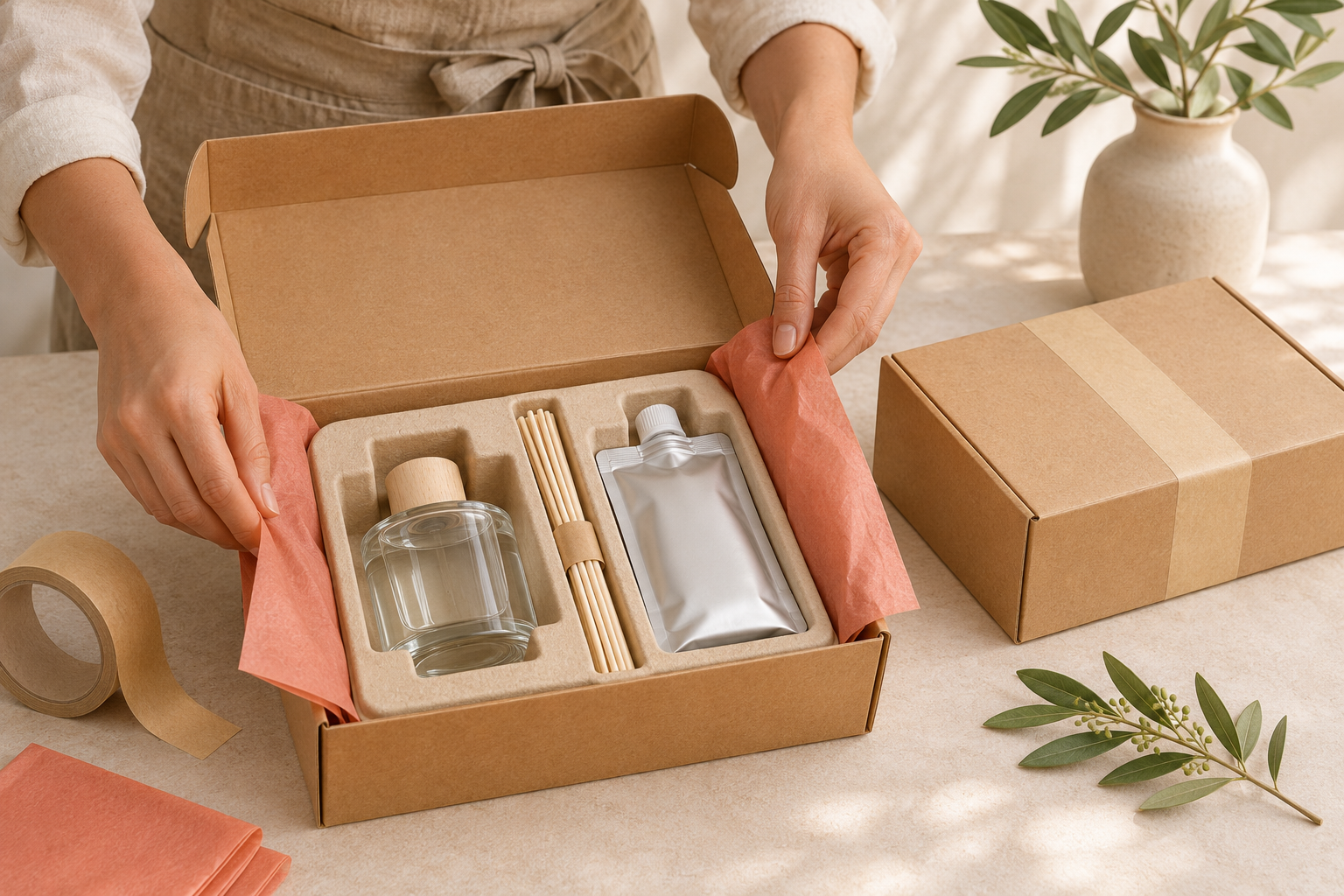
Glass bottles need a close-fitting protective insert that keeps them from moving, separates them from accessories and reduces the chance of glass-on-glass contact. Keep spare reeds in a sleeve or separate compartment so their ends do not puncture the bottle wrap. Protect the cap and closure from accidental loosening. A carton should remain shut in ordinary handling and show no sign of leakage when a packed sample is checked after transit testing.
Do not assume that a padded envelope is suitable because the bottle is small. Test the complete parcel in the final box with the chosen carrier and service. Use a qualified packaging provider for high-value, liquid or unusual parcels. Conduct a repeatable internal transit check to look for broken glass, leaks, crushed boxes, reed damage and labels scuffed beyond readability. A home drop test is a packaging check, not a product-safety certification.
Confirm the transport classification of each liquid from the current supplier documentation. Some fragrance mixtures may be flammable or otherwise restricted; classification depends on the actual formulation. The government explains that dangerous goods are divided into classes which affect packaging and transport in its dangerous goods guidance. Ask the carrier whether it accepts your product, in what quantity and under which packaging conditions. Do not infer that a product can be sent by every postal service because a competitor offers it.
For electric diffusers, protect the device, adapter and accessories from movement, moisture and impact. Keep the manufacturer’s instructions and safety information with the product. Avoid adding a promotional insert that contradicts the use instructions or makes an unreviewed health claim. A short care card can point the customer to the full instructions and customer support contact, but it should not replace mandatory information.
Keep fragrance stock in the storage conditions specified by the supplier. Use a tidy, secure area away from incompatible goods and sources of heat or ignition where the safety information calls for it. Separate saleable units from samples, damaged packs, customer returns and stock on hold. If labels include date or batch information, make sure pickers can see it and use a consistent stock rotation method.
Maintain a product file for each scent and device model. Keep the current specification, safety data sheet where applicable, classification and label review, supplier details, approved artwork, change notices, purchase orders, delivery records, batch details, sample checks and customer complaints together. Note who reviewed each version and which batches it covers. A folder with unlabeled PDFs is not a useful record if you cannot tell which formulation a file applies to.
Write a short withdrawal and recall plan before you start. Name who can remove a listing, pause a fulfilment account, isolate stock and contact customers. Record the supplier, product code, batch, affected order references, action date, customer resolution and any authority contacted. OPSS says businesses should report product safety risks and incidents through the appropriate route; its business advice explains that sellers need traceable supplier records and a response process.
Treat a report of a hot plug, electrical fault, leaking bottle, missing warning, unexpected formula, strong reaction or breakage as a report to log and assess. Do not diagnose the customer or advise medical treatment. Preserve the product details and batch evidence, stop sale if the report suggests a wider risk, contact the supplier and seek advice from the relevant enforcement authority or qualified professional. Make sure a backup person can access the records if the usual owner is unavailable.
Choose one clear main query for the category page or guide, such as “home fragrance diffusers” or “reed diffuser refills”, based on the product you actually sell. Use the phrase naturally in the page title, opening paragraph, a relevant heading and a useful meta description. Write different titles and descriptions for reed diffusers, electric devices and refills. Repeating the same template for every scent creates weak search pages and makes it harder for a customer to compare the offer.
Build supporting pages around genuine purchase questions: how to choose a diffuser format, what is included in a refill, how to check model compatibility, how to care for a vessel and how orders are packed. Keep claims evidence-based. Do not publish medical advice or imply that a scent treats a condition. Link each guide to the relevant product pages and link product pages to clear delivery, returns and care information.
Use descriptive image file names and alt text that say what the image shows. A filename such as `reed-diffuser-and-refill-set.webp` is more useful than `image-final-3.webp`. Do not use alternative text to repeat the target keyword when it adds no help to someone who cannot see the image. Add captions only when they explain a practical point, such as the fact that a refill fits a named bottle.
Check the page on a phone. Confirm that headings scan clearly, the price and contents are visible, compatibility text is readable, image crops do not cut off the product, buttons work and the checkout does not hide delivery costs. Measure product-page visits, add-to-basket activity, conversion, average order value, delivery damage, customer questions per order, repeat refill purchase and contribution. Change the page based on observed confusion, not on a generic score alone.
Set a release gate that must be met before taking orders. The gate can include supplier identity checked, current product documents on file, label reviewed for the target territory, sample inspected, device tested according to its instructions, carrier acceptance confirmed, landed cost calculated, batch-record process ready, product-page information checked and return/incident process written. If a required item is unresolved, extend the preparation period rather than letting a launch date force a decision.
For a low-risk test, start with a modest quantity that matches the supplier’s minimum order, shelf-life or stock-life information, likely demand and available cash. Keep a record of why that amount is reasonable. If the only way to get a lower unit cost is to buy a quantity that may sit unsold, compare the discount with storage, expiry, cash tie-up and potential formula changes.
Ask a few prospective customers to review the page for clarity. Ask them to find the format, size, what is included, refill compatibility, instructions, warnings, shipping cost and returns details. They can tell you whether the information is findable; they cannot approve the legal classification, guarantee safety or verify a health claim. Revise the page when readers misinterpret what the product does or which accessories arrive.
Use this calendar as a working sequence, not a promise that every product can be approved in one month. A classification question, missing test report or supplier delay may take longer. Keep the release gate in place even if the schedule slips.
Choose one buyer context and one or two formats. Write down the product type, scent direction, vessel or device, target territory and first buyer question. Review current competitor listings for product information and recurring complaints. Talk to potential buyers and write a short summary of repeated questions. Request supplier specifications, safety information, batch details, prices, minimum orders and lead times.
Receive representative samples. Check the pack, closure, instructions, accessories and compatibility. Ask what changes would require a new label or assessment. Confirm the classification and label responsibilities for each role in the supply chain. Get an electrical product’s technical documentation checked by someone competent. Contact a carrier with the exact product information before making a delivery promise.
Build the full order-cost calculation. Measure the final packed size and weight. Ask the carrier for written confirmation of accepted products and conditions. Test the packaging with a representative order and adjust the insert if the contents move. Draft product pages with accurate scent notes, dimensions, inclusions, compatibility, care and delivery details. Review the wording for product claims and make the required consumer information easy to find.
Set up stock and batch records, customer service templates, a recall contact list and a process to pause sale. Run a test order from checkout through pick, batch capture, packing and dispatch. Check the live product page on desktop and mobile. Release a limited quantity to a defined audience. Monitor questions, delivery damage, cancellations, return reasons and contribution. Reorder only after the evidence supports it.

You can sell them if the product meets the requirements that apply to its formula, label, packaging, transport and sales territory. Confirm the supplier documentation and your own role in the supply chain before taking orders.
There is no single general licence for every room fragrance product. Specific chemical, product-safety, electrical, biocidal, packaging and transport duties can apply depending on what the item is and what your business does. Ask for a product-specific check.
No. A pictogram is used where the product classification and applicable rules require one. Do not copy one from another seller’s label. Have the exact mixture and market reviewed by the responsible supplier or a competent adviser.
Decanting or refilling can change your legal role and may bring classification, labelling, packaging and traceability responsibilities. Do not do it until a qualified adviser confirms the requirements for your formula and market.
Do not make an objective health claim unless it has been reviewed and supported under the applicable advertising rules. A fragrance description should not promise to treat or improve a health condition. Get specialist review before using wellbeing claims.
Do not make a general safety promise for all pets or homes without evidence and specialist review. Follow the manufacturer’s actual use instructions and warnings. “Natural” ingredients do not automatically mean harmless.
No. Use only the liquids, concentration and cleaning method specified for the exact model. A formula that works in one device may damage or block another, and the supplier’s instructions should guide the product page.
Check the current product classification and safety information, then confirm acceptance and packaging conditions with your carrier. Some fragrance mixtures may be subject to dangerous-goods restrictions. Never assume every postal service accepts the same liquid.
Request a product specification, current safety information, classification and label guidance for the target market, packaging details, batch identification, compatibility instructions, change notifications, defect handling and recall support. For electric devices, ask for the model-specific technical and conformity documents.
Use the supplier’s minimum order, lead time, product life, storage conditions, expected demand and your cash limit. Choose the smallest quantity that lets you test demand and fulfil orders without taking on stock you may not sell.
Show the format, fragrance notes, size, materials, contents, compatibility, instructions, warnings, delivery cost and timing, returns process and contact details. Keep essential information in readable text rather than relying only on label photos.
Subtract all variable costs from the amount you keep after payment and any applicable tax treatment. Include inbound freight, product, packaging, labour, fees, delivery, breakage, refunds and customer acquisition. The remainder is contribution before fixed overhead and tax, not net profit.
Choose one diffuser format, one buyer question and one supplier to investigate. Request the specification and safety information, inspect a representative sample, check whether your role changes if you import or relabel the product, then price a complete order. A clear first range is easier to support when its product facts, warnings, images and delivery process all agree.
Once the range, supplier and fulfilment plan are clear, the store can help customers compare what is included and how each product is used. Review the setup or contact the MLFG team about your next practical step.
PREFERRED SOURCE
Like what you’re reading? Add Make Local for Global as a preferred source on Google to see more of our articles when you search.

Build your online presence without having to figure out everything yourself.