

READY TO SELL Body Scrubs ONLINE?
Get a store built for you in 5 days, plus training and support to help you start, run, and grow your Alternative business.

Learn how to sell body scrubs online: compare formats, check Great Britain cosmetics rules, test samples, write careful claims and price orders with realistic delivery costs.


Body scrubs look simple on a shelf. Selling them well takes more than choosing a scent: buyers need to understand the texture, how to use the product, what is in it and who is responsible for its safety.
A focused range, documented supplier checks and realistic parcel costs give a new shop a sounder start. Use the steps below to plan a small body-scrub business without making skin-treatment promises or ordering more stock than you can test.
Clear product pages help shoppers compare size, ingredients, use instructions and delivery before they place an order.
“Body scrub for everyone” gives shoppers little reason to pick your product. Try a clear starting point: a low-fragrance shower scrub, a giftable seasonal set, a travel-size pair or a locally made range with a documented ingredient story.
Talk with five people who fit that buyer. Ask what they expect from a scrub, what makes a jar awkward in the shower, what size they would try first and what information they look for before buying. Show a draft product page and record the questions they still have.
Use those answers to choose one audience and one product promise you can support with the product facts. Avoid implying that a scrub treats a skin condition. Your earlier MLFG article on selling all-natural skincare covers broader positioning and honest ingredient communication; this page focuses on the extra decisions for a rinse-off exfoliating product.
Products sold as body scrubs can vary in exfoliating particles, base, fragrance, container and use directions. A description such as “sugar scrub” is not enough to judge skin feel, stability or suitability. Ask the maker for the precise specification and test the exact item you intend to sell.
| Format | What to check | Useful page details |
|---|---|---|
| Sugar-grain scrub | Particle size and feel when wet; whether grains dissolve during use | Texture, directions, size and rinse-off use |
| Salt-grain scrub | Grain shape and feel; scent and ingredient details; jar seal | Full ingredient list, use directions and any cautions supplied by the maker |
| Fine-particle or oat-style scrub | Particle consistency, clumping, moisture exposure and accurate material description | A close-up texture image and exact maker-approved wording |
| Pre-made private-label scrub | Your legal role, product file access, label ownership, batch records and change control | Brand, responsible business details, size, ingredients and clear contact route |
These are evaluation prompts, not claims that every product in a format has the same properties. Follow the product maker’s current specification.

A practical first collection might contain one core scrub, a smaller trial size and one gift set that uses the same verified products. Keep the range manageable so you can track batches, photograph each item and learn which option attracts genuine interest.
You could resell a finished product from a UK wholesaler, sell a manufacturer’s product under a private-label agreement, or make and market your own formulation. These routes are not interchangeable. Your duties can change if your name appears on the label, you import the product, or you alter its formula or claims.
For products placed on the Great Britain market, the government’s cosmetics compliance guidance explains the Responsible Person role and the need for a safety assessment, Product Information File (PIF), compliant labelling and notification through the Submit Cosmetic Product Notifications (SCPN) service before sale. Northern Ireland follows a different route under the relevant EU cosmetics rules. Check the rules for the place where the product will be sold.
Ask the supplier in writing who acts as Responsible Person for each product and market. Request access to the documents needed to verify the exact product, label, batch and notification status. Do not assume a wholesaler’s “compliant” statement covers a relabelled jar or a formula that later changes.
If you make your own scrub or sell it under your own brand, speak with a qualified cosmetic safety assessor and confirm your obligations before offering it for sale. The UK government says a cosmetic needs a safety assessment by a qualified assessor and a PIF for the Responsible Person. This is not a do-it-yourself recipe project.
Check particle materials too. In England, the Microbeads in Rinse-off Personal Care Products Regulations prohibit manufacture and supply of rinse-off personal-care products containing plastic microbeads. Confirm what each exfoliating particle is made of; do not rely on vague terms such as “beads”. Rules may differ across UK nations, so verify the relevant local position for your business.
MLFG can discuss a website for a small product business, including how to organise its range and explain product details clearly.
Order samples from the exact supplier and batch route you expect to use. Compare the received label with the online specification. Record the lot or batch details, fill size, seal condition, scent description and the supplier’s storage and use instructions.

Do not open, decant or repackage a cosmetic for resale without first checking how that affects product safety, traceability and your legal role. Keep records that connect each order to the stock batch shipped.
Cosmetics are for cleansing, perfuming, changing appearance, protecting or keeping parts of the body in good condition. Product claims need evidence and must not imply a function the product does not have. The GB cosmetics guidance sets out these principles; the ASA’s beauty and cosmetics advice covers advertising claims too.
Describe verified texture, scent, size, directions and ingredients. Avoid claims that the scrub cures, prevents or treats a skin disorder, removes toxins or guarantees a result. Words such as “natural”, “gentle” or “suitable for sensitive skin” still need a clear basis and evidence for the specific product.
Before a listing goes live, compare every product photo and online detail against the current label. The government’s consumer cosmetics information explains label details such as the Responsible Person’s name and address, nominal content, precautions and batch identification. Check the full legal requirements for the market and product rather than treating this short list as complete.
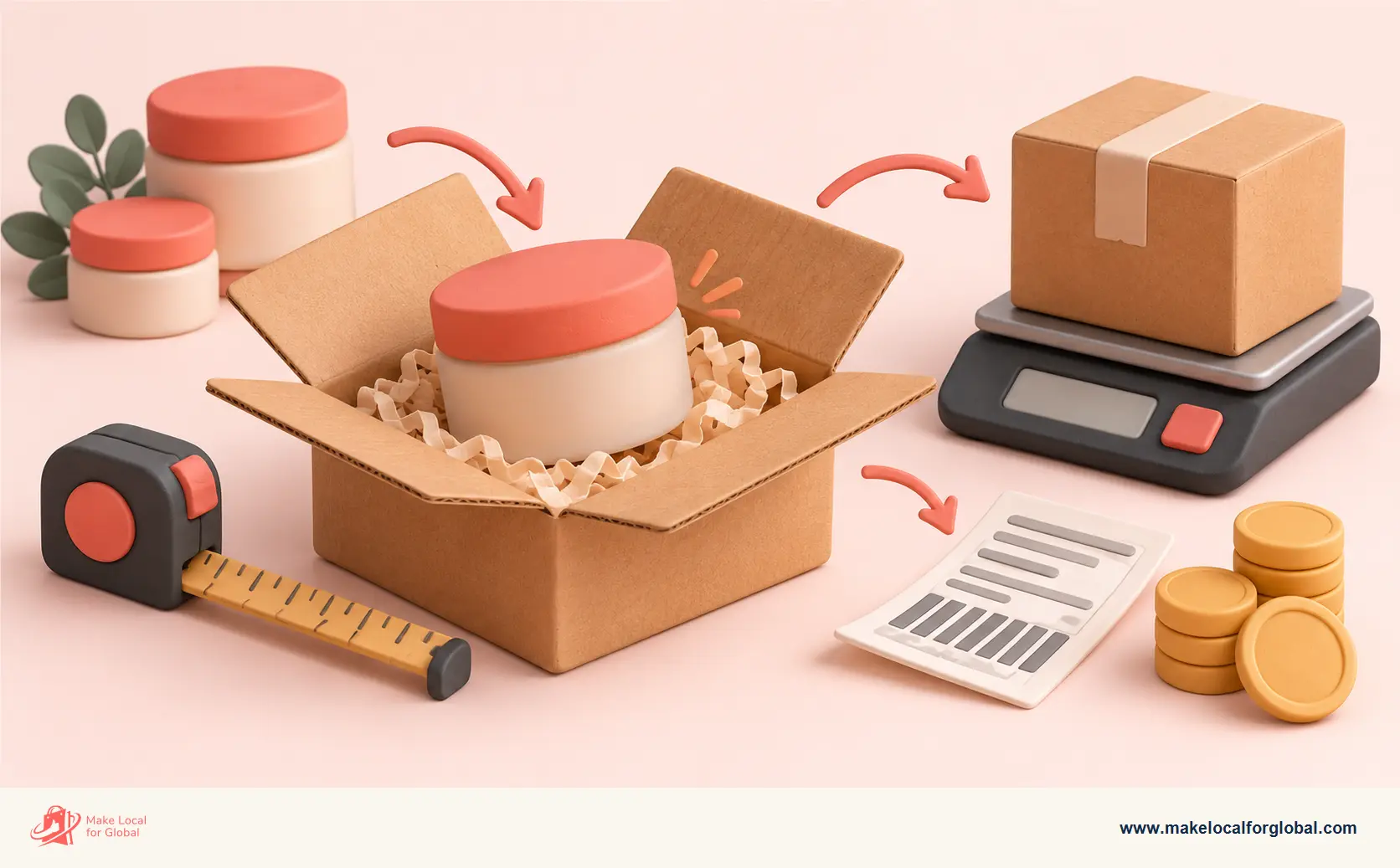
Small jars can be heavy for their selling price, and oil-rich products can mark packaging if a lid leaks. Measure and weigh the packed order, then use the carrier price for those exact dimensions. Add product cost, inbound freight, outer packaging, payment charges, delivery subsidy, returns allowance and customer acquisition cost.
| Illustrative per-order item | Example cost |
|---|---|
| Two scrub jars, landed stock cost | £8.40 |
| Inbound freight allocation | £0.80 |
| Protective parcel materials | £1.20 |
| Tracked delivery | £3.95 |
| Payment fee allowance | £0.90 |
| Returns or damage allowance | £0.75 |
| Customer acquisition allowance | £3.00 |
| Example variable order cost | £19.00 |
| Example order value | £29.00 |
| Contribution before overheads and tax | £10.00 |
Illustration only: £29.00 minus £19.00 equals £10.00. These invented figures are not market prices or a profit forecast. The example assumes the seller is not VAT-registered and the landed stock cost includes any VAT charged. Add your own labour and fixed costs; check VAT treatment with HMRC or an accountant.
Run the same calculation for one jar and a bundle. A bundle makes sense only if its combined price covers the added stock, packaging weight, fulfilment time and customer-service risk. Review the GOV.UK distance-selling information for the pre-purchase details and cancellation rights that apply to online consumer orders.
A shopper should not have to guess the jar size, scrub texture or whether a spatula is included. Use original photos of the product and label, then add a close-up of the texture and a picture showing the size in context. Do not use a generated image as proof of the real formula or package.
Example title: “Citrus sugar body scrub, 200 g, rinse-off”. Under it, describe only confirmed details: the listed fragrance, the actual ingredient declaration, the maker’s directions and whether the product is sealed. If the scent or formula changes, update the page and keep the old batch records.
Start with a single sales channel and a repeatable way to answer buyer questions. Product-specific content can show the jar size beside an everyday object, explain how to read a label, demonstrate the closed parcel test or compare the two scrub formats in your range.
For search, build pages around real questions such as “how to choose a body scrub jar size” or “what to check before buying a body scrub”. Keep advice general and point readers back to the exact manufacturer directions for your product. Ask a few likely buyers to find the ingredient list and delivery cost on a phone; note where they pause.
| Week | Work to complete | Signal to record |
|---|---|---|
| 1 | Interview five likely buyers; shortlist one customer group and two product formats | Repeated questions, preferred size and buying occasion |
| 2 | Ask suppliers for exact product, label, responsible-person and batch information; order samples | Complete files, sample cost, lead time and unanswered compliance points |
| 3 | Check samples, test the packed parcel and calculate single-item and bundle costs | Seal or label faults, parcel weight, carrier quote and contribution |
| 4 | Publish a small verified range, share three helpful product posts and review buyer questions | Product-page visits, add-to-baskets, orders, returns and repeated questions |
Use this as a planning sequence, not a promise that legal checks or supplier lead times will fit four weeks. Do not offer a product until the required safety and market steps are complete.
Make Local for Global can talk through a small product range, the pages shoppers need and the next practical step for your business.
Possibly, but making and selling a cosmetic brings safety, documentation, labelling and notification duties. For Great Britain, check the government cosmetics guidance and speak with a qualified safety assessor before you sell. Check the separate rules for Northern Ireland if you plan to trade there.
Use the exact product name, net contents, full ingredient list, maker-approved directions and precautions, clear photos of the actual label, delivery terms and contact details. Check market labelling rules for the Responsible Person details and other required information.
Do not make treatment or cure claims for a cosmetic scrub. Claims need suitable evidence and must match the product’s permitted cosmetic function. Ask a regulatory adviser to review any wording that may cross into a medicinal claim.
Begin with the smallest supplier quantity that lets you complete compliance checks and fulfil a modest test. Use buyer interviews, sample results and real page behaviour to guide a reorder. Compare the cost of a small order with the risk of holding stock whose batch, label or specification later changes.
PREFERRED SOURCE
Like what you’re reading? Add Make Local for Global as a preferred source on Google to see more of our articles when you search.

Build your online presence without having to figure out everything yourself.