

READY TO SELL bamboo cutlery ONLINE?
Get a store built for you in 5 days, plus training and support to help you start, run, and grow your Alternative business.

A practical guide to selling bamboo cutlery online: verify materials and food-contact suitability, test samples, write clearer product pages and price each order.

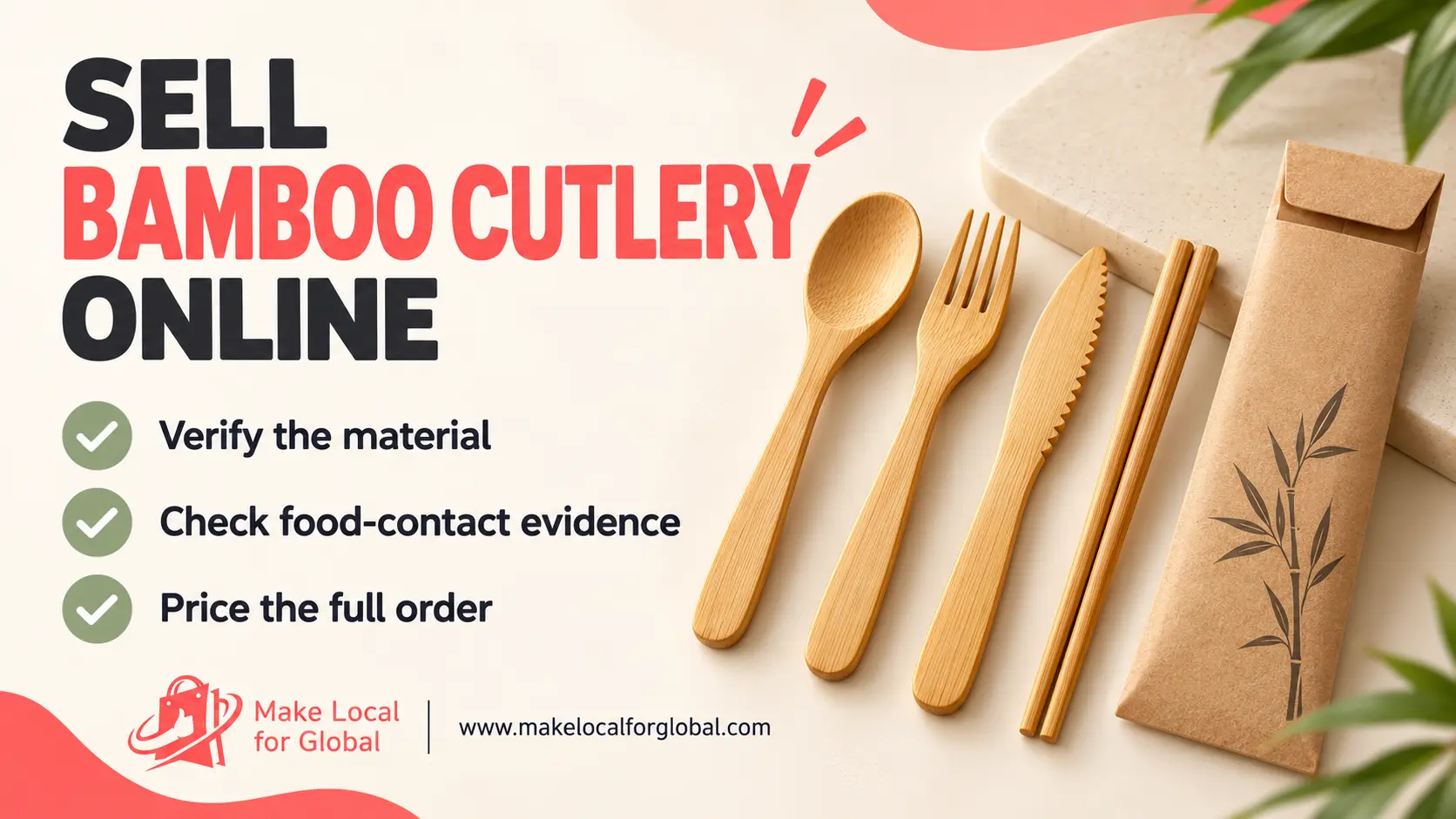
Bamboo cutlery can suit travel kits, lunch sets and household ranges. But before you order stock, verify exactly what each utensil is made from, whether it is suitable for your intended food contact and market, and what the customer receives.
Build your offer around documented products, clear pack contents and practical care instructions. In Great Britain, do not sell plastic food-contact utensils containing bamboo or other unauthorised plant material unless the product has the required authorisation. Single-material bamboo products still need to meet applicable food-contact requirements.
If your shop covers more bamboo homeware, our guide to selling bamboo sheets online explores range planning for a related product category. Cutlery needs its own checks for material, finish and care.
Give shoppers a clear place to compare sets, check what is included and ask questions before ordering.
A commuter may want a compact spoon, fork and chopsticks in a washable sleeve. A family may prefer several place settings. A café, caterer or event organiser may ask about bulk quantities, packing formats, lead times and repeat supply.
Talk to likely buyers before placing a large order. Ask what they use now, what gets lost, how they carry utensils and which pieces belong in a useful kit. Note their own words: they can guide product names, pack sizes, photography and FAQs.
Compare a small number of offers—for example, a three-piece travel set and a family pack—with exact contents and prices. Track product-page visits, enquiries and paid orders. A poll is a useful prompt, but a completed order or deposit is stronger evidence of demand.
Start with a few distinct offers. State whether a pouch, brush, napkin, straw or spare piece is included; a styled photo should not imply extras that are sold separately.
| Offer idea | Possible buyer | Details to confirm |
|---|---|---|
| Compact travel set | Commuters and day trips | Piece count, lengths, sleeve material and cleaning advice |
| Lunch kit | People packing meals for work or school | Included pieces, age suitability and storage pouch |
| Household pack | Homes needing several matching sets | Quantity, finish consistency and replacement stock |
| Business order | Cafés, caterers and event organisers | Minimum order, packaging, lead time and repeat supply |
These are example offer formats, not claims about demand. Test interest with your own customers.
“Bamboo cutlery” can describe very different products. Ask if each utensil is made solely from bamboo or if bamboo fibre or powder is mixed with plastic, resin or another binder. Request the complete material specification in writing. A natural colour or visible flecks do not prove the composition.
The Food Standards Agency (FSA) and Food Standards Scotland advise businesses not to sell plastic food containers or utensils containing bamboo and similar unauthorised plant materials for food contact in Great Britain. The FSA notice says this advice does not apply to products made solely from bamboo or another plant material. That is not a blanket confirmation that every single-material item is compliant: general food-contact safety requirements still apply. Northern Ireland has a different route. Read the current FSA notice on bamboo-containing plastic utensils and get market-specific advice if composition is unclear.
The FSA’s food-contact materials guidance covers utensils and cutlery. Ask for evidence relating to the exact item, intended foods, temperatures and use. A generic “food safe” statement, logo or report for a different product is not enough to establish suitability for your stock.

Environmental claims need evidence too. Be specific about what a claim means and keep proof for the exact product and disposal conditions. Review the ASA guidance on environmental claims before using terms such as “eco-friendly”, “biodegradable” or “compostable”.
Order a sample from the same production route you plan to use. Compare its material and labels with the supplier’s written description. Keep the response, invoice, product reference and batch details together.
Inspect for splinters, cracks, rough edges, loose fibres, sharp points and uneven finishes. Check that forks and chopsticks match the listing. Dated sample photos help track quality, but a visual inspection does not replace compliance evidence.

Name the set and the feature a buyer is comparing. For example, only call it a “three-piece bamboo travel set with cotton pouch” if the pouch is cotton and included. Show the complete set, then add close-ups of the edges, handles, packaging and any pouch.
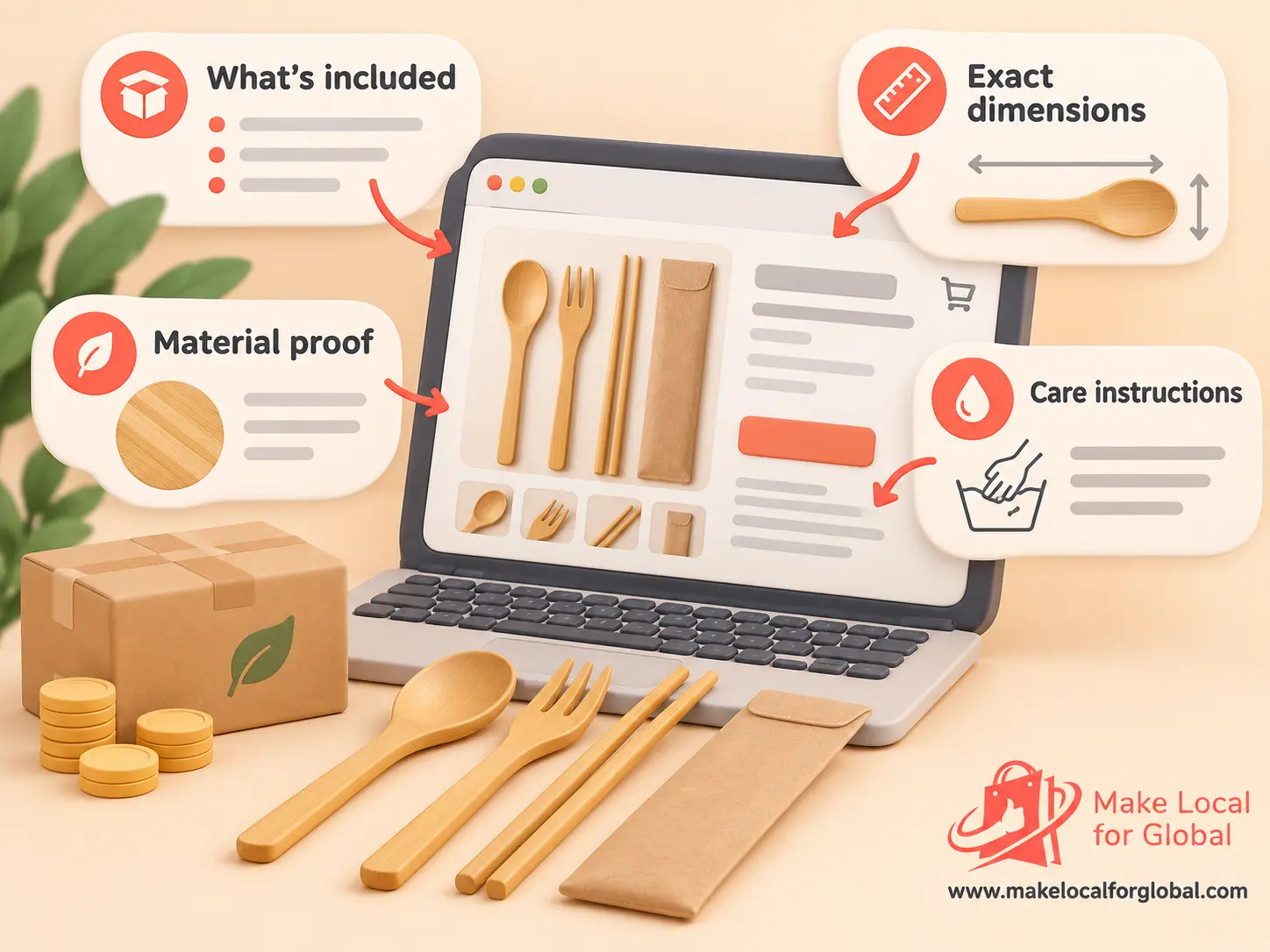
Cost a typical parcel, including stock, inbound freight, protective packaging, postage, payment fees, expected returns or replacements and customer acquisition. Check the current fees from your own providers; rates vary.
| Illustrative cost per order | Example |
|---|---|
| Set and share of inbound freight | £5.60 |
| Protective sleeve and packing | £0.65 |
| Postage | £3.75 |
| Payment fee allowance | £1.20 |
| Returns or defect allowance | £1.00 |
| Customer acquisition allowance | £2.50 |
| Total variable cost | £14.70 |
| Example price | £24.00 |
| Contribution before overheads and tax | £9.30 |
Illustrative only, before VAT. Replace with your actual costs. Contribution is not net profit.
At the example price, £24.00 minus £14.70 leaves £9.30 before fixed costs, owner time, tax and VAT effects. Recalculate if a pouch, branded box or extra set changes parcel size or postage, and allow for damaged stock or price changes.
A well-organised ecommerce site can bring product options, delivery details and customer questions together as you test a range.
Choose packaging that protects the set without obscuring what is included. Test a packed parcel, weigh it and confirm the carrier price before promising delivery dates. Business buyers may need agreed order quantities, dispatch windows and a process for shortages or damaged items.
For many online consumer orders in Great Britain, shoppers have 14 days after delivery to tell the seller they wish to cancel, and a further 14 days to return the goods. Check the current distance-selling rules and returns and refund guidance; exceptions and other markets can differ. Also check current restrictions on single-use plastic cutlery in England if your range includes disposable items. A reusable product description does not remove the need to understand the rules for the item you sell.
Use search wording that accurately describes the verified item, such as “bamboo travel cutlery set with pouch”. Answer questions about pack contents, dimensions, materials, finish, care and delivery with short copy and clear photos.
Test one route at a time: show a travel kit to commuters, ask independent retailers about a small wholesale pack or discuss a lunch set with a local group. Set a limit for paid promotion. Track visits, enquiries, conversion, order value, returns and customer-acquisition cost. Change one part of the offer or product page at a time so you can see what helped.
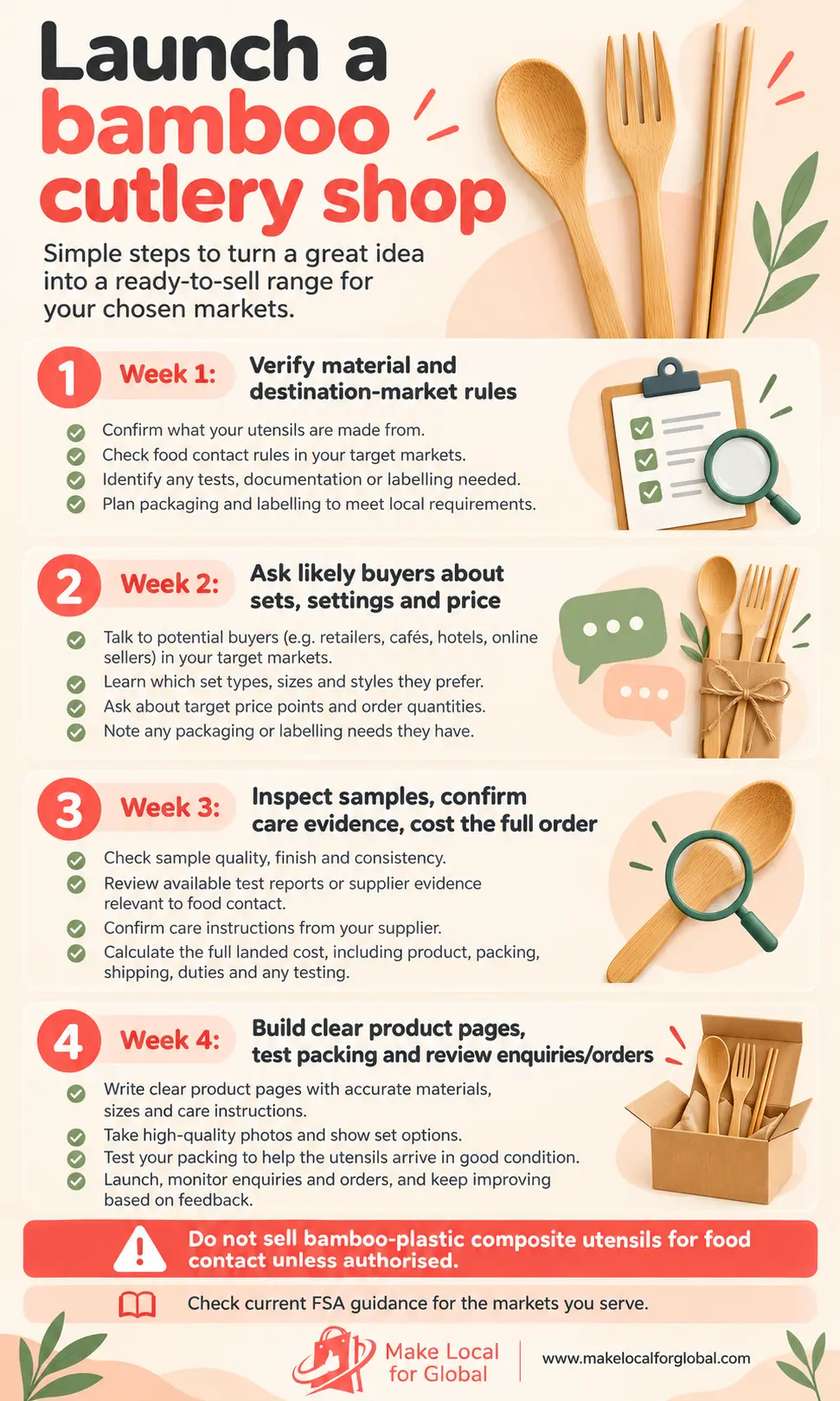
| Week | Action | What to record |
|---|---|---|
| 1 | Verify composition, food-contact evidence and target-market rules. | Supplier documents, open questions and compliance gaps. |
| 2 | Ask likely buyers which sets, quantities and prices suit them. | Repeated requests, preferred contents and objections. |
| 3 | Inspect samples, cost an order and prepare page copy and photos. | Sample issues, full variable cost and missing details. |
| 4 | Test packing and checkout, then run a small sales or enquiry test. | Orders, enquiries, delivery, returns and acquisition cost. |
At the end of the month, use results to decide what to change. You may need a clearer care explanation, stronger supplier evidence, different pack contents or a revised price. Add stock when buyer response, product quality and compliance checks support it.
Do not sell it for food contact unless it has the required authorisation for the destination market. FSA and FSS advice says businesses should not sell plastic utensils containing bamboo and other unauthorised plant material in Great Britain. Check current advice before listing.
No. The FSA’s notice about bamboo in plastic does not cover products made solely from bamboo, but sellers still need to meet food-contact requirements. Request evidence for the exact item and intended use.
Let buyer research guide the choice. A set might include a spoon, fork, knife or chopsticks and a pouch; clearly state the exact pieces and measurements.
Only make environmental claims you can substantiate for the specific product and disposal conditions. Avoid broad wording that implies benefits you cannot prove.
Make Local for Global supports small businesses with ecommerce websites. Review the plans or get in touch about the product range you are preparing.
PREFERRED SOURCE
Like what you’re reading? Add Make Local for Global as a preferred source on Google to see more of our articles when you search.

Build your online presence without having to figure out everything yourself.