READY TO SELL face serums ONLINE?
Get a store built for you in 5 days, plus training and support to help you start, run, and grow your Alternative business.

Plan a face-serum range that customers can understand and you can support. This guide covers sourcing, cosmetic compliance, supplier checks, full order costs, product pages and a measured launch.


Face serums can look like a simple product to sell: a small bottle, a few drops, an ingredient story and a polished photograph. The business behind that bottle is more demanding. You need a clear customer, a formula and supplier you can stand behind, compliant product information, packaging that protects the product, a price that pays for the whole order and a route to repeat customers. This guide takes you through those decisions in a practical order, so you can test a focused face-serum range before tying up too much cash in stock.
The opportunity is not to make the loudest skincare promise. It is to help a defined group of shoppers choose confidently. A useful online range answers questions about texture, finish, packaging, ingredients as declared by the manufacturer, use directions, delivery and returns. It explains what the product is designed to do without drifting into unapproved medical claims. If you are still deciding whether skincare is the right category, start with our guide to selling anti-ageing creams online and compare the customer, compliance and fulfilment work with this more focused serum plan.
A serum is commonly positioned as a concentrated-feeling, lightweight leave-on skincare step, but the word does not identify one universal formula, strength, texture or result. Products called serums can be water-based, gelled, emulsion-like or oil-based. Some are designed to sit under a moisturiser; others are marketed as a simple standalone facial oil. A shopper cannot infer the product’s ingredients, suitability or performance from the category name. Your product page must therefore translate the manufacturer’s approved product information into clear buying details rather than rely on the word “serum” to do the selling.
Serums also create a trust-heavy purchase. People apply them to facial skin, often near the eyes, and may be cautious about fragrance, texture, allergens, packaging hygiene and how a product fits with the rest of a routine. That makes factual descriptions, clear photos, complete ingredients and accurate directions central to conversion. It also makes supplier checks and compliance work essential before you list the item. A store that gives shoppers useful answers can compete on clarity and service even when it does not have a huge range or a celebrity brand.
Think about the business model before selecting products. Are you reselling finished products from a UK distributor, importing an established brand, arranging private label, or developing your own formula? Each route changes your cash requirement, control over packaging and claims, minimum order quantities, lead times and regulatory responsibilities. Do not assume that a supplier’s confidence or a product’s existing presence on a marketplace means you can sell it compliantly under your own business name. Establish who is legally responsible for the product, which territory it is intended for and what evidence you are entitled to use.
Start with a specific buying context, not a list of fashionable ingredients. A customer might want a lightweight layer for a simple morning routine, a fragrance-free option, a giftable product from a local maker, a travel-sized format, or a serum that fits a particular price point. Those are starting hypotheses, not claims about skin outcomes. Write down what the shopper is trying to decide: whether the texture feels right, whether the bottle is easy to dispense, what the product costs per use, whether the ingredients suit their preferences, or whether the seller can answer questions promptly.
Choose one primary customer group for your first test. You might focus on shoppers who prefer short routines, customers looking for a considered gift, or buyers drawn to a particular design and provenance story. Avoid trying to serve every skin type, age group and concern from day one. Broad positioning creates a confusing range and pushes you towards generic product copy. A narrower group gives you more useful questions to ask during research and makes it easier to select imagery, packaging and a sales channel that match.
Use small, observable signals to test demand before ordering stock. Review search suggestions and marketplace listings to understand how people describe products, but treat public counts and trend tools as directional rather than a sales forecast. Read recent customer reviews for products in a similar price band. Note what shoppers praise, what causes returns, which questions remain unanswered and how much packaging detail they need. Look for repeat patterns: “too sticky,” “dropper is awkward,” “scent is stronger than expected,” or “arrived leaking” may reveal experience gaps you can address with selection, content or packaging checks.
Then speak to real prospective buyers. Ask what they currently buy, what they compare before checkout and what made them repurchase or switch. Ask them to explain the last time they selected a facial product, rather than ask whether they would buy your idea. Compliments are not evidence of demand. A stronger signal is a concrete action: joining a waitlist, selecting between two product concepts, paying for a sample where appropriate, or returning to a product page after seeing the full price and delivery terms. Record the question, the answer and the next action so the research remains useful.
Build a simple positioning statement for yourself: “For [specific customer], this range offers [clear product or shopping difference], supported by [verifiable evidence].” If the last phrase is vague, you may not yet have a differentiator. “Premium,” “clean,” “natural” and “results-driven” are not meaningful on their own. A difference could be a well-explained texture choice, a transparent ingredient list, a particular package format, a trusted maker, a gift-ready set or fast, dependable service. Only use claims that match the supplier’s approved information and your evidence.
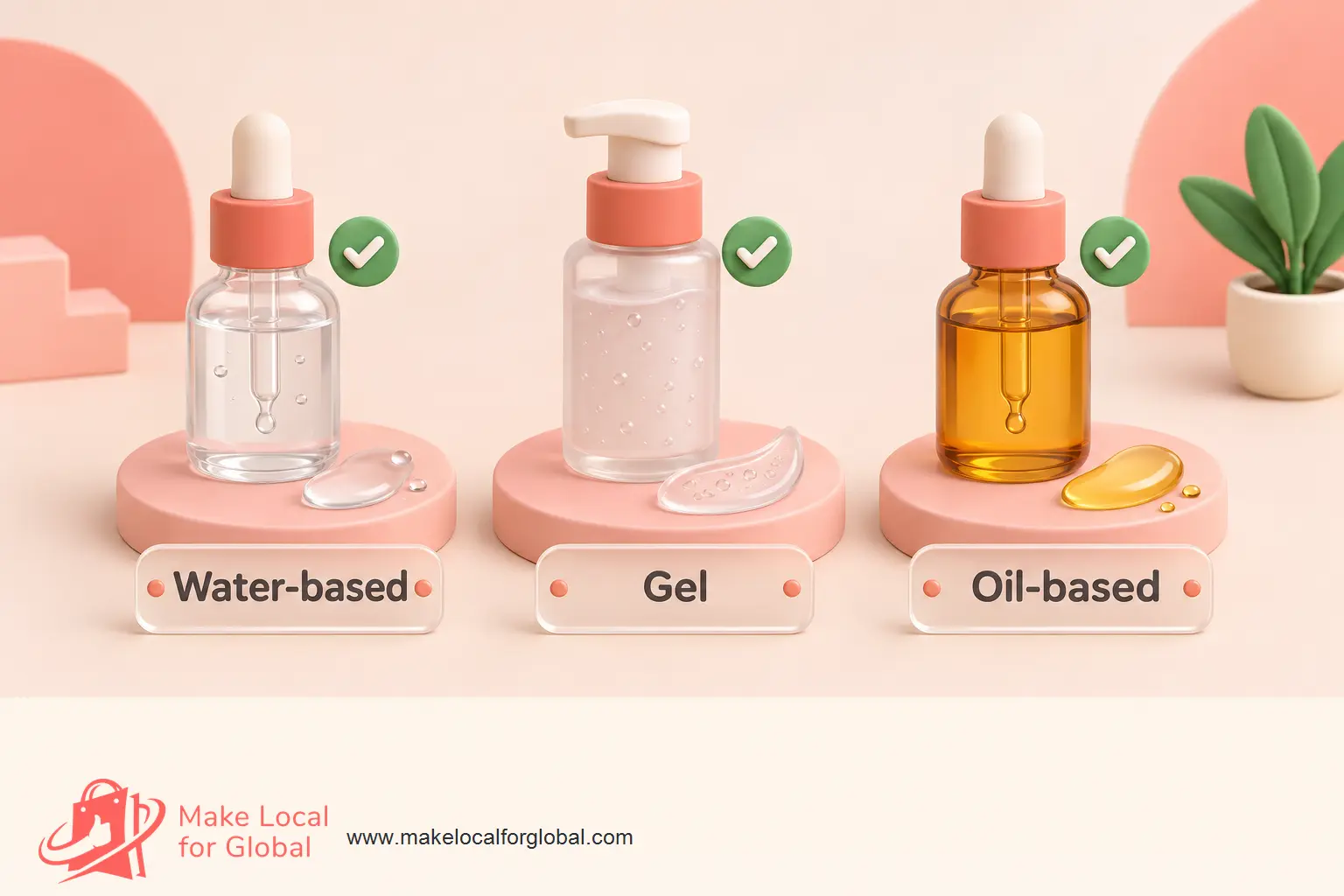
Water-based formulas often feel light and may use a dropper, pump or airless pack. Gel formats can be designed for a smooth spread and may use a pump or tube. Oil-based products are typically more emollient in feel, though the actual experience depends on the formulation and the person using it. These broad descriptions do not establish quality or suitability. Ask the manufacturer for the product specification, full ingredient declaration, directions, precautions, compatibility information and claims dossier for the exact SKU and market. Do not infer performance from the ingredient list alone.
Before you choose a format, obtain samples from the actual production source and packaging configuration you plan to sell. A sample poured into a generic tester may not represent the final pack. Test the dispenser across repeated uses, check whether the container can stand or travel as described, note whether labels remain legible, and check the closure for leakage. Store samples according to the supplier’s guidance and record the lot or sample reference. Your test is an incoming quality and usability check; it is not a substitute for a qualified safety assessment, stability programme or manufacturer’s quality process.
There is no need to stock every format at launch. Pick a small assortment that gives the customer a reason to compare without multiplying inventory and information requirements. One hero serum plus a complementary product can be easier to explain than six near-identical bottles. If shoppers cannot understand why the products differ, you may have added complexity without adding choice. Keep the range coherent: consistent price logic, packaging quality, image style, directions and support response create a stronger first impression than a large grid of similar items.
Buying from an authorised distributor can reduce the work of creating a brand and may provide established product information, batch traceability and packaging. It does not remove your duty to check that the goods are authentic, intended for the market in which you will sell, properly labelled, in date and supplied with the rights to use product photographs and descriptions. Confirm the distributor’s territory, returns policy, lead times, minimum order and evidence of authorisation. Ask how recalls, damaged stock and customer complaints are handled. Keep invoices and lot information so you can trace stock if a concern arises.
A private-label manufacturer may let you select an existing base formula and add your identity, label and pack. This can create a differentiated shopfront, but it also increases your responsibility to agree exactly what is being made, which claims are supported, who holds the product file, who is the Responsible Person where required, and who manages notifications and changes. Get the agreement in writing. Ask whether the formula, fragrance, pack, product name or directions can change between production runs, how changes are communicated, what happens if a component becomes unavailable, and which party signs off artwork and regulatory information.
Commissioning a custom formula usually requires more time, specialist input, testing and cash than reselling finished goods. Development can involve briefs, sample rounds, stability and compatibility work, safety review, packaging decisions, manufacturing validation and minimum production volumes. Do not publish a launch date until you have a realistic timeline from the manufacturer and the required evidence is complete. A formula that performs well in a sample is not automatically ready for commercial sale. Work with qualified professionals and use written specifications and change control; do not attempt to replace safety assessment or product testing with informal home experiments.
Importing introduces customs, logistics, product compliance and territory questions alongside the product itself. Find out who is the importer of record, who is the Responsible Person in each market, which local language and address details are needed, how ingredients are declared, and whether product notifications and files cover the country where the customer lives. A product made outside the UK is not automatically compliant for sale in Great Britain or Northern Ireland. Confirm whether a supplier’s documents cover your exact formulation, branding and destination, rather than assuming one certificate or registration applies everywhere.
Assess a supplier as a business partner, not just a price list. Ask for its legal business name and address, manufacturing location, relevant quality-system information, product specification, full ingredient list, batch traceability process, storage conditions, shelf-life information, and a clear contact for quality complaints. For a finished cosmetic, ask which Responsible Person is named for the target market and how the required product safety and notification records are maintained. Confirm that documents relate to the current formula, pack and product identity. If any answer is missing or evasive, pause the order and resolve it before committing funds.
Ask for a written quotation that separates unit price, decoration or label costs, setup fees, samples, freight, duties or taxes, carton quantities, payment timing and minimum order quantity. Clarify the production lead time and whether it starts after artwork approval, deposit, or another milestone. Check whether a quoted price includes shipping to your door or only to a port or warehouse. Get the supplier to explain how short-dated, damaged, leaking or out-of-spec units are handled. The cheapest unit can become the most expensive option if it creates high defect rates, long cash conversion cycles or customer-service problems.
Review samples against the specification you plan to sell. Keep a dated record with the supplier name, SKU, batch or sample reference, pack format and observations. Check the scent, appearance, texture, dispenser, seal, closure and label readability against supplied information. These observations help you assess the retail experience, but they do not establish safety, stability, efficacy or regulatory compliance. Do not ask customers to test a product that is not cleared for sale, and do not distribute testers without checking that the activity and product status are appropriate.

Confirm how a supplier communicates changes. A new fragrance, ingredient source, concentration, package material, label or production site may affect product records and the claims you can make. Agree that changes are notified before production and establish who reviews the impact. Keep versions of specifications and artwork with dates. If you receive stock that does not match the approved specification, quarantine it and seek a documented resolution rather than silently blending it into saleable inventory.
Cosmetic requirements depend on where you sell and your role in the supply chain. In Great Britain, the business placing a cosmetic on the market needs to ensure that the applicable requirements are met. A Responsible Person established in the UK is required; a Product Information File must be maintained in English and include the Cosmetic Product Safety Report; and the product must be notified through the Submit Cosmetic Product Notifications service before it is made available. The Responsible Person and manufacturer have defined responsibilities, and a safety assessment must be completed by a qualified assessor before sale. Read the current UK Government guidance for making cosmetics available in Great Britain and have a qualified compliance professional confirm how it applies to your supply route.
The Product Information File is not simply a marketing folder. It should contain the information required under the applicable rules, including the safety report, product description, manufacturing method and GMP statement, evidence supporting claimed effects where relevant, and information about animal testing where applicable. It must be accessible to the competent authority at the Responsible Person’s address and retained for the period specified by law. Agree in writing who controls the file, who can access it, how it is updated and what happens if you switch manufacturers or cease working with a brand.
Northern Ireland follows a different route from Great Britain. Cosmetics placed on the Northern Ireland market are subject to the EU cosmetics framework, including an EU or NI-based Responsible Person and notification through the EU Cosmetics Products Notification Portal. A GB-based seller who wants to serve NI customers should check the current rules, product notification and labelling position before enabling checkout for that territory. Do not assume a UK Responsible Person or a GB SCPN notification alone covers Northern Ireland. The Government’s Northern Ireland cosmetics guidance explains the distinction. Confirm the latest operational details before launch because cross-border requirements can change.
For each product, check the label and pack information against the applicable territory. Rules cover matters such as the Responsible Person’s name and address, nominal content, durability or period-after-opening information where applicable, precautions, batch identification, product function where it is not obvious, and ingredient declaration. Cosmetics sold in the EU and Northern Ireland also have language and local Responsible Person requirements. Do not design the label from another brand’s pack or assume a marketplace listing has all information correct. Have final artwork reviewed by someone qualified for the destination market before production.
Keep a compliance record for each exact SKU. A practical control sheet can record the product name and formula version, market, Responsible Person, notification status, PIF location, safety assessor, label proof, approved claims, supplier, batch range, date received and date released for sale. Add a stop-sale contact and recall procedure. If a customer reports an adverse event or a batch issue, you need to know what stock they bought, how to reach the Responsible Person and how the concern will be assessed. Clear records make a small shop more dependable and reduce the chance that a rushed relisting puts the wrong information online.
Use only claims that are truthful, understandable and backed by appropriate evidence for the exact product. A manufacturer may provide approved wording or a claims dossier, but you must still use it in context and avoid creating a stronger impression through your headline, imagery, customer stories or before-and-after content. A cosmetic description can discuss the product’s appearance, texture, packaging and intended cosmetic function where substantiated. It should not imply that the serum diagnoses, treats or prevents a disease or delivers a medical outcome.
Be cautious with claims about acne, eczema, rosacea, inflammation, infection, scarring, hormonal conditions, wound healing or other medical conditions. A product’s classification can depend on its presentation, intended purpose, claims, ingredients and mode of action. If you imply treatment or prevention of disease, it could be considered a medicine rather than a cosmetic. Review the MHRA guidance on borderline products and obtain specialist advice if wording is uncertain. A disclaimer at the bottom of a page will not necessarily undo a medical impression created by the product name or headline.
Likewise, avoid sweeping promises such as “works for every skin type,” “clinically proven” or “safe for sensitive skin” unless the evidence supports the exact claim and wording. Do not invent percentages, timelines, dermatologist endorsements, test results or customer outcomes. If you describe an ingredient, make sure the name and role match the product information and do not infer a benefit that the evidence does not establish. For example, saying that a product contains a named ingredient is different from promising that it changes a biological process or guarantees a visible result.
Keep a claim substantiation file with the source, exact approved wording, product version, conditions of use and evidence owner. This can include supplier documents, test reports, consumer-use research or other relevant evidence. Make sure the evidence actually supports the claim and that the claim is not misleading in the overall context. UK advertising guidance expects health and beauty claims to be supported; see the ASA/CAP guidance on substantiating health and beauty claims. If the supplier will not provide proof, leave the claim out. Safer, clearer copy is better than a high-risk promise you cannot substantiate.
A useful first range might contain one hero serum and one or two complementary alternatives that solve a genuine choice problem. For example, you could distinguish a lightweight water-based texture from an oil-based texture, or offer one full size and one travel size if the supplier and rules allow. The goal is to help a shopper find the right product for their preference, not to imply that a more expensive item is clinically superior. Each SKU adds money tied up in stock, product records, imagery, customer questions and replenishment decisions. Start with the smallest range that lets you test your position credibly.
Use a range matrix before you order. For each candidate, record the target buyer, product type, texture, pack size, shelf-life, unit cost, minimum order, likely retail price, gross margin before fulfilment, supplier documentation, claim restrictions and reason it belongs. Then compare overlaps. If two items have the same format, price and target buyer, explain why a shopper would choose one over the other. If you cannot, remove one from the initial range or select a clearer alternative. An intentionally small range can make the store feel focused rather than incomplete when the differences are well explained.
Consider price architecture as part of the range. Shoppers should understand the difference between a starter size, core product and bundle. Any bundle must be accurately described and its discount must be real. Avoid adding a “premium” tier solely to create a price anchor. Add value through a relevant size, practical packaging, clear support or a suitable gift presentation. Make sure each combination has an inventory plan and that the products in a bundle can be sold together in the required market.
Packaging affects dispensing, leakage, hygiene, product protection, postage and the way the item looks in a photograph. Droppers can feel familiar to some buyers but may be awkward when hands are slippery or the bottle is nearly empty. Pumps can be easy to use but might not dispense a very thick formula well. Airless packs may be chosen for specific product and packaging reasons, but do not claim they preserve a formula unless the manufacturer’s evidence supports that. Ask the supplier about material compatibility, priming, closure integrity, transport testing and what to do if a pack fails.
Check that the label remains readable at the actual bottle size. Include enough space for required information and do not shrink essential warnings to fit a decorative design. Make sure the product name, volume, directions, precautions and ingredient declaration can be found on the container or any permitted outer packaging. Review the production proof, not just a screen mockup. Confirm colour, spelling, batch/lot area, barcode, adhesive, print durability and whether the label can be applied consistently. Keep the signed-off artwork version with the product file and record any later changes.
For online shipping, test the complete packed order with the supplier’s guidance and your carrier’s rules. Use a leak-resistant inner protection, a sturdy outer carton and packaging that limits movement without excessive void fill. Check the parcel after realistic handling and temperature conditions. A test is a useful packaging quality check, not a replacement for the manufacturer’s stability and compatibility evidence. Measure the final package and weigh it; a small change in box dimensions can move an order into a more expensive shipping band or affect marketplace fulfilment fees.
Think about accessibility and clarity. A customer should be able to identify the product and read the directions without needing to decode a tiny, low-contrast label. Product photos should show the real container and its scale, not a dramatic retouched image that hides the label or implies a different pack. Use a clear image of the front, back and dispenser where useful. If the supplier grants image rights, keep the permission and check that the photographs match the batch and packaging you will actually ship.
Do not price a serum by multiplying its landed unit cost and hoping the remainder is profit. Calculate the economics of a real order. Include the product, inbound freight, import charges where applicable, packaging, pick and pack, payment processing, marketplace fees, shipping subsidy, expected damage and leakage, returns allowance, customer service, samples, photography, advertising, discounts and tax treatment. Some costs vary by order; others are monthly overhead. Separate the two so you can see the contribution each order makes before fixed costs.

Use this illustrative model as a structure, not as a forecast. Suppose a 30 ml serum costs £7.20 from the manufacturer, and allocated inbound freight and duties add £1.30 per unit. A carton, protective insert and label add £0.85. The landed and packed product cost is then £9.35. If the retail price is £24 including any applicable VAT, you must account for tax correctly before calculating revenue available to the business. A payment fee might be around £0.70 on an order, outbound postage and packing £3.10, and a modest marketing cost £4.00. Before overhead, returns and other costs, this leaves less than the simple £24 minus £9.35 calculation suggests.
Build the model with your real supplier quotes and channel rates. Use formulas so changing a retail price, fee or delivery cost updates contribution automatically. For each sales route, calculate revenue excluding any tax that is not yours to keep, minus product cost, transaction fees, variable fulfilment, shipping subsidy, discounts and an expected returns or damage allowance. This is the contribution before overhead. Then compare the contribution with monthly fixed costs such as software, storage, insurance, accounting and a reasonable allowance for your time. If you sell on more than one channel, do not assume each one has the same fee structure or customer acquisition cost.
Stress-test the assumptions. What happens if inbound freight rises 15%, the supplier’s minimum order doubles, the average order contains one item instead of two, paid acquisition costs are £3 higher, or 3% of deliveries need a refund or replacement? What price do you need to break even after a coupon? Do not use optimistic repeat purchasing to justify a loss-making first order unless you can demonstrate retention. A sustainable launch should work on the first order or have a clearly funded and measured plan to acquire repeat buyers.
Be transparent about taxes and shipping. Confirm whether your business must register for VAT and how each channel displays tax, and get qualified accounting advice for your circumstances. Show delivery charges and dispatch times before checkout. Free shipping is a pricing choice: include its cost in the price or define a threshold that still works after fees. A high free-delivery threshold can increase basket size, but it may also cause abandonment if it feels arbitrary. Test the full landed basket price against comparable offers, not just the headline price of the bottle.
Give every product page a unique title and a concise description based on the actual item. Include product type, size, texture, packaging, verified ingredients as declared, directions, precautions, full ingredient list, storage information and delivery details where permitted and available. Explain who might prefer the format without making unsupported suitability claims. Use direct language. A customer deciding between two bottles should be able to understand the difference without reading exaggerated copy or guessing from the product colour.
Use a page structure that answers purchase questions in order: what it is, what is in the package, what the texture and dispenser are like, how the manufacturer says it should be used, what ingredients and precautions are on the label, how it ships, and what happens if the order arrives damaged. Include multiple images from different angles. Add a short comparison chart if the range contains meaningful differences. Do not add a manually written contents list to this guide; the site generates the article contents section automatically.
Write search-friendly content for people rather than repeat a keyword unnaturally. A page title might identify the serum type and size, while the body answers specific questions about packaging, delivery or range differences. Use one clear H1 for the page title and logical subheadings underneath. Use descriptive image filenames and alt text that explains what an image shows; avoid stuffing alt text with every search phrase. Add internal links where they genuinely help a shopper or new seller. For example, connect a relevant discussion of skincare range planning to our guide to selling aloe vera products online, and link to your shipping or returns information from the product page.
Search visibility takes time and no title or plugin score guarantees a ranking. Make the page fast, mobile friendly and easy to navigate. Avoid duplicate product pages that differ only by a trivial word. Keep canonical product URLs stable, use redirects if a URL must change, and submit the site’s sitemap through the relevant search tools. Track impressions, clicks, add-to-cart actions, conversion rate and search terms after launch. Use the data to improve the page when it reveals an unanswered question, not to add unrelated paragraphs solely to reach a word count.
Keep a separate editorial page for the business education behind the category and avoid making the product listing compete with your own guide. The article can explain how to sell face serums; the product page should focus on the specific serum being sold. This distinction helps search engines and readers understand which page is meant to answer which question. Do not copy a supplier’s text across every product page. Rewrite it accurately for your store, preserve required wording where necessary, and confirm that any benefits remain within approved claims.
Your own ecommerce site offers control over brand, customer experience and first-party insight, but you need to bring qualified visitors to it and maintain the store. A marketplace can provide search traffic and buyer trust, but it may charge significant fees, limit customer data, impose category rules and require precise product documentation. Social commerce can help demonstrate packaging or answer questions, but a post’s reach is unpredictable and a product claim in a video is still a claim. Choose one primary channel and one supporting channel for the first test. Learn the full workflow before spreading stock across multiple platforms.
Before listing on a marketplace, review its current restricted-products policies and documentation rules for cosmetics. Confirm how it handles expiry dates, batch traceability, authenticity, returns and product safety complaints. Keep product and supplier records available in the required format. Never use a marketplace listing to bypass an unresolved compliance question. A listing removed after launch can strand inventory and damage customer trust. If the platform does not make a rule clear, ask its support team before ordering stock for that channel.
For an independent site, make sure the store is ready to take an order end to end. Test mobile navigation, product variants, shipping zones, tax display, payment confirmation, stock deduction, order emails and refund handling. Make support contact details easy to find. Set up analytics and consent controls in accordance with your privacy obligations. If you want help shaping a store around a product range, see our website design service or contact Make Local for Global to discuss the practical requirements.
Helpful content can show the real product, explain its size, demonstrate how its packaging opens, compare the texture described by the manufacturer, and answer the questions customers ask. A short video can show the pump or dropper being used with clean hands and explain the amount in the manufacturer’s directions. Avoid demonstrating use on another person unless you have appropriate consent and follow the product instructions. Do not suggest that one person’s experience proves an outcome for everyone.
Build content from customer questions. If several shoppers ask whether the product is fragranced, make the fragrance information easy to find. If they ask how the pack travels, show the closure and explain how orders are protected. If the ingredient declaration is confusing, reproduce it accurately and explain where the full list appears. These improvements reduce hesitation without claiming the product treats a condition. Ask customers for honest reviews of service and product experience, and never edit a review to imply a result the customer did not report.
Plan a modest content cadence you can sustain. One useful comparison, one clear product demonstration and one behind-the-scenes explanation of sourcing or packing may be more valuable than daily generic posts. Use the same approved claims across the product page, email, social captions, creator briefs and paid advertising. Brief anyone creating content for you about phrases they must avoid and ask to review content before it goes live. Your responsibility is not limited to copy you wrote yourself if the store republishes a creator’s misleading claim.
Use email to support a relationship rather than pressure a shopper. A welcome series can introduce the range and provide factual product guidance. A post-purchase email can confirm dispatch and invite feedback after a reasonable period. A replenishment reminder should be based on a reasonable product-use interval and offer a simple opt-out. Do not assume how quickly a customer will finish a bottle or send unsolicited marketing without the required consent. Make every message consistent with your privacy and electronic marketing obligations.
Start with a stock plan that protects cash. Calculate the minimum order, lead time, shelf-life and expected weekly demand before committing to a large batch. The goal is enough inventory to learn and fulfil orders reliably, not to negotiate a low unit price at the expense of cash flow. Track stock by product and batch. Separate sellable, damaged, quarantined and expired or short-dated stock. Use first-expiry-first-out rotation where appropriate and set reorder points that include supplier lead time and a realistic buffer.
Decide whether you will pack orders yourself or use a fulfilment partner. Self-fulfilment can keep early costs and quality control close, but you need suitable storage, packing time, accurate records and a reliable dispatch routine. A fulfilment partner can scale operations, but check its cosmetic handling, lot tracking, expiry rules, returns process, storage conditions, minimum fees and service levels. Ask how the partner handles a recall or batch hold. Confirm that it can pass order and batch data to you quickly if you need to identify affected customers.
Write a fulfilment checklist: pick the correct SKU and batch, check the pack for damage or leakage, protect the bottle, include the correct paperwork, seal the parcel and record dispatch. Do not repackage a cosmetic or remove information from the label unless the regulatory position and quality controls allow it. Store stock according to supplier instructions and keep it away from conditions that could compromise the product. Train anyone handling stock to isolate unusual odour, colour, leakage, broken seals or label problems and report them rather than ship them.
Set clear customer-service rules. Tell customers how to report a damaged delivery, what evidence you need, how refunds or replacements work and how quickly you respond. Check the applicable consumer rules for online sales, hygiene-related exceptions and returns before writing a policy. Do not promise that a customer has no rights because a product is skincare. If a customer reports a possible adverse reaction, respond calmly, collect necessary details securely, avoid diagnosing or giving medical advice, and escalate the report to the Responsible Person or qualified safety contact promptly. Record it and follow the supplier’s reporting process.
Have a recall and incident plan before the first order. The plan should identify the decision maker, Responsible Person, regulator contact route, supplier and fulfilment contacts, lot information, customer communication process, sales-channel contacts and method for stopping further sales. Keep the listing, advertisements and social posts that relate to the affected product so you can correct or remove them. A small business does not need a complicated manual, but it does need to know who acts first and how to identify the stock and customers involved.
Before going live, run a launch-readiness review. Confirm product identity, market, Responsible Person, safety documents, notification, label, claims, supplier agreement, images, stock and delivery route. Then test the checkout and customer communications from a mobile device. Confirm the order reflects the correct tax and shipping, the confirmation email is clear, and a refund or cancellation can be processed. Do not launch a SKU while an essential document or territory question is unresolved just because a campaign date is approaching.
Set a small initial objective that measures learning. For instance, you might aim to learn which of two formats attracts qualified product-page visits, whether shoppers understand the pack size, or whether the delivered price creates abandonment. Decide your budget and stop conditions in advance. Track page views, add-to-cart rate, checkout completion, acquisition cost, average order value, refund rate, leakage or damage, support contacts and repeat purchase. A low number of orders may be too small to prove a trend; record the sample size and do not overinterpret a handful of purchases.
Use customer questions as product-development input, not a reason to make stronger claims. If customers do not understand the texture, improve the description or imagery. If they are uncertain about ingredients, make the label information easier to access. If the final delivery price causes surprise, show it sooner or rethink the fulfilment model. If a particular SKU generates repeated complaints, pause sales while you investigate. A measured launch is not just an advertising test; it also evaluates product quality, packaging and customer experience.
Days 1–4: define the opportunity. Choose one customer group and write down the buying decision you want to make easier. Review comparable products and customer reviews, noting repeated questions and disappointments. Speak to a few prospective buyers about their real purchase habits. Create a one-page brief that describes your target buyer, positioning hypothesis, likely selling channel and what evidence would make you continue or stop.
Days 5–9: shortlist suppliers and formats. Compare a small number of supply routes. Request exact product specifications, ingredient declarations, territory information, compliance responsibility, claims evidence, batch controls, samples, quotations and minimums. Remove suppliers who cannot provide clear answers. Record the cost, lead time, shelf-life and documents for each SKU in a comparison sheet. Keep the range narrow enough to manage.
Days 10–14: review samples and compliance route. Evaluate the real sample and pack for usability and consistency with the written specification. Confirm the Responsible Person and records for the market you intend to serve. Arrange qualified review of safety, product notification, label and claims. Confirm who owns and maintains the PIF and how a change or incident will be handled. Do not treat this step as complete until the required evidence is available for the exact product.
Days 15–19: model the economics. Build an order-level cost model using supplier and channel quotes. Include tax, inbound costs, packing, payment or marketplace fees, delivery, returns and marketing assumptions. Compare a few price points and discount scenarios. Check cash required for stock, packaging, launch costs and a replenishment order. Set a maximum order size and a stop-loss budget. If the margin only works under unrealistic repeat purchasing or zero returns, revisit the product or channel.
Days 20–24: prepare the store. Create accurate product pages, label images, comparison details and customer-service information. Obtain permission for all product photography and keep records of that permission. Configure stock, tax, shipping, returns and order emails. Test the buying journey on a phone. Make sure every claim is supported and every link works. Ask someone unfamiliar with the project to find the full ingredient list, shipping price and returns instructions without your help.
Days 25–30: soft launch and review. Release a controlled amount of stock through the channel you can serve best. Monitor orders, support questions, delivery outcomes, packaging issues and conversion data. Talk to early customers about the buying process and product information, not just whether they “like” the concept. Keep a weekly decision log. Decide whether to continue, improve the page, change the offer, switch a supplier or pause. A good test can prove that an idea needs changing; that learning is more valuable than scaling a weak plan.

Possibly, but where you store stock and how you fulfil orders must follow the product’s storage instructions, quality controls and any applicable legal or insurance requirements. A home address does not remove your responsibility to verify the product, records, labels and claims. If you manufacture, relabel or import products yourself, your obligations may be different from simply reselling sealed goods. Confirm the route with a qualified professional and the relevant authority before accepting orders.
The exact duties depend on your role, territory and supply arrangement. A cosmetic must have the required safety assessment completed by a qualified assessor before it is placed on the market, and the Responsible Person must maintain the required file. A distributor generally needs to check the applicable conditions and preserve product information; a business placing a product under its own name or importing it may have broader responsibilities. Do not assume a supplier’s statement is enough: identify the Responsible Person and verify that the assessment and file cover the exact formula, pack and market.
Yes, if the product and supply chain meet the rules in every territory where you sell. Importing can affect who is the Responsible Person, who handles customs, which notification is required and which label information must appear. Ask for documents linked to the exact product and destination. A product that is available in another country or on a marketplace is not automatically ready for sale in Great Britain, Northern Ireland or the EU.
Use only wording that is accurate, supported by evidence and not misleading in context. A cosmetic positioning phrase may still create a specific impression when combined with imagery, testimonials or detailed results language. Do not promise to erase wrinkles, lift sagging skin or produce a guaranteed medical or biological outcome unless the claim is legally appropriate and supported. Get the supplier’s approved claims and evidence reviewed before publishing.
Do not make treatment or prevention claims without specialist regulatory advice. Claims about treating a medical condition can affect whether a product is considered a cosmetic or a medicine. A small disclaimer is not a reliable fix if the product name, headline, image or testimonial implies treatment. Keep descriptions within verified cosmetic claims and ask the MHRA or a qualified adviser if the classification is uncertain.
There is no universal number. A small range that gives customers a clear choice is usually easier to explain, finance and manage than a large selection of near-duplicates. Consider one main product and one or two alternatives only if the differences are meaningful, sourced reliably and supported by complete records. Use early customer questions and order data to decide whether to expand.
Only add recurring billing when the product, customer behaviour and fulfilment model support it. The expected consumption interval should be based on reasonable product information and customer choice, not invented urgency. Explain billing frequency, cancellation, renewal and delivery clearly before a customer subscribes. Make sure subscription software, customer support, stock forecasting and applicable consumer rules are addressed before launch.
Include the exact product name, size, packaging, accurate ingredient declaration, manufacturer-provided directions and precautions, storage information where relevant, delivery and returns terms, and clear photographs of the actual item. Explain differences between products and answer common questions. Ensure claims are substantiated and the necessary label information is not replaced by a marketing summary.
Private label can reduce formulation development, but it does not remove the need to define responsibilities, review product documentation, approve claims and labels, understand market requirements or control changes. Custom development often adds more technical work, testing, time and cost. Compare both routes with the real MOQ, documents, lead time, rights and risk allocation in writing.
Respond promptly and respectfully. Do not diagnose the customer or make claims about the cause. Record the product, batch, purchase date, issue and any relevant details securely, then escalate a possible adverse event to the Responsible Person or qualified safety contact under the agreed process. For a leaking or damaged pack, isolate related stock and contact the supplier. If a safety concern appears, pause sales while it is assessed and follow the incident or recall plan.
Selling face serums online can work when the business is built around the product’s real details and a customer’s actual decision. Start with a narrow buyer and a coherent range. Check the supplier, formula identity, pack, territory and documents before ordering. Use claims you can substantiate, calculate the full order economics, and make product pages useful enough that shoppers know what they are buying. Treat fulfilment, complaint handling and batch traceability as part of the product, not back-office tasks.
Launch in a way that gives you evidence. Learn whether shoppers understand the range, whether the order economics hold, how the package travels and what questions remain. Improve the information and operations before adding more products or channels. If you need help planning a focused online store or want to talk through the next step, contact Make Local for Global.
PREFERRED SOURCE
Like what you’re reading? Add Make Local for Global as a preferred source on Google to see more of our articles when you search.

Build your online presence without having to figure out everything yourself.