READY TO SELL glass bottles ONLINE?
Get a store built for you in 5 days, plus training and support to help you start, run, and grow your Alternative business.

Learn how to sell glass bottles online: choose the right use and closure, check samples, protect each parcel, calculate full order costs and list with accurate product details.

Glass bottles look simple until a buyer asks whether the cap leaks, what fits through the opening, whether the bottle is safe for a particular use, or how it will arrive intact. A useful shop answers those questions before checkout.
This article focuses on empty reusable bottles and empty bottles sold for household, refill, craft and food-packaging uses. It does not cover selling drinks already filled into bottles. That business has extra rules for the drink itself. The practical route is to start with one buyer, choose a small set of bottle and closure combinations, test real samples and cost the packed order before buying a large quantity.
Choose a sensible route for your first bottle range
Use the Ecommerce Pathfinder to compare starting routes before you commit to a store setup or a large stock order.
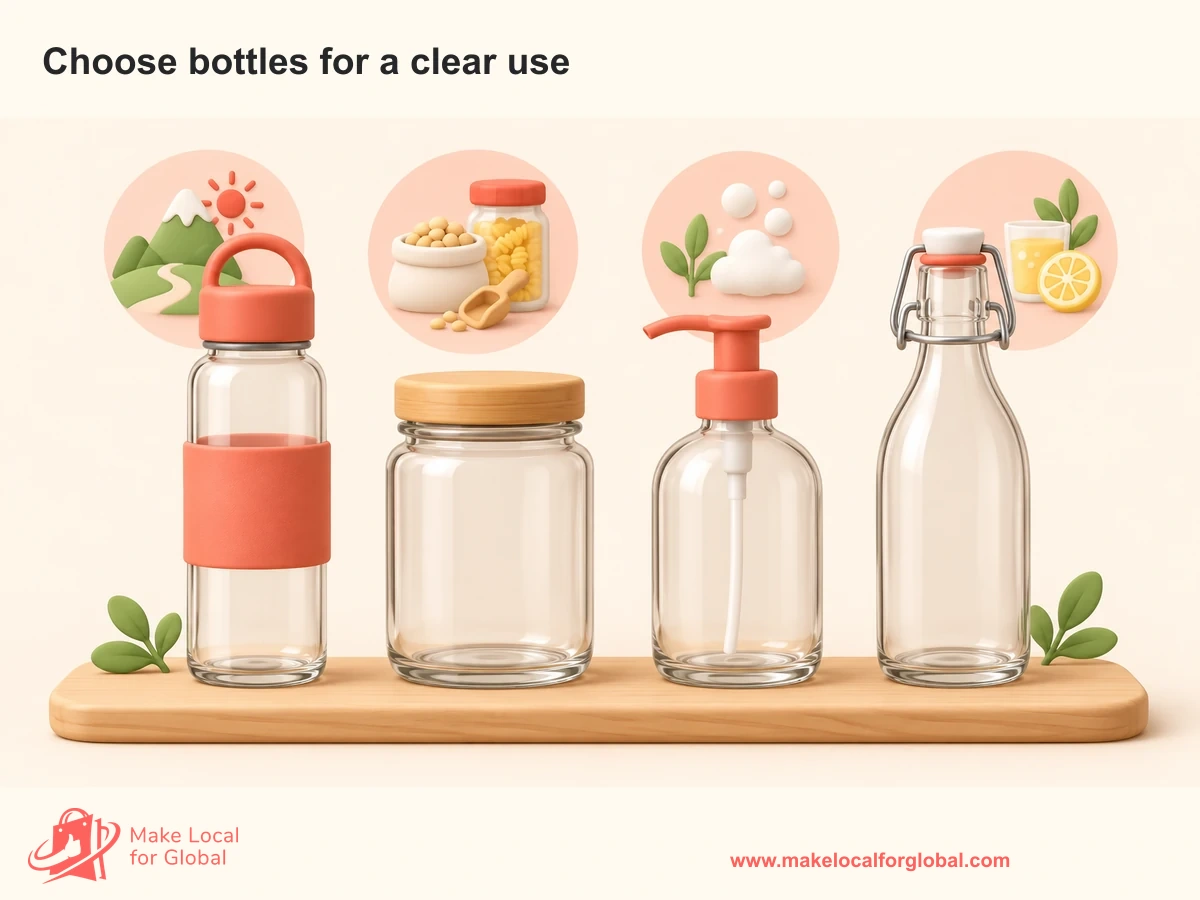
“Glass bottles” can mean several quite different products. A customer who wants a daily water bottle cares about carrying comfort and a dependable cap. A small food maker buying empty bottles for cordial needs a different capacity, neck finish, closure and documentation. A home-fragrance buyer may care more about a compatible reducer or spray top.
Begin with one customer and one main use. Then decide whether your store sells bottles for that use, bottle accessories, or a coordinated kit. Do not group unrelated formats into one product page merely because they are made from glass.
Write down the specific person or business you expect to serve. For example, a home refill shopper may want a compact dispenser that sits neatly beside a sink. A small drinks maker may need a repeatable bottle specification and matching closures in case quantities. A gift buyer may want a reusable bottle, protective sleeve and gift packaging in one purchase.
Talk to a few likely buyers before placing a wholesale order. Ask what they currently use, what causes problems, how often they reorder, which capacity they need and what proof they require from a supplier. These conversations do not prove demand, but they reveal the language and product details your page should answer.
Look for evidence in small actions. Invite a buyer to join a waitlist for a stated capacity. Show two sample formats to a local maker and ask which they would test. Offer a short survey to existing customers. Record the number of people who take each action, then ask a follow-up question. A vague “I like it” is less useful than a buyer naming the volume, cap and target purchase date.
Start with a few families and write the use on each internal product brief. A compact range could include reusable drink bottles, pantry or oil bottles, refill dispensers, and empty bottles sold to makers. Those categories still contain many technical variants, so each listing needs a precise product name.
For a reusable drink bottle, define the capacity, outer dimensions, approximate filled weight, mouth opening, closure design and any supplied sleeve. For an oil or vinegar bottle, note the neck and pouring insert, whether the closure is included and the intended contents stated by the supplier. For a refill dispenser, identify whether the pump is included, its dip-tube length and the formula types the supplier supports. For maker packaging, include the bottle capacity, finish or neck specification, compatible closure code, carton quantity and whether the closure is included.
Some bottles are marketed for water or pantry storage; others are packaging components for a producer to fill and label. A decorative bottle should not be represented as suitable for drinking or food storage without evidence for that intended use. Likewise, do not promise that a bottle handles hot liquids, freezing, dishwashers, carbonation or repeated sterilising unless the manufacturer’s evidence covers that exact model and use.
If you sell fruit-infuser bottles, separate that offer from plain reusable glass bottles. The infuser, lid and cleaning steps change the product questions, as covered in the fruit infuser bottle selling article. A glass bottle bundle can still link to it when a buyer is comparing everyday drinkware.
An opening range might use one main body style in two capacities, plus one carefully selected accessory. A second style should be added only when it serves a distinct need, such as a wider mouth for cleaning or a different closure for pouring. This keeps sample checking, stock control and photography manageable.
Use three clear offer levels if your costs and buyer research support them:
Do not use “entry”, “core” and “premium” as labels customers must decode. Give each option a plain name, state exactly what arrives and show the difference in the product photos. A higher price should correspond to a real difference such as a second bottle, a tested sleeve or a documented finish, rather than a vague quality claim.
| Range decision | A useful first choice | What to prove before listing |
|---|---|---|
| Daily reusable bottle | One body, two capacities | Filled weight, cap fit, cleaning access and transport leak test |
| Pantry bottle | One capacity with pouring closure | Compatibility with the stated contents and clean pour behaviour |
| Refill dispenser | One bottle and pump combination | Pump fit, dip-tube reach and supplier compatibility guidance |
| Maker packaging | One bottle and closure code | Neck finish, closure match, case quantity and food-contact evidence where relevant |
The table is a planning aid, not a claim that every bottle is suitable for every use. Keep a specification sheet for each supplier SKU and revise it if the supplier changes a component.
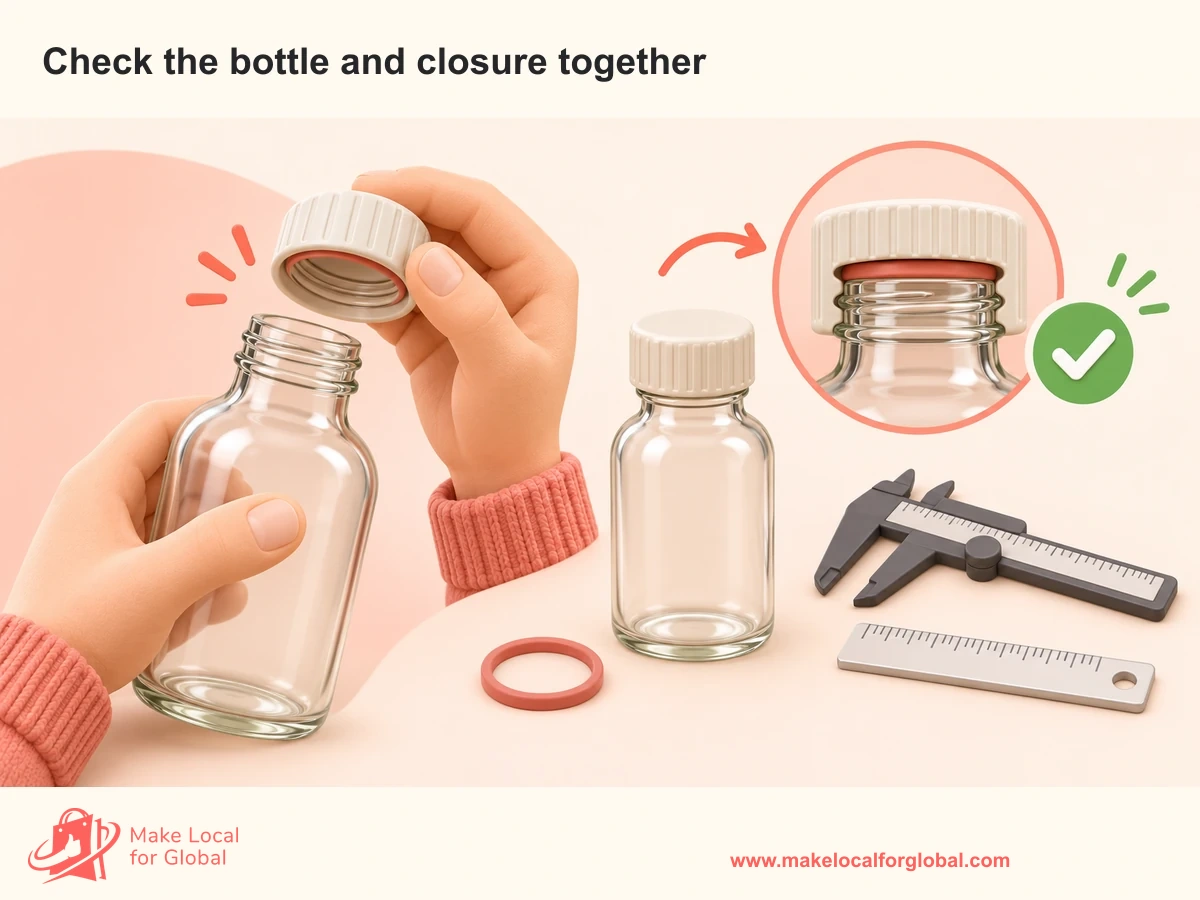
Glass body, closure and sealing part form one product system. A cap that looks close may have a different thread, liner or sealing surface. A pump can be too short for a taller bottle, and a pouring insert can fit loosely even when the screw cap closes.
You can buy from a UK wholesaler, import from a manufacturer, work with a packaging distributor or sell a designed product produced under your brand. Each route changes lead time, minimum order, paperwork and responsibility. Ask suppliers for a written quote at the quantity you intend to test, then ask what changes at the next price break.
A local distributor may offer smaller orders and easier sample replacements. The unit price can be higher, yet the first trial may cost less once transport, duty, storage and damage are considered. A direct manufacturer may provide more choice in necks, colours or decoration. It can also require a larger minimum order and more work to verify quality and shipping performance.
Before committing, ask the supplier:
Keep the answers with the SKU record. Save dated supplier documents, sample photographs, order references and any change notices. If the manufacturer changes a neck, cap liner, tint or coating, treat the revised version as a new sample check.
Order samples from the actual production line or stock you expect to buy. If a sample is hand-finished, ask whether the bulk item will use the same process. Inspect more than one unit where possible; one good sample cannot show how consistent a case will be.
Start with a visual check under good light. Look for chips, cracks, sharp edges, uneven seams, bubbles or marks in places that affect use, closure or appearance. Compare bottles side by side for height, diameter, base stability and colour. A cosmetic mark may be acceptable in one décor category and unacceptable on a clear reusable bottle. Set your own acceptance criteria and photograph examples before stock arrives.
Measure the parts that determine compatibility. Check the bottle opening or neck, thread profile where accessible, cap dimensions, gasket position and pump tube length. Use the supplier’s technical drawing for the specification; a basic ruler is useful for screening, not a substitute for a proper gauge when the fit tolerance matters. Record the model and batch for each sample.
Close and open the cap repeatedly using the intended method. Check that it engages cleanly without cross-threading. If the bottle is sold for liquid storage, fill it with the intended test liquid, close it as instructed and turn it over above a sink. Test the assembled product under normal handling, including any expected carry position. A brief bench check does not prove long-term performance, so do not write “leakproof” unless the supplier or your documented test supports that claim and conditions are stated.
Test cleaning and usability. Can a normal bottle brush reach the base? Does the cap or pump disassemble as described? Is there a small area that traps residue? If a bottle is intended for reuse, follow the supplier’s cleaning advice and do not test extreme temperatures unless the manufacturer says that use is safe. A glass wall can be sound while a closure, gasket or decorative coating fails the customer’s routine.
For dispensing formats, test the actual contents only when the supplier allows it and the contents are safe to handle. Check that the pump primes, the tube reaches the bottom and the output is consistent. For a pouring top, check whether the flow is controlled and whether the insert drips after use. Note the liquid and conditions; a test with water does not establish compatibility with oils, alcohol, acidic liquids or cosmetic formulas.
If the bottles will be used for food or drink, do not rely on the material alone or a generic “food grade” phrase. Ask for evidence that covers the bottle, closure, gasket, liner, decoration and intended contact conditions. The Food Standards Agency describes controls for materials and articles expected to contact food, including packaging and components such as printing inks and adhesives. See its food contact materials regulations overview. The relevant rules and enforcement instruments vary across England, Wales, Scotland and Northern Ireland, so check the authority for where you place the product on the market.
Glass is difficult to assess from a single lifestyle photo. A buyer needs to understand the shape, capacity, opening, closure, scale, pack contents and safe intended use. Build the product page to answer those questions in the order they arise.
Use product type, capacity or key format and the main use where it is supported. Examples include “Reusable glass water bottle, 500 ml, stainless-steel screw cap” or “Clear oil bottle with pourer, 250 ml, set of two”. These are example structures only; use exact values and materials from the supplier’s documents.
Do not lead with an unsupported superlative such as “best”, “unbreakable” or “leakproof”. Avoid calling a bottle “BPA-free” as a headline when the claim relates to parts or materials you have not verified. Put the most useful product phrase first, then add a specific attribute that helps the buyer distinguish it.
Use a neutral background and even light so clear glass edges remain visible. Photograph the bottle upright, then show the closure off the bottle, the opening, the base and any supplied sleeve or insert. Include a hand or familiar object for scale only if the object does not mislead about actual dimensions.
Use the exact colour and finish of the stock being sold. Clear, amber, green-tinted and coated bottles can look different under warm lighting. If the tint varies by batch, state that in the listing and do not select only the most saturated sample for the main image.
For a multi-pack, show the number of bottles and identify whether caps or accessories are included. If packaging is shown as a gift carton but it is an optional add-on, label the option clearly. A photograph should reinforce the written specification rather than create an expectation the delivered order will not meet.
Include verified details that help with fit and use. A useful listing might specify:
Separate verified manufacturer information from your own observations. For example: “Supplier states the bottle is intended for cold drinks. We checked the cap fit and a room-temperature water inversion test on sample units. This does not establish suitability for hot liquids.” Use only wording that matches the evidence you hold.
Write short answers to the questions buyers send most often. Is a cap included? What material is the closure? Can the opening fit ice cubes? Can the bottle go in a dishwasher? Is it suitable for hot liquids? Does the pump arrive assembled? What size carton does a single unit ship in? If you cannot confirm an answer, ask your supplier before adding the claim.
These answers reduce uncertainty and support customer service. They can also reveal gaps in your range: repeated questions about a carry sleeve or a wider opening may signal a useful accessory or alternate bottle to test.
The bottle is only one part of a successful delivery. Glass can arrive with a cracked neck, chipped rim or broken base if it moves inside the carton or contacts another bottle. Your packaging must support the shape, protect closures and fit the carrier service you choose.
Identify the points most likely to be damaged: the neck, rim, shoulders, base and any protruding pump or swing-top hardware. The bottle should not rattle, hit a hard outer wall or press its closure against another item. A cap can scratch another bottle even when the glass stays intact.
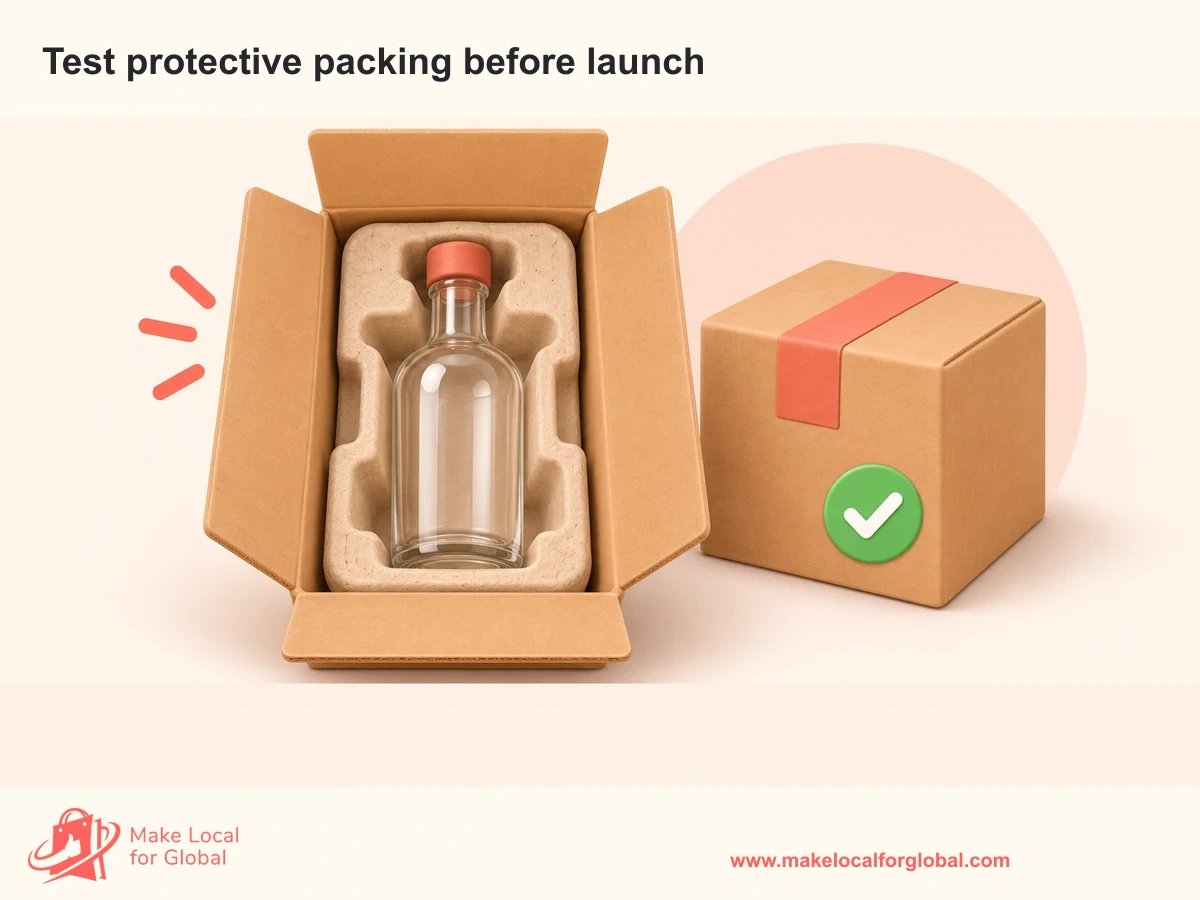
Use a fitted insert or a tested combination of cushioning and dividers to hold the bottle in place. For a multi-bottle order, keep each bottle separated. Do not rely on a thin layer of paper around glass if the bottle can slide freely in the carton. A presentation box may make the product look special; add suitable outer protection before it goes into the carrier network.
Choose a carton that fits the protective materials without compressing the bottle. Check that a parcel label, tape or external sleeve does not obscure required handling or return information. If the product can leak because of its intended contents, design secondary containment and confirm material compatibility with the supplier. For empty bottle products, keep the closure protected from loosening or impact.
Build the parcel using the same bottle, inserts, void fill, carton, tape and packing method your fulfilment process will use. Ask another person to pack a unit from your written instructions. If their parcel differs materially from yours, the pack process is not ready to hand over.
Inspect whether the bottle can move in any direction. Check the top, base and sides for contact points. Close the carton and handle it as a parcel would be handled. Use a measured test plan that is appropriate for your carrier and risk, and record what was done. A home drop test is a screening check, not certification and not a guarantee of carrier performance.
Send test parcels to yourself or a willing reviewer using the same service and route you expect to offer. Photograph the inside before dispatch and after arrival. Record the package condition, glass condition and closure condition. If it fails, change one part of the packaging and repeat the test with a newly packed unit. Keep the failed sample and photographs with the packaging record.
Track breakage and damage once orders begin. Record order date, bottle SKU, supplier lot, carrier service, packaging version, damage location and refund or replacement cost. If a certain neck or closure fails more often, pause that SKU and investigate rather than treating each refund as an isolated inconvenience.
A bottle’s wholesale price is not the cost of fulfilling a sale. Include the components that change with an order, then check what remains before fixed overhead and tax. This is contribution, not net profit.
The worked example below is hypothetical. It shows the arithmetic for a one-bottle order and is not a supplier quote or a recommended retail price. Replace every figure with actual invoices and fee schedules. Amounts are shown excluding recoverable VAT; a business that cannot recover input VAT should include the non-recoverable amount in its cost.
| One-order item | Illustrative amount |
|---|---|
| Bottle and closure, including inbound freight allocation | £5.40 |
| Protective insert and outer carton | £1.80 |
| Packing material and labour allowance | £0.90 |
| Tracked delivery charged by the carrier | £4.60 |
| Payment fee allowance | £0.85 |
| Returns and breakage reserve | £1.20 |
| Customer acquisition allowance | £2.50 |
| Illustrative variable order cost | £17.25 |
| Example customer price, excluding VAT for this calculation | £25.00 |
| Illustrative contribution before fixed costs and tax | £7.75 |
The arithmetic is £25.00 minus £17.25 = £7.75. Every amount above is an assumption. The example treats the sale price and costs on an excluding-VAT basis for clarity. If your customer-facing price includes VAT, calculate the net sales amount using your VAT position before comparing it with costs. Take VAT and accounting advice for your own business.
Add other variable items when they apply: a printed sleeve, pick-and-pack charge, marketplace commission, payment method surcharge where lawful, shipping subsidy, gift note, import duty, insurance or a second outbound parcel for a replacement. Avoid counting the same fee twice. If a shipping charge is collected from the customer, include it in sales revenue and include the carrier charge in cost.
For imported products, allocate the shipment’s freight, insurance, duty and any handling charges across the units in that shipment using a consistent method. Divide the relevant total by the number of sellable units received. If some units arrive broken or fail inspection, their cost still affects the landed cost of the units you can sell.
For a domestic wholesaler, check whether the unit quote includes delivery, VAT, carton fees and minimum order charges. A low unit price can become expensive if the order requires several sizes in high quantities. Compare like with like: same bottle model, closure, packing configuration, order quantity and delivery terms.
At launch, the actual breakage rate is unknown. Put a temporary reserve into the model, but label it as an assumption. After each block of orders, replace it with observed returns, damage, refunds and replacement shipping. Keep a separate view for damage-related costs, so a packaging problem does not disappear inside a broad returns percentage.
For example, if you set aside £1.20 per order initially, treat it as a planning estimate only. If the first twenty orders create £46 of breakage refunds, replacements and return postage, the observed average for that period is £2.30 per order. A small sample may swing sharply, so review it again after more orders and investigate the cause before changing the selling price.
Bundles can spread one delivery charge across multiple bottles, but they add packaging weight and may need dividers. Calculate each bundle from its real configuration. Do not assume that the contribution on two bottles is twice the contribution on one bottle.
| Offer | What changes in the cost sheet | Question to answer |
|---|---|---|
| One bottle | Single protective insert and parcel | Does the price cover a full tracked shipment? |
| Pair | Divider, extra weight, possibly higher postage | Does the buyer value two bottles enough to cover the added cost? |
| Gift set | Presentation packaging, insert, message card | Is the gift pack protected by a suitable outer carton? |
| Case quantity | Lower handling per unit, larger parcel or pallet | Is the buyer a business with a repeat-use specification? |
Review contribution by SKU and channel. A marketplace order may have a different commission than a direct website order. A product that works for local collection may not work at the same price for a single-parcel delivery. Keep those scenarios separate.
Product rules depend on the product’s intended use, the seller’s role and where the goods are placed on the market. Great Britain and Northern Ireland can have different requirements, and selling filled beverages adds further obligations. Use current official sources and ask the relevant regulator or qualified adviser if your exact product and role are unclear.
For general consumer products supplied in Great Britain, the government’s guidance on the General Product Safety Regulations says producers and distributors have safety and traceability duties. It describes producer records such as a producer name and address and product or batch reference where reasonable, sample checking and complaint records. Distributors should retain information showing from whom products were purchased and cooperate with authorities. Read the current Great Britain product safety guidance.
For a small online seller, a practical record includes supplier, purchase date, manufacturer code, batch or lot, units received, checks made, complaints, corrective actions and customer contact details where lawful. Keep a process for stopping sales if a safety concern appears. A bottle that is chipped, unstable or mismatched to its advertised closure should not be sent to a customer.
If you import or sell under your own brand, your legal role may differ from that of a retailer reselling a UK supplier’s product. Identify which role applies before writing labels or deciding who handles safety notices. Do not copy a supplier’s address or declarations without confirming permission and accuracy.
If the bottle is marketed for food or drink contact, obtain evidence for the complete product and the stated conditions. Check the glass, lid, gasket, liner, insert, coating, printing and adhesive where they may contact the contents. A supplier document for an uncoated glass body does not automatically cover a printed bottle or a cap with a different liner.
Keep intended-use wording narrow. A claim for cold water does not prove a bottle is suitable for hot tea, carbonated drinks, oils, vinegar or long-term storage. A dishwasher icon should be backed by the exact product’s care information. Where the supplier’s evidence does not answer a question, do not infer suitability from appearance or from the word “glass”.
Food contact controls have jurisdiction-specific instruments. The FSA’s food contact materials overview explains the national regulations in England, Wales and Northern Ireland and their enforcement role. Check the corresponding Scottish guidance and the rules for Northern Ireland or any overseas market you serve. This overview is a starting point, not a full compliance assessment for a particular bottle.
Selling empty bottles for use as packaging can count as a distinct packaging activity under UK extended producer responsibility. The relevant outcome depends on what your business does, who else handled the packaging and whether another producer is responsible for the packaging. Do not assume an online retailer is outside the rules because it sells the bottle empty.
Use the government’s EPR packaging checker and the current small producer guidance. The rules describe packaging activities including supplying empty packaging and selling packaging to end consumers. Assess the activity, turnover and tonnage using the current guidance for the relevant obligation year. Keep the reasoning and source records. Ask the environmental regulator or EPR support team if the seller’s role is unclear.
This topic is empty and reusable glass bottles. If you fill them and sell a drink, check the separate food business, food labelling, hygiene, alcohol or other product rules that apply to the actual contents. A bottle guide cannot replace those product-specific checks.
For distance sales, GOV.UK says sellers must provide key information before an order, including business details, description, total price, delivery arrangements and cancellation information. Online customers generally have up to 14 days after delivery to cancel, with exceptions for certain products and situations. See the official distance selling guidance and returns and refunds law.
State delivery time, delivery cost, the carrier option, what is included and how to contact you before checkout. Give a clear procedure for a parcel that arrives damaged. Ask customers to keep the packaging and share photos, but do not make a voluntary damage process a condition that removes their legal rights. Keep your published terms and customer support instructions consistent.
Use a channel that fits the buyer and the order. A direct store gives you control of product education and bundles. A marketplace can help test search terms and customer questions, but fees and listing rules affect the cost. Local shops, refill stores, gift shops and small makers can offer a direct route to wholesale feedback.
For reusable consumer bottles, test a direct page with one or two capacities and a clear photo set. For maker packaging, prepare a trade page with case quantities, closure codes, technical documents and a request form for repeat orders. For dispensers, show the pump and dip tube beside the bottle, and explain what is confirmed by the supplier.
Make one small channel test at a time. For example, invite ten local refill or gift shops to review a sample sheet. Measure how many reply, request a sample, ask for a trade quote and place a trial order. For a direct product page, track impressions, product-page visits, add-to-cart actions, checkout completion and questions about closure or capacity. These measures show where the page needs work; they do not guarantee sales.
Use buyer language in page titles and headings when it matches the product. Search phrases may include “reusable glass water bottle”, “glass bottle with screw cap”, “empty glass bottles for drinks”, “oil bottle with pourer” and “glass refill dispenser”. Verify the exact wording customers use through your own search query reports, marketplace search terms, customer messages and keyword tools. Do not add every phrase to one page. Create separate pages only for genuinely different products or uses.
Create support content that answers one task at a time: how to measure a bottle opening, how to choose a closure, what to check on a sample and how to pack glass for posting. Link those pages to the relevant product with clear anchor text. The glass jars selling article is useful for sellers comparing jars and wide-mouth containers. The glass vases selling article covers décor vessels and their protective packing. The drinking glasses article is about drinkware sets rather than empty bottles.
If you are building a store, plan the pages around the product evidence you already have. The product page should state exact specifications, show the cap and bottle together and make delivery information easy to find. A collection page can group products by use, such as reusable bottles, pantry bottles or refill dispensers, while avoiding claims that blur their intended purpose.
Plan the store around the way bottles ship
Review the available ecommerce plans and compare the pages, product options and checkout details your first range needs.
Store bottles in their original cartons until they are needed, in a dry location where cartons cannot be crushed or knocked. Keep different models and closure codes separated. Label the shelf location and carton clearly so a packer does not substitute a near-match cap.
Use a simple stock record with SKU, supplier code, batch or lot, carton quantity, units received, damaged units, units reserved and reorder point. Count stock after receiving it and before a large promotion. For bottle and closure combinations, track the components separately if they arrive in different cartons.
Write a packing instruction with photographs. It should show the correct insert orientation, any sleeve or cap preparation, how to close the carton and how to place the shipping label. Ask another person to pack a test order from that instruction. Review the steps after a damaged delivery or a supplier packaging change.
Prepare a customer service response that asks for the order number, bottle SKU, closure type and photos of the product and package. Use the evidence to decide whether the cause points to a supplier defect, packing method, carrier handling or listing mismatch. Replace or refund in line with consumer rights and your policy. If a potential safety defect is reported, pause sales of the affected lot while you investigate.
Review actual data weekly during the first month: orders, cancellations, delivery time, customer questions, damage, replacements, contribution per order and stock remaining. A low sales count alone does not tell you whether the product is wrong. Check whether people see the listing, understand it, trust the specifications and accept the delivered price.
| Period | Actions | Evidence to record |
|---|---|---|
| Days 1–7: choose the buyer | Speak with likely buyers, select one use, compare three supplier options and ask for samples and specifications. | Buyer questions, requested capacity, use, intended purchase timing and supplier responses. |
| Days 8–14: test the sample | Inspect glass, measure parts, match closures, check cleaning and confirm intended-use documents. | Sample photos, measurements, lot references, pass/fail notes and unresolved claims. |
| Days 15–21: cost and pack | Build the cost sheet, pack a one-unit and multi-unit parcel, send sample parcels and revise the insert if needed. | Actual invoices, pack dimensions, carrier quote, test results and packaging revision. |
| Days 22–30: list and learn | Publish a focused product page, show exact contents and delivery, run one small channel test, answer questions and review results. | Visits, enquiries, orders, checkout issues, damage reports, contribution and stock. |
At the end of the month, make one decision: reorder the tested item, revise a specific weakness or stop the test. Use actual buyer questions and order data. If few people reach the product page, review discovery and channel fit before changing the bottle. If visitors ask the same closure or capacity question, improve the listing. If a parcel arrives damaged, pause that configuration until the pack has been revised and retested.
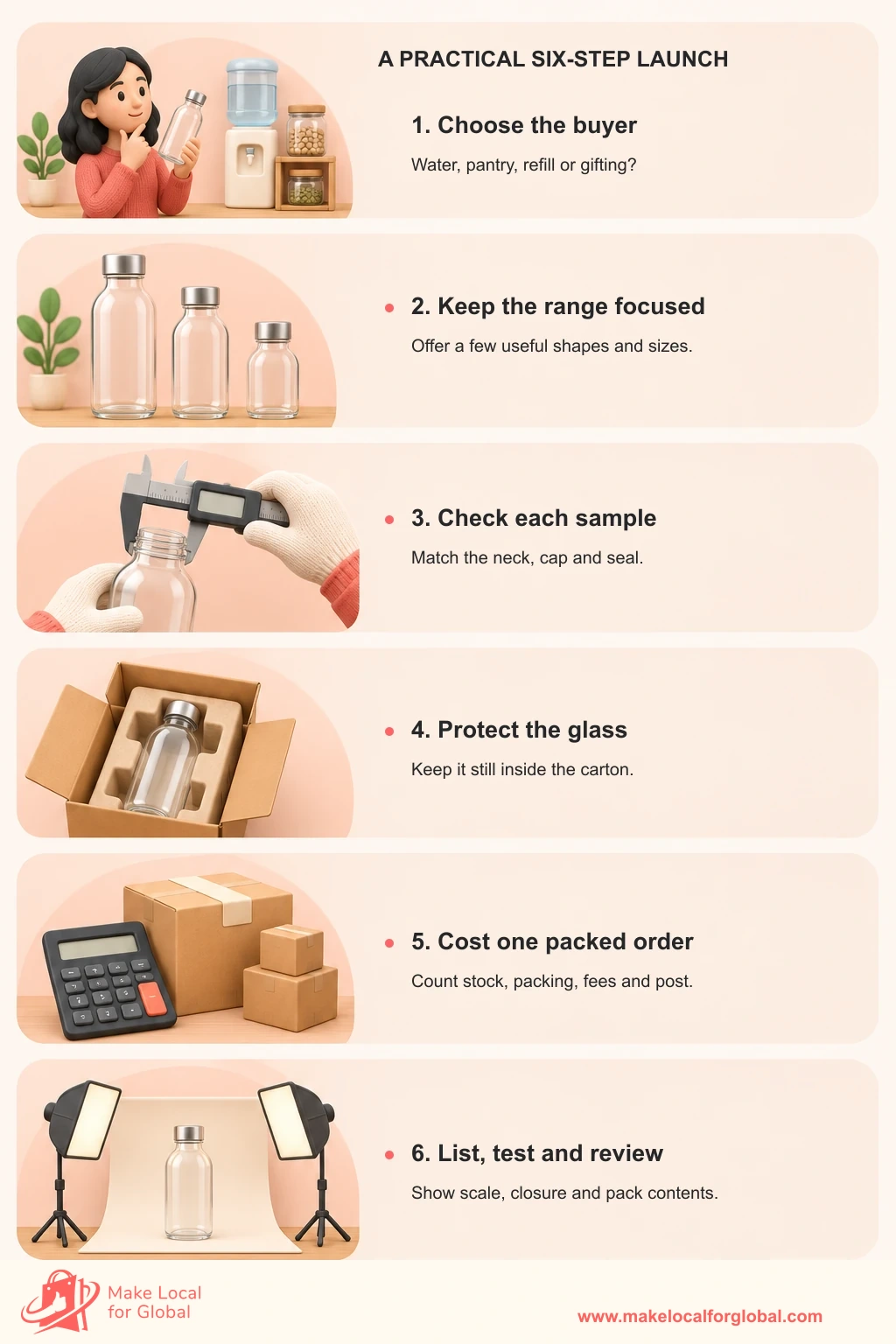
Yes, start with a small number of well-specified bottles and order samples before committing to stock. Decide who the buyer is, confirm the intended use and closure, then test how the complete parcel travels. Keep claims within the supplier evidence.
Choose the bottle that solves a clear need for the buyer you have spoken with. A reusable drink bottle, an oil bottle, a refill dispenser and a packaging bottle serve different jobs. Compare sample cost, closure fit, documentation, order size and the way each one can be packed.
Use the exact neck or finish specification and closure code from the manufacturer. Ask the supplier to confirm compatibility in writing, then test the delivered bottle and closure together. Similar-looking threads can still fail to seal properly.
Only use food-contact claims supported by documents for the full product and intended conditions, including parts such as the cap, gasket, liner, coating and decoration where relevant. A general glass description does not establish suitability for every food or temperature.
Use a fitted insert or tested protection that holds each bottle away from the carton walls and other bottles. Pack the product exactly as you plan to fulfil orders, then send test parcels and record the results. A presentation box alone may need an outer shipping carton.
State verified capacity, dimensions, bottle colour, closure type, included accessories, intended use, care information, packed quantity and delivery terms. Show the full bottle, opening, base, closure and scale. Mark supplier specifications separately from your own sample observations.
They can fall within an EPR packaging activity when supplied as empty packaging, but the outcome depends on the seller’s role and current thresholds. Use the official GOV.UK checker and guidance for the current obligation year, then keep a record of your assessment.
Add landed stock cost, protective packaging, packing labour, delivery, payment or marketplace fees, a returns and damage allowance and customer acquisition. Compare that total with the net sale amount, accounting for your VAT position. The remaining contribution still has to cover fixed costs and tax.
Add an accessory only after confirming that it fits the listed bottle and solves a real customer need. A sleeve, brush, spare cap or pump may be useful, but each one adds compatibility questions and stock decisions. State whether it is included or sold separately.
Ask for the order details and photos of the outer carton, insert and damaged bottle. Respond under your returns and consumer rights policy, record the bottle lot and packaging version, and review whether the parcel allowed movement or impact. Pause the affected configuration if you suspect a product safety issue.
No. This article covers empty reusable bottles and packaging. Filling the bottle and selling its contents adds requirements for the food or other product, its label, production and storage. Check the rules for the actual contents and the parts of the UK where you sell.
Choose one buyer and one bottle format. Request a sample with the matching closure, write down the exact specification and build a cost sheet for a packed order. Test the package before ordering a full case. When the details are clear, publish a product page that answers the buyer’s questions before checkout.
Ready to put your tested range online?
Discuss the store setup, product pages and order flow you need for a careful first launch.
PREFERRED SOURCE
Like what you’re reading? Add Make Local for Global as a preferred source on Google to see more of our articles when you search.

Build your online presence without having to figure out everything yourself.