

READY TO SELL Garden Sprayers ONLINE?
Get a store built for you in 5 days, plus training and support to help you start, run, and grow your Alternative business.

A practical plan for selling garden sprayers online: choose buyers, compare formats, test samples, price delivery, write useful listings and check UK selling duties.


Garden sprayers look simple on a shelf, yet buyers need to match the tool to a job, choose a comfortable format and know what can safely go through it. That gives a small online shop room to be useful: sell a focused range, explain the limits plainly and help customers avoid ordering a sprayer that is awkward to carry, clean or store.
To sell garden sprayers online, start with one clear customer group, compare trigger bottles with hand-pump and battery models, then test samples with water before ordering stock. Price the complete parcel, show capacity and compatibility accurately, and check the product-safety and distance-selling rules that apply to your business. A compact range with clear differences is easier to explain than a catalogue of near-identical tanks.
If you are weighing up whether this is a suitable first product, use the Ecommerce Pathfinder to organise the decision. It can help you think through the customer, offer and selling route before you commit cash to stock.
A garden sprayer is a container and delivery system for applying water or a compatible liquid in a controlled pattern. The term covers a broad set of products: a small trigger bottle for a few pots, a hand-pump bottle for a greenhouse bench, a shoulder sprayer for a larger patch, or a powered backpack model for repeated work over a wider area.
These products are not interchangeable. Capacity affects how much liquid a user carries; pressure design changes how the spray is produced; a lance changes reach; and seals, filters and nozzle parts affect cleaning and maintenance. A good product page makes each point concrete instead of describing every model as suitable for every garden.
Keep the scope of your first shop clear. This article covers the sprayer equipment itself and accessories such as lances, nozzles, spare seals and cleaning brushes. Selling the equipment is a different activity from selling plant protection products or other chemical formulations. If you plan to add chemicals, check the separate authorisation, distribution and labelling requirements before offering them for sale.
The easiest range to explain starts with a particular buyer and repeated job. A houseplant owner may want a small bottle that is easy to handle and store. Someone caring for a few greenhouse benches may prefer a hand-pump sprayer with an adjustable nozzle. An allotment grower or grounds worker may value a longer lance, a shoulder strap, replaceable seals or a battery model that reduces repeated pumping.
Those are starting hypotheses, not proof of demand. Ask a small set of people what they use now, where it frustrates them and what they would need to see before trying another model. Talk with allotment holders, greenhouse owners, community garden groups or small landscaping firms. Do not ask only whether someone likes the idea; ask about their current product, how often it is used, how it is cleaned and what they paid for the last replacement.
Look for a pattern across answers. If several greenhouse growers complain that a nozzle clogs and replacement parts are hard to find, spare-part access may matter more than a larger tank. If people say a full backpack is too heavy, capacity and loaded weight deserve more attention than a long list of spray settings. Record what people actually do, not only what they say they might buy.
Build a one-page concept for a small range and show it to likely buyers. Describe three models in plain language, include example prices, name the job each suits and invite people to join an email list or request a sample review. A sign-up is a more useful signal than a casual compliment, though it still does not prove that the person will place an order.
For a local test, take photographs of supplier samples to a community garden session and ask participants to compare the grip, fill opening, strap and nozzle. Do not ask them to handle chemicals or use the sprayer on plants during the test. A water-only demonstration is enough to discuss the physical product. Write down each person’s task and objections so the result does not become a vague note that people were interested.
Search demand can give a second signal. Review the phrases people use, such as “hand pressure garden sprayer”, “battery garden sprayer” or “replacement sprayer seals”. Compare the language in search suggestions, marketplace listings and customer questions. Search volume is not a promise of sales; treat it as a clue about how buyers describe the job and the details they expect to see on a page.
Set a small evidence threshold before placing a wholesale order. For example, require feedback from ten likely customers, at least three specific requests for the same format, and a landed-cost estimate that leaves room for shipping and returns. The number is your own test rule rather than an industry benchmark. Its purpose is to stop a large purchase being justified by one enthusiastic conversation.
Choose products around their intended use, not a ladder of prices alone. A small entry model can serve a few indoor or patio plants; a mid-range model can support more frequent watering or garden-care tasks; and a higher-priced option may add a longer lance, battery operation, comfortable shoulder straps or useful spare parts. Buyers should be able to see why the price changes.
| Format | Likely buyer or task | Questions to answer | Possible trade-off |
|---|---|---|---|
| Trigger bottle | A few pots, seedlings or small jobs | Is the trigger comfortable? Does the nozzle switch between the stated patterns? | Small capacity means frequent refills for larger areas. |
| Hand-pump bottle | Greenhouse bench, patio or a compact bed | How is pressure built and released? Is the fill opening wide enough? | Repeated pumping can tire a hand or arm. |
| Shoulder sprayer | More plants or a longer session | How does the strap sit when the tank is loaded? Can the user reach the controls? | Filled weight may be too high for some buyers. |
| Backpack hand-pump | Longer garden tasks where hands-free carrying helps | Are the shoulder straps, hose, lance and seals replaceable? | Needs storage space and a clear cleaning routine. |
| Battery backpack | Frequent use where manual pumping is inconvenient | What is included, battery capacity, charging time and compatible spares? | Higher stock cost, battery duties and charging details to manage. |
Those descriptions are broad buying prompts, not performance claims. Check the maker’s instructions for each model. A product may be sold for watering or applying a named compatible liquid, but the allowed use depends on its materials, seals, instructions and the liquid’s own label. Do not claim that every sprayer can be used with every garden treatment.

Ask whether a supplier’s stated capacity means the tank’s total volume or the amount the user can fill for operation. A tank may need empty space for pressure or to reduce spill risk, so usable capacity can sit below the headline figure. Put both values on your product page when the manufacturer provides them, and label them accurately.
Weight changes with liquid volume. A one-litre capacity difference is roughly a one-kilogram difference in water carried, before adding the sprayer itself, straps, lance and accessories. That simple comparison helps a shopper think about comfort. It does not replace the maker’s maximum fill line or safe-use instructions.
Measure the packed item too. A long lance, wide base or curved handle may change the parcel size though the tank is modest. The storage dimensions can matter to a customer with limited shed space, and the shipping dimensions can change your courier charge. Record both the assembled product size and the packed carton size.
Terms such as “adjustable nozzle” are too broad on their own. Confirm whether a model offers a narrow jet, a wider fan, a mist or another pattern, and whether the change comes from turning a tip, swapping a part or changing a setting. Photograph the supplied nozzle and explain which parts are included in the box.
A lance can improve reach, yet it may make a compact tool awkward in a small greenhouse. A filter can catch debris, but the buyer needs to know where it sits and whether it can be removed for cleaning. These are useful comparison points for a buying chart ; they show a practical reason to select one model over another.
A focused opening range could contain three products: a compact trigger bottle, a hand-pump pressure sprayer and one larger shoulder or backpack model. Add an accessory only when it answers a real need, such as a replacement nozzle or a compatible seal kit. This gives you enough choice to compare formats without holding many similar units.
Define each offer by customer and task. For example, describe the trigger bottle as a compact option for a few pots, the pump model as a choice for a small greenhouse bench and the backpack product as a higher-capacity format for repeated garden work. Confirm the product instructions support those descriptions before publishing the claims.
Show an entry, core and premium choice only when each has a clear reason to exist. The entry model might be easy to store. The core model might add a lance or comfortable strap. The premium model might use battery operation or include a spare-parts kit. If the only difference is colour, explain that honestly and avoid presenting it as a functional upgrade.
A useful bundle might combine a sprayer with a spare nozzle and the correct seals for that model. A greenhouse bundle could add plant labels or a small watering accessory if customers have asked for those items. List every component and confirm compatibility. Do not include liquids or imply that a bundle is approved for a treatment when the product documentation and local rules do not support that claim.
Calculate a bundle as one order, not as a group of retail prices added together. A second item can increase parcel weight and damage risk. The discount must leave enough money to cover the additional picking, packing and delivery work. Compare the bundle contribution with the same products sold separately before making it a permanent offer.
Accessories can make a narrow shop more helpful, yet too many small parts create support questions. Keep a compatibility table with the sprayer model, part code, seal material, nozzle type and supplier reference. A customer who can confirm the fit before ordering is less likely to return an incompatible accessory.
Potential routes include buying from a UK wholesaler, becoming a stockist for a manufacturer, importing directly or using a supplier that fulfils orders for you. Each route shifts the work. A local wholesaler may give you smaller opening quantities and faster replenishment. Direct importing may offer more product choice but puts more responsibility on you for safety records, shipping, customs, spares and quality checks.
Ask every supplier for the exact model identifiers, current product instructions, available spare parts, replacement seal details, warranty terms and carton dimensions. Request the material information for the tank, hose and seals, plus the liquids or conditions the maker says are compatible. Ask for current product images and permission to use them, or take your own photographs of your sample.
Ask how the supplier handles a leak, a cracked tank or a faulty switch. Find out whether a replacement part can be sent, whether the entire unit must come back and who pays for return carriage. Request the process in writing. A low wholesale price may become costly if every fault needs a full replacement shipment.
Before committing to a larger order, compare quotes on the same basis. One quote may include a lance and spare seals; another may list them as paid extras. Compare minimum order quantity, unit price, freight, VAT, delivery terms, packaging, payment timing, lead time, quality records, warranty and return process. Keep the exact quote date and currency in your notes.
For a first test, a UK trade supplier may be practical ; you can often buy a small number of units and see how customers respond before committing to an import. A manufacturer stockist agreement can provide model knowledge and spare parts, though you need to read its territory, pricing and presentation terms. Direct importing can suit a business with enough experience to check documentation, product safety and shipment costs before the goods leave the supplier.
Dropshipping can reduce stock held by you, but it does not remove your responsibility to describe the item accurately or resolve customer service issues. Check the dispatch location, packaging, return address, stock updates, tracking data, parcel damage process and whether the supplier will include your own invoice. Order a sample to your own address. A supplier photograph is not proof of how an order will arrive.
Do not order from a supplier solely on the basis of a marketplace listing with a low unit cost. Confirm the legal name of the supplier, its trading address, who is responsible for the product, how to trace a batch, and how you can contact it if a safety concern arises. For imported goods, check who is treated as the importer for the market where you sell and what information must appear on the packaging or product page.
Order a sample of each format you intend to list. Record the supplier, model code, batch or date mark, contents of the box and any differences from the quotation. Photograph the unit from the front, side and top. Keep the instructions, carton, receipt and supplier messages together with your test notes so you can trace what you reviewed.
Run a controlled water-only inspection in a suitable outdoor or sink area. Follow the product instructions, fill to the marked line and check that the cap, hose, lance and nozzle fit. Look for leaks around seals and connections. Operate the trigger or pump as the maker directs. Check the spray pattern against a plain card or safe surface; do not use a chemical for a basic retail sample test.

Use a simple pass, investigate or reject result for every check. A loose seal that can be replaced may be an issue to clarify with the supplier. A crack, leaking connection or missing safety instruction can be a reason to stop the listing until the supplier gives a satisfactory answer. Keep the record and the supplier’s response; do not turn an unresolved fault into a reassuring claim.
When a manufacturer gives care or maintenance directions, follow the manual for that model. For example, Matabi’s maintenance advice says to clean its sprayers with water, avoid metal objects when clearing a blocked nozzle and check each product’s specific manual for maintenance guidance. Those are manufacturer instructions for its products, not a universal rule for every sprayer. Link to the maker’s own directions where they apply.
A shop selling an empty garden sprayer is not automatically selling a pesticide. Keep product copy focused on the equipment and the manufacturer’s stated compatibility. Do not name a chemical treatment as a recommended use only after the relevant product instructions and legal position have been checked.
Plant protection products, commonly called pesticides, have their own rules for authorisation, purchase, storage, use and disposal. HSE guidance says professional users applying these products as part of their work need a recognised certificate, and it sets out separate expectations for professional purchases. If you intend to sell chemicals alongside sprayers, read the HSE overview of plant protection products and the HSE guidance for garden, home and allotment users before doing so.
Do not use a sprayer sales page to give dosing instructions or encourage off-label use. If a buyer asks whether a particular liquid can go through a model, point to the sprayer manual and the liquid’s approved label. If either source is unclear, ask the manufacturer or product supplier for written guidance before replying.
If you make, import, distribute or sell consumer products in the UK, you have product-safety responsibilities. The Office for Product Safety and Standards states that products should only be sold when compliance with applicable safety regulations has been demonstrated appropriately. In Great Britain, the General Product Safety Regulations 2005 apply; for Northern Ireland, Regulation (EU) 2023/988 on general product safety has applied since 13 December 2024. Read the current GOV.UK product-safety advice for businesses for the role that matches your supply route and the market you serve.
Keep records that connect your listing to a supplier, model and batch. Store the instructions, conformity or safety information supplied for the product, product photographs, supplier invoice, complaints, repair notes and any action taken after a fault. Give customers a clear way to contact your business. If a supplier changes a model or removes a spare part, review the page before an old claim remains online.
Battery-powered sprayers add questions about the electrical unit, battery, charger, charging instructions and end-of-life disposal. Check whether your business has duties under the electrical waste rules and the battery take-back rules. GOV.UK describes retailer obligations for electrical waste take-back and says sellers supplying 32kg or more of portable batteries per year must offer free collection of waste batteries. The exact route depends on how you sell and supply the product; review current guidance before adding powered models.
These rules can change and can differ across Great Britain and Northern Ireland. If you import products, sell across borders or supply chemicals, speak with a product-safety adviser or the relevant regulator about your exact role. A blog checklist is a starting point for research, not a substitute for a compliance review.
A sprayer’s wholesale cost is only one part of the order. Include freight into your stock location, import costs where relevant, packaging, payment fees, delivery to the buyer, advertising or other acquisition cost and an allowance for faults, returns and refunds. A larger backpack model may cost more to ship than its weight suggests if the carton is bulky.
The example below is illustrative, not a forecast. It assumes a UK seller registered for VAT, a standard-rated product and a £44.99 customer price including 20% VAT, the current standard rate for most goods and services. Replace every line with your own supplier quote, carrier rate, payment fee and return history before setting a real price.
| Order line | Illustrative amount | How to replace the estimate |
|---|---|---|
| Customer price including VAT | £44.99 | Use the price shown on your shop. |
| Sales value excluding 20% VAT | £37.49 | £44.99 ÷ 1.20, for this VAT-registered example. |
| Sprayer purchase cost | −£12.50 | Use your actual net unit cost. |
| Inbound freight per unit | −£1.80 | Allocate the shipment charge across sellable units. |
| Outer packaging and protection | −£1.30 | Include carton, inserts, tape and void fill. |
| Tracked customer delivery | −£4.20 | Use the packed dimensions and service you plan to buy. |
| Payment or marketplace fee | −£1.25 | Replace with the fee charged on this transaction. |
| Customer acquisition allowance | −£5.00 | Use your measured campaign cost per order. |
| Faults and returns allowance | −£1.75 | Estimate from expected return rate and average cost. |
| Illustrative contribution before overheads | £9.69 | £37.49 − £12.50 − £1.80 − £1.30 − £4.20 − £1.25 − £5.00 − £1.75. |
The £9.69 is contribution before overheads, not net profit. It does not pay for your time, insurance, website, storage, accounting, software, unsold stock, income tax or corporation tax. A seller who is not VAT registered needs a different calculation, and tax treatment can depend on the business and supply. Check your own VAT position with HMRC or an accountant.
Run the same arithmetic for every product size and sales channel. A battery backpack may have a higher selling price but a more costly parcel and larger return loss. A small trigger bottle may be inexpensive to ship yet leave too little contribution after a marketplace fee. Compare the amount left per order and the cash tied up in a minimum order, not just the apparent margin percentage.
Use a break-even check for promotion. If your contribution before advertising is £14.69 and your measured customer-acquisition cost is £5.00, the order leaves £9.69 before overheads. If a discount reduces the selling price by £5.00, the order may leave only £4.69. That might be acceptable for a short test, but it should be a deliberate choice rather than a surprise discovered after orders arrive.
Get a packed sample measured and weighed. Record the longest side, second side, height and total weight with protective material in place. A long lance may push a parcel into a more expensive bracket. A box that is too loose can let the hose, tank or nozzle strike the carton wall during transit; a box that is too tight may press on a trigger or valve.
Ask a carrier for a quote using those real measurements and check any restrictions for the powered model’s battery. Do not use the sprayer’s assembled dimensions in place of the shipping carton. If a customer sees a low delivery estimate at checkout and you later discover a bulky-item surcharge, the order economics and customer experience both suffer.
A useful listing tells a shopper what the sprayer does, who it may suit, what is in the box and what limits apply. Do not rely on a supplier name or a string of search phrases to explain the product. Use the language buyers use, then provide enough specifications for a careful decision.
Example product title: 5L Hand-Pump Garden Sprayer with Adjustable Nozzle and Shoulder Strap
Example opening: A hand-pump sprayer for small garden beds, greenhouse benches and patio plants. The 5-litre tank, adjustable nozzle and shoulder strap give you a compact option for routine jobs where a trigger bottle is too small. Check the product manual for compatible liquids and cleaning directions before use.
Use that copy only if the sample and manufacturer records confirm those details. If “adjustable nozzle” means one jet with a small range of settings, describe it accurately. If the strap is optional, do not suggest it is included. Replace “routine jobs” with a defined use only when the instructions allow it.
Make a comparison table easy to scan on a phone. Use consistent units, spell out unfamiliar terms and include a short note when a value is a manufacturer claim. If a specification is unavailable, ask for it or omit it. Do not fill a blank by guessing, and do not say “fits most sprayers” when the connection size has not been checked.
Photograph the exact model you ship. Include a clear front view, a side view, the fill opening, the nozzle, the carry strap and a photograph of everything included in the carton. Show the sprayer beside a familiar object or give measured dimensions so customers can judge its size. Use a close-up for controls that would be hard to see in the main photograph.
A short video can show the assembly, how the nozzle changes setting and how the lance clips into storage. Keep the demonstration consistent with the manual and use water only. Do not imply a performance rate, spray distance or battery run time that you have not measured in a controlled and repeatable way.
Place a comparison image or chart beside the buying explanation, not as a substitute for it. A photograph gives a visual impression; it cannot answer whether a seal is replaceable or how heavy the unit is when filled. Include descriptive alt text for accessibility, such as “Battery backpack sprayer with shoulder straps, lance and hose”. Avoid repeating the same keyword in every image description.
Before a customer places an order online, UK distance-selling guidance says the seller must provide key information such as business contact details, a description of the goods, the total price including taxes, payment options, delivery arrangements and cancellation information. Read the current GOV.UK distance-selling guidance and make sure your checkout and confirmation email state the terms in a clear way.
Consumers normally have a 14-day period to cancel an online goods order after receiving it, subject to the rules and exceptions that apply. Explain how the customer contacts you, how a return is arranged and what condition the product should be in. Do not hide return information behind a link that is hard to find at checkout. If a product has been filled with a chemical or is unsafe to transport, handle the return according to the product and carrier requirements; do not assume it can go through the ordinary parcel route.
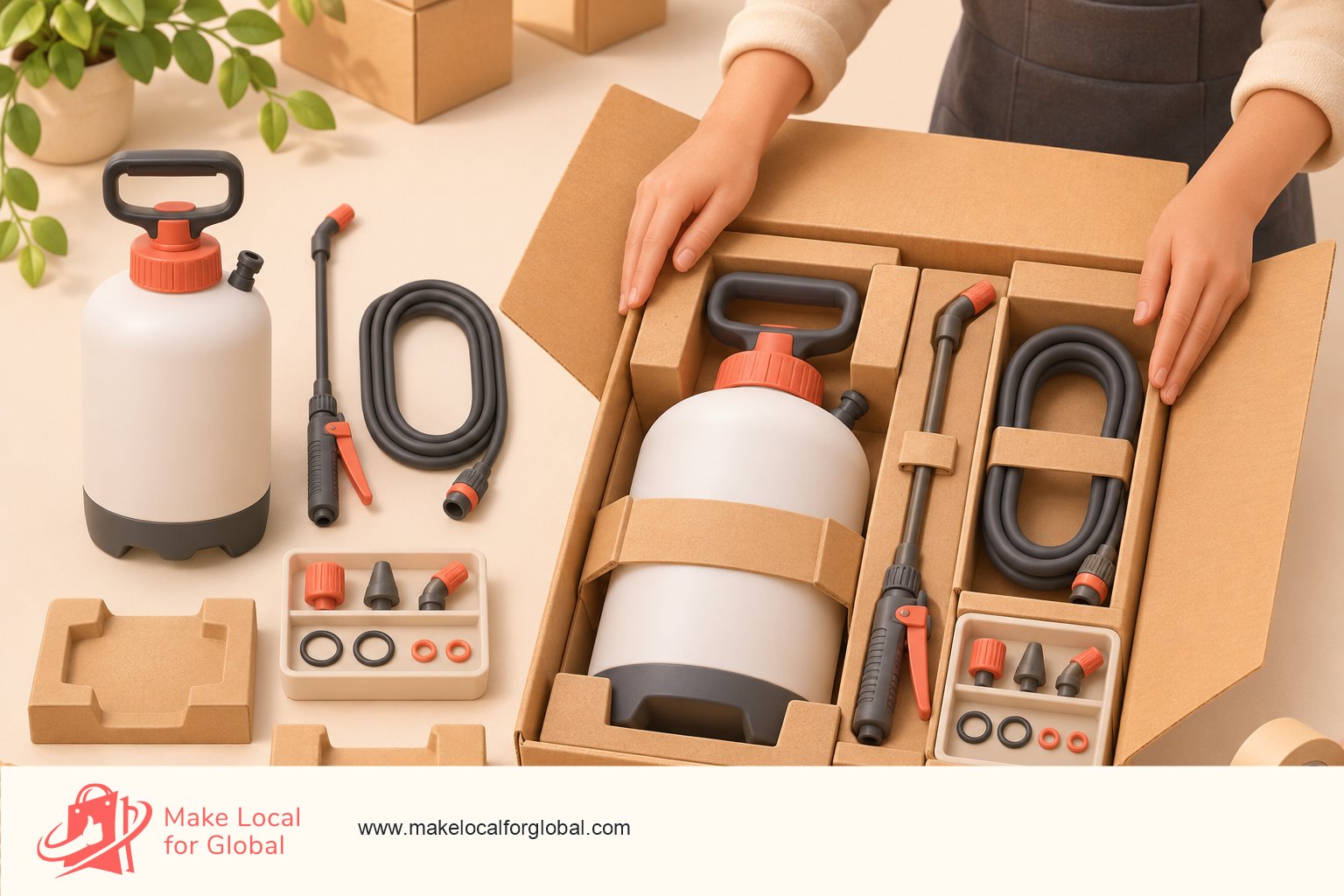
Write an order-picking checklist for each model. Check the model code, tank, lance, hose, nozzle, seal kit, charger and battery against the listing. Keep loose accessories in a small bag or compartment, protect the nozzle tip and clip the lance so it cannot puncture the carton. Dispatch the sprayer empty and dry, in line with the maker’s instructions.
Create a response template for common questions: whether a sprayer suits a particular liquid, where to find the model manual, which seal kit fits, how to release pressure, how to order a replacement nozzle and what to do if the box arrives damaged. Link to the correct source rather than guessing. Keep a log of recurring questions; they show where the listing or instruction sheet needs clearer wording.
Check deliveries after the first few orders. Record late parcels, carton damage, leakage reports, missing parts and return reasons. If several customers ask the same question, add the answer to the product page. If a fault repeats across units, pause that model and raise the issue with the supplier before shipping more.
Your own online shop gives you room to explain the range and collect customer questions, but you need to attract visitors and handle the whole purchase process. A marketplace may put your offer beside active product searches, yet listing rules, competition, fees and customer data access vary. A local garden centre, allotment supplier or trade relationship can give you direct feedback, though it may require wholesale pricing, in-person delivery or agreed stock terms.
Pick one main channel for the first test. Add the same honest product details and high-quality photographs, then compare the response by model. Do not change the title, price, photograph and delivery offer at the same time; if the result changes, you will not know which edit mattered. Keep a simple weekly record of page visits, add-to-basket actions, orders, questions, cancellations, returns and contribution per order.
Useful search themes may include the sprayer type, size, nozzle, intended task, compatible spare part and buyer setting. Examples include “hand pump garden sprayer”, “battery backpack sprayer”, “replacement nozzle for [model]” and “garden sprayer for greenhouse benches”. Use only phrases that accurately describe your product. Search engines reward useful pages over repeated wording; write for a person comparing two models.
Make educational content answer real questions: how to choose a tank capacity, which checks to make before buying, how to find a replacement seal, what to look for in a lance or what to ask a supplier about a battery model. Link this article to relevant gardening products such as garden tools, grow lights and garden planters. Those links help a reader explore related product ideas without implying that the products must be sold as one bundle.
At the end of a two-week test, compare the models by customer questions and contribution, not only by clicks. A high number of visits with no orders might point to unclear compatibility, missing delivery information or a price mismatch. Orders with repeated questions may show that the page needs better photographs or a clearer list of included parts. Ask customers what helped them decide and what information they had to request.
If you want help planning the shop around your chosen product range, contact Make Local for Global to discuss your next steps. Prepare your buyer notes, sample findings and order-cost calculation so the conversation can focus on the decisions you need to make.
Several models with the same capacity, pump design and nozzle create choice without giving customers a meaningful reason to choose. Start with formats that serve distinct users. Add another option only when customer feedback or sales records show a gap, such as a need for a longer lance or a reliable source of replacement parts.
A supplier page may use an unclear capacity figure or list an accessory that is not in the carton you receive. Compare each claim with the physical sample, manual and quote. Keep the source of each statement in your product file. Remove any claim that you cannot substantiate rather than hoping the customer will not notice.
Seals and tank materials can differ, and product instructions may limit what can be used. A broad claim that a sprayer is “chemical resistant” can mislead a buyer if the supplier only tested it with a narrow group of liquids. State the approved compatibility information supplied for that exact model and refer the customer to the manual and product label.
Freight, packaging, card fees, bulky-item surcharges, returns and advertising can use up the difference between wholesale and retail. Use the worked-order calculation above, then update it with real quotes. If contribution is too low, test a different model, bundle or supplier instead of assuming more orders will fix the maths.
A sprayer can appear inexpensive until a buyer needs a seal or nozzle that cannot be sourced. Ask about repair parts before choosing a supplier. Keep model numbers and part references on the site so customers can find the right component, then check that the supplier still lists those parts before you promise availability.
Powered products add questions about the battery, charger, charging time, replacement supply, disposal and parcel handling. Confirm what ships with the unit, record the battery model and check applicable electrical-waste and battery take-back guidance. If the supplier cannot provide clear instructions, delay the listing rather than trying to fill in the details yourself.
A clean studio image makes the product look attractive, yet customers still need to know whether the battery, charger, strap, spare nozzle and manual are included. Photograph the exact carton contents. Keep the hero image clear, then add detail shots and a comparison table that answer practical questions.
Yes. You can focus your shop on empty sprayers, nozzles, lances and compatible replacement parts. Describe the equipment using the maker’s instructions. Do not bundle in a chemical or make an unverified treatment claim; selling plant protection products brings separate rules that you need to check before offering them.
Choose the format that matches the buyer group you can reach and the evidence you have gathered. A trigger bottle may suit a compact plant-care offer; a hand-pump model may fit a greenhouse or small bed; a backpack model may serve more frequent work. Test samples, compare supplier terms and calculate a packed-order cost before choosing stock.
There is no fixed number for every seller. A small test with two or three clearly different formats is easier to inspect and explain than a broad catalogue. Keep the order small enough that you can review each unit, learn from customer questions and avoid tying too much cash into slow-moving stock.
Follow the manufacturer’s instructions and use water only for a basic function check. Inspect the tank, seal, connections, pressure controls, nozzle settings, strap, hose, lance and carton. Do not improvise a pressure test or put a chemical through the product as part of a routine sample review.
Include the unit cost, inbound freight, import costs if they apply, packaging, delivery, payment or marketplace fees, customer acquisition and a reasonable allowance for faults and returns. Calculate VAT using your own tax position. The remaining contribution still needs to cover overheads and tax; it is not the same as net profit.
Do not assume a single test rule covers every product. The National Sprayer Testing Scheme guidance says knapsack, hand-held and pedestrian pesticide application equipment do not require a formal test under its stated scheme, but should be inspected by a competent person, repaired where needed and recorded. Other equipment categories have different test timings. This relates to pesticide application equipment; check the current rules for the exact machine and intended use, and do not present the scheme as a blanket sales certification for every garden sprayer.
Confirm the charger and battery details, warranty, replacement supply, charging instructions and compatible parts. Review electrical product-safety, electrical waste, battery take-back and courier requirements that apply to your business. State precisely whether the battery and charger are included, and state a run time only with reliable evidence for the stated conditions.
Show your business contact details, an accurate product description, total price including taxes, payment options, delivery costs and timing, cancellation information and the relevant return terms. GOV.UK’s distance-selling guidance explains the information required for online orders. Check the current rules and confirm the same details appear on the product page, checkout and confirmation message.
A month is enough to gather structured evidence, inspect samples and prepare a narrow listing. It is not a promise that a shop will be profitable in 30 days. Set a cash limit before starting and pause if the evidence or product checks do not meet your standards.
| Week | Actions | What to record |
|---|---|---|
| 1: Define the buyer | Choose one customer group, write three interview questions, speak with likely buyers and review their current sprayer options. | Current products, recurring frustrations, preferred format and stated price range. |
| 2: Compare supply | Request quotes from at least two suppliers, compare the same model specification and order a small sample if the figures work. | Model codes, minimum order, unit cost, freight, delivery time, spares and return terms. |
| 3: Inspect and price | Follow the sample checklist, take photographs, measure the carton and calculate a complete order contribution. | Pass or investigate result for each check, image set, parcel dimensions and cost assumptions. |
| 4: Publish a test offer | Write a clear page, add a comparison chart, explain compatibility limits and send a small amount of targeted traffic. | Visits, questions, basket actions, orders, cancellations, returns and contribution per sale. |

At the end of the month, decide whether to reorder, revise the page, change supplier or stop. Reorder only when customer evidence, sample quality and contribution support the next purchase. If people ask for a format you do not stock, check the supplier, price and safety details before adding it. If the main concern is a high delivery cost, test packaging or a different model before discounting the product.
Use your notes to build the next step rather than starting from scratch. Keep a supplier record, model comparison sheet, sample checklist, parcel measurements, product images, cost calculation and customer-question log. This set of records will make future ordering and support more consistent, and it gives you a clear reason for every item in the range.
For a final check on the shop idea, revisit the Ecommerce Pathfinder with the evidence from your first test. If you would like help selecting the next practical step, speak with Make Local for Global about your plan.
PREFERRED SOURCE
Like what you’re reading? Add Make Local for Global as a preferred source on Google to see more of our articles when you search.

Build your online presence without having to figure out everything yourself.