

READY TO SELL crib bedding ONLINE?
Get a store built for you in 5 days, plus training and support to help you start, run, and grow your Alternative business.

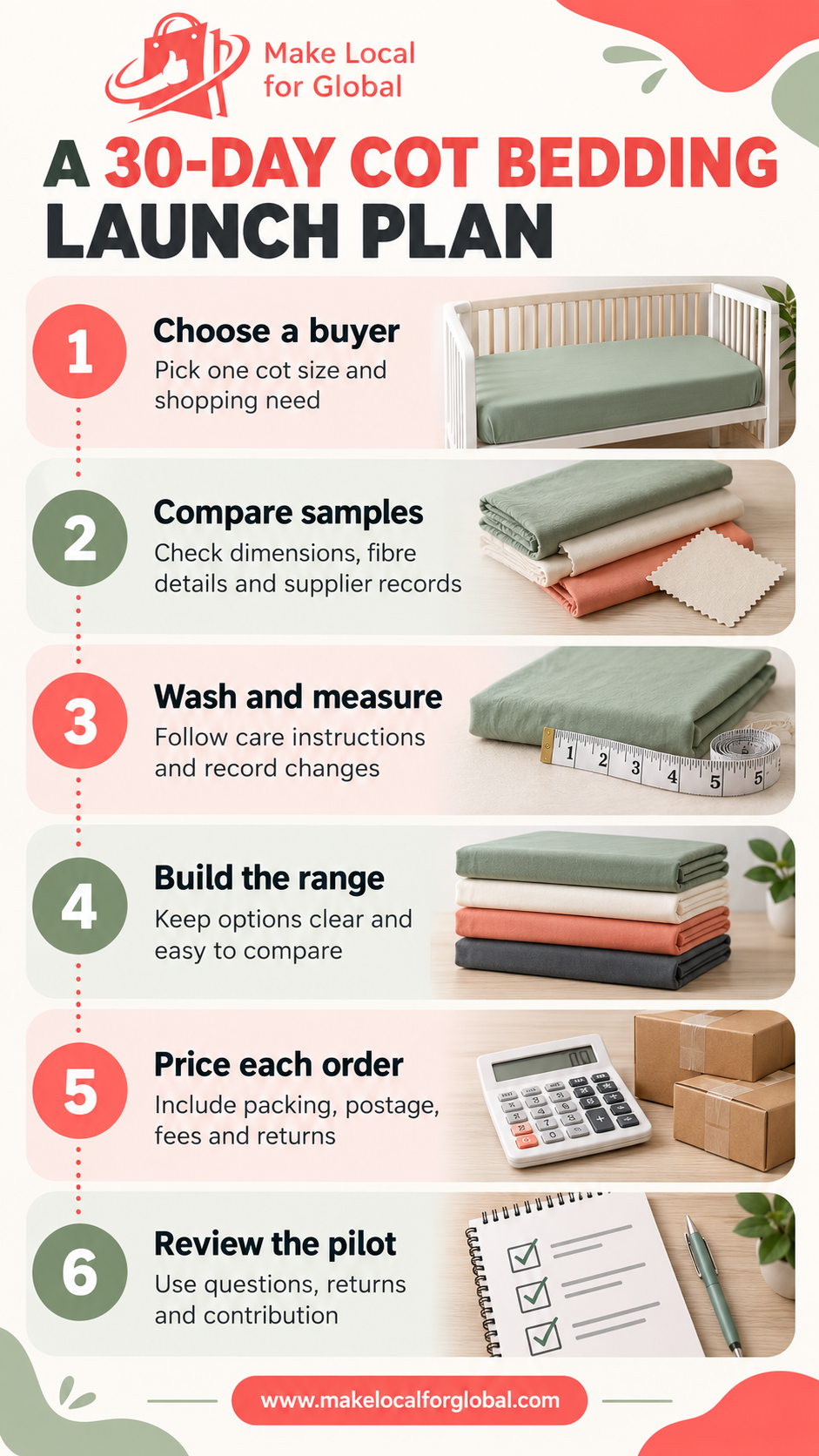
Build a focused crib-bedding range with verified cot-mattress sizes, textile samples, care checks, clear pack contents and full-order pricing.


Crib bedding is a broad shopping phrase, but a useful online range is much more specific. A parent may be looking for fitted cot sheets that match a mattress size, an easy-care spare set for laundry day, or a lightweight blanket made from a clearly described fabric. Those products have different dimensions, care needs and customer expectations. A seller who gives exact measurements and honest material details can make the choice easier without making promises about a baby’s sleep or safety.
This guide is for a new seller deciding whether and how to test a crib-bedding range. It focuses on fitted sheets, sheet sets, mattress protectors and textile accessories, with UK wording such as cot bedding alongside the search phrase crib bedding. It explains how to select a buyer, compare samples, document fit and care, calculate the full order cost and write a product page that answers practical questions.
Baby sleep products deserve careful boundaries. NHS guidance says a baby’s cot should be kept clear of pillows, cot bumpers and loose bedding; product sellers should not turn decorative extras into sleep-safety recommendations. This article is about running a responsible textile business, not about advising parents on how to put a baby to sleep. Follow current public-health advice and product rules for every market you serve.
Choose one mattress size, test the textiles, and calculate the complete order cost before buying stock.
Searchers use “crib bedding” for different items and bundles. In the UK, shoppers often say cot sheet, fitted sheet, cot-bed bedding, Moses-basket sheet or cot bedding set. In the United States, crib sheet and crib bedding are more common. Do not assume that a term means the same mattress size, product bundle or use in every country. Your first decision is which item you can describe, source and fulfil accurately.
Start with one clear group rather than an all-in-one nursery collection. For example, a shop might test fitted sheets for a stated cot-mattress dimension, with a small selection of colours and a spare two-sheet set. A different seller might focus on fitted sheets for travel cots, or offer textile covers designed for a specified mattress protector model. Each direction brings a different fit question and product specification.
Treat decorative bedding sets with particular care. Some products marketed as cot or crib “sets” include pillows, duvets, padded bumpers, quilts or other objects. NHS advice does not recommend pillows, cot bumpers or loose bedding in a baby’s cot. Avoid building a product offer around these items for infant sleep or describing them as essentials. If a set contains an item whose use could create a sleep hazard, pause and get competent product-safety advice before sourcing or marketing it. A seller should not try to make an unsafe assortment acceptable by changing the wording.
Write down the first buyer group you want to help and the job they are trying to complete. A first-time parent may need one spare fitted sheet with a clearly stated size. A gift buyer may need to understand exactly what a bundle contains. A childminder may be buying several repeated sizes and need reliable reorder information. A grandparent may be replacing a sheet for a cot inherited within the family and may not know the mattress measurements.
Those examples are hypotheses to investigate, not proven demand. Speak with people in the group you can reach. Ask what they bought last time, which measurements they used, what made them return or keep a sheet, and which care or fabric details they wanted to see. Ask them to show you a product page that felt clear or confusing. Keep notes on the question and answer; avoid collecting personal information that you do not need.
The question “Will this fit my cot?” is too vague to answer with “universal”. A better exchange starts with the mattress maker’s stated length, width and depth, the sheet’s own stated dimensions and the product’s stretch or pocket construction. If a buyer is not sure of a mattress brand, provide a measurement guide and encourage them to check the manufacturer’s instructions. Do not suggest that a sheet can compensate for an ill-fitting, damaged or unsuitable mattress.
Make product categories easy to understand. A fitted cot sheet is a textile intended to cover a specified mattress. A mattress protector is another product with its own construction, care, thickness and fit. A cot skirt, decorative cushion or wall textile is décor and should not be presented as something to place in a baby’s sleep space. A blanket is a textile product; selling it does not mean you should encourage loose bedding use for an infant.
Avoid bundles that blur these differences. A customer should see whether a set contains one fitted sheet, two fitted sheets, a removable mattress cover, a storage bag or a separate décor item. Show the contents in both words and photographs. Do not use a styled nursery scene that makes an unsafe product combination look like a suggested sleep arrangement.
A first range is a set of deliberate choices that a small seller can sample, describe, price and reorder. Each extra size, colour, fabric and pack quantity increases stock complexity. It also creates a new chance for the listing, order system or warehouse label to show the wrong size. Start with fewer options and add another only when buyer evidence or supplier reliability justifies it.
| Product group | Buyer question | Evidence to collect before listing | Common confusion |
|---|---|---|---|
| Fitted cot sheet | What mattress dimensions is this made for? | Finished sheet measurements, pocket depth, elastic layout and wash result | A marketplace label such as “standard” without a size chart |
| Cot-bed fitted sheet | Does it fit the mattress in this bed mode? | Mattress maker’s dimensions, sheet dimensions and the intended bed configuration | Treating a cot and a cot-bed mattress as interchangeable |
| Travel-cot sheet | Which model or dimensions does it match? | Measured mattress, compatible model list if verified, elastic and wash checks | Assuming every travel cot has the same mattress size |
| Two-sheet pack | What exactly is included? | Number of sheets, material and dimensions for every unit | Main photograph showing a set that differs from the delivered pack |
| Mattress protector | How does it fit and how should it be cleaned? | Product-specific construction, sizing, care instructions and evidence for claims | Treating the protector as a sheet or as a substitute for a fitted sheet |
| Textile gift set | Which items are included and what are they for? | Itemised contents, fibre details, care, intended use and safety review | Including pillows, bumpers or loose bedding in infant sleep bundles |
Create a range ladder only when the products truly differ. An entry offer might be one fitted sheet for a single stated mattress size. A main offer might be a two-sheet pack in the same verified size. A premium version could use a different fabric or finish if a physical sample supports the description and the extra price. It is not necessary to invent a “luxury” tier just to fill a table. The value can be convenience, colour choice, size clarity or a reliable reorder.
| Range choice | Example | Useful customer information |
|---|---|---|
| Single | One fitted sheet in one size | Mattress dimensions, fabric composition, care and pack contents |
| Spare pack | Two matching sheets | Count, whether both pieces are identical, and price per sheet |
| Colour option | A small palette for the same specification | Whether the shade varies between batches and how it appears in daylight photos |
| Size option | Separately listed mattress sizes | A comparison chart and a measurement method for length, width and depth |

Use an internal SKU that records the item, size, colour and pack count in the same order every time. For example, a code might use `SHEET-COT-120X60-SAGE-2PK`; choose a structure that suits your stock system and use it consistently. Never rely on a product title alone when picking orders. Confirm whether the printed size refers to the mattress, the finished textile or the packaging, and say so clearly.
A textile listing should do more than name a colour and say “soft”. Ask suppliers for a specification sheet that identifies the item, model or product code, fibre composition, finished dimensions, tolerance, care instructions, production origin and packaging. Ask who is responsible for each specification and how a change to a material or factory will be communicated. Keep a dated copy of the supplier’s response and match it to the sample.
Record the mattress dimensions that the sheet is designed to cover and the finished textile measurements from your sample. A fitted sheet can have a pocket depth, elastic path and corner construction that affect how it sits; measuring only the flat fabric may not explain fit. Ask the supplier which measurement method it uses. If the product stretches, state that fact carefully and list dimensions from the approved sample rather than implying that stretch makes the product universal.
Measure with a flexible tape on a flat surface and write down the conditions: sample code, measurement points, whether it was washed, and whether the fabric was relaxed or stretched. Use the same method on every sample so comparisons are meaningful. Show a diagram that tells a customer which mattress dimensions to check. Explain that a cot’s external frame dimensions are not the mattress dimensions.
If the customer must compare the sheet with a mattress model, include the model name only when you have verified it. Product compatibility lists can become outdated when brands change sizes. Date your internal verification and set a review reminder. If you cannot confirm compatibility, publish the dimensions and measurement guide instead of a broad brand-fit claim.

Ask for fibre content by component, not just a marketing name such as “bamboo”, “organic”, “natural” or “eco”. A fabric can be a blend, and a product may combine a textile outer layer with elastic or a coated backing. Verify the composition against the supplier’s documentation and the physical item. Do not describe a blended textile as “100%” of one fibre unless the claim is supported and permitted under the rules that apply in the destination market.
The UK Government’s textile-labelling guidance says manufacturers and retailers must follow rules and that a label must show fibre content; if a product has components with different fibre contents, the content of each must be shown. The guidance currently applies to England, Scotland and Wales. Confirm the position for Northern Ireland and any export market you serve. Use the official GOV.UK textile-labelling guidance and the linked current technical guidance when deciding the label format. Do not treat a supplier’s old listing as proof that your own product complies.
Words such as “breathable”, “cooling”, “hypoallergenic”, “chemical-free”, “antibacterial”, “non-toxic” or “safe for newborns” can imply a performance or health benefit. Do not use them just because they appear on supplier marketing. Ask what the words mean, what evidence supports them, which exact model and batch was assessed, who performed the assessment, and whether the evidence covers the wording you want. If the claim affects health, sleep or safety, have it reviewed by a competent adviser. A visual impression or a material name is not sufficient evidence.
Photograph the textile in neutral daylight and use the same setting for each colour in a collection. Screens and lighting can make a shade look different, so avoid promising an exact match. If customers can choose between colour variants, make sure the image, variant label, SKU, inventory and dispatch label all refer to the same option.
Care information must match the supplied product. Check the sew-in label, packaging and supplier care sheet. If they conflict, resolve the discrepancy before listing. Do not invent a wash temperature or drying method. A sample test can show what happened to one sample under one specific cycle; it does not prove every production batch will behave identically. State product-specific instructions from the manufacturer and keep any additional tests separate from the care label.
Ask for at least one sample of the exact product code and size you intend to stock. If sizes, colours or fabrics use different construction, request each material difference you need to verify. The word “sample” is not enough: write down whether the sample is production-equivalent, whether the supplier will use the same factory and material for the main order, and how a substitution will be approved.
Inspect the delivered sample against a checklist before washing it. Check the label, seams, elastic, corners, stitching, finish, loose threads, odour, packaging and any supplied warnings. Compare the fabric and construction with the supplier’s specification. Note defects with clear photographs and the product code. If something looks unusual, stop and ask the supplier or a competent product-safety adviser rather than guessing what it means.
Measure length, width and depth using the method you plan to explain to customers. Fit the sheet onto the specific mattress size it is designed for, following the product’s intended use and instructions. Check whether the corners stay in place and whether the fabric gathers or pulls in a way that differs from the product photos. Do not test by adding a child or baby to the scene. This is a textile fit check, not a safety certification.
Wash and dry the sample according to the manufacturer’s instructions. Record the cycle, detergent type if relevant, drying method, date and number of cycles. Remeasure the textile and inspect the elastic, seams and colour after drying. A repeated test can help you find obvious quality problems; it does not establish a universal performance claim. Keep your observations factual: “this sample measured X before and Y after one specified cycle” is more useful than “never shrinks”.
Set pass criteria before opening the package. For example: label matches supplier file, no visible seam defects, sample fits the intended mattress in the stated configuration, size stays within a written tolerance, and care instructions are present and consistent. Your criteria should be practical and product-specific. Do not make up a safety tolerance or claim a certification test that you have not completed.
| Check | What to record | Decision prompt |
|---|---|---|
| Identity | Supplier, model code, size, material and batch | Is this the exact item that would be delivered in a bulk order? |
| Dimensions | Mattress size, finished sheet size, pocket depth and method | Can a shopper repeat the measurement without guessing? |
| Construction | Elastic, corners, seams, stitching and finish | Does the sample match the product description and photographs? |
| Care | Label, care sheet, wash cycle and drying method | Do the supplier instructions agree across product and packaging? |
| After-care condition | Measurements, colour, seams and elastic after the test | Have you separated one sample’s result from a product-wide promise? |
| Pack contents | Number and identity of each piece | Could a picker distinguish the pack from a single-sheet SKU? |

Create a supplier file with the approved sample photos, specification, label copy, invoice, communications, inspection notes and agreed change-control process. Keep a retained sample if the supplier permits. On receipt of a later shipment, inspect units from the delivery and compare them with the approved sample. Quarantine stock that does not match. Do not silently change the listing to make non-matching stock appear correct.
Businesses that make, import, distribute or sell consumer products in the UK have responsibilities to ensure products are safe and comply with relevant labelling requirements. GOV.UK’s Office for Product Safety and Standards guidance explains that the general product-safety route differs between Great Britain and Northern Ireland. In Great Britain, the General Product Safety Regulations 2005 apply; in Northern Ireland, EU Regulation 2023/988 has applied since 13 December 2024. See the current business product-safety advice and Great Britain GPSR guidance. Check if a more specific rule or market requirement applies to the particular product.
Do not assume that a textile is exempt from the need to assess safety because it is soft or simple. Identify the product’s foreseeable uses, materials, components, age group and marketing. A cover, waterproof backing, fastener, tie, filling, decorative attachment or claim may change the questions to ask. Keep supplier documentation and a traceable product code. If a report suggests a product may be unsafe, stop sales and follow current regulator guidance; do not wait for a complaint to decide what the warning means.
The Office for Product Safety and Standards has published a campaign on baby sleep products and issued a 2025 alert about baby sleep pillows. NHS safer-sleep advice says the cot should not contain pillows, cot bumpers or loose bedding. Use that information to set a strict line in merchandising: do not call a pillow, bumper, nest, positioner, duvet or loose decorative textile a baby sleep essential. Do not use a styled cot photo that suggests such an item belongs in a baby’s sleep space. Read the current NHS safer-sleep guidance and OPSS baby sleep products advice.
Keep the article and your own listings focused on accurate product information. Do not tell a parent how to manage a baby’s sleep or temperature. Do not use a safety badge, medical benefit, risk-reduction claim or “approved” wording unless the exact product, claim, relevant standard and evidence have been reviewed and support it. If you sell outside the UK, research the destination’s rules before taking orders. A global shipping option does not make a product compliant everywhere.
The product page should let someone decide whether the exact textile matches the mattress they have and whether the pack contains what they expect. Start with a precise title, such as “Fitted cot sheet for mattress X by Y cm, two-pack”. Put the product’s own size measurement next to the mattress size it is designed for. Label each number so the shopper can tell whether it refers to the mattress, finished textile or pocket depth.
Show the full pack contents in a short, scannable section. State the count, size, fibre composition, colour, care instructions, any included storage bag and what is not included. If the main photo shows multiple items but the listing price buys only one, make this obvious near the price and again in the contents section. Avoid generic text that could make a shopper believe a sheet includes a mattress, cot, protector or blanket.
Build a measurement diagram from the product’s verified measurements. Use arrows for mattress length and width, plus a separate illustration of depth where it matters. Explain where the customer can find the mattress details and how to measure a mattress if the manufacturer’s information is missing. Do not encourage a customer to buy a sheet that is too small on the assumption that elastic will solve the fit.
Use real sample photographs wherever possible. Include a close-up of the fabric, label, corner construction, seams, elastic and the folded pack. Use a clean empty cot only when needed to show scale, with a clear sleep surface and no unsafe items. Do not use a staged baby photo as evidence of fit or comfort. Alt text should describe the informative image and its function rather than stuff keywords. For example: “Measuring the length and width of a cot mattress before choosing a fitted sheet.”
Answer common support questions before checkout: Which mattress size is this intended for? Is the stated size for the mattress or the sheet? What is in the pack? How should it be washed? Does the colour shown represent the item exactly? Can the customer return an opened textile? The returns policy should explain the applicable rights without claiming that hygiene concerns remove statutory rights automatically. If a returned textile is opened or used, follow applicable law and your published policy; ask a qualified adviser if you are unsure.
Make a claims register with each phrase used in the product page, packaging and ads. Record the source and the date of the evidence. Use descriptive language you can verify: “elasticated corners”, “two fitted sheets in the pack”, “fibre content stated on the label” or “measured for a mattress of the dimensions shown”. Avoid comparative claims such as “best”, “safest”, “healthiest” or “more breathable” unless you have reliable, appropriate evidence and the comparison is fair.
If a supplier offers a certificate, ask which organisation issued it, what standard or test it covers, which exact model and batch were evaluated, and whether the certificate remains valid. A laboratory report for a different fabric or a logo copied into a catalogue does not establish compliance for your item. Do not upload a certificate or use a badge you cannot verify.
Search the exact phrases customers use. Compare “cot sheet”, “cot fitted sheet”, “crib sheet”, “cot bed sheet”, “travel cot sheet” and the mattress size wording you have verified. The language can vary by region, so reflect the customer’s term in a relevant heading or product description without pretending that one item covers every format. A phrase in a search suggestion is an idea to investigate, not proof of demand.
Read marketplace reviews and questions for recurring details shoppers miss: mattress depth, shrinkage, elastic quality, set count, colour variation, fabric feel, packaging and wash care. Note the problem in your own words. Do not copy another seller’s reviews, photography, descriptions or diagrams. A competitor’s product page can show a gap in information but cannot verify that its measurements or claims are correct.
Talk to a few likely buyers and show them two or three real samples or accurate mock-ups. Ask them to choose a size from a small set of mattress measurements, interpret the contents list and describe what else they need to know. Track the question they ask, where they hesitate and which image or detail resolves the confusion. A small group does not represent every shopper, but it can help you improve your page before launch.
Your own ecommerce shop gives you control over sizing guidance, product comparisons and customer service, but you must attract traffic and maintain the checkout, privacy information, delivery and returns. A marketplace can put your sheet beside existing searches, though it brings fees, strict listing rules and price competition. Social content can demonstrate how to measure a mattress or inspect a care label; it should link to the full product page and not replace required specifications.
Build useful search content around real questions: “How to measure a cot mattress for a fitted sheet”, “What does a two-pack include?” or “How to read a textile fibre label”. Write answers that match current public guidance, your own product evidence and your intended country. Do not publish parent-facing safety recommendations based only on a supplier’s sales copy. For more on building a related home-textile range, see our guide to selling bed linen online. For adjacent baby products, compare the guides to selling cot mattresses online, selling baby cribs online and selling baby clothes online.
The supplier’s price per sheet is only one part of the cost. List what you spend for the product to reach the customer in saleable condition. Depending on your fulfilment model, this can include the sample allocation, unit cost, inbound freight, duty or import fees, quality checks, labels, storage, packing materials, pick and pack, carrier, payment processing, marketplace commission, discounts, customer-acquisition spend, returns, replacements and damaged stock. Check each current quote or fee schedule rather than reusing last year’s number.
Use a per-order model and a separate monthly overhead model. Contribution is the selling price excluding any tax you collect for government, less variable costs for that order. The amount remaining can contribute to software, insurance, professional advice, accounting, rent and owner pay. A positive contribution is not the same thing as profit. Include tax treatment and VAT considerations with an accountant or current official guidance for your own business situation.
| Cost line | What to include | How to verify it |
|---|---|---|
| Product | Sheet, pack or textile set purchased | Supplier quotation and final approved SKU |
| Inbound and import | Freight, clearance, duty and relevant charges | Forwarder quote, customs information and invoice |
| Inspection | Sample cost, check time and any independent testing | Sample invoice and written test quote |
| Packaging | Mailer or box, label, protective wrap and insert | Pack a real order and price the exact materials |
| Fulfilment | Pick, pack, storage and inventory service | Current provider rate card or your recorded labour |
| Delivery | Carrier charge, remote-area fee and tracking | Weigh and measure a packed sample parcel |
| Channel and payment | Marketplace, card and transaction fees | Current fee schedule for your payment method |
| Returns and defects | Return postage, inspection, replacement and unsaleable unit allowance | Past data when available; conservative pilot estimate before launch |
| Acquisition | Paid promotion, affiliate commission or content cost per order | Actual campaign spend and attributable orders |
Consider an illustrative test order: one two-sheet pack sells for £28 before any VAT treatment. Suppose the goods cost £7.20, inbound cost allocation is £1.10, packing is £1.20, postage is £3.50, payment and channel fees are £1.40, and a provisional returns/defect reserve is £1.60. The variable costs total £16.00, leaving £12.00 contribution before overheads, tax obligations and owner time. These numbers are made up to show the method, not a market quote or recommended price.
Now test the same offer with a discount, a second pack in the parcel, a higher carrier charge or a returned unit. A bundle may reduce postage per sheet, but it can also make the buyer’s first purchase more expensive. A one-sheet offer might attract a lower basket value while leaving similar fulfilment and payment costs. Model both cases with the actual parcel dimensions and fees. Choose the offer that works for the customer and your cost structure, not the one that only looks attractive in a unit-price comparison.
| Scenario | Sale amount | Variable costs | Contribution before overhead |
|---|---|---|---|
| Illustrative two-sheet order | £28.00 | £16.00 | £12.00 |
| Same order with a £3 discount | £25.00 | £16.00 | £9.00 |
| Example of added £2.50 delivery cost | £28.00 | £18.50 | £9.50 |
Replace every example amount with your own quote. If the margin becomes too small, consider a different pack count, a more suitable fulfilment method, a supplier change, a lower acquisition cost or a different price. Do not hide delivery in a “free” shipping claim; it still has a cost. If you set a free-delivery threshold, calculate whether the larger basket contribution covers the postage.
Forecast demand by SKU. A 120 by 60 cm sheet in sage is a different line from a 140 by 70 cm sheet in cream, even if the fabric is the same. If you add a second pack size or an extra pattern, the stock count and reorder rule must include each option. Begin with fewer dimensions and colours than you feel tempted to offer. Use a spreadsheet with current stock, committed orders, supplier lead time, reorder quantity and a date to review assumptions.
Store textiles dry and away from odours, dust, sunlight and pests. Use a stock location label and keep the original care and composition labels with each unit. When an order arrives, verify the SKU, pack count, size and colour before sealing the parcel. A second person can check the first few orders when a new product launches. Keep one photo of the packed order if that is part of your quality process.
Pack a sample parcel and check its weight and dimensions. Fold the product without crushing the elastic, protect it from moisture in transit and use packaging that is right-sized. If the textile arrives with compression creases, assess whether they relax under the care instructions before promising a smooth appearance. Include a simple paper or digital care note only when it matches the actual label and does not contradict the manufacturer.
GOV.UK distance-selling guidance requires sellers to provide key information before an order and explains cancellation rights for many online purchases. Government returns guidance describes the customer’s cancellation period for distance sales and the refund timeline. Read the current online and distance-selling guidance and returns and refunds rules. Build a policy that accurately explains what a customer should do, when they can cancel and how you handle the return. Get advice for exceptions or disputed cases rather than treating opened packaging as an automatic reason to deny a refund.
Packaging rules can apply to small or growing businesses depending on the business’s activity, annual turnover and packaging tonnage. Check the current GOV.UK EPR packaging test and record the packaging you use. Do not assume that a small order volume by itself settles whether you have an obligation.
Show the mattress dimensions, verified fibre details and care instructions so customers can compare the exact sheet.
Prepare a short response for common size questions. Ask the customer to confirm mattress length, width and depth, and direct them to the product’s comparison diagram. Do not request a child’s name, date of birth, health details or a photo of a child when a measurement is enough. Keep customer records limited to what is needed to answer the query and fulfil the order.
If a customer reports that a sheet does not fit, ask which product code and mattress dimensions they used, what measurement method they followed and whether the item was washed. Listen first and record the information. Compare it with your own specification and retained sample. A single complaint may reveal an unclear diagram, a supplier variation or a picker’s mistake. Escalate any report that suggests a safety problem and follow the applicable product-safety process.
Agree how the supplier will notify you about a change in fabric mill, dye, elastic, pattern, factory, label, packaging or subcontractor. A change that sounds minor can alter the product’s appearance or fit. Do not continue using the old photos and measurements if a material change makes them inaccurate. Review the listing, sample and claims register before you sell the changed item.
Select one buyer group and one starting use. Review the tracker of questions you heard and marketplace queries; identify the dimension or bundle detail that causes the most confusion. Confirm which cot or crib mattress size you can serve and whether that size is common in your intended market. Decide whether you will use UK terms, US terms or both, and explain the product’s dimensions without relying on the label “standard”.
Ask a small number of suppliers for the same type of item and written specification. Request fibre details, finished dimensions, care instructions, label format, production location, sample price, minimum order, production lead time, packaging dimensions and defect policy. Ask whether the sample is the same as the item in a production batch. Compare the offers in a spreadsheet instead of judging a supplier only on its unit price.
Measure each sample with one method. Inspect the elastic, seams, corners and label. Wash it according to the manufacturer’s care instructions and record what happened. Re-measure, compare the result with the supplier specification and photograph any issue. Ask a relevant adviser about any unresolved safety or labelling question before you move towards a purchase order.
Choose the minimum number of sizes, colours and pack counts that lets you test the idea. Assign each a SKU. Photograph the textile, label, corner and pack contents. Build a complete cost sheet, including the packed parcel, fees, customer acquisition and returns allowance. Choose a price and stock limit that fit your available cash; do not order a broad size run merely because the supplier offers one.
Ask a few likely buyers to choose the matching sheet from a small set of mattress measurements. See if they can identify the pack contents, fibre details and care instructions without prompting. Note every point at which they pause or choose the wrong size. Revise the title, diagrams, photographs or variation labels. Check that the checkout, delivery estimate and returns information are easy to find on a mobile phone.
Set a clear limit for the first stock order and promotion spend. Publish only when product identity, labels, sample checks, page facts and fulfilment steps are ready. Record visits, questions, orders, contribution, delivery performance, cancellations, returns and fit complaints. Review what the evidence says about each size and colour. Decide whether to replenish, adjust the page, test one next option or stop.
Using “standard size” without stating dimensions. Mattress sizes and product terms vary between brands and markets. Give the mattress dimensions the item is designed for and the method for checking them.
Treating a cot and a cot bed as one size. The frame names do not tell the customer the mattress measurement. Match a sheet to the exact mattress dimension and configuration you have verified.
Putting unsafe sleep items in a bundle. Pillows, cot bumpers and loose decorative items should not be marketed as infant sleep essentials. Review the contents and images, not only the product title.
Publishing unverified fibre or health claims. A supplier adjective or an image of a label is not proof. Confirm composition and evidence for every claim before using it.
Skipping the wash test. An unwashed sample cannot show how it behaves after care. Record one test’s conditions and avoid turning it into a guarantee for every batch.
Confusing mattress size with sheet size. Tell shoppers exactly which number they are reading and show where each measurement is taken.
Showing more items than the order includes. Make pack count obvious in the main image, title, price area and contents list.
Buying too many colour and size combinations. Extra SKUs tie up cash and increase pick errors. Use buyer evidence to expand gradually.
Setting a price from unit cost alone. Inbound freight, packing, postage, channel fees, returns and marketing change the contribution. Model the whole order.
Writing a returns policy that overstates hygiene exclusions. Read the current distance-selling rules and get advice on a specific case. Do not present your own preference as a legal exception.
Start with the product you can specify and test most clearly. A fitted sheet in one verified size can be simpler to explain than a large bundle with several textiles and more chances for a customer to misunderstand what is included. Compare actual buyer questions and sample quality before choosing.
Use the phrase the customer understands, such as cot sheet, cot-bed sheet or travel-cot sheet, and state the exact mattress dimensions. You can mention “crib bedding” where useful for international search, but explain the item and the market-specific size rather than assuming the words are interchangeable.
Show the mattress length, width and any relevant depth the product is intended for, plus the finished sheet size if that helps a buyer compare. Explain how to measure and keep mattress dimensions distinct from cot-frame dimensions. Only list a model compatibility you have verified.
Do not market these as items for an infant’s cot or as baby sleep essentials. NHS guidance advises against pillows, cot bumpers and loose bedding in the cot. Review current public-health and product-safety guidance before offering any product that could be used in a baby sleep space.
Only if the exact claim is supported by reliable evidence and is lawful in the market where you sell. A fibre name or supplier brochure does not prove a health or safety benefit. Keep a record of the evidence and seek competent review before making a claim.
Match the item to its specification, inspect the label, seams, elastic and corners, measure it, follow the care instructions and measure it again after washing. Record the product code and test conditions. Treat that result as evidence about that sample under that test, not a guarantee for every batch.
Use verified fibre-composition information from the item and supplier records. UK textile-labelling guidance states that labels must show fibre content and that different components may need their own content information. Check the relevant rule for Northern Ireland and each other destination market.
Show the mattress measurements, identify what the numbers refer to, use a clear measurement diagram and put pack contents near the purchase decision. Test the page with likely buyers and revise any point they misunderstand. Do not use “fits most” as a substitute for evidence.
It depends on the price customers accept and the complete order costs, including freight, packaging, delivery, channel fees, marketing, returns and overhead. Build a per-order contribution model from current supplier and carrier quotes, then compare it with your monthly fixed costs. A positive contribution is not the same as net profit.
Ask for the exact product code, fibre composition, dimensions, care instructions, production-equivalent sample status, packaging, lead time, minimum order, defect terms and change-notification process. Resolve differences between the sample, label and documents before you commit.
Many distance purchases carry cancellation rights and refund duties. The exact position depends on the transaction and any applicable exception. Use current GOV.UK distance-selling and refund guidance, explain the process accurately and obtain advice for a specific case.
Pick one fitted-sheet size and speak with a few buyers before ordering a range. Request a sample with a written specification, measure it, inspect the label and follow the care instructions. Add the complete parcel, returns and channel costs to your price model. Publish only the compatibility and product claims you can support.
For a wider view of the ecommerce decision, start with the Ecommerce Pathfinder. Use the startup budget planner to map sample, stock and launch costs. If your plan needs a second pair of eyes, contact the MLFG team with the exact product and market questions you want to resolve.
Bring your sample measurements, care checks and full-order cost model into a focused shop plan.
PREFERRED SOURCE
Like what you’re reading? Add Make Local for Global as a preferred source on Google to see more of our articles when you search.

Build your online presence without having to figure out everything yourself.