

Make Local for Global Logo

READY TO SELL air purifiers ONLINE?

Get a store built for you in 5 days, plus training and support to help you start, run, and grow your Alternative business.

Sell air purifiers: how to choose, price and sell them online

A practical guide to selling air purifiers online, from choosing HEPA and carbon filter setups to building a curated range by room size, reducing returns with clearer expectations, and growing repeat revenue through replacement filters.

Make Local for Global

Table of content

Air purifiers are one of those products people buy when they’re fed up.

Allergies, dust, pet hair, cooking smells, wildfire smoke drifting over, a baby arriving, a partner who snores with their mouth open – whatever.

If you want to sell air purifiers online, you can build a solid business because the demand is real and repeat-friendly.

The catch is that buyers get overwhelmed fast, and returns happen when you overpromise.

Start with the real reasons people buy air purifiers

Most customers aren’t “into air purifiers”.

They’re trying to solve a problem in a specific room.

Common buyer motivations

  • Hay fever and allergies
  • Pet dander and lingering odours
  • Dust in older homes and flats
  • Smoke and pollution concerns
  • Kids’ bedrooms and nurseries
  • Home offices and better focus
  • Mould worries (often confused with purification)

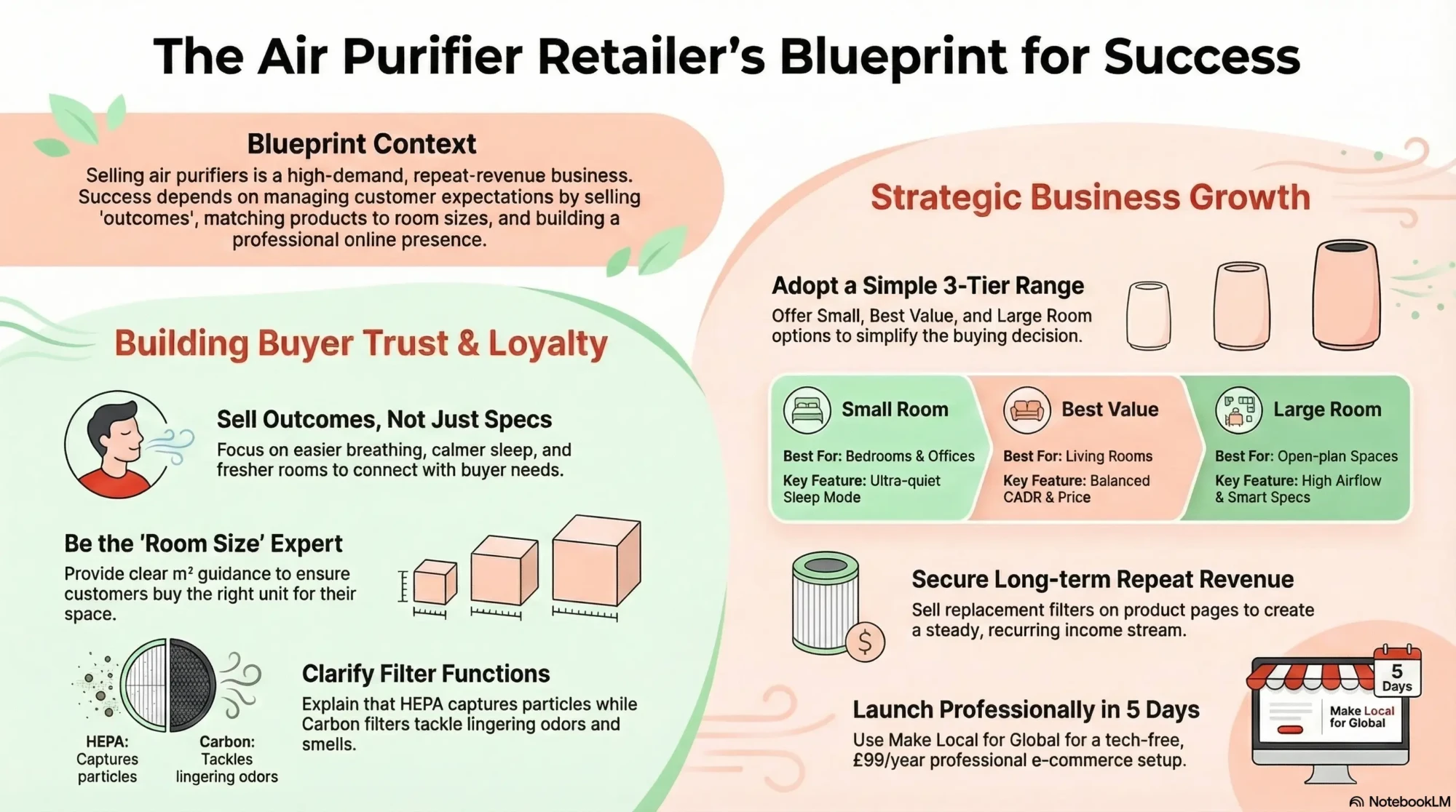
Sell the outcome: easier breathing, less dust, calmer sleep, fresher rooms.

Be clear about what air purifiers can and can’t do

This is where trust is won.

Air purifiers can help with particles in the air: dust, pollen, pet dander, and some smoke particles.

They can also help reduce certain odours if they have the right filter setup.

They are not a magic fix for damp problems, and they don’t replace ventilation.

Tip: Put “Pick the purifier based on room size” everywhere. Most unhappy customers bought a unit that’s too small and expected it to do miracles.

Pick your niche within air purifiers

“Air purifier” is a big category.

Small sellers do better by choosing a clear angle.

Niches that work well

  • Allergy-focused: bedrooms, hay fever season, quiet operation
  • Pet homes: hair, dander, odour control
  • Small spaces: flats, student rooms, office desks
  • Premium home air: design-led, smart features, larger rooms
  • Filter replacement sales: long-term repeat revenue

Pick one main niche and build a curated range that fits it.

Help buyers choose the right air purifier (without confusing them)

Most buyers just want to know: “Will this work in my room?”

That comes down to coverage, filter type, and noise.

Room size and CADR: explain it simply

Customers will see “CADR” and panic.

Keep it human:

  • Tell them the recommended room size in m²
  • Explain that higher airflow cleans a room faster
  • Suggest a bigger size if they want faster results

If you want a simple rule for your shop: “Choose a purifier rated for slightly bigger than your room.”

Filter types buyers care about

  • HEPA-style / HEPA: for dust, pollen, pet dander and fine particles
  • Carbon filter: helps with odours and some VOCs
  • Pre-filter: catches larger dust and hair, extends filter life

Be cautious with “medical” or “kills viruses” language.

Stick to what filters do in practical home terms.

Noise levels: the bedroom deal-breaker

For bedroom buyers, noise matters as much as performance.

Offer clear guidance:

  • Quiet/sleep mode for bedrooms
  • Higher fan speeds for quick clean-ups
  • What the purifier sounds like in plain terms (low hum, noticeable fan)

Comparison table: air purifier types by household

Buyer typeBest featuresWhat to avoid overpromisingBest product angle
Allergy sufferersHEPA, quiet mode, strong airflowInstant symptom “cures”Bedroom air comfort
Pet homesPre-filter + HEPA + carbonRemoving all smells instantlyLess dander, fresher room
Small flatsCompact size, low running costCovering the whole home from one unitRoom-by-room solution
Odour controlGood carbon filter and airflowFixing damp/mould causesKitchen and pet odours
Home officeQuiet mid-speed, auto mode“Productivity guarantee” claimsCleaner-feeling workspace

Build an air purifier range that sells (and keeps returns low)

Air purifiers are a category where fewer, better options sell more than a messy wall of products.

Offer three clear tiers

  • Small room: bedrooms, home office, kids rooms
  • Best value: most living rooms and general households
  • Large room: open-plan spaces, higher airflow needs

Then add a special “pet homes” version if you can, with a stronger pre-filter and carbon.

Make filter replacements part of your business model

Filter replacements are where steady revenue comes from.

Do these things well:

  • Sell replacement filters on the same product page
  • Explain replacement frequency in plain terms
  • Offer multi-buy or subscription-style reminders

Customers don’t mind replacing filters.

They mind being surprised by it.

Tip: Put the running-cost story on the page: filter price range, typical replacement interval, and power use note. Transparency builds trust and reduces “hidden costs” complaints.

Price air purifiers for profit

You’re selling a mix of hardware margin and filter repeat sales.

So pricing should reflect support, returns risk, and warranty handling.

What to include in pricing

  • Product cost
  • Shipping and packaging
  • Warranty support allowance
  • Returns allowance (wrong room size is common)
  • Payment fees
  • Profit margin

Bundles that increase order value

  • Purifier + spare filter bundle
  • Bedroom bundle: purifier + allergy-friendly filter pack (if available)
  • Pet bundle: purifier + extra pre-filters

Bundles feel helpful because they reduce future hassle.

Create product pages that convert

Air purifier pages should answer five questions quickly: room size, filters, noise, running cost, and warranty.

Air purifier product page checklist

  • Recommended room size in m²
  • CADR/airflow explained simply
  • Filter system: HEPA, carbon, pre-filter
  • Noise notes: sleep mode and what “quiet” means
  • Running costs: filter replacement frequency and energy use note
  • Best for: allergies, pets, odours, small spaces
  • What’s included: filters in the box, app features if relevant
  • Warranty and support details
  • Delivery and returns: clear and fair

Photos and videos that sell air purifiers

  • In-room scale photos (bedroom and living room)
  • Filter system photo showing layers
  • Controls close-up (buttons or app screen)
  • Noise demo video if you can
  • Replacement filter photo for cross-sell

Seeing the filter layers builds confidence.

Market air purifiers with practical, reassuring content

This category works brilliantly with search-led content because people google their symptoms and problems.

Content ideas that sell air purifiers

  • “Do air purifiers help with allergies?”
  • “Air purifier size guide: how to choose for your room”
  • “Best air purifier for pet hair and dander”
  • “HEPA vs carbon filters: what’s the difference?”
  • “How often should you replace air purifier filters?”
  • “Air purifier vs dehumidifier: which do you need?”

Use search terms people type

  • Best air purifier
  • Air purifier for allergies
  • Air purifier for pets
  • HEPA air purifier
  • Air purifier room size guide
  • Do air purifiers work

Use them naturally in headings and FAQs.

Set up an online shop without the tech headache

Air purifiers sell best when the site makes it easy to choose by room and problem.

What your shop must do well

  • Shop by room size and use case (allergies, pets, odours)
  • Clear filters and simple comparisons
  • Replacement filters easy to find
  • Honest “what it can do” messaging
  • Mobile-friendly checkout

Done-for-you ecommerce setup can help you launch properly

If you’re selling products with lots of specs and compatibility considerations, site structure matters.

Make Local for Global offers a done-for-you ecommerce setup that’s simple, affordable, and built for small sellers who want a professional shop without wrestling with tech.

If you want help structuring your categories and product pages, you can book a free consultation.

If you’re ready to get selling with a clean ecommerce setup, you can Get your website for £99/year.

FAQ: selling air purifiers online

Are air purifiers worth selling online?

Yes, because demand is steady for allergies, pet homes and air comfort, and filter replacements create repeat revenue, but you need clear room-size guidance to reduce returns.

What air purifiers sell best?

Mid-range “best value” purifiers sized for typical bedrooms and living rooms often sell best, while pet-focused models with stronger pre-filters and carbon do well for households with animals.

How do I reduce returns on air purifiers?

Make room-size guidance prominent, explain that bigger units clean faster, be honest about what purifiers can and can’t do for damp and mould, and clearly show running costs and filter replacement needs.

Should I sell replacement filters as well?

Yes, because it increases customer lifetime value and makes your shop more useful, and many buyers prefer buying filters from the same place they bought the purifier.

How do I compete with big retailers selling air purifiers?

Compete on clarity and guidance by helping customers choose the right size and filter setup, offering bundles with spare filters, and being transparent about running costs, because many buyers will pay more to feel confident.

A practical 30-day plan to start selling air purifiers

If you want to launch cleanly, build around a small curated range and strong guidance.

Week 1: range and positioning

  • Choose 6 – 12 core units across small, best value, and large room sizes
  • Create a simple room-size guide and a “which one should I buy?” page
  • Stock replacement filters from day one

Week 2: product pages and assets

  • Write product pages using the checklist above
  • Photograph filters and controls clearly
  • Create one comparison page for your core models

Week 3: policies and support

  • Write clear warranty and returns pages
  • Prepare quick replies for room size and filter questions
  • Set up spare filter bundles as your main upsell

Week 4: marketing rhythm

  • Publish two posts: room-size guide and HEPA vs carbon
  • Create landing pages for allergies and pet homes
  • Promote your best-value purifier as the default recommendation

Air purifiers sell when you make buying feel safe and straightforward.

Lead with room size, be honest about limitations, and build repeat revenue with replacement filters.

Do that, and you’ll have a product line that sells year-round.

PREFERRED SOURCE

Keep finding us on Google

Like what you’re reading? Add Make Local for Global as a preferred source on Google to see more of our articles when you search.

Newsletter Form in Blog

Sign up for our
FREE ecommerce newsletters!


By providing your email, you agree to our Privacy and Cookie Policy, as well as our Terms and Conditions.


DOWNLOAD FREE GUIDE
ebookmockup 1

How to sell air purifiers Online

Join 5,000+ others who downloaded
Blog to PDF Form
No spam, Unsubscribe any time.

Ready to Start Your Online Business?

Build your online presence without having to figure out everything yourself.

DOWNLOAD FREE GUIDE

How to sell air purifiers online

A simple plan to get your first steady online orders
ebookmockup 1
  • What to do first (so you don't waste time)
  • How to price and present your air purifiers
  • How to get traffic and turn it into orders
  • Join 5,000+ others who downloaded this
Blog to PDF Form
No spam, Unsubscribe any time.

Start Selling

air purifiers

Withing 5 days

You’ve read the guide. Now see if you qualify for a done-for-you online store for air purifiers sellers.
Find out if this is right for you in under 60 seconds.
  • No tech skills neeed
  • Store ready in 5 days
Qualifying / Questionnaire Form
  • Step 1
  • Step 2
  • Step 3
  • Step 4
  • Step 5

Answer a few quick questions and I’ll point you in the right direction.