

READY TO SELL Crochet Kits ONLINE?
Get a store built for you in 5 days, plus training and support to help you start, run, and grow your Alternative business.

Learn how to sell crochet kits online with a tested beginner project, pattern rights, yarn checks, a full order cost breakdown, clearer product pages and a 30-day launch plan.


Crochet kits bring the materials and instructions for one project into a single purchase. For a new seller, the hard part is making the kit feel complete to a beginner, costing it accurately and showing what the buyer will receive. A box of yarn and a hook is not yet a finished offer. The buyer needs to know what they can make, how long the project may take, what skills they need and whether every required item is included.
The most manageable way to start is with one tested project for one clear buyer. Write or license the pattern, calculate the yarn from a finished sample, add only the tools the maker needs and test the whole pack with someone who is new to crochet. Then price the order after materials, packing, fees, postage, support time and returns allowance. Expand the range only after real enquiries and orders show which choice to add.
The Product To Sell archive has further examples of focused starter ranges. If your offer includes yarn or accessories beyond a single kit, see the related guide to selling craft supplies online and the article about selling yarn patterns online.
A clear website can show the finished project, list every kit item and answer delivery questions in one place.
“People who crochet” is too broad to guide the first product. A beginner buying a first kit wants confidence and plain instructions. An experienced crocheter may already own hooks and markers, and may care more about a particular yarn, colourway or designer. A gift buyer needs an attractive, easy-to-understand present with a reliable delivery date. Those needs point to different pack contents and product pages.
Start with a short buyer note: who is buying, who will use the kit, what occasion prompts the purchase, what the maker has already tried and what might stop them completing the project. For example, an adult beginner making a first headband may need a clear photo guide and an appropriately sized hook. A friend buying a birthday gift may need a gift message and the age or skill level in plain view.
Choose a project whose result can be explained in one sentence. “A soft ribbed headband made with one skein, using chain and half-treble stitches” gives a buyer a better picture than “a creative crochet experience”. Keep the promise honest. If a test beginner needs several evenings to finish it, do not present it as a quick afternoon activity without evidence.
Interview a few people who resemble the intended buyer. Ask what they last made, what instructions confused them, what supplies they had to buy separately and what they would expect inside a kit. Show a rough offer and ask which detail would affect their decision. Do not lead them to praise an idea. Listen for questions, objections and the project they describe in their own words.
Use search suggestions and marketplace listings as a way to collect language, not as proof of demand or sales. Record the phrases people use for the object and the skill level. Check comments and reviews for repeated concerns, such as yarn quantity, unclear abbreviations, hook size or colours that look different from the photographs. Treat those as questions to test with your own buyers, not as verified facts about every customer.
One pattern in three colourways can teach you more than ten unrelated designs. Each additional project brings a new yarn calculation, test sample, set of photographs, stock forecast and support burden. Begin with a small range that shares yarn weight, hook size and packaging where practical. This makes purchasing easier and reduces the chance that a slow-moving colour leaves you with stranded accessories.
Simple squares, dishcloths, coasters, headbands and small scarves can work as first projects when the pattern explains the stitches and finishing. The project itself does not make a kit beginner-friendly. A pattern with confusing terms or a tight gauge can still leave a first-time maker stuck. Test the actual instructions and sample with someone who has not seen them before.
Small crocheted figures can photograph well and make giftable kits, but they often involve increases, decreases, shaping and sewing several pieces together. A finished toy may be a separate product from a kit that enables someone to make a toy. If the kit is marketed or intended for play by children under 14, check the toy rules before sale. The Great Britain guidance covers safety assessment, conformity procedures, warnings and identification; Northern Ireland has separate guidance. Review the current GOV.UK toy safety guidance for Great Britain and get qualified advice for the product and sales territory.
Seasonal colours or a gift sleeve can support a limited edition, but forecast the final order date and delivery time before promoting it. A seasonal item bought after the making period has started may have a much shorter selling window. State dispatch times and any last-order date accurately. Keep the base pattern or colour choices useful outside the holiday period if you want leftover stock to remain sellable.
Avoid multiplying options before you know what buyers want. You might offer a core kit with yarn and pattern, a complete kit with the basic tools, and a gift version with the same tested contents in a presentation sleeve. Explain each difference beside its price. A buyer should not need to compare five nearly identical listings to discover whether a hook is included.
Do not call a kit “complete” if a maker needs to supply scissors, a particular hook or another material that is not in the box. Either include the item or list it clearly under “You will need”. Note when a photograph shows props that are not included. This one detail can prevent avoidable disappointment and customer-service work.
Map the project from the buyer’s first step to the last. List the yarn, hook, stitch markers, blunt yarn needle, pattern, finishing materials and any packaging needed. Then check which items the intended buyer may already own. A beginner bundle may benefit from a small tool set; a maker-focused version might omit tools and lower its price. Present both choices only if the distinction is clear and the packing process stays manageable.
Write the skill level using tasks the maker can recognise. Say “you should be able to chain and work a basic stitch” instead of relying on a vague star rating. Explain any new stitch before it appears. Define whether the pattern uses UK or US stitch names, and state that choice near the top. The terms differ, and a buyer who starts with the wrong stitch name may not notice until the sample is too large or too small.
Give a realistic finished size, with a note that tension changes the result. List the yarn fibre, weight category, length or mass supplied, hook size, tools, pattern format, language and number of colour choices. If the kit makes a wearable item, provide an appropriate size range and explain how the maker can adjust it. If it makes a decorative object, include the approximate finished dimensions and intended use.
Think about pattern access before printing. A printed pattern suits a gift box, but paper costs money and may be inconvenient if the customer wants to enlarge the text. A downloadable PDF or QR link can reduce paper and enable updates, yet the buyer needs reliable access after purchase. If you include both, state that clearly. Test the code from a phone with no account logged in and keep the destination active.
Write instructions in a consistent order: materials, abbreviations, tension or gauge, finished measurements, set-up, numbered steps, colour changes, finishing, care and help contact. Use photographs or diagrams only when they answer a real question. A clear close-up of where to insert the hook can be more useful than several lifestyle pictures. Use accessible text contrast and explain colour changes in words, not colour alone.
If a designer created the pattern, agree the kit rights in writing. Ask whether the licence allows you to reproduce the pattern in print or as a digital download, how many copies it covers, what attribution is required, whether updates are allowed and whether the licence covers the countries where you sell. Permission to buy a pattern for personal use does not automatically let you copy it into products. The Intellectual Property Office notice on knitting and sewing patterns explains that written patterns, charts and illustrations can receive copyright protection. Keep the licence with your supplier records.
Potential suppliers include yarn makers, wholesalers, craft distributors and local independent mills. A domestic supplier may make communication and smaller trial orders easier. An overseas source may provide a colour or fibre mix that is difficult to find locally, but adds lead time, shipping and import work. Compare the full landed cost and the supplier’s terms rather than the unit price alone.
If you are still judging whether your craft idea can support a viable offer, try MLFG’s Business Idea Stress Test. Use the questions to identify what you need to check with buyers and suppliers before ordering a larger batch.
Ask for fibre composition, yarn weight, metres per ball, shade references, batch information, care instructions, available stock, minimum order, lead time and a policy for damaged or inconsistent goods. For hooks, confirm the size marking and material. If the supplier offers a product claim such as organic, recycled or machine washable, request evidence and check what that claim covers. Do not repeat a supplier marketing claim as if it applies to your finished kit without checking.
Buy samples before setting a product page or ordering a large quantity. Use the yarn in the actual pattern with the intended hook. Confirm that the finished piece has the expected drape, size and feel. A yarn that looks lovely on a cone may split during use or make the stitches difficult for a beginner to see. A hook with an uncomfortable grip can affect the experience, so test the included tool rather than relying only on its package description.
Shade is a product specification, not a minor decoration. Photograph each offered colour in consistent light and identify any expected variation between screens and physical yarn. Whenever possible, purchase enough of a colourway from one dye lot for a production run. Record the batch references and use them to group stock. If later yarn looks visibly different, do not silently mix it into a kit that promises matching colours.
Ask whether the supplier will notify you when an item is discontinued or delayed. Keep a second source for common accessories where possible, but sample the replacement before using it. A different hook shape, needle eye or stitch-marker size can affect the pattern. Do not treat a substitute as equivalent until the full kit has been tested with it.
Set a reorder point for each yarn and colour based on the time needed to replenish it and the number of kits you can complete. A spreadsheet can track opening quantity, orders, samples, damaged stock and remaining packs. Keep saleable stock separate from test pieces. Label boxes with yarn name and batch information so you can locate a matching supply when resolving a buyer’s question.
Make the project yourself from the kit contents, following only the written pattern. Track every point where you pause, reread or improvise. If a step makes sense only when your experience fills in a missing step, improve the instructions or add a close-up. Record how much yarn is left after finishing. A kit that leaves only a few centimetres may not allow for a different tension or a mistake, so review the allowance before selling it.
Ask a first-time crocheter to test the complete pack without coaching. Observe where they begin, what they look for and whether they can identify the hook, yarn and pattern. Ask them to mark confusing language and note the time spent. Step in only for a safety concern; the goal is to find where the pack fails without help.
Record the pattern version and test date. If you update stitch terms, yarn length or a diagram, change the version number and check stock that still includes an older printed copy. The digital file, product listing and packaging insert should describe the same kit. A short version note lets you investigate a customer report without guessing which instructions they received.
Weigh or measure yarn for every size and colour variation that changes the quantity. Include a sensible allowance for normal differences in tension and mistakes, based on actual test results. Do not copy a quantity from a pattern if the supplied yarn brand, weight or length differs. If the project uses multiple shades, calculate each shade separately and make the contents list easy to check.
Check every packed sample against a pick list. Count skeins, verify shade, match the hook and stitch markers, confirm the needle is included, and check that the pattern is the latest version. Photograph the contents laid out exactly as the buyer will receive them. The check helps you catch missing tools before dispatch and gives you a record of what “complete” meant for that order.
Plan a safe way to package small tools. Needles and hooks should not move loose through yarn or poke through the mailer. Keep stitch markers contained. A child-directed craft product may require added safety steps and age warnings; do not assume a generic craft disclaimer replaces the applicable product rules. Consult the regulator’s current guidance for the product’s intended users and use.

Work through the buyer, costs and delivery assumptions for your kit before a larger order.
Calculate contribution per order before committing to a retail price. Contribution is what remains after variable costs for that sale. It is not net profit: fixed software, storage, insurance, accounting, equipment, taxes and unpaid development time still need to be covered. Put your own packing and customer-service time into the calculation so the kit does not appear profitable only when your hours are treated as free.
Use supplier invoices and the actual fee schedule for each channel. Marketplace charges can depend on listing, transaction, payment processing, advertising, currency or tax treatment. Check the channel’s current official pricing page and model a typical order. The fee in the example below is a made-up allowance; replace it with the charge shown in your account before choosing a price.
The figures below describe one hypothetical beginner kit sold for £28.00. They assume one domestic order and show the marketplace/payment cost as an illustrative estimate. Postage and input costs differ by kit, parcel size, supplier and channel. This example is not a forecast of sales or profit.
| Cost line | Example | What to check |
|---|---|---|
| Customer price received | £28.00 | Confirm whether your displayed price includes VAT |
| Yarn, hook and notions | £7.20 | Include enough yarn plus all kit tools |
| Pattern licence allocation | £2.50 | Use the actual royalty or per-kit allocation |
| Packing materials and card | £1.10 | Include protective wrap and printed insert |
| Inbound freight allocation | £0.80 | Divide shipment cost over usable stock |
| Channel and payment fees | £2.52 | Replace with the current fee for this order |
| Outbound postage | £3.60 | Weigh the packed parcel and check the service |
| Pick, pack and support time | £1.50 | Value the minutes spent on the order |
| Returns and replacement allowance | £1.00 | Use your observed issue rate as it develops |
| Promotion cost allocated per sale | £2.00 | Review actual acquisition cost by channel |
| Illustrative contribution | £5.78 | Before fixed costs, tax and other overhead |
Illustrative figures only. Replace them with your actual costs.
The arithmetic is £28.00 minus £22.22 of listed variable costs, leaving £5.78. It is a thin contribution if the seller still needs to pay monthly costs or compensate for design work. You could reduce packaging cost, improve supplier terms, offer a higher-value kit or adjust the price. Do not remove a needed yarn allowance or safe packing to make the arithmetic look better.
The example treats the customer price and inputs as cash amounts for a seller who has not added VAT to this transaction. VAT-registered sellers need to model output VAT and recoverable input VAT correctly. The UK registration threshold is based on taxable turnover, with current rules on the GOV.UK VAT threshold page. Check your rolling turnover and expected taxable turnover, and get accounting advice for your circumstances.
Calculate a second scenario for a discounted sale and for a customer return. A percentage discount reduces the amount received but leaves postage and most kit costs unchanged. If an order is returned in sellable condition, some materials may return to stock; printed patterns, opened yarn and damaged tools may not. Write down the assumptions instead of treating every return as a full recovery.
Test bundle economics before introducing free shipping. A second kit may share one parcel, yet it can increase weight and packing time. Price the bundle with actual postage bands and channel fees. If a customer pays a separate shipping charge, include how the platform calculates fees on that charge. Keep a margin sheet for every channel and update it when rates or fulfilment methods change.
Track actual results after launch: average order value, fee per order, postage, time to pack, customer questions, returns and repeat purchases. Compare actual contribution with the estimate each month. A product with steady enquiries but poor contribution may need a different price or pack format. A product with good contribution but few views may need stronger photographs or a different route to buyers.
Use a title that names the product and describes the project or experience in ordinary language. For example: “Beginner Crochet Headband Kit with Merino Blend Yarn and Printed Pattern”. Only include the fibre claim if it is accurate and the specific yarn supports it. Avoid a title made from a string of repeated search terms; it is harder to read and does not explain why the kit suits a buyer.
Open the description with the outcome, skill level and what is included. A buyer should know within a few lines whether this makes a headband, a set of coasters or a small toy, and whether the required hook comes in the box. Follow with materials, finished size, yarn amount, hook size, pattern format, language, delivery contents, care information and anything the customer needs to supply.
Use a “You will need” list only for items that are truly outside the kit. If the kit includes a blunt needle but not scissors, say so. If the pattern assumes the maker can tie off ends, explain that skill. Keep the language consistent between the product page, package insert and pattern so the buyer is not comparing different instructions.
Show the finished project beside the kit contents, then add close-ups of stitch texture, yarn labels, tool sizes and packaging. Include a scale reference, such as the project beside a hand or ruler, if dimensions matter. Photograph colour in daylight or consistent soft lighting and keep edited colour close to the actual yarn. Add accessible alt text that describes the image, not a list of keywords.
Write a short delivery section with the processing time, expected carrier service, dispatch days and tracking details where available. State when a made-to-order kit will be ready to dispatch. Never imply that an item is ready to ship if it is awaiting a supplier restock. Clear expectations support the gift buyer who needs to decide whether the parcel will arrive in time.
Answer likely questions before the buyer contacts you. Explain what “beginner” means in this pattern, whether US or UK terms are used, whether the yarn is enough for the stated project, if the pattern is printed or digital, and what to do if a skein or tool is missing. Do not promise that every beginner will finish in a fixed time. Describe the test conditions and treat time estimates as an indication.
An online marketplace can help a new seller meet people who already browse craft products. A hosted shop gives you more control over the product page and customer experience, but you need a way to bring buyers to it. Craft fairs and workshops let buyers touch yarn and ask about the pattern, yet require travel, display stock and time. You can test one channel first, then compare the cost and workload before adding another.
Before opening accounts, check each platform’s current rules for handmade goods, digital patterns, prohibited claims, fulfilment, returns, fees and advertising. Policies can change. Save a copy of the relevant fee schedule and terms with the date you checked them. Do not build a pricing sheet around a remembered fee from an older listing.
Offer a small test run with a clear dispatch date and limited quantity that reflects stock you actually have. A preorder can help measure interest, but it creates a delivery commitment. State when the kit will ship and what happens if a supplier delay affects that date. Do not accept payment for stock you cannot reasonably deliver on the stated terms.
Use one product page and a set of honest photographs to test two useful messages. One might focus on “your first crochet headband”; another could focus on “a ready-to-gift craft kit”. Keep the underlying product and price stable during the test so you can see whether language or audience changes the response. Record views, saves, enquiries and orders over the same period. A small number of clicks is not enough to claim one message wins.
For an email list, offer something that helps the buyer decide, such as a stitch glossary or a printable materials checklist. Explain what emails they will receive and collect consent correctly. Follow privacy rules for the people and territories you contact. Do not add marketplace buyers to a marketing list without marketing consent.
Share short demonstrations that answer product questions: what comes in a kit, how the hook is held, what the first rows look like, how to read a stitch chart, or how to choose a shade. Keep each post useful without requiring a purchase. Link to the exact kit shown so the buyer can compare the page with the video.
Ask a customer for permission before reusing their project photo or review in marketing. Keep the original wording and do not imply that one person’s result is typical. If you offer a discount for feedback, explain the arrangement and follow the platform’s review policy. Honest product feedback can reveal where the instructions or pack need work.
Product rules depend on what you sell, who it is for and where it is supplied. For Great Britain, the General Product Safety Regulations provide a baseline for consumer products, with specific rules taking priority where they apply. Northern Ireland follows a different product-safety route in some areas. Read the current GOV.UK product safety advice for businesses and identify the rules for the kit’s materials, accessories and intended use before sale.
A craft kit promoted for adult beginners is not automatically a toy. A kit intended for children’s play, or reasonably expected to be used that way, needs closer review. The product’s presentation, design and marketing can matter. Small parts, sharp tools and warnings require careful assessment. If you sell a kit for children, review the applicable regulations and conformity steps before listing it. Do not put a small age label on a product and assume that it changes how the kit will be assessed.
Keep supplier invoices, yarn fibre information, batch references, product versions, pattern licences, sample records and complaints in an organised file. Record which kit version went into each production batch. A traceable record helps you investigate a quality report, contact affected customers where required and answer questions from a regulator or marketplace.
Textile labels need accurate fibre information where labelling rules apply. Check the Textile Products (Labelling and Fibre Composition) Regulations and current guidance for the product you supply. Do not describe a blend as pure wool or repeat an unverified “eco” statement. Keep the yarn manufacturer’s composition details and check that product page copy matches the label supplied with the yarn.
For pattern rights, keep permission that covers the actual activity: copying the instructions into each kit, translating them, delivering a download, making illustrations and using pattern photographs in promotions. A licence to sell a finished item does not necessarily allow you to reproduce the pattern itself. Ask the designer directly when terms are unclear, and keep the written answer with the pattern version.
For online and distance sales, provide the required pre-purchase information, including your business identity, product description, total price and delivery details. UK distance-selling rules usually give consumers 14 days after delivery to cancel an order, subject to specific exceptions. Personalised goods may be treated differently in some cases, but a standard crochet kit is not automatically exempt. Read GOV.UK online and distance selling guidance, set out a fair returns process and seek advice if an exception might apply.
Review packaging obligations if the business grows, imports packed goods or sells own-brand products. UK packaging Extended Producer Responsibility duties depend on role, turnover and tonnage thresholds. The rules can apply to different organisations in a supply chain. Use the current GOV.UK EPR packaging guidance to check your position rather than assuming a small parcel is outside the scheme.
These links are a starting point for research, not a substitute for advice on a specific product or territory. Rules can change, and kits may combine yarn with other products. Check the source that applies on the date you launch, document the decision and ask a qualified adviser when the product’s intended users or safety status are uncertain.
Choose an outer mailer or box that protects the contents without adding unnecessary weight or volume. Fold the pattern so it does not crease across an important diagram. Keep tools in a sleeve or small pouch, and contain stitch markers so they do not scatter through the yarn. Test the parcel with the carrier’s size and weight limits before committing to a postage price.
Use a pick list with the project name and version. The packer checks the pattern, yarn quantity and shade, hook size, needle, markers, insert and address label. A second check is useful for higher-value gift kits or multi-colour packs. Record a missing or damaged item before it ships, then correct the stock count.
Keep yarn dry and protected in storage. Store colour batches separately and avoid leaving stock in direct sunlight where colours may fade. Use the same method for sample and sale stock, and rotate older stock first when the product remains in good condition. Mark damaged packaging or yarn clearly so it cannot be picked by mistake.
Provide an easy support route. A buyer may need help locating a step, identifying a missing marker or downloading the pattern. Include the order reference they should share and a typical reply period. If the pattern has a known correction, update the download and tell affected buyers how to get the revised copy. Keep the answer kind and specific, including for a question already answered in the instructions.
Write a returns process that follows consumer rights and the sales channel’s rules. State how a buyer can contact you, what condition an item should be returned in and how refunds are handled. Do not claim “no returns” in a way that removes statutory rights. If a kit arrives incomplete or faulty, resolve the issue under the rules that apply. Track the reason so a repeated complaint can lead to a product or packing change.
Collect feedback after delivery with a neutral question: “Was any part of the pattern difficult to follow?” is more useful than “Did you love our amazing kit?” Group answers by issue, then update the pattern, listing or pack only when the evidence points to a real fix. Keep the older version record so support can identify which instructions a buyer has.
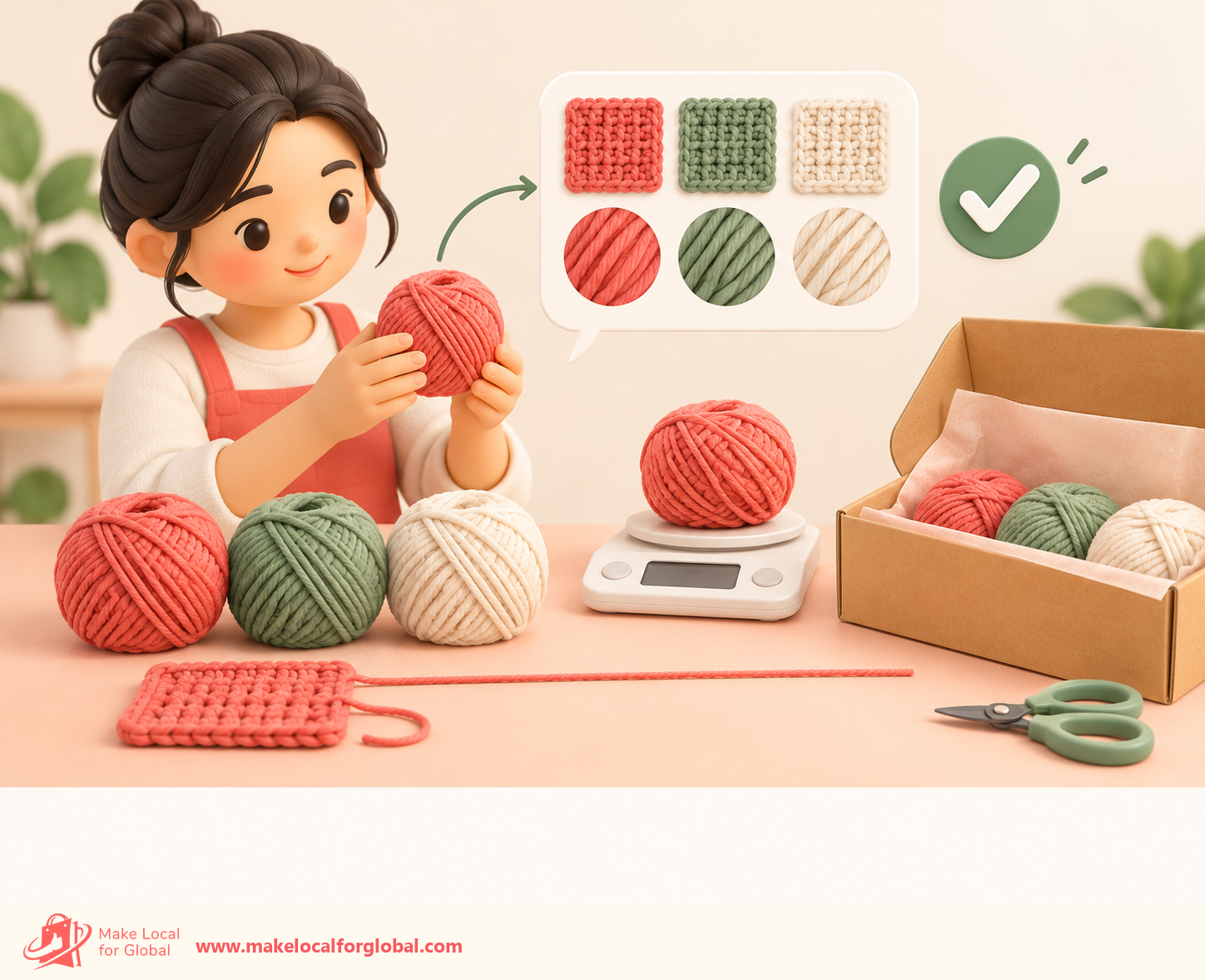
Begin with a clean image that shows both the finished project and the main kit materials. Add a second photograph with every item arranged in the box. Use close-ups for the stitch texture, printed instructions, yarn label and tools. If a photograph includes scissors or another prop that is not included, label that fact on the page.
Use a simple background that helps the yarn colour read accurately. Keep lighting consistent between shade choices. Photograph the finished object at its actual scale. Avoid heavy editing that changes fibre texture or colour. A short clip can show the yarn thickness, hook grip or first step, but make sure the demonstration matches the supplied pattern.
Prepare alt text that gives a useful description, such as “Coral and sage crochet headband kit with yarn, hook, markers and printed pattern”. Each image should have its own description. Do not repeat the same phrase across every photograph. Write captions only when they add a practical detail, such as the finished width or what appears in the box.
Make a process picture that gives the buyer confidence: choose a project, check the yarn, follow the pattern and finish the item. Use real details from the kit. If you show an accessory in an image, include it or state that it is not supplied. Good visual information can reduce uncertainty before a purchase.
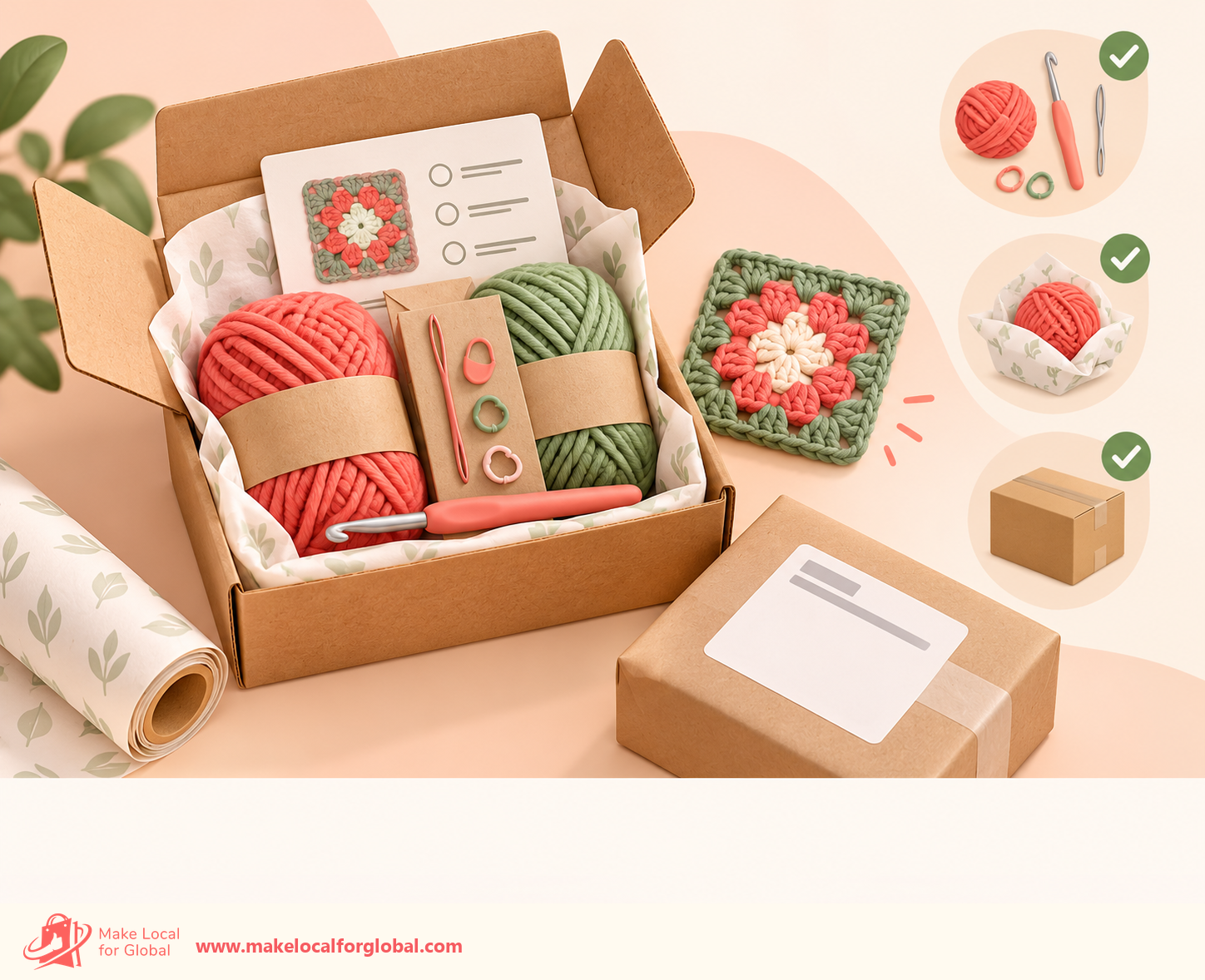
Write a buyer note and choose one project. Source sample yarn and tools, secure the pattern rights, then make a sample from the written instructions. Record the yarn used, the time taken and any corrections. Ask a new maker to complete the kit without coaching. Revise the pattern and listing until the test feedback points to no unresolved blocker.
Build the order cost sheet from supplier invoices, packaging, postage and channel fees. Decide whether your chosen price pays for your time and leaves enough contribution for fixed costs. Order a limited quantity based on the test and supplier lead time. Record the shade batches, pattern version and reorder point.
Photograph the sample and full contents, write the product page and check every detail against the actual kit. State skill level, stitch terminology, yarn amount, hook size, finished dimensions, pattern format, dispatch time and items the buyer supplies. Set up the returns and support process, test the checkout and send a parcel to yourself or a tester to check the packing.
Share the listing with the audience you chose and make a few useful demonstrations. Record page visits, saves, enquiries, sales, time to pack, customer questions and contribution per order. Review the results on day 30. If people ask about yarn amount, improve that part of the page. If they like the sample but leave at checkout, inspect shipping and total price. Change one factor at a time so the next test teaches you something.
Do not treat one sale or a handful of likes as proof that a full range will work. Repeat the test with a fresh group or channel if the sample is too small. Add a second pattern only after you can explain who it serves, what differs from the first kit and how it affects stock, photography, support and fulfilment.

Buying a large quantity before testing the pattern creates risk if the first sample uses more yarn than expected. Start with a small trial and track the actual amount used. Recalculate if the fibre, yarn weight, hook size or project size changes. A small allowance for mistakes can improve the buyer experience, but it should come from sample results rather than guesswork.
Using an advanced pattern in a beginner package can cause support requests and unfinished projects. If the design requires several techniques, either teach those steps clearly or present the kit for a maker who already knows them. State the prerequisite in the listing and the pattern. A buyer should be able to judge the challenge before paying.
Adding too many colours and accessories increases stock complexity. Each shade may require a separate reorder and photograph. If tools are bundled, each must be counted, packed and described. Keep the opening range small enough that you can check every kit and explain the choices without a complicated chart.
Underpricing by ignoring time makes a busy order book feel unrewarding. Measure the minutes spent picking, packing, printing, responding and replacing missing items. You may automate a label or use batch packing later, but use the current process in the first cost model. If the price cannot cover that work, change the offer before volume increases.
Treating a pattern licence as a one-line purchase can lead to unclear rights. Confirm rights for copies, online downloads, images and updates before creating a kit around another person’s work. Keep permission and credit requirements on file. If the pattern includes character art or another protected image, check the rights for that material too.
Promising an environmental or health benefit without evidence can mislead buyers. State the fibre and care information supplied by the manufacturer, and make broader claims only when you can substantiate them for the product and packaging. A plain accurate description helps buyers choose based on their needs.
Yes, if you have the rights needed for the way you plan to sell it. Ask the designer whether you can reproduce the instructions in print or as a download, how attribution should appear and whether the permission covers each kit. Keep the written licence. Buying a personal-use pattern does not by itself give permission to copy it for customers.
Include enough yarn for the tested project, the correct hook when the offer says it is included, stitch markers or other tools required by the pattern, a blunt yarn needle for finishing, and clear instructions. State whether scissors or any other item is not included. Test the complete kit with a new crocheter before sale.
Make the project with the exact yarn and hook planned for the kit, then record the yarn mass or length used. Repeat the test and account for ordinary differences in tension and mistakes. Measure each colour separately for a multi-shade project. Update the quantity if you change yarn, size or pattern instructions.
Offer tools if they help the target buyer start without another purchase. A complete beginner kit may include the hook and finishing tools; a maker-focused pack may be less expensive without them. Make the difference obvious in the title, contents list and photographs. Do not show a tool as included if it is a prop.
That depends on the kit’s design, intended use, presentation and reasonably expected use. If it is intended for play by children under 14, the toy safety requirements may apply. Assess small parts, tools, warnings, conformity and the sales territory before offering it. Obtain product safety advice for a children’s kit rather than relying on a generic age statement.
There is no single reliable price for every project. Add yarn, tools, pattern rights, packing, inbound freight, channel fees, postage, order handling time, customer acquisition and a returns allowance. Compare the final offer with similar products, then test whether buyers respond at a price that leaves a contribution after variable costs.
VAT obligations depend on your business and taxable turnover. The registration threshold and rules can change, so check the current GOV.UK VAT guidance and ask an accountant if you are near the limit or sell across borders. Rework your price calculation if your VAT status changes.
State the project, skill level, UK or US stitch terms, yarn fibre and quantity, hook size, finished size, pattern format, every included tool, anything the buyer supplies, care details and dispatch time. Use honest photographs of the finished sample and the complete contents. Include a clear way to request help.
One well-tested project is enough to learn whether the offer, price, page and packing process work. Add another design after buyer questions or orders show a useful gap. Shared yarn weights and tools can simplify stock, but every new pattern still needs its own sample, yarn calculation and content checks.
The Intellectual Property Office explains that the answer depends on the work and rights involved; some decorative elements may remain protected when the underlying method is not. Read the pattern terms and the IPO guidance, especially if the finished item copies a character or artwork. Ask the rights holder or a legal adviser when the situation is uncertain.
Publish a returns process that follows consumer law and the marketplace’s rules. Distance sales usually include a cancellation period, with defined exceptions. A standard kit is not automatically exempt. Explain how the customer contacts you, how a returned product is assessed and when a refund is made. Fix any faulty or incomplete kit under the rights that apply.
Add a design when you can name its buyer, explain the added value and show that the pattern, yarn quantity, price and fulfilment have been tested. Review sales and enquiry data over a useful period rather than reacting to one comment. Confirm that the extra stock will not weaken your ability to keep the first kit available.
A good first crochet kit helps a buyer picture the finished project, know what arrives and start without guessing. Choose one audience, test the pattern and materials, calculate the full order cost and state the limits of the offer plainly. Keep records of rights, yarn batches, product versions and customer feedback so that the next decision rests on real evidence.
If you are preparing a shop around craft products, MLFG can help you plan a clear online presence. Explore website design or contact the team to discuss your next step.
PREFERRED SOURCE
Like what you’re reading? Add Make Local for Global as a preferred source on Google to see more of our articles when you search.

Build your online presence without having to figure out everything yourself.