

Use a practical six-area review to check product roles, buyer evidence, order contribution, stock, fulfilment and store measurement.

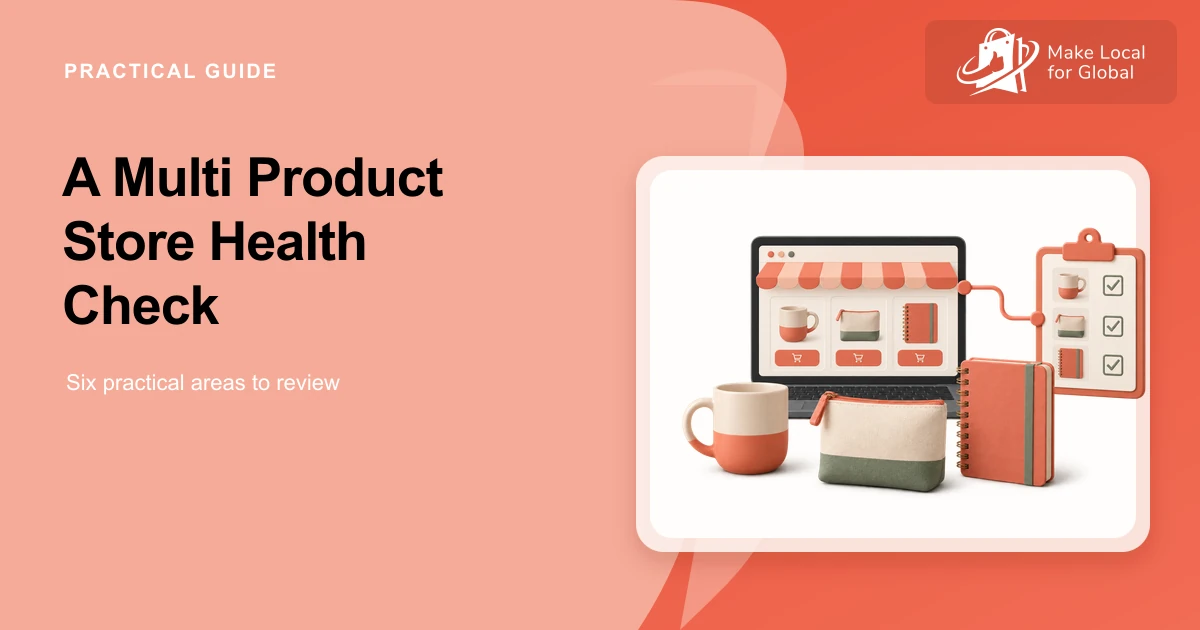
A multi product store can look busy while its underlying routines are difficult to compare. One product may attract orders, another may contribute more after variable costs, while a third depends on a supplier or delivery promise that has not been checked recently. A structured multi product store health check helps you review those moving parts without pretending a short assessment can diagnose the whole business.
This guide sets out six useful areas to review: product roles, buyer evidence, order contribution, product information, stock control, fulfilment and measurement. It also explains what records to gather, how to choose a proportionate next check, and why the result should be treated as a prompt rather than a forecast.
Answer six practical questions about your catalogue, orders, stock and customer routines. The free assessment turns your answers into an evidence map and one focused next check.
It is a short, repeatable review of the evidence and operating routines that support a store with several products. Rather than looking only at headline revenue, it asks whether product decisions, order costs, stock records, buyer information and fulfilment can be checked from current sources.
A useful review compares like with like. Choose a date range, use consistent product identifiers, state whether figures include VAT, and note unusual promotions, stockouts or seasonal events. For example, a product with £1,200 in sales is not automatically healthier than one with £850. The second product may have different order volume, variable costs, return levels or stock commitments. Sales and contribution answer different questions, and contribution after variable costs is not net profit.
Start by writing down who each important product is for and what job it does in the range. A product might be an entry option, a core item, a repeat purchase or a useful add-on. Those roles are hypotheses until buyer questions, orders, repeat purchases or other relevant evidence support them.
Keep the evidence specific: what was observed, when, and from which source? A short note such as “three recent customers asked whether the mug is dishwasher safe” is more actionable than “people like the mug”. Compare a small sample of products first. That keeps the review manageable and makes it easier to spot missing information before changing the whole catalogue.
Product pages should make the important differences easy to understand. Names, images, sizes, materials, variants, availability, delivery information and returns details should match the product a customer will receive. Consistent information also helps the person picking an order identify the right item.

A practical check is to ask someone unfamiliar with the store to compare two products on a phone. Can they tell the size, colour, intended use, delivery terms and key difference without guessing? Record where they hesitate. This is not a formal usability study, but it can expose a confusing title, missing variant detail or image that does not show scale.
For a typical order, record the selling price and costs that vary with that order. Depending on the business, these might include product cost, packaging, delivery subsidy, payment fees, marketplace fees or a discount. Use one VAT basis and the same definitions for each product. If some costs are unknown, label them as unknown rather than silently treating them as zero.
For example, suppose an order sells for £32. A £13 product cost, £2 packaging and £3 delivery contribution leave £14 before payment fees, returns, overhead and other costs. That £14 is not a profit forecast. It is a simple contribution figure with clear exclusions. Keep an invoice or order record alongside the calculation so another person can check the inputs.

When sales and contribution differ, do not jump to a price change. Check whether the period, discounts, returned orders and channel mix are comparable. A high sales total can conceal weak order contribution, but a single calculation also cannot account for every business cost.
Stock records should distinguish units that can be sold now from units that are reserved, damaged or confirmed as incoming. Add a count date and identify the products that drive the most orders or create the greatest fulfilment risk. Compare the record with a count or reliable system source and note discrepancies instead of overwriting them without explanation.
For example, a system may show 20 units, while 3 are reserved and 2 are damaged. The store may have 15 saleable units, not 20. If a supplier says 10 more are on the way, record the confirmation and expected date separately from stock already received.
Choose a typical order with more than one item and follow it from checkout to delivery. Check who confirms stock, picks the right variants, packs the items, sends tracking and responds if one product is delayed, missing or damaged. Compare the customer-facing delivery and returns information with what the business can currently deliver.

For UK consumer orders, make sure the store’s current delivery and cancellation information reflects its own product and customer circumstances. Official guidance explains that online buyers generally have cancellation rights, with exceptions and timing rules that should be checked against the situation. Do not rely on a generic checklist as legal advice. See the [GOV.UK guide to online and distance selling](https://www.gov.uk/online-and-distance-selling-for-businesses) and [GOV.UK returns and refunds guidance](https://www.gov.uk/accepting-returns-and-giving-refunds).
Use the assessment to identify the strongest evidence, the biggest gap and one practical check to complete next. Your answers stay in your browser unless you request the PDF.
Choose a small number of measures that connect to a question you can act on: orders by product, contribution after specified variable costs, stockouts, returns, dispatch time or repeated customer questions. Set the date range and definitions once, record the source, then note one follow-up action and its owner.
Keep accounting records accurate and retain documents that explain transactions. The UK government’s guidance on [business accounting and finance](https://www.business.gov.uk/support/accounting-tax-cashflow/setting-up-business-accounting-and-finance/) and [records for self-employed people](https://www.gov.uk/self-employed-records/what-records-to-keep) explains record-keeping responsibilities. The right records depend on how the business is organised, so check the relevant guidance for your situation.
| Area | Evidence to check | Useful next question |
|---|---|---|
| Product roles | Buyer need, orders, repeated questions | Why does this product belong in the range? |
| Product information | Page details, variants, images, delivery terms | Can a buyer compare and choose confidently? |
| Order contribution | Order record, product cost, packaging, delivery and fees | Are dates and cost definitions consistent? |
| Stock | Dated count, reservations, damaged and incoming units | How many units can be sold now? |
| Fulfilment | Pick and pack steps, dispatch, tracking and support | What happens when one item is unavailable? |
| Review routine | Measures, source, period, action owner | What evidence would change the next decision? |
The free assessment gives each of six areas a simple self-reported signal, then highlights a stronger area, a gap and a next check. It does not connect to your shop, inspect analytics, calculate a financial forecast or verify the information you enter. A result is only as useful as the evidence behind each answer.
Use the lowest-scoring area to choose a source to verify. That might be an order, invoice, stock count, product page, customer question or supplier confirmation. Write down what you learned and choose a review date. If the first check changes your view, update the next step rather than treating the original score as a verdict.
Choose a rhythm that matches how often your range, stock or orders change. A small store might review a few key signals monthly and check stock more often for fast-moving or seasonal items. Keep the period and definitions consistent so comparisons remain meaningful.
No. It can help organise evidence and identify a question worth investigating. Decisions about pricing, promotions, discontinuation or replenishment need current customer, cost, supplier and operational context.
No. Contribution after selected variable costs excludes other costs and accounting treatment. State exactly what you included, keep figures on a consistent VAT basis and consult an appropriate adviser for reporting questions.
Yes. Enter your first name, last name and email address. After Fluent Forms confirms the submission, the PDF download button appears. The form has no consent checkbox; the site privacy policy explains how submitted details are handled.
Review six practical areas, then use the evidence gap to pick a small next action. Keep the source and review date with your notes.
MLFG brings a store, hosting, domain, business email, AI tools and training into one £99/year plan. See plan details or talk through your next step.
PREFERRED SOURCE
Like what you’re reading? Add Make Local for Global as a preferred source on Google to see more of our articles when you search.
























Build your online presence without having to figure out everything yourself.