

READY TO SELL Bento Boxes ONLINE?
Get a store built for you in 5 days, plus training and support to help you start, run, and grow your Alternative business.

Thinking of selling bento boxes? Learn how to choose a focused lunchware range, check food-contact evidence, test suppliers, price each order and prepare clear product pages.


A bento box is more than a container. Buyers want to know whether lunch will stay separate, whether the box fits a bag, how to clean it and whether it can hold a dressing without leaking. A shop that answers those questions clearly can make a small range feel far more considered.
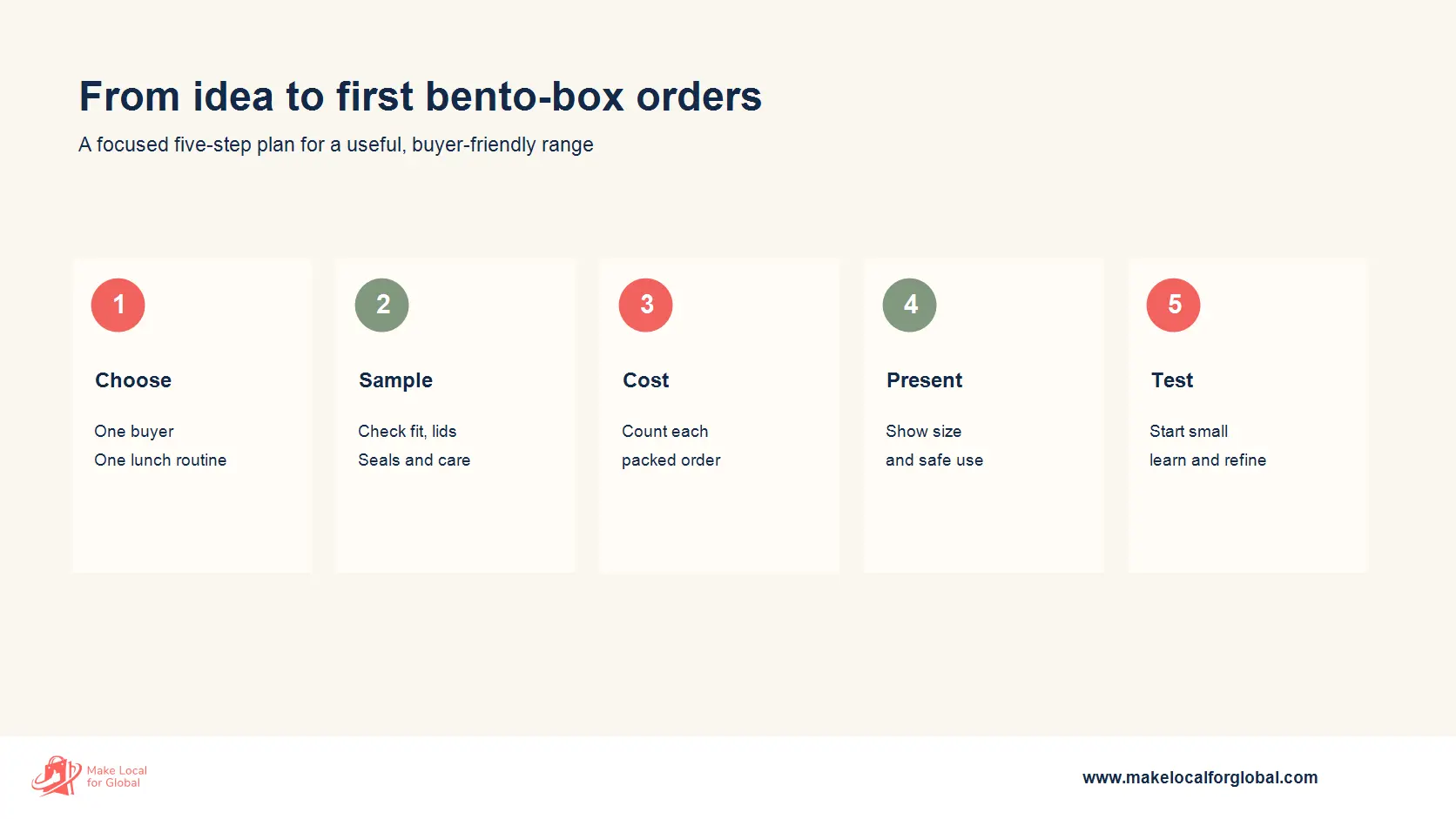
This step-by-step plan covers product selection, supplier checks, food-contact evidence, pricing and a 30-day launch test. Start with one lunch routine and build a range around it.
Make Local for Global helps small businesses get an ecommerce website set up, with training and support to manage it. Explore the service or ask a question about your plans.
The term covers many lunch containers: a single divided tray, a stackable two-tier box, a stainless-steel tin or a set with a sauce pot and cutlery. These are not interchangeable. A commuter carrying soup has different needs from a parent packing fruit and a sandwich.
Possible buyers include parents preparing school lunches, office workers carrying meals, students with limited storage, and people who portion snacks for a day out. Choose one group to serve first. It will guide your product mix, photos and product-page details.
Before ordering stock, review public questions and feedback on comparable products. Note repeated requests about capacity, leakage, cleaning or whether the lid can go in a microwave. Treat those comments as ideas to test with your own sample, not as proof that every box has the same limits.
Make each item solve a different lunch problem. Three near-identical boxes in new colours create choice without helping a shopper decide.
| Product role | What to compare | Details to verify |
|---|---|---|
| Everyday divided box | Compartments, usable capacity, closure | External and internal size, parts, care instructions |
| Stackable set | Tier connection, height, portability | How tiers lock, whether each tier closes alone |
| Stainless-steel lunch tin | Weight, edge finish, divider design | Material grade, lid material, liquid-use limits |
| Starter bundle | Box plus sauce pot or cutlery | Which parts are included and their safe-use limits |
Product characteristics depend on the exact model. Confirm every point with the supplier and sample before you publish a claim.

For an example of why product-specific details matter, IKEA says its UTBJUDa two-tier box is for dry food and not leakproof, while the HAVSTOBIS glass container is listed as leakproof and has a different material mix. Those are the maker’s specifications for those products, not claims to copy onto another model.
A lunch box touches food, so a supplier’s broad phrase such as “food safe” is not enough to evaluate an item. Ask for the product’s material breakdown, intended uses, temperature limits, cleaning directions and supporting food-contact documentation for the exact model and parts.
The Food Standards Agency’s food-contact materials overview and packaging guidance explain the UK rules and written evidence for relevant materials. Rules can vary by nation and destination market. The FSA’s June 2026 BPA note explains that EU BPA rules apply in Northern Ireland under the Windsor Framework; these rules do not currently apply directly to the GB domestic market. Check the current position for the places you sell to.
If you import or sell consumer products, product-safety responsibilities can apply beyond food-contact rules. Read the Office for Product Safety and Standards’ business advice and obtain suitable professional advice where your role or destination market is unclear.
Ask who manufactured the box, where it was made and whether the supplied report matches the model number, colour and components in your order. Request an answer in writing. If a supplier cannot connect its documents to the item you will receive, pause the order rather than filling gaps with assumptions.
Buy samples before committing to a case quantity. Inspect several units if possible: one attractive sample does not show how consistent a production batch will be.
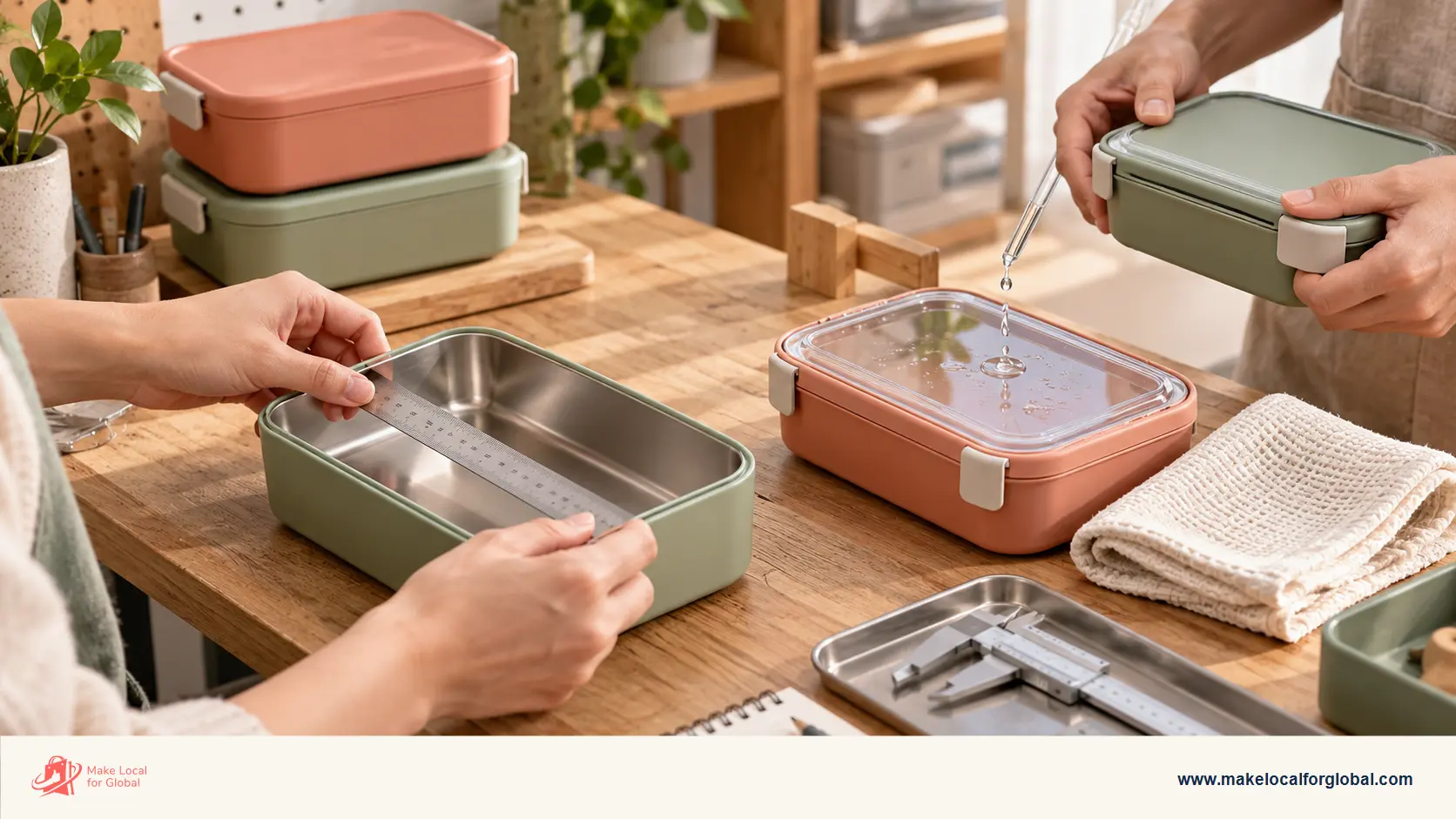
Write down what passed, what failed and the evidence behind each claim. For a related example of checking material claims and sample quality, see the baking-mats selling checklist.
Set a selling price after counting costs that arrive with each order. Here is an illustrative direct-to-customer example for one bento box. Replace every figure with a quote from your own supplier, carrier and payment provider.
| Per-order item | Illustrative cost |
|---|---|
| Box landed to your stock location | £7.20 |
| Protective packaging | £0.85 |
| Tracked postage | £3.45 |
| Payment fee allowance | £0.65 |
| Returns and damage allowance | £0.50 |
| Customer acquisition allowance | £2.50 |
| Variable order cost | £15.15 |
| Example selling price | £24.95 |
| Contribution before fixed costs and tax | £9.80 |
Illustrative only: £24.95 minus £15.15 equals £9.80. This is contribution, not net profit. It excludes business overheads and any tax position. Confirm whether figures include VAT and how payment fees are charged.
If your taxable turnover passes the current £90,000 VAT registration threshold, or you expect it to pass in the next 30 days, HMRC says you must register. Check the latest VAT registration guidance and review how VAT affects your displayed price and margin with an accountant.
A shopper should be able to compare size, materials, care and delivery without hunting through the page. MLFG can help you prepare an online store for the products you plan to sell.
Lead with the lunch problem the item solves, then give exact product facts. “Keeps your lunch organised” is a mood, not a specification. State the measured capacity, dimensions, compartment layout and what arrives in the parcel.
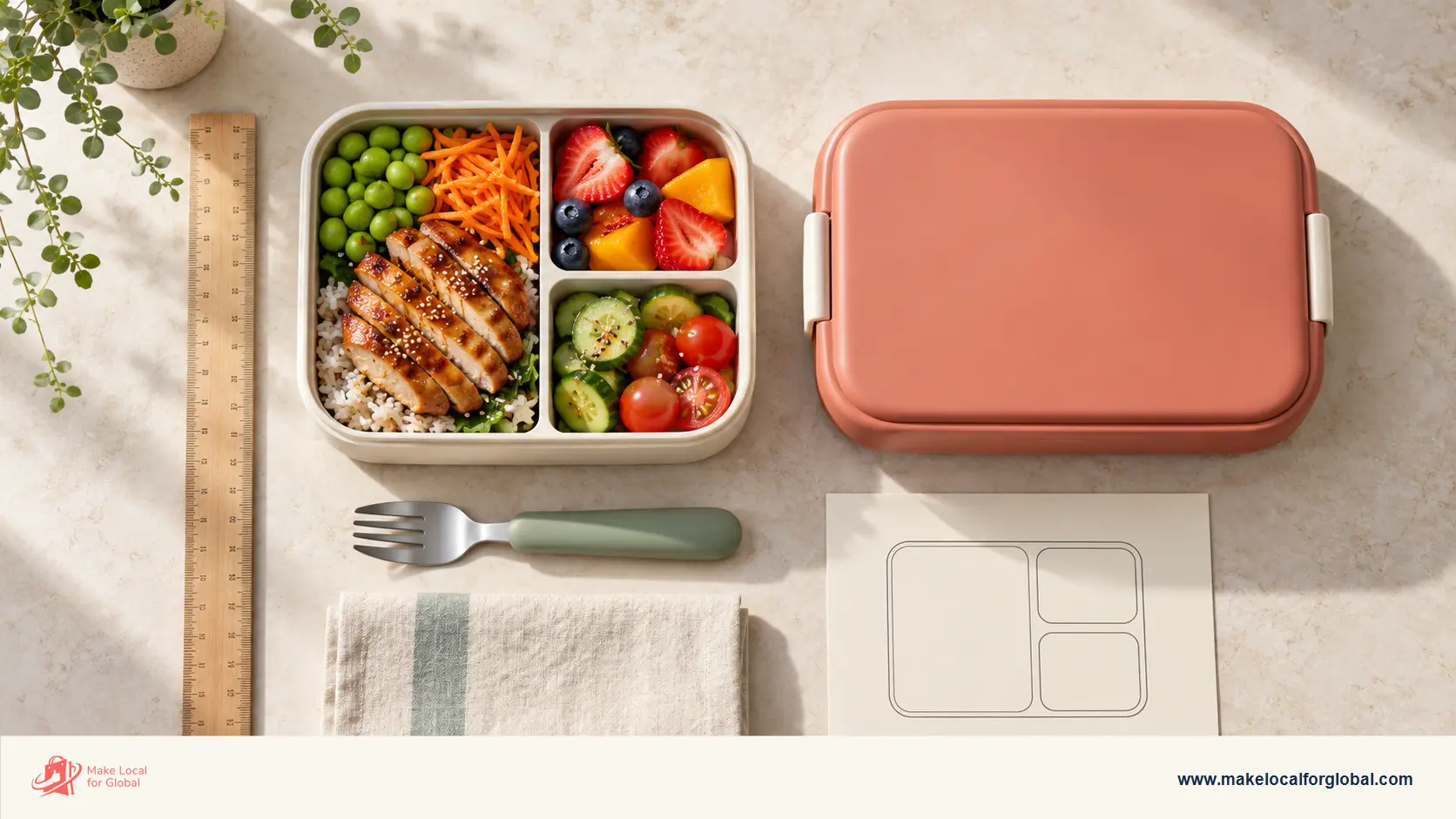
Try a product title such as “Two-tier lunch box, 900 ml, removable divider, slate”. Only include the capacity, divider and colour if your sample and supplier paperwork confirm them. Add a short paragraph on the lunch routine, then a scannable specification list.
Good photographs do not replace written specifications. They should help shoppers see what the text describes, not invite them to guess what is in the box.
Bento boxes can have bulky packaging relative to their selling price. Measure a packed sample and check postage bands before choosing a mailer. Add protection around corners and latches, then make a trial shipment to check whether parts shift or surfaces scratch.
Set a simple stock record by model, colour and component. Keep replacement seals or spare sauce cups separate if your supplier sells them, and decide how you will handle an incomplete set or a damaged latch.
For UK consumer orders made online, explain delivery, cancellation and returns before checkout. GOV.UK says customers normally have 14 days after delivery to cancel a distance order, subject to exceptions; read the current distance-selling rules and do not rely on a blanket “no returns” statement.
For adjacent lunch products, the MLFG page on selling lunch bags online can help you think about a coordinated offer. A bento box and a bag can make a sensible bundle when you have checked their sizes together.
Before you buy deep stock, ask a handful of people in your chosen customer group to compare two clearly described designs. Show the dimensions, material, price and use limits. Ask which one they would choose for next week’s lunch and why.
Then publish a simple landing page or a few product listings and track visits, questions, email sign-ups and paid orders. A large number of likes with no product-page visits is not the same signal as a buyer completing checkout. Set a stock limit and a review date before running a paid promotion.
| Week | Actions | What to record |
|---|---|---|
| 1. Choose | Pick one buyer and lunch routine. Compare three product concepts and ask five people to choose. | Top concerns, preferred format, price reactions |
| 2. Verify | Order samples, request documents, test fit, closure, care limits and parcel protection. | Pass or fail by model, supplier gaps, landed costs |
| 3. Present | Photograph the sample, write a specification-led page, calculate contribution and set returns information. | Page questions, checkout friction, packed dimensions |
| 4. Test | Launch a small quantity, share two useful lunch-prep posts and review enquiries and orders. | Visits, add-to-carts, orders, returns and customer questions |
Set your own stock and promotion limits before the test. Use observations to choose the next small change.
They can suit a focused kitchen or lunchware shop, but the category includes many designs and price points. Test one clear customer need, verify product claims and calculate the packed-order contribution before placing a large order.
Ask for evidence and instructions for the exact model, including seals and removable cups. Test a sample with the intended liquid use and state the limits clearly. A divider or tight lid alone does not prove leak resistance.
Only when the maker’s documentation confirms that claim for the specific parts and use conditions. Metal bodies must not be presented as microwave-safe. Explain whether a lid, seal or sauce pot must be removed during heating.
Test a small bundle such as a box with a matching lunch bag, sauce pot or reusable cutlery. Check that pieces fit, are compatible and have documented care instructions. Show the bundle contents and price separately from single items.
There is no reliable figure without your own costs, conversion rate, returns and sales volume. Use a contribution calculation for each order, then subtract fixed overheads and tax to assess business results over time.
Build your product pages around verified details, clear photos and a buying experience that works on a phone. Make Local for Global can help you plan an ecommerce website and get it ready for your products.
PREFERRED SOURCE
Like what you’re reading? Add Make Local for Global as a preferred source on Google to see more of our articles when you search.

Build your online presence without having to figure out everything yourself.