

READY TO SELL Baking Mats ONLINE?
Get a store built for you in 5 days, plus training and support to help you start, run, and grow your Alternative business.

Thinking of selling baking mats? Learn how to choose a focused range, check suppliers, price each order, write clearer product pages and launch with confidence.

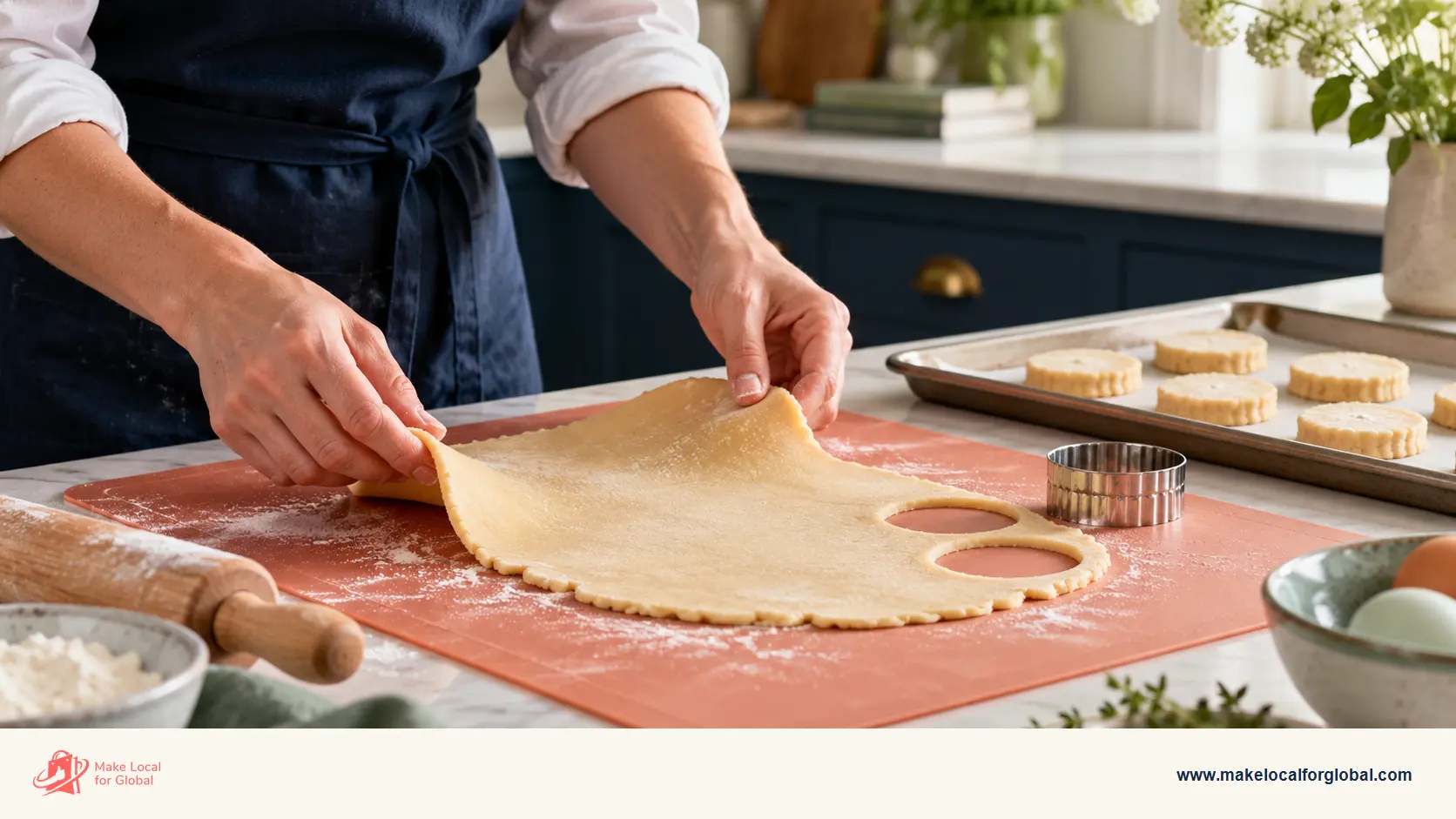
A reusable baking mat looks simple: a flexible sheet that sits under pastry or biscuits. But a customer choosing one online wants to know much more. Will it fit their tray? What is it made from? How hot can it go? How should it be cleaned?
Those questions give a small seller room to stand out. A focused range, clear evidence and useful product pages can make baking mats a practical online niche. This guide walks through choosing stock, checking suppliers, pricing orders and earning buyer confidence.
Make Local for Global helps small businesses get an ecommerce website set up, with training and support to manage it. Explore the service or ask a question about your plans.
“Baking mat” can describe several products, so begin with the exact item you intend to sell. Reusable oven liners, pastry-rolling mats and textured cookie sheets can differ in construction, size and intended use. Some are silicone, some combine silicone with reinforcing fabric, and some use different materials altogether. Confirm the composition with the manufacturer rather than guessing from a listing photo.
Potential buyers include home bakers who want a reusable surface, pastry makers who need measurement guides, and people replacing worn kitchen accessories. A gift buyer may value presentation and a neat starter set. A professional baker may care more about dimensions, repeatability and care instructions.
A shop aimed at “everyone who bakes” is hard to remember. Start with a specific use, such as pastry preparation for home cooks, biscuit baking for families, or compact accessories for small kitchens. This choice guides your product selection, photos and wording.
Check demand before buying a large quantity. Review marketplace questions and product reviews for recurring concerns: mats that are too small, hard-to-read measurements, unclear oven limits or cleaning confusion. Look for gaps you can solve with verified specifications and better support, not simply a lower price.
Keep the first collection tight enough to explain and manage. A few well-differentiated options are more useful than a catalogue of near-identical colours.

Use names that help shoppers compare: “large pastry mat, 60 × 40 cm” tells more than “premium mat”. Make measurements easy to find and explain how the mat relates to a common oven tray without implying a universal fit. Tray sizes vary; give the actual product dimensions.
Because a baking mat touches food and may be heated, supplier checks matter. Ask for the full material composition, intended uses, temperature limits, care directions and the documents that support the product’s food-contact suitability. Ask which exact model or batch the documents cover. Keep those records with supplier and batch information.
A phrase such as “food grade” on a sales page is not a substitute for evidence. If a supplier cannot explain what the mat contains or provide relevant documentation, pause before listing it. Do not infer oven, microwave, freezer or dishwasher suitability from the word “silicone” or from another seller’s product description.
Food-contact requirements can depend on material, intended use and where the product is sold. Read the current Food Standards Agency guidance on food-contact materials, and check the rules for the nation and market you serve. If importing or selling into Northern Ireland or the EU, confirm the applicable requirements with a competent adviser; requirements can differ from Great Britain.
Before committing to stock, order samples from the same source you plan to use. Compare dimensions against your listing, inspect edges and printing, and follow the maker’s first-use and cleaning directions. If you test it with baking, stay within the manufacturer’s stated limits. A household bake test can help you assess usability, but it does not prove chemical compliance.

A low wholesale price can hide expensive postage, protective packaging or replacements. Work out contribution per order before deciding what to charge. The example below is illustrative, not a suggested market price. Replace it with quotes and fees for your own business.
| Example order cost | Amount |
|---|---|
| Customer price (not VAT registered in this illustration) | £19.99 |
| Mat purchase cost | £2.50 |
| Inbound delivery per unit | £0.35 |
| Protective packaging | £0.85 |
| Postage and fulfilment | £3.10 |
| Payment fee estimate | £0.56 |
| Returns or damage allowance | £0.60 |
| Promotion cost per order | £1.50 |
| Illustrative contribution before overheads and tax | £10.53 |
Illustration only. It excludes fixed overheads and tax. Payment fees vary. If VAT registered, recalculate using the correct VAT treatment and recoverable input VAT. Check current HMRC guidance.
Then test more than one basket. A two-mat set might raise order value, but only if the bundle’s discount, packing time and parcel size still leave a healthy contribution. Include your website, insurance, storage, returns handling and your own time in the wider business plan.
For VAT, HMRC currently says UK businesses must register when taxable turnover goes above £90,000, subject to the detailed rules and exceptions. Check the live HMRC VAT registration guidance and get advice if you are close to the threshold or sell across borders.
A clear online store can bring your product details, delivery information and customer enquiries together. Explore what is included before choosing a route.
Your product page should remove uncertainty before checkout. Put the key facts near the top, use short paragraphs and show the actual item from more than one angle.
Take one wide photo to show the whole mat, a close-up of its surface, and a scale photo beside a tray or ruler. Add a short demonstration only if it shows normal use and matches the supplier’s directions. Never use a photograph that suggests an accessory is included when it is not.

Use customer language in headings and image captions, such as “Will it fit my baking tray?” or “How do I clean it?” Answer with exact facts, not broad promises. Add related internal reading where it fits naturally; for example, our guide to choosing and selling kitchen gadgets covers how a focused kitchen range can be positioned online.
A marketplace can help you test whether a particular size or bundle attracts interest. Your own website gives you more room for care details, comparisons, FAQs and your wider brand story. You can use social channels to demonstrate the product, then direct interested shoppers to a complete product page.
Useful content ideas include a tray-measurement guide, a plain-language explanation of the differences between your models, and a cleaning guide based on the maker’s directions. Link from these articles to the relevant product page. A thoughtful niche article such as our guide to selling spice jars offers another example of explaining a kitchen-related product range to shoppers.
Track visits, add-to-basket actions, completed orders, questions and returns by product. If shoppers repeatedly ask about tray fit, move dimensions higher on the page. If they leave after seeing delivery, check the parcel cost and dispatch estimate. Use evidence from your own buyers to decide what to improve.
| When | Focus | Useful outcome |
|---|---|---|
| Days 1–5 | Choose a buyer and compare competing products | A short brief with customer needs, prices and unanswered questions |
| Days 6–10 | Request supplier documents and order samples | Evidence file, product measurements and a sample-check record |
| Days 11–15 | Calculate costs and select a small range | A price sheet with single and bundle scenarios |
| Days 16–22 | Photograph stock and draft product pages | Accurate photos, size details, care notes and policies |
| Days 23–30 | Share the store, answer questions and review results | First feedback to guide your next order, page edit or content idea |

They can suit a focused kitchen-accessories shop because buyers can compare sizes, surfaces and sets online. Profitability depends on demand, supplier quality, delivery costs, competition and your ability to explain the exact product. Test with a small order before scaling.
Confirm the exact material composition, intended use, temperature limits, cleaning directions and food-contact evidence for the model you will sell. Keep supplier and batch records, and do not rely on a generic “food grade” claim alone.
Give precise measurements, material, surface details, supported uses, maker’s care instructions, what is included, delivery timing and returns information. Use clear photos to show scale and surface finish.
Add stock, inbound freight, packing, postage, payment fees, promotion and an allowance for returns or damage. Then consider fixed overheads and VAT where applicable. Review the price alongside comparable items and the value your product page provides.
Only make claims supported by reliable evidence for that exact product. State the manufacturer’s specified limits and directions rather than using blanket claims. If you are unsure, ask the supplier for documentation and get suitable compliance advice before listing it.
The strongest start is a small, well-explained range: products selected for a clear buyer, supplier details you can stand behind, costs you have actually calculated and pages that answer practical questions. Let early orders and customer feedback decide what you add next.
Make Local for Global supports small businesses with website setup, training and ongoing help. Review the service details or start a conversation about your product idea.
PREFERRED SOURCE
Like what you’re reading? Add Make Local for Global as a preferred source on Google to see more of our articles when you search.

Build your online presence without having to figure out everything yourself.