

READY TO SELL Baking Moulds ONLINE?
Get a store built for you in 5 days, plus training and support to help you start, run, and grow your Alternative business.

Learn how to sell baking moulds online by choosing a focused range, checking food-contact evidence, testing release and heat limits, pricing delivery and packing each order safely.


Baking moulds look simple on a product page. A buyer sees a tray, a shape and a price. A seller has to make a longer list of decisions: who will use it, what it is made from, how hot it can get, how the food releases, how it will be packed and whether the full order still leaves a contribution.
If you want to sell baking moulds online, start with a small range and prove each sample. A focused offer gives you better photos, clearer product pages and fewer stock decisions. This plan takes you from the first buyer test to a safe, priced launch.
MLFG can help you shape a clear online shop around one product idea, with pages that make the next buyer decision easier.
Different buyers ask for different shapes, cavity sizes and price points. A home baker may want a six-cup tray that stores easily. A cake maker may need repeatable portions. A gift buyer may choose a heart, flower or seasonal shape and care more about presentation.
Pick one first buyer and write down the job the mould must do. For example: “A home baker wants small cakes that release cleanly and fit a standard oven.” That sentence gives you a better product brief than “sell silicone bakeware”.
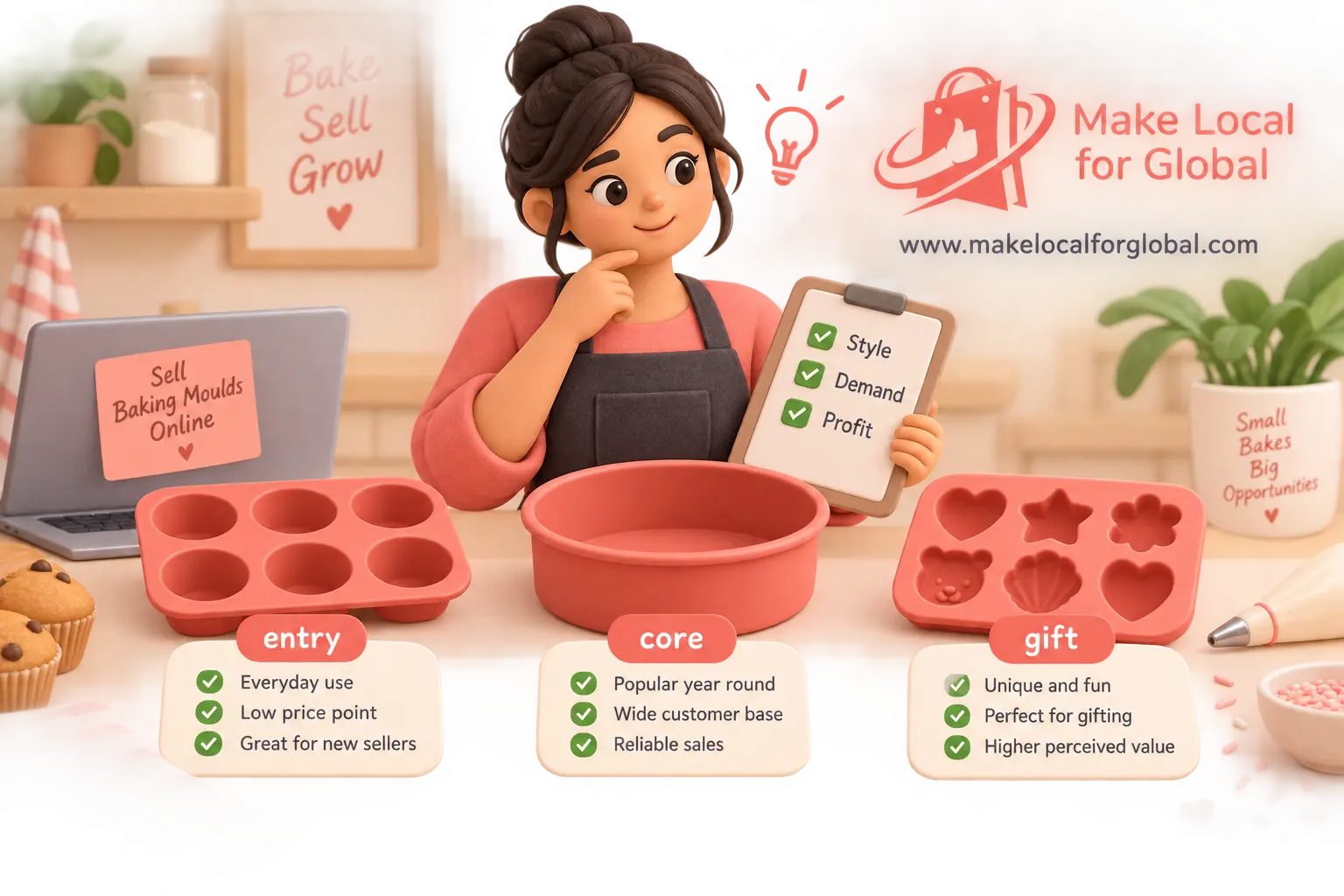
A small range can still give shoppers a choice. Use three roles rather than ordering many unrelated shapes.
| Role | Product idea | What to prove |
|---|---|---|
| Entry | Six-cup muffin or cupcake mould | Useful size, easy release and a clear low-risk price |
| Core | Round cake, loaf or tart mould | Cavity depth, stability and repeatable results |
| Gift | Heart, flower or seasonal shape | Shape detail, presentation and gift demand |
Use the roles as a starting test. Replace them when buyer conversations show a stronger use case.
Silicone is flexible and can make release simple. It needs a clear heat limit, care advice and a storage plan. Metal moulds feel firm and can suit buyers who want a structured tray, though they may need a different release method and more protective packaging.
Do not write “food-grade” from a supplier headline alone. Ask for the material specification, intended food-contact use, temperature range, care instructions and traceability details. Keep the evidence with the product record.
Send a short question list to each supplier. Ask which material is used, which foods and temperatures the product is intended for, how the cavities were measured and how the supplier handles a batch defect. Request product photographs, packaging dimensions and a sample from the same production method as the planned order.
Examples from UK retail pages show why these details belong on your own product record. Hobbycraft lists a six-well silicone tray at 32.5 by 18 cm with an oven limit of 230°C and dishwasher, freezer and microwave use. ProCook lists six silicone cupcake cases with a 230°C oven limit and a one-year guarantee. These are product-specific claims, not defaults for every mould. Read the supplier’s own evidence before publishing a specification.
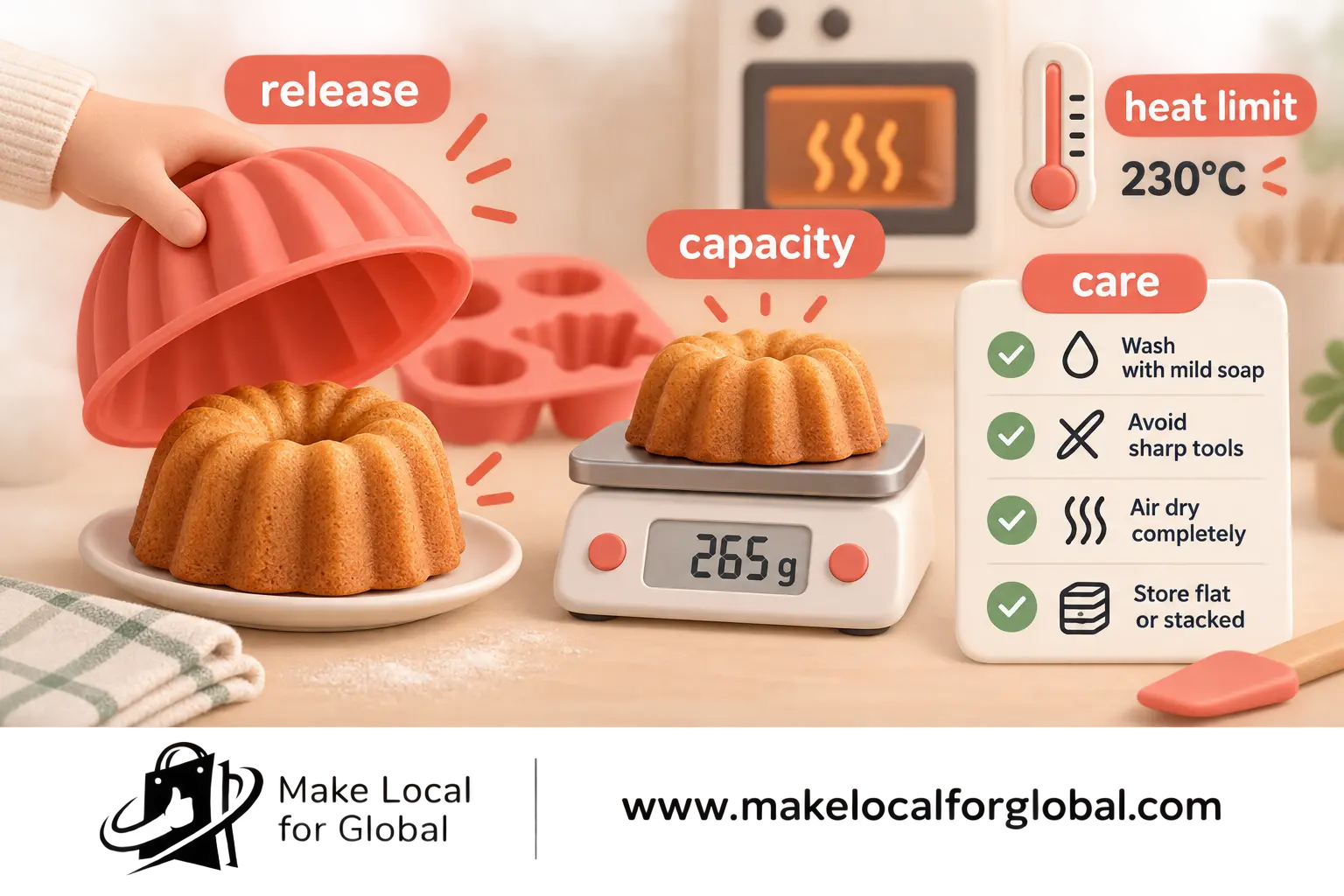
A sample that looks good on a desk can fail in a real kitchen. Run the same checks for each shape and record the result with photographs.
| Check | Method | Record |
|---|---|---|
| Release | Bake one recipe, cool it fully and turn it out without sharp tools | Clean release, torn edge or residue |
| Capacity | Fill a cavity with water and weigh the result | Approximate millilitres and cavity variation |
| Heat | Use the supplier’s stated limit and follow the oven instructions | Warping, odour, colour change or stable shape |
| Care | Wash using the stated method and dry fully | Staining, trapped water or surface damage |
Do not claim a test result for a whole batch from one sample. Keep the sample record with the supplier and batch details.
A baking mould touches food, so the material and intended use need careful treatment. The Food Standards Agency describes kitchenware and utensils as food-contact materials and provides guidance on authorisation requirements. Read the Food Standards Agency food-contact materials guidance and keep the evidence supplied for your product.
In Great Britain, the General Product Safety Regulations 2005 guidance says consumer products must be safe in normal or reasonably foreseeable use. If you import or manufacture, the OPSS advice for manufacturers and importers covers safety information, traceability, sample checks and action when a risk appears. Northern Ireland follows a separate product-safety route, so check the current guidance for the market you serve.
Once your sample checks are recorded, MLFG can help turn the evidence into a clear shop page with useful product information and a direct route to order.
A mould that costs £3 from a supplier does not cost £3 to sell. Add the product, inbound freight, packaging, payment fees, delivery, returns allowance and customer acquisition test. State whether VAT is included in your example.
| Cost line | Illustrative amount | Note |
|---|---|---|
| Mould and inbound freight | £4.20 | One entry silicone mould, allocated delivery included |
| Outer pack and paper protection | £0.85 | Small carton, tissue and tape |
| Payment and shop fees | £0.90 | Illustrative allowance, check your provider |
| Tracked delivery | £4.95 | Check the service, parcel size and current price |
| Returns and damage allowance | £0.60 | Set from your own order history after launch |
| Demand test allowance | £1.50 | Small content or advert test, not a guaranteed result |
| Total illustrative cost | £13.00 | VAT treatment depends on your business |
Illustration only. A £19.99 selling price would leave £6.99 before fixed overheads, tax and your own time. That is a contribution, not net profit.
Royal Mail lists a small parcel maximum of 45 cm by 35 cm by 16 cm and 2 kg. Use the parcel’s packed weight and dimensions when you price delivery. Its fragile-item guidance recommends a sturdy box, cushioning and dividers so the mould cannot move or hit the carton wall.
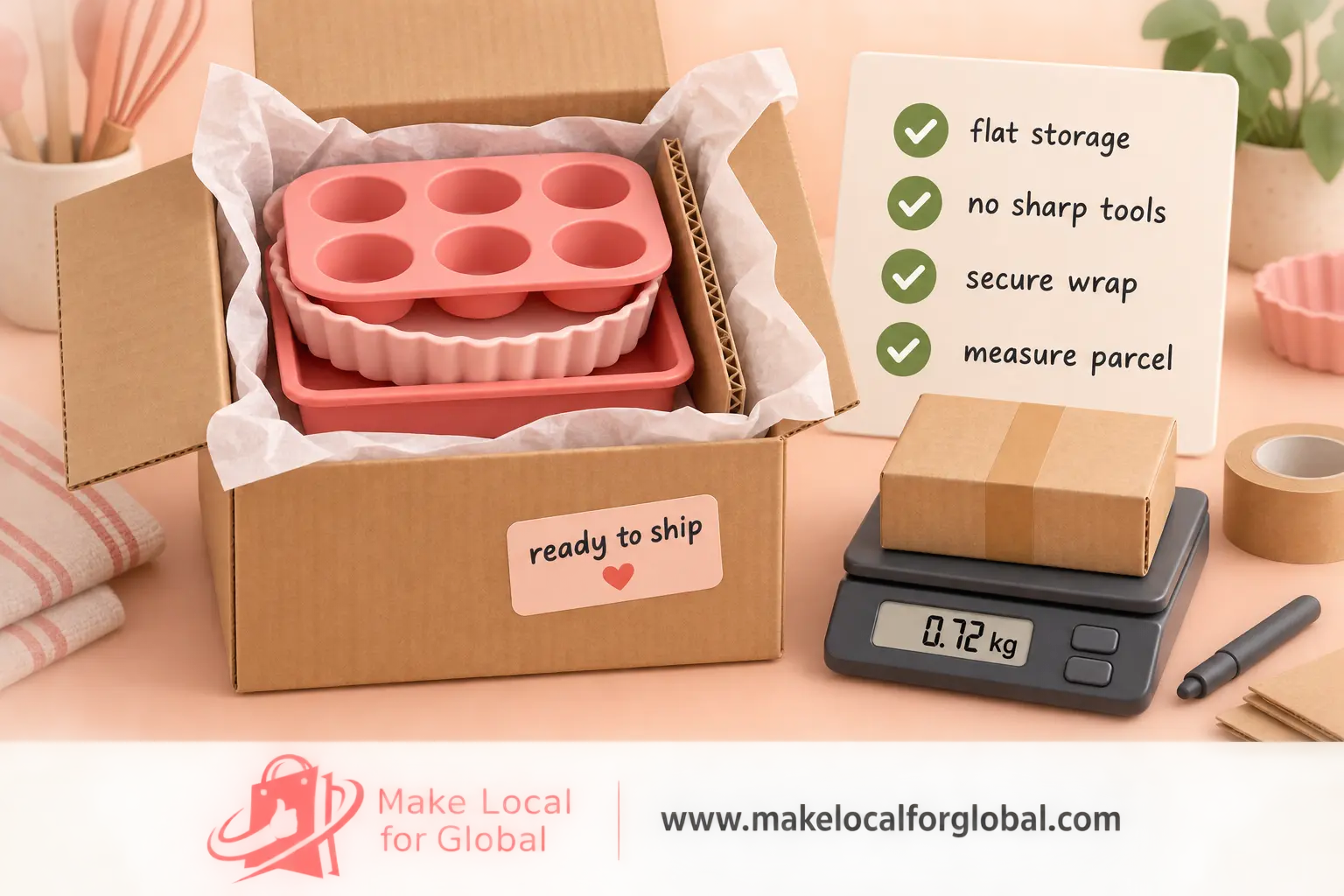
If your shop sells several kitchen products, you can compare the packing logic with the guide to selling beer mugs online. The products need different protection, yet both need a tested carton, a delivery allowance and clear customer information.
Use a title that names the shape, cavity count and main use. “Six-cup silicone muffin mould, 230°C oven safe” tells a buyer more than “pink baking tray”.
Write a short care section in plain language: wash before first use, let the mould cool, avoid sharp tools and store it flat or stacked as the supplier states. If the model is not suitable for a microwave, dishwasher or freezer, say so near the main specification.
Your first test can run on a simple product page, a marketplace listing or a small social campaign. Use one buyer, one hero mould and one measurable action. Track product-page visits, saved items, messages, email sign-ups and paid orders.

| Week | Action | Observation |
|---|---|---|
| 1 | Choose the buyer, shortlist three mould roles and request samples | Supplier response, evidence gaps and sample lead times |
| 2 | Run release, capacity, heat and care checks | Faults, repeatability and the claims you can support |
| 3 | Photograph the product, write the page and pack test orders | Buyer questions, packed weight and parcel damage points |
| 4 | Run one small demand test and review the cost record | Visits, messages, orders, returns and next stock decision |
Use observations to choose the next action. Do not order a large range from interest alone.
They can be easy to explain when the buyer can see the cavity size, use limits, care steps and a real baked result. A flexible mould still needs a stable handling and packing plan.
Ask for the exact material, food-contact evidence, temperature range, dimensions, care instructions, batch traceability and defect process. Request a sample from the production method you intend to order.
Start with a full delivered-order calculation. Add product, inbound freight, packaging, payment fees, delivery, returns and demand testing. Then choose a price that leaves a contribution after those costs, with tax and fixed overheads kept separate.
Check the product rules, food-contact requirements, labelling and distance-selling duties for each destination. Great Britain and Northern Ireland do not use identical product-safety routes, so write the market scope into your product record.
Pick one buyer, one entry mould and one sample test. Record the evidence, price the packed order and publish a product page that answers the questions a real baker will ask. A small, well-tested range gives you a cleaner next decision than a cupboard full of untested shapes.
MLFG can help you plan the page, connect the offer to your audience and build a practical next step for selling online.
PREFERRED SOURCE
Like what you’re reading? Add Make Local for Global as a preferred source on Google to see more of our articles when you search.

Build your online presence without having to figure out everything yourself.