

Review product information, order costs in £, supplier hand-offs, customer support and store records with a practical dropshipping health check.


A busy order dashboard can make a dropshipping store look healthy. But sales alone do not tell you whether customers understand the offer, whether an order moves cleanly from checkout to supplier, or whether the money left after each sale covers the costs you actually incur. A useful store health check looks at the whole operating path and marks the difference between evidence and assumption.
This guide gives you a practical way to review an existing store without treating one strong week as proof that every part of the business is working. You can also use the free Dropshipping Store Health Assessment to score six operating areas and create a personalised next-step plan.
It is a structured review of the systems that turn a product page into a completed customer order and a learning loop. It is not a score that predicts profit. Instead, it asks whether you can explain how the store works, what the customer is promised, what one order costs and how you respond when reality differs from the plan.
Review six connected areas: the product offer and buyer, order economics, supplier process, customer-facing information, service recovery, and records. A gap in any one area can affect the others. For example, an unclear delivery range can increase support contacts, while incomplete cost records can hide whether a promotion is affordable.
Start with one product and one likely buyer. Can someone visiting the page understand what the item is for, which variant suits them, what is included and what its limitations are? Compare the store page with current supplier information. Confirm details such as dimensions, materials, compatibility, dispatch location and variant names before relying on them.
Then look at actual questions and returns. Repeated questions about sizing or compatibility may indicate a page gap. A mismatch between a product photo and the delivered item can signal that an image, variant or description needs checking. Record the evidence and its date so you know which details need refreshing when a supplier listing changes.
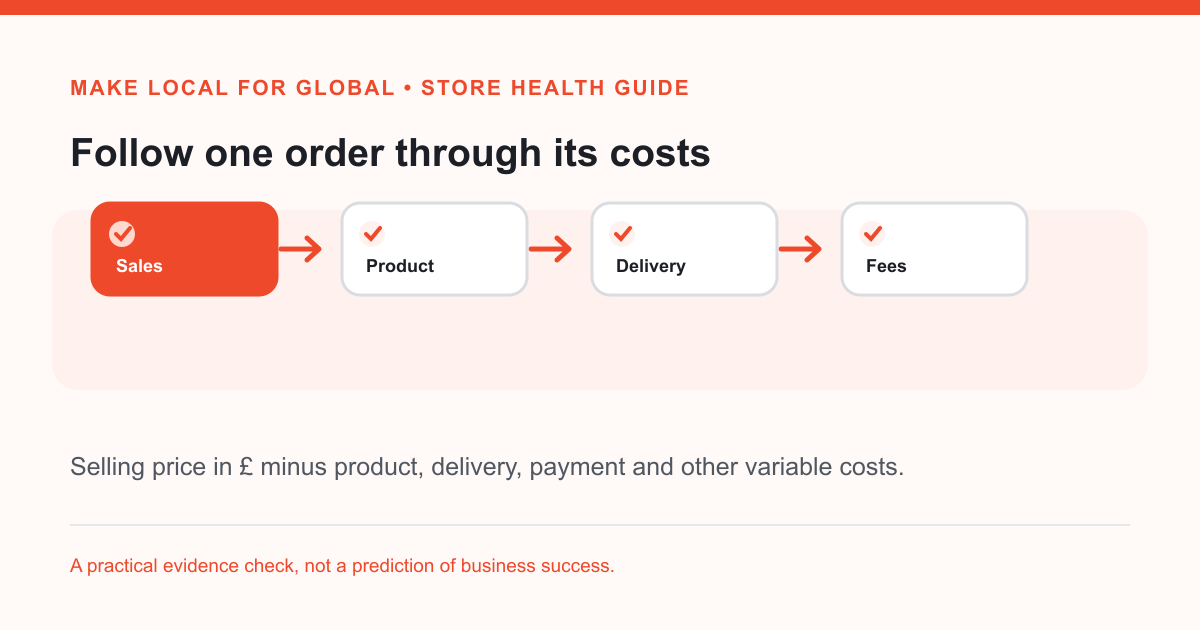
A markup is not the same as an order contribution. Choose a completed order and list the amount the customer paid in £, then subtract the product cost, supplier delivery, payment processing, platform charges, discount, refund or other costs that change with the order. If a supplier charge is in another currency, note the exchange-rate basis and date rather than silently mixing currencies.
Keep fixed costs separate from variable order costs, and be clear about what the calculation does not include. A simple review can tell you whether your current price and order mix deserve a closer look, but it does not replace bookkeeping, tax advice or a complete cash-flow plan.
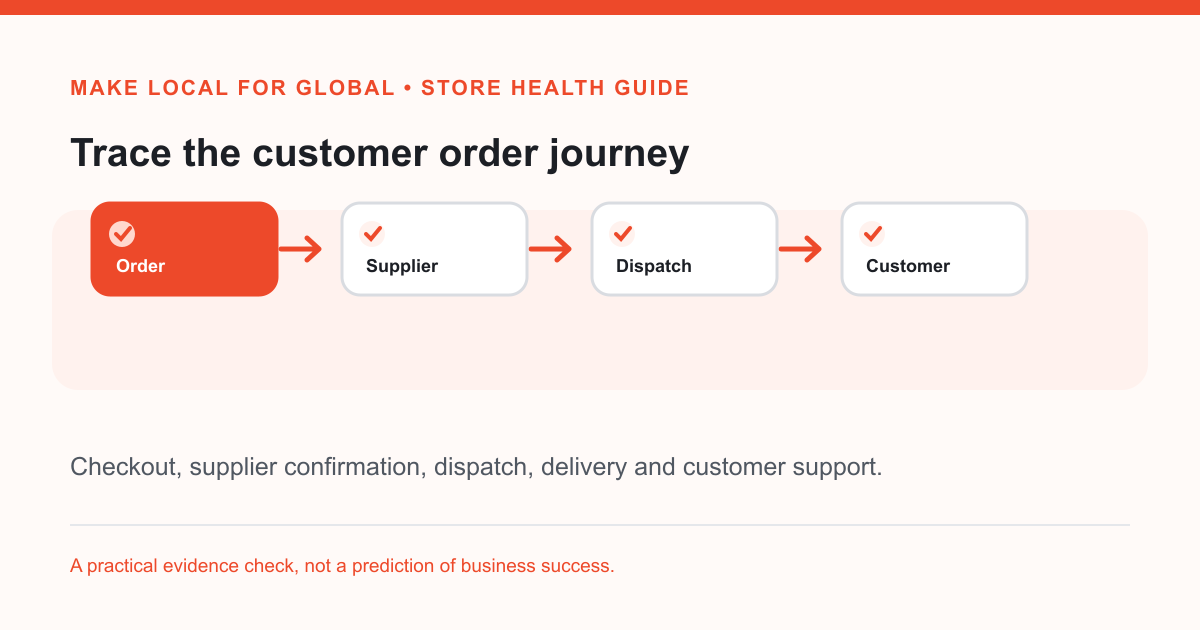
Map what happens after checkout. Who receives the order? How is the selected variant passed on? When does the supplier confirm it? What happens if stock is unavailable, an address is incomplete or an integration fails? Write down the owner and the next step at each hand-off.
A controlled test or a small sample of real orders can expose differences between the documented process and what happens in practice. Record the order date, supplier acknowledgement, dispatch, tracking updates and delivery outcome. If the main unknown is a supplier’s capability, use the Dropshipping Supplier Assessment to organise the questions you still need answered.
Check the full mobile journey, from product page to checkout. Can a customer find a realistic delivery range, the total price, a way to contact the business and clear returns information before ordering? Does the live wording match the operation you can actually deliver?
UK rules for online sales include information customers must receive before ordering, including the seller’s identity and contact details, product description, total price, payment and delivery arrangements. Requirements vary with the product and where you sell, so verify current official guidance for your circumstances. Start with the government’s online and distance selling guidance, and check the relevant returns and refund rules. This article is operational guidance, not legal advice.
For a late, damaged or incorrect order, decide who checks the case, what evidence is needed and when the customer receives the next update. The supplier or carrier may help investigate, but the store should have a clear customer-support route. Use accurate language: tell the customer what you know, what you are checking and when you will follow up.
Use the free assessment to review the product, costs, supplier process and customer experience in one focused pass.
Review your store healthKeep a short log of issue type, first response, resolution and any repeated cause. Patterns in the log can point to a supplier hand-off, product information or delivery expectation that needs attention. Avoid making a promise about an outcome until it has been confirmed.
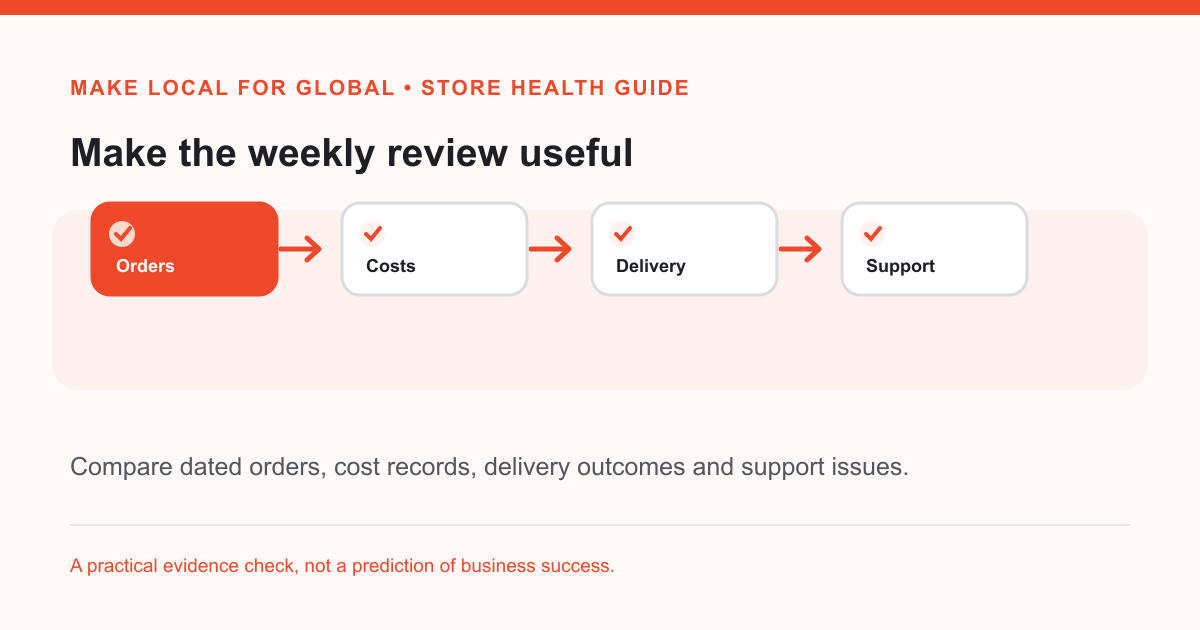
Choose a handful of measures you can explain and review them on a regular schedule. For example, compare the number of orders placed and fulfilled, delivery exceptions, refunds or cancellations, variable costs in £ and common support issues. Define the period and source for each measure. If a figure changes, look at the underlying orders before deciding what caused it.
Keep records that connect the customer order to the supplier charge and outcome. HMRC explains which VAT records a VAT-registered business must keep and the relevant retention period in its VAT record-keeping guidance. Check the current rules and any requirements that apply to your own business. The point of the review is not to collect every possible metric. It is to make one small, evidence-based decision at a time.
Do not expand the review into a complicated scorecard before you know what decision it should support. A useful first action might be to verify a delivery route, correct a product detail, confirm a supplier process or reconcile the cost of a completed order. Record what you expected, what you observed and what you will check next.
Review six operating areas, see your strongest signal and biggest gap, and download a practical next-step plan.
Use the free store health assessmentA store health check is most useful when it changes one practical decision. If order movement is unclear, review the delivery route. If supplier communication is the weak point, confirm the process before committing further. If your costs are incomplete, calculate one order in £ and note every assumption. If customer questions repeat, improve the page or support information that should answer them.
The assessment organises your evidence, highlights one priority gap and creates a three-page PDF plan you can revisit.
Start the store health checkFor related checks, compare your delivery process with the Dropshipping Delivery Risk Assessment and revisit order economics with the Dropshipping Pricing Lab. Each tool covers a different part of the operating picture.
PREFERRED SOURCE
Like what you’re reading? Add Make Local for Global as a preferred source on Google to see more of our articles when you search.





















Build your online presence without having to figure out everything yourself.