

Plan a digital product with clear creation costs, a testable price and cautious sales assumptions. Compare a six-month scenario in £.


A digital product can look simple from the outside: make a file, upload it, and sell a copy. The business behind it still has decisions to make. How much time and money will creation take? What does each sale leave after fees and refunds? How many people need to see the offer for a small test to be useful?
This guide shows how to model those moving parts without treating guesses as a forecast. You can also use the free Digital Products Simulator to compare cautious, working and stretch scenarios across six months.
Try the free simulator with your own price, creation costs, fees and audience assumptions. Adjust each input and see what changes.
It is a product delivered electronically rather than as a parcel. Examples include a printable planner, a spreadsheet, a design template, an ebook, a workbook, a pattern or a recorded course. The format changes how the product is made and delivered, but it does not remove the work of understanding a buyer, describing the offer, supporting customers and keeping records.
A useful first version has a clear audience and job. “A template” is a file type. “A weekly stock-count sheet for independent gift shops” describes a more testable offer. You do not need a perfect niche before beginning, but you do need a specific enough promise to ask potential buyers useful questions.
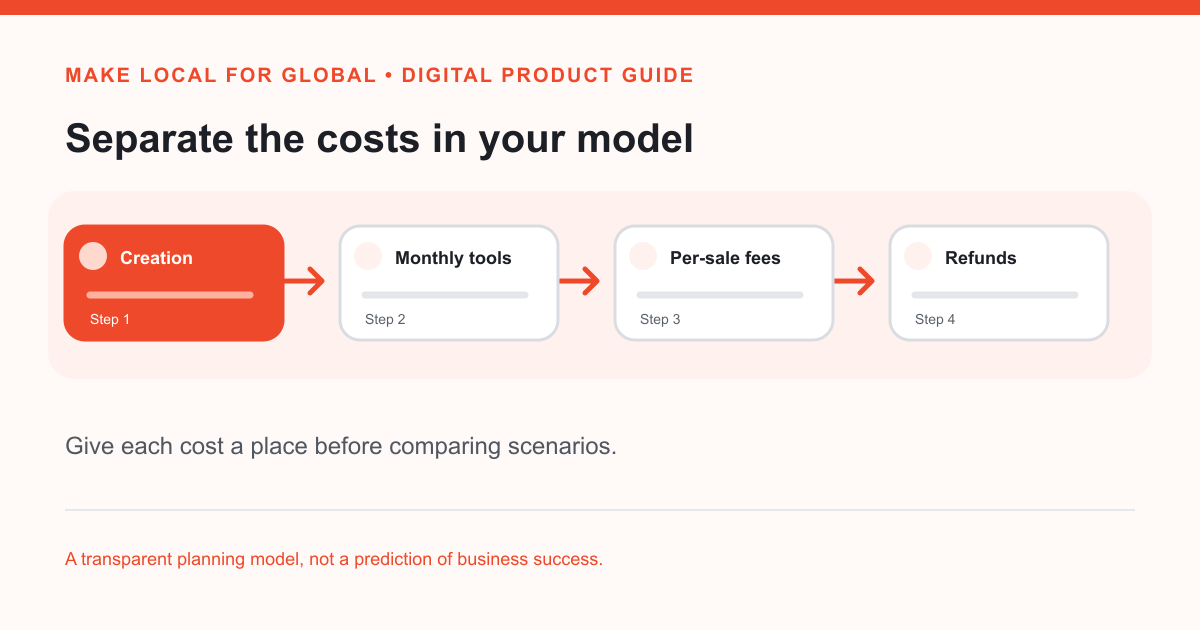
“Digital” does not mean cost-free. Start by listing what you spend to make a usable first version, then note the expenses that continue while the product is available. Finally, estimate which charges happen when a customer buys or requests a refund. The goal is not false precision. It is to make assumptions visible enough to test.
| Cost group | Examples | Model it as |
|---|---|---|
| Creation | Research, design, writing, editing, testing | One-off setup cost, including a value for your time if useful |
| Recurring tools | Software, website, storage, email platform | Monthly amount for the period you are modelling |
| Per-sale costs | Marketplace, payment or transaction fees | A fee per completed sale or a percentage from current provider terms |
| After-sale costs | Refunds, customer support, updates | A stated rate or time allowance, then revisit it with evidence |
Keep tax treatment separate from a simple operating scenario. VAT depends on the product, customer location, registration status and sales route. If you sell downloads or streaming content to consumers, check the current UK guidance on online selling and digital content. For digital services supplied to consumers in other countries, read the relevant HMRC VAT guidance or get tailored advice. The simulator deliberately does not calculate tax.
A PDF is not automatically worth less than a video, and a large download is not automatically useful. Price should reflect what the product helps a particular buyer do, what is included, how easy it is to use, the alternatives available and the cost of delivering support or updates. A price is a proposition to test, not a value established by the file extension.
Work out the amount left from one sale after the variable charges you have listed. For example, if an item is priced at £19.00, the estimated refund rate is 4% and your combined fee estimate is £1.10, the modelled contribution is about £17.14 before fixed tools, creation cost, tax and your own labour. These are illustrative inputs, not a recommended price or a promise about what customers will buy.
For a deeper pricing exercise, read our guide to pricing digital products such as planners and templates. It covers how to think about price, value, fees and what the customer receives.
A scenario needs a path between the people who might see an offer and completed purchases. You could start with an audience estimate, a page-view estimate and a conversion assumption. Keep the stages distinct: a social follower is not automatically a store visitor, and a visitor is not automatically a buyer.

Start with a cautious case that you can explain. A working estimate can represent your current best assumptions, while a stretch case asks what would happen if they were stronger. These are not industry benchmarks. If you do not have your own data, mark the inputs as hypotheses and use small experiments to improve them.
Run cautious, working and stretch assumptions in the free simulator. The difference between them can show which unknown is worth checking first.
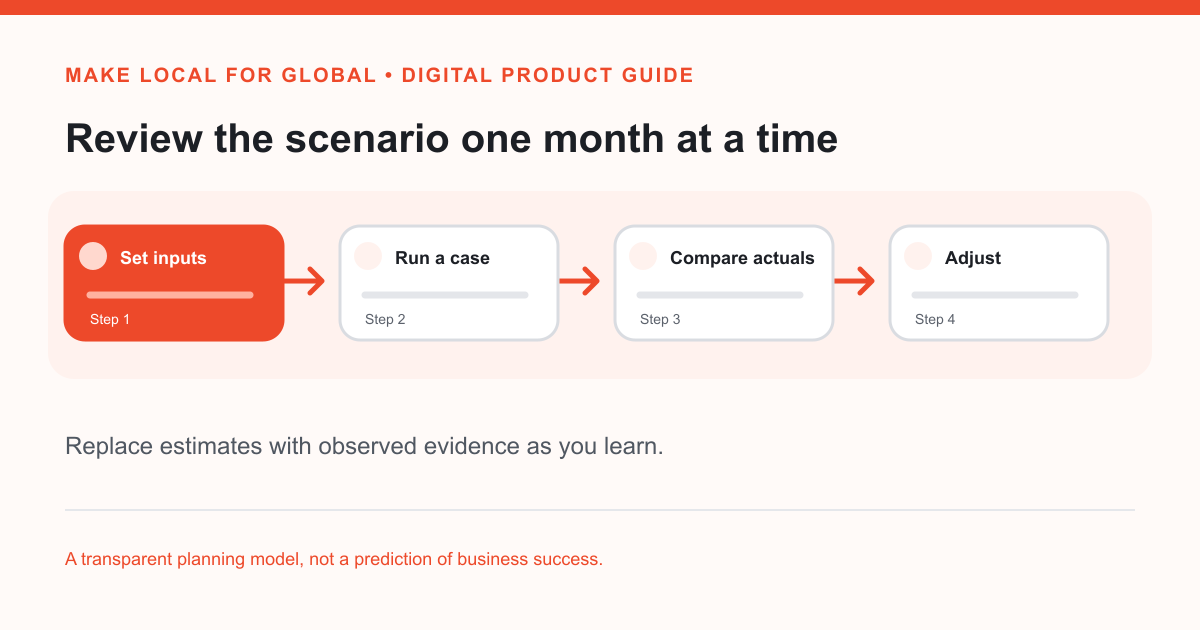
The simulator estimates sales by applying your audience and conversion assumptions, then adjusts the scenario and subtracts the costs entered. Fractional sales are expected values across a scenario, not part-orders. “Money after listed costs” is not the same as profit you can take home: it excludes tax and any cost you did not include. Break-even is only as useful as the inputs and cost categories behind it.
Use the month-by-month view to see when recurring tools and initial creation spend are included. Ask what changes if the audience does not grow, conversion is lower, refunds are higher or the launch takes longer. If one input dominates the result, treat it as a priority for evidence gathering rather than a reason to commit more money.
Before building a large catalogue, use a small test to find out whether the offer is understandable and useful. A test can be a buyer conversation, a sample page, a prototype shared with permission or a small launch with a clear budget and stop point. Follow the rules that apply to your route, especially where you collect personal details or take payment.
If you sell downloadable digital content to UK consumers, GOV.UK notes that extra rules can apply to instant downloads, including specific pre-download agreement and acknowledgement requirements where a customer loses the 14-day cancellation right. Check the current official online selling guidance and get advice for your specific offer. Do not copy a generic checkout setting without understanding what it asks the customer to agree to.
There is no single reliable starting cost. It depends on the product, tools, platform, time, support and marketing you choose. List one-off and recurring costs separately, then verify provider charges before committing.
There is no universal rate that applies to every audience, offer, channel and stage. Use a cautious placeholder if you lack data, label it clearly and replace it with your own measured results when available.
No. You may continue to pay for software, web hosting, platform fees, customer support, updates, refunds and promotion. Some of these vary by sale; others continue each month.
No. It is a simplified planning tool and does not determine whether you need to register, charge or account for tax. Check official guidance for your circumstances or speak to a qualified adviser.
A useful plan does not need a perfect forecast. It needs clear assumptions, realistic costs and a way to compare them with what happens. Build one focused product idea, talk to intended buyers, verify your delivery and fees, then update the model as evidence arrives.
Use the simulator to organise a six-month working scenario, then review the result against real evidence. For help taking the next step, see the MLFG plans or talk through your project.
For general questions about building an online store, visit the MLFG contact page. The model and this article are educational, not financial, tax or legal advice.
PREFERRED SOURCE
Like what you’re reading? Add Make Local for Global as a preferred source on Google to see more of our articles when you search.






















Build your online presence without having to figure out everything yourself.