READY TO SELL bike lights ONLINE?
Get a store built for you in 5 days, plus training and support to help you start, run, and grow your Alternative business.

Plan a bike-light range with practical sample tests, full per-order costs, UK lighting and battery checks, clear product pages and a measurable 30-day launch.


Bike lights look like a simple product, yet buyers need confidence in three things: the beam is useful, the mount stays put and the battery lasts for their rides. Sellers who answer those questions clearly can build a focused range instead of competing on a vague “bright light” claim.
A practical way to start is with a dependable front and rear set, a compact backup option and a clear guide to fitting, charging and safe use. Test demand before placing a large order, then use real sample checks and full order costs to choose what earns a place in the shop.
When customers compare beam pattern, fitting and battery details, a well-structured shop can make those answers easy to find on a phone.

Start with a buyer and a riding situation, not a long list of technical claims. A commuter who parks outdoors may care most about quick removal and USB charging. A leisure rider on unlit lanes may care more about a steady beam, secure mounting and a backup rear light.
| Buyer or use | Range idea | Details to show |
|---|---|---|
| Everyday commuting | Front and rear rechargeable set | Charging port, charge time, runtime by mode, mount type |
| Unlit routes | Steady front beam plus rear light | Beam shape, aim guidance, weather notes and tested runtime |
| Short urban trips | Compact clip-on pair or backup light | How it attaches, removal steps and battery indicator |
| Gift buyers | Matched set with a charging cable | What’s in the box, compatibility and gift-ready packaging |
These are starting points, not fixed customer segments. Ask local cycling groups, workplace commuters or repair shops which problem they see most. A short survey can help, but a small preorder or paid pilot gives stronger evidence than “I would buy that” answers.
Keep the first range easy to explain: an entry set, a higher-output set with verified specifications, and a small rear-only backup. Add helmet, side or dynamo-powered lights only after customer questions and supplier evidence justify them. A helmet light should be presented as an extra light, not as a replacement for a correctly fitted cycle light.

Ask a supplier for the exact model number, product specification, instructions, test evidence, battery chemistry and the name of the manufacturer. Ask what changes between batches and how faults or safety notices are handled. Keep purchase records and supplier details so each item can be traced.
Order samples from the same production version you intend to sell. Test the light on the types of handlebar and seatpost named in the listing. Check that rubber straps sit flat, the mount does not twist under hand pressure, and the light can be removed without tools if that is part of the offer.
Do not copy claims such as “waterproof”, “road legal” or a particular lumen figure without evidence for that exact model. Lumens alone do not tell a buyer how the beam is shaped or aimed. Describe the maker’s measured specification, then separate it from your own hands-on observations.
Clear product pages, useful comparisons and a simple contact route help a small seller answer buyer questions before they abandon a basket.
For pedal cycles used between sunset and sunrise in Great Britain, GOV.UK describes a white front light, red rear light, red rear reflector and amber pedal reflectors. Its guidance says lamps may be steady or flashing, with requirements for certain flashing lights, and advises a steady front light on unlit roads. The rules apply to mainland Great Britain, not Northern Ireland, and sellers should check the latest rules for each market they serve. Read the current GOV.UK cycle lighting guidance before making compliance claims.
Product sellers have safety duties too. Businesses that make, import, distribute or sell consumer products must take steps to make sure products are safe and meet applicable labelling rules. If you import or sell under your own brand, your responsibilities can differ from those of a retailer reselling a UK-sourced product. Start with GOV.UK product safety advice for businesses and get specialist advice where your role or the market is unclear.
Bike lights often contain batteries. If your business is the first in the selling chain to place batteries on the UK market, including batteries inside a product, producer-responsibility duties may apply. Separate retailer take-back rules can depend on the quantity of portable batteries supplied. Read GOV.UK battery producer guidance and retailer and distributor guidance to identify the rule that matches your role and volume.
For online orders, show the business identity, total price, delivery terms and cancellation information before checkout. GOV.UK explains the distance-selling information requirements and the rules for cancellations, returns and refunds. This is general information, not legal advice.
List every cost attached to one order. The example below is hypothetical, assumes a UK sale to a consumer and uses illustrative figures. Replace them with written supplier quotes, your payment rate and actual postage. The VAT treatment depends on your business and prices, so check your own accounting setup.
| Per-order item | Illustrative cost |
|---|---|
| Front and rear light set | £9.20 |
| Inbound freight allocation | £0.75 |
| Box, insert and protective packing | £0.60 |
| Payment fee estimate | £0.79 |
| Tracked postage paid by seller | £3.49 |
| Returns and fault allowance | £1.25 |
| Customer acquisition test | £3.50 |
| Total listed variable costs | £19.58 |
| Example customer price | £24.99 |
| Contribution before overhead and tax | £5.41 |
Illustration only. Figures are not a supplier quote or a prediction of sales. Contribution is not net profit.
The arithmetic is £24.99 less £19.58 = £5.41. That contribution still has to cover fixed costs such as software, insurance, storage, accountancy, your time and tax. If VAT applies, build the calculation from the correct net sales and recoverable cost amounts instead of treating VAT collected as income.
Compare a single set with a two-bike household bundle or a set plus a rear backup. A bundle can raise the order value, but only if the extra items solve a real need and do not add more picking, packing or returns cost than the contribution they bring.
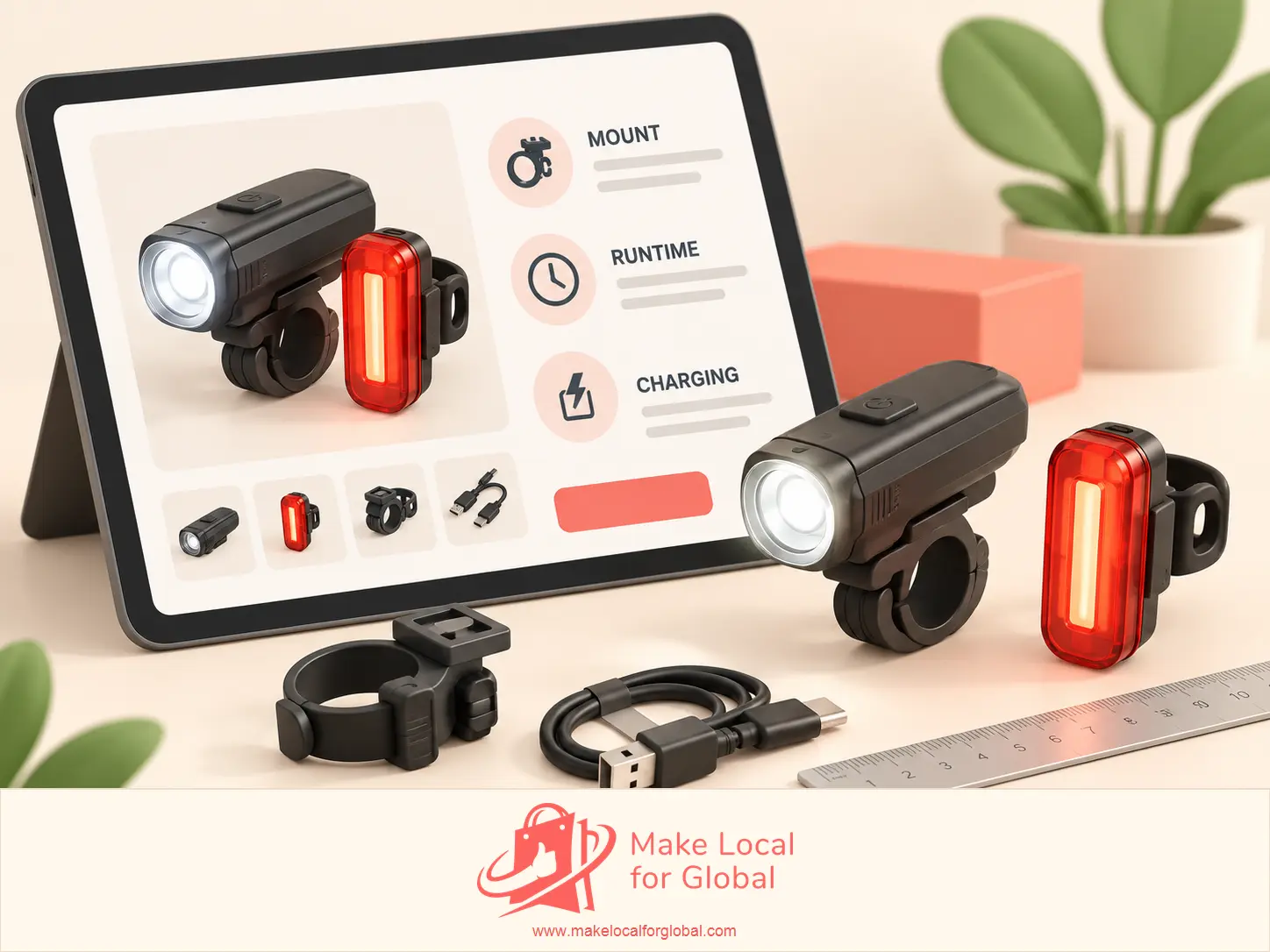
A useful title names the product and the buyer benefit without promising a result: “USB-Rechargeable Front and Rear Bike Light Set for Daily Commuting”. Then show the front and rear lights together, each mount, the charging port, the size in a hand and the actual contents of the box.
Use your own photographs against a neutral background and on a real compatible bicycle. A short clip can show the mount being fitted and removed. Never stage road use in a way that distracts a rider or creates a hazard.
A direct shop gives you control over product education and customer questions. Marketplaces can expose a new seller to people already browsing, but compare their current fees, listing rules and return processes before calculating margin. Do not treat visits or likes as proof that the price works.
Try one search-focused product page, a local commuter-group feedback session and a small paid test with a fixed spending cap. Track product-page visits, add-to-basket rate, completed orders, questions about fitting, cancellations and returns. If visitors leave after checking compatibility, improve the mount details before buying more stock.
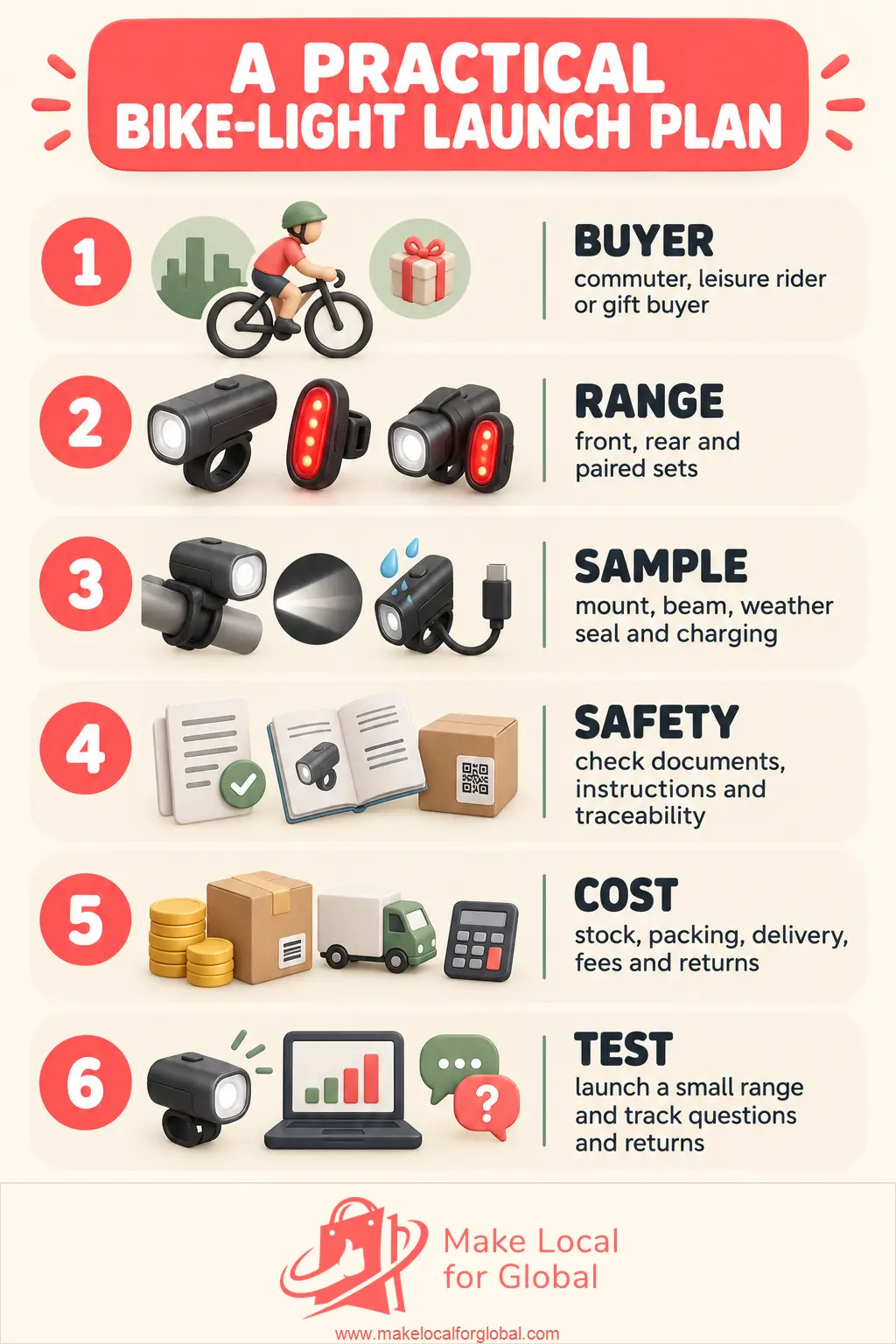
| Week | Actions | Evidence to review |
|---|---|---|
| 1: Listen | Interview 8 to 12 likely riders; record commute, route and mounting needs. | Repeated problems and requested price range |
| 2: Verify | Request documents, compare suppliers and test samples across named mounts and modes. | Runtime records, defects, fit limits and complete landed cost |
| 3: Present | Photograph the set, write the product page and publish shipping, returns and safety details. | Can a first-time buyer identify what’s included and whether it fits? |
| 4: Measure | Run a small channel test, answer questions and review each order or abandoned basket. | Contribution per order, fit questions, faults and return reasons |
At the end of the month, keep only the models that pass your quality checks and have evidence of buyer interest at a price that leaves contribution after variable costs. Update your listing when batch details or instructions change.
Yes. One well-tested front and rear set can be a sensible pilot. Make the fit limits and test evidence clear, then add variants only when buyer feedback points to a specific need.
Confirm the supplier, manufacturer, model, safety documents, instructions, battery details, labelling and traceability. Work out whether your business is acting as an importer or first seller in the chain, since that can change your duties.
GOV.UK says lights are not required to be fitted at the point of sale, but any lights that are fitted must meet the relevant rules. Separate rules apply to their use on roads after dark. Check the official guidance for the area where you sell and the claims you make.
Show the light attached to a compatible bar and seatpost, give dimensions and explain how the mount works. Publish realistic runtime conditions, box contents, charging details, delivery times and the return process.
Test both models with your target riders. Rechargeable versions may reduce the need to buy disposable cells, but buyers may care about charge time, cable type or access to a charger. Replacement-cell versions need clear battery specifications and safe handling information. Compare the full landed cost and supplier evidence.
Make Local for Global can help you present your offer and give potential customers a clear route to ask about it. Tell the team what you plan to sell and where you need help.
PREFERRED SOURCE
Like what you’re reading? Add Make Local for Global as a preferred source on Google to see more of our articles when you search.

Build your online presence without having to figure out everything yourself.