

READY TO SELL bookends ONLINE?
Get a store built for you in 5 days, plus training and support to help you start, run, and grow your Alternative business.

A practical guide to selling bookends online, from choosing a customer and testing metal, wood or stone-look designs to building bundles, pricing every cost and launching a focused shop.


Bookends are small products with a clear job: keep books upright and make a shelf look finished. That makes them a useful category for a focused ecommerce shop, a home décor collection, a bookshop add-on or a personalised gift range.
You do not need dozens of shapes to start. Choose a clear customer, test how the product behaves on a real shelf, price the full delivered cost and build a product page that shows size, weight, grip and finish.
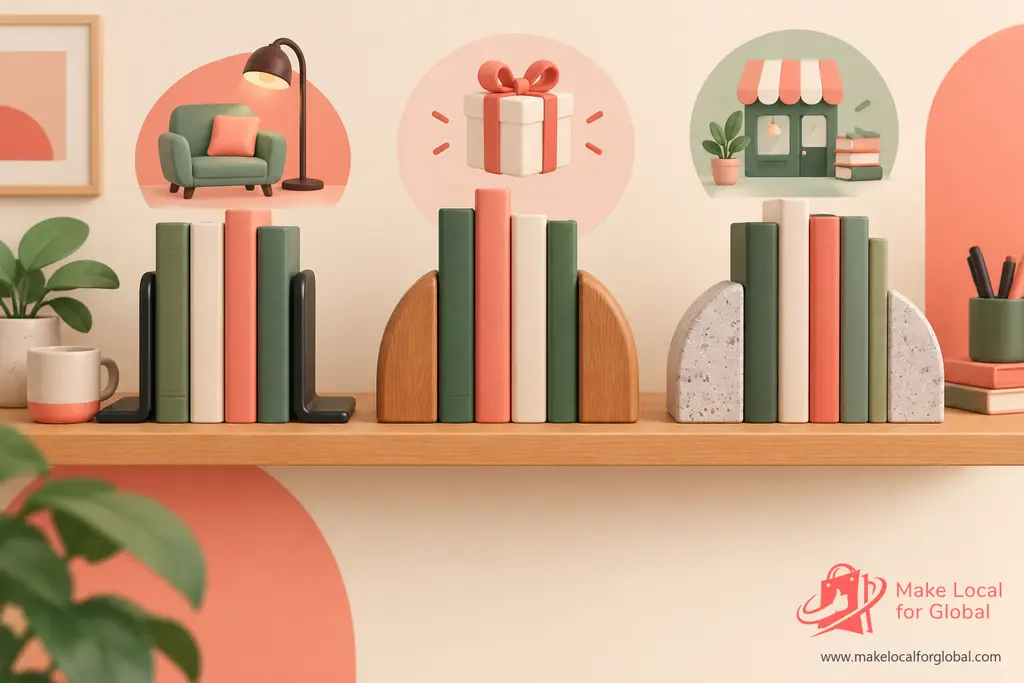
People buy bookends for more than storage. A reader may want a calm reading corner, a parent may need a safer shelf for children’s books, and a gift buyer may want initials, a favourite animal or a literary reference.
Commercial buyers have different questions. Independent bookshops, offices, schools, libraries, holiday lets and interior stylists care about repeat supply, consistent finish, safe packaging and a sensible price per pair.
Pick one main lane for the first collection. A shop that tries to sell classroom metal supports, luxury stone pieces and novelty animal shapes at once can feel unclear.
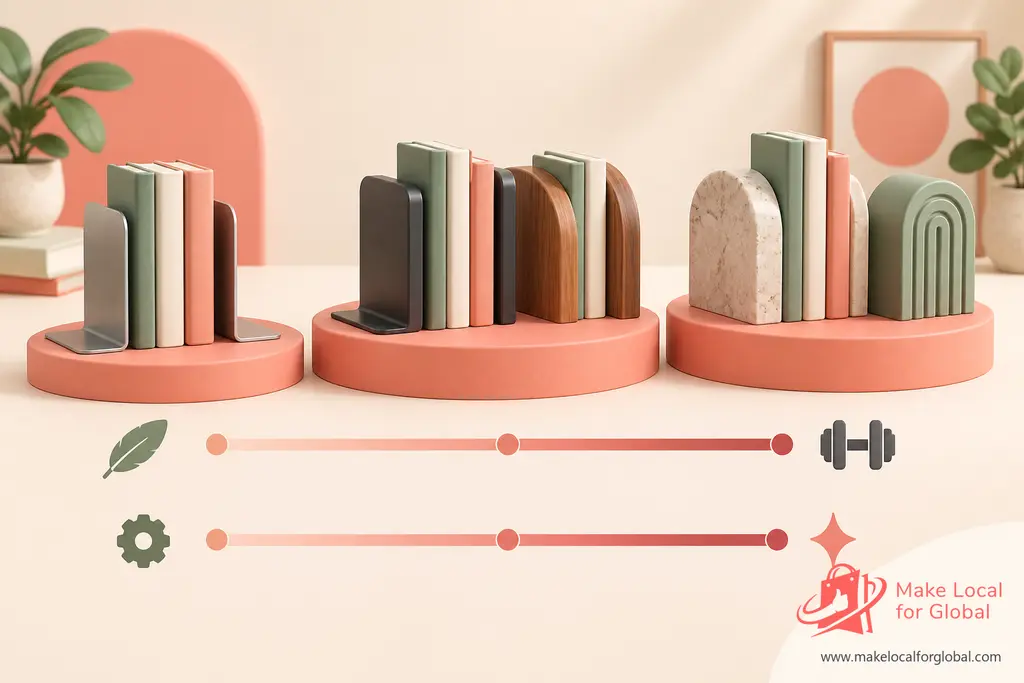
Material affects stability, appearance, packing cost and the type of customer you can serve. Ask suppliers for the actual dimensions, weight, base thickness, surface finish and load test method rather than relying on a styled photograph.
Steel and aluminium supports suit customers who want a slim product that can hold a row of heavier books. Check whether the base flexes, whether paint chips at the edges and whether the feet leave marks on a wooden or painted shelf.
Wood can sell as a home accessory as well as a functional item. Confirm the timber or board type, finish, moisture protection, grain variation and whether the base has enough weight for the size of the piece.
These materials can create a premium look, but breakage and parcel weight need careful testing. Ask for drop-test samples, corner protection and a clear replacement process before placing a larger order.
Adjustable bookends can help readers organise changing shelf sections. The moving part must stay firm, the base must sit flat and the mechanism should not scratch the shelf or catch on book covers.
A three-tier range gives customers a starting point without creating a catalogue that is hard to manage.
Keep the differences visible. Show the weight, dimensions, supported shelf depth, material, finish and the number of books each design is intended to hold.
A bundle should make the shelf easier to organise or the gift easier to give. Avoid adding an unrelated item just to raise the order value.
MLFG can help turn a broad product idea into a focused range, shop structure and launch plan.
Bookends are easy to compare when the shopper can see which design fits the shelf, the books and the budget. Use plain labels rather than making the reader decode material jargon.
| Bookend type | Best for | What sells it | Be clear about |
|---|---|---|---|
| Slim metal pair | Students and home offices | Low profile and easy storage | Base size, grip and shelf marks |
| Heavy metal pair | Large hardbacks and offices | Stability and long use | Weight and lifting guidance |
| Decorative wood | Living rooms and gifts | Warm finish and display appeal | Timber, finish and variation |
| Stone-look or resin | Statement shelves | A sculptural focal point | Weight, breakage and care |
| Personalised pair | Housewarming and reader gifts | A personal message | Character limits and production time |
Use your own supplier measurements and tested load guidance before publishing a product claim.
The factory price is not your profit. Add inbound freight, duty where applicable, inspection, packaging, storage, payment fees, marketplace fees, delivery subsidy, replacements, returns and marketing.
For a simple example, a pair that costs £7.50 to make may reach £12.80 before customer delivery after freight, packaging, payment allowance and damage allowance. A selling price of £24.95 leaves room for overheads only if your real figures support it.
Show the reason for the price. “Premium” alone is not a reason. Weight, finish, design detail, personalisation and packaging give the customer something concrete to compare.
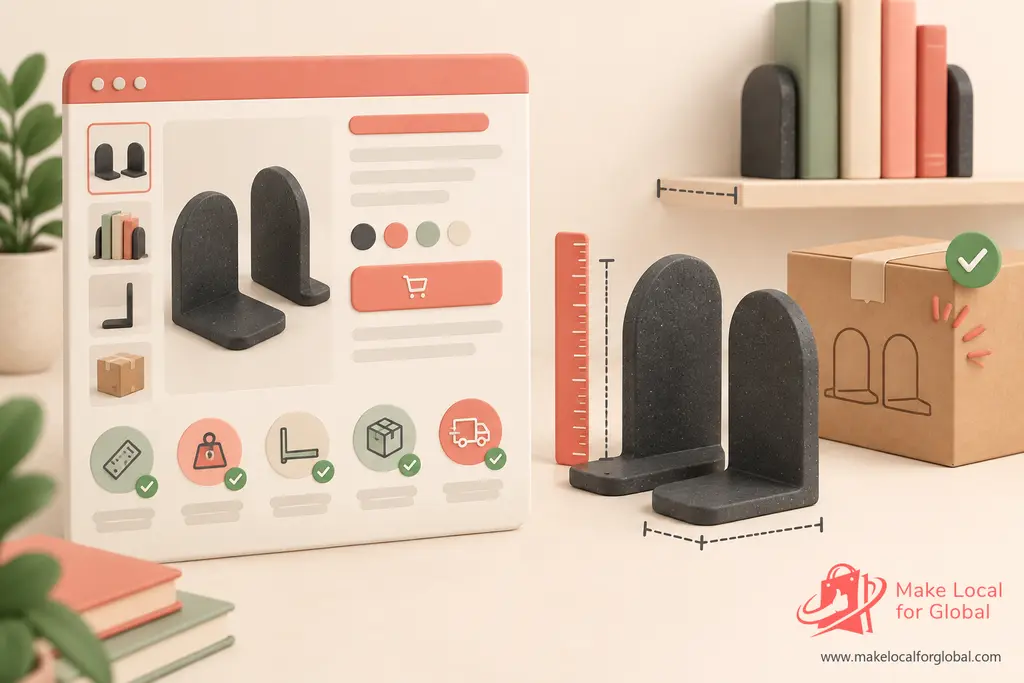
Customers cannot feel the weight or see the base from a small marketplace thumbnail. Your product page needs to answer those questions before checkout.
Photograph the product holding paperback novels, large hardbacks and a small group of children’s books. Add one scale photograph in a hand and one shelf photograph from the front.
For personalised products, show the exact lettering style, a real example, the character limit and the approval step. This prevents a gift buyer from guessing.
MLFG can organise your collection, product information, delivery details and mobile shop so customers can make a clear choice.
Ask for samples from more than one supplier. Test the product on a shelf, push a full row of books against it, move it repeatedly and inspect the base for marks.
Drop-test the packed parcel from several sides. Stone, ceramic and resin may need corner protection, while thin metal edges can cut through weak cardboard. Record the result and change the pack before taking paid orders.
Keep supplier names, batch details, material information, warnings and complaint records. Check current UK product safety and consumer guidance before launch, especially if you import or sell products for children’s rooms.
Bookends are visual. A simple shelf photograph can show the material, scale, colour and purpose in one frame.
Use search phrases naturally, such as “wooden bookends”, “heavy bookends for large books”, “bookends for children’s shelves” and “personalised bookends”. Write for the customer first and use the phrase where it fits.
Organise the shop by use case or material, not by a long list of similar names. Let customers filter by decorative, adjustable, heavy-duty, personalised, wood or metal.
If the collection is small, a focused one-page shop can work well. Add a full catalogue only when the products and customer questions justify it.
Record which design sells, which colour is chosen, what customers ask before buying and why anyone returns a pair. This tells you more than a guess about what people might like.
After 25 orders, improve the product pages. After 50, review bundles and packaging. After 100, decide whether to reorder the core product, add a new finish or test a trade offer.
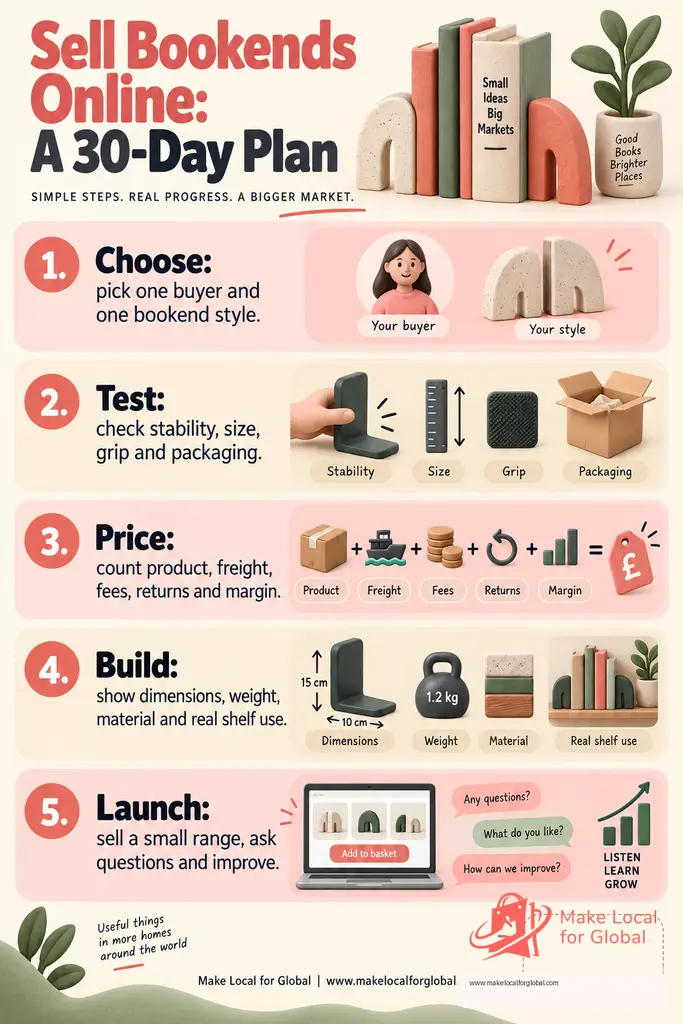
The roadmap keeps the first month manageable: choose one buyer, test the bookend, price the full order, show the evidence on the product page and use early customer questions to improve the range.
Start with a clear collection, helpful product pages and a shop that is easy for readers and gift buyers to use.
They can be, when the product has a clear use and the listing proves stability, size and finish. Decorative and personalised options can support gift sales, while simple metal pairs can support repeat and trade orders.
There is no single best style. Slim metal suits practical buyers, heavier pieces suit large books, and decorative or personalised designs suit home décor and gifting.
Show the pair beside real books, state dimensions and weight, explain shelf depth, show the base and describe material variation. Pack fragile pieces with enough protection.
Most customers expect a pair, so make quantity clear in the title, photos and checkout. Single supports can work for trade or modular designs, but label them clearly.
You can test demand through a marketplace or social channel, but a website gives space to explain the range, collect customer questions and build repeat sales.
Bookends sell when the customer can picture the finished shelf and trust the product to do its job. Start with one clear lane, test the samples, show the details and let the first orders guide the next collection.
PREFERRED SOURCE
Like what you’re reading? Add Make Local for Global as a preferred source on Google to see more of our articles when you search.