

READY TO SELL Designer handbags ONLINE?
Get a store built for you in 5 days, plus training and support to help you start, run, and grow your Alternative business.

Learn how to sell designer handbags online: choose a sourcing model, verify provenance, grade condition, price full costs and ship high-value bags safely.


A designer handbag can carry a high selling price, but that price depends on more than the label. Buyers need confidence that the bag is genuine, the condition is described accurately, the dimensions suit their needs and the parcel will arrive safely. Those details shape the whole business: how you source stock, what evidence you keep, how you photograph each item and how much money remains after a sale.
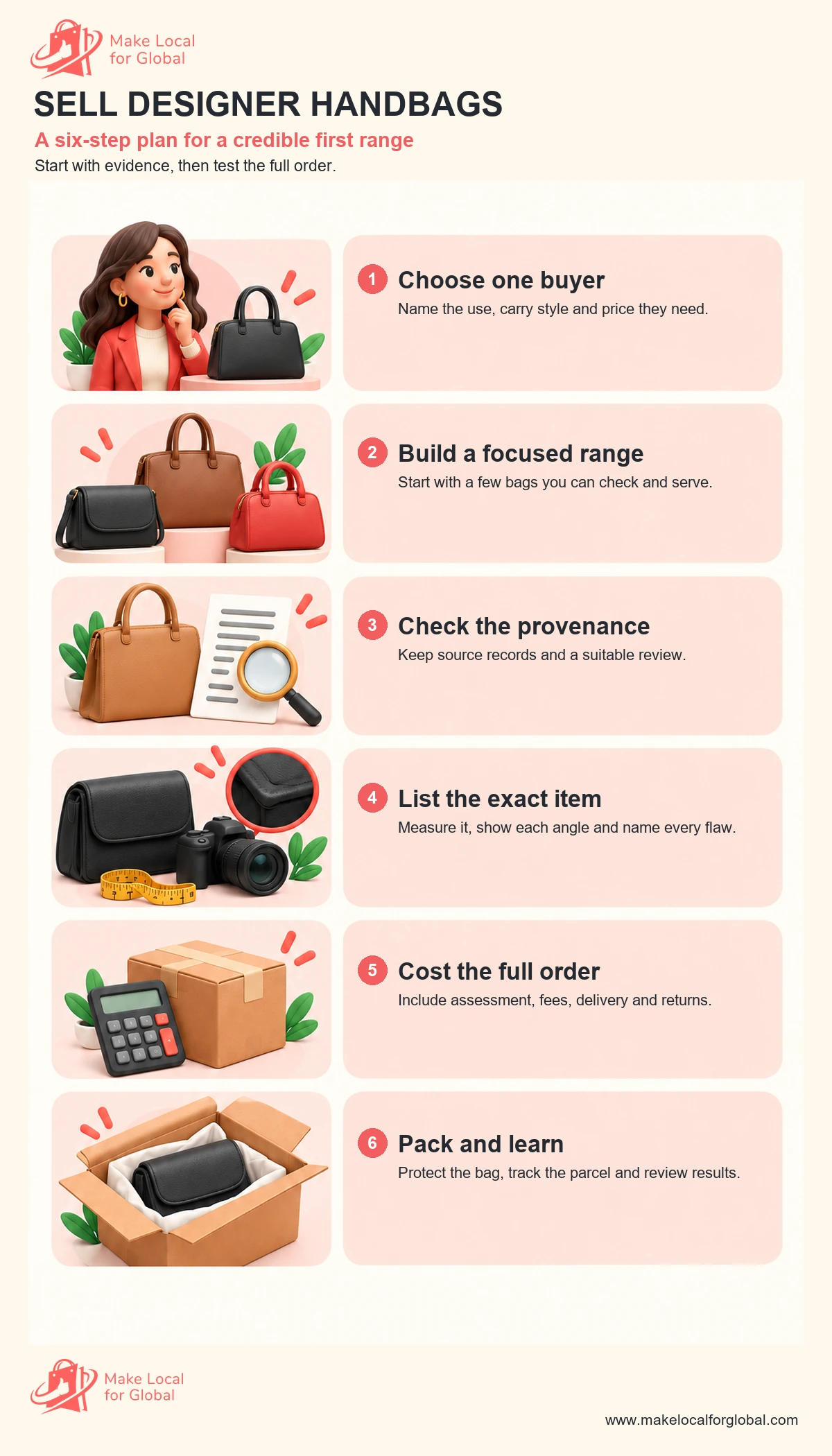
To sell designer handbags online, choose a trading model first. You might resell authenticated pre-owned bags, sell new branded products through authorised supply, or create handbags under your own label. Build a small range around one buyer, verify every claim, test your listing and calculate the full order cost before buying stock. The sections below take you through those decisions from demand checks to after-sales support.
Compare buyer demand, sourcing evidence, cash needs and fulfilment for a physical product range before you place an order.
“Designer handbags” can mean several different businesses. The source of your products changes your paperwork, inventory, listing language, cash needs and risk. Keep the routes separate in your notes and do not use a resale process for new wholesale stock without adapting it.
A resale shop buys individual bags from private sellers, trade suppliers, auctions or consignment partners and sells them on. The inventory may include one example of a style, colour and condition. Each unit needs its own record and photographs. A repeatable process for checking source, authenticity indicators, condition and return handling matters more than a large catalogue.
You can buy items outright, sell on consignment or operate a hybrid. Buying outright gives you control over the listing and dispatch, but your cash stays tied up until the item sells. Consignment can lower the cost of acquiring stock, though you need written terms for ownership, price changes, payout timing, returns, damage, authentication and what happens if an item cannot be sold.
Do not treat a supplier’s statement that a bag is “authentic” as proof by itself. Ask what evidence comes with the item, who carries the loss if a test fails, whether the seller accepts returns for an authenticity dispute and whether you may inspect the item before paying. Keep the answers with the specific stock record.
New branded stock can offer consistent condition, repeatable product codes and a clearer replenishment route. You need to establish that your supplier can sell the products to you and that the channel, territory and use of brand assets are permitted. Ask for invoices, a current product catalogue, written distribution terms and the supplier’s returns process.
A wholesaler’s possession of branded goods does not by itself prove that you have permission to use brand photography, logos or campaign copy. Obtain the rights or use your own photographs and accurate factual descriptions. Check whether there are limits on marketplace sales, discounting, exports or presentation of the brand.
An own-label range gives you more control over shape, colour, materials, packaging and replenishment. It requires development work: a product brief, sample rounds, specifications, manufacturing agreements, quality checks and reliable claims about materials. The bag must stand on its own design and finish. Do not apply another company’s marks or make the product look official, licensed or connected to a known brand when it is not.
If you design a bag inspired by broad fashion preferences, use your own construction details, naming, photos and visual identity. Avoid copying a protected design, logo, signature pattern or other distinctive brand feature. The Intellectual Property Office provides guidance on using another person’s intellectual property; obtain specialist advice if a design or product name sits close to another brand.
Phrases such as “designer inspired”, “designer style” or “replica” do not make an unauthorised copy safe to sell. A bag bearing a counterfeit mark is still a counterfeit product. The UK government’s IP crime guidance for businesses describes the risks around selling counterfeit goods and misuse of protected marks.
Set a sourcing rule before you start: if a supplier cannot show a credible route to the product, pause the order. A low price can be a warning, but price alone cannot prove a bag is fake or genuine. The decision needs documentation and product-specific assessment.
A buyer group gives you a practical way to limit the range. “People who like fashion” is too wide. A first-time buyer seeking a daily work bag, a collector seeking a discontinued model and a gift buyer comparing compact evening bags will look for different proof, size information and service.
Choose one group and write down the job the bag needs to do. For example: “I am testing authenticated pre-owned shoulder bags for people who want a medium everyday bag with a crossbody option.” That sentence suggests the sizes, strap measurements, condition grades, authentication steps, colours and photographs you must prepare.
Ask likely customers what they already carry, what does not work with their current bag and what would make them trust an online seller. Invite them to handle a real sample if you can do that safely. Ask which dimensions matter, whether they need a top handle and detachable strap, what they place inside the bag and which signs of wear would change their decision.
Show a few real listing concepts with the same information and different product types. Ask the person to explain what they would compare before paying. Their questions can reveal missing images or uncertain wording. A comment such as “I love the colour” is useful for language; a measured comparison, request for a particular feature or paid order gives stronger evidence of buying intent.
Record the phrases people use: “pre-owned designer handbag”, “authenticated leather crossbody bag”, “vintage top-handle bag”, or the exact brand and model when the product is genuine and the use of that name is lawful. Note queries in your customer messages and search analytics. Do not fill titles with repeated brand terms, unrelated model names or claims you cannot support.
Look at marketplace questions and critical reviews for common points of uncertainty: authenticity, condition, strap drop, interior space, odour, colour accuracy, dust bag inclusion, proof of purchase and return terms. These observations help you improve the listing. They do not prove demand or justify a forecast on their own.
A modest test could be a landing page with a realistic intended price and a sign-up form, an appointment-only edit at a local event, or a short list of bags sourced on consignment. Set a rule before you run the test, such as five qualified enquiries from your chosen buyer group or a set number of sales without discounting below your target price. Do not accept payment for stock you cannot supply on the promised date.
If you are still weighing different product ideas, MLFG’s Product To Sell topic library gives you related articles to compare range planning, fulfilment and buyer questions.
A new shop does not need every silhouette, brand, era and price point. Start with a range that can be checked, described and packed with care. A narrow edit helps you learn which product type attracts a suitable buyer and which part of your process takes the most time.
If the buyer needs a compact occasion bag, compare range planning with the guide to selling clutch purses online. For a hands-free style, see selling crossbody bags online; for a smaller everyday carry product, compare the cosmetic bag range guide. Each product has different buyer questions, so use those pages as related planning examples rather than copying their specifications.
| Handbag type | Possible buyer need | Checks for a first listing |
|---|---|---|
| Top-handle bag | Structured carry for work, events or short outings | Handle drop, opening width, base shape, closure and whether a strap is included |
| Crossbody bag | Hands-free use for travel or daily errands | Strap range, adjustment points, weight, closure security and body fit |
| Shoulder bag | Regular access and a familiar carry position | Strap drop, shoulder comfort, opening, internal compartments and weight |
| Tote bag | Carrying larger items such as a laptop or shopping | Base support, handle strength, internal dimensions, fastening and load guidance |
| Clutch or evening bag | Compact use for occasions | Chain or strap inclusion, closure, phone fit, lining and visible surface marks |
| Mini bag | Small essentials in a compact format | Exact capacity, phone dimensions, strap options and proportion in a real photograph |
| Vintage or archive bag | Buyers searching for a particular era or model | Exact period or model evidence, restoration history, materials and provenance |
The table gives starting points for questions, not universal product rules. Measure each item. Brands and models vary, and a label such as “medium” does not provide a consistent size across sellers.
A small resale edit might include a few lower-priced, well-described entry items, a core group that matches your buyer’s main use and one or two higher-value pieces only when your evidence and cash position support them. For a new own-label business, those tiers may come from material, size or construction options rather than a famous name.
A tier should have a real reason. A higher price can reflect verified provenance, condition, rarity supported by evidence, a complete accessory set or more involved sourcing. Do not add a “premium” label to make an ordinary bag seem scarce. If an item is one of a kind, explain that it is a one-off unit in your stock and avoid manufactured countdowns or false scarcity messages.
A bag with a matching strap, dust bag or care card may be sold as a complete set when each included item has been checked and described. A gift bundle can pair a bag with a relevant, unbranded accessory, but each extra item changes the packing, price and return process. A bag care kit should not contain chemical treatments without suitable instructions and product information from the supplier.
For a pre-owned listing, state which accessories are included and photograph them. A dust bag, box, receipt or authenticity card can affect buyer expectations, but an accessory alone does not prove a bag’s authenticity. Keep the bundle contents together during storage so that an item does not ship with the wrong strap or packaging.
Possible sources include authorised wholesalers, brand-approved distributors, reputable resale wholesalers, private sellers, consignment partners, auctions and direct design manufacturers. Each has different evidence and payment terms. Before you buy, write down the source route and the documents you expect to receive.
Keep a record for each bag: an individual stock reference, supplier or consignor, purchase date, amount paid, invoice or consignment agreement, product identity, stated material, evidence received, assessment outcome, condition notes, repair history, accessories, listing link and sale reference. Store sensitive purchase documents with access limited to people who need them. Do not publish a previous owner’s personal details or the full supplier invoice in a public listing.
If you can inspect a sample, compare it to the supplier’s written specification. Check the silhouette, dimensions, weight, material claims, stitching, lining, handles, attachment points, closure, hardware, internal pockets and included parts. Open and close the fastener several times. Load the bag with the weight or objects the listing will suggest, then carry it briefly by the handles and strap.
For an own-label product, write acceptance criteria before the sample arrives. One supplier sample might be judged on strap length, seam finish, zipper travel, lining fit, colour match and packaging. Give the supplier a marked-up list of changes and keep a final approved sample for later comparison. A photograph alone may not reveal texture, weight or how hardware feels.
For a one-off pre-owned bag, the sample is the sale item. Inspect every panel, corner, base, seam, handle, strap, lining, pocket, fastener and accessory. Record flaws under neutral light. A second person can check whether your condition notes match what the photographs show.
Authentication is the most sensitive part of selling branded bags. No single serial number, date code, dust bag, card, receipt, smell, stitch count or online photo proves that every bag is genuine. Details change by model, production year, factory and repair history. Counterfeiters can copy some markings and accessories.
Write a procedure before buying the first high-value item. It might require a traceable invoice from an authorised supply partner, or a documented chain from a prior owner with independent review. Decide which items require a specialist authenticator, which models or eras you will not accept and how you will handle conflicting results.
Ask any authenticator to state their scope, fee, evidence requirements, experience with the relevant category, turnaround time and exact result wording. Check what happens if the result is “inconclusive”. Keep the assessment linked to the stock number. Do not edit a certificate or present a result for one bag as proof for a different item.
An online authentication service may offer an opinion based on photographs. That can be a useful screening step, but do not describe it as a physical examination if the bag was not inspected in person. Follow the service’s actual terms and state the level of review accurately.
A product specialist may compare construction, materials, lining, hardware, markings, stitching, proportions, date or production codes where relevant, known model changes and the item’s documented history. You can gather clear photographs and records for that review. Avoid publishing a public checklist that suggests a few easy tests can certify every bag.
If an item has been repaired, altered or refinished, record who completed the work, when it happened and which parts changed. Restoration can affect originality and resale value. Do not call a replaced strap, repainted edge or non-original dust bag original to the product.
Save the purchase invoice, seller declaration, consignment agreement, assessment report and any permitted proof of purchase. Record who reviewed the item and when. If you later receive a buyer concern, this history helps you investigate the exact unit rather than rely on memory.
Do not overstate what the records prove. A receipt shows a transaction; it may not prove that the item described on it is the same item now in your stock. A box may have been switched. A date code may be plausible but not decisive. Say what you verified and keep the supporting material.
If you cannot support the product’s branded identity after a reasonable review, do not list it as genuine. Pause the item, ask the supplier for more evidence or return it under the agreed terms. Do not sell it as a “replica”, “dupe” or “inspired” version with a protected mark.

Condition words mean different things to different shoppers. Create your own plain grading system, then explain it near the product details. A grade must describe the physical item and its known history; it cannot hide wear that affects appearance or use.
| Listing label | What the seller might mean | Evidence the page should show |
|---|---|---|
| New with tags | Unused item with original tags still attached | Tag condition, storage marks, included packaging and any handling |
| New without tags | Described as unused, but original tags are absent | Basis for “unused”, any storage wear, accessories and packaging |
| Excellent pre-owned | Light signs of prior use, no major visible damage | Corner, handle, lining and hardware views; named minor marks |
| Good pre-owned | Visible wear that does not prevent ordinary use | Close-ups of wear, repairs, stains, odour if relevant and function |
| Fair or project item | Heavy wear, missing parts or repair needs | Every material issue, closure function and parts that are absent |
These are example labels, not an industry grading standard. Define your own threshold and use it consistently. Avoid saying “like new” when a buyer can see worn corners, handle darkening, a damaged closure or a strong odour.
Inspect the bag empty and under even light. Check the base corners, piping, handles, strap holes, strap clips, zip teeth, clasp, lining seams, pockets and areas around hardware. Note stains, pen marks, cracking, peeling, colour transfer, loose stitching, repairs, replacement parts and residue from storage. If you find a smell, describe it plainly where it may affect a buyer’s decision. Do not mask it with fragrance and then call the bag odour-free.
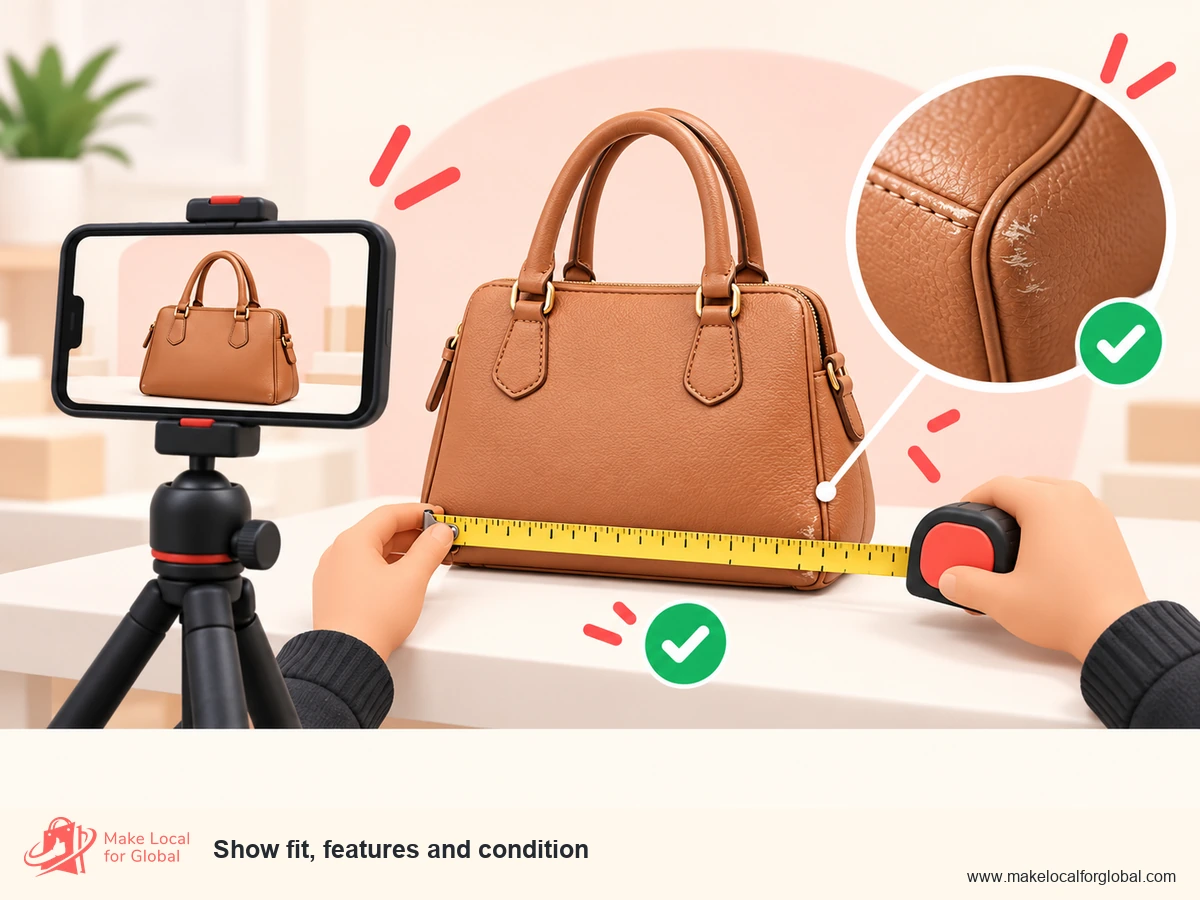
If a condition issue is visible, show a close-up beside a wider context image. Use a simple scale, such as a ruler placed near a small mark, only when it helps explain size. Do not retouch, blur or shade a flaw so that it disappears. Keep the original image files in the item’s record.
A high sold price does not equal a high contribution. An item can sit for months, need costly authentication or return after delivery. Price each model or one-off item using comparable completed sales, condition, completeness, evidence, channel fees, shipping, repair, return exposure and the time your process takes.
Use completed transactions when the platform makes them available. Compare the same model, approximate size, material, age or production period, condition, accessories and proof. An asking price only shows what a seller hopes to receive. A sale price does not tell you the seller’s acquisition cost, fees, return rate or net result.
Record several close comparisons rather than copying one unusually high result. Note the date and platform in your internal worksheet. For rare items, the comparison set may be thin; use a conservative range and leave room to learn. Describe a bag as “rare” or “investment grade” only when the claim is specific and supported. Avoid promises that it will rise in value.
The example below uses one pre-owned handbag sold for £525. The numbers are invented for planning and are not a supplier quote, platform fee schedule or forecast. Replace each figure with your own evidence. The total assumes a non-VAT-registered example for simple arithmetic; VAT treatment, income tax, owner pay and fixed overheads are not included.
| Order item | Illustrative amount |
|---|---|
| Customer sale price | £525.00 |
| Purchase from consignor or supplier | -£310.00 |
| Independent assessment | -£18.00 |
| Cleaning or minor repair allocation | -£22.00 |
| Inbound delivery and collection allocation | -£8.00 |
| Listing and photography time allocation | -£6.00 |
| Protective packaging | -£9.00 |
| Tracked, insured outbound delivery | -£12.00 |
| Example selling and payment fees at 12% | -£63.00 |
| Returns, dispute or damage provision | -£20.00 |
| Customer acquisition allocation | -£14.00 |
| Illustrative contribution before overheads and tax | £43.00 |
Arithmetic: £525 less £310, £18, £22, £8, £6, £9, £12, £63, £20 and £14 equals £43. The 12% fee line is an assumption for this example; check the actual payment processor and marketplace fees on their official pages before setting your price. If the sale takes an extra hour of support or the customer returns the item, the result changes.
Contribution is the amount left after the listed order-level costs. It is not net profit. Rent, software, insurance, bookkeeping, unsold inventory, tax and your pay still need to be covered by the business. Add a buffer for the actual cost of returns, payment disputes and value loss on an item that cannot be resold in the same condition.
Choose the lowest contribution you are prepared to accept for each product type before a listing goes live. For a one-off bag, the required return may need to reflect the time spent sourcing, checking, photographing, storing and answering questions. If the expected contribution falls below the floor, reject the purchase or negotiate a lower acquisition cost.
Set review dates for aged stock. At each review, compare views, saves, questions, offers and completed sales. Change one variable at a time: first images, then the description, then price or channel. Record each change. A quick discount can hide a sourcing problem and teach you little.
Organise the product, supplier and launch decisions before a new range takes on more stock.
VAT treatment can differ for new goods, pre-owned goods, imports, locations and the way you source an item. A VAT margin scheme may be available for eligible second-hand goods, but eligibility and record rules are specific. HMRC says a second-hand item must be suitable for further use as it is or after repair, and its margin scheme guidance sets out which goods may qualify.
If you are considering the scheme, read HMRC’s record-keeping requirements before buying. The item’s purchase evidence and sale invoice need required details. Some stock, such as items where VAT was charged to you, may not qualify under the same route. Do not calculate an assumed scheme amount by subtracting your repair, packaging or advertising costs from the margin; the scheme has its own rules.
A reseller importing bags, selling across borders or trading in Northern Ireland may face different rules from a business buying a local second-hand item and selling it in Great Britain. Ask an accountant or HMRC for advice on your facts. Keep VAT treatment separate in the stock and order records so the bookkeeper can trace each sale.
For an own-label or new wholesale range, build the price using the applicable VAT treatment from the start. Put VAT status into the financial model, use current rates and thresholds only after checking HMRC’s live guidance, and do not assume your customer-facing price can be changed later without affecting demand.
A buyer should be able to understand which bag is for sale, what proof supports its description, what condition it is in, what fits inside and what arrives in the parcel. Give the item an individual stock code. One-off bags need one listing per physical item, with the right photographs and records attached.
A useful title can include the genuine brand and model when lawful and supported, a product type, key size or carry feature and condition. For an own-label product, lead with your own brand or design name and factual product details. Do not add a popular brand name to attract visitors to an unrelated bag.
Example for a verified pre-owned item: “Pre-owned [Brand] [Model] medium leather shoulder bag, black, good condition”. Replace each bracket only when you have evidence. Example for an own label: “Marlowe medium zip-top leather satchel, olive, adjustable strap”. Neither title claims scarcity, investment value or a certification you cannot show.
Record the bag’s widest point, height, depth, handle drop and strap length. State how you measured, whether the dimensions are approximate and whether a base or side expands. For internal space, give dimensions that matter to the intended use, such as the usable width for a small tablet. A “fits a laptop” claim needs a named maximum device dimension, not a vague screen size.
List materials accurately, including lining and trims where known. Distinguish leather, coated canvas, textile, synthetic material and mixed construction. If the source cannot support an animal species, fibre content or country-of-origin claim, leave it out or qualify it accurately. Do not use “vegan leather” if that phrase may confuse buyers about the material; name the actual material where you can verify it.
State the closure type, pockets, strap options, weight, included accessories, dust bag or box, repair history, known flaws, odour where relevant, storage marks and delivery method. For pre-owned goods, disclose prior use and give the condition details for that exact unit. If a feature is missing, say so.
Photograph the actual item with clean, even light and a neutral background. Use a consistent frame for the front, back, both sides, base, handles, strap, opening, lining, pockets, maker marks relevant to the assessment, and each flaw. A photograph of a similar model is not a substitute for images of a one-off item.
Include a scale reference only where it helps. A person holding the bag can show proportion, but add measured dimensions since body size varies. Show the bag closed and open. Photograph included accessories beside it. Keep colour close to the real item; explain that display settings can change how a shade appears.
Do not publish private identification data or full authentication documents. A cropped detail can show a feature without exposing a previous owner’s name, address, transaction number or a code that could be misused. Keep the unedited originals for your records.
Tell buyers how the item was sourced and which review took place. Use precise wording such as “supplied by an authorised distributor; invoice retained” only when that is accurate and permitted. If an independent specialist assessed it, state the name of the service and the scope of the review where you have permission. Do not say “certified authentic” if the service only provided a limited photo opinion.
A statement such as “all bags guaranteed genuine” creates a promise about every listing. Make sure you have a repeatable evidence process to support that promise and a plan for disputes. If a bag’s identity is uncertain, do not hide the uncertainty in a broad disclaimer and continue to sell it as genuine.
Use one short condition summary near the top, then list details. For example: “Good pre-owned condition. The base corners show visible rubbing; the zip works; the lining has one small ink mark shown in photo 8. The shoulder strap is included. Dust bag is not included.” This gives the buyer a clear expectation.
Avoid a string of vague adjectives such as “stunning”, “perfect” and “rare find”. Factual details support a decision and are easier for a second staff member to confirm before packing. Keep the public listing aligned with the item’s internal condition report.
A hosted shop gives you control over product pages, customer data and brand presentation, but you need to attract visitors and build trust. A marketplace can bring shoppers with an existing account, though its fee structure, authenticity policies, disputes process, prohibited items and listing rules vary. A social shop can help you show new arrivals, but a social message is not a replacement for clear order terms or a durable item record.
Compare each channel against the actual bag and buyer. Check whether one-off inventory syncs correctly, how the channel treats branded resale, what authentication proof it accepts, which photos and claims it allows, how funds are held, what fee applies to a completed sale and how returns or disputes work. Read the platform’s current seller documentation before you rely on a feature or fee.
If you sell on more than one channel, use one source of truth for stock. Mark a bag as reserved or sold as soon as your process requires, then remove it elsewhere. A duplicate sale can damage trust and create a costly cancellation. Record the channel, order number, fee and fulfilment status against the stock code.
A local appointment or pop-up can let a buyer inspect a bag in person. Explain the appointment rules, payment method and receipt. If the transaction takes place in person, the consumer cancellation rules may differ from an online order, but the buyer still has rights if the item is faulty or not as described. Ask for advice before making a policy that assumes all in-person sales are final.
For a standalone shop, keep navigation simple: bags by type, price band or condition; an authentication and condition policy; delivery information; returns; contact details; and a clear explanation of who operates the business. MLFG’s website design service can be one option to explore when you need help planning a shop experience.
A customer may judge the whole order by whether the bag arrives in the condition shown online. Use a storage process that limits dust, moisture, direct sunlight, pressure, odour transfer and hardware scratches. Follow any material-specific care instructions from the manufacturer or a qualified conservator. Do not apply a polish, dye or cleaning agent to a valuable bag without knowing how the material will react.
Before packing, check the stock number, buyer order and all included accessories. Photograph the item and packaging condition for the order record. Support the bag’s shape with clean, non-printed paper or another suitable insert, protect hardware from contact with the surface and place the item in a clean dust bag if one is part of the order. Keep the dust bag and parcel materials from carrying strong scent or lint.
Choose a carton that leaves room for protective padding but does not let the bag move. Add a moisture barrier where suitable, protect corners and strap attachments and keep the shipping label away from the product. Seal the carton and gently move it in several directions to identify shifting. Repack if the item can strike a side or another piece.
Use delivery with tracking and insurance that matches the sale value and the carrier’s terms. Check the carrier’s compensation limits, excluded goods, signature options, claims window and packing requirements. A tracking scan does not prove the parcel was insured for its full contents value. Keep the carrier receipt and dispatch photos until the return or claim window has passed.

Write a clear policy for condition, authenticity questions, return requests, delivery damage and repair reports. Train anyone who answers messages to use the same product record and reply calmly. Ask the buyer to keep packaging and send photos of an issue, but do not make the process harder than your legal duties allow.
For online sales to UK consumers, the GOV.UK returns guidance says customers can usually cancel a distance purchase within 14 days of receiving the item, then have another 14 days to return it after telling you. Exceptions apply to certain types of goods; an ordinary handbag is not listed as a blanket exception. Faulty or misdescribed goods have separate rights. Check the current rules and how they apply to your exact sales model before publishing a policy.
The online and distance selling rules require specified information before a customer places an order, including the trader’s identity and contact details, a description, price, payment, delivery arrangements and cancellation information. Display your terms where a buyer can find them before checkout. A “no returns” line does not remove statutory rights.
If a buyer disputes authenticity, find the exact stock record, source documents, listing version, assessment scope, dispatch photos and delivery record. Acknowledge the concern and follow the channel’s procedure. Do not accuse the customer of tampering before you have reviewed the evidence. A fair investigation can protect both the buyer and the business.
The Consumer Rights Act requires goods to match their description and meet applicable quality standards. A known fault that was clearly drawn to the buyer’s attention can affect what they can expect from that disclosed point, but it does not remove every other right. Read the government’s summary of implied and statutory rights and take professional advice for a specific dispute.
For each bag, create a page that matches what a buyer might actually search for: product type, size, colour, condition and genuine brand or model terms where supported. Use descriptive headings and image alt text. A useful image description says what the image shows, such as “Tan pre-owned crossbody handbag, front view with adjustable strap”, rather than repeating a long list of keywords.
Write a short article or social post answering one buyer question at a time: how you assess a bag, what a condition grade means, how to measure strap drop, what fits inside a specific size, how you pack a sale or how a consignment arrangement works. Use original images from your own stock. Do not publish an authentication tutorial that invites buyers to rely on two or three surface signs as proof.
Collect email sign-ups with a clear explanation of what updates a subscriber will receive and how to leave the list. Send new-stock updates only when the stock is available. If a bag sells, update the page, stock feed and campaign material. Keep the old URL if it has useful information; offer a similar item only when that item really exists.
For launch, choose a small set of measurable actions: direct visits to a listing, questions about dimensions, saves, checkout starts, completed sales, returns, time to sell and contribution after fees. Review the numbers each week. If people visit but do not enquire, check the photographs, item details and price range. If questions repeat, bring the answer higher on the page. If an item sells but leaves little contribution, review acquisition, fee and fulfilment costs before sourcing another.
Keep marketing claims fair. The Competition and Markets Authority’s business guidance on unfair commercial practices explains that online claims and other practices can affect a consumer’s decision. Use real stock levels, real reviews with permission and supportable statements about origin, material, condition and value.
Some handbags use leather or other parts from species covered by wildlife trade controls. A supplier may use a familiar material name without telling you enough to identify the species or the item’s history. Do not assume that an old bag, a second-hand listing or a domestic sale removes every requirement.
Before buying a bag made from a species that could be covered by CITES or the Ivory Act, identify the material and species, ask for supporting records and check the current rules for the route and intended sale. The commercial-use certificate guidance explains that certain listed specimens need a commercial-use certificate when offered for sale. GOV.UK’s worked specimen guidance includes handbags made from crocodile skin or snakeskin as examples and sets out conditions for the exception. The Ivory Act guidance sets out separate controls for items containing ivory.
These examples do not mean every exotic-leather handbag needs the same document. The material, species, age, processing, origin, location and trade route can change the answer. If you cannot establish what the bag contains or what document applies, pause the listing and ask APHA, a qualified adviser or the relevant authority. Do not invent a material description to complete a product page.
A month of small tasks can reveal whether your process works before you commit to broad stock. Set the date, stock limit, budget and result you will use to decide whether to continue. Treat the plan as an experiment rather than a promise of sales.
Choose new authorised stock, authenticated resale, consignment or own-label development. Interview a small group of likely buyers. Write down what they need, their most common trust questions and the price range they compare. Select one narrow product type and define which material, condition and source you will accept.
Set a maximum first-test budget that includes stock, authentication, photography, repairs, packaging, fees, delivery, return exposure and the money needed for refunds. Decide what evidence must exist before you send payment. Write the stop rule for stock that cannot be supported.
Contact suppliers with the question list above. Obtain the invoice or consignment agreement before the item moves into your stock. Inspect a sample or one bag against written criteria. For pre-owned stock, complete a condition report and the chosen authenticity review. Ask a specialist if the item’s material or origin raises a wildlife-trade question.
Record the acquisition cost and the actual time spent. If the supplier cannot support a brand, material or history claim, change the listing plan or return the item. Keep your evidence rule even after payment.
Photograph the actual bag in a consistent light. Prepare front, rear, side, base, interior, handle, strap, closure, accessories and flaw images. Add dimensions, weight, material evidence, condition notes, included items, authentication scope and delivery details. Ask someone unfamiliar with the item to read the page and list the unanswered questions.
Calculate the order contribution using the current channel fee schedule and a realistic return provision. Compare the asking price to recent completed sales for like-for-like examples. Change the cost sheet or reject the listing if the price does not meet your floor.
Publish only stock you hold or can supply under a clear agreement. Share the listing with the buyer group and collect questions. Record views, saves, messages, sales, return requests, time spent and contribution. Check whether your product page answers fit, condition and proof questions without a personal explanation.
At the review date, choose one of three actions: restock a product type that met your evidence rule and contribution floor; revise one part of the offer and run a new test; or stop that product route and retain your cash. Record the reason so the next purchase uses what you learned.
It can produce a positive contribution when the acquisition price, selling fee, authentication, repair, delivery, return risk and time all fit the sale price. That result varies by model, condition and sales channel. Calculate each item separately and distinguish contribution from net profit.
You can sell your own lawful design when the product, name, images and branding do not misuse another party’s intellectual property. Do not attach a protected logo, describe a copy as genuine or imply that another brand approved it. If the design or name may be confused with an existing protected product, seek advice before listing.
Use a documented sourcing route and a repeatable assessment process suited to the relevant brand, model and period. Keep invoices and reports linked to the individual stock item. No single card, code, box, receipt or visual clue proves every bag.
A specialist review may help when your own process cannot support a claim or the item’s value warrants another opinion. Check the service’s method, scope, expertise, terms and handling of inconclusive results. State what was reviewed accurately.
Show the actual front, back, sides, base, handles, strap, closure, interior, pockets, included accessories and every relevant flaw. Add a scale reference or a person holding the bag when it helps explain proportions. Do not conceal wear or publish private details from an invoice or certificate.
Use a consistent plain-language grade, then name each visible fault, repair and missing accessory. Pair the condition notes with close-up photographs. Buyers should be able to tell ordinary wear from a problem that affects use or value.
The answer depends on the exact species, item history, date, location and trade route. Certain specimens need documents for commercial use, and some worked items may meet a defined exception. Check the current GOV.UK and APHA guidance before buying or listing a bag with protected materials.
Some eligible second-hand goods may qualify, but the rules depend on how the item was acquired and the records kept. HMRC’s eligibility and record pages explain the conditions. Ask an accountant or HMRC about your own transactions before applying the scheme.
UK online consumer sales usually include a cancellation period, along with separate rights when goods are faulty or not as described. Some exceptions apply to particular goods. Set out the current terms before checkout and check GOV.UK guidance for your sales model.
There is no universal number. Choose a quantity that keeps your maximum loss within budget and lets you complete the checks on every item. A single sourced bag or a few consignment pieces can test your process before a larger order.
Use the genuine product type, accurate brand and model where supported, relevant size or carry style, colour and condition. Use your own label and factual details for an own-brand design. Leave out unrelated brand terms, unsupported “rare” claims and repeated keywords.
Compare buyer reach, fees, authenticity rules, product policy, payment timing, returns, dispute process, data access and effort. A marketplace may simplify discovery; a standalone shop gives you more control over the buying experience but needs its own traffic plan. Many sellers test one channel before adding another.
Pause the listing and keep the item separate from confirmed stock. Ask the supplier or consignor to resolve the issue under the written terms. Do not sell the bag as genuine or relabel it as a replica. Keep the review record and seek qualified advice if the supplier disputes the result.
The guidance below is a starting point for UK sellers. Rules can differ across Great Britain, Northern Ireland and overseas markets, and your obligations depend on the product, source and transaction.
Check whether your listing explains the exact item, its evidence, condition, price and delivery before a customer reaches checkout.
PREFERRED SOURCE
Like what you’re reading? Add Make Local for Global as a preferred source on Google to see more of our articles when you search.

Build your online presence without having to figure out everything yourself.