

READY TO SELL Desk Organisers ONLINE?
Get a store built for you in 5 days, plus training and support to help you start, run, and grow your Alternative business.

Plan a desk-organiser range around real workspace measurements, tested samples, clear material claims and the full parcel cost.

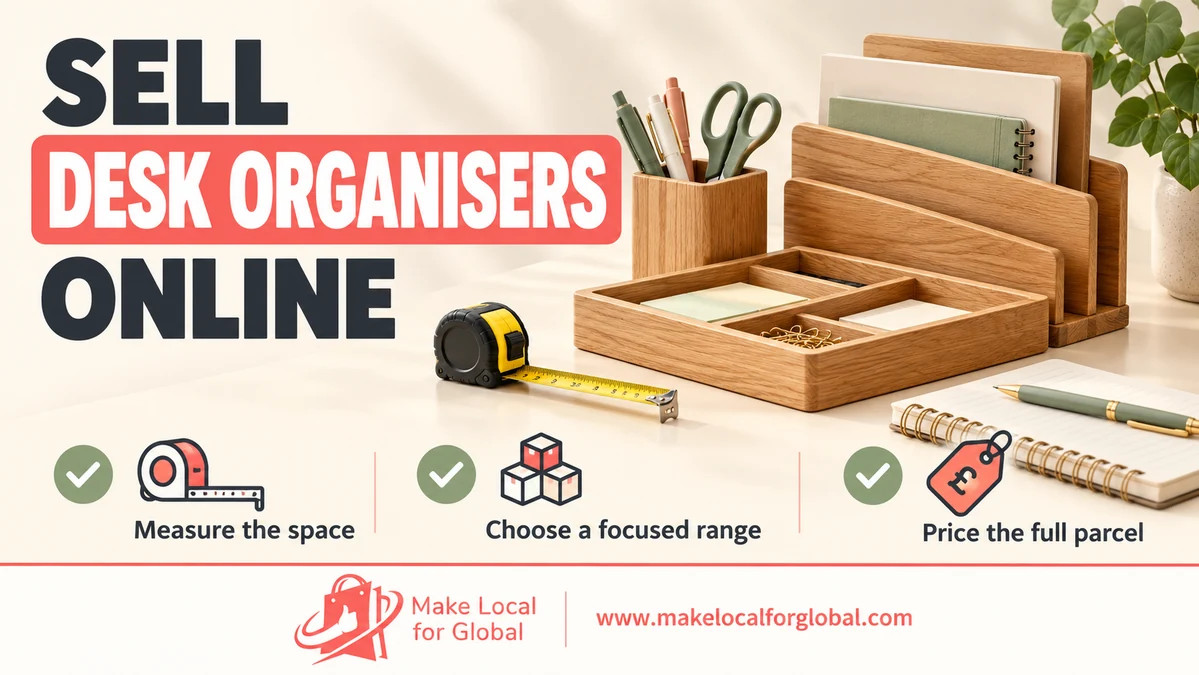
Desk organisers look like simple products, but the useful ones solve a very specific space problem. A tray can tidy a desk and still be too large for a narrow home workspace. A letter sorter can look generous in a photograph but fail to hold the A4 papers its buyer actually uses. A cable box can hide a tangle without leaving enough ventilation or room for plugs. Those details shape whether the product feels useful after delivery, not just attractive on a product tile.
If you want to sell desk organisers online, start with a buyer and a job to be done, then build a small range around real measurements, tested samples and a parcel you can price confidently. You do not need a catalogue of every caddy, drawer divider and cable accessory. You need enough evidence to show who a product helps, what it fits, how it is made, how much arrives in the box and what the complete order costs you.
This guide walks through that work from first idea to first sale. It covers home, study and studio desks; organisers for paper, stationery and cables; materials and finishes; sizing; sample checks; sourcing; product pages; order economics; delivery and returns; and a controlled first-month launch. The examples are planning tools, not promises of demand or profit. Replace assumptions with your own supplier quotes and checkout data.
Before ordering stock, make sure the product, dimensions and customer journey are clear. Explore how a focused ecommerce store can present a useful range.
“People who work at desks” is too wide to guide a first product. A remote worker may need to keep a laptop and notebook in a small corner of a kitchen table. A student might want a compact set that moves between a bedroom desk and a shared study area. A maker may need a holder for cutting tools, clips and small parts. A bookkeeper may need a sorter for incoming papers and folders. Each buyer uses different objects, has different space and has different tolerance for assembly, maintenance and price.
Write a one-sentence customer hypothesis. For example: “I want to help people in small rented rooms keep daily stationery and a notebook together without taking over the desk.” It tells you to measure footprint, include a notebook in photographs, avoid permanent fittings and check whether the organiser can move easily.
Talk to potential buyers before selecting stock. Ask them to show you the desk or describe its width, what currently gets lost, what they have tried and what would make them remove an organiser after a week. You may hear that a tray catches dust, a pen cup tips over, a large unit blocks a monitor or a wooden finish is difficult to clean. Keep exact words and repeated situations rather than treating compliments as proof of demand.
Look for observable intent. A request for dimensions, a comparison between finishes, a saved product, a sample request or a paid preorder with transparent delivery terms tells you more than a general “I like it”. A few conversations do not establish a market. They help you choose a low-risk test and identify what the first page must answer.
Pick one primary setting: a compact home desk, a student study area, a creative studio or a shared household work surface. A student set may prioritise portable pieces; a craft workspace may need compartments for small tools; a minimal home-office set may need a low profile and coherent finish. Start with a clear reason for the range, then expand when evidence supports it.
Keep the customer description respectful and practical. Do not make assumptions about income, ability, age or home size. If you design for limited space, show the actual footprint and what it holds. If you make an accessibility claim, check it with real users and substantiate it for the exact product.
Desk organisation includes several jobs. A valet tray keeps small daily objects together. A pen cup stores upright tools. A letter sorter keeps papers visible. A drawer divider makes hidden space easier to use. A monitor riser can raise a screen while adding storage. A cable tray, sleeve or box manages leads. These products do not automatically belong in one collection just because they sit near a desk.
Describe the task in the buyer’s language. “Keep the items you use every day together” is clearer than “premium workspace optimisation”. “Separate current paperwork from finished files” is clearer than “improve productivity”. Avoid promising that an organiser will make someone more productive, reduce stress or improve posture unless you have evidence. The physical function is enough: hold, separate, raise, route, contain or keep visible.
For each idea, write down what goes inside; where it sits; how often the buyer reaches for it; and what it must not obstruct. A tray for keys and earbuds needs a different lip and compartment arrangement from a paper sorter. A cable box has different heat and access considerations from a wooden pen pot.
Test the job with a rough paper mock-up before you spend on a sample. Fold a card tray to the planned footprint, place a laptop and notebook beside it, and see whether the object still fits. This will not prove stability or demand, but it can expose an unsuitable size early.

A useful first range is easy to compare. Start with a few roles rather than many near-identical colours: one shallow tray, one vertical paper sorter and one compact modular caddy, for example. Add a cable-management piece only when you understand its materials, access and heat limitations. A monitor shelf may be heavier and need a different parcel cost.
A simple range ladder can include a starter item, a coordinated set and an optional add-on. The starter item solves one small problem. The set makes sense when the pieces genuinely work together. Make clear what is included, what is optional, how many pieces arrive and whether photographs show props that are not in the box.
| Product role | Best suited to | Check before listing |
|---|---|---|
| Catch-all tray | Daily small items and stationery | Footprint, compartment size, surface protection |
| Letter sorter | Papers and notebooks kept upright | Paper size, slot width, stability and loaded depth |
| Modular caddy | Tools and supplies that need separation | Module dimensions, connection method and wobble |
| Cable organiser | Leads and plugs around a workstation | Openings, access, heat and supplied parts |
Examples are planning prompts. Check the exact product and costs for your own offer.
Treat the table as a planning prompt. The photographs and specification should identify what your sample actually holds.
Avoid launching every colour and configuration at once. Variants multiply stock combinations, photographs, inventory records and packing errors. Start with the option that best represents the customer hypothesis. Inspect a different material or finish as its own variant.
Name products so shoppers can tell them apart. “Compact Letter Sorter, Natural Finish” is more useful than an internal code. Keep SKU codes separate from display names and use consistent option labels on the product page, order confirmation and picking list.
Desk organisers are sold in wood, bamboo, veneer, metal, acrylic, felt, paperboard and plastics, as well as mixed-material combinations. Each changes weight, feel, care, packaging, price and product claims. A bamboo-coloured coating is not the same as a bamboo product. Veneer over a composite panel is not solid timber. Acrylic can scratch; felt may gather dust; metal can add weight or expose sharp edges if poorly finished.
Ask the supplier for a component-by-component material breakdown. Record what the tray, base, drawer, feet, handle and finish are made from. Ask whether a finish is stain, oil, lacquer, paint, powder coating or laminate where relevant. Do not infer species or recycled content from a photo or colour name. If the supplier cannot document a claim, narrow the description or leave it out.
Consider how materials behave in use. An organiser may sit near a hot drink, sunny window, charging cable or frequently wiped surface. Ask the supplier for care instructions and test them on the sample. Do not recommend soaking wood or using solvents on acrylic unless the manufacturer confirms that advice for the exact finish.
Environmental descriptions need care. “Made from bamboo” should refer to the product or specific parts that are bamboo. “Recycled” needs evidence and an explanation of which component it applies to. Avoid broad terms such as “eco-friendly” when the evidence supports only one material. The CMA’s Green Claims Code says claims should be clear, accurate, supported and not create a misleading impression of the product’s overall impact.
For every variant, record supplier name and code, product name, component materials, finish, assembly, dimensions, weight, verified country of origin, minimum order, lead time, carton dimensions, pack quantity and known tolerances. Add links to test reports, care instructions or safety information. Mark each fact as confirmed, sample-checked, supplier-stated or unknown.
This sheet is your source of truth for listings and replenishment, not a substitute for a legally required label. If a factory changes the finish or board thickness, update the record and decide whether a new sample is needed. For a mixed-material product, describe each part that matters rather than using a vague phrase such as “natural wood organiser”.

Measurements are among the most useful details in an online listing. Record overall width, depth and height plus usable internal dimensions. For trays, measure the base area and lip height. For a pen cup, give its opening and internal depth. For a paper sorter, state slot width and the largest paper format that fits when loaded. For modular units, list each component and the assembled footprint. Outer dimensions are not usable storage.
Measure a physical sample, not only a supplier image or drawing. Use a ruler or calliper for small compartments and a tape measure for overall footprint. Record measurement points and any tolerance. If construction causes variation, explain how you measured and avoid false precision.
Show the product beside ordinary desk items. An A4 sheet, notebook or laptop can provide scale, but identify props where helpful and do not imply that they are included. A visual reference supports but does not replace written dimensions.
Measure the desk space the product will occupy. Consider a monitor stand, keyboard, mouse movement, laptop lid, lamp base and writing area. A wide organiser can block a screen or leave little space for a notebook. For cable products, check that openings match likely layouts and allow access to switches and plugs. Do not claim universal compatibility when desks differ.
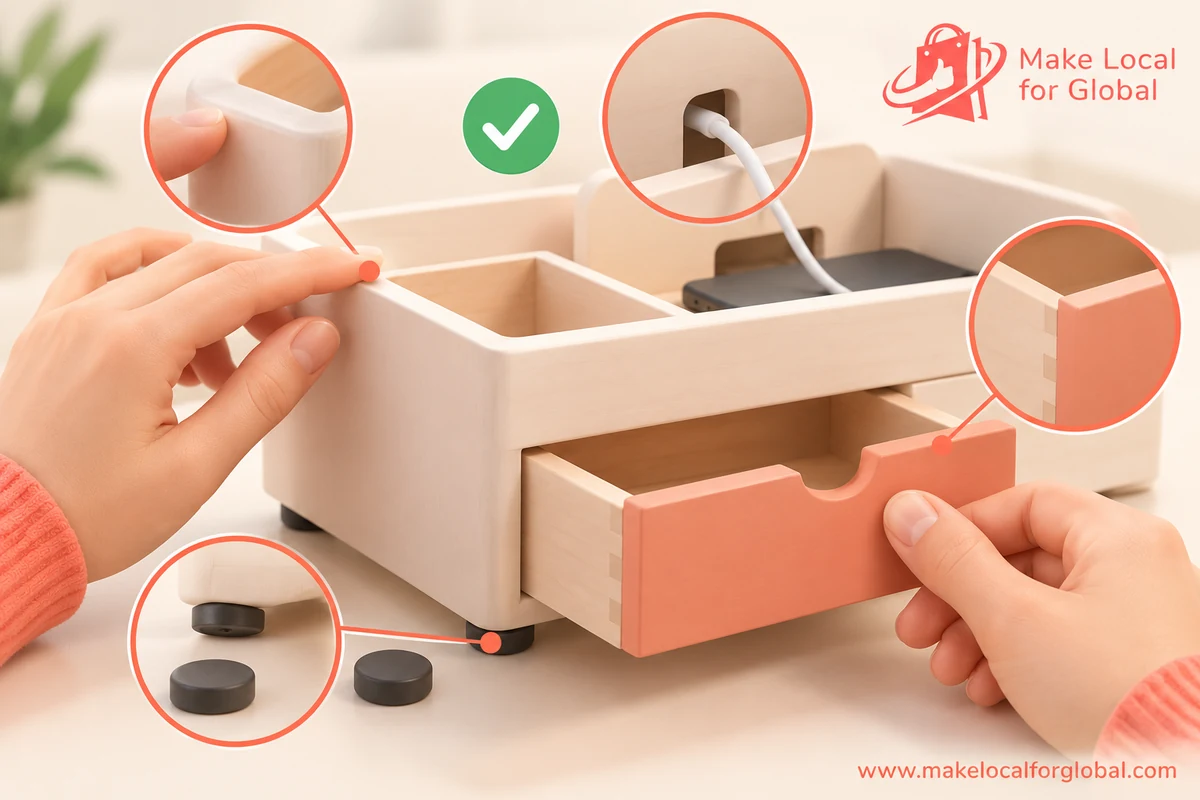
A polished supplier photograph does not prove that a product fits your offer. Order a sample or inspect one through a reliable process. Check the full object in daylight and indoor light. Photograph it from all sides and keep supplier code, date and finish in your record.
For a tray or caddy, check for rocking, square walls, rough corners and whether it holds the items you plan to show. For a drawer organiser, pull the drawer repeatedly and check for snagging or a loose handle. For a paper sorter, insert the intended paper and see whether it remains stable when one slot is full. For a cable organiser, inspect the openings and test access with the intended cable shapes. Do not insert plugs in a way that creates an electrical hazard.
Check the surface where the product will sit. Look for rough feet, exposed fasteners, paint transfer, failing adhesive pads or a finish that scratches during ordinary handling. If a supplier calls a base non-slip, test it on likely surfaces and keep the claim only if evidence supports it. Do not publish a load capacity based on informal handling.
If assembly is required, build the sample as a customer would. Confirm parts, follow instructions, record tools needed and check whether it can be repacked for a return. Missing hardware and unclear instructions can turn a low-cost accessory into a support problem.
Keep one approved sample as a reference. When stock arrives, compare colour, dimensions, finish, drawer action, feet, packaging and component count. Photograph variations and ask the supplier how they will be resolved. A sample is a control point, not a guarantee that every run will be identical.
Desk organisers are everyday consumer goods, but general product-safety rules still matter. The Office for Product Safety and Standards explains that businesses who make, import, distribute or sell consumer products have responsibilities to ensure products are safe and comply with relevant labelling requirements. Read the current product safety advice for businesses and Great Britain guidance. Northern Ireland has a separate framework: general product safety guidance for Northern Ireland.
Ask the maker or importer for product identification, traceability details, warnings or care instructions, responsible business details where relevant, and foreseeable-risk information. Check for splinters, sharp edges, small detachable parts, pinch points, tipping, unstable bases or a finish that transfers. A cable box does not become an electrical product because chargers may be stored nearby, but do not call it an electrical safety device unless it has been designed and assessed for that purpose.
Age and intended-use claims can change which rules apply. A pen holder photographed in a child’s room is not automatically a toy, but marketing it as a children’s product brings other considerations. Do not describe it as child-safe without checking the design and requirements. Assess magnets, small parts, coatings or supplied electrical accessories specifically.
Claims should match evidence. “Fits A4 paper” should be tested with A4 paper. “Scratch-resistant” needs support for the exact finish. “Waterproof” is stronger than “wipes clean”. “Non-slip”, “recycled”, “handmade”, “solid wood” and “made in Britain” also need evidence. See the government’s product labelling guidance on claims about materials, size, origin and what a product can do.
Keep supplier documents with the SKU. If a concern appears, pause the affected listing while you investigate, preserve batch and order records and consult current official guidance or a competent adviser. A generic certificate may not apply to the exact product or market.
You might source from a UK wholesaler, commission a local maker, import from a manufacturer or sell made-to-order. Each model changes stock, lead time, quality control and customer communication. A maker may offer small runs and material detail but need longer production. An importer may quote a lower unit price but require larger minimums and more work on freight, duty, records and cash flow. A wholesaler may simplify replenishment while selling the same products to many shops.
Ask suppliers the same questions before comparing quotes: exact materials and finish; carton size and packed weight; assembled or flat-packed; minimum by finish; defect and replacement process; availability of spare components; test information for the exact SKU; notice of design changes; and whether they can provide production and packaging photos.
Request a written quote with currency, validity period, product code, quantity, delivery term, carton configuration, lead time and payment schedule. For imports, ask a customs broker or official tariff tool about classification and charges rather than guessing from a product name. Keep freight, duty and brokerage amounts so you can reconstruct landed cost.
| Check | What to record |
|---|---|
| Product identity | SKU, dimensions, material breakdown and finish |
| Sample result | Defects, fit, assembly, photos and approval date |
| Commercial terms | Minimum, unit cost, payment terms and quote expiry |
| Delivery | Lead time, carton dimensions, weight and shipping terms |
| Evidence | Safety information, care instructions and supported claims |
| After-sales | Fault reporting, spare parts, replacements and response time |
Examples are planning prompts. Check the exact product and costs for your own offer.
Do not choose solely on the lowest quote. A small saving can disappear if dimensions drift, cartons arrive damaged or finish names do not match the sample. A supplier’s responsiveness before the first payment is useful context, but not a guarantee of future service.
A desk organiser is easy to copy in a photograph. Differentiation can come from a real functional choice: a footprint designed for narrow desks, interchangeable sections, a paper slot tested with notebooks, a replaceable drawer insert, documented materials, a finish that suits the buyer’s setting or a more helpful bundle. Do not add a feature simply to make the product sound unique. It should improve a decision or solve a frustration you have observed.
If you personalise a product, confirm the method and its limits. Engraving may alter a finish, create a minimum quantity or add lead time. A name plate may be a separate component that can detach. Ask how personalisation is proofed, what happens when a customer enters a long name and whether a return exception applies. Do not promise a delivery date until the maker confirms capacity.
Bundles should combine items people use together and make the contents clear. A tray, pen cup and paper sorter can form a coordinated desk set if dimensions and finish genuinely work together. State how many of each piece are included, whether the colours match or are merely coordinated, and what is not included. Show the set price beside individual products.
A range name can communicate use. A “small desk reset” might include a slim tray and compact sorter; a “studio tools” set might pair a deep pen cup with a small-parts tray. These names describe a use case, not a guaranteed outcome. Test whether buyers understand them and retain an accurate product description for every SKU.
The unit quote is not the cost of a sale. Model one complete order, including product, freight to you, import charges if applicable, packaging, fulfilment, postage, payment or marketplace fees, paid acquisition and a realistic allowance for damage, returns or reshipment. If a bundle has three products, use the cost of all three and the correct carton.
Here is an illustrative direct-to-customer order for a coordinated desk-organiser set sold at £44.00:
| Cost line | Example amount |
|---|---|
| Product set | £13.50 |
| Inbound freight and import-cost allocation | £3.20 |
| Protective packaging | £2.25 |
| Outbound parcel | £4.85 |
| Payment and selling-fee allowance | £1.10 |
| Customer acquisition allowance | £5.00 |
| Damage and returns reserve | £2.20 |
| Total variable cost | £32.10 |
| Contribution before overheads and tax | £11.90 |
Examples are planning prompts. Check the exact product and costs for your own offer.
This example assumes a shipping configuration and fee allowance that you must replace with your own quotes. At £44, £11.90 remains after the listed variable costs, before software, insurance, storage, content production, accountancy, owner pay and tax. It is not net profit. If customers pay delivery separately, adjust revenue and carrier cost. If VAT applies, calculate consistently with your VAT position and seek qualified advice if needed.
Calculate contribution as selling price minus variable cost per order. Also record the cash needed before a sale: minimum order, sample, freight, duty, packaging stock and the time between paying a supplier and receiving customer funds. A product can show positive contribution but still be an uncomfortable first test if the minimum ties up cash or takes too much storage space.
Stress-test the model. What if postage rises by £1.50, a return costs £8, two pieces are damaged or advertising cost doubles? What if the set ships in two parcels? A small sensitivity table shows which assumption has the greatest effect. Decide the minimum contribution you need before placing an order and what you will do if the actual result is lower.
Use actual supplier, packaging and delivery costs to decide what the first test can safely include.
Do not set the price by doubling a supplier quote or copying the most expensive competitor. Compare products with similar dimensions, material, finish, contents, assembly, delivery and service. A small acrylic pen pot is not a fair comparison for a solid-timber desk set. Record the date, page and features for each example. Competitor prices change and do not prove that a product sells at that price.
Use your cost model to set a minimum viable price, then test whether the target customer understands the offer. Calculate contribution at several price points and bundle sizes. If the £44 set produces £11.90 contribution before fixed costs, a £39 promotion can reduce it substantially even though product and postage costs remain. Give discounts a reason and end date rather than making them the default response to slow sales.
Think about pricing architecture. An individual tray can be an accessible entry point; a bundle can reward buying pieces together; a premium finish can carry a higher price only if the added material, labour or value is clear. Keep the options manageable and label savings accurately. Do not show a crossed-out “usual price” that was never genuinely charged.
Build a return and damage allowance into decisions, but do not use it to excuse poor quality. If one organiser has frequent damage because its corners are exposed, improve packaging, change the design or stop offering it. A price that covers preventable failures can still produce unhappy customers and poor reviews.
The product page should answer a shopper’s question before asking for an order. Use a descriptive title that names the product, size or distinguishing feature. The opening lines should explain the organiser’s job and verified material. Put price, options, stock status and delivery information where a buyer can find them.
Include overall and usable dimensions, material by component, finish, weight, assembly, care, contents and parcel information where it affects delivery. State whether the item is sold alone or as a set. Explain which objects in photographs are props. If a sorter fits A4 sheets but not a ring binder, be explicit. If a drawer has 18 cm of usable internal width, publish that rather than only its outer width.
Make variation clear. Natural wood grain or small handmade differences may be legitimate, but a buyer should know what range to expect. If colour changes under warm and cool light, show realistic photographs and avoid promising an exact screen match. If products in a set are coordinated rather than identical in material, say so.
For search, write for someone looking for a specific solution. Use phrases such as “desk organiser for a small workspace” only where the product genuinely fits. Do not repeat a key phrase unnaturally in every heading. Give each product a distinct title, accurate description and useful image text. Link to adjacent guides such as computer desks, computer accessories and cork boards to help shoppers explore related choices without replacing this page.
Before checkout, provide business contact details, product description, total price and taxes, payment, delivery arrangements and costs, timing and cancellation information. The UK’s online and distance-selling guidance explains the information businesses must provide. Keep policies readable and consistent with what you can fulfil.
One attractive hero photograph is not enough when usefulness depends on fit. Show the full object against a plain background, then in a real desk setup with familiar items for scale. Photograph the inside, underside, feet, drawer, modular connection and cable openings. Include a close-up of any finish or texture that changes how the item looks or feels.
Use consistent angles and lighting across variants. Do not edit away grain variation, marks or a translucent tint. If the product combines materials, make their boundaries visible. A pale item on a pale desk may need shadow or contrast to show its edges, but the colour should remain believable.
Add a dimension diagram with measurement points. Do not cover useful detail with decorative typography. A diagram can explain footprint, usable space and compartment depth, while photos show what fits. Show an A4 sheet inside the sorter and state whether it is included.
The sample-check illustration in this guide shows why edge finish, drawer movement and cable openings matter. The packing illustration shows how a snug carton, corner protection and a movement check relate to damage prevention. Use your own sample for commercial product photography. Generated illustrations can explain a process but should not be presented as exact photographs of stock unless they faithfully depict it.
Write descriptive alt text for informative images, such as “A wooden desk tray measured beside a laptop to compare width and depth.” Avoid repeating a search phrase in every alt. A decorative divider can have empty alt text, but a product or sizing illustration should be described.
Small desk items can still arrive damaged. A tray may split at a corner, acrylic may scratch, metal legs may bend, a drawer may slide against the finish or loose parts may rattle. Inspect the fully packed sample and measure the sealed parcel after all protective material is included.
Choose a carton that protects without leaving excessive movement. Protect exposed corners, add a surface layer to prevent rubbing and restrain the product inside. Separate detachable parts in a labelled bag. Secure a drawer or hinged section for transit in a way the customer can remove cleanly. Avoid adhesive that damages the finish.
Test the actual packing method through the service you plan to use, then inspect the organiser and carton on arrival. Record the packing method and adjust it after damage reports. Do not claim a package is certified for a carrier test unless it has been tested to that standard.
If you describe packaging as recyclable, compostable or plastic-free, confirm the materials and disposal conditions. Some protective materials need specialist processing. The Green Claims Code also applies to packaging claims.
A standalone shop gives you control over product pages, bundles, email capture and measurement content, but you need to bring the audience and manage the whole customer journey. A marketplace may attract people searching for home-office goods while charging fees and setting policies. Social platforms can demonstrate a modular organiser, but views are not the same as orders. A local market lets people handle a finish, though it adds event and stock costs.
Choose one primary channel for the first test. Make sure photographs, SKU labels, stock counts and customer service can support it. If you list on several platforms, synchronise stock or cap the available quantity. Keep a master product record that can be adapted for different image crops and attributes.
Use content that demonstrates a decision: what fits inside the tray, how a sorter handles A4 papers, how a product fits beside a laptop or how to choose shallow versus deep storage. Track which page, email, event or campaign produces an enquiry or purchase.
Set a small advertising budget you can afford to spend while learning. Decide the audience, creative, landing page and stopping rule in advance. If visitors click but do not add to basket, investigate price, page clarity, delivery or fit before increasing spend. Impressions alone do not show that a campaign is working.
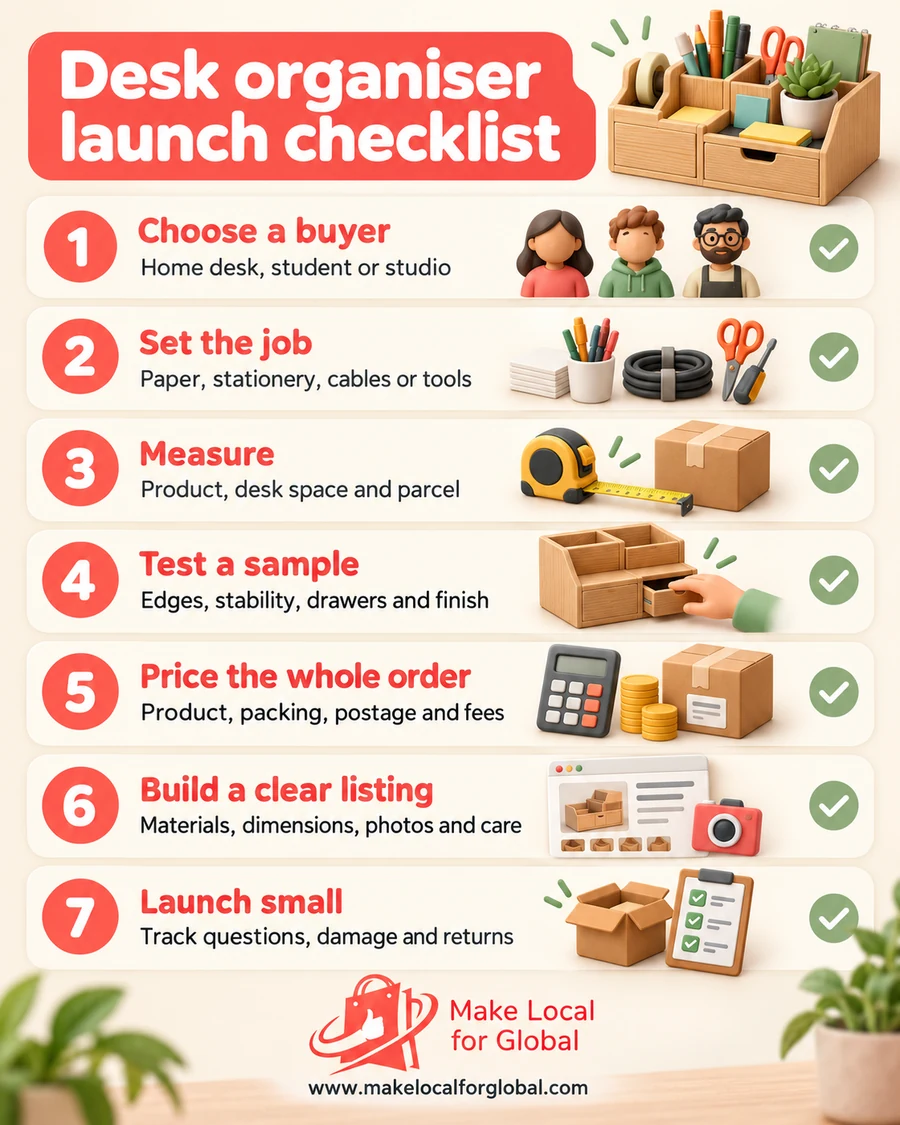
A short launch plan keeps the first experiment focused and gives you a decision point before reordering.
| Period | Work to complete | Evidence to keep |
|---|---|---|
| Days 1–5 | Interview potential buyers and define one desk problem | Notes, repeated questions and a testable buyer statement |
| Days 6–10 | Compare supplier options and mock up footprints | Quotes, carton estimates and desk-space photographs |
| Days 11–15 | Order and inspect a sample | Dated sample record, dimensions and defect photos |
| Days 16–20 | Cost the complete parcel and confirm the price | Cost model, carrier quote and target contribution |
| Days 21–25 | Build the listing and photograph the actual sample | Product copy, variant matrix and page screenshots |
| Days 26–30 | Launch a limited quantity and review behaviour | Visits, questions, orders, returns and damage notes |
Examples are planning prompts. Check the exact product and costs for your own offer.
At the end of each stage, write down what remains unknown. If the supplier has not confirmed the finish, do not publish a definite material claim. If the parcel cost is unknown, do not announce free delivery without including that cost in the model. If buyers cannot tell whether the set includes one tray or three, fix the page before taking orders.
Launch with a quantity you can service. A small test might be made-to-order, a limited stock run or a sample-backed preorder with an honest dispatch date. Make sure the payment, order confirmation, dispatch email and tracking process work. Use a safe test order or platform test mode where available.
At day 30, choose a next action: restock the same SKU, change one feature, clarify the page, test another buyer or stop. Do not add ten variants simply because the first fortnight was quiet. Review traffic quality, questions, conversion, contribution, returns and time spent. A good test produces a better decision, not necessarily a large sales number.
Decide how a buyer can reach you and how quickly you can answer product questions. Keep standard answers for dimensions, materials, assembly, care, delivery and set contents, but tailor replies when someone asks about a particular desk or paper size. If you do not know whether an item fits, ask for the relevant measurement and explain what you can verify.
Create an issue log with SKU, order, batch, issue type, evidence, action and resolution. Common patterns might include colour expectations, a sticking drawer, missing feet, parcel damage or a footprint larger than expected. One complaint may be isolated; several similar complaints can reveal a product or listing problem. Keep customer details secure and use only the information needed for follow-up.
Online customers generally have cancellation rights for a limited period after delivery, subject to exceptions. Read the current returns and refunds guidance and ensure your policy explains cancellation, return arrangements, refund timing and delivery charges accurately. Do not assume a desk organiser is exempt because it has been opened. If you sell a personalised item, confirm whether an exception applies instead of adding a blanket no-returns statement.
For damage, ask for photographs of the carton, internal packing and product, plus the order reference. Respond with a practical remedy that reflects the issue and your obligations. Make the replacement or refund decision easy to follow. A vague policy or slow response can turn a small parcel issue into a public review problem.
Set a baseline before launch. Record product-page visits, add-to-basket rate, completed orders, average order value, refund or replacement rate, delivery cost and contribution. Also record questions per order and the time needed to pack each set. These measures help explain whether the product, page, audience or fulfilment needs attention.
Use each signal as a clue rather than a verdict. High page visits and few basket additions may suggest that price, photos, size or delivery terms need work. Many basket additions but few checkouts can point to unexpected delivery charges, payment friction or unclear dispatch timing. Repeated questions about whether stationery is included mean the page should state contents more clearly. Damage at one corner suggests a packaging or design issue.
Change one important part of the offer at a time. If you replace the product photo, change price and launch a discount in the same week, it is hard to know what helped. Keep a change log with date and reason. Compare a meaningful period or group of orders rather than reacting to one visitor. Consistent records matter more than elaborate analytics software.
Before reordering, check cash and stock movement. A best-selling tray might generate little contribution if it requires an expensive parcel or frequent replacements. A slower product may be valuable as a set component only if the bundle raises customer value without making margin worse. Look at the complete basket and fulfilment effort, not just the number of pieces sold.
A common mistake is selecting by appearance alone. A neat organiser can occupy too much desk space, hide what is inside or have awkward compartments. Test it with ordinary stationery and a real desk before commissioning a batch.
Another is relying on outer dimensions. Buyers need usable space, the format that fits and the room it takes beside their equipment. Add measurement diagrams and clear examples instead of claims such as “fits everything”.
A third mistake is treating a coordinated photograph as proof that a bundle is complete. Show the exact pieces included, name optional accessories and state quantities beside the price. Keep props, plants and devices distinguishable from the product.
Some sellers copy material claims without checking them. Confirm whether the item is solid wood, veneer, bamboo, acrylic or a mixture. Keep evidence for recycled content, origin, finish and performance claims. If a claim is undocumented, remove or narrow it.
Do not price only the organiser. Packaging, parcel service, fees, acquisition and returns affect contribution. Check the packed carton and use a real carrier quote. Model a set as one order and include every item.
Do not launch too many variants before the product page and inventory system are ready. Six finishes can multiply photos, SKUs and stock risk. Start with the variant that serves the clearest use case.
Do not call an organiser safe for children, suitable for electrical devices, non-slip, waterproof or sustainable without the right evidence. Those claims shape expectations and may create safety or consumer-law concerns. Describe what you have verified.
Finally, do not treat early quiet as a reason to buy more stock. Check whether the right people saw the page, whether images show scale, whether measurements answer questions and whether the delivered price is clear. Change the offer after identifying a plausible reason.
It can produce a viable contribution, but the result depends on unit cost, landed freight, packaging, parcel price, fees, acquisition, damage and returns. Calculate one complete order and subtract variable costs from the selling price. Then account for fixed overheads, owner pay and tax. The gap between supplier quote and selling price is not profit.
Choose one product that solves a clear problem for a buyer you can reach. A shallow tray, paper sorter or modular caddy can be a starting hypothesis, but the best option depends on desk space, items stored, supplier terms and shipping. Interview potential buyers and test a sample before placing a larger order.
Measure the outer footprint and usable internal space on the sample. Compare it with the desk, laptop, notebook, keyboard and other equipment. State measurement points and show a scale reference. Ask customers to compare their own dimensions rather than promising universal fit.
A single item is easier to understand and can be a lower-commitment purchase. A bundle can raise order value if pieces solve related jobs and work together. State exactly what is included and model the cost of the full parcel before setting the price.
There is no single best material. Timber, veneer, bamboo, metal, acrylic, felt and plastics differ in weight, appearance, care and cost. Choose according to the customer’s use, test the finish and describe each component accurately. Do not confuse colour with material identity.
Use specific claims only when you hold credible evidence for the exact claim. Explain whether it applies to a component, packaging or the whole product. Broad terms can imply an overall environmental benefit that is difficult to substantiate. Review the CMA Green Claims Code and avoid claims beyond the evidence.
Check dimensions, usable space, stability, edges, finish, drawer movement, feet, assembly, cable openings where relevant and packaging. Test ordinary use without inventing load or safety claims. Keep photos and a dated record, then compare incoming stock with the approved sample.
Use a carton sized for the packed product, protect exposed corners and finishes, restrain movement and separate loose parts. Measure the sealed parcel and test the packing method through the service you plan to use. Verify disposal claims before describing packaging as recyclable or compostable.
Include a clear product name, price, contents, material by component, finish, overall and usable dimensions, care, assembly, photographs, delivery and returns. Identify props and options. State limitations where fit or compatibility depends on the customer’s desk.
They are consumer products and should be safe in normal or reasonably foreseeable use. Specific obligations depend on design, market and intended use. Check current official guidance, keep product identification and supplier records, and seek competent advice if a component or claim raises a regulatory question.
Start with the smallest range that tests your buyer hypothesis: often a few distinct roles rather than many colour variants. Consider minimum order quantities, sample cost, storage, photos, packing and cash at risk. Add products when evidence and capacity support them.
Track visits, basket additions, orders, contribution, delivery cost, questions, returns, damage and packing time. Look for repeated patterns and test one meaningful change at a time. Decide what evidence would justify a restock, a page change or ending the test.
Before placing a larger order, write a one-page decision note. Name the buyer, the job, the chosen organiser, verified materials, sample result, supplier, order quantity and money at risk. Attach the dimension sheet, quote, packed parcel measurement, cost model, page outline and returns plan. List unanswered questions with an owner and a date to resolve them.
Set a limit on the first test. That might be a small stock run, made-to-order window or transparent preorder, depending on supplier and cash position. Be honest about dispatch and stock. Keep enough time to inspect goods, pack orders and answer buyers. A low-cost experiment is only low risk if customers are not left waiting for a product you cannot supply.
After each order, check whether the organiser did the job the page promised. Did the paper fit? Did the drawer work? Did the buyer understand the contents? Did the parcel arrive without damage? Did actual fees and shipping match the model? Update the product record and listing with verified learning.
For the surrounding workspace, compare your offer with our guides to selling computer desks online, computer accessories and cork boards. Keep each page focused on its own buyer decision and link between related choices.
Before spending on more stock, review order cost and storage space. Start with our pricing resources, then contact Make Local for Global if you want help deciding which ecommerce step to take next.
Start with the product and cost evidence you have, then decide what support would make the next step easier.
PREFERRED SOURCE
Like what you’re reading? Add Make Local for Global as a preferred source on Google to see more of our articles when you search.

Build your online presence without having to figure out everything yourself.