

READY TO SELL dog beds ONLINE?
Get a store built for you in 5 days, plus training and support to help you start, run, and grow your Alternative business.

Learn how to choose a focused dog-bed range, check sizing and care claims, test supplier samples, price bulky delivery and build a practical launch plan.


A dog bed can look simple until you have to choose sizes, filling, washable covers, parcel dimensions and return rules. A seller who gets those details right can make buying less uncertain for dog owners and protect the margin on a bulky item. This guide gives you a practical route to research, source, price and sell dog beds online, with a small first range and checks you can repeat.
Work out which shop setup fits your product range and budget before you order stock.
Yes. Dog beds are a practical product category with clear differences in shape, size, surface, filling, care and delivery. That gives a small seller room to create a focused offer. The work sits in choosing a customer problem you can serve, making measurements easy to compare, checking claims, and costing delivery before setting a price.
Start with a reason to buy, rather than a broad catalogue. You might focus on removable covers for everyday cleaning, a compact crate mat, a bed for a particular room style, or a raised cot for indoor or sheltered outdoor use. Each angle has different size, fabric, care and shipping needs. Do not add several bed forms just to make the shop look full.
Your first task is not to prove that every dog owner wants a new bed. It is to learn whether a reachable group of buyers understands the offer, accepts the price and can find a size that makes sense. Use conversations, a landing page, a local pop-up or a small quantity of samples to collect evidence before committing to a large order.
“Dog owners” is too broad to guide a first product decision. Think about the dog’s sleeping habits, the owner’s home, where the bed will be used, and what makes an online purchase uncertain. A useful offer answers one or two of these questions clearly.
Describe a buyer in observable terms. For example: “People in flats who need a bed that fits beside a desk and has a cover they can remove.” Another example might be: “Owners of medium dogs who take a familiar bed on short trips and need a washable travel mat.” These statements suggest measurements, product photos and questions for research.
Talk to people who match the profile. Ask what bed they bought most recently, how they chose its size, what they found hard to judge online, how they clean it, and what happened when the dog ignored it or the cover wore out. Ask to see the label or the product page if they are comfortable sharing it. Listen for specific examples, not just compliments about an idea.
Record exact phrases, repeat problems and the conditions around each story. “The bed was too small” is a starting point. Ask what the dog’s sleeping posture was, which dimensions were given, and how the owner measured the animal or bed. That may point to an unclear size chart rather than a need for a larger product.
Create a one-page product concept with the target buyer, bed form, three likely sizes, fabric, care method, estimated delivery and a price range. Ask 10 to 15 relevant people to compare it with the bed they use now. If you have an audience, share a product page prototype and measure qualified clicks, size-guide use, email sign-ups and requests for availability.
These are early signals, not a promise of sales. People can say they like an idea without buying it. Stronger evidence comes from a paid sample order, a pre-order with clear terms, a small batch sold at the intended price, or repeated questions from buyers who have a real need. Do not collect money for an item you cannot supply within the delivery promise you make.
For each test, write down what would change your decision. If most people cannot match their dog to a size, improve the measuring information before buying stock. If delivery makes the final price unacceptable, test a lighter style, a flatter pack or a local fulfilment option. If people ask for another colour but show no interest in the core product, treat colour as a later decision.
Different forms solve different practical problems. Compare the type, the shape of the sleeping area, what can be removed for cleaning, and the parcel it creates. A compact range is easier to explain and cheaper to test than a catalogue with several shapes, fabrics and colours in every size.
| Bed form | What to describe | What to check before listing |
|---|---|---|
| Flat cushion or mattress | Overall and sleeping-area dimensions, fill, cover construction and care | Fill thickness after unpacking, seam finish and whether the cover can be removed |
| Bolster bed | Base area, inner sleeping area, wall height and entry opening | How much space bolsters take away from the usable interior |
| Cave or hooded bed | Opening width, interior depth, hood support and finished shape | Whether the hood remains open and how the item is packed |
| Raised cot | Frame footprint, platform height, fabric panel, assembly and care | Fasteners, joints, stability on the intended surface and replacement parts |
| Crate mat or travel bed | Internal crate fit, fold or roll size, surface and wash instructions | Actual packed size, whether it stays flat and how edges are finished |
| Water-resistant base style | Which surface resists moisture and the test basis for that wording | Do not call a whole bed waterproof without evidence covering the finished item and use case |

On the range card above, the point is not to stock all three forms. Select one format that fits your buyer profile, then add only the options that help that buyer choose. If a washable cover is your main reason to buy, make the cover construction and care information more prominent than a long list of decorative colours.
State whether the listing includes one complete bed, a removable cover only, a cushion insert, spare covers, a carry bag or replacement filling. Show what arrives in the parcel. A photograph with a spare cover or toy beside the bed can make buyers assume those items are included, so caption it or use a separate “sold separately” image.
Keep product names consistent across the site, invoices and supplier records. If “Small bolster bed” is a complete bed and “Small spare cover” is an accessory, do not use near-identical names that make the included items hard to understand. A short product code can help when checking incoming stock, packing an order or responding to a return.
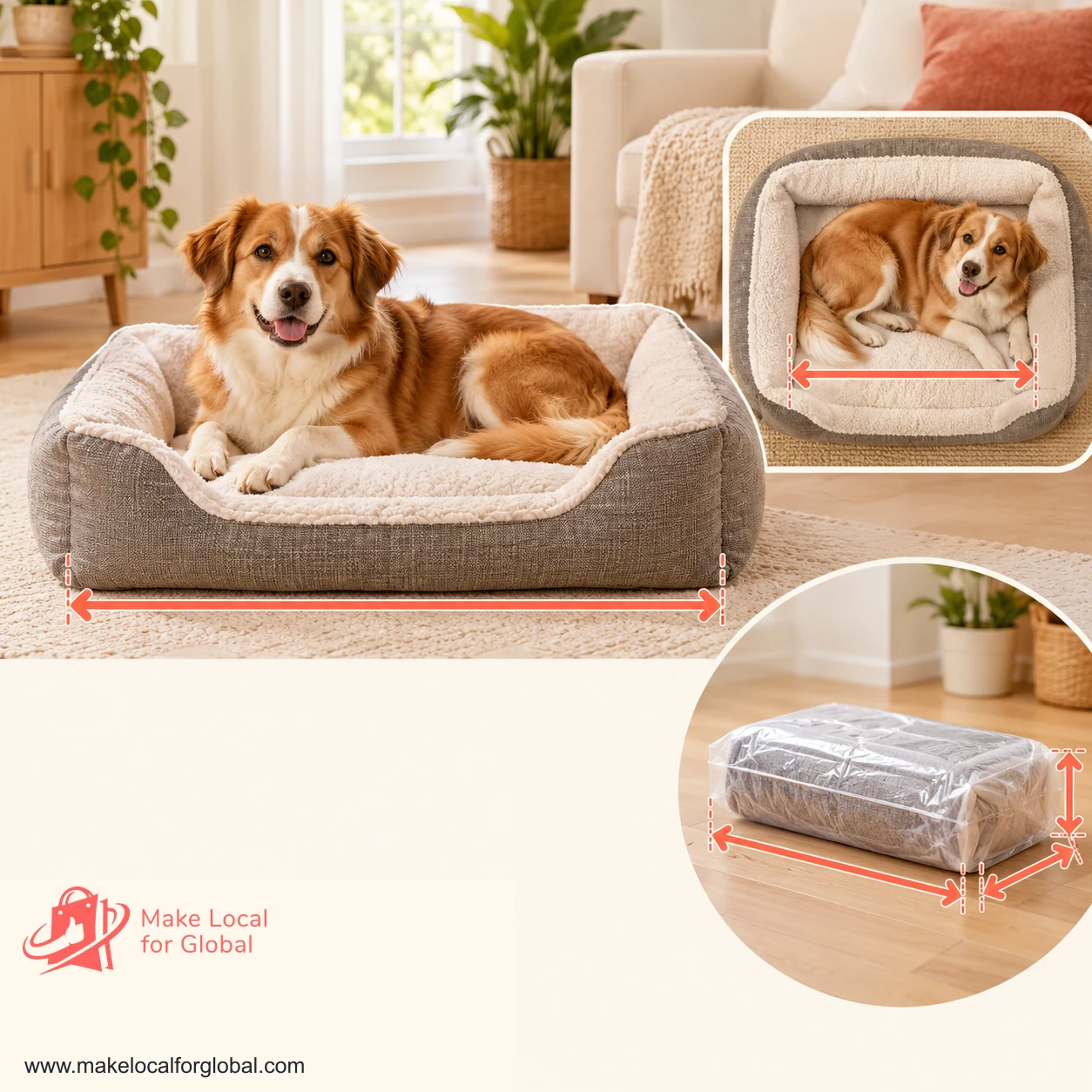
Sizing can cause expensive returns when an owner compares the dog’s length with the bed’s outside dimensions. A bolster takes up area. A hooded bed has an opening and internal depth. A flat mat may list only its outer width and length. Give buyers both the overall dimensions and the usable sleeping area when the shape reduces the space inside.
Use a firm surface and a repeatable measurement method. Measure the maximum outer length and width of the fully opened bed. For a bolster style, measure the inside floor area between the raised sides. For a cave or hood, measure the opening and internal depth. For a cot, record the frame footprint, raised platform height and usable fabric area.
Measure a sample after it has settled from its packaging. If a product is compressed for transport, ask the manufacturer how long it should take to recover and what handling is needed. Do not create a recovery promise from a quick visual guess. Give a realistic range only when supplier instructions or your own repeated sample checks support it.
Measure multiple units from the sample batch. If the dimensions vary, note the range and discuss the tolerance with the supplier. Your published measurement should reflect how buyers receive the item, not just a factory drawing. Add a short note that textile products may vary slightly only when your incoming checks show that variation and your seller terms explain it clearly.
Give a measurement method that does not imply a guaranteed fit. Suggest measuring the dog when it is relaxed in its usual sleeping position, then comparing that measurement with the usable sleeping area. A dog that curls up may use a different space from one that stretches out. Size guidance should invite the owner to account for posture, preferred room and whether the dog shares the bed with a blanket.
Use a consistent measurement point. For a stretched posture, show where to place the tape from nose to tail base, then explain that the owner should allow extra room based on the dog’s sleeping position and product shape. Write a centimetre allowance only when you tested it for the bed design and have a clear basis. Many sizes have been labelled “medium” differently by different makers, so never rely on the size name alone.
A simple size table may include the bed’s outer width and length, interior width and length, bolster height, suitable crate dimensions if relevant, and a descriptive scale reference such as the model dog’s approximate measurements. Use representative photographs. A small dog beside an oversized bed does not show the true fit for a medium dog.
Material names alone do not tell an owner how a finished bed behaves. A polyester cover, cotton blend or textured weave can feel and perform differently depending on its weight, backing, stitching and finish. Ask the supplier for the composition, construction and care instructions for the exact model you will sell.
State which surfaces use which material. A cover may have a woven top, a coated lower panel and a polyester lining. A raised cot can have a mesh sleeping panel with a separate metal or plastic frame. Name the material only as accurately as the supplier documentation allows. If the outer cover is a blend, publish the actual fibre percentages when available rather than shortening them to one material.
Describe the construction in plain words: removable cover or fixed cover; zipped or envelope closure; stitched or heat-bonded seams; loose fill or a single foam insert; grippy base or standard fabric underside. Tell the customer which piece can be washed and whether the filling or frame must be removed first. Do not suggest that every dog bed is machine washable if only the cover can go in the washing machine.
Words such as “waterproof”, “chew-proof”, “non-slip”, “orthopaedic”, “odour-resistant” and “eco-friendly” can create clear expectations. Before using any of them, ask what test supports the claim, which part of the bed was tested, what conditions were used and what limitations apply. A water-resistant base is not the same statement as a waterproof bed. A non-slip underside can still move on some floor finishes.
Do not imply a medical benefit from foam, thickness or a photograph of a dog sleeping. If you use a health-related or objective performance claim, keep documentary support for the exact model and make the wording match the evidence. CAP guidance says advertisers need evidence for objective claims consumers are likely to regard as verifiable. The [ASA and CAP advice on substantiation](https://www.asa.org.uk/advice-online/substantiation.html) explains that requirement for advertising.
Environmental language needs the same care. “Made with recycled fibre” should identify which component and, where you can, the percentage or standard behind it. Avoid broad terms such as “green” or “sustainable” when you cannot show what the claim means across the product’s life. Read the [CMA Green Claims Code](https://www.gov.uk/government/publications/green-claims-code-making-environmental-claims) before putting environmental statements in product pages, packaging or ads.
Make product sizes, care information and delivery details easy for customers to find before checkout.
Potential suppliers include UK makers, importers, wholesalers, manufacturers and print or cut-and-sew partners for your own designs. Each route changes minimum order quantities, product control, lead times, documentation, unit cost and your role if something goes wrong. Compare the landed cost and control you need, not just the factory price.
Request a written quote that separates product, customisation, packaging and freight. Ask whether the quote includes delivery to your door, customs charges and any handling fees. A very low unit price may leave costs outside the headline figure. Confirm which currency is used, when the price expires and whether an order deposit is refundable if the sample fails an agreed specification.
If a supplier says the bed meets a safety standard or has passed a test, ask for the document and verify that the product identity, model and date match your order. Avoid relying on a certificate image with no issuing body, test method or product number. Keep the quote, sample notes, purchase order, batch reference and final approved artwork together.
Check one sample as a customer would: open the parcel, follow the instructions, assemble the item if needed, remove the cover if that is part of the offer and measure the finished shape. Photograph each step. Note any smell, loose threads, sharp edges, exposed fasteners, uneven fill, open seams, damaged zip or staining. These observations help you compare suppliers and write truthful care and setup instructions.
Inspect the seam lines around corners and high-load points. Pull the cover gently along the direction it is likely to be stressed, and operate the zip across its full path several times. Do not use a sample test as a safety certification. It can reveal a defect in your sample; it does not prove that every unit or every type of dog will behave the same way.
Wash the removable cover exactly as the care label states. Record the water temperature, cycle, drying method, time to dry, change in measured dimensions and any change in colour or texture. If the label says hand wash or spot clean, test that method and record the time and result. Do not advertise machine washing when the only evidence is a supplier’s verbal assurance.
For filled products, unzip or open an approved inspection area if that can be done without damaging the sample. Check whether filling is distributed evenly and whether internal compartments prevent it shifting. Ask the supplier how filling is secured in production. For a cot, assemble the frame with the supplied parts, inspect the joints and test it on the floor surface stated by the manufacturer.
Keep a pass/fail checklist with a field for evidence and a corrective action. “Failed” should not be a feeling. Write down the loose seam at the left corner, the cover that shrank by a measured amount, or the zip that caught on the fabric. Send that record to the supplier and ask for a corrected sample before placing a stock order.

Product rules depend on where you sell, who makes or imports the item, and whether another law applies to that product. Dog beds should not be treated like ordinary low-risk accessories without checking their materials, construction, intended use, warnings and foreseeable use. Keep records of what you checked and ask a qualified adviser when your product or sales territory creates a specific legal question.
For Great Britain, the Office for Product Safety and Standards says businesses that make, import, distribute or sell consumer products are responsible for making sure products are safe and following relevant labelling rules. Its [product-safety advice for businesses](https://www.gov.uk/guidance/product-safety-advice-for-businesses) summarises the duties, evidence and corrective action businesses may need to consider. The general product-safety guidance for [Great Britain](https://www.gov.uk/government/publications/general-product-safety-regulations-2005) is separate from Northern Ireland guidance; check the current rules for the place where you make the product available.
If you place a product on the market under your own name, modify it, or import it from outside the UK, your responsibilities may differ from those of a retailer reselling an unchanged UK product. Ask a supplier who the manufacturer and importer are, what identification appears on the item or packaging, and how a batch can be traced. Keep the supplier address, product model, invoice, incoming quantity and batch identifiers. Have a way to contact affected buyers if a safety issue is reported.
Check whether other legislation applies to the material or the way the product is sold. Do not copy a label from another shop or assume that a supplier’s generic statement covers every market. The advice here is a starting point for UK sellers, not a legal assessment of an individual product. Review official guidance before launch and again if you change supplier, product materials, design or destination country.
Show the business name and contact details, the product’s main characteristics, total price, delivery arrangements, payment terms and returns information before the customer commits. The GOV.UK page on [online and distance selling for businesses](https://www.gov.uk/online-and-distance-selling-for-businesses) explains pre-contract information and cancellation rights. It states that customers buying most goods online can tell the seller they wish to cancel within 14 days after delivery, then have another 14 days to send the goods back.
Write the delivery promise in plain terms: dispatch window, delivery area, carrier method, tracking and what happens if a parcel is delayed or damaged. Explain the process for a cancellation or fault and give an accessible contact route. Do not describe a return policy as removing statutory rights. For a UK overview of distance-sale returns, read [GOV.UK’s returns and refunds guidance](https://www.gov.uk/accepting-returns-and-giving-refunds).
If you sell into Northern Ireland or elsewhere in Europe, check the specific product-safety and consumer information rules that apply to those markets. The rules can differ from Great Britain. For sales outside the UK, confirm tax, customs, delivery, labelling and returns requirements before enabling a country at checkout.
A bed can be expensive to deliver when it has a large outer size, bulky fill or a shape that does not compress safely. Price each model using the packed dimensions and actual carrier quote. A unit cost that appears attractive before freight may leave little contribution once payment, packaging, delivery, returns and advertising are included.
Ask the supplier for the finished product dimensions and the parcel dimensions after packing. Measure a delivered sample yourself. Record both actual weight and the carrier’s billable weight or size band. A lightweight cushion can still take up a large van space. A compressed parcel might cost less to send, but only use compression if the supplier allows it and the bed returns to its documented shape.
Include inbound freight, customs duty if due, import VAT cash flow, packaging, storage, pick-and-pack, delivery to the buyer, payment processing, marketplace commission, discounts, returns, damage and customer acquisition. Add a fair allowance for replacements or refunds using your own evidence as orders accumulate. Do not treat a hoped-for low return rate as a cost of zero.
The numbers below are an illustration for planning, not a supplier quote or a suggested market price. It assumes a seller who is not VAT registered and charges £59.99 for the bed with standard delivery included. Actual VAT treatment, carrier prices, platform fees and acquisition costs vary, so replace every figure with your own quote and order data.
| Per-order item | Illustrative amount |
|---|---|
| Customer price received | £59.99 |
| Bed and supplier packaging | −£18.00 |
| Inbound freight allocation | −£2.60 |
| Outer carton and protective packing | −£1.10 |
| Payment and selling fees allowance | −£2.10 |
| Outbound delivery | −£6.50 |
| Returns and damage allowance | −£2.40 |
| Customer acquisition allowance | −£8.00 |
| Contribution before fixed costs and tax | £19.29 |
The arithmetic is £59.99 minus £18.00, £2.60, £1.10, £2.10, £6.50, £2.40 and £8.00 = £19.29. That is contribution after the listed variable costs. It is not net profit. You still need to cover fixed costs such as insurance, storage, software, photography, accounting, samples, rent and your own time, then consider tax.
If you register for VAT or reach the applicable registration point, redo the calculation using net sales value and the treatment of input VAT that applies to your business. The example does not include an income tax or corporation tax calculation. Confirm current thresholds and accounting treatment with HMRC guidance or an accountant, since rules and your business position matter.
Run a second version for a large bed, a discounted order and a sale through each channel you might use. If your wide-bed delivery costs twice as much, the same selling price may not work. If customers pay delivery separately, disclose the price before checkout and still include the carrier fee in your margin model. Test free delivery only after adding it to the item economics.
Set a walk-away threshold before you spend on ads. For instance, the business may require at least £15 contribution per order before fixed overheads. If a product has £19.29 contribution in the example, a discount or extra delivery charge can take it under that threshold. The threshold is a decision rule for your business, not a claim about what another seller earns.
Product pages should let someone decide whether the bed fits their home and dog, what arrives, how it is cleaned and what it costs to receive. Use plain language and keep the same names and measurements in the title, variant options, specification table, size guide and packaging insert.
A title such as “Large Orthopaedic Dog Bed, Waterproof, Chew Proof” makes several claims and says little about the model. A clearer version might be “Removable-Cover Bolster Dog Bed, 90 × 70 cm, Charcoal”. Use words that describe verified features. In the first paragraph, name the bed form, the intended room or use, the included parts, the available sizes and the main care detail.
In the specifications, list external dimensions, usable sleeping area, height of raised sides, materials by component, filling type if known, closure, cover removal, care method, assembly details, contents, packed size and delivery estimate. If the supplier cannot confirm the filling, do not make it a selling point until you get a reliable specification.
Use a clean main photo with the full bed visible. Add a top view, side view, close-up of the fabric, zip or seams, a removable cover being handled, the bed beside a familiar household object for scale, and a picture with a dog whose size is stated carefully. A ruler or measurement graphic can help if it matches the real item. Do not stretch the product in editing or present a decorative throw as a supplied component.
For size variants, use the same camera angle and scale where possible. Show how outer bed size compares with and inside sleeping space. If every size does not fit in one photo, make separate labelled images or create a diagram based on actual measurements. Use alt text that describes the visible scene, such as “Charcoal bolster bed with a tape measure across the inner sleeping area”, rather than repeating the keyphrase in every image description.
Answer common questions next to the purchase choice: “Does the bed include a cushion insert?”, “Can I wash the whole bed?”, “What is the interior size?”, “Can the cover be bought separately?”, “How is a compressed bed restored?” and “Which delivery method is used?” If a buyer must contact you to learn the size or what the parcel contains, revise the page.
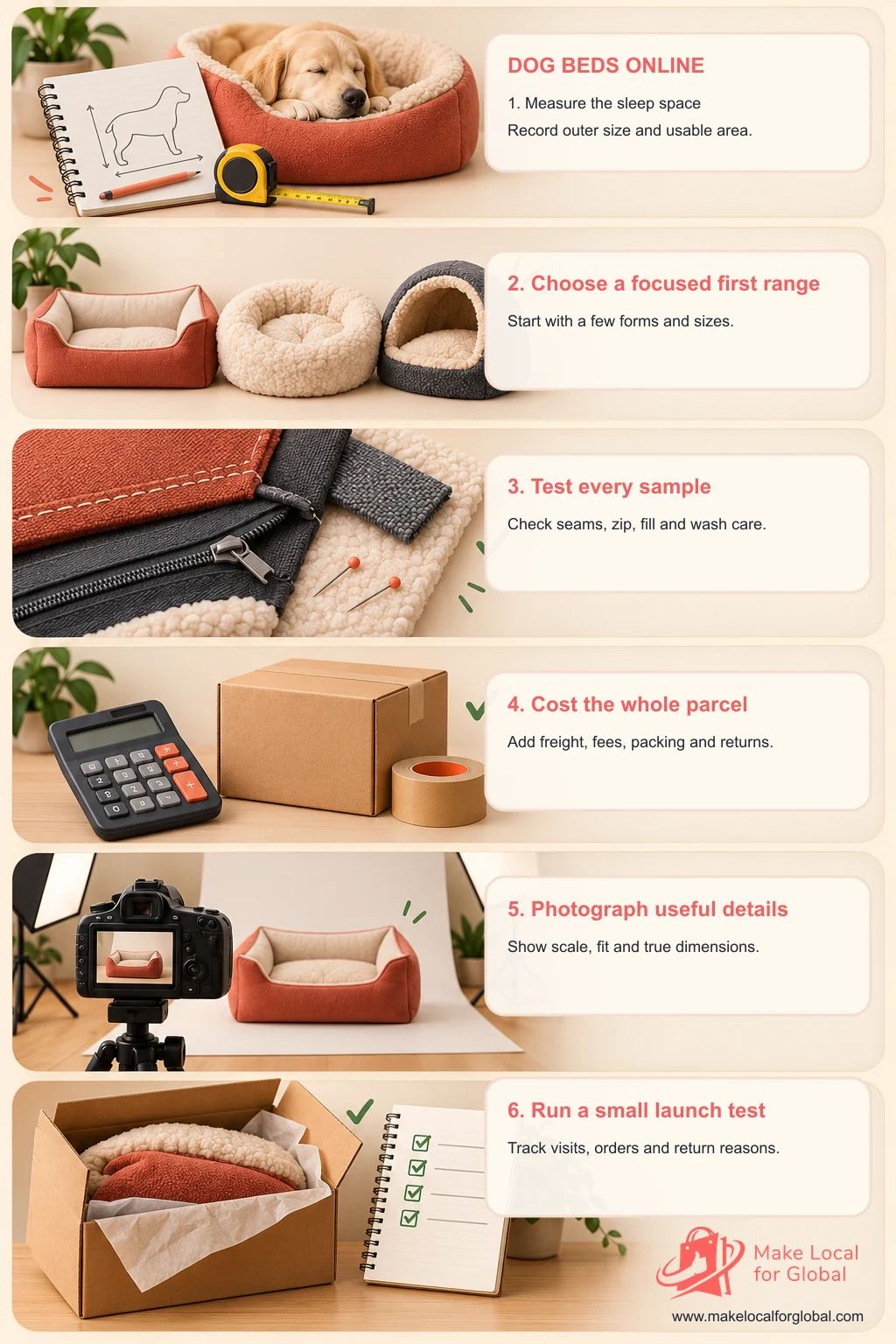
Storage and shipping take up more space for dog beds than for small pet accessories. Before ordering a size run, calculate how many packages fit in your available storage and how you will move them. Record the cubic space of an unpacked bed and its packed parcel. A supplier that offers compression may reduce storage volume, but confirm that the compression method preserves the product and that the customer can restore the item safely.
Self-fulfilment gives you direct control of product checks and customer updates, but you need room for stock, packing materials and collections. A fulfilment partner can store and ship orders, with fees for inbound handling, storage, pick-and-pack, packaging, returns and special-size parcels. Compare its full rate card with your own time and space costs. Ask how oversized boxes are charged and whether a bed variant is eligible for standard service.
Dropshipping can reduce the stock you hold, though you may have less control over sample consistency, dispatch, customer packaging and return handling. Before offering this model, order samples to your own address and test the supplier’s dispatch updates, parcel condition and delivery promise. The seller remains the visible point of contact for the buyer, so agree how the supplier will share tracking and handle a delay.
For made-to-order beds, set a realistic production lead time and state it near the buy button. Keep a small buffer for supplier delays, quality rework and carrier disruption. Do not label a product “in stock” if it will only be made after the order. Explain when the delivery estimate begins and what happens if a requested size is unavailable.
Use a packaging test on a sample parcel before choosing a final box or mailer. Check the outer layer for punctures, moisture ingress, burst seams and crushed corners after a normal carrier transit. Use a clean inner bag if the product specification supports it. Keep instructions away from sharp packing staples, and avoid packaging that can snag or mark the cover.
Include a concise instruction card that tells the buyer how to open the parcel without cutting the bed, whether the item needs to be shaken or left to recover, which cover can be washed, and how to contact you with a damaged delivery. Only describe restoration steps that the manufacturer approves or that you verified with repeat sample checks.
Photograph the packed sample beside a tape measure. Use its actual packed dimensions to request a carrier quote. Then pack a test order through the same process a customer order will use and weigh it. A packaging change can move a parcel into a more expensive price band, so update the cost sheet when you replace a box, add a leaflet or bundle a spare cover.
A marketplace can help a new seller reach people already searching for pet products, but fees, listing rules, competition and customer data access vary by platform. A shop on your own domain gives you more control over product education and customer journeys, though you need to create the traffic. Social marketplaces and local events can help you learn which shapes, fabrics and prices attract questions.
Choose a first channel where you can fulfil orders and answer questions reliably. Build a cost sheet for that channel, including listing and transaction fees. Do not assume marketplace traffic means profitable demand. Track product-page visits, size-guide clicks, add-to-cart actions, purchases, delivery cost, cancellation, return reasons and support questions.
Use phrases buyers might type, such as “bolster dog bed dimensions”, “removable washable dog bed cover” or “dog crate mat sizes”. These are research ideas, not proof of search volume. Check the language customers use in interviews, support messages and search data. Keep one primary product page per product and avoid making many near-identical pages for every size if the content would repeat.
Publish useful support content that answers product questions: how to measure a dog bed, what to compare in a washable cover, how to choose between a cushion and bolster, and what parcel dimensions mean for delivery. Link each article to the matching size guide or product page. Make each page answer a distinct question rather than repeating the same sales text.
For related pet-product range decisions, read our articles on selling dog collars online and selling cat collars online. The products are different, yet the supplier, fit-detail and product-page questions may help you plan a pet range. Browse the Product To Sell article collection for further product-specific examples.
Choose one buyer profile, one product, one creative idea and one call to action for each test. A local dog group may prefer a fitting demonstration and measurements. Search ads may test a phrase about washable bolster beds. Short videos can show the cover being removed, the bed’s interior measurement or the parcel being packed. Follow group rules and ask for permission before using a customer’s pet or home in a promotion.
Set a capped budget and a stop point. If a test produces clicks but no size-guide use, the landing page may not answer the real question. If people add to basket but abandon after seeing the delivery price, test a different shipping offer or bed design before increasing ad spend. If orders arrive but many buyers ask how to clean the bed, move care instructions higher on the page.
Do not judge a channel from one day or a handful of impressions. Record the date, spend, audience, product and result. Compare cost per qualified visit, conversion, contribution after acquisition, returns and support time across comparable periods. Keep the result, including disappointing responses. It tells you which assumption to test next.
Some customers may cancel when the size does not fit their room, the dog rejects the bed or the colour differs from their expectation. Others may report a seam, zip, filling or delivery problem. Use a simple support record: order reference, product and batch, issue, photos if volunteered, requested resolution, action taken and date closed.
For a sizing return, ask which published measurement the customer used and how the bed was measured. This can show whether the problem came from unclear copy, a supplier variance, an image that distorted scale, or a buyer preference you had not anticipated. Do not argue with a customer to protect a metric. Apply your policy and legal duties fairly, then use the reason to improve the listing.
For a damaged or potentially unsafe item, ask the customer to stop using it until you understand the issue. Escalate the report to the supplier, retain photographs and batch information, and check whether other units may share the fault. The OPSS business guidance describes the need for businesses to address unsafe products and cooperate with corrective action. A serious safety concern may need specialist advice or contact with the relevant authority.
Review return reasons monthly. If one bed shape has repeated “smaller inside than expected” reports, change the measurement graphic. If “cover too hard to remove” appears often, add a demonstration video and revisit the zip specification. If damage clusters around one supplier batch, pause sales of that batch during your investigation instead of changing only the customer service script.
Use the first month to reduce uncertainty. The goal is to make a set of observable decisions, not to promise a fixed sales result. If your supplier lead time is longer than 30 days, use the plan to test the offer and prepare the shop before stock arrives.
| Period | Actions | Evidence to save |
|---|---|---|
| Days 1–7: Buyer and problem | Interview 10–15 target buyers; compare current beds; draft a narrow buyer profile and product concept | Quoted needs, measurement confusion, cleaning questions and accepted price reactions |
| Days 8–14: Supplier and sample | Request comparable quotes; order or inspect samples; measure, wash and photograph one model | Supplier documents, sample checklist, packed size, care test and landed-cost inputs |
| Days 15–21: Page and offer | Build one product page, size guide, returns information and parcel test; ask five buyers to review clarity | Questions from page reviewers, missing details, delivery quote and revision notes |
| Days 22–30: Small launch test | Open a limited quantity or clearly stated made-to-order offer; test one channel and respond to every question | Qualified visits, orders, contribution, support time, cancellations and return reasons |
At the end of each week, write one sentence about the main thing learned and one change for the next week. Keep the product, price and marketing test stable long enough to read the result. If you change the photo, shipping fee, headline and audience at once, you will not know which change affected the response.
Before increasing stock, check that the product has passed your agreed sample standard, buyers can choose a size from the page, delivery is affordable for your target price and the order contribution clears your own threshold. If a condition fails, make a small correction and test again. A decision to stop is useful if the evidence does not support the offer.
It depends on your purchase cost, packed size, delivery, channel fees, returns, advertising and fixed costs. Build a per-order model using quotes for the exact bed and test it with a small quantity. The £19.29 contribution in the worked example is hypothetical and does not represent typical results or net profit.
Choose one form that matches a buyer problem you have observed, such as a crate mat for a particular crate size or a bolster bed with clearly removable cover. Use buyer interviews, product samples and delivery quotes to decide. Avoid choosing only if a supplier offers many colours.
Measure the finished outer bed and usable sleeping area separately. Provide a simple method for measuring the dog in a natural sleeping position and explain that the owner should compare the dog’s usual posture with the product’s internal dimensions. Do not rely on size labels such as small or large by themselves.
Making your own can give you greater control over materials, shape and production quantities, but it requires time, equipment, repeatable quality checks and product records. Wholesale can simplify production, though it leaves you dependent on supplier specifications and minimum orders. Compare full landed cost, quality control, lead time and your ability to respond to a defect.
Use those terms only when you hold suitable evidence for the specific product and your wording accurately describes what was tested. Explain limits, such as which panel resists water or which test supports a particular feature. Do not imply medical treatment or a guaranteed result for a dog.
For most goods bought online by consumers in the UK, the customer can notify the seller of cancellation within 14 days after delivery and then has another 14 days to return the item. Exceptions and the details of refunds matter, so publish the required information and check current GOV.UK guidance for your business and sales territory.
Compare supplier packaging, safe compression, bed shapes, carrier size bands and fulfilment rates. Ask for packed dimensions, test a real parcel and include returns in your cost model. Do not compress a bed or promise a recovery time outside the manufacturer’s instructions and evidence.
Show the full bed, top and side views, inner and outer measurements, fabric and seam details, removable-cover steps, a dog for scale, packaging and the parts included. Use the same angle across size variants where possible and write alt text about the visible image.
A strong dog-bed offer is clear about who it serves, how the bed is measured, what the fabric and care claims mean, and how the parcel reaches the buyer. Start with a small range, check the sample and cost the full order before you grow stock. When the shop itself needs work, compare MLFG’s ecommerce setup options or talk with the team about what you need.
Compare the setup options, list what your first product page needs, and choose a small test you can measure.
PREFERRED SOURCE
Like what you’re reading? Add Make Local for Global as a preferred source on Google to see more of our articles when you search.

Build your online presence without having to figure out everything yourself.