

READY TO SELL Diaper bags ONLINE?
Get a store built for you in 5 days, plus training and support to help you start, run, and grow your Alternative business.

Plan a changing bag range with buyer research, sample checks, UK product safety notes, full-order pricing, clear product pages and careful fulfilment.

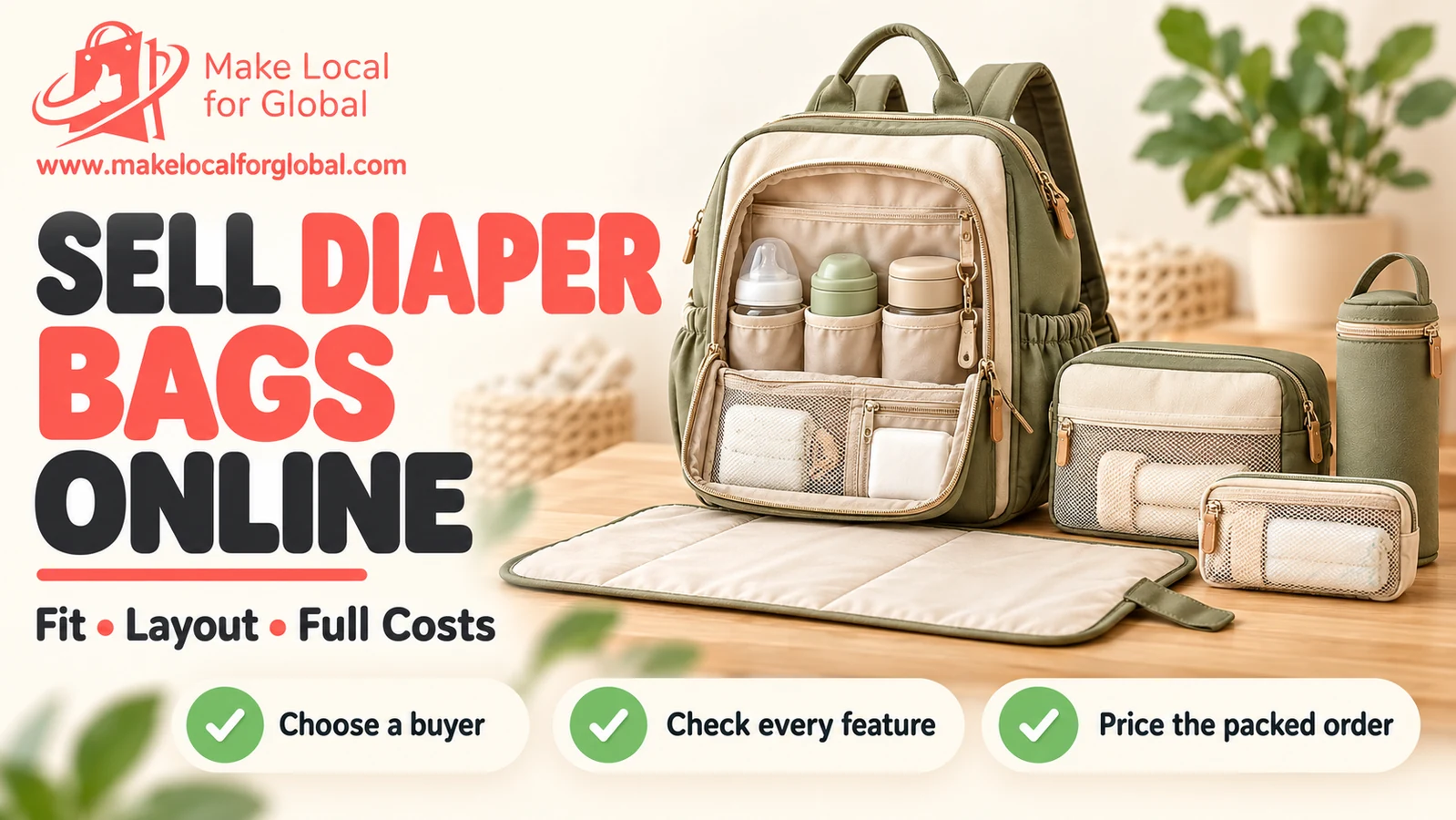
A changing bag has a practical job. A parent may need one hand free, quick access to wipes, space for spare clothes, and a way to keep clean items apart from damp ones. The best opening range starts with a clear use case and a sample that works in a real day out, not a long list of pockets chosen from a supplier catalogue.
To sell diaper bags online, choose one buyer group, compare a small set of bag shapes, test hardware and materials, then price the parcel from measured costs. In the UK, many shoppers search for the phrase changing bags, and buyers in other markets use diaper bags. Use both phrases naturally in category copy and product details, then explain the intended use and limits with care.
A changing bag is a carry bag, not a child carrier or a safety device. A bag may come with pram clips, a changing mat or insulated pockets, yet those features do not by themselves prove compatibility, hygiene performance or safety. Verify every claim with the supplier and your own checks before adding it to a product page.
Present a clear first range
A focused buyer, measured bag and useful product page give shoppers information they can compare.
“Parents” is too broad as a first customer profile. A shopper leaving home for a quick trip may value a compact shoulder bag. A parent carrying supplies for a full day may prefer a larger backpack with separate pockets. Another may want a simple tote that can move between a pushchair and a car.
Choose a starting group you can describe in one sentence. Examples include a first-time parent who wants a clearly organised everyday bag, a parent of two who needs more capacity, or a commuter who wants a bag that still looks suitable at work. Each group gives you a different way to assess size, weight, appearance and price.
Do not assume the person buying the bag is always the person carrying it. A gift buyer may focus on colour and presentation. The daily user may care more about strap comfort, access, and whether a bottle fits upright. Ask what each person needs before deciding which features matter most.
Ask about recent actions rather than abstract opinions. “What did you carry on your last three outings?” produces more useful detail than “Would you buy a bag with twelve pockets?” Ask what was awkward to find, what became wet or dirty, what stayed unused, and how the bag was carried.
Speak with a small group of parents who match the customer you hope to serve. A short conversation can reveal whether users carry a compact kit or a full day’s supplies. Ask about the bag they use now, not only the bag they might buy in the future. Take notes without collecting a child’s name, health details or other private information.
Observe the contents list rather than treating every request as a product feature. If several people carry a water bottle, spare clothes and wipes, those items may help you test pocket layout. If only one person requests a built-in phone charger, that feature may add supplier cost without helping the first range.
Create a one-page concept with two or three distinct bag ideas, a clear example price and a short description. Ask people in the intended buyer group which one they would compare, what information they need before buying, and what would stop them ordering. A positive comment is not a sale, so track stronger evidence such as a wait-list sign-up, a request to see a sample or a paid pre-order where terms are clear and lawful.
Record the source and result of each test. For example: “12 parents viewed the three concepts; five asked about backpack capacity; three joined the sample update list.” Those figures illustrate a useful log, not a market benchmark. Repeat the test with a second design or a different price before making a large stock commitment.
| Test question | What to show | Useful signal |
|---|---|---|
| Which carry style suits the outing? | Backpack, tote and compact shoulder bag | One style draws repeated questions |
| Which items need separate space? | A sample contents layout | Users can explain the layout |
| What makes a bag hard to use? | Close-ups of zips, straps and pockets | People identify a feature to inspect |
| What price information is missing? | Example price and delivery charge | Buyers ask about the same value |
| What supports a purchase decision? | Sample photos, dimensions and terms | Buyers request details you can document |
A small test should change a decision. If comments suggest the bag looks attractive but nobody understands its size, improve the product page before changing the product. If several users say it feels heavier than expected once filled, test a lighter construction or show a loaded weight. Do not order a feature just to make the specification look longer.
A first range can use one main bag body with a few practical variations. This keeps purchasing, photography and inventory easier to manage. It gives shoppers choice without making every colour, lining or accessory a separate stock risk.
| Bag type | Possible use | Points to check |
|---|---|---|
| Backpack changing bag | Longer outings or hands-free carrying | Strap adjustment, back panel, access when worn, loaded comfort |
| Tote changing bag | Short trips or familiar open-top shape | Shoulder drop, closure, divider, weight on one shoulder |
| Messenger or shoulder bag | Quick access and cross-body carry | Strap width, adjustment, buckle position and balance |
| Compact organiser | A smaller kit or insert inside another bag | What fits, whether it stays in place, cleaning and edge finish |
| Convertible bag | More than one carry configuration | Strap changes, unused hardware, instructions and added weight |
| Bag with changing mat | Mat bundled with a carry bag | Folded size, surface cleaning, storage and clear instructions |
| Bag with stroller clips | Bag intended to attach to a compatible pushchair | Clip construction, instructions and verified compatibility |
These are product formats, not a recommendation that every bag needs every feature. More compartments help only if the layout is easy to understand and the bag remains comfortable when full.
A small, costed range might include one backpack in two colourways, a tote in one colour, and a removable organiser sold separately. Another range may begin with one model in two sizes. Pick a structure that gives you enough information to compare demand without producing a complicated size-and-colour grid.
Count each size and colour combination as a stock decision. Three styles in four colours create twelve variants before you add an accessory. A single core style in three colours creates three. The simpler range may produce clearer evidence about which colour or feature should receive the next order.
Use entry, core and premium tiers when each offers a real benefit. An entry bag could provide the main carry function; the core version might add a removable organiser and changing mat; a premium version could use a tested upgraded fabric, added storage and support terms you can honour. Avoid charging more for an extra pocket if it does not help the buyer.
Write a specification that a sample checker can verify. “Large” and “high quality” leave too much room for interpretation. Record external dimensions, internal usable space, empty weight, strap range, pocket count, zip type, lining composition where known, and the contents used to demonstrate capacity.
Measure the bag open and closed. Record the changing mat separately, if included. A bag that looks roomy in a styled photograph may have a small opening or a divider that reduces usable space. Photograph a known set of common items beside the bag, then list that set in the product description.
Capacity claims should explain what was measured. If you give a litre figure, state whether it came from the maker or your own measurement and how it was calculated. Avoid relying on a visual estimate. A photo with a standard bottle, wipes pack and folded garment can help a shopper judge scale, yet brands and sizes vary.
Describe colours in plain words and show them under consistent lighting. “Sage green” can look different on a mobile screen from a warm olive. Include a close-up if colour is central to the choice. Keep the product name clear enough for a buyer to compare one size with another.
A bag can feel comfortable when empty and awkward when loaded. Fill the sample with the contents you plan to show, weigh it, and try it on a short walk. Check whether it stays balanced, whether an outer pocket is reachable, and whether the bag is comfortable when the wearer bends or lifts a pushchair.
Ask several adults of different heights to adjust the straps. Note where the bag sits and whether buckles or clips rub against the wearer. If the bag is intended for cross-body use, test the strap at its full and shortest adjustment. Publish a strap range measured on the actual product, not a generic supplier image.
Test the opening with one hand. A zip, magnetic closure or flap creates a different experience. Check whether the main compartment opens without contents falling out, whether a zip catches on the lining, and whether the bag can close with the example packing list inside.
A pocket layout should make a task easier. A bag might separate wipes from spare clothes, keep a bottle upright, hold a phone where it can be reached, and provide a place for a damp item to be isolated. The feature list is useful only if the sample proves the pocket is large enough and easy to find.
Ask users to pack a sample without telling them where each item should go. Watch where they naturally place a bottle, keys, wipes, a change of clothes and a damp garment. If several people try the same layout, you can see whether labels or photos help explain it.
Do not call a pocket insulated without supplier evidence and a clear explanation of its limits. Insulation does not mean a pocket will keep contents at a safe temperature for any period. If a bag is not a food storage product, do not make claims that could lead a buyer to treat it as one.
A removable changing mat can be a useful bundle, yet it raises extra questions. What are its dimensions when open and folded? How is its surface cleaned? Does it attach to the bag or sit inside? Are instructions clear about the surface and place where it should be used? Keep descriptions factual. Do not imply the mat replaces safe supervision or a purpose-built changing surface.
Stroller clips create another specific promise. A photo showing a bag hanging from a pushchair can look like a universal compatibility claim. Ask the supplier for approved attachment instructions and compatibility limits. Test the actual clips and bag under a documented load condition. If you cannot substantiate a universal fit, say which products or models have been checked, or describe the clips as included accessories without claiming they fit every pushchair. Do not encourage overloading or tell customers to leave a bag attached if the maker’s instructions do not support that use.
Related products can increase the usefulness of an offer: a washable organiser insert, a pouch for small items, or a separate wet bag. Keep dimensions and care instructions clear. A customer should know whether an accessory fits one model or the full range.

Choose a sourcing route that matches the evidence and cash you have. A wholesaler may offer lower minimum quantities and faster access to stock, but another seller may offer the same product. A manufacturer can adapt dimensions or colours, yet a custom order often needs a larger quantity, longer lead time and clearer technical specification. Handmade production can make a small run possible, with capacity and consistency to confirm before taking orders.
A supplier should answer questions about materials, ownership of product design, minimum order quantity, sample costs, lead time, packaging, quality checks and defective stock. Ask whether the quotation covers the changing mat, accessories, labels and branded packaging. Request the complete specification for the exact bag you intend to sell, not a similar catalogue image.
Send a brief that records:
Confirm terms in writing. A quotation that lists only one unit price may omit import duty, carton dimensions, payment fees or packaging. Ask what happens when a sample differs from a bulk order. Record the approved sample and any changes after approval.
A lower quote can shift cost or risk into another part of the order. Compare the same product specification, delivery arrangement, unit count, payment timing and delivery estimate. Ask for a sample made by the production method planned for the main order. A hand-finished sample may not reveal variation in a larger run.
For a small opening order, compare one colour with one or two variants rather than selecting from a large catalogue. Ask whether colours can be repeated in later runs and whether the lining, zips and clips will remain available. A discontinued trim can make a replacement batch look different.
When importing, document the product description, origin, material breakdown where available, shipping method and person responsible for customs processes. Check current HMRC and border guidance for the business’s route and product details. Do not assume a supplier’s “tax included” quote covers every charge or creates the right importer arrangement.
A supplier’s certificate or test document may relate to another item, factory or revision. Match it to the model, material, colour and production date. Keep a copy with purchase records and ask questions when details do not match.
Order a sample before committing to the main run. Record the supplier, model code, colour, date received and parts included. Photograph the bag from the same angles you expect to use online. Those photos make later changes easier to spot.
Use a checklist for each sample:
These checks compare the sample with the written specification. They do not replace a risk assessment or prove that a product is safe for every user. If you make, import or distribute a consumer product, you remain responsible for your role and obligations. Ask a competent testing body or Trading Standards for product-specific advice where a risk is unclear.
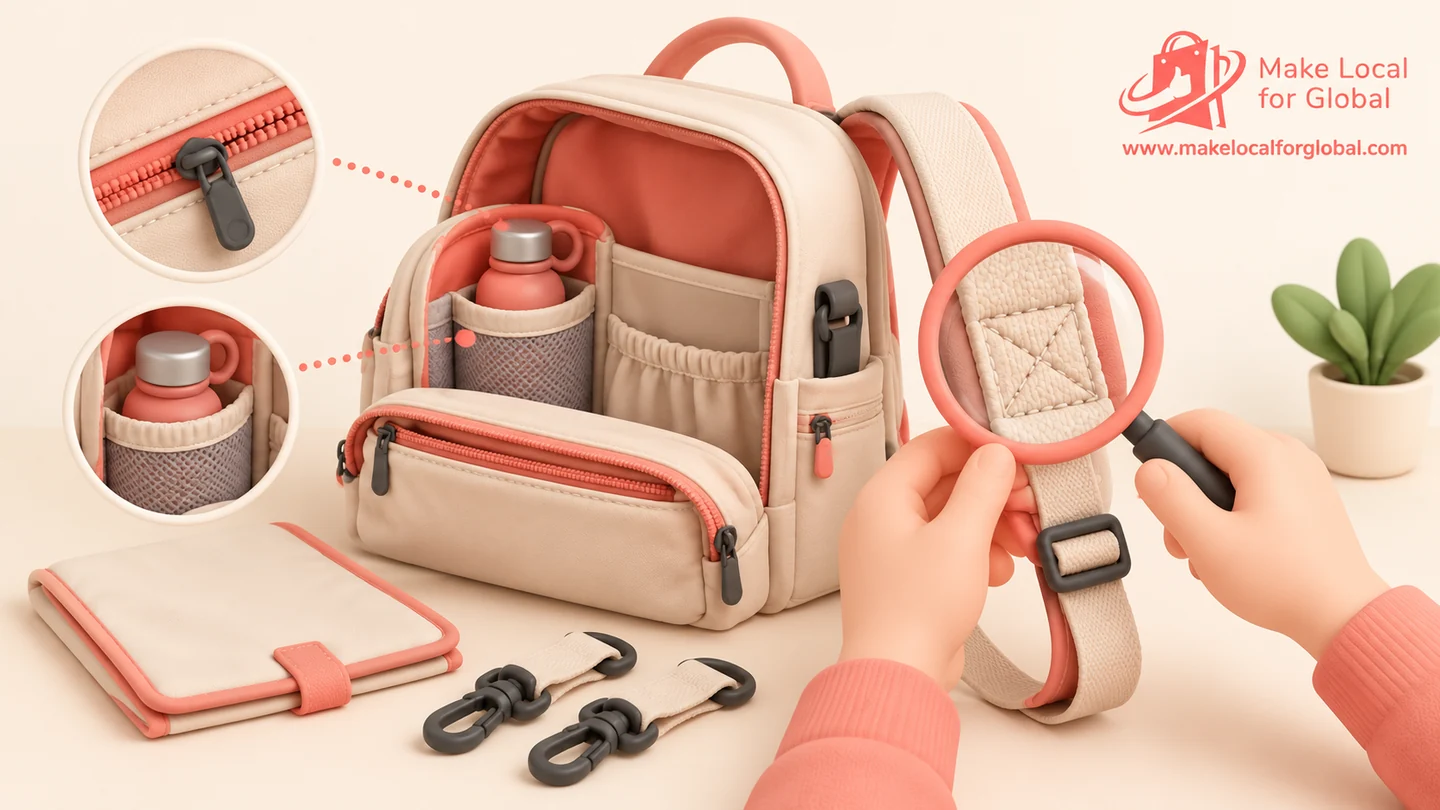
Keep an approval record. Note the details you accepted, defects you rejected and changes the supplier agreed to make. If bulk goods arrive with a different strap, lining or closure, compare them with the recorded sample and decide whether to pause sales until the change has been assessed.
If the sample fails a check, ask whether the cause is a single defect, a design issue or a mismatch between the brief and the item. Do not accept a verbal promise as a quality-control plan. A replacement sample with the agreed change should be checked again before a purchase order.
Requirements depend on what you sell, where you sell it and your role in the supply chain. A plain changing bag does not automatically become a toy, child carrier or regulated baby product solely from parental use. Add-ons, intended use and claims can change the analysis. Check the classification for the exact product and market before importing or manufacturing.
For Great Britain, the General Product Safety Regulations 2005 guidance says consumer products must be safe in normal or reasonably foreseeable use. The Office for Product Safety and Standards advice for businesses explains responsibilities for makers, importers, distributors and sellers, including risk reduction, records, labelling and instructions where relevant.
Northern Ireland has a separate position. The UK government factsheet on EU Regulation 2023/988 for Northern Ireland explains rules that have applied there since 13 December 2024. It describes responsible economic operator, traceability and online marketplace requirements. Do not copy a Great Britain checklist into an NI listing without checking the NI route.
Make a record of your product role. A business that imports a finished bag may have duties that differ from a retailer buying from a UK wholesaler. A business that chooses materials, specifies a new design or puts its own name on a product may take on manufacturer responsibilities. Ask the supplier for the information that lets you identify the factory, model and batch. Keep invoices, sample notes, test records and complaint reports.
The product or packaging should carry the identification information and contact details required for the relevant rules and market. Ask a product safety specialist to confirm what must appear on the changing bag, its label, packaging and online listing. Do not add CE or UKCA marks as decoration. Use a conformity mark only where product category and applicable law require it.
A product safety file can be practical. Keep the supplier specification, risk notes, sample photos, approved changes, batch records, customer incidents and action log together. If a complaint reports a broken strap or sharp component, record model and batch, check whether other orders are affected, and use the appropriate reporting route. OPSS guidance says businesses should monitor safety issues and notify Trading Standards when risks are identified.
A changing bag may combine woven fabric, coated fabric, leather, metal, plastic and foam. Get the composition for each material from the supplier and describe it accurately. Do not label a bag “organic cotton”, “recycled”, “vegan leather”, “waterproof” or “antibacterial” without evidence for the claim.
The GOV.UK textile labelling guidance says textile products in scope need fibre composition information and manufacturers and retailers share responsibility for accurate information. The Textile Products (Labelling and Fibre Composition) Regulations 2012 include detailed scope and exemptions. A bag may not be covered in the same way as a garment, so confirm the exact product and any textile accessories rather than assuming one rule applies to each component.
If a changing mat, blanket or removable textile pouch is sold with the bag, check whether that item falls within the textile rules on its own. Keep supplier composition information and make online claims consistent with the physical label. If a material name is a trade term, explain what it means instead of presenting it as a fibre.
A product page needs more than attractive photos. UK distance selling rules require buyers to see business contact details, product description, full price, payment options, delivery arrangements and cancellation information before they order. Read the current GOV.UK distance selling guidance and check separate rules that apply to customers outside Great Britain.
For many online goods, the customer can cancel within 14 days after delivery and has another 14 days to return the item after giving notice. The GOV.UK returns guidance explains refund and delivery requirements. A bag policy should not say “no returns” in a way that removes statutory rights. Make your change-of-mind process easy to follow, then handle faults under the customer’s legal rights.
Descriptions and marketing claims should be accurate. The GOV.UK page on marketing and advertising law explains that businesses cannot mislead customers with false claims or by leaving out key information. A listing that calls a bag “waterproof” when it has only a water-resistant coating can lead to a dispute and a poor review.
The unit price is one line in the cost model. A useful selling price needs to cover the product, inbound transport, import costs where relevant, packaging, payment or marketplace fees, outbound shipping, expected returns, discounts and customer acquisition. It should leave enough contribution to cover fixed overheads and owner pay.
The following example is illustrative only. Replace each input with a quote from your supplier, shipping provider and selling platform. It assumes one changing backpack sold through a direct online store, with figures before VAT accounting. They are not a typical market price or a profit forecast.
| Per-order item | Illustrative cost |
|---|---|
| Bag purchase price | £18.00 |
| Inbound freight and duty allocation | £3.20 |
| Product packaging and insert | £1.10 |
| Payment and platform fees | £2.20 |
| Outbound postage | £4.50 |
| Returns and damage allowance | £1.50 |
| Customer acquisition allocation | £5.00 |
| Total variable cost | £35.50 |
| Example selling price | £54.00 |
| Contribution before fixed overheads | £18.50 |
Arithmetic: £18.00 + £3.20 + £1.10 + £2.20 + £4.50 + £1.50 + £5.00 = £35.50. £54.00 − £35.50 = £18.50 contribution before fixed costs such as software, storage, insurance, accounting and the owner’s time. If the business is VAT registered, calculate sale and costs under its VAT treatment before judging contribution. Do not treat contribution as net profit.
Measure the parcel after the bag is packed in its shipping carton. A changing bag can be bulky even when light. A carrier may price it by actual weight, size or a dimensional calculation. Test the real packed sample against the delivery service’s size bands. Do not use unboxed product dimensions as parcel dimensions.
Include an allowance for refunds, damaged parcels and unsellable returns. Build it from your own order evidence once available. At launch, label the assumption and revisit it after 20 or 30 completed orders. A return allowance is not a hidden fee deducted from a customer refund; it is a planning figure for the seller’s costs.
Separate fixed start-up costs from variable cost per order. If product photography, samples and initial packaging cost £600, and each completed order contributes £18.50 before fixed monthly overheads, then £600 ÷ £18.50 is about 33 orders to recover those start-up costs. This check leaves out taxes, owner time and recurring costs, so it is a planning aid rather than a forecast.
If the calculation gives a low contribution, test the cause one line at a time. A smaller parcel may reduce delivery cost. A higher price may work if customer research supports the value. A bundle may increase basket value when it combines items the buyer needs. Reducing packaging below a protective level can raise damage and return costs, so test the packed parcel before changing it.
Check a few scenarios:
| Scenario | What changes | What to record |
|---|---|---|
| Base case | Current price and supplier quote | Contribution per completed order |
| Higher shipping | Carrier quote rises or parcel crosses a size band | Margin after delivery |
| Return sensitivity | More orders are returned or marked unsellable | Refund cash flow and stock value |
| Lower acquisition cost | More orders arrive through search or referrals | Contribution by channel |
| Discounted bundle | A pouch is included at a tested basket price | Bundle cost and units sold |
Do not add a percentage margin to product cost and assume the result is profitable. The cost model needs actual selling fees, shipping, packaging, customer acquisition and returns. Review it when your supplier changes the quote, carrier pricing changes, or a discount alters the basket.
A price should reflect materials, construction, use, support and cost of reaching the customer. Compare products that solve a similar carry problem, but avoid treating a competitor’s list price as proof your own product will sell at the same level. Record date, product type, included accessories, delivery charge and sale price for each comparison.
Keep the offer ladder simple:
| Offer | Product | Buyer question it answers |
|---|---|---|
| Starter | One compact bag with main carry features | “Can I carry the basics without a large bag?” |
| Core | Main backpack or tote with a clear pocket layout | “Can I organise supplies for a longer outing?” |
| Bundle | Bag plus a tested organiser or pouch | “Can I keep smaller items together?” |
| Gift option | Bag in gift packaging with a clear gift note | “Can I give this without guessing what is included?” |
Offer a bundle only when you know the cost and contents. Make the bundled items visible in product photos and list each included part. If the pouch is optional, do not include it in a photograph without labelling the image. Confusion about what is included can create complaints and returns.
Set a free-delivery threshold only after testing its effect on contribution. A threshold can prompt a larger order, yet it can reduce margin if the average parcel already has a high shipping cost. Run the calculation with the carrier charge you have been quoted.
For launch promotions, state the normal price and terms clearly. Do not use a false countdown or claim a discount from a price that was never charged. Track the number of buyers who use a code, average order value and return rate. Stop a promotion if it brings orders that cost more to fulfil than they contribute.
A useful page lets a shopper decide whether the bag fits their routine. Start with a product name that identifies carry style and size. Add a one-sentence summary of intended use, then show dimensions, empty weight, strap adjustment, materials, cleaning information, exact accessories and delivery details.
A product title could be: “Everyday Changing Backpack, 18 L, Olive”. Replace the example details with verified values. Do not use a string of synonyms such as “baby diaper nappy maternity bag travel backpack”. Place “changing bag” or “diaper bag” in a natural heading and use the other phrase where it helps overseas buyers. Keep each variation’s title distinct.
Use a specification table:
| Product detail | Example information to publish |
|---|---|
| Bag shape | Backpack with two shoulder straps |
| External size | Measured height, width and depth |
| Empty weight | Weighed without accessories |
| Main fabric and lining | Supplier-confirmed material names |
| Strap adjustment | Measured range on the sample |
| Pockets | Number and position, with an annotated photo |
| Included extras | List of items supplied with the bag |
| Cleaning | Supplier’s written care instructions |
| Packed parcel | Actual parcel size and weight |
| Delivery and returns | Current options and store policy |
Replace every example label with accurate values from the product. Do not copy a supplier’s specification when the sample differs. If you have not tested a cleaning method, quote the maker’s instructions and avoid claiming a stain can be removed.
Use consistent lighting and show the bag empty and packed. Include front, back, side, open interior, strap attachment, zip close-up, lining, pocket layout, changing mat and included clips. A hand holding the bag or a common item beside it can show scale, but do not use a child as a prop.
Create one “what fits” image using a labelled list of actual test items. Keep items consistent between photo and description. If a bottle, wipe pack or garment was used for scale, state that product dimensions vary. Do not make the shopper infer size from a model’s body.
Show colour in natural light and use close-up photos for fabric texture and hardware. If the product is available in several colours, photograph each one rather than recolouring a single image. A colour swatch can support the choice but should not replace a real product photo.
Write alt text that describes what is visible, such as “Olive changing backpack open to show bottle pockets, organiser sections and removable changing mat.” Keep alt text useful to someone who cannot see the image. Do not repeat the page title in every image description.
Add a short FAQ on the product page when answers are specific to that model. Common questions include:
Do not invent an answer to avoid losing a sale. If a compatibility test is not complete, say it has not been checked. If a supplier does not provide a material detail, request it before publishing a claim.
A standalone online shop gives you control over product pages, customer service and brand presentation. A marketplace can place a new seller beside established listings and may provide built-in checkout, yet each platform has its own fees, category rules and returns process. Compare the total cost and customer data you receive before choosing.
Test one main channel and one discovery channel instead of opening every account at once. A small store plus a local parent group referral test may show whether price and product page are clear. A marketplace listing can test search demand, but compare its fee and competition with your own store’s acquisition cost. Read current platform terms directly; rates and rules change.
Build a list of search phrases from real customer language. Start with “changing bag backpack”, “changing bag with organiser”, “compact changing bag”, “large changing backpack” and “diaper bag for travel”. Check whether each phrase matches products you stock. Do not create separate pages for every small word variation.
Use helpful collection content to answer questions before people reach the product. Examples include a comparison of backpack and tote layouts, a measured packing list for a short outing, and a guide to checking stroller clip compatibility. Link each piece to the relevant model with accurate wording. Browse the Product To Sell article collection for more product-by-product planning examples.
Search optimisation begins with a page that matches the buyer’s question. Google’s SEO Starter Guide recommends useful original content, readable structure, descriptive URLs and clear link text. For a changing bag page, use a concise title, a useful meta description, real product details, descriptive image alt text and internal links that explain their destination. A title or keyword cannot guarantee a Google position.
A simple first campaign can show one product photo, one dimensions panel and a clear price. Ask viewers which detail they need next, then improve the page from the responses. If you run paid promotion, cap the test budget and track clicks, add-to-basket actions, completed orders and returns separately. A high click count with no checkout may point to a page, price or product mismatch.
Related sellers may find useful ideas in selling backpacks online, especially the advice on carry fit and storage. If your range uses smaller removable organisers, see the utility pouch selling guide. Clear link text helps readers know what each page covers.
Plan your shop costs around real orders
Compare store plans after you have a first range, packed parcel size and selling cost model.
Assign a simple SKU to each model, size and colour. Store the SKU on the product, purchase order, stock record and customer order. If a strap or lining changes, a model and batch reference help identify which orders may be affected.
Use a reorder point based on supplier lead time and actual sales, not a guess from one busy weekend. A basic method is average weekly units sold multiplied by supplier lead time in weeks, plus a small buffer you can afford to hold. The buffer should reflect order uncertainty and cash available. Recalculate it after each purchase cycle.
Example: if you sell four bags a week and a verified reorder takes six weeks, basic lead-time demand is 24 units. A 6-unit buffer makes the reorder point 30. That calculation is illustrative; replace it with actual demand and delivery performance. Do not let the formula force a new order if a quality issue or design change is pending.
Check goods as they arrive. Count each carton, photograph damaged packaging, sample-check units against the approved standard and keep a batch record. Confirm colours, accessories, labels and instructions before adding new stock to the available quantity. A supplier’s quality report can support your process, yet it does not replace your own checks on receipt.
Review stock by model and colour. One colour may bring views but few orders; another bag shape may attract more returns. Use visits, conversion, returns, complaints and stock age together. Do not restock a slow variant just from its place in the original range.
If you change suppliers, compare the new sample with the old one side by side. Check dimensions, weight, material, hardware and colour. Update the product page and photos when a meaningful detail changes. Do not mix old and new product versions under one listing if a buyer would receive a materially different bag.
Package the bag so it arrives clean, dry and in the advertised condition. Use a dust cover or protective inner wrap where it helps prevent marks, then choose packaging sized for the measured parcel. Avoid stuffing a bag so tightly that it loses shape, creases permanently or presses hardware into the fabric.
Test the parcel from the supplier’s warehouse through the delivery route you intend to use. Seal a sample as a customer order, measure it, weigh it, shake it gently and inspect the contents after opening. For longer transit or fragile accessories, use a documented packaging test that suits the item and route. Do not claim a bag is “crush-proof” without reliable evidence.
If the bag includes a changing mat, keep it protected from dust and materials that could mark it. Separate accessories so the customer can see what is included. Add a packing slip that identifies the item and a simple care note based on supplier guidance. Do not add leaflets with unverified hygiene or health advice.
Compare fulfilment options using current service terms: pickup, delivery time, tracking, parcel dimensions, compensation cover and claims steps. A cheaper service may have no suitable cover for a lost parcel or may not collect from your location. Record order-to-dispatch time and actual delivery time to set a realistic promise on the site.

Give the customer a clear dispatch email and tracking details where the service supports them. If a parcel is delayed, tell the buyer what you know and what action you are taking. Keep the carrier receipt and parcel reference until the order is resolved.
A clear returns process protects time and trust. Explain the return window, how to contact the business, who pays return postage for a change-of-mind return, and how a faulty or misdescribed item will be handled. Legal rights for online orders apply regardless of your preferred store policy.
Ask what caused a return without making the customer feel blamed. A short reason list can show whether the issue was size, colour, capacity, strap comfort, a fault, delivery or a product-page expectation. Keep personal details to what you need for the order and the customer’s request.
Inspect returned stock before placing it back for sale. Record whether tags are attached, the bag is clean, accessories are present and there is wear or damage. Follow applicable refund rules. Do not resell a used bag as new.
Treat a report of a broken strap, sharp part or failed clip as a possible product issue. Ask for the order number, model and photos, then check the batch record and other complaints. Pause affected stock if the issue could create a safety risk. Follow reporting and corrective-action advice from OPSS or the relevant authority.
Write support answers once you have seen a question repeat. If shoppers ask whether a bottle fits, add an exact bottle diameter or a photo of the tested example. If buyers ask whether the bag fits every pram, replace a broad claim with tested model names and a clear compatibility note.
A first month can produce evidence without a large range. Set one outcome for each week, keep stock modest and review what happened before placing a second order.
| Week | Actions | Evidence to record |
|---|---|---|
| 1: Buyer and concept | Speak with target parents, note carry problems, compare two bag shapes | Repeated tasks, capacity needs, buyer questions |
| 2: Samples and cost | Request samples, test straps and zips, measure parcel, price the full order | Defects, supplier response, landed cost and delivery quote |
| 3: Page and photos | Write specifications, photograph included items, publish terms and return details | Page visits, product questions and image clarity |
| 4: Small sales test | Open a limited order window, share one useful content piece, review fulfilment | Orders, contribution, dispatch time, return reasons |
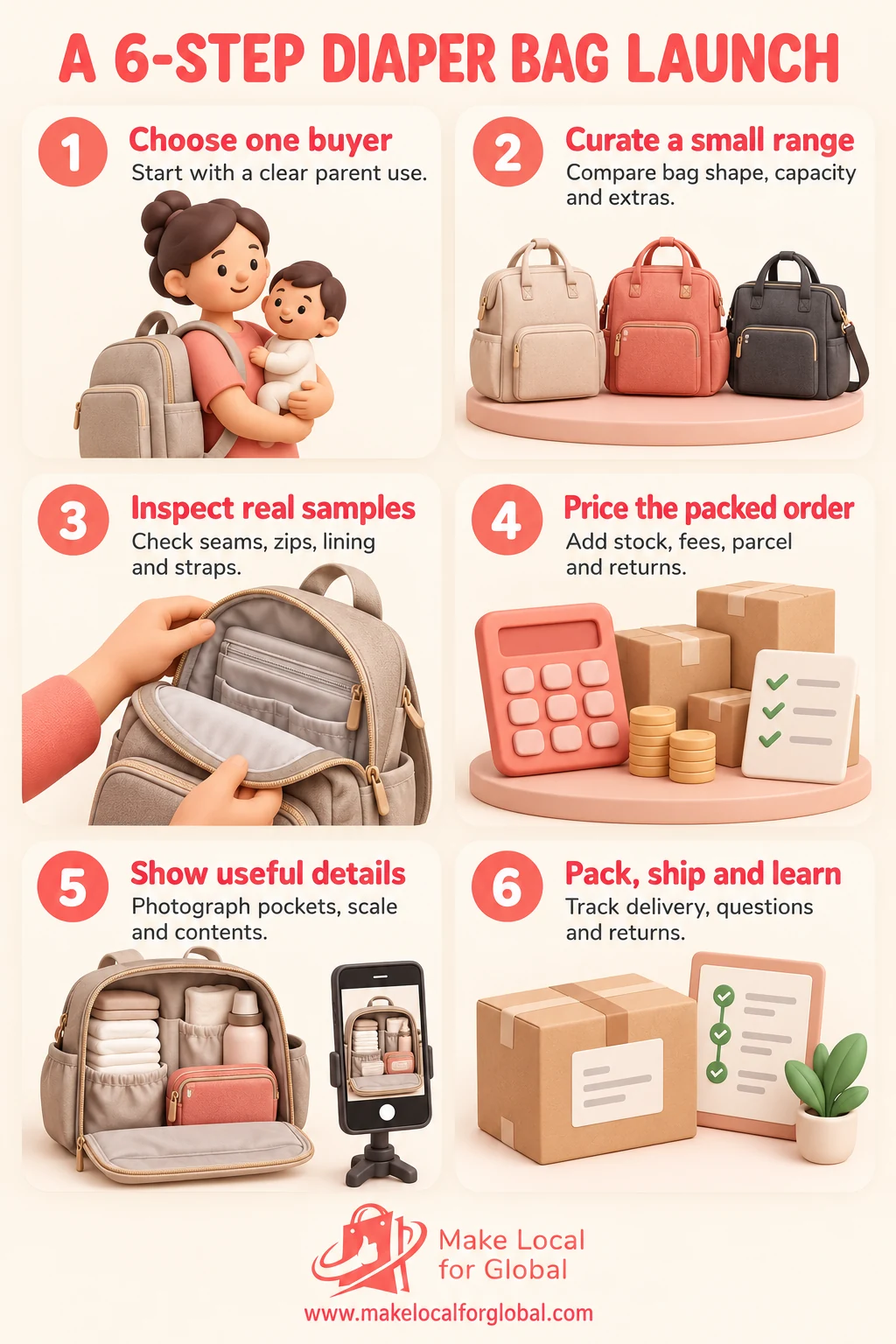
Set a stop point before the test begins. For example: do not reorder until you have inspected a sample from the next batch, received a current shipping quote and seen a minimum number of completed orders. Choose that minimum from your cash position and supplier lead time; there is no universal target.
Keep the launch log short enough to update. Add date, action, result, decision and owner. An example entry might read: “24 October, five buyers checked the capacity photo; four asked for loaded dimensions; add an annotated packing image.” That result has a next step; “people liked it” does not.
If you need a site to explain the range and its delivery terms, review MLFG website design services. The pricing page lists current plan information, and the contact page provides a route to ask about a suitable setup. Choose based on your requirements, stock plan and budget.
Yes. The product name can reflect phrases your intended customers use, provided the description is accurate. UK shoppers often use “changing bag”, and shoppers in other markets may search for “diaper bag”. Use both terms naturally where they help the buyer understand the product.
Choose one main bag style for a clear customer and a small number of variations. Add an organiser or changing mat only when sample checks and customer feedback support it. A focused range is easier to cost, photograph and review.
Your duties depend on your role, product design, intended use and market. You need to assess the product and establish that it meets applicable safety rules. Ask the supplier for relevant technical information and use a competent testing provider or Trading Standards when you cannot confirm a product requirement.
Only make a compatibility claim you can support. Check the maker’s instructions and test each model you name. If you have not tested a model, state that the clip is included and the customer should check compatibility with the pushchair maker.
There is no single best material for every buyer. Compare weight, feel, cleanability, colour consistency, wear, supplier evidence and total cost. Confirm composition and care instructions before writing claims such as recycled, organic, water-resistant or wipe-clean.
Do not assume a changing bag falls within an exception for sealed hygiene items. Online customers have statutory cancellation rights for many goods, and fault rights remain separate. Check current rules and describe the actual return process before checkout.
Add landed product cost, packaging, selling fees, delivery, returns allowance and customer acquisition. Then review contribution against fixed overheads, owner time and any VAT treatment that applies to the business. Use current quotes and measured parcel dimensions.
Photograph a repeatable set of items beside the open bag, list them in the caption or product copy, and include internal measurements. Do not imply every brand or size will fit. Update the photo if the product changes.
Compare current fees, competition, customer access, delivery rules and returns process with the cost of bringing buyers to your own store. A small test can show which route works for your product and cash budget. You do not need to open every channel on launch day.
Use sample checks, supplier lead time, demand-test results and available cash. Model how much of the first order you can afford to hold if a colour sells slowly. Do not use an unverified “industry standard” order size.
Turn your sample checks into a shop plan
When you are ready to show a tested range online, discuss how a product-focused store could present the bags, options and delivery terms.
Write one buyer profile, request a sample against a short specification, and test the loaded bag before approving stock. Measure the packed parcel, price the complete order and publish dimensions, materials, included items, care and delivery terms. Use the first sales and return evidence to decide which variant earns a second order.
For related planning, compare backpacks and utility pouches. Each has a different carry or storage use, so keep buyer and product details distinct. Browse more Product To Sell articles when you are comparing another category.
PREFERRED SOURCE
Like what you’re reading? Add Make Local for Global as a preferred source on Google to see more of our articles when you search.

Build your online presence without having to figure out everything yourself.