
READY TO SELL Dining Sets ONLINE?
Get a store built for you in 5 days, plus training and support to help you start, run, and grow your Alternative business.

Plan a focused dining furniture range, check room fit and construction, price bulky delivery, and give buyers clear set contents, measurements and returns information.

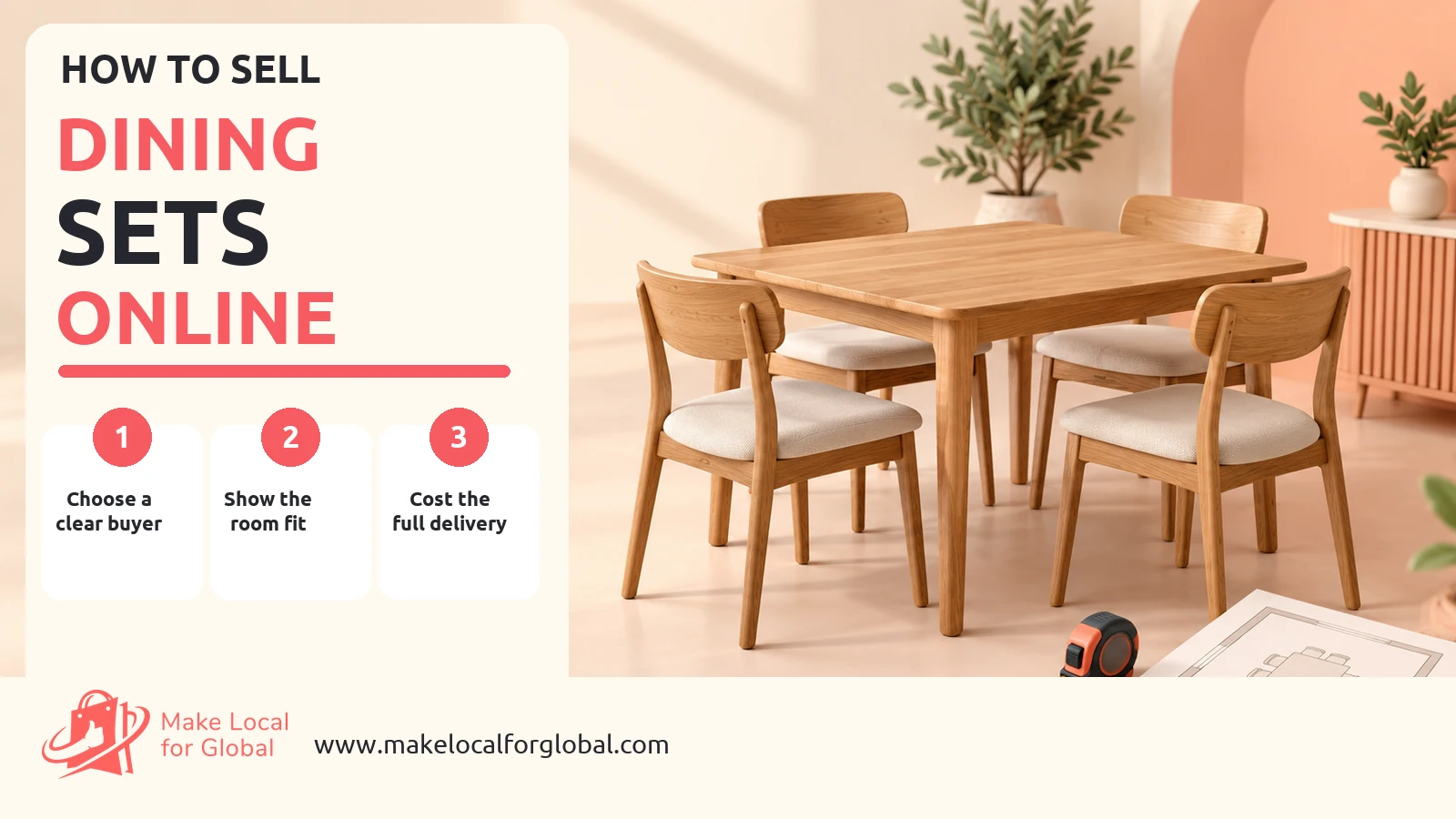
A dining set is a high-consideration purchase. A buyer needs to picture the table in a real room, understand how many people it seats, check chair comfort and know whether the whole order can arrive without damage. For a new seller, the challenge is to build a range that answers those questions before a large stock order ties up cash.
The term “dining set” can describe a table sold with matching chairs, a coordinated dining collection, or a dinnerware bundle. This article focuses on furniture: a dining table sold with its matching chairs. If you mean plates and serving pieces, use the product-specific guidance for selling dinnerware sets online instead. The same range, room-fit and freight advice does not transfer neatly between those two product types.
You can start with one buyer, a small set of dimensions and finishes, a tested sample, a complete delivery price and an honest product page. Then use buyer questions, completed orders and delivery issues to decide what to change. The figures in the worked example are hypothetical planning inputs, not retail benchmarks or expected profit.
Check the dining-set idea before committing to bulky stock
Define the buyer, room and product promise, then test whether a focused table-and-chair range solves a real problem.
A dining table serves a daily routine and takes up visible floor space. Start with the room, household and use case before selecting a style or asking a supplier for a price list.
Potential buyers include a couple fitting out a first flat, a family replacing a damaged table, someone furnishing a small kitchen-diner, a renter seeking a table that can move home, or a household planning occasional guests. These groups need distinct choices. A compact extendable table solves another problem from a large fixed farmhouse table.
Write a practical offer in one sentence. For example: “A compact oak-effect table and four chairs for renters who want everyday dining in a narrow kitchen-diner, with clear assembled measurements and delivery to the room.” Another could be: “A solid-wood six-seat set for households who value repairable parts, replacement chair covers and a specified lead time.”
The sentence helps you decide what to measure, photograph and ask the supplier. If the promise includes moving the set through a tight hallway, your listing needs component dimensions and assembly details, not only the table footprint.
Speak with people who match the intended buyer. Ask what table they use now, what they dislike, how many people usually eat there, whether they host guests and what stops them buying a replacement. Ask them to measure their current room or share the dimensions they used for a recent furniture purchase.
Show a sample product card with the planned price, table and chair dimensions, finish, assembly time, delivery method and return terms. Ask the person to explain what they believe is included. Their questions reveal missing information. If several buyers ask whether the chairs tuck fully under the table, photograph that detail and state the measurement.
A small landing page or waitlist can collect size and finish preferences before stock arrives. Make clear whether a product is available, made to order or only being researched. Do not accept payment for a set you cannot supply as described. Track product-page visits, qualified questions, waitlist sign-ups and paid orders separately; they represent different strengths of demand evidence.
Record the size people can accommodate, how many chairs they expect, whether they need extension leaves and what delivery support they value. Those observations can shape the first range more reliably than a broad claim that “everyone needs a dining table”.
Dining furniture spans different materials, sizes, construction methods and delivery needs. A first shop can be easier to run when the opening range has a clear design idea and a manageable number of component variants.
A fixed table has a stable footprint and a straightforward product specification. It can suit buyers with a known room size, though it may be too large for a narrow home or too small when guests arrive.
If you are selling a table without its chairs, see the guide to selling dining tables online. For chair-only ranges, use the guide to selling dining chairs online.
An extending table offers a smaller everyday footprint with extra capacity for occasional use. The seller must explain the closed and extended lengths, how the leaf is stored, whether one person can operate the mechanism and whether matching chair storage is available. Photograph both configurations and list the dimensions for each.
A drop-leaf or gateleg table can reduce its footprint when not in use. Buyers may want to know how each leaf is supported, how much floor space the legs need and whether the table wobbles when one side is extended. Do not describe a table as suitable for a room until the buyer can compare its open and closed dimensions with their own space.
Solid wood can be sanded or repaired depending on the species, finish and construction. It may show grain and colour variation. Tell buyers which parts are solid wood and which use veneer or engineered boards. Avoid calling a set “solid oak” if only the top layer is oak veneer.
Wood veneer can offer a real wood surface over a stable substrate, with limits on sanding and water exposure. State the actual surface material and care instructions supplied by the maker. “Wood look” is not enough detail for a high-price product.
Laminated or melamine surfaces can be easier to wipe clean and can hold a consistent colour. Buyers may ask about edge finish, heat resistance, scratches and whether a damaged panel can be replaced. Base claims on maker documentation or a sample test.
Metal frames can make a table feel visually lighter or suit an industrial style. Check the coating at corners and fixings, leg levelling options and whether floor protectors are supplied. For upholstered dining chairs, identify the cover fabric and whether it is removable or replaceable.
An entry set can use a compact table and a smaller chair count, a durable easy-care surface or a simpler finish. The core set should match the main buyer you plan to serve. A specialist option might be an extending table, a solid-wood model, a bench combination or a premium upholstery choice.
These tiers need a practical reason to exist. Avoid multiplying almost identical colours and chair fabrics before you know which ones attract enquiries. Each finish can add supplier minimums, sample checks, product photography, stock records and the risk of a component mismatch.
A cautious first range might include two table shapes, two finishes, one coordinated chair style and two sizes. Those are planning examples, not an order recommendation. For made-to-order products, keep sample costs, supplier lead times and customization limits in the plan. For stock-held furniture, reduce the number of large boxed components until you have evidence of demand.
| Range choice | Buyer question | What to show | First-range watch-out |
|---|---|---|---|
| Fixed four-seat table | Will it fit my room and routine? | Overall length, width, height, chair count and under-table clearance | The chair count alone does not prove comfortable seating |
| Extending table | How large is it open and closed? | Both lengths, extension method, leaf storage and support | Show the leaf in use, not only a closed product photo |
| Bench and chair set | Can everyone sit comfortably? | Bench length, table overhang, seat height and access | A bench can be harder to use when pushed under the table |
| Upholstered chairs | What is the fabric and care routine? | Material, cleaning guidance, removable-cover status and spare-part option | Check whether the cover or foam can be replaced |
| Small-space set | Can chairs move in the available area? | Table footprint, chair depth and room clearance example | Avoid promising fit without the buyer's room measurements |
Use a bundle only when the combination makes the order more useful. Matching chairs, a leaf storage bag, floor protectors or replacement glides can be appropriate if the supplier confirms compatibility. State the number and type of chairs. A separate dining bench or care kit should not be presented as included if it is an optional add-on.
A supplier's catalogue image and price do not establish that its stock will meet your description or reach your buyer in usable condition. Confirm the business, product source, order terms, evidence and fulfilment route before placing a deposit.
A UK furniture maker may offer made-to-order pieces, trade pricing and access to construction details. Ask about minimum order value, finish options, production capacity, lead time, packaging and who arranges delivery. Confirm whether you may sell through your own site and use the supplied images.
A domestic wholesaler or distributor can offer ready-made lines and consolidated delivery. Ask whether components are stocked together, whether chair fabrics can be reordered and how discontinued finishes are handled. Request a written stock-feed or back-order process if the website will show live availability.
An importer or overseas factory can give you more control over the range. It can make you responsible for import documentation, product safety checks, customs, timber sourcing obligations and consumer support. Build the full landed cost and the expected lead time before you compare the quoted unit price with a domestic option.
A marketplace or trade platform can help you discover makers. Treat any supplier directory or verification badge as an introduction, not proof of product quality. Verify the legal seller, physical address, invoices, payment terms, references and return process independently.
Before paying, request:
Clarify whether the price is ex works, collected, delivered to a warehouse or delivered to the customer's room. “Free delivery” can hide a restriction to a postcode area, a doorstep drop-off or a long wait for a second-person service.
A sample lets you check an actual table corner, chair joint, surface, coating, fabric and assembly process. Request a complete set or the smallest useful sample configuration. A single finish chip cannot tell you whether the full table will show a colour variation or whether a chair feels stable.
Use a consistent check sheet. Record the product code, supplier, delivery date, carton condition, parts present, assembly time, measured dimensions and any mismatch with the product page or drawing. Keep dated photographs with the sample record.
During assembly, follow the instructions without adding extra force. Check that pilot holes align, fixings seat properly, legs reach the floor evenly and the table remains stable on a level surface. Sit on each chair and gently check for movement at the joints. Inspect corners, edges, underside, finish, welds, screw heads and upholstery seams.
Do not apply loads or conduct safety tests beyond what you can safely and competently assess. If a structure, restraint or finish raises a safety concern, stop the evaluation and ask the maker for test evidence or an independent qualified assessment. Do not sell a sample with a known fault as a standard new set.
The sample review should include the shipping route. Photograph cartons before opening. Look for crushed corners, abrasion, water marks and gaps in internal protection. Ask the supplier how the packaging was tested and what happens when a carton arrives damaged.
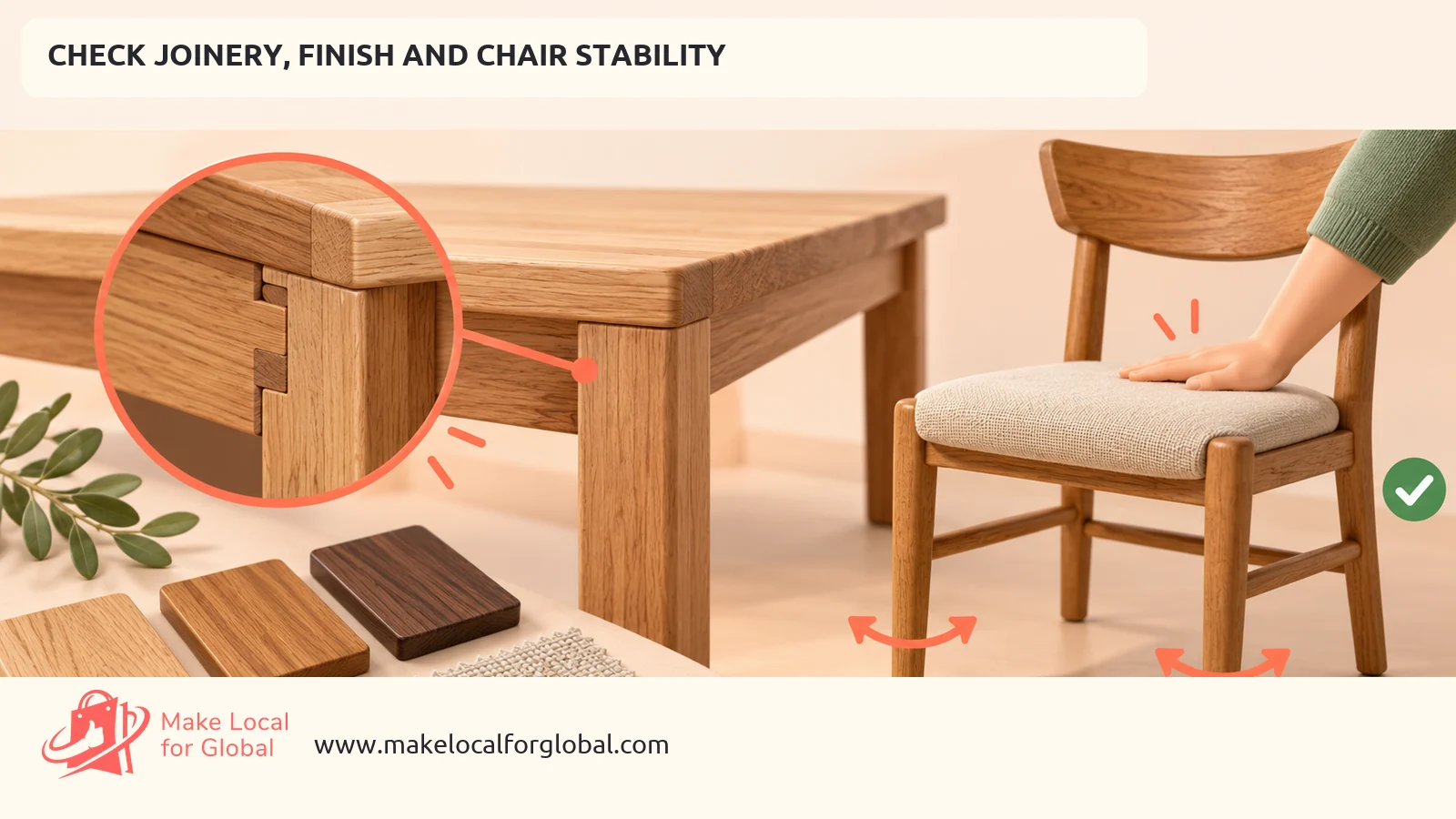
Room fit is a major purchase decision. A buyer needs more than “seats four”. Give measurements in a consistent order and explain how chairs affect the total footprint.
For each table, show the assembled height, length and width. For an extension model, show both closed and extended lengths, the size and number of leaves, how the leaf fits, and whether it is stored inside the table. Give the number of chairs included and their width, depth and overall height.
For each chair, include seat height, seat width, seat depth and any arm height that affects whether it fits under the table. Measure finished products using a repeatable method. Note that supplier dimensions can vary by a small tolerance; confirm the maker's specification before publishing a precision claim.
Show under-table clearance at the point where a seated person's knees would be, including an apron or crossbar if present. Buyers may want to tuck chairs beneath the table, but the chair back can extend beyond the table edge. A diagram or photo with a chair partly tucked in makes this easier to understand.
Invite the buyer to mark the tabletop outline on the floor with paper or masking tape. Add the chair footprint, then pull the chairs back as they would when sitting down. Check door swings, radiator positions, kitchen units, walkways and access to other seats.
Do not present one clearance figure as a legal standard or universal comfort rule. Instead, ask the buyer to compare the complete set footprint with their room and movement needs. A person may have mobility requirements or use a high chair that changes the usable space.
For delivery, show the dimensions of the largest carton and any part that is not designed to be removed. Ask buyers to measure the narrowest point along the route: entrance, hall, turn, stairs and internal door. A table may fit in the dining room but fail to pass a stair landing in its box.

A manufacturer's seat count is a useful label, not a promise that every body shape will fit comfortably. Show the tabletop length and the number of chairs placed at each side and end. If the table is intended for four, photograph four chairs in the positions the maker recommends.
State whether a chair has arms and whether the end chairs need more clearance. For an extendable set, show the increased number of seats only when the maker confirms the arrangement. Explain whether extra chairs are sold separately and whether they match the finish and fabric.
A dining set page should answer what is included, how it fits, what it is made from, how it arrives and what the customer needs to do next. Clear details can prevent costly misunderstandings and returns.
Example title: “Marlow Oak-Effect Extending Dining Table with Four Upholstered Chairs”. Use the actual name, surface material, form and included chair count. If the top is veneer or engineered board, say so in the specification instead of implying solid wood.
Example opening: “A compact four-seat table that extends for occasional guests. The set includes one table and four matching chairs in oatmeal fabric. Check the closed and extended dimensions against your room and delivery route before ordering.”
Only claim “solid oak”, “scratch-resistant”, “stain-proof”, “eco-friendly” or “easy assembly” when the supplier can substantiate the statement and its scope. Replace vague comfort claims with information a buyer can compare, such as seat height, seat depth and upholstery composition.
Include:
Use a clean front three-quarter hero image showing the entire table and every included chair. Add close views of the table edge, leg fixings, underside, extension mechanism, chair joint, seat upholstery and finish. Include a photo of the set in a modest dining room to help shoppers judge proportion, but give the actual measurements beside it.
Show both extension positions. Photograph an included leaf and demonstrate how it stores. If the listing covers multiple finishes or fabrics, use a labelled variant image for each one. Do not present a styled vase, rug or pendant light as included. Use captions or a clear “accessories not included” note where needed.
Use accurate alt text for meaningful images. For example: “Four-seat oak-effect dining set with an extending table and four oatmeal upholstered chairs in a bright dining room.” Do not repeat the same alt text for a detail photo of an extension rail or chair joint.
State whether the courier delivers to the kerb, building entrance, ground-floor room or selected room. Explain whether the service includes unpacking, assembly and removal of packaging. Do not advertise a room-of-choice service if the supplier's carrier only offers a doorstep delivery.
Set a realistic dispatch or made-to-order timeframe. Tell customers how to report damage, what photos to keep and how quickly to contact you. Make a pre-delivery contact process clear for bulky items, since missed appointments can add costs and delay a replacement.
Large products can have low order counts and high handling costs. A margin estimate should include purchase, inbound freight, customs where relevant, packaging, payment fees, final-mile delivery, damage and return risk, advertising and service labour.
Assume a VAT-registered seller charges £1,199 including 20% VAT for a four-chair dining set. The net sales value before VAT is £999.17. The following example assumes recoverable VAT is excluded from supplier costs where applicable and the seller accounts for output VAT correctly.
| Cost line | Illustrative amount | Planning note |
|---|---|---|
| Supplier set cost | £420.00 | Table and four chairs, excluding recoverable VAT |
| Inbound freight and handling | £55.00 | Supplier to UK stock location |
| Import duty and brokerage | £35.00 | Use the actual tariff and customs quote for an import |
| Protective outer packaging | £28.00 | Corner boards, wrap, carton reinforcement |
| Payment fee | £35.07 | Example only: 2.9% of £1,199 plus £0.30 |
| Customer delivery | £100.00 | Two-person or bulky-item service assumption |
| Damage and return allowance | £50.00 | Reserve based on an estimate, then replace with actual data |
| Customer acquisition cost | £40.00 | Advertising spend allocated to this order |
| Estimated variable cost | £763.07 | Sum of the listed costs |
| Contribution before overhead | £236.10 | £999.17 net sales minus £763.07 variable cost |
The example does not establish a suitable market price or expected contribution. Replace each line with written supplier, carrier and platform figures. Include the cost of returned furniture, replacement components, failed deliveries, card disputes and customer support when you have real data.
Contribution is not net profit. It does not deduct fixed overhead, rent, storage, software, insurance, wages, tax or the cost of your own time. A seller who is not VAT-registered should build the calculation around their actual VAT treatment and irrecoverable input VAT rather than copying this registered-seller example.
Start with the net sales value you need after transaction fees and variable fulfilment. Add the product cost, inbound transport, import costs, packaging, delivery, expected return/damage cost and customer acquisition. Then decide what contribution the business needs for overhead and cash recovery.
Use a landed-cost worksheet for each sourcing route. A local supplier price may already include a delivery allowance or domestic VAT; an import quote may exclude customs brokerage, port fees, local transport or storage. Do not count a cost twice or leave it out solely when it is missing from the factory invoice.
Model a low, expected and high delivery or damage outcome. If one damaged table can erase the contribution from several orders, ask whether the packaging, carrier contract or price needs to change before launch.
Cost the complete dining-set order
Model sourcing, VAT treatment, packaging, bulky delivery, payment fees, returns and customer acquisition before setting the price.
Responsibilities depend on what the set includes, how it is made, who places it on the market and where the customer lives. A seller reselling a finished product from a UK supplier may have different duties from the manufacturer or first importer, but still needs to act with due care and provide accurate product information.
The UK Furniture and Furnishings (Fire) (Safety) rules cover specified domestic upholstered furniture and related products. A dining table without upholstery is not the same product as a padded chair. Check whether each upholstered component falls within the current scope and collect the supplier's compliance evidence for the exact model.
The 2025 amendments came into force on 30 October 2025. They changed the rules, including removing the previous requirement for manufacturers to attach a display label to new products. Second-hand furniture has separate permanent-label provisions. Do not rely on old stock photos or an old label checklist to decide whether a current item complies. Read the current UK statutory guidance on the amended furniture fire-safety regulations and ask a competent adviser if a product's status is unclear.
If a dining chair is upholstered, request the maker's current written evidence, material details and test basis. Keep the documents connected to the SKU or batch. If the supplier cannot identify the applicable requirement or show evidence, pause the listing until the question is resolved.
Wooden furniture and products containing timber can fall within the UK Timber Regulations. The role matters. A GB business that first places timber or a timber product on the GB market may have operator duties, including due diligence. A business buying products already placed on that market may have trader record-keeping duties. Imports and Northern Ireland have their own rules and guidance. Review the current UK timber and FLEGT guidance and confirm your role before importing.
Keep invoices, supplier identity, product references, origin details, material declarations and safety records. A sustainability logo alone does not replace evidence about the exact product or your legal responsibilities. Advertise certified wood only when the maker provides valid documentation for the model and claim.
The Office for Product Safety and Standards explains that businesses making, importing, distributing or selling consumer products must follow applicable rules and take steps to keep products safe. See its product safety advice for businesses. If you are the manufacturer or importer, check the specific guidance for manufacturers and importers and seek qualified advice where needed.
For consumer sales, goods must match their description, be of satisfactory quality and be fit for the purpose the buyer made known. A set shown with four chairs should arrive with four chairs, the stated finish and the specified components. Put known cosmetic variation or a sample limitation in clear pre-purchase information.
For online sales, explain who pays for standard delivery, how cancellations work and how bulky items are collected. GOV.UK describes the distance-selling cancellation period for goods, and gives details on accepting returns and giving refunds. Statutory rights for faulty or misdescribed goods remain separate from change-of-mind returns. The online and distance-selling guidance for businesses covers information to provide before an order. Check current rules for the relevant UK jurisdiction and the terms of your carrier.
Avoid a blanket “no returns on furniture” statement. Do not promise that the customer loses all rights after assembly or opening packaging. Explain how to protect the product during inspection and how to contact you if a part is missing or damaged.
A dining set is difficult to replace in a small parcel network. Ask carriers for the actual service level, access requirements, carton limits, insurance scope, delivery slots, failed-delivery charges and damage-claim deadlines.
Ask whether the table top, legs, chairs and fittings ship in separate cartons. Keep hardware in a labelled internal bag secured where it cannot scratch the surface or move loose inside the box. Protect table corners, chair legs, glass or stone tops and exposed edges with an appropriate system verified by the packer.
A carton that passes a visual check can still fail on a corner impact or vibration route. Request packaging test information from the supplier or have a sample shipment assessed by a qualified packaging provider. Run a controlled sample shipment before committing to a large order, and document the carton condition on arrival.
If you make packing changes, check that they do not hide a product hazard or make assembly instructions inaccurate. Keep the carton measurements and packed weight current so delivery quotes and product pages match what the carrier receives.

A parcel or pallet drop may cost less, but it can leave the buyer to move heavy cartons indoors. A two-person room-of-choice delivery costs more and needs a clear building-access process. Assembly and packaging removal add further work and should be priced and insured correctly.
Tell buyers about stairs, narrow turns, lift dimensions and access restrictions before checkout. Ask the carrier what happens if access prevents delivery. Define whether the order is left at the entrance, returned to depot or rescheduled, and who pays a second attempt.
For made-to-order sets, keep the customer informed if a supplier date slips. A lead time is not a dispatch date. Confirm that all table and chair components are ready before booking the carrier, then send the customer a delivery-window update.
Create a return and damage process that records order number, carton condition, photos, missing parts, customer description, carrier report and the next action. Keep replacement parts available where the supplier supports them. A missing screw pack may be easier to resolve than returning a full set, but do not use partial compensation to deny a consumer's legal rights.
Review return reasons monthly. Separate “too large for the room”, “colour different from screen”, “chair uncomfortable”, “damaged in transit”, “missing part” and “assembly unclear”. Each category points to a different improvement in sourcing, photography, measurement, packaging or page copy.
A specialist furniture website gives you control over detailed pages, room-fit content and delivery explanations. A marketplace may bring shoppers who already search for furniture, but its category rules, commission, delivery promises, image requirements and return processes need to fit a large-item order.
Use one main channel for the first test. Make the stock position accurate and connect each product variant to the supplier or warehouse record. A table finish can be a separate variant; a different chair fabric may change the entire product code. Keep the set contents explicit so a customer cannot accidentally choose a table without the promised chairs.
Before launch, test a complete order path. Check product options, shipping postcode limits, delivery fee, confirmation email, dispatch updates, cancellation information, damage contact route and refund process. Use a platform test mode or a non-live workflow when available.
For a showroom or sample appointment, keep the price and inventory record aligned with the online offer. Do not display one fabric sample and ship another without telling the buyer. If photography or display pieces are not for sale, label that clearly.
High-intent search phrases can include “four seat dining table set”, “small dining table with chairs”, “extendable dining table with four chairs”, “oak dining set” and “dining table measurements”. Use the terms that match the actual product. Do not use “solid wood dining set” for a veneer model to attract clicks.
Create useful pages or posts around specific purchase questions: how to measure a dining space, what to check before buying an extending table, how chair seat height affects fit, or how to prepare for bulky furniture delivery. Link to the exact product family and include dimensions, not generic trend claims.
A simple acquisition test can compare two landing-page versions: one leads with small-room fit and actual measurements; another leads with the extendable feature and the closed/open dimensions. Use a modest spend cap and compare qualified product questions, add-to-cart actions and completed orders. Do not treat views or likes as proof of sales demand.
Collect consent before adding customers to marketing lists. Ask for a review only after delivery, and never offer a reward in exchange for a positive rating. Use customer feedback to clarify assembly, fabric care and delivery expectations. Request permission before publishing customer images or identifiable home details.
Lifestyle photos help shoppers picture the set, but they do not tell them whether it fits. Add measurements and show the chair footprint. Include both table lengths for extension products.
A buyer may interpret “oak table” as solid oak throughout. Name the surface and construction by component. Check the supplier specification and make the product title agree with the details.
“Seats six” does not tell a shopper how many chairs are in the box, whether end seats are comfortable or what happens when the table extends. Show the exact layout and contents.
A low carrier quote may exclude stairs, room placement, assembly or a second visit. Confirm the customer's service choice, geographic range and delivery route before setting a fixed price.
Small alignment or wobble issues become returns when they appear in a customer's home. Assemble the sample using the included instructions and record what the buyer will need to do.
A damaged table top or chair leg can require a replacement component or a full collection. Ask for evidence of packaging performance and model the cost of damage and reverse logistics.
A catalogue-level assurance may not identify the exact chair fabric or production batch. Keep documents linked to the SKU and ask a qualified product-safety adviser when the applicable rule is uncertain.
Pick one buyer and one room-use case. Interview five to ten people who match that profile. Ask what they measure, what blocks a purchase and how they expect large furniture to be delivered. Build one sample product card and note what people cannot answer from it.
Success signal: several qualified buyers can describe the size, seating and delivery information they need, and the proposed price is not rejected before they understand the offer.
Request written product, material, safety, timber and delivery information from at least two plausible suppliers. Compare exact set contents, minimum orders, finish availability, cartons and lead times. Assemble and inspect one sample or arrange a competent independent check.
Success signal: you can trace the model, explain what it is made from, assemble it using supplied instructions, document the sample condition and model the complete order cost.
Photograph the hero view and the details buyers asked about. Write the dimensions, materials, seat layout, assembly notes and delivery terms. Agree the carrier process, damage-report route, replacement-parts availability and return collection assumptions. Test the order and customer email workflow.
Success signal: a person unfamiliar with the product can identify exactly what is included, assess room fit and explain what happens after checkout.
Publish the selected range with accurate stock status. Use a small, fixed advertising or content test linked to a clear buyer question. Record product views, qualified enquiries, orders, delivery cost, assembly questions, damage and cancellation reasons.
Success signal: you can explain which buyer and product page attracted useful interest, what the first delivery cost and what needs revision. Increase stock only when the order data and cash plan support it.
It often means a table with a specified number of matching chairs, but each seller defines the product. State the table, chair count, bench, extension leaves, hardware and other components included in the exact order.
Start with a buyer and room type you can describe, then choose a table form, chair count and finish you can source and inspect. Confirm size, delivery route and total order cost before you commit to stock.
Show assembled table length, width and height, plus the closed and extended measurements for an extension model. List each chair's width, depth, overall height and seat height. Explain any size tolerance provided by the maker.
Show the table and chair footprint, advise buyers to mark the outline on their floor and remind them to include pulled-back chair space, door swings and the delivery route. Do not promise a fit without their room measurements.
Either can suit a clear buyer need. Describe the construction accurately, explain care and repair limits, and test the actual finish. Do not call a veneer product solid wood.
They may fall under UK upholstered-furniture fire-safety rules, depending on the product and current scope. The rules changed in 2025, so check the current statutory guidance and obtain evidence for the exact product from the supplier.
Your duties depend on whether you manufacture, import, first place or trade a timber product and on the market involved. Check current UK timber rules, keep supplier records and confirm your legal role before importing or making a product available in Great Britain or Northern Ireland.
Get a quote for the actual carton count, dimensions, weight, destination and service level. Include access, room placement, failed delivery, packaging, insurance and returns where applicable. Recheck the quote when the product or carrier changes.
You can consider a marketplace if its current rules, fees, listing format, delivery services and returns process suit bulky furniture. Compare the total variable cost and control over product information with a direct ecommerce site.
Record the order, carton condition, affected component, photos, carrier report and customer contact. Follow the applicable consumer rights and carrier claim process. Keep replacement part options available, but do not make the customer give up statutory rights to receive help.
Yes, if the product options and order total are clear before checkout. Make it obvious whether a displayed price is for the table only or for a complete set, and describe any compatibility limits for separately purchased chairs.
Check the sample's dimensions, stability, finish, assembly, packaging, supplier documentation, delivery route and actual buyer interest. Make a larger order only when the complete costs, risks and evidence support it.
Choose one buyer problem, select a range you can describe precisely and inspect a real sample before you commit. Publish complete measurements, exact set contents, material details, room-fit help and a delivery promise your supplier and carrier can meet.
Treat safety and timber records as part of product selection, not paperwork to chase after a customer asks. Include bulky delivery and damage risk in the order model. Then use buyer questions, completed deliveries and return reasons to decide what to improve before widening the range.
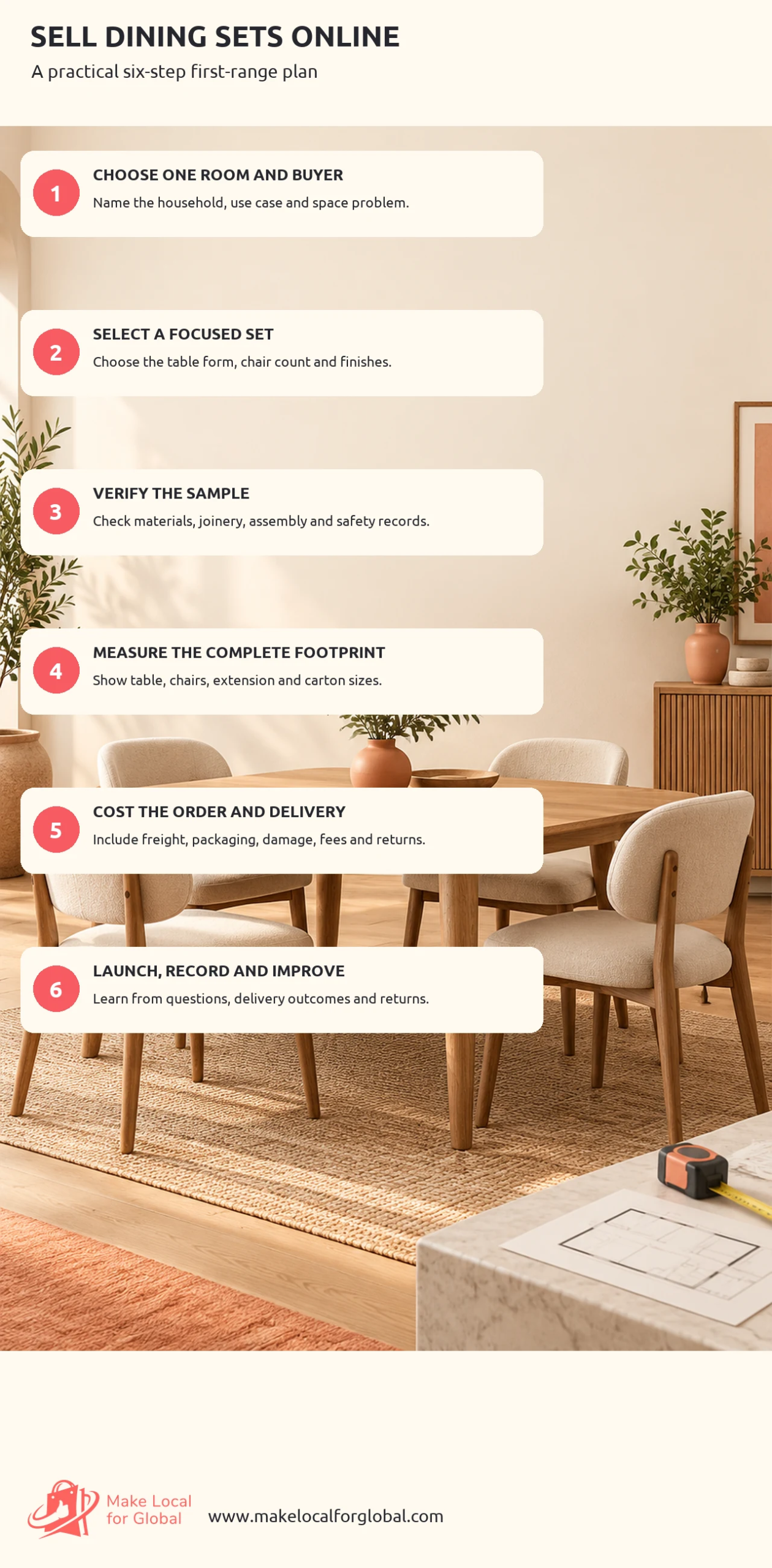
Review the first range before buying more furniture stock
Check buyer questions, room-fit concerns, contribution and delivery outcomes before adding table forms or chair variants.
PREFERRED SOURCE
Like what you’re reading? Add Make Local for Global as a preferred source on Google to see more of our articles when you search.

Build your online presence without having to figure out everything yourself.