READY TO SELL Face Primers ONLINE?
Get a store built for you in 5 days, plus training and support to help you start, run, and grow your Alternative business.

Choose a face-primer buyer, verify the exact formula and claims, check samples, and calculate the full delivered order before committing to stock.

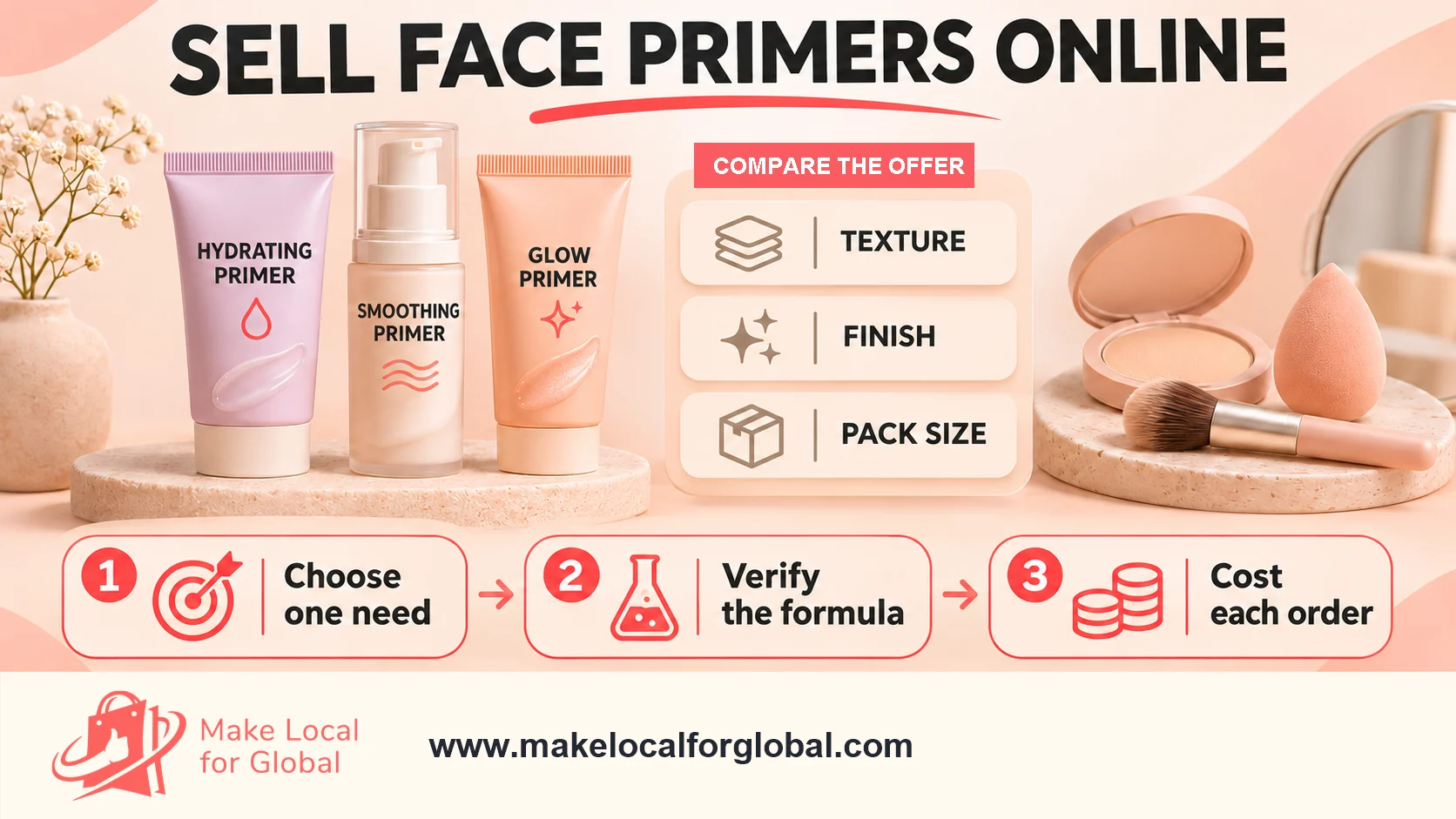
A face primer sits between skincare and makeup, so shoppers often judge it by what happens after it goes on: does it feel comfortable, work with their foundation and come in a pack they can use without waste? Those questions give a small online seller a more useful starting point than a long ingredient story or a catalogue full of near-identical tubes.
Selling primer still requires careful choices. The product is a cosmetic, so its safety records, label, Responsible Person and claims matter. The formula and packaging need to match what the supplier has documented, and the full order cost must include postage, payment fees, promotion, returns and any stock that reaches its use-by date before it sells.
Planning a makeup range for your online shop?
Compare store options after you know the first product, pack size and delivery plan you want to support.
Start with one buyer and one makeup-prep need. Compare a short list of finished products or suppliers, request documents for the exact formula and pack, test samples using the maker’s directions, then calculate what a delivered order leaves after variable costs. This page focuses on selling face primers to Great Britain. Northern Ireland and overseas markets need separate checks.
Face primer is a product applied before foundation or other complexion makeup. Shoppers may look for a particular feel, finish, amount of slip, grip under makeup or packaging format. The word “primer” does not describe one standard formula. A mattifying balm, a hydrating gel, a silicone-rich smoothing product and a radiance-focused lotion may sit in the same category, yet they ask different questions of a buyer and a seller.
That variety can support a clear niche, though it can make an unfocused range harder to shop. A first-time store does not need one item for every skin concern or every foundation. It needs a few products whose intended use and product details are clear enough for a shopper to compare.
The seller’s job is to make the product choice less uncertain. Show the exact pack, volume, full ingredients, use directions and precautions. Explain only the texture, finish or cosmetic effect that the supplier supports. If a primer has a tint, fragrance, shimmer, SPF claim or a special applicator, show that fact plainly and make the photos match the item being shipped.
Begin with a particular person, routine and point of friction. A person who wants a less shiny finish before a long workday may look for one type of primer. A shopper who dislikes a tight or dry feel may ask for a different texture. Someone preparing makeup for a wedding, stage performance or photography may care about the finish under particular lighting. A gift buyer might value a simple shade-free product in a presentable tube.
These are starting hypotheses. They are not proof that a product will perform in the stated way. The formula, maker’s approved wording and evidence must support any claim you put on the product page. Targeting a skin condition calls for prior confirmation of the product classification and wording with a suitable adviser.
Talk with five to ten people who resemble the buyer group. Ask what they apply before foundation, which products they already own, what they dislike about the order of their routine, how they judge texture and what they check on a label. Ask them to compare two real product descriptions or sample packs only when the manufacturer permits safe sampling. Do not ask only whether they “like the idea”. Ask which one they would pay for at a stated price and what they would need to know before checkout.
Record the phrases they use. If several people ask whether a primer feels tacky, include a clear texture description based on the sample and supplier evidence. If shoppers ask whether it works with a particular foundation, test that specific pairing or state that you have not tested it. If the main concern is fragrance, photograph the label and give the manufacturer’s stated fragrance information accurately.
You can review marketplace listings, search suggestions and public customer reviews to see how people describe the category. Treat those sources as clues, not a sales forecast. A popular phrase or many reviews do not show how much demand a new shop can win. Look for repeated buying questions, complaints about packaging, missing ingredient details, strong scent or unclear instructions. Decide which question your store can answer better.
Set a simple working statement: “For [buyer], this primer offers [verified product distinction], shown by [supplier or sample evidence].” Replace every bracket with a fact you can support. If the distinction still relies on words such as “perfect”, “clean” or “professional”, it needs more work.

Product names vary by brand. Use the maker’s own classification and full product information rather than treating these descriptions as standard categories.
| Product direction | Shopper question to investigate | Evidence to request or check |
|---|---|---|
| Smoothing or blurring | What feel and appearance does the maker describe? | Approved claims, product texture, directions and any claim evidence |
| Hydrating feel | How does the product sit under the shopper’s other layers? | Formula description, use directions and sample observations |
| Mattifying finish | What does the product mean by “matte” and how is it supported? | Exact approved wording and any relevant substantiation |
| Radiance or glow | Is the look created by shimmer, tint, light reflection or another feature? | Shade and finish details, ingredient list and accurate photos |
| Gripping or long-wear positioning | What does the maker claim about makeup wear? | Evidence and approved time-based language for that exact formula |
| Tinted primer | Which tone or undertone is shown, and how is it described? | Accurate shade list, swatches under consistent light and return plan |
| SPF-containing primer | What protection claim and directions appear on the exact product? | Product-specific testing, label approval and advice on claims |
Do not infer that two products are compatible from a short social post or an ingredient shorthand. People often call formulas water-based or silicone-based, yet a product can contain water with several silicone ingredients or combine different materials. Ask the manufacturer how it describes the formula and what pairings it has tested. Test the actual primer with a small set of foundations your target buyers use, following both products’ directions. Describe the test conditions and outcome without turning one test into a promise for every routine.
Choose a first range with a reason for each item. A useful start might be one clear, untinted primer in two pack sizes, or one main formula with a second finish for a clearly different buyer need. Each extra shade, fragrance, size or formula increases stock complexity and the number of product records, photos and customer questions. Add variety only when the option changes a real buying decision.
An entry product could be a smaller size that helps a shopper try the texture. A core item could be the standard size that meets the main use case. A premium item might have a larger pack or a verified formulation feature that matters to the chosen buyer. Those are range roles, not claims that one size performs better.
Write down the role before contacting suppliers. For each product, note the intended buyer, the pack size, the feature that sets it apart from the next item, minimum order, lead time, unit cost, shelf-life information and a reason the buyer might choose it. If two entries answer the same question and one has no clear reason to exist, remove one from the first test.
Bundles should solve a practical shopping need. A primer paired with a compatible foundation or setting product can make sense only when you have permission to sell both and enough product information to describe the set accurately. A brush or sponge might raise the basket value, but it brings another SKU, cleaning question, stock count and fulfilment item. Calculate the complete bundle cost and test whether buyers want it before ordering.
You might resell an established brand from a UK wholesaler, buy directly from a manufacturer, use a private-label formula, commission a custom product, or make the product yourself. Each route gives you a different mix of control, cost, lead time and responsibility. A low wholesale price can be a poor choice if the supplier cannot identify the formula version, give current label artwork or explain who handles the cosmetic records.
Ask each supplier for information on the exact product, formula, shade, pack and market. Keep the answer in writing. A supplier’s catalogue description may cover several variants, so record the SKU and product name that will appear on the invoice and on the stock.
Use these questions in your supplier review:
Ask the supplier to match every file to a product version. Keep the quotation, purchase order, invoice, label proof, product specification, safety and claim evidence you are entitled to hold, batch details and change notices together. If a document names another shade or formula, pause the purchase and ask for a corrected record. A similar product name does not prove that the safety work covers your exact stock.
For a finished product resold under the maker’s brand, a distributor may have a narrower role than a business importing it or putting its own name on the pack. The legal position depends on what your business does and where the product is placed on the market. A private-label agreement alone does not identify who must act as Responsible Person.
In Great Britain, every cosmetic made available to consumers needs a Responsible Person established at a UK address. That person must meet the regulatory duties, including product safety, keeping the PIF, making the required notification, responding to serious undesirable effects and holding evidence for marketing claims. A postal forwarding service or PO box does not count as an established address. Read the current GOV.UK cosmetics guidance for Great Britain before agreeing a supply route.
A cosmetic’s Product Information File includes a safety report and product description, manufacturing information and claim support where relevant. A qualified safety assessor must assess the cosmetic before it is made available. Do not buy bulk stock on the assumption that a certificate for another item or a supplier’s short email replaces those records. If you make a formula, import a product or sell it under your own brand, obtain written advice on your role and records before placing an order.
Northern Ireland follows a separate cosmetics route. The official Northern Ireland regulation guidance explains the applicable rules, Responsible Person and notification arrangements. Do not assume that a Great Britain Responsible Person or GB notification automatically covers an NI sale. Check each destination before turning on delivery to it.
The GB notification service is used by the Responsible Person. A reseller should not copy private details into a public listing or claim that a product has been verified in a service that the public cannot access. Ask the Responsible Person for written confirmation that the exact product is ready for the market you intend to serve.
The packaging and online information must agree. The GB guidance lists label particulars that include the Responsible Person’s name and address, country of origin for imported products, nominal content, durability information, precautions, a product identifier such as a batch number, what the product does and the ingredient list. The ingredient list may appear on packaging, but a buyer should be able to review relevant product information before ordering. Confirm the rules for the product and pack, including the exceptions and where a leaflet may be needed.
Create an incoming-stock checklist. Inspect the outer carton for damage, check the product name and SKU, compare the pack with the approved artwork, confirm volume or weight, look for the batch code and date information, check that seals are intact, and record the number of units received. Take a photograph of any label or package issue before you contact the supplier. Keep stock with a short remaining shelf life separate until you have decided whether the sales period and customer information remain suitable.
Check how the ingredients are displayed. Use the full INCI list supplied for that formula. Do not rearrange it, abbreviate it or add a new “free from” list from an ingredient database. A supplier can confirm whether a particular substance is present and whether the wording has been approved. A buyer may have allergies or preferences, so readable ingredient information helps them make their own decision.
If the primer contains fragrance, shimmer or a tint, make the detail easy to see. Photograph the back label and show a shade swatch only when it matches the actual item under consistent lighting. Explain if a pack contains one size or a set. Do not use photos that hide the small print or imply that a product has a different colour from the one the warehouse will pick.
Storage can affect quality. Follow the maker’s instructions for heat, sunlight, freezing, humidity and shelf rotation. Ask the supplier what to do if products arrive warm or if a seal has failed. Do not invent a storage range from a different cosmetic. Record receipt date and batch details, use first-expiry-first-out rotation where appropriate, and remove any product that no longer meets the seller’s release checks.
Write down each objective claim that will appear on the product name, page, packaging, advert, email or social post. Ask what a reasonable shopper will understand it to mean, and check that you hold evidence for that exact product and wording. The ASA and CAP guidance on beauty and cosmetics says advertisers need evidence for efficacy claims and should not exaggerate the effect through wording, before-and-after photographs or image editing. The CAP substantiation advice explains that objective claims require adequate supporting evidence.
Claims such as “smooth-looking finish” or “makeup sits evenly” may still need support in context. A line such as “lasts all day”, “reduces the appearance of pores by 80%”, “safe for sensitive skin” or “works with every foundation” makes a stronger promise. Do not copy a competitor’s wording, a marketplace bullet or an influencer’s personal review as proof.
Keep a claim table with the product name, formula revision, exact phrase, source file, evidence owner and approved channels. If the manufacturer provides a consumer-use test, check the sample size, question, duration and exact formulation. A survey about how participants felt is not the same as a clinical measurement. Do not turn a subjective response into an objective percentage claim.
Avoid language that says a cosmetic treats acne, eczema, rosacea, infection, inflammation, scars or another medical condition. Product classification can depend on the product’s purpose and overall presentation. A disclaimer in a footer will not repair a product name or image that gives a medical impression. Ask a competent adviser or the relevant authority to review uncertain wording before it goes live.
Before-and-after photos need the same care. Keep lighting, camera, pose and makeup consistent. Do not retouch skin texture to make the primer appear to change pores or lines. If the image shows a sample effect, identify the product and the test conditions, and make sure the evidence supports the impression a customer will take away.
If a creator receives a free product, commission or other benefit, review the relevant ad disclosure rules before publication. A testimonial can include an opinion, yet any objective result it implies still needs suitable evidence. Save approval records and the final version of every claim-led campaign.

Order the sample from the supplier who will fulfil the first batch. Record the date, SKU, formula revision, lot or batch identifier, pack size and supplier. Photograph the closed parcel and product label. Note whether the tube or pump leaked, whether the cap opened in transit and whether the seal was intact.
Follow the product instructions. Do not ask an untrained tester to apply a cosmetic to compromised skin, near the eyes or in another way the label does not permit. If you conduct user research, get permission, explain what people will do, protect personal information and avoid asking participants to make health claims. A small shop sample test is for product choice and presentation; it cannot replace the Responsible Person’s safety work or a qualified assessment.
Use one observation sheet per formula. Record the amount dispensed, package control, scent as perceived, spread, tack, dry-down time, finish, residue, ease of cleaning from tools and any stated reaction. Keep subjective comments labelled as observations from that tester, not as a guarantee. Do not publish a tester’s face or message without consent and an approved process.
If you compare the primer with a foundation, use one defined pairing at a time. Follow both manufacturers’ directions, keep the skin-prep routine consistent, apply a controlled amount and note the time between layers. Record the foundation name, primer batch, amount, application method, room conditions and any visible pilling or separation. A result with one foundation does not show that the primer works with every brand or routine.
Check the pack over several uses if the maker’s use directions allow it. Try the pump or tube repeatedly, store it as instructed, check whether the nozzle clogs and whether the cap stays clean. Do not open the product to inspect ingredients or modify the pack. A package that looks good on a photo may be awkward for a buyer with limited grip or hard to empty; include an accessibility question in your review.
Create a hold, pass or reject note. Hold a sample when the label, seal, ingredient list or model does not match the documents. Reject it if the supplier cannot explain a mismatch or the product shows a safety issue. Pass it for a limited first range when the pack, data and sample meet your defined checks. Keep the record with the purchase decision so another person can understand why you chose the SKU.
Use the price the customer will pay, then account for tax and each order cost. The example below is hypothetical, not a recommended retail price, supplier quote or forecast. It assumes a VAT-registered seller charges a single delivered price of £19.99 and the sale is subject to the 20% standard rate. Check the correct treatment of your products and delivery with a tax adviser. GOV.UK lists the current VAT rates.
| Per-order item | Illustrative amount | What to check |
|---|---|---|
| Customer payment, delivered, including VAT | £19.99 | Test willingness to pay and show delivery terms |
| Sales value excluding output VAT | £16.66 | Confirm registration and treatment |
| Primer purchase cost | £4.20 | SKU price on the current supplier invoice |
| Inbound freight allocation | £0.45 | Freight, duty and clearance where relevant |
| Retail and outer packaging | £0.70 | Tube, carton, protective mailer and insert |
| Outbound delivery | £3.20 | Current parcel quote for actual packed dimensions |
| Payment fee allowance | £0.70 | Your processor’s percentage and fixed fee |
| Returns, leakage and expiry reserve | £0.60 | Actual early return and write-off evidence |
| Customer acquisition allowance | £3.00 | Attributed campaign spend per paid order |
| Contribution before fixed costs | £3.81 | Not net profit |
The arithmetic is £16.66 less £4.20, £0.45, £0.70, £3.20, £0.70, £0.60 and £3.00, leaving £3.81 before fixed overheads, labour, insurance, software, tax and other costs. The fee allowance is rounded for illustration. A payment provider may charge on the gross payment and may use a fixed charge, so substitute your actual contract. Do not deduct VAT twice or treat output VAT as revenue.
Make three versions of the calculation. A cautious case uses a higher postage quote, more leakage or expiry, a lower selling price and greater advertising cost. An expected case uses written supplier and carrier quotes. A strong case should be based on a measured change, such as fewer damaged parcels or an actual lower purchase price, not an optimistic guess.
Check the pack size against its cost. A 15 ml sample and a 30 ml tube need distinct stock records and accurate page details. A larger size may give a buyer more product per order, yet it can raise the stock commitment, postage weight and time needed to sell before expiry. Calculate margin per product and cash tied up in the minimum order.
For bundles, add every unit, carton, label, packing material and pick time. Include free samples if the supplier charges for them, and confirm their intended use, notification and label treatment. A free sample is still a cosmetic made available to a consumer in Great Britain and must be covered by the applicable requirements. Do not advertise a “gift” that has no supporting safety or product information.
Review the calculation after the first set of paid orders. Compare actual carrier invoices, payment fees, damaged packs, returns, acquisition cost and staff time with the assumptions. If the order leaves too little contribution, change one factor at a time or do not stock the item. A discount can raise sales volume and still reduce the money left per order.
Give each product a clear, specific title that names its type and meaningful, verified distinction. For example: “30 ml Radiance Face Primer, [verified tint or finish]”. Replace bracketed wording with exact information from the approved product data. Do not use “best primer”, “poreless”, “non-comedogenic”, “all-day wear” or a skin suitability claim before the manufacturer approves evidence for the exact formula.
Place the most useful details beside the price. State the quantity, texture description, pack type, shade or fragrance if applicable, intended cosmetic use and what arrives in the order. Show the full price, delivery charge, likely dispatch time and contact route before checkout. Link to a readable ingredients and precautions section that matches the label.
Use consistent specification fields across each product in the range:
Show how two products differ in a comparison table. Use the same order for size, finish, tint, fragrance, pack format, directions and supported claims. If data is missing, ask the supplier or state that it has not been confirmed. A blank cell can look like an intentional absence, so explain what the shopper should do with missing information.
Use language that helps someone choose without diagnosing their skin. “A clear gel primer described by the maker for use before complexion makeup” is more grounded than “solves dry, oily and sensitive skin”. Say which facts came from the manufacturer and which observations came from your own sample. Do not promise a result that depends on skincare, foundation, application technique or environmental conditions you have not tested.
Search phrases may include “sell face primers online”, “face primer product range”, “makeup primer supplier” and the product’s exact finish or pack size. Use these only where the page answers that query. Give each primer page its own title, description and useful supporting copy. Do not repeat the same phrase in every heading or add product names for traffic when the product is not in stock.
Internal links can help the reader compare related categories and understand the next step. Link to the relevant face moisturiser article when explaining the skincare step before primer, and to the face serum article where shoppers compare routine products. Keep each page focused on the product it covers. Readers still deciding on a category can browse the Product To Sell ideas.
Still comparing product ideas?
Browse other product guides and assess each idea against the buyer, supplier and fulfilment work it will need.
Use manufacturer-approved imagery where your agreement permits it, then add photographs of the actual unit you sell. Show the front, back label, cap or pump, carton, seal, volume and any tint. Keep lighting and camera position consistent across the range. A photo of a generic primer tube cannot prove the formula, shade, quantity, pump or ingredients of the item in your stock.
Create a useful set:
Do not put makeup on a model and imply that the image proves a claim. If you show application, state which product and amount were used, follow its directions and avoid editing the result. Ask for written permission before you use a customer image or a creator’s tutorial. Store consent and campaign approvals with the image file.
Illustrations can explain how texture, finish and pack format relate. Label an editorial illustration as an illustration when a reader could mistake it for the exact product. Never let generated text invent a certification, formula ingredient, test result, user quote or product feature. Use descriptive alt text that explains what the image is doing, such as “Comparison of three primer textures beside the corresponding product packs”. Do not repeat the same keyword in every alt field.
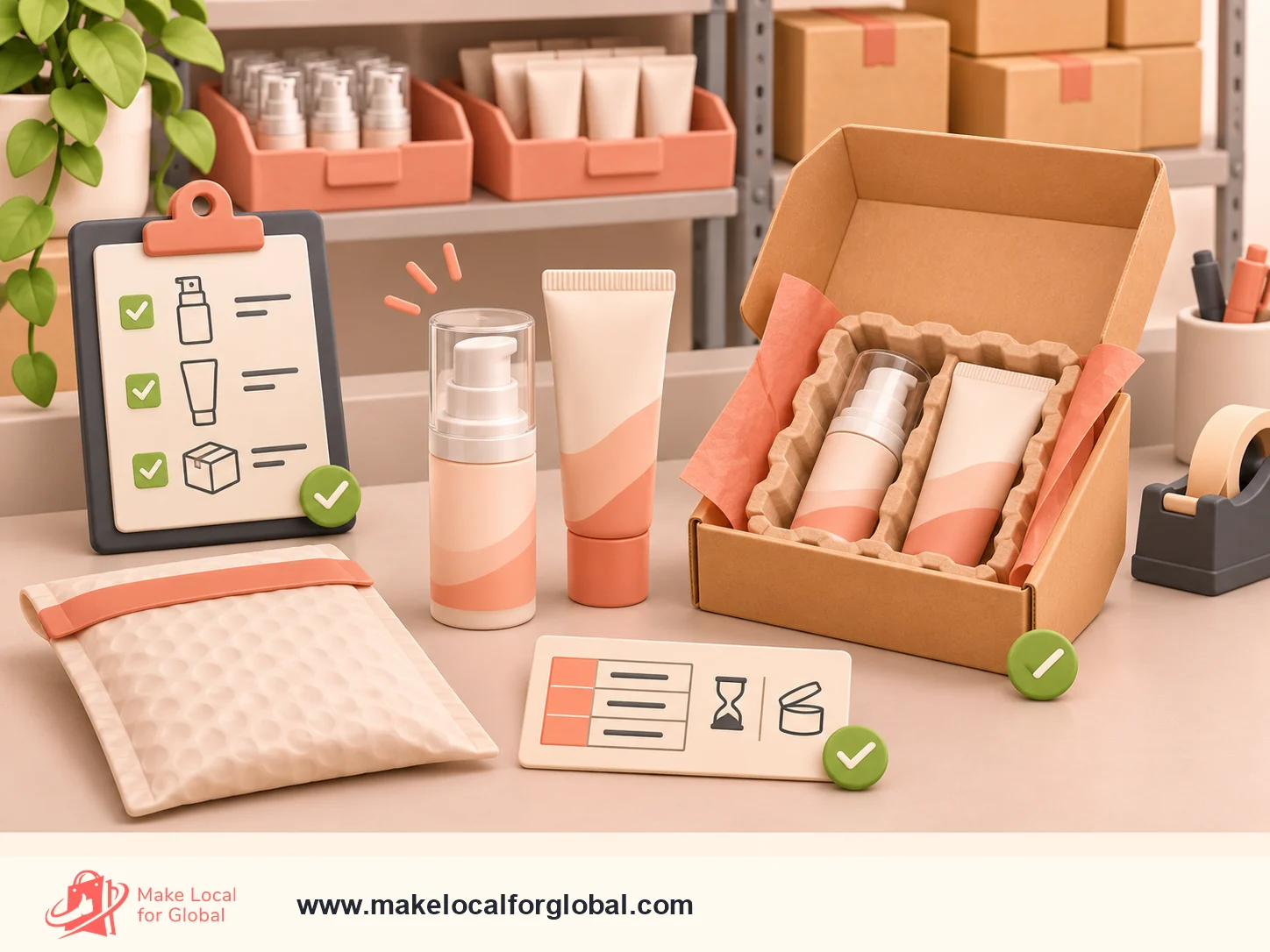
Set an opening stock limit based on the supplier’s minimum order, product shelf life and cash you can afford to hold. Record SKU, formula revision, shade, batch, quantity received, date received and units released. Keep different formula versions separate. If a label or pack changes, update the page and image before the changed stock ships.
Store products under the conditions supplied by the Responsible Person or manufacturer. Keep cartons away from direct heat, sunlight and damp where the product instructions require it. Rotate stock by date. Check the seal and batch during picking, and remove any damaged or expired unit from sale. A bargain case with a short remaining life may create avoidable waste if you cannot sell it in time.
Pack a real order before you set the delivery price. Check whether the tube can be squeezed or punctured in transit, whether the pump needs a cap, whether a glass container needs cushioning, and whether the label will stay clean. Use protective material that fits the chosen pack and does not add a large courier charge. Photograph the closed parcel and measure its weight and dimensions.
Ask the carrier which service accepts your exact product and packaging. Do not assume every cosmetic has the same shipping classification. If the supplier’s safety data or product formulation raises a flammability or transport question, ask the manufacturer and carrier before accepting orders. Use accurate customs descriptions for overseas parcels and check the destination’s cosmetics rules before adding a country to checkout.
Set the return process before launch. Tell customers how to report a damaged pack, leaking pump, missing item or product concern. Keep opened or returned cosmetics separate from saleable units until you have checked the condition and followed the Responsible Person’s instructions. Do not return opened stock to the shelf by default. Record the batch, order, complaint and response in case another customer reports the same issue.
Distance sales have cancellation and information rules. The GOV.UK online and distance selling guidance explains the information businesses must provide and the usual cancellation period. There are exceptions for certain sealed goods that cannot be returned for health or hygiene reasons once opened; that does not mean every cosmetic can be marked “no returns”. Check whether the exact product and seal qualify, and keep statutory rights for faulty, damaged or misdescribed goods clear. The GOV.UK returns and refunds guidance gives the relevant customer information.
The Consumer Rights Act 2015 sets out rights for goods that are not of satisfactory quality, fit for purpose or as described. Have your terms checked for the products and markets you serve. Do not rely on a small print line to undo an inaccurate listing.
Your own online shop gives you room to show ingredients, precautions, pack images, delivery terms and comparisons. A marketplace can provide discovery, but its listing rules, fees, cosmetics policies and returns process may constrain what you can explain. Read the current requirements for each channel before uploading a beauty product. Keep stock and batch records in one place even when orders arrive from several routes.
Start with one main product page for each genuinely distinct formula or shade. Use variations only when the shopper can see what changes, and when every variation has its own correct image, ingredient list, label, stock count and price. A confusing dropdown with several formulas can lead to a buyer receiving a product different from what they thought they selected.
Try a small number of customer acquisition tests. You could publish a clear comparison page, share a short texture video, send a sample to a creator who follows your ad disclosure process, or ask an existing audience which of two documented pack sizes they would choose. Set a small budget and a measure before you begin: product-page visits from the chosen audience, add-to-basket rate, paid orders, return questions or the cost of a sale.
Avoid judging a campaign by likes alone. A post can attract attention from people who are not the target buyer. Track where qualified visitors came from and whether they saw the full price, ingredients, delivery, and return information. If many shoppers ask the same question, update the page before increasing the promotion budget.
Write support content that answers a real product question. A short article can explain how to read primer pack details, how to compare two finishes or what to ask a manufacturer before private label. A routine comparison can connect to existing face moisturiser and face serum articles without suggesting that a primer replaces skincare. Link each content page to the exact product or collection it helps a reader evaluate.
For store planning, compare the available online shop options against the number of SKUs, product information work, payment setup and fulfilment process you have confirmed. Choose a setup that fits the actual product range and your ability to manage orders.
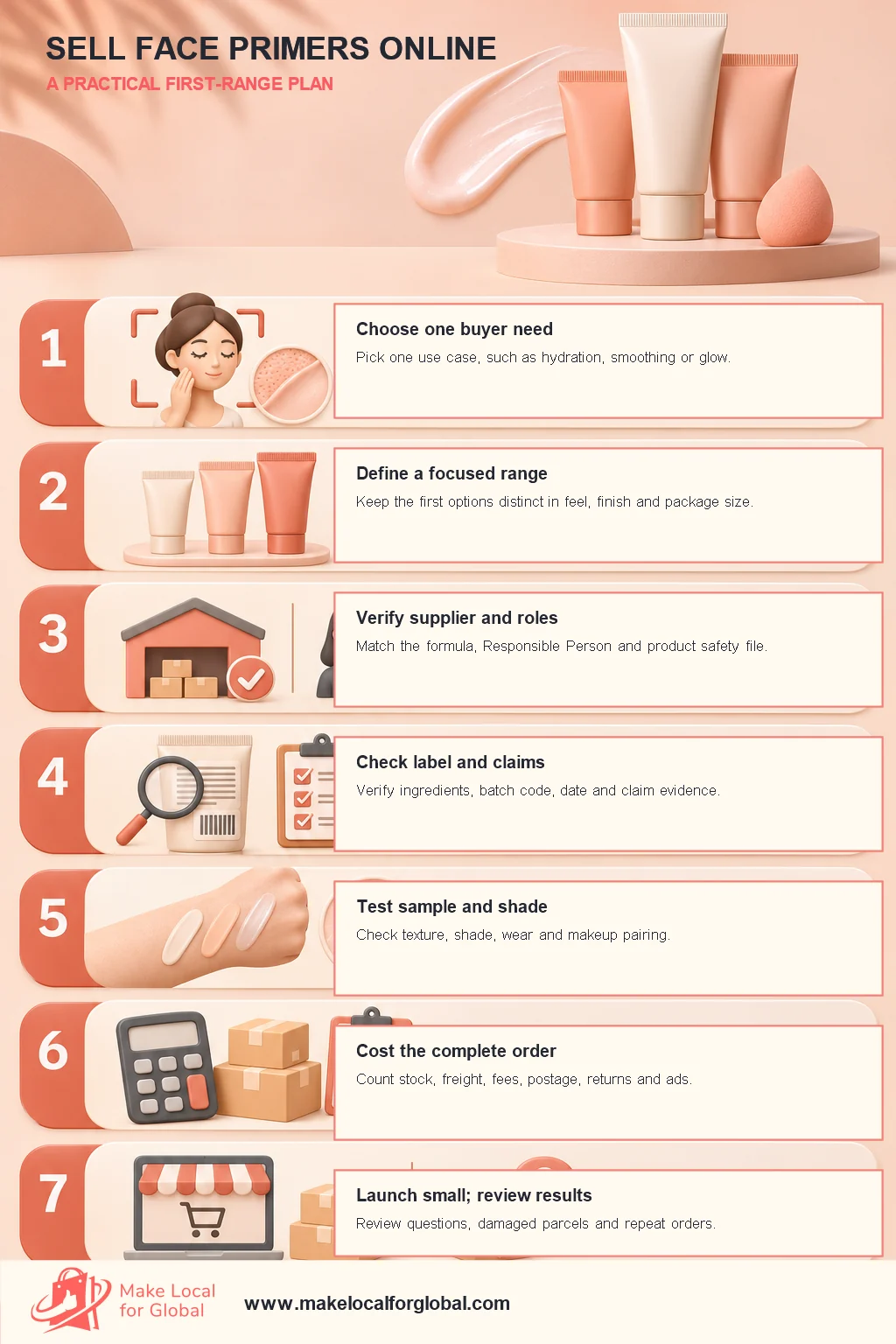
Use the first month to reduce uncertainty, not to force a product launch before its records are ready. If a supplier check, assessment or label review is incomplete, move the launch date. A calendar cannot make a product ready for sale.
Pick one use case and speak with five to ten people who match it. Ask what they use before makeup, what product information they rely on, what pack size is useful and what makes them avoid a new cosmetic. Compare two real product concepts with their full price, ingredients available from the supplier, delivery and return information. Record questions and objections without treating a friendly response as a sale.
Use those conversations to create a short range brief. Name the buyer, the finish or texture under investigation, the product format, target checkout price and maximum opening stock cost. Do not write a performance promise into the brief without the supplier’s evidence and approval.
Send the supplier question list. Confirm the Responsible Person and notification route for the market. Ask for the formula version, label proof, safety file arrangement, claim evidence, batch system, shelf-life information and written change process. Order one sample from the source that will supply the stock you intend to sell.
Check the sample against the product record and label. Use the maker’s instructions, take notes on pack function and texture, and test a foundation pairing only where the product directions allow it. Hold the sample if the formula, label, batch or documents do not match. Save the final answer from the supplier.
Build the per-order cost calculation with written product and delivery quotes. Add packaging, fees, return allowance, promotion and tax treatment. Compare one item and any proposed bundle. Decide how many units you can hold through the stated shelf life.
Photograph the sample and label. Draft the product page from verified facts. Ask someone outside the business to find the size, ingredients, directions, price, delivery charge and returns route. If they cannot find a detail, improve the page before checkout goes live.
Start with a quantity small enough to inspect and fulfil carefully. Set a promotion budget you can afford to lose during a test. Track visits, add-to-basket actions, paid orders, delivery cost, damaged packs, questions, returns and time spent packing each order. Keep batch records connected to each order.
At the end of the month, choose one action: reorder, revise the page or pack, test a different supplier, or stop. Reorder only when the supplier file, actual sample, customer feedback and full-order cost support it. If buyers ask for another finish, confirm a real product and its documents before adding a new option. If delivery or promotion takes too much of the sale, change the cost model before discounting.
Every shade adds inventory, product imagery, formula records and customer questions. Start with the smallest range that still gives a meaningful choice. Add a shade when people ask for it and the supplier can document it.
A popular ingredient name does not prove that a primer performs as claimed or that a particular formula is suitable for a buyer. Describe the exact pack and use approved product evidence. Do not add a benefit that the supplier has not confirmed.
Ask who is Responsible Person, where the PIF is held, who submits the notification and which market the records cover. Get the arrangement in writing. If the supplier avoids specific answers, delay the order.
Another seller’s wording and image do not support your claim. Keep approved language and evidence for the exact formula. Avoid retouching or a photo setup that gives the product an effect the evidence does not show.
An order includes freight, packaging, carrier fees, payment, promotion, expiry and returns. Calculate the delivered order and distinguish contribution from net profit before setting a discount or free-delivery threshold.
The seal and product condition affect safety, customer trust and legal handling. Keep returned stock separate and follow the Responsible Person’s instructions. Record batch information and look for repeated problems.
You can resell a product when the supply and product meet the rules for the market you serve. Ask who acts as Responsible Person, confirm that the exact formula is covered by the required records and notification, and check the label, claims and batch details. Do not rely on a product appearing on a wholesale site as proof that your own listing is ready.
A cosmetic must have the required safety assessment completed by a qualified assessor before it is placed on the Great Britain market, and the assessment must cover the formula and intended use. The Responsible Person maintains the Product Information File. A private-label seller may take on duties through the way the product is branded or imported, so agree the role in writing before production.
Making a cosmetic at home does not remove the requirements for safety assessment, product records, notification, suitable labelling and good manufacturing practice. Ask a qualified adviser to review your exact formula and production process. Do not start taking paid orders until the required route is complete.
Check both markets separately. Great Britain and Northern Ireland have different cosmetics arrangements, including Responsible Person and notification requirements. Confirm which party holds each role and whether the packaging and records cover each destination before enabling shipping.
Ask for the product and formula identity, market, Responsible Person, PIF and safety-report arrangement, notification status, label artwork, full ingredients, precautions, shelf-life and storage details, batch system, claim evidence, minimum order, lead time and change-control process. Request the answer for the exact item and pack, not a general company statement.
Use the maker’s approved product description and observations from the exact sample. State whether a claim refers to appearance, texture or feel, and do not convert a subjective observation into a measured result. Keep the same wording on the product page, social post, advertisement and creator brief.
Use an objective or time-based claim only when you have suitable evidence for the exact product and wording. Ask the Responsible Person or manufacturer for approved support. Do not make a percentage or wear-time claim from a casual test, copied competitor statement or unverified customer quote.
Only if a defined buyer asks for that attribute and the supplier’s ingredient list supports it. A label such as silicone-free does not establish a particular cosmetic result or suitability for every person. Verify each formula and avoid adding the same claim to products that have different ingredient lists.
Photograph the exact shade under consistent neutral lighting and show the label name. A swatch can help only if it matches the product and has not been colour-adjusted. Add a note about the photo conditions and do not imply that one screen shows every shopper’s perceived colour accurately.
Do not apply a blanket rule to every cosmetic. Some sealed goods can fall under a hygiene-related cancellation exception once opened, but the exact item, seal and customer information matter. Faulty, damaged or misdescribed goods have separate rights. Have your returns wording checked and give customers a clear route to report a problem.
Use the smallest quantity that meets the supplier’s minimum and gives you enough time to test customer response before the product’s stated durability period. Check the money tied up in every shade and size. If the supplier requires a larger order than you can sell safely, look for another route or test demand before committing.
Look at paid orders, contribution per order, delivery performance, customer questions, leakage, cancellations and returns. A high number of views or social reactions does not prove that the product will support repeat orders. Decide in advance which measure would lead you to reorder, revise the page or stop.
Choose one shopper and one makeup-prep need, then look for a product that you can describe accurately and source with the right records. Ask who handles the safety file and notification, check the exact label and claim evidence, test the real sample, photograph the actual pack and calculate the full delivered order.
Start small enough to inspect the stock and read the questions. Use order and return records to decide whether another shade, finish or pack size belongs in the range. If you are ready to plan the shop around the product and service work you have confirmed, compare the online shop options.
Ready to plan the first face-primer collection?
Compare store options against your SKU count, product information, payments and fulfilment plan.
PREFERRED SOURCE
Like what you’re reading? Add Make Local for Global as a preferred source on Google to see more of our articles when you search.

Build your online presence without having to figure out everything yourself.