READY TO SELL Faux Brick Wallpaper ONLINE?
Get a store built for you in 5 days, plus training and support to help you start, run, and grow your Alternative business.

Learn how to sell faux brick wallpaper online: compare constructions, verify roll details, test samples, calculate coverage and price the full delivered order.

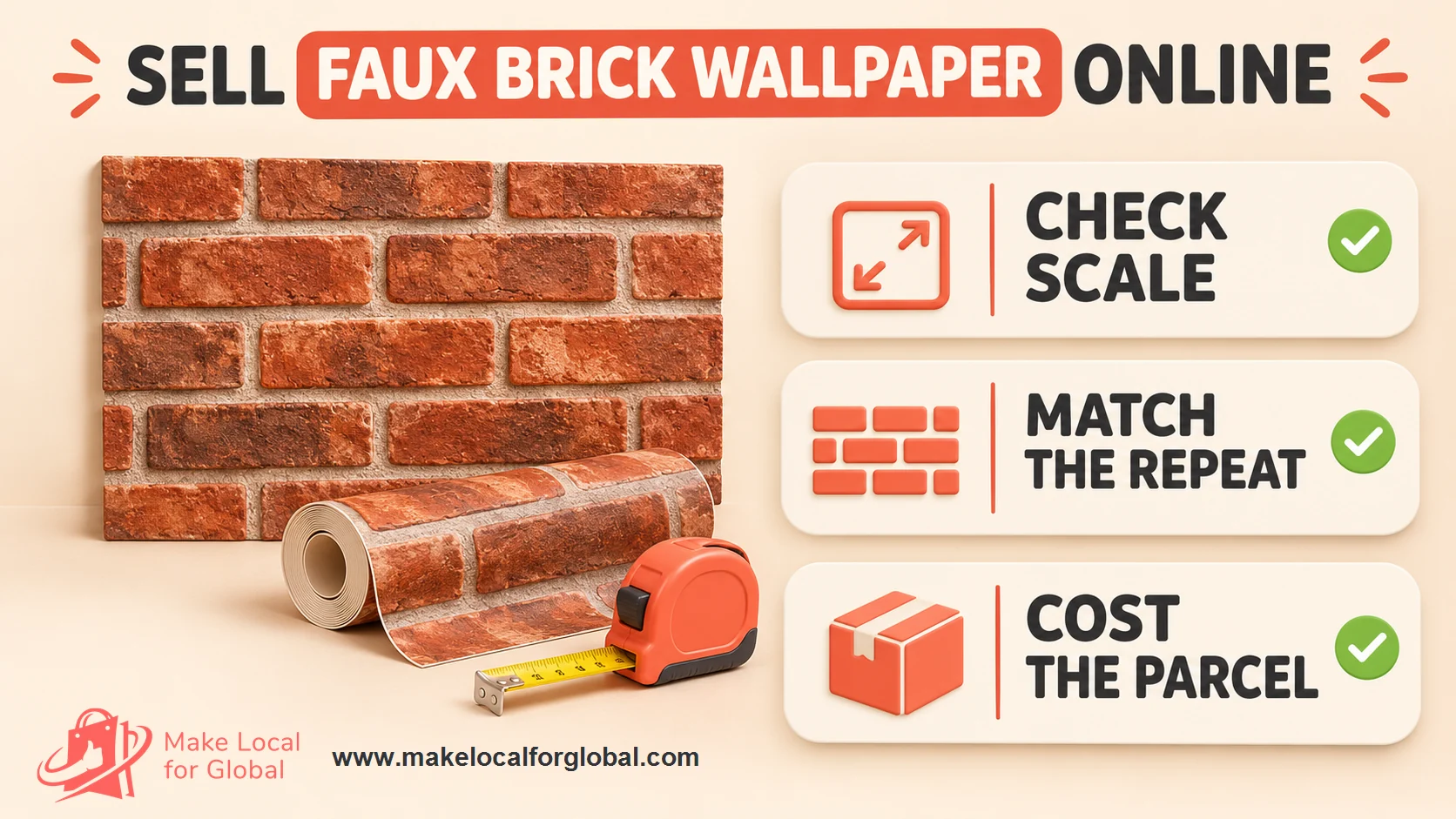
Faux brick wallpaper sells a wall effect through a screen. A shopper cannot feel the texture, compare the print to a real brick, or check how the repeat meets at a corner before buying. That uncertainty shapes the product range, the photos, the order calculation and the returns policy.
The first decision is what you mean by faux brick wallpaper. It could be a flat printed roll, a raised vinyl surface, a textured non-woven wallcovering, a peel-and-stick film, or a made-to-measure mural. These products differ in installation, wall suitability, fire-performance documentation, package size and customer expectations. Pick a narrow starting range and describe the actual material, not an impression created by a styled room photo.
Planning an online wallpaper range?
Once you know the roll formats, first stock depth and delivery plan, compare store options against the catalogue and fulfilment you need.
Selling well begins with a sample and a specification sheet. Match brick scale and colour, verify roll width and pattern repeat, test how the surface photographs, calculate the number of rolls a project needs, then price the full packed order. A customer who can see the repeat, read the batch details and estimate coverage has a clearer basis for choosing.
The phrase covers several constructions. A printed paper may show mortar lines without any raised surface. A vinyl-coated design can add a slight relief. Embossed wallpaper has a physical texture, though the depth and feel vary by product. Peel-and-stick wallpaper uses a pressure-sensitive backing. A wall mural may be printed in numbered panels instead of supplied as conventional rolls.
Do not put these into one product variation if a buyer would receive a different installation method or surface. Give each construction its own product page or clearly named variation, with matching photos and instructions. A term such as “brick wallpaper” can describe the pattern, but the customer still needs to know if it is paper, vinyl, non-woven, self-adhesive or a mural.
Faux brick designs can suit people who want an industrial look, a feature wall, a backdrop for a shop or studio, or a temporary change in a rented room. Some buyers want a realistic reclaimed-brick pattern. Others prefer a clean whitewashed print, a dark charcoal wall, a painted red brick, or a lighter design that makes a compact room feel less busy. Treat these as buyer hypotheses to test, not proof of demand.
The product may be used in a home, office, café, retail space or set. Those uses can create different questions. A householder may ask how many rolls cover one wall. A shop owner may ask how a large area looks under bright lighting. A set decorator may ask whether a roll can be sourced again for a second shoot. Your first range should answer one group’s questions well before it tries to serve every use.
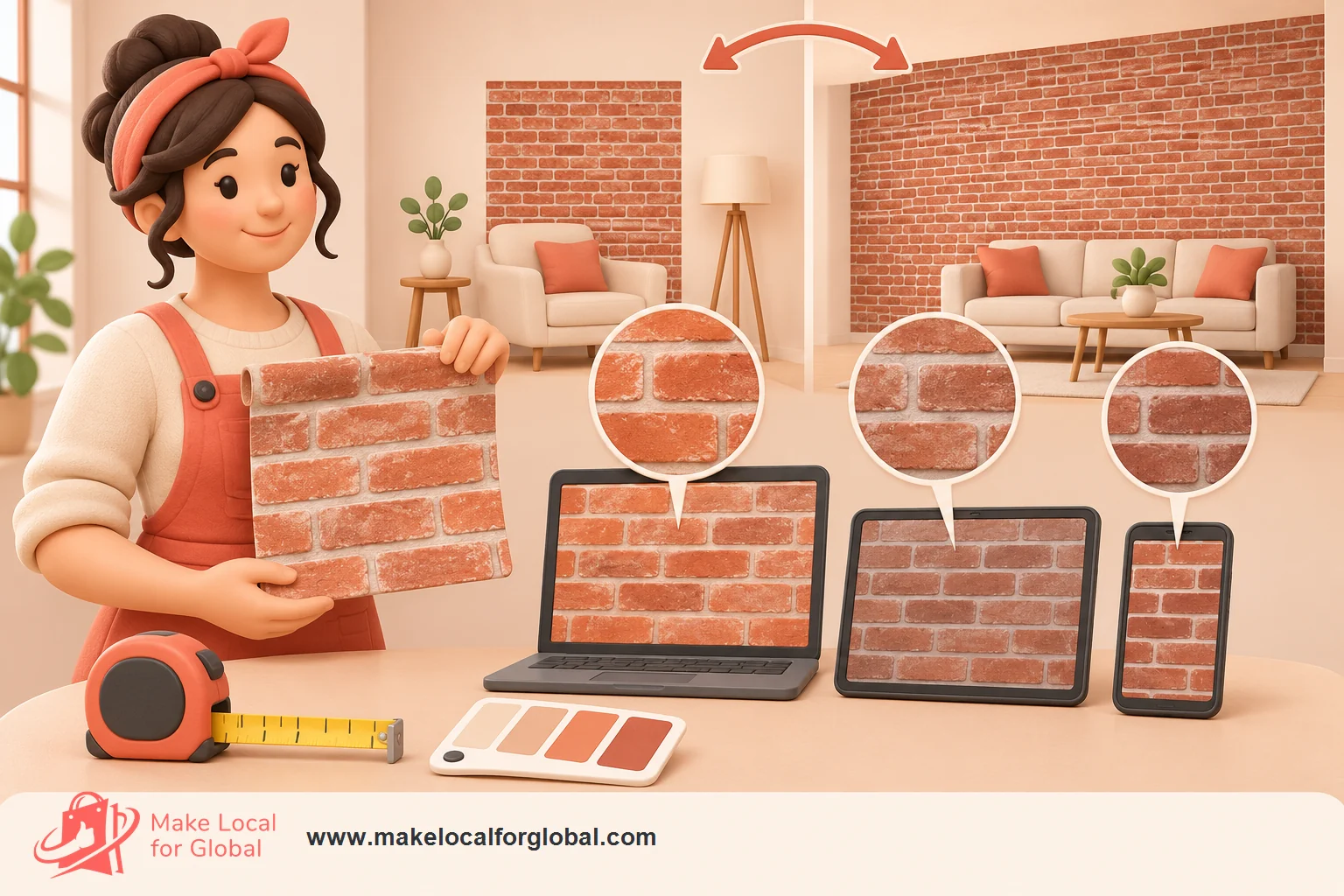
Write a short buyer description before contacting suppliers. For example: “A renter who wants a brick-look backdrop for a small study and needs to know whether the adhesive suits a smooth painted wall.” That statement is a research prompt. It is not a promise that a wallpaper can be removed cleanly or installed on every painted wall.
Speak with people who match the buyer. Ask what room they would decorate, which wall they would cover, what colour brick they prefer, how much texture they expect, how they would measure the area, and what would stop them placing an order. Ask them to compare two actual samples under the same lighting. If they choose a screen image, show them the physical sample later and ask what looked different.
Look for repeated decision questions. Do buyers ask whether the pattern has a real raised surface? Do they need to understand a straight match or a drop match? Are they unsure if a roll covers one wall? Does a peel-and-stick product seem easier, but they have textured walls? Such questions can guide the page and help you choose one product type to test.
Check public search results, marketplace listings and room photos for the language people use. Note the pattern style, colour, construction, roll size, room setting, reviews that mention colour mismatch, peeling edges or hard-to-match seams, and unanswered questions. A large number of listings does not tell you how many people will buy from a new store. Use this work to spot a gap in product information, not to forecast sales.
Before you place a bulk order, test demand with a sample board, an email survey or a simple product page that clearly says when stock will be available. Do not accept payment for goods you cannot supply by the date promised. Record how many people ask for a sample, request a coverage estimate or click through to delivery information. A compliment about a pattern is weaker evidence than a buyer taking a concrete step at a stated price.
Ask the manufacturer for the construction, recommended adhesive, wall preparation, removal method, cleaning guidance, lightfastness information and intended use. The following table shows questions for range planning. It is not a substitute for the product’s current technical sheet.
| Construction | Buyer question | Seller check |
|---|---|---|
| Printed paper | Is the print flat or textured? | Paper weight, paste method, pattern repeat and cleaning guidance |
| Vinyl-coated or vinyl-surfaced | How raised is the texture? | Surface material, cleaning limits, technical data and permitted claims |
| Non-woven wallcovering | Does adhesive go on the wall or paper? | Exact hanging instructions, paste specification and substrate limits |
| Peel-and-stick film | Which wall finishes are supported? | Approved surface, curing time, temperature, removal method and sample test |
| Printed mural panels | How many numbered drops arrive? | Finished dimensions, panel sequence, overlap or butt seam, and reprint policy |
| Textured or embossed paper | Does the relief feel like brick? | Relief depth as described by maker, shadow under lighting and pack protection |
Terms such as washable, scrubbable, removable, stain-resistant or fire-rated need product-specific evidence. A photo cannot prove washability. A removable backing does not guarantee that paint will stay intact when the product comes off. Ask the maker for the exact wording and conditions, then show those limitations near the relevant claim.
Plan an entry, core and premium offer only where the choice means something to the buyer. An entry item might be a sample pack or a smaller roll, if the supplier offers one. A core item could be the most-requested brick colour and texture. A premium option might be a mural or a heavier surface with a documented feature. Do not call a product premium merely because its retail price is higher.
A useful opening range could include two distinct colourways of the same construction and one sample set. Another route could be one classic red brick print in two surface finishes. Keep the number of patterns small enough that you can hold matching rolls from one batch. A huge catalogue can make photography, stock accuracy and customer support harder before you know which design buyers prefer.
Bundles can add a practical benefit. A sample pack with a discount code for a later full order can help a shopper compare colour first. A hanging kit can be useful when the included tools match the manufacturer’s instructions. State what the kit contains and what additional equipment a person needs. Do not add paste, primer or tools to a bundle without checking compatibility with the exact wallpaper.
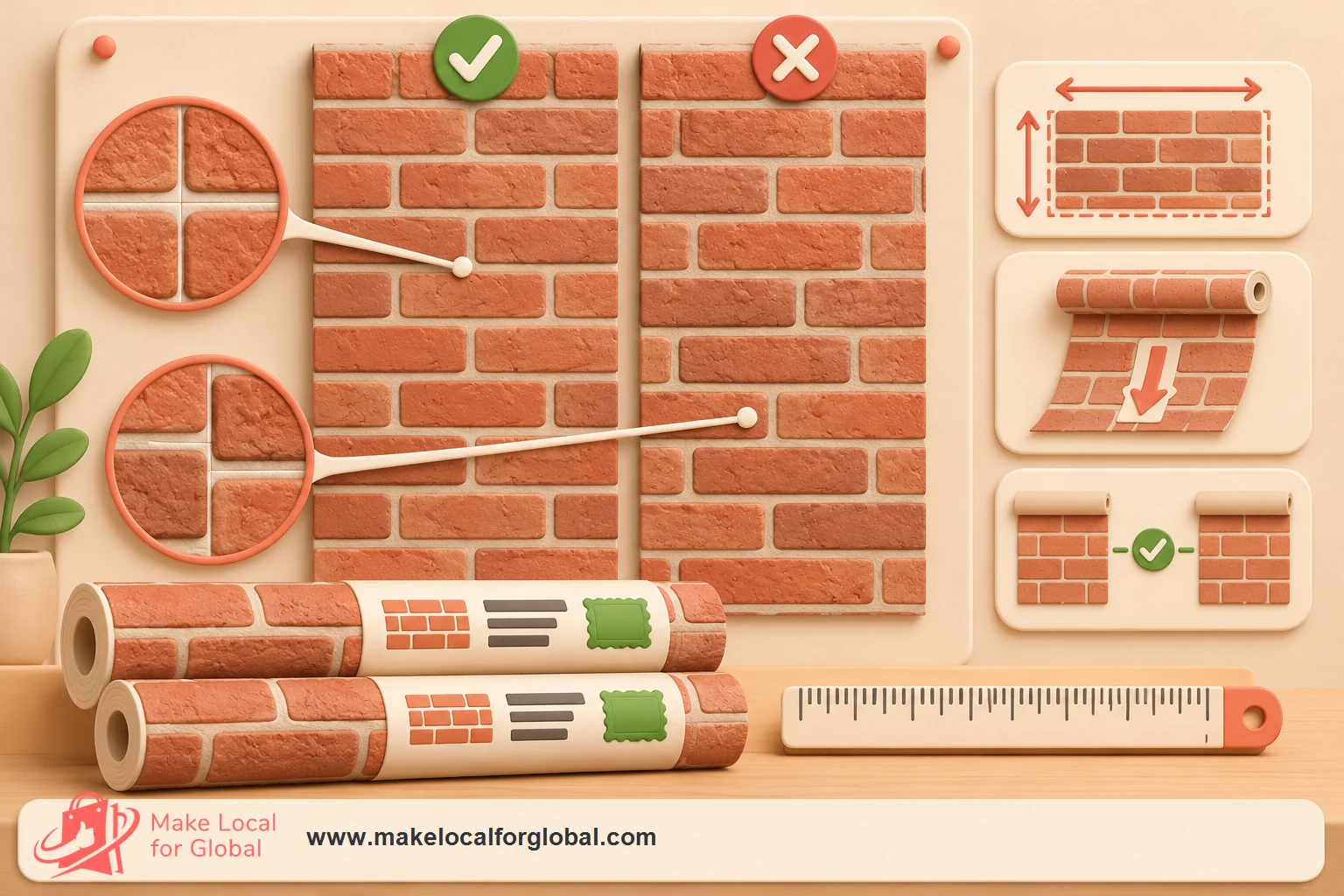
Brick scale changes the impression of a room. A small print with frequent mortar lines can feel busy across a large wall. Large brick blocks can dominate a narrow hallway. A close crop may hide the repeat, while a wide room photo may make the printed bricks look smaller than they are.
Compare the sample against a ruler or another object of known size, then photograph it at a distance that shows the actual print scale. Include one close view of the surface and one wider view of a complete repeat. Tell the customer whether the image is a styled room scene, a sample photo or a computer-generated illustration. Never present a mock room as a photograph of the exact paper installed in a real property.
Read the repeat and match information from the technical sheet. A straight match lines up the design at the same point across adjacent drops. A half-drop or other offset match shifts the next drop. A free match may not require set alignment. Manufacturers use different names, so copy the actual product specification. A repeat consumes usable length and can raise the number of rolls needed for a room.
Colour changes with lighting, screen settings, paper, surface finish and viewing distance. Use neutral light for sample photographs, avoid filters that alter hue, and show the same sample in a close view and a room context. If a finish has reflective particles or raised texture, photograph it from more than one angle. A single flat image may erase the detail that makes the product appealing.
Keep one labelled sample from each design and production batch you sell. A supplier may update inks or materials without changing a product name. When a customer asks about a previous order, the batch number and a retained sample help you compare what was shipped with the current stock.
Compare manufacturers, importers, trade distributors, print-on-demand wallpaper suppliers and private-label routes. A local wholesaler can make sample orders and returns easier. Direct import may offer more control over design, but it can add freight, customs, longer lead times and more work to check conformity. A print-on-demand arrangement may avoid holding finished rolls, yet the seller still needs clear quality checks and written terms for reprints, colour variation and missed delivery dates.
Request a written specification for the exact design and SKU. Record the product name, construction, base material, finished width and length, repeat, match type, weight or thickness if supplied, surface finish, adhesive instructions, wall limits, cleaning advice, batch format, storage directions and packaging dimensions. Ask whether the product comes in single rolls or double rolls and what the listed coverage calculation assumes.
Ask the supplier:
Keep the answer linked to the exact code and batch. A generic document for a company’s wallpaper collection may not apply to the design you plan to sell. If a technical sheet omits a key fact, ask for a current version. A supplier who cannot explain the product’s installation method or batch coding creates a support problem later.
For a private-label order, define in writing who controls the artwork, owns the print file, approves colour proofs, manages product markings, handles complaints and pays for a misprinted batch. Do not assume that a contract transfers a manufacturer’s legal role automatically. Ask a product-compliance adviser to review your role if you import, rebrand or sell a product with an intended use in regulated construction settings.
Some wallcoverings are construction products for regulatory purposes. The route depends on the product, intended use and market. Great Britain and Northern Ireland can have different arrangements. The government’s Construction Products Regulation guidance for Great Britain explains the regulatory framework, and the current product-marking guidance describes accepted marking routes. Ask the manufacturer or importer which requirements apply to the wallpaper you are selling.
Do not add a CE or UKCA badge to a product image because a competitor has one. Do not write “fireproof”, “fire-resistant” or “commercial grade” without current product evidence and a clear understanding of what the test covers. If a business customer asks for a fire classification, supply the exact maker’s document and make clear that the customer’s designer, building control professional or responsible contractor must check the wall assembly and intended setting.
Building regulations consider the wall surface and the substrate together. England’s Approved Document B for fire safety includes wall-lining classifications and describes conditions for wallcoverings used in certain settings. That does not let a retailer infer a building-level result from a wallpaper sample. A classification can depend on the product, adhesive, substrate, fixing method and location. Do not generalise a test report beyond its stated scope.
For sales in Northern Ireland, the product route can differ. For sales to the EU, check current EU construction-product requirements and the rules in each destination. Do not switch on international shipping just because a carrier offers the service. Product documents, taxes, consumer information and delivery terms need checking for the destination.
Order samples from the supplier who would fulfil the first trade order. Record the date, supplier, product code, batch where available and sample dimensions. Compare the surface under daylight and warm indoor light. Photograph the sample without a filter and note whether the printed mortar lines look sharper, duller or warmer in person than online.
For a roll sample, inspect the whole repeat. Check whether the bricks line up across a seam, whether the repeat is easy to identify, whether edges are square and whether the surface has creases or marks. If the product is textured, feel the raised areas and view them from the side. If it is self-adhesive, follow the product instructions on a permitted test panel, not a customer’s wall.
Test installation only within the manufacturer’s directions. Use the recommended wall type, paste or preparation. Record the wall surface, room temperature, wait time, paste or method, and what happened at the seam and edge. If a peel-and-stick paper is not approved for textured walls, do not test it there as a way to expand the product’s stated use. A seller’s quick test cannot replace a manufacturer’s test or a formal performance assessment.
Inspect the roll after delivery. Photograph the outer box before opening, then check the roll ends, wrapper, printed surface, label, batch and number of units. Compare the design and colour with the retained sample. Keep a hold area for damaged or mismatched stock. Do not mix batches in one order without telling the customer and checking that the visual difference is acceptable.
Set a written pass, hold or reject result. Pass a sample only when the code matches the supplier documents and the print, roll dimensions and package suit your product page. Hold it if the batch is missing, the spec disagrees with the sample, or the supplier has not answered a use or marking question. Reject it if the supplier cannot resolve a mismatch or the product is damaged. Save the decision with the sample photos and supplier message.
Wallpaper coverage is difficult to estimate from a photograph. A buyer needs the finished wall width and height, the roll width and length, the repeat and match type, and the number of doors or windows that affect cutting. Even then, the amount required depends on the installer’s cutting plan and the maker’s calculator. Direct shoppers to the supplier’s calculation tool when one is available. Graham & Brown’s room-measuring advice notes that the pattern repeat and match type affect the amount required.
Do not promise that one roll covers a standard bedroom. Room shapes vary, ceilings may not be level, and a pattern repeat can reduce usable length. Create a simple measurement worksheet that asks for each wall’s width, wall height, roll dimensions, product code and pattern match. Tell the buyer to measure each wall, not only the room perimeter, and to follow the manufacturer’s instructions on openings and wastage.
Show the roll width and length beside the price. State the pattern repeat in the same units the manufacturer uses and explain what match it requires. If the maker supplies a coverage figure, quote it with the maker’s assumptions. Avoid altering the figure to make a listing appear to cover more area. If a customer measures in metres but your supplier’s data uses centimetres, show a conversion clearly.
Consider offering an estimate check before the order. A buyer can provide wall dimensions and the exact design code, then you can point them to the supplier’s calculator or request a written calculation from the manufacturer. Do not tell them the number of rolls based on incomplete measurements. Ask them to include cutting allowance, pattern repeat and their installer’s preference.
Tell the customer to buy the full project quantity from one batch where possible. Extra rolls can matter if the installer damages a drop or the wall needs repair later. Do not create false urgency around a batch number. Explain what happens if the same batch is no longer available and whether a new print run can differ visibly.
A customer may buy several rolls for one project, so your cost model should consider order size, carton dimensions and carrier limits. Use supplier quotes, a measured sample parcel and your actual payment rates. The example below is hypothetical. It assumes a VAT-registered seller charges the standard VAT rate and sells four rolls with standard delivery for £139.95. Confirm the treatment for your own products and business with an accountant. GOV.UK publishes the current VAT rates.
| Per-order item | Illustrative amount | What to replace with your own figure |
|---|---|---|
| Customer payment for four rolls and delivery, including VAT | £139.95 | Your tested price and delivery charge |
| Sale value excluding 20% output VAT | £116.63 | Correct VAT treatment for your business |
| Four wallpaper rolls at £18 each | £72.00 | Current supplier invoice for the exact batch |
| Inbound freight allocation | £2.40 | Freight, customs and clearance if relevant |
| Outer carton, end protection and packing material | £3.60 | Cost for the box that fits the real parcel |
| Outbound carrier service | £8.50 | Measured parcel quote and service level |
| Payment fee allowance | £4.36 | Your processor’s actual percentage and fixed fee |
| Damage and return reserve | £3.00 | Early evidence from complaints and returns |
| Customer acquisition allowance | £8.00 | Campaign cost per paid order |
| Contribution before fixed costs | £14.77 | Not net profit |
The arithmetic is £116.63 less £72.00, £2.40, £3.60, £8.50, £4.36, £3.00 and £8.00. The remaining £14.77 is contribution before rent, staff time, insurance, software, income or corporation tax and other fixed costs. The payment fee assumes a percentage on the full payment plus a fixed charge. Replace it with the rate in your payment-provider agreement.
The example is not a recommended market price. It may not represent your supplier, delivery charge, fees or demand. Its job is to show why a product that appears to have a healthy price gap can leave little money once a long carton, packaging and paid promotion enter the calculation.
Build a cautious, expected and stronger case. In the cautious case, test a higher carrier price, one damaged roll, a partial refund or a higher acquisition cost. The expected case should use written supplier and courier quotes. The stronger case should use a measured saving, such as a carton that safely carries more rolls or a tested reduction in ad cost. Do not use an untested discount as proof that a product is profitable.
Track the cost by order size. One roll might need a tube or long carton and incur a high delivery cost per unit. Four rolls could use a larger box but spread the carrier charge. A ten-roll order may exceed a parcel size or weight limit and need a different service. Measure each packed configuration, not just the roll in its supplier wrapper.
Add the cost of samples, free replacements and print errors. If you send a sample pack for a small fee, include the envelope, postage, payment fee and labour. If a sample purchase earns credit against a later order, explain the terms and check that your ecommerce system applies the credit correctly. A free sample still costs money to assemble and deliver.
Review the cost sheet after paid orders arrive. Replace the carrier estimate with the invoice, compare actual box and tape usage, record payment fees, damaged packaging, customer acquisition and support time. If large orders contribute less than expected, check size-based delivery charges and packaging. Do not assume that a higher basket value improves profit automatically.
Use a specific title such as “Red Reclaimed-Brick Print, Textured Vinyl Wallpaper, 10 m Roll” only when each detail is verified. Replace the sample dimensions with the manufacturer’s figures. Put construction and installation method near the title, not in a paragraph several screens below. If the paper has a flat printed surface, say so even if the room photo looks three-dimensional.
Show the customer the material, colour, scale, dimensions and repeat. Include the manufacturer’s pattern-match symbol or an accurate plain-language description. State whether the product is paste-the-wall, paste-the-paper, pre-pasted or self-adhesive. Give the wall and room conditions from the instructions. Mention that the customer should read those instructions before opening or installing a roll.
Use a consistent product specification block:
Write a short description that helps someone decide. For example: “A flat printed brick design on the listed paper base. Each roll measures [verified width] by [verified length]. Check the required quantity using the manufacturer’s coverage tool; the pattern repeat is [verified figure] and uses a [verified match] alignment.” This wording is deliberately factual. Do not fill the brackets until the supplier data is confirmed.
Add a comparison table for designs that are truly different. Compare construction, texture, colour, roll size, pattern repeat, installation method, wall limits and documented cleaning guidance. Do not compare a flat paper and a textured peel-and-stick film by price alone. The materials and installation work differ, so a shopper needs those facts before choosing.
Search language should match the actual page. Useful phrases may include “faux brick wallpaper”, “brick effect wallpaper”, “red brick wallpaper”, “white brick wallpaper” or “peel and stick brick wallpaper” where the product is that type. Use a phrase in the title, URL, introduction or subheading only where the listing answers the search. Do not repeat it in every heading. Give each design its own product-specific page title, meta description, images and specifications.
Internal links can lead to a guide on measuring a wall, another wallpaper construction or a related decorating product. Link to a destination that gives the reader a useful next choice. Avoid linking every mention of the word “wall” or “brick” to the same page. Keep the product page focused on the design and installation facts for that SKU.
Still weighing up product ideas?
Use the other product guides to compare buyer questions, supplier requirements and delivery work before choosing what to test.
Create a photo set that answers real questions. Use the same sample for the colour close-up and pattern-repeat shot. Include a ruler or a printed scale card in at least one frame. Show the edge, backing and texture where the manufacturer permits you to handle the sample. If the image is an illustration, label it as such.
Photograph the paper in neutral light and preserve the original colour. Include a close view of the bricks and mortar, a complete repeat, the roll label, the finished roll dimensions and a wider context. If you show a room, state whether it is a real installation or an illustrative mock-up. A mock-up can help someone imagine placement, but it should not conceal that the actual product is flat print or that the wall colour affects the final result.
Take a photograph of the parcel after the roll is packed. Use that image to explain how the seller protects the ends and prevents crushing. Show the actual box size or list the packed dimensions where useful. Do not use a parcel image that implies the carrier will keep it upright if the service handles it in a different position.
Use descriptive alt text for each image. “Close view of red brick-effect wallpaper with the printed repeat visible beside a ruler” explains the image. “Wallpaper wallpaper brick wallpaper” does not. Alt text should match the asset and should not claim a texture the paper does not have.
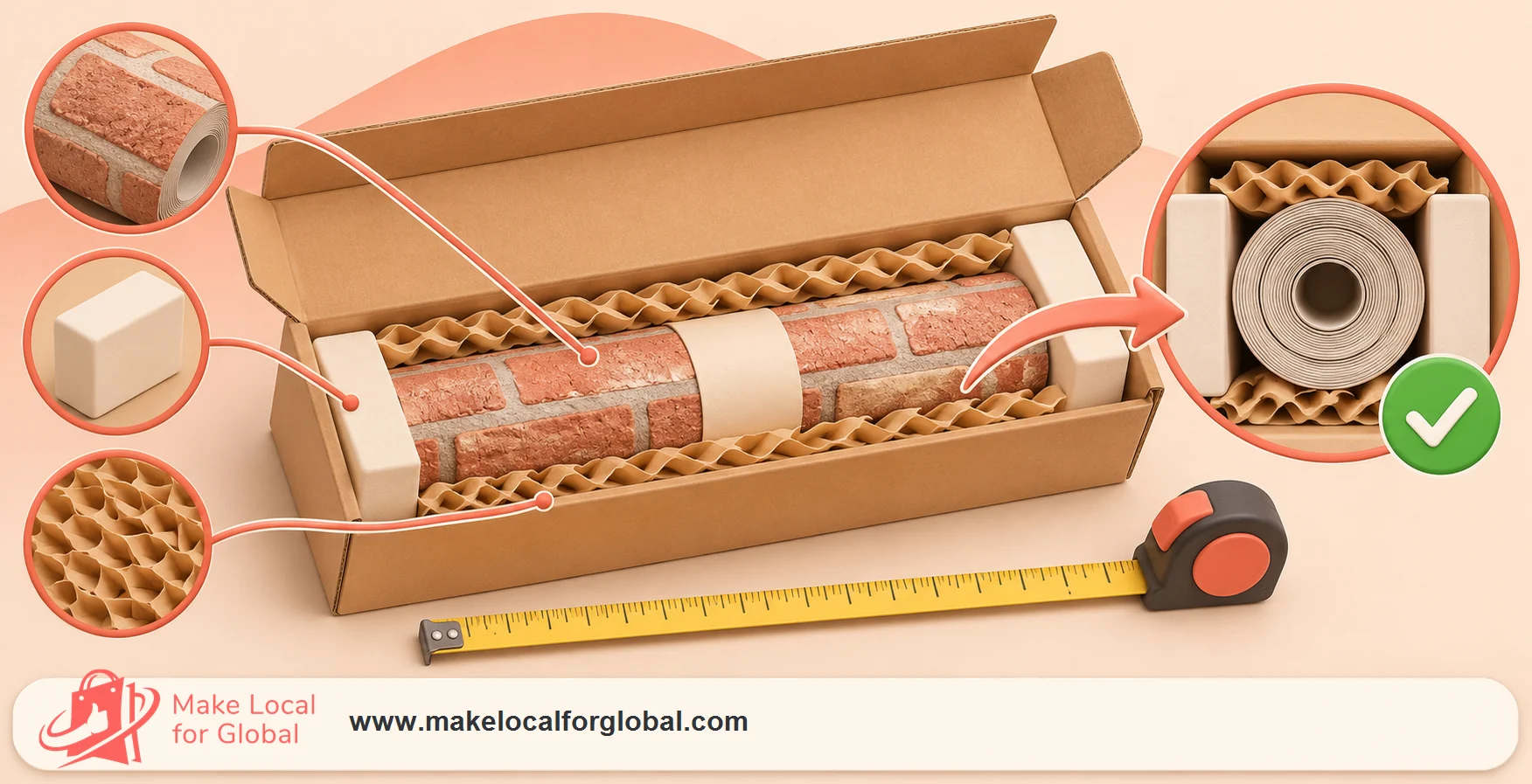
Wallpaper can arrive in a long narrow carton that does not fit ordinary parcel assumptions. Measure its packed length, width, height and weight. Check the carrier’s current size limits and surcharges. A roll that fits a carrier’s maximum may still incur a non-standard handling fee, so ask for a quote against the actual parcel.
Protect the ends, keep the roll straight and use a carton that resists crushing. Test the pack by turning it gently, checking for movement and inspecting the wrapper after transit. Avoid tight straps that dent the roll or tape that pulls at the surface when removed. If the manufacturer’s package already protects the roll, confirm whether an outer carton is needed for the carrier route and gift presentation.
Store rolls upright or horizontally as the maker instructs, away from sunlight, moisture and temperature swings. Keep each batch together. Record receipt date, product code, batch, roll count, storage location and units shipped. Use a stock system that stops a customer ordering a quantity you do not have. When a roll is reserved for a customer service issue, take it out of available stock.
Use a pick check before dispatch. Match the product code, colour, roll count and batch. Confirm that the label and pack are legible, the wrapper is intact and the right installation instructions are included or linked. Photograph any damaged stock before contacting the supplier. Keep complaint records connected to the batch so you can spot repeat issues.
Offer a clear process for a crushed parcel, damaged roll, missing roll or visible print defect. Ask the customer to send images of the outer packaging, the roll label and the affected area before installation when practical. Do not make them wait for a courier investigation before you respond to a concern about goods that arrived damaged or do not match their description.
Online customers usually have a 14-day period after delivery to tell the seller they want to cancel a distance purchase. GOV.UK’s distance-selling guidance explains the information to provide before an order. Its returns and refunds guidance covers the standard right to cancel and return process.
Some goods made to a customer’s specifications or clearly personalised can be treated differently under the Consumer Contracts Regulations. A standard wallpaper design selected from a shop’s regular catalogue is not automatically made-to-measure simply because the customer orders several rolls. If you sell custom mural dimensions, a bespoke colour or a design printed to a customer’s wall plan, get advice on whether the product qualifies before telling the buyer that cancellation rights do not apply.
Customers still have rights if goods are faulty, damaged or not as described. The Consumer Rights Act 2015 says goods supplied by description must match that description. Do not use a return policy to avoid responsibility for a wrong colourway, short roll, missing panel, defective print or incorrect product information.
Write the return process in plain language. State how a customer contacts you, whether they pay the return postage for a change-of-mind cancellation, how to package a long roll, when the refund is due and how you handle goods that arrive damaged. Tell buyers to keep the wrapper and batch label until they have checked the delivery. Do not tell them to install all the paper before raising a concern about a mismatch.
Track the reasons for returns. A “colour not as expected” complaint may point to poor lighting or an unclear screen-to-sample explanation. “Not enough rolls” may reveal a weak coverage page. “Pattern does not line up” may be a batch or repeat issue. Each reason suggests a different fix. Do not respond to every return by adding a blanket no-return rule.
Your own shop gives space for roll dimensions, repeat diagrams, installation notes, room photos and delivery costs. A marketplace can provide search exposure, but current rules, fees and listing limits differ. Read the platform’s wallpaper and construction-product requirements before listing. Keep product codes and batch stock in one source of truth if you use more than one channel.
Start with a main listing for each materially different construction or pattern. Use a colour variation only when the shopper can see which details change and every option has the right image, SKU, batch, price and delivery. If a user selects whitewashed brick, the order system must not send a red-brick roll because both share one product record.
Test one acquisition route at a time. You might publish a wall-measuring worksheet, make a short video showing a real sample beside a ruler, send a sample board to a local interior stylist, or advertise a photo carousel that explains print scale. Set a capped budget and one measure before spending, such as qualified product-page visits, sample requests, checkout starts, paid orders or delivery cost per order.
Do not judge an ad by likes alone. Track the search phrase, landing page, selected product, order size, delivery region, paid order, return or support question. If shoppers open the product page but leave at delivery, measure the package and quote another carrier. If many people request a sample, consider a paid sample pack with a clearly explained credit toward a later order.
Write useful support content around a question the page cannot fully answer. A guide to pattern matches can link to each exact design. A room-measuring worksheet can explain which measurements to collect before using the maker’s calculator. A comparison of peel-and-stick and paste-applied products can explain that wall compatibility varies by product. Link the content to the relevant product, not a generic category page that leaves the shopper searching again.
Use the first month to reduce uncertainty. If the maker has not sent current dimensions, instructions or product documents, move the launch date. A calendar cannot make an unknown roll specification ready for sale.
Choose one buyer and one wall problem. Speak with five to ten people who match that buyer. Ask what they would use the wallpaper for, whether they expect a flat or raised surface, how they measure a wall and what information they need before ordering. Note questions word for word.
Review a small sample of public listings. Record construction, colour, repeat details, coverage claims, sample availability, delivery promise and review themes. Do not copy their wording or infer sales volume from ranking position. Use the notes to decide what your product information should explain clearly.
Set a short range brief. Name the buyer, pattern, construction, starting price hypothesis, sample limit, expected parcel size and the maximum amount of cash you can tie up in opening stock. Remove any product that has no clear role in that brief.
Send the supplier questions for each exact SKU. Ask for the latest technical sheet, hanging instructions, batch format, dimensions, repeat and market documents. Confirm which party is responsible for the applicable product requirements and whether a construction-product route applies.
Order one sample from the supply route you expect to use. Record the colour under two light types, brick scale, repeat, surface feel, backing and installation method. Keep the sample label. Hold the product if the supplier’s documentation and physical sample do not match.
Ask a qualified adviser about any unclear product marking, intended use or fire claim. Keep the exact question, product code and written response. Do not rely on a sales representative’s general statement if your page will make a specific performance claim.
Measure the packed parcel for one roll, four rolls and your likely largest order. Get carrier quotes and test a carton. Calculate supplier cost, inbound freight, packaging, carrier, payment, damage, returns, acquisition and tax treatment. Write down which figures are actual quotes and which are assumptions.
Photograph the sample and product label. Prepare a product page with roll size, repeat, match, construction, wall suitability, installation method, delivery and return information. Ask someone who did not help write it to identify the product’s surface and calculate what information they still need before buying.
Build a simple support template for order questions. Ask the customer for wall height and widths, product code, desired wall, batch information and a photograph when relevant. Do not give a roll count from a room photo alone.
Open with a quantity you can inspect and ship accurately. Cap any campaign spend at an amount you can afford to lose in a test. Track visits, sample requests, paid orders, basket size, delivery cost, print concerns, returns and time spent answering questions.
After the first paid orders, review every parcel and enquiry. Did the roll arrive straight? Could the customer read the batch label? Did they understand the pattern repeat? Did they need a coverage check? If the same question appears more than once, update the product page or help content before buying more stock.
At the end of the month, decide whether to reorder, revise the listing, test another supplier or stop. Reorder only when the sample, supplier documents, customer feedback and full-order cost still support the choice. A popular room image does not justify a larger inventory order by itself.
A staged room can look convincing, but the image may hide the print scale and surface construction. Label illustrations clearly and show the physical sample beside a ruler. Use the real product for the colour and repeat photos.
A shopper who orders textured paste-applied paper should not receive a peel-and-stick film. Separate products when the backing, adhesive, wall limits or care instructions differ. Keep the stock code tied to the exact page option.
“Four rolls cover a bedroom” ignores wall height, match, openings, cuts and installer preference. Publish the manufacturer’s dimensions and direct the buyer to a calculator or a measurement check instead of giving a universal roll count.
A classification for one wallpaper on one substrate does not establish performance for every wall. Request documents for the exact product and use. Leave a claim off the listing until the evidence and permitted wording are confirmed.
Many styles and batches create more chances for colour mismatch and slow stock. Start with a tight selection and keep matching rolls together. Add a new pattern when customer questions and sample requests justify the stock risk.
Long parcels, packaging and delivery can consume the difference between trade and retail prices. Measure a packed order and include payment, damage, return and acquisition costs. Review actual order evidence before setting discounts.
It depends on the SKU. Some products are flat printed paper, while others have a coated or embossed surface. Check the maker’s specification and show a close photo of the exact sample.
Use the product’s exact dimensions, pattern repeat and match type, plus measurements for each wall. Direct the customer to the maker’s calculator or a qualified installer. Do not infer a quantity from a room photo.
Only use that phrase if the maker supports it for the exact wall conditions and removal method. A self-adhesive backing may still affect paint or fail on a textured or unsuitable surface. State the allowed surface and test advice from the product instructions.
Requirements depend on the product’s intended use and the market. Ask the manufacturer or importer for current documentation and get advice where a building or commercial use is involved. Do not create a rating from a sample or a competing listing.
Not automatically. A regular catalogue design ordered in several rolls is not necessarily personalised. A product made to a buyer’s dimensions or a custom specification may be treated differently. Check the actual contract and product with an adviser before you state an exception.
A sample helps a buyer compare colour, scale and surface before committing to several rolls. Price the sample pack and postage, state what it contains, and explain whether a credit applies to a later purchase.
Ask for construction, roll dimensions, repeat, match, installation instructions, wall limits, batch coding, storage, approved claims, market documents, minimum order, lead time and the process for damage or print defects. Match every answer to the exact SKU.
Use a real installation photo only when you have permission and the photo shows the exact design. If you use a mock-up, label it as an illustration and show a separate photo of the physical sample. Do not change the brick colour with a filter.
Do not mix batches by default. Check the manufacturer’s advice and compare the actual rolls. Tell the buyer if a same-batch quantity is unavailable, and let them decide before dispatch.
Follow the maker’s packaging requirements, protect both ends, prevent bending and use a carton that matches the measured parcel. Test the packed sample through the selected carrier route and check the size limits before offering a delivery price.
Ask for the product code, batch label, an image of the roll in neutral light and the order details. Compare the report with your retained sample and supplier documentation. Record the outcome and update the product photos or batch controls if the mismatch points to a repeat problem.
Track paid orders by pattern, sample requests, roll count, shipping cost, damage, returns, customer questions and contribution per order. Those measures show whether the page, parcel and product range work together. Views and likes alone do not show whether the offer is sustainable.
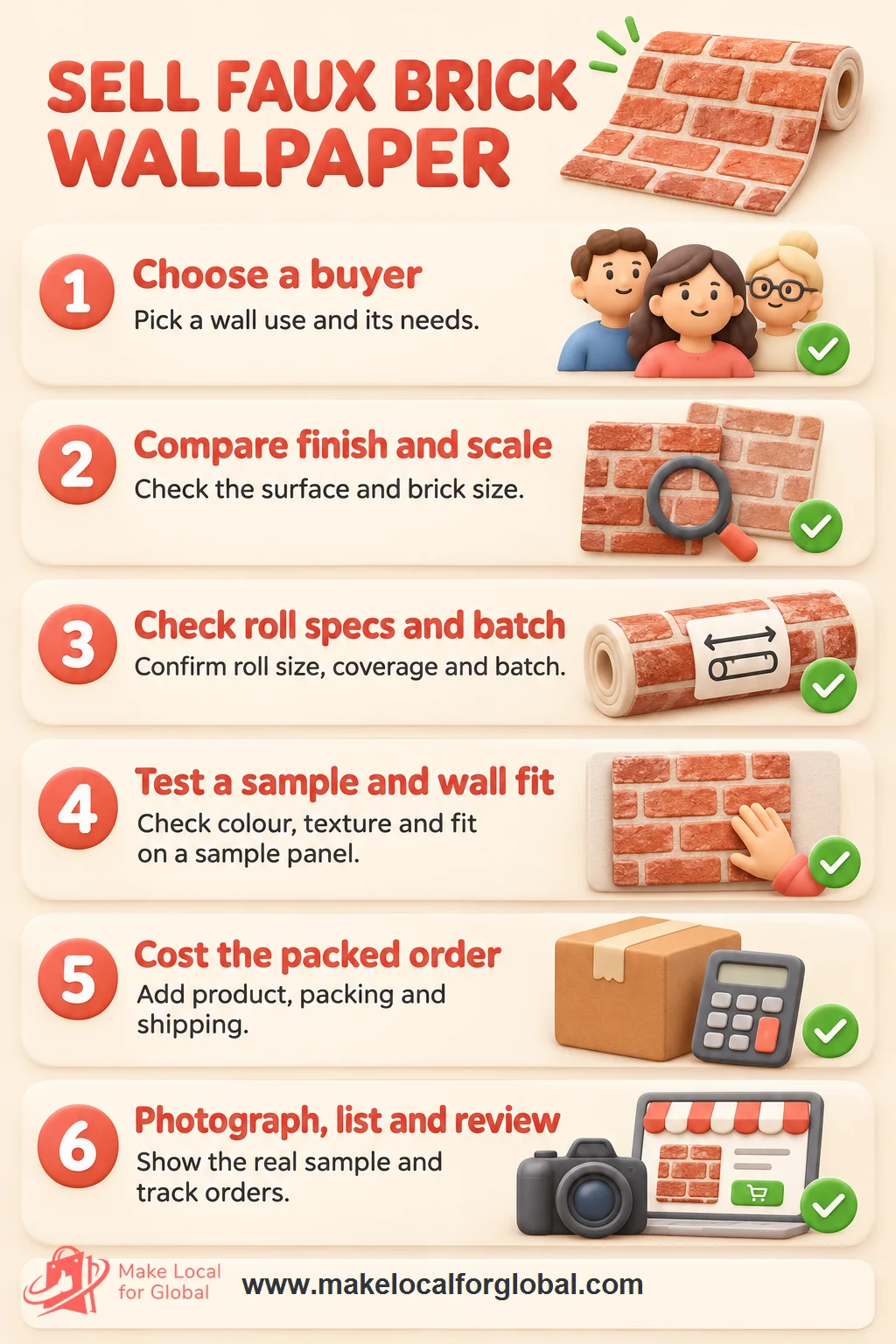
Choose a buyer and a wall use, then source a product you can describe in exact terms. Check the real sample, roll size, repeat and batch. Ask who handles the product documentation for your market. Test the parcel and calculate the full order before you commit to a large range.
Keep the first launch narrow enough to inspect every roll and answer questions with evidence. Use sample requests, paid orders, delivery results and return reasons to decide what belongs next. If a product’s dimensions, safety documents or install limits remain unclear, hold the listing until the supplier answers.
Ready to test a focused wallpaper range?
Use the sample, coverage and packed-order figures to decide how many designs you can describe and deliver confidently.
PREFERRED SOURCE
Like what you’re reading? Add Make Local for Global as a preferred source on Google to see more of our articles when you search.

Build your online presence without having to figure out everything yourself.