READY TO SELL Flower Vases ONLINE?
Get a store built for you in 5 days, plus training and support to help you start, run, and grow your Alternative business.

Learn how to sell flower vases online with a focused range, verified samples, full-order pricing, protective packaging, useful product pages and a practical launch plan.


A vase can be a quiet home accessory, a practical vessel for fresh stems, a sculptural object for a shelf, or a gift bought for a house move. That variety is an opportunity, but it can also make a first range unfocused. The strongest small shop does not try to sell every shape to every person. It starts with a clear buyer, a few well-tested products and product pages that answer the questions a customer cannot resolve through a screen.
This guide walks through the decisions behind a sellable flower-vase range: demand research, materials and use, sampling, supplier checks, pricing, packaging, photography, product pages, legal responsibilities, marketing and a practical first-month launch. It treats flower vases as a broad product category. If your offer is specifically ceramic, our guide to selling ceramic vases online covers material-specific range and shipping decisions; for metal, see how to sell metal vases. If you sell arrangements as well, our separate floral arrangements guide covers that different product and fulfilment model.
The aim is not to predict a guaranteed bestseller. It is to reduce avoidable uncertainty before you commit money to stock, and to learn from real customer behaviour once your first products are live.
Plan the range, present its details clearly and make buying straightforward for your customers.
Before browsing suppliers, write a one-sentence description of the business. “A small collection of water-tested vases for people who buy fresh flowers for compact homes” gives you more useful boundaries than “beautiful vases for everyone”. Your sentence should name the buyer, the setting or job the vase performs, and the point of difference you can actually deliver. That difference might be a considered size range, replaceable inner liners, a gift-ready finish, accessible prices, or clear dimensions and water-use information. Avoid promises such as “the most sustainable” or “leak-proof” unless you can substantiate them product by product.
Decide whether you will sell ready-made stock, made-to-order pieces, your own designs manufactured by a supplier, or a carefully selected assortment from wholesalers and makers. Each route changes your cash requirement, lead time, quality control and ability to replenish a popular item. A maker sourcing small batches may offer a distinctive product but uncertain restock dates. A large wholesaler may replenish more quickly but leave you competing on similar designs. Your first operating model should fit the time and money you can put into the shop, not only the version that looks most impressive in a mood board.
Sketch the customer journey too. A buyer may discover a vase through a room photograph, compare its dimensions with a shelf, wonder whether it holds water, check delivery timing, and then decide whether it is suitable as a gift. That journey creates practical work for the shop: accurate specifications, photographs that show scale, clear packaging and delivery information, and a reliable response when an item arrives damaged. If you are not ready to handle those basics consistently, narrow the launch rather than widening the range.
Start with two or three plausible customer groups and investigate the job each is hiring the vase to do. A renter in a compact flat may value a small footprint, stable base and easy-to-clean form. Someone buying a housewarming gift may value a clear gift message, attractive packaging and a delivery date they can trust. A florist or event stylist may need repeatable dimensions, a consistent finish and several matching pieces. A café or short-let host may care about durability, replenishment and how a collection looks together. These are hypotheses, not facts about every person in those groups, so check them through conversations and small tests.
Talk to people who resemble the intended buyers before you order a large batch. Show a small selection of product photographs or samples and ask what they would use each vase for, where it would sit, what they need to know before buying and what would make them hesitate. Ask them to compare options and explain the choice. “Which one would you buy?” is less informative than “What would you check before ordering this, and what would stop you?” Do not lead them by listing the benefits you hope to hear. Record the questions and objections in their own words, then use those phrases to improve the product page.
You can test interest with a simple landing page or a small number of listings, but interpret signals carefully. A social-media like is not a sale, and a mailing-list signup is not proof that an item can be delivered profitably. More useful early evidence includes a customer asking a specific purchase question, adding an item to a basket, paying for a sample release, or placing a repeat trade enquiry. Be transparent if a product is a prototype or pre-order. Do not accept payment until you can clearly state the expected dispatch date and meet the applicable distance-selling rules.
Compare existing shops to identify gaps, not to copy them. Note the range of sizes, materials, prices, delivery options, dimensions, return terms and the clarity of their product photography. Read reviews for recurring unmet needs such as unclear scale, finish differences or breakage. Treat reviews as a source of questions to investigate, not proof that every supplier or product has the same problem. Your opportunity may be a better buying experience rather than a radically new vase shape.

A first collection should be small enough to understand and broad enough to let a customer make a real choice. A useful way to begin is to define roles rather than collect unrelated designs: a compact bud vase, a medium everyday vase, a taller statement piece and perhaps a giftable set. Those roles are prompts, not a prescribed number of products. Your own customer evidence may point to fewer sizes or a different group entirely. Make each product earn its place by serving a buyer need, filling a price point or complementing another item without creating confusing near-duplicates.
Create a simple range matrix. Put use or buyer type down one side and dimensions, material, finish and price across the top. A matrix can reveal that three products are almost identical in height and opening, or that you have no option for the shelf size your interviews surfaced. It can also show where one style is available in too many colours before you know which colour sells. This is useful because each variant adds photography, stock forecasting, storage and customer-service work. A choice is valuable when it helps the buyer; it becomes friction when it multiplies options without a clear reason.
Think about the complete product rather than just its front-facing look. A stable base, smooth edges, a practical opening and a finish that behaves as described can be part of the range proposition. Avoid assuming that every attractive decorative vessel is intended to hold water. Make a clear distinction between vases suitable for fresh flowers and decorative pieces intended for dried stems or display. If products differ in that respect, treat the distinction as essential product information, not a minor note hidden at the bottom of the description.
Use a modest buying plan. Set an amount you can afford to have tied up in stock and packaging, then allocate it across tested products rather than dividing it equally by instinct. If a product requires a larger minimum order, ask whether the supplier can offer a smaller trial quantity, a sample order or a mixed carton. A low unit cost can be misleading when the minimum purchase creates slow-moving inventory. Keep some cash available for replacements, postage, marketing tests and the ordinary surprises of a first launch.
The word “vase” covers very different constructions. Glass may make the water level and stems visible, while opaque ceramic or stoneware conceals them. Metal, resin, wood, cement, recycled composites and mixed-material designs introduce their own questions about lining, finish, care, weight and intended use. The material name by itself does not prove that a particular piece is waterproof, food-safe, shatter-resistant, recycled or suitable for outdoor use. Get product-specific information from the maker or manufacturer, then check the actual sample against the claims you plan to make.
Describe finishes precisely and honestly. “Hand-finished” should mean something about the process that is true of the actual product. “Natural” can be vague; if you use it, explain the material or finish rather than implying an environmental benefit. “Waterproof” should not appear because the vessel looks glazed or has a metal exterior. Ask what surface is in contact with water, whether an insert or liner is required, and what cleaning or care is recommended. Keep supplier evidence and test notes with the item’s SKU so the information remains available when you reorder or answer a customer.
Colour also needs careful handling online. Screens and lighting affect how a finish appears, and handmade or small-batch products may vary. Photograph the actual production sample in neutral, consistent light. If a supplier says colour may vary, ask how much variation to expect and decide whether the difference remains acceptable to your intended customer. Explain natural variation where relevant without using it as a blanket excuse for damage or a product that materially differs from its description. If the variation is large, sell by batch or show more than one representative example.
Care details are part of product selection. A textured surface might collect dust; a narrow neck may be harder to clean; a delicate finish may need a soft cloth. Verify care instructions with the supplier rather than inventing them. Avoid putting a vase in a dishwasher or advising abrasive cleaners unless the manufacturer confirms that treatment is suitable. Clear care information can prevent avoidable damage and returns while helping buyers decide whether the product fits their home and routine.
Treat sourcing as an evidence-gathering exercise rather than a price search. Make a shortlist of makers, wholesalers and manufacturers whose products suit your intended buyer and order size. Ask what the quoted price includes, whether the stock is ready to ship, how often the range changes, what the minimum order is, whether finishes or dimensions vary between batches, and what happens if goods arrive damaged or differ from the sample. Request written specifications, trading details and clear product codes. Keep a record of who you spoke to, when, the quoted lead time, and the version of the specification you relied on.
Request samples before committing to a meaningful quantity. Compare the sample with the written description, product photographs and any claims you plan to make. Ask whether the sample is representative of normal production or specially selected. For handmade pieces, find out what variation is expected and how the maker identifies a piece outside the acceptable range. If samples are not available, ask why and decide whether the remaining uncertainty fits your budget. A small first order may be a better test than accepting a large minimum order without seeing the product.
Check delivery and import responsibilities before comparing overseas offers. Identify who pays freight, insurance, import charges, customs brokerage and final delivery. Confirm the currency and payment terms, and whether the supplier’s quote is for goods alone or includes transport. The lowest factory price may result in the highest landed cost once freight, tax, brokerage and damage risk are included. A local supplier with a higher unit price may make a first launch easier to manage if replenishment is faster and claims are simpler. Compare total documented costs, not one number in a catalogue.
Set your quality standard before a sample arrives. Depending on the design, check dimensions, weight, stability, rim finish, surface marks, colour, seams, packaging, included liner, water suitability and care instructions. Use the same method on every sample and record each item as pass, fail or question. Photograph a possible defect beside a ruler or another scale reference, and save the evidence with the SKU. This makes a supplier conversation more useful and lets you compare a later batch against the first.
Inspect the base, interior, rim, joins and coating under consistent light. Put the vase on a level surface and note any rocking. Check whether the opening is practical for the intended use and whether the item is easy to clean as described by its maker. If an insert is supplied, see if it fits securely and can be removed without damage. Do not conduct a test that could injure you or damage a product you intend to assess. If a product has a component or finish you do not understand, ask the supplier before offering it for sale.
Decide which handmade differences are acceptable for your target buyer and price. A minor variation may be part of a genuine small-batch product, but that does not make every flaw acceptable. Document what is normal and what would make you reject or grade an item. If the supplier’s variation exceeds your tolerance, ask whether they can sort the order, revise the specification or separate batches. Explain real variation on the product page and photograph representative pieces. Do not use “handmade character” as a blanket answer when the product materially differs from what a customer was shown.
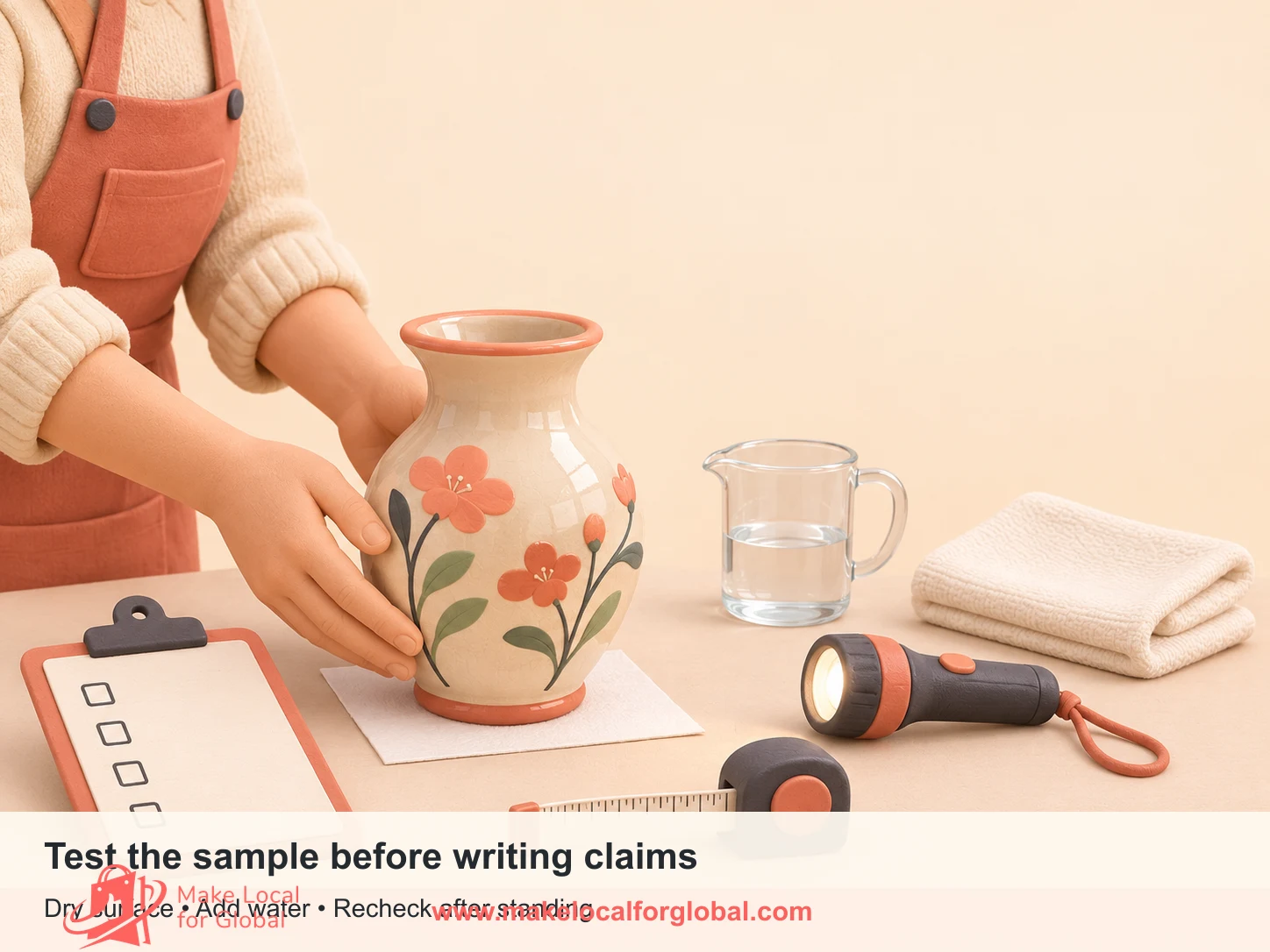
Never infer that a vase holds water from its shape, glaze or exterior material. Check the maker’s instructions and test the actual sample with a simple documented method suitable for that product. Put the clean, dry sample on a stable, water-resistant surface with dry paper beneath the base. Add water to the level recommended by the supplier, leave it standing for an appropriate period, then check the paper, base and outside for moisture. Record the date, product code, sample batch, water level, duration and result. If the item uses an insert, test the assembly as the customer will receive it.
One sample passing a short test does not prove that every unit from every batch will behave identically. If water performance is central to the product, test multiple samples and discuss the test with the maker. Recheck when a supplier, finish, liner or manufacturing method changes. Avoid absolute phrases such as “leak-proof” or “will never mark furniture” unless you can substantiate the exact claim and its limits. Use plain product language that reflects your evidence. If the item is decorative only or intended for dry stems, state that near the top of the product page and do not photograph it in a way that implies fresh-flower use.
Check stability for the setting you describe. A tall narrow vase can behave differently from a short, broad one, while a heavy vessel may suit a console table but not a light shelf. Consider the item empty and, when relevant, filled as intended. Record the base width, weight if measured, and any practical limitation. Do not claim that a design is child-safe or pet-safe based on a casual stability check. A precise note about a tall narrow shape may help a shopper choose a suitable place for it without overstating safety.
Customers cannot pick a vase up through a screen, so make measurements easy to find. Decide how your shop measures total height, widest diameter, base diameter and opening width. If the shape is irregular, explain where the width is measured. Weight can help with shelf or handling decisions. Capacity may also be useful, but only if measured consistently and relevant to the product’s intended use. Check supplier numbers against your samples; if handmade variation changes dimensions, state a realistic range instead of implying every unit is identical.
Give customers a visual sense of scale as well as numbers. A vase photographed alone against a blank background can look much larger or smaller than it is. Include a contextual view on a normal shelf or table and close-ups of the opening and base. Keep camera angles consistent and avoid a wide lens close to the object, which can distort its proportions. Do not digitally stretch or shrink a product. If you use a hand or household object for scale, make sure it is not presented as something included in the order.
Review the specification from a buyer’s perspective. Could someone confuse the opening width with the widest part of the vase? Are measurements in centimetres and clearly labelled? Does a set list each piece’s dimensions or only the group size? A customer fitting a vase in a cubby needs total height and base width; a customer considering fresh stems may need the opening and water suitability. Consistent presentation helps compare products without opening several tabs and reduces repeated questions.
If you sell consumer products in Great Britain, your responsibilities depend on your role in the supply chain, such as manufacturer, importer, distributor or own-brand seller. Read the current General Product Safety Regulations guidance for Great Britain and the government’s product safety advice for businesses. Northern Ireland may follow different rules, so verify the current guidance for each territory you serve. A supplier’s assurance is useful evidence, but it does not automatically resolve your own responsibilities.
Keep records that let you identify products and suppliers: item code, material information, batch or order reference, dates received, inspection results, instructions, claims and any safety complaint. If you stock several sizes or finishes, make each variant distinguishable in your records. A general note saying “vase” will not help you investigate which size or batch a customer bought. Record product substitutions and specification changes before reordering. If an incident suggests a risk, investigate promptly and follow the applicable reporting and corrective-action requirements rather than treating it only as a customer-service matter.
Think about foreseeable risks in the actual product: breakage, sharp edges, an unstable base, heavy weight, coating, detachable parts and intended placement. Do not invent a safety certificate or claim compliance with a standard you have not checked. Seek competent advice if the product design or sales territory raises a requirement you do not understand. The rules can change and differ across markets, so check official guidance and get professional advice where needed.
For online orders, provide the applicable business identity and contact details, an accurate description, total price, delivery arrangements and cancellation information before the customer buys. The government explains these duties in its distance-selling guidance. Its returns and refunds guidance describes cancellation and refund rules, including the usual 14-day periods for online purchases and defined exceptions. Check current guidance for your product and sales model; do not assume a decorative or made-to-order vase is exempt without a basis.
A supplier’s unit price is only one part of your order cost. Include purchase price, inbound freight allocation, customs or import charges where applicable, packaging, packing labour, payment processing, marketplace fees, postage subsidy, damage allowance, returns handling and customer acquisition. Also account for overheads such as software, storage, insurance, photography and bookkeeping. Some overheads are not direct costs on each order, but the business still has to recover them over time.
Separate tax from profit. VAT registration and pricing duties depend on your circumstances and can change, so check current HMRC guidance or speak to an accountant. Record whether supplier prices include tax and how tax applies to each sale. Keep collected tax separate from operating cash. A spreadsheet will not replace accounting advice, but a clear cost model helps you see whether a product can support the service you intend to provide.
Use a worked example with round figures. A vase costs £12 from the supplier, inbound freight allocation is £1.50, packaging is £2.20, and packing labour is valued at £1.80. Those costs total £17.50 before payment, marketplace fees or customer delivery. If you sell it for £34, pay £1.30 in fees and contribute £3.50 towards postage, £11.70 remains before overhead, tax, marketing and damage or returns. That remainder is contribution, not guaranteed profit. Replace every example figure with your actual costs before deciding whether to stock the item.
Model low, expected and high-cost scenarios. In a high-cost case, freight may rise, the carton may need extra protection or a customer may return an item. If the product only works when every cost is at its most favourable, change the product, supplier, price or fulfilment method before committing. A design with a healthy paper margin may still be a poor choice if it occupies costly storage, takes a long time to pack or arrives with inconsistent quality. Revisit the model after real orders show the time and materials you actually use.
| Example order cost | Amount |
|---|---|
| Vase purchase price | £12.00 |
| Inbound freight allocation | £1.50 |
| Protective packaging | £2.20 |
| Packing labour allowance | £1.80 |
| Payment and marketplace fees | £1.30 |
| Postage contribution | £3.50 |
| Illustrative total variable costs | £22.30 |
| Example selling price | £34.00 |
| Contribution before overhead, tax and damage | £11.70 |
Illustrative figures only. Replace them with your actual supplier, fee, postage and packing costs.
A well-structured product page can help shoppers understand sizes, finishes, delivery and intended use before they order.
Once you know the complete order cost, test possible selling prices against the buyer’s perceived value and the alternatives they can find. Comparable products are useful context, but they do not set your price automatically. A small maker with limited capacity may have a different cost structure from a large retailer importing thousands of units. If your vase offers a clearer size range, verified water use or carefully protective packaging, explain those facts without suggesting that they guarantee a customer outcome. A higher price needs a reason a buyer can see and trust.
Use contribution margin to compare products and channels. The contribution is the selling price, less the variable costs required to sell and fulfil that order. If a vase costs more to pick and pack, is fragile, attracts more customer questions or requires a larger parcel, its contribution may be weaker even when the retail price is higher. Model discounts too. A 10 per cent code reduces revenue while payment and delivery costs remain. If you plan to offer a promotion, check the margin before advertising it and make sure any “was” price complies with current pricing rules.
Avoid racing the cheapest marketplace listing if you cannot match its purchase volume or logistics. Competing on price alone can leave no room to replace a damaged order or answer a customer carefully. Instead, define the service included in your price: accurate photographs, responsive support, a dependable dispatch process and clear care information. These are not claims of luxury; they are practical parts of buying a breakable homeware product online. Review the price after real orders reveal actual packing time, carrier charges, questions and returns.
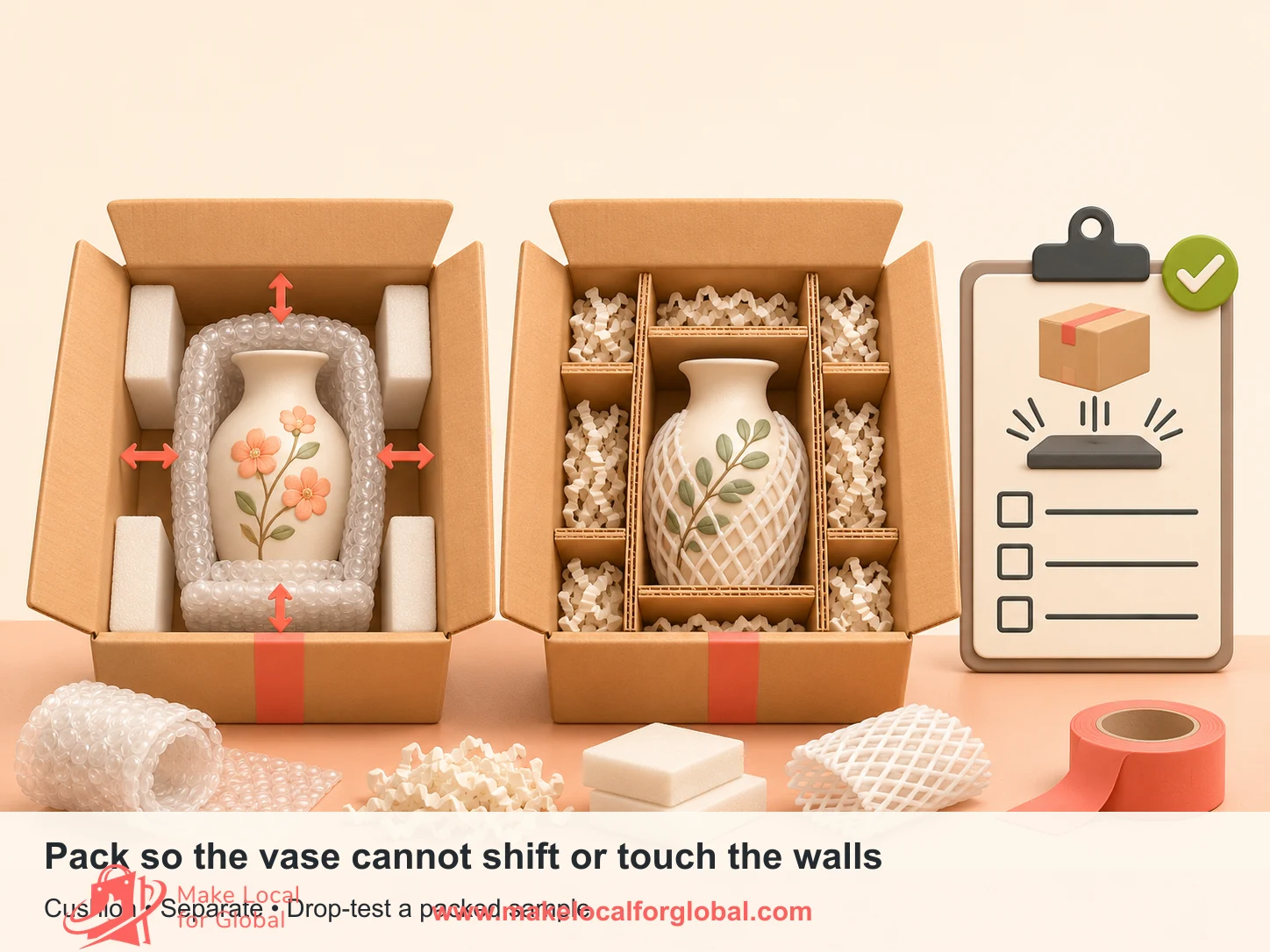
A vase is a breakable, often awkwardly shaped item. The right packaging depends on its material, form, weight, dimensions, finish, transit route and whether it is shipping alone or in a set. Start with the carrier’s current packaging advice and test the complete packed parcel, rather than assuming that a fragile label or a layer of bubble wrap will be enough. Royal Mail’s fragile-item packing guide recommends a strong outer box, cushioning and keeping fragile items from touching the box walls or one another. Check the latest carrier rules because size limits and acceptance terms may vary.
Protect protruding rims, narrow necks, handles, feet and any separate liner. Make sure the vessel cannot move within its inner protection and that the inner package cannot shift within the outer box. If you ship two vases together, use a divider that prevents contact throughout the parcel. Fill gaps with material that keeps its shape under handling. Do not let the vase bear the weight of other contents. For heavier items, choose a box and cushioning that can support the load without the walls bowing or the base breaking through.
Run practical pack tests on a sample, record the materials and time required, and open the parcel afterwards to inspect the product. A controlled drop or vibration check can reveal obvious movement, but it does not guarantee survival through every real-world journey. Ask your carrier what tests or packaging standards it expects for your chosen service, and keep a written packing specification so each order is consistent. Photograph the packed method for staff training. If a supplier ships direct to your customer, ask for evidence of its packing process and test a parcel from that supplier before making promises on your product page.
Packaging also affects the customer’s first impression and environmental footprint. Use right-sized cartons and avoid unnecessary fillers, but do not remove protection that the item needs to arrive intact. Choose materials based on function, availability and local disposal guidance. Make environmental claims only when you can substantiate them for the actual packaging. Packaging extended producer responsibility rules vary by business activity and size; use the current government EPR packaging check and small-producer guidance rather than relying on a general threshold remembered from an old article.
Choose a carrier by the service the customer needs and the parcel you have actually measured. Weigh and measure the packed vase, including any outer carton, then compare suitable tracked services, collection options, compensation terms and delivery estimates. A fragile item may need more careful packing and tracking than a low-value accessory. Ask the carrier how to report transit damage, what evidence it needs and which packaging requirements affect a claim. Record the actual cost and dispatch time for each product type; do not use one average if tall, wide and small vases travel very differently.
Set realistic dispatch cut-off times and explain them clearly. Distinguish the time you need to prepare an order from the carrier’s estimated transit time. For a made-to-order item, show the production lead time separately from shipping. If you cannot meet an advertised date, tell the customer promptly and follow the applicable rules for delay, cancellation and refund. Never imply that you control a carrier’s exact delivery time when you do not. If an item is a gift, let the customer know whether it arrives in a presentation box, whether a message is included and whether the outer packaging reveals the contents.
Create a damage workflow before the first incident. Ask the customer for the order number and clear photos of the item and packaging, respond with empathy, then resolve the matter promptly in line with consumer rights and the carrier’s claim process. Do not ask a customer to pay a return cost that the law or your stated terms do not allow. Do not make the customer negotiate with the carrier on your behalf if the shop is responsible for the sale. Keep a record of what broke, where the packaging failed and which batch was involved. Use the pattern to improve the pack, product selection or supplier conversation, not to blame the customer.
Plan a repeatable photography set for each product. Use a clean main image showing the full vase against a calm background; a contextual image showing it on an ordinary shelf or table; a close-up that makes the finish and opening visible; and a size reference that does not distort the object. For a product that is sold as water-holding, an image with water can be helpful only after the claim has been checked. If it is decorative only, avoid showing fresh stems in water in a way that implies otherwise. Keep the actual colour as close as practical to the sample under neutral light.
Use consistent camera height and lighting across a collection so customers can compare products. Keep the product large enough to inspect, but leave enough of the frame to understand its silhouette. Photograph a set as the customer receives it and show what is included. Avoid props that could be mistaken as included merchandise. If flowers, stands, trays or liners are not included, state that in the image caption or product description where confusion is likely. Include a simple measurement graphic only when every number is accurate and remains legible on mobile.
Do not use a wide-angle lens close to the vase; it can exaggerate the foreground and change proportions. Do not retouch out surface marks that appear on saleable stock if those marks are typical, or digitally recolour the finish to match a trend. If batch variation is normal, photograph more than one representative piece and explain it. Keep image files optimised for the site without blurring details or making text unreadable. Descriptive alt text should explain the image’s useful content for someone who cannot see it, not cram in repeated search terms. In this guide, the images show a range choice, a sample test, a packing method and a six-step launch plan.
A good product page helps a buyer decide without guessing. Start with the product name and a short direct description of what it is, who it may suit and its intended use. Then give the specifications in a consistent order: height, widest width, base diameter, opening, weight, material, finish, colour, what is included, care, water suitability, stock status and dispatch estimate. Add a note about natural or batch variation if it is material to the purchase. Avoid leaving critical qualifications in a footnote or behind a link that the shopper may miss.
Describe the use accurately. If the vase is intended for dried stems or display only, say that near the start and explain any reason the maker supplied. If the vase has a liner, identify whether it is included, removable and replaceable. Do not imply a product is suitable for a particular flower size, table, outdoor setting or cleaning method unless the dimensions or maker’s advice support that statement. A brief comparison with another size can be useful, but give the dimensions rather than relying on “small”, “medium” and “large”. Those labels mean different things to different shoppers.
Include clear photographs, price, delivery costs, delivery estimate, return information, stock availability and customer-service contact details. Explain whether the box is gift-ready or just protective shipping packaging. Give a simple answer to common questions in the page itself: does it hold water, how wide is the opening, how much space does the base need, what comes in the box, and how should the item be cleaned? The exact answer differs by SKU, so avoid a generic description copied across the collection. If two variants differ in water use or finish, make that difference explicit in the selection interface and order confirmation.
Write for a human first. A relevant phrase such as “ceramic flower vase” can appear naturally when it accurately describes the item, but do not repeat “buy flower vases online” in every paragraph. Search engines need distinct, useful information too: a page should make clear what the item is, what distinguishes it, and how it is bought. Use unique descriptions for products that genuinely differ, and combine near-identical variants thoughtfully so the catalogue does not become a set of thin, interchangeable pages. Make internal links helpful: guide a shopper to matching sizes, care guidance or a relevant category without distracting them from checkout.
A marketplace can provide a built-in audience and a quick way to test listings, but it also controls listing rules, fees, discovery and part of the customer relationship. Your own ecommerce site gives you more control over the brand, product information and customer journey, but you are responsible for attracting visitors and maintaining the store. A social platform can help you show products in context and speak with potential buyers, but the platform should lead to a dependable product page and checkout. Choose one main channel to learn first, rather than trying to build a marketplace shop, a full ecommerce site, several social accounts and a wholesale catalogue at the same time.
Compare channel costs in the same way you compare vase costs. Include listing, transaction, payment, advertising and fulfilment fees, and review how refunds or disputes work. Check whether you can legally and practically sell the product in the territories the platform supports. Read current seller rules before investing heavily in listings or ads. A channel that appears free can still require significant photography, customer-service, promotion and administration time. Add that time to your decision even if you initially perform it yourself.
Keep product data in a reusable file: SKU, title, dimensions, material, finish, care, price, stock, weight, image paths, alt text, supplier and packaging specification. This reduces errors when adding a product to more than one channel. Use a SKU that distinguishes size and finish without encoding information that will change every time you update the description. If you sell through multiple channels, define how stock counts stay in sync. Overselling a fragile or limited-run item damages trust and may create refund work that erodes the product’s margin.
Begin with the phrases a buyer might use to find the exact product and answer the query behind them. “Tall ribbed vase”, “small bud vase” and “water-holding ceramic vase” describe different needs; a general category page cannot answer every specific question. Use the words accurately in page titles, headings, product descriptions and image filenames where appropriate, but let the inventory determine the language. Do not call a metal-look coating “metal”, or label a display piece as a fresh-flower vase, to capture a search phrase.
Organise the shop so a visitor can browse by useful attributes such as material, size, colour, style or intended use, provided you have enough products in each group to make that filter meaningful. Keep category pages distinct from individual product pages. A category can explain the range and help customers compare; a product page should describe one specific item. Do not create a separate indexable page for every combination of minor colour and size if each page contains the same text and offers little unique value. Check how the ecommerce platform handles variant URLs, canonical tags and indexation.
Write page titles and descriptions that accurately state the product and benefit. Give each important page its own wording; repeated templates create a bland search result and make it harder for customers to distinguish products. Track search impressions, clicks, add-to-basket actions and purchases, not rankings alone. Search performance is affected by competition, site quality, links, customer demand and many other signals. No article or metadata change can guarantee a Google position. Update your pages when stock, price, materials or claims change, and remove or redirect discontinued items in a way that preserves a useful shopper journey.
Your content can help a buyer answer a question before they reach the product page. Show how to measure a shelf opening, compare vase heights, choose a water-holding vessel or check what fits a narrow neck. Use your sample notes and real customer questions as the starting point. Explain limits as well as benefits. A useful article may help someone realise that one of your vases is not right for their space; that honesty can build confidence in the products that do fit. Link the advice to the relevant product or collection, and keep the article useful even if the reader is not ready to buy.
Use social posts to show distinct details rather than repeating the same styled shot with a new caption. A short video could show the actual opening and base, demonstrate how the packed item is secured, compare two heights on the same shelf or answer a real question about cleaning. Avoid staging a water demonstration before you have verified that the specific vase holds water. If the maker’s process or material origin is part of your message, keep evidence and permission to share it. Do not imply that a product is handmade locally, recycled, sustainable or ethically sourced unless the claim is accurate and supported.
Email can support repeat purchases and trade enquiries, but collect and use customer data in line with current privacy and electronic-marketing rules. Make sign-up optional and explain what subscribers will receive. Keep fulfilment emails separate from promotional messages. A vase may be bought as a gift, for a home move or as a repeat purchase for a business, so an after-purchase email can ask whether the item arrived safely and invite feedback without pressuring a customer to praise it. Use their answer to improve the product page and packaging. Ask permission before using a customer’s photograph or review in marketing.
Write a short response process for the questions you expect: dimensions, water suitability, care, stock, dispatch, gift options, damage and returns. Keep answers consistent with the supplier’s specification and your own sample tests. If you need to check a detail, say so and follow up rather than guessing. Assign someone to check messages on a realistic schedule and set an internal target for acknowledging a problem. A calm, prompt response can prevent confusion, but it does not remove statutory rights or make a damaged product acceptable.
Publish a clear delivery and returns page and link to it before checkout. Explain who pays for return postage in the situations where the law permits you to set that term, how to begin a return, how long a refund normally takes and what happens when a product arrives damaged. Make sure the terms match the actual checkout and order emails. The government’s consumer guidance explains that online buyers generally have a 14-day period to notify a trader after receiving an order, then another 14 days to send it back; there are defined exceptions. Check the current refund rules, including the treatment of standard delivery, and get advice if the product or sales model has unusual features.
Track more than the number of returns. Record why a product came back: colour or dimensions differed from expectation, the vase did not suit the intended shelf, the item broke in transit, the finish did not match the photo, or the buyer changed their mind. Separate customer preference from a product-description or quality problem. If one SKU repeatedly generates the same question, improve the product page. If a cluster of breakages share a packing weakness, fix the pack before dispatching more. If the item itself is inconsistent, pause the listing and speak to the supplier. Do not treat every complaint as a one-off if the evidence points to a pattern.
Assign each product a SKU and record units ordered, received, inspected, reserved, sold, damaged and available. For small collections, a spreadsheet may be sufficient if someone updates it promptly and the data remains consistent across channels. Set a reorder point based on supplier lead time, recent sales and the cash you have available. Do not use a complicated forecast when you have only a few weeks of data. Instead, label the decision as a test, monitor it closely and avoid tying up cash in a speculative large order.
Separate sell-through from revenue. A product that sells quickly at a discount may contribute less than a slower product at a sustainable price. Review the contribution per order, time spent packing and customer questions alongside units sold. A tall vase may attract attention but cost more to ship and store. A small vase may be easier to dispatch but have lower order value. These differences can guide bundles, thresholds or channel choices, but only after you have tested that customers actually want the proposed offer.
Keep enough working cash for restock, refunds, packaging, carrier charges and tax. A supplier deposit paid today may not turn into saleable stock for weeks, so cash-flow timing matters. Note payment terms, lead times and any seasonal closure that could delay a reorder. If demand rises beyond what your packing process can handle, consider limiting stock availability or extending dispatch time transparently rather than accepting more orders than you can fulfil. Your reputation depends on promises you can keep, not just on the product being attractive.
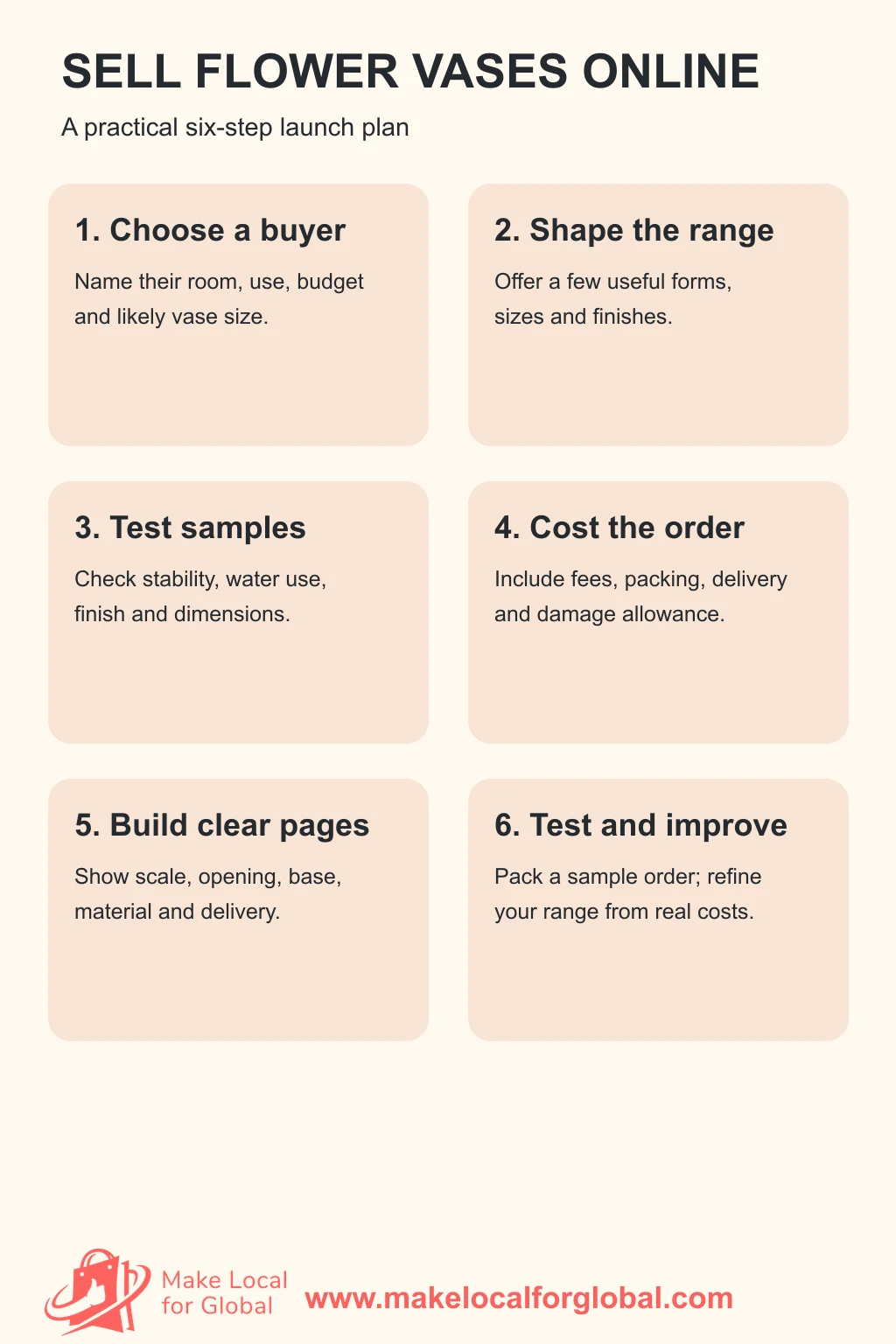
Use the first month to learn in manageable stages. In week one, confirm supplier information, receive samples, test dimensions and intended use, set your quality checklist and calculate a full per-order cost. Decide which products meet your standard and which need a supplier question. Do not photograph or advertise a claim you have not checked. Create a small number of products that represent clear roles in the range, then prepare their specifications, packaging and returns information before the listings go live.
In week two, create and review the product pages on mobile and desktop. Ask someone who has not seen your notes to find the dimensions, water suitability, delivery estimate, price and returns information. Watch where they hesitate. Check that image proportions are realistic, product variants are labelled plainly, basket totals are clear and the checkout works. Place a test order using the platform’s supported process and make sure the confirmation email, stock count and dispatch workflow behave as intended. Avoid using a real customer order as your first test of the process.
In week three, publish the first listings and make a small, measurable promotion. This may be a post that answers one buyer question, a listing on the channel your research suggested, or a modest paid campaign with a fixed budget you can afford to lose. Define what you want to learn before you spend: which product page attracts qualified visits, whether the size photographs answer the scale question, or which route produces a purchase. Do not increase advertising simply because a post received views. Check the cost per order and contribution after fees and fulfilment.
In week four, review actual orders, search terms, customer questions, dispatch time, packaging use, damage, returns and stock. Compare what happened with your original assumptions. If a product gets traffic but no baskets, investigate whether the price, images, specifications or buyer fit is unclear. If a listing converts but its margin is weak, revisit price or pack cost. If customers repeatedly ask about water use, make that answer prominent. Keep what the evidence supports, revise what customers found confusing, and defer new variants until the current products give you a reason to expand.
Ordering a broad collection before defining the buyer is one of the costliest mistakes. Many designs can create the appearance of choice while making it harder to photograph, store, describe and replenish the range. A better first move is to choose a few products with clear roles, then let customer questions and sales evidence guide additions. Likewise, buying a large quantity because the unit price looks attractive can tie up money in a product that has not been tested for quality, demand or delivery cost.
Another frequent mistake is using vague copy where the shopper needs a fact. “Perfect for any flowers” does not tell the customer the opening width, height, water suitability or care instructions. “High quality” does not explain what was checked. Replace general praise with dimensions, material, finish, sample-test notes and any verified limitation. Avoid assuming that a vase holds water or that a supplier’s photo is representative of the product you will ship. Keep evidence next to the SKU so marketing copy stays aligned with the actual product.
Underestimating packaging, returns and service also weakens a fragile-product business. A cheap unit cost does not compensate for repeated transit damage, a carton that is expensive to store or a packing process that takes longer than expected. Test the complete shipment and price the whole order. Make delivery and return terms visible before checkout. If there is a problem, respond promptly and use the evidence to fix the cause. These operational details may not be the most photogenic part of a vase brand, but they shape the customer’s experience as much as the object does.
Finally, do not assume that a new website, polished thumbnail or frequent social posts will create demand automatically. Marketing helps the right person discover a product; it cannot make a poor fit, unclear information or unprofitable order into a sound offer. Set one test at a time, measure meaningful outcomes, and accept that an early product may need to be changed or dropped. A small, evidence-led range can be a stronger starting point than a large catalogue built on guesses.
It can be, but profitability depends on purchase and landed cost, price, packaging, shipping, fees, marketing, damage, returns and overhead. Build a cost model for each SKU and update it using real orders. A vase with a high retail price may still have a weak contribution if it is expensive to protect and dispatch. There is no guaranteed margin for the category.
No. A product’s appearance is not enough to confirm water suitability. Check the manufacturer’s instructions and test the sample using a documented method. If it is intended for dry stems or display, state that clearly on the product page and show it in a way that does not imply fresh-flower use.
There is no universal number. Start with enough products to offer a meaningful choice for your specific customer, but only as many as you can inspect, photograph, describe, store and fulfil properly. Use a small range matrix to spot gaps and duplicates, then add variants when customer evidence supports them.
Use a sturdy box and protective materials suited to the product’s weight and shape. Protect the rim and other vulnerable points, prevent movement inside the box, keep the vase from touching the box walls, and separate pieces shipped together. Test the packed parcel and follow your chosen carrier’s current requirements; a fragile label is not a substitute for effective cushioning.
You remain responsible for the products you supply in the role you occupy in the supply chain. Obtain specifications, traceability and safety information, inspect samples and keep records. The exact responsibilities depend on whether you manufacture, import, distribute or sell under your own brand, so check current official guidance for the markets you serve.
Choose based on the buyer, channel fees, control over product information, discovery, fulfilment and your capacity to manage the shop. A marketplace may help you test listings, while your own site can provide more control but requires you to attract visitors. You can start with one primary channel, learn from it and add another when your process is stable.
Include accurate dimensions, weight where useful, material, finish, colour, intended use, water suitability, care, what is included, price, availability, delivery estimate and returns information. Show the product at realistic scale from several useful angles. Make any meaningful variation or limitation easy to find before checkout.
Respond promptly, ask for clear information and photographs, resolve the customer’s issue in line with consumer law and your stated terms, and handle any carrier claim through the correct process. Record the product batch and packing method. If the same failure repeats, pause dispatch while you investigate and improve the product or packaging.
Choose one buyer and one vase you can source as a sample. Measure it, verify its intended use, inspect the finish, test the packaging and calculate the complete order cost. If it passes those checks, publish a product page that gives a shopper enough evidence to choose. If it does not, use the result to change the product or supplier before buying stock. A focused first range gives you a clearer way to learn what customers value and whether the business can fulfil that promise.
If you are ready to turn your tested products into an online shop, MLFG can help you plan the next step.
PREFERRED SOURCE
Like what you’re reading? Add Make Local for Global as a preferred source on Google to see more of our articles when you search.

Build your online presence without having to figure out everything yourself.