READY TO SELL Flatware Sets ONLINE?
Get a store built for you in 5 days, plus training and support to help you start, run, and grow your Alternative business.

Learn how to sell flatware sets online with clear piece counts, verified material claims, practical sample checks, full order costing and safer fulfilment.

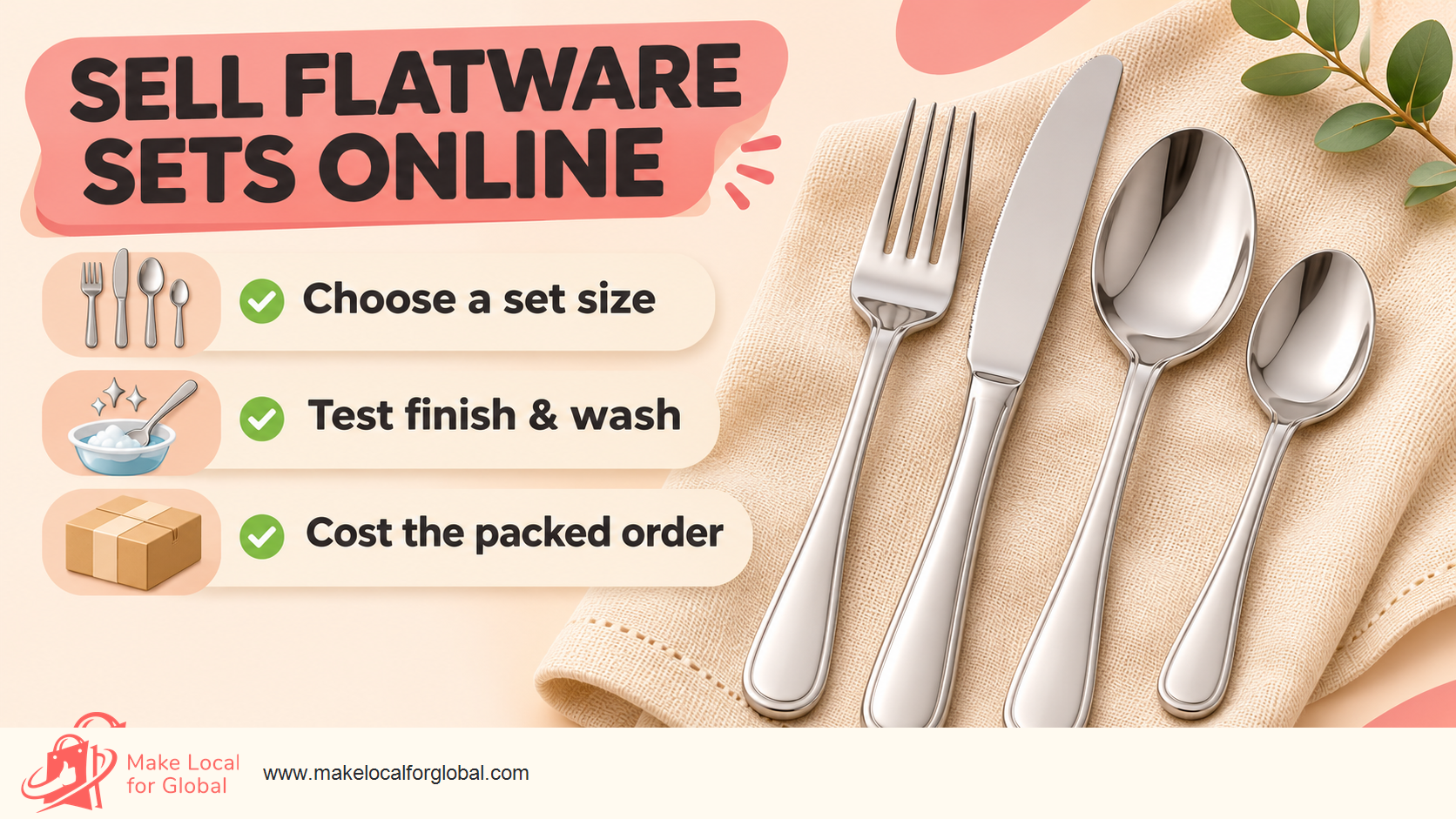
A flatware set has to do more than look polished in a photograph. Buyers need to know how many place settings they receive, which pieces are included, what the metal and finish claims mean, and how the set will arrive without scratching or shifting in transit. For a new seller, those details shape the product range, cost, listing and return rate.
Flatware is the common product term in many catalogues. In the UK, shoppers often search for cutlery. A useful shop can use both words naturally, then explain whether a set is made for everyday meals, entertaining, a first home, a holiday let or a gift. This guide sets out a practical route from choosing a buyer to reviewing the first month of orders.
The short answer: start with one clearly described set, verify every supplier claim, test the finish and the packed parcel, and calculate the contribution from a real order. Add variants only when customer questions and sales data show what people need next.
Bring your chosen buyer, sample notes and first order cost to a planning conversation about your shop and product pages.
“People who eat at home” is too broad to guide your first purchase. A couple setting up a home may want a simple four-person set. A family replacing missing pieces may prefer a larger service for six. A short-let host may care about replacements and repeatable availability. A gift buyer may value a presentation box more than a low price per piece. A café owner has different expectations about quantity, durability, wash cycles and replenishment.
Pick one group and one buying moment. Write a sentence such as: “I sell a dishwasher-compatible everyday cutlery set for renters furnishing their first kitchen.” That sentence helps you decide which pieces to include, what questions to answer and where to show the offer. It keeps an early range from drifting into steak knives, serving spoons, camping utensils and premium giftware before any of those needs have been tested.
Talk to ten people who fit your intended buyer profile. Do not ask whether they like your idea. Ask what they last bought, which pieces they use, what they disliked, how many settings they own and what information they could not find. If you are considering a housewarming set, ask how the recipient would store it and whether they would keep the presentation box. For a replacement offer, ask whether people want matching single pieces or a complete new service.
Review marketplace questions and low-rated reviews for existing products. Sort comments into themes: missing teaspoons, uncomfortable handles, dull knives, scratches, vague material claims, bulky packaging or poor gift presentation. Treat reviews as buyer language and possible product questions, not as proof that every set has the same flaw. Record the source and date of each observation.
Test a small concept before committing to a large minimum order. Make a sample product page or a one-page range board with the intended set contents, photos of the actual sample if available, price hypothesis and delivery terms. Ask target buyers what they would need to know before ordering. Count specific objections and unanswered questions. A repeated question about teaspoon counts is a clearer next step than a polite “looks good”.
A “16-piece set” often means four place settings with four pieces per person, but product conventions vary. Never rely on a title alone. State the total count and list each item. A common table setting could include a dinner fork, dinner knife, tablespoon and teaspoon per person. Some ranges replace the tablespoon with a dessert spoon or add a salad fork. If a seller offers a service for six, make clear whether that means six pieces or six complete place settings.
Photograph the pieces laid out in the same order as the inventory list. A buyer should be able to match the image to the contents without guessing. If the set includes serving utensils, list those separately from place-setting pieces. Explain whether a case, tray, drawer insert or gift box is included in the purchase price.
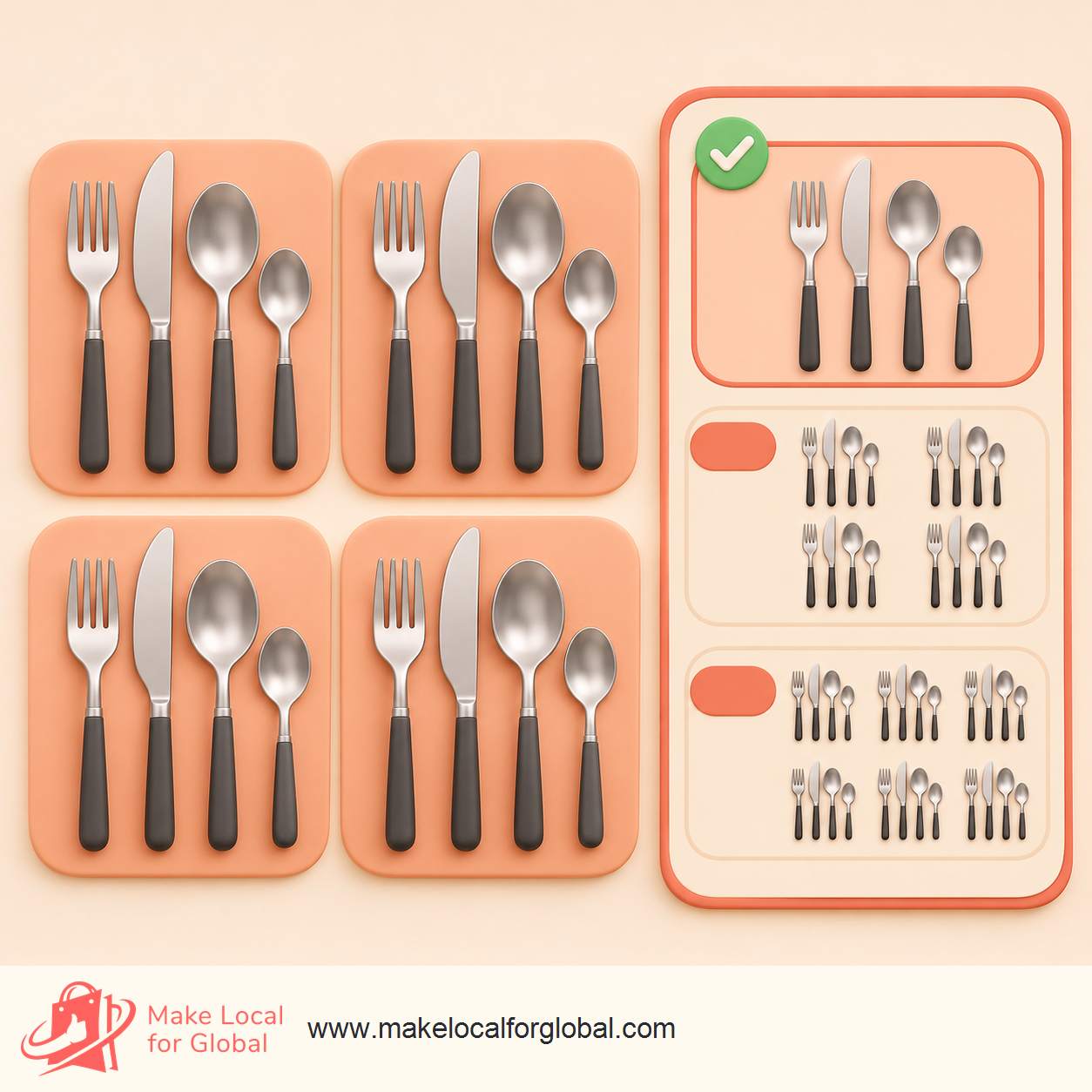
A compact range can use three clear offers: a four-person starter set, a six-person everyday set and a gift-ready version of the core set. Keep the pieces and finish consistent where possible so photos, stock records and replacement orders remain manageable. If you offer black, gold or coloured handles, treat each finish as a separate stock decision: it can carry separate supplier minimums, packaging and photography needs.
Use a contents formula in your stock sheet. For example, six people multiplied by four pieces per person equals 24 pieces. If a box contains those 24 pieces plus a serving spoon and serving fork, the total is 26. State both the place-setting count and the total pieces. When an offer contains a storage tray, record it as a separate included item.
Ask your supplier for a written pack list, unit weights, dimensions of the boxed product and a photo of the exact configuration. Check whether the quoted quantity refers to a set, a single piece, a pair or a carton. A low price can be misleading if its unit is unclear. Ask for a sample invoice or pro forma document showing the unit of sale before paying a deposit.
Replacement pieces can solve a real problem: one lost teaspoon does not always justify buying a full set. Yet individual piece sales need separate storage, SKU records, picking and postage calculations. They may be a second-stage offer. First, ask buyers how often they replace pieces and whether they need the same pattern or simply a compatible style. Ask the supplier whether the pattern and finish will remain available, and how a later batch may differ.
If you do sell singles, show the exact piece, handle profile, length, weight and pattern. Use a photo beside a ruler or a dimension graphic. State whether the piece matches a named collection only when the supplier can substantiate that match. A broad “fits most sets” claim is hard for customers to assess and can lead to avoidable returns.
Flatware may be sold in stainless steel, plated metal, silver, titanium-coated finishes, coloured coatings, wood, bamboo or combinations of materials. Each requires a distinct description and sample check. Stainless steel is a category, not a complete performance promise. Supplier descriptions may use grades such as 18/0, 18/8 or 18/10 to describe chromium and nickel content. Ask the supplier for the exact material specification and supporting documents for the product you will receive.
Do not turn a grade number into a guarantee that an item cannot rust, stain or pit. Corrosion resistance depends on the material, manufacturing, surface condition, cleaning products, water conditions, storage and use. A magnet test cannot identify every steel grade or prove a product is safe for food contact. Treat such tests as limited observations only, not a replacement for written supplier evidence or appropriate technical assessment.
Plated or coloured flatware may need different care. Find out which process makes the finish, whether it covers food-contact surfaces, what cleaning method is approved, and whether the supplier has tests relevant to abrasion, dishwasher cycles or colour transfer. Ask how to avoid scratching during storage. Never write “dishwasher safe”, “tarnish proof”, “non-toxic” or “food safe” solely on the strength of a supplier listing. Keep evidence for each claim.
For wood or bamboo handles, identify the materials in the handle and the metal portion. Ask about coatings, adhesives, cleaning instructions, moisture limits and replacement availability. For a mixed-material product, state what each component is made from and how a customer should care for it. If the whole piece cannot go in a dishwasher, say so before checkout and show the hand-washing instruction clearly.
Cutlery touches food, so food-contact material rules may apply to the item and some of its components. The Food Standards Agency explains that food-contact materials include kitchen equipment and utensils and that chemical transfer from a material into food is a safety concern. Ask the manufacturer or importer what evidence supports the item’s intended food-contact use, how materials and batches are identified, and whether any coatings or decoration alter the assessment. Get answers that identify the actual product, not a similar-looking catalogue item. See the [Food Standards Agency’s food contact materials guidance](https://www.food.gov.uk/business-guidance/regulated-products/food-contact-materials-guidance).
Requirements can depend on where a product is placed on the market and how it is made or imported. Get advice from an appropriate product compliance specialist when documentation is incomplete or the construction is unfamiliar. Keep supplier names, invoices, product references, batch details and correspondence together. Do not present an unsupported certificate number or compliance logo in a product listing.
Potential sources include UK wholesalers, specialist kitchenware makers, importers, trade fairs and manufacturers abroad. A local wholesaler can make small trial orders easier, yet its range and margins may differ from a direct factory order. A direct manufacturer may offer handle, finish or packaging choices, with longer lead times, larger minimums, customs work and more responsibility for product checks. Compare the full landed cost and your role in the supply chain, not just the unit price.
Ask each supplier the same set of questions so quotes can be compared fairly: What is the exact composition of each part? What is the weight of each piece and the full set? Which tests support the use and care claims? What is the minimum order by pattern and finish? How long does production take after approval? Can the supplier identify the production batch? How are defects reported and replaced? What is the cost of a pre-production sample, printed packaging and later reorder?
Request a written specification with dimensions, weights, material description, finish, contents, care instructions, packaging configuration and product reference. For food-contact evidence, ask for the documents relevant to the actual finished item and intended use. If the supplier sends a general brochure with no item reference, ask for clarification. Save the answer with a date. Record the name of the person who confirmed the claim and the version of the product they described.
Confirm the commercial terms: currency, payment schedule, delivery term, freight, insurance, duties, import VAT treatment, carton count, damage process and who pays for a replacement shipment. For overseas supply, ask who appears as importer of record and who provides the required import information. Get a landed-cost estimate from your freight provider or customs adviser, then compare the quote with a UK source.
Do not assume every item under one factory name comes from the same production line. Ask how changes to steel, polish, handle thickness, packaging or subcontractor are communicated. Put a process in writing: production starts after the approved sample and specification; any material deviation needs your sign-off. A change in finish may change the colour in photos or the cleaning instruction, which affects what you can promise customers.
Wholesale lets a beginner buy a finished product, often with a lower order commitment and faster replenishment. The trade-off is that other shops may carry the same item, the product story is set by the brand, and price competition may be stronger. Own-label production can give more control over patterns, packaging and product-page imagery; it adds artwork approval, a larger cash commitment and more responsibility for the claims made under your brand.
Drop-shipping can reduce stockholding, but it does not remove responsibility for accurate listings, customer service or product safety. Confirm who holds stock, what packaging is used, whether any supplier documents are available, how return addresses work and how the supplier handles stock changes. Place a test order to your own address. Inspect the parcel, service speed, invoice, product and packing before advertising a delivery promise.
Private label should come after a seller has proof of a specific buyer need. It is easy to pay for a custom logo before the size, finish and set count have been validated. Begin with a standard sample, ask buyers to respond to concrete choices, then request a quote for the modifications that matter. Set a maximum cash exposure and include stock that may remain unsold. A forecast is a planning tool, not proof that the stock will sell.
Inspect at least one sample from every finish and construction you plan to list. Compare the received sample with the specification and the supplier’s photographs. Lay pieces side by side on a neutral surface, check left-right symmetry, look at the join between handle and head, and inspect the edges under bright light. Record what you see with close-up photographs. A polished piece can hide small marks in dim light, so check from more than one angle.
Run practical checks based on intended use and the product instructions. Hold the fork and spoon as a customer would. Is the handle comfortable for the buyer group? Does the spoon bowl hold a useful amount? Does the knife cut the foods it is meant for? Does the table knife have a safe edge for its intended use? Are the tines aligned and free of burrs? A small sample check does not certify the item. If a safety concern appears, stop and ask the supplier for technical review.
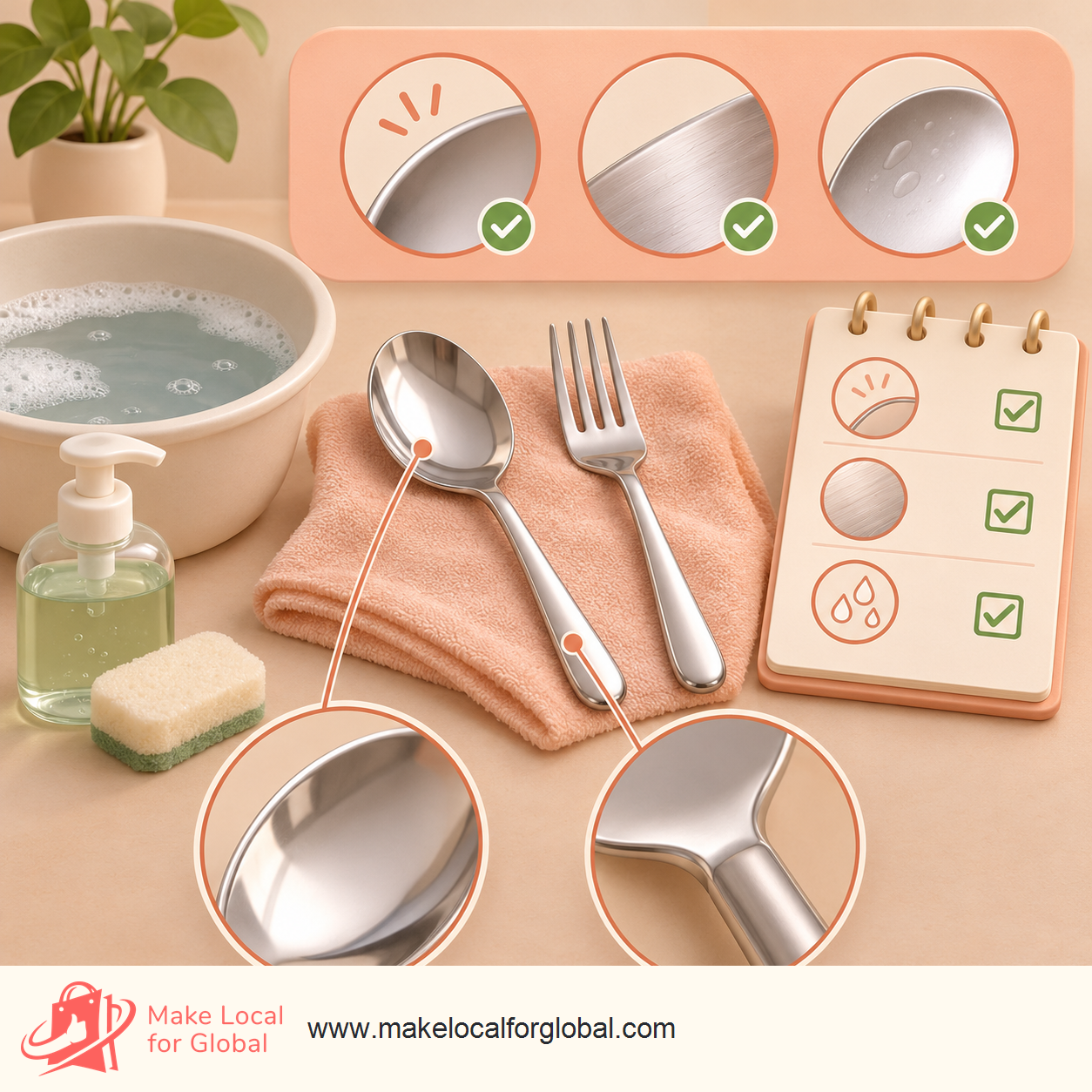
Follow the manufacturer’s care instructions for washing tests. If the claim says dishwasher-compatible, run the sample through the stated cycle and inspect it after drying. Photograph it before the test and again after repeated cycles if the supplier provides a suitable test protocol. Look for staining, corrosion spots, finish changes, loose handles, water traps or marks that transfer to a cloth. Do not invent a cycle count or promote your informal trial as laboratory testing.
Check more than one piece if you can. A single sample may not show batch variation. Ask the supplier for a pre-shipment sample from the production batch or a documented inspection result. Decide in writing what would make a batch unacceptable, such as a missing piece, bent fork tine, sharp burr, mismatched finish, loose joint or packaging that cannot keep the items separated. Keep a retained sample to compare with future deliveries.
Test the complete box, not just the loose utensils. Count every piece against the pack list. Check the presentation case, insert, sleeve, care card and outer carton. Shake the closed box gently to check whether the utensils shift. Open it and inspect for rubbing marks. If a product is intended as a gift, assess the unboxing without adding extra ribbons or packaging that will not be included in the delivered unit.
Write a sample record with a date, product reference, finish, supplier, piece count, actual weight, dimensions, test steps, photographs, result and follow-up questions. Keep the sample record beside the supplier quote and compliance files. This makes it easier to notice if a reorder differs from the first batch. A short note such as “fork handle feels heavier than sample” is useful only if you record which sample and batch you compared.
A supplier’s unit price is one line in the calculation. Include inbound transport, import and payment costs where relevant, inspection, storage, packaging, postage, marketplace or payment fees, customer acquisition, returns allowance and the seller’s own time. Keep VAT separate in your worksheet. The illustration below is hypothetical, assumes one set is sent to a UK buyer, and treats the prices and fees as amounts excluding recoverable VAT. Replace every figure with a current quote from your supplier, platform and carrier.
| Cost line | Illustrative amount | What to check |
|---|---|---|
| Flatware set bought from supplier | £11.20 | Supplier unit price for one 16-piece set |
| Inbound freight and import allocation | £1.80 | Spread the shipment total across sellable units |
| Protective packing materials | £1.10 | Sleeves, box, tape and void protection |
| Tracked parcel postage | £3.45 | Quote after weighing the packed set |
| Payment or marketplace fee | £2.10 | Use the actual fee base and transaction charge |
| Returns and damage allowance | £0.90 | Estimate from your own early order experience |
| Customer acquisition allocation | £2.00 | Track the cost of the channel that brought the order |
| Total variable cost | £22.55 | £11.20 + £1.80 + £1.10 + £3.45 + £2.10 + £0.90 + £2.00 |
| Example selling price | £34.99 | Before fixed overhead and income tax |
| Illustrative contribution | £12.44 | £34.99 minus £22.55 |
Illustration only. Figures are not current supplier quotes or a profit forecast. Check VAT, platform fees, carrier prices and tax treatment for the seller’s own circumstances.
The £12.44 contribution is not net profit. It has not paid for website hosting, accounting, insurance, photography, subscriptions, returns outside the allowance, damaged units, owner wages, corporation or income tax, or fixed storage costs. If a promotion reduces the price by £5, the contribution falls by £5 unless another cost changes. Add a line for each cost you incur, then test the result at full price, discounted price and a higher postage or fee scenario.
For a set priced at £34.99, compare the full order cost across two delivery options. A large gift box may push the parcel into another size band. A thinner box can lower postage, but could let the utensils rub or puncture the carton. Pack a real sample, weigh it, measure all three dimensions and ask the carrier for the right service. Use the packed measurement, not the supplier’s product-only dimensions.
Track the difference between conversion price and contribution. A price can look attractive next to competitor listings and still leave too little after delivery and fees. Record gross sales, refunds, shipping charged, shipping paid, discounts, payment fees and acquisition spending for each channel. Compare like with like: set count, stated material, finish, packaging and postage terms should be similar before a price comparison informs a decision.
Make a reorder rule before launch. For example, review the sell-through, available stock and delivery lead time each week. Set a cash ceiling and a minimum stock quantity based on actual orders. Do not multiply one unusually busy weekend into a full-year forecast. If sales are slow, check page visits, product questions, delivery cost and offer clarity before assuming that a lower price will solve the problem.
Compare your set contents, landed cost, postage and selling fees before you commit to a larger order.
Write for the person comparing set contents, material and care. A title could be “16-piece stainless-steel cutlery set for four, satin finish”. Use the phrase “flatware set” where it fits the market and include “cutlery” in the body or a relevant heading for UK shoppers. Avoid repeating the phrase in every line. A product name that describes the exact offer is more useful than a slogan with no count or material.
The opening description should state the number of place settings, total pieces, names of each utensil, material specification from the supplier, finish, dimensions or weights that matter, included storage, care guidance and dispatch estimate. If a detail has not been verified, do not make a confident claim. Add a short “What is in the box?” list and state what is not included if buyers could reasonably assume it is.
Use a clear contents table for multi-size offers. Include number of people, number of each piece per person, total pieces, serving utensils and storage case. Label the selector “Set for four” or “Set for six” and pair it with its total count. Do not make a buyer infer the configuration from a photograph or a dropdown option called “large”. If one option has a different material or finish, name that distinction before selection.
Photograph the full set from above on a neutral surface, with each item spaced apart. Use a second photo showing the pieces beside a familiar place setting, a close-up of the handle join and a view of the case. Show the actual colour and finish under balanced light. Include a scale reference or dimensions when length and handle thickness shape the decision. For gift orders, show the packaging the buyer receives, not a styled box made only for the photo.
Alt text should explain what an image shows, not repeat a list of search terms. “Sixteen-piece cutlery set arranged as four place settings” helps someone who cannot see the image. If a photograph is purely decorative and adds no information, it may need empty alt text according to the site’s accessibility setup. Captions should add context, such as “Each place setting includes one fork, knife, tablespoon and teaspoon”, rather than duplicate the product title.
Answer care questions in plain language. If the supplier says hand wash only, show that note beside the product facts and packaging insert. If a finish needs a soft cloth or must not be soaked, say so clearly. Do not instruct buyers to mix chemicals or polish the item in an untested way. If stains or marks appear, provide a customer service route and use the manufacturer’s verified care guidance.
Use one image style across the range so a shopper can compare shape and scale. Keep each set in the same orientation, with neutral light and a consistent camera distance. A separate lifestyle shot can show a table setting, but it should not replace the complete contents photograph. A dramatic reflection may look attractive yet conceal the polish or colour. Take one image under diffuse light and a close-up under ordinary indoor lighting.
Show a scale reference with measurements in centimetres. List the exact length of a dinner knife and spoon if a customer needs to compare them to a drawer divider or existing set. A ruler image is not a substitute for written dimensions. If the product has an unusually heavy handle, state the piece weight where it matters to the target buyer, then explain how you measured it.
Keep “gift-ready” factual. State whether the set arrives in a presentation box and whether a gift note is available. If a gift wrap costs extra, show that charge before checkout. Do not imply that a sleeve, ribbon or message card is included if it is only used for photography. Gift presentation should be tested after shipping, as a scuffed box can undermine a product intended for a special occasion.
Before publishing, ask another person to find the answer to five questions without assistance: How many people does this serve? How many pieces are included? What material and finish is it? How should it be cleaned? What will arrive in the parcel? Record any hesitation, then revise the page. This simple check can reveal where the product copy assumes knowledge the buyer does not have.
Use search phrases as clues to a buyer’s task, then write a page that answers it. A customer searching “cutlery set for six” needs a clear service count. “Stainless steel flatware set” calls for accurate material detail. “Dishwasher safe cutlery” needs a verified care statement, not an unsupported badge. “Cutlery set gift box” asks what packaging arrives. Use the phrase naturally in a page title, product description or heading when it belongs there.
Search the actual terms in your preferred keyword tool, marketplace search bar and site-search logs. Note suggestions and the questions customers ask before purchase. Do not treat search volume estimates as guaranteed demand. Compare a few related phrases and choose the one that describes your offer most precisely. A small shop can start with one well-structured product page, a useful collection page and an article answering a related question.
Marketplace listings can help you test demand where buyers already compare household goods. Read current category rules, fee schedules, photo requirements, dispatch metrics, return handling and product-safety obligations. These can change, so check the platform’s current seller documentation before pricing. If the marketplace controls the buyer relationship, retain your own records of orders, customer issues and batch details in a lawful way.
A standalone shop offers more control over the brand, product information and customer journey. It requires a reliable payment flow, useful delivery information, customer service, security, analytics and a way to bring shoppers to the site. Make the first collection concise. Link from the collection to product pages and from product pages to care information, shipping and returns. Test mobile checkout with a small real order before sending paid traffic.
Use a small acquisition test with a stated budget and a defined observation period. For example, compare one search-focused landing page with a short social video demonstrating the set contents. Track impressions, page visits, add-to-basket events, checkouts, sales, refunds and acquisition spending. The aim is to learn which message brings a qualified buyer, not to claim that a certain post will produce sales. Stop or adjust when the spend reaches the limit you set in advance.
Useful content can answer questions before a customer needs help. Possible topics include how to count pieces in a cutlery set, what to check in a finish description, how to organise a flatware drawer and how to care for a plated surface. Do not present a general article as technical proof. Link to product documents for verified material and care details. Keep product-page copy distinct from articles that cover broader advice.
Businesses that make, import, distribute or sell consumer products in the UK have responsibilities for product safety and labelling. The Office for Product Safety and Standards says sellers must not sell products they know, or should know, are unsafe, and that businesses need records identifying their suppliers. Requirements vary by product and location. Great Britain and Northern Ireland do not always follow identical rules. Check the current [GOV.UK product safety advice for businesses](https://www.gov.uk/guidance/product-safety-advice-for-businesses) and use a qualified adviser for product-specific questions.
If you import, make or sell under your own brand, establish what role you have in the supply chain. Keep a file with supplier identity, invoices, item references, batch or lot information, specifications, product risk notes, appropriate test evidence, labels, customer instructions and incident records. If a product may be unsafe, pause sales and get advice on the right corrective action. Do not wait for a complaint to decide how a batch can be traced.
For food-contact materials, ask what documentation supports the intended contact with food and how the materials are traceable. The FSA describes food-contact materials as including utensils and kitchen equipment, and notes that chemicals can migrate into food from materials. The relevant requirements can depend on where a product is sold and the material or coating involved. Obtain advice for the actual product and intended market. Do not claim that a test or declaration covers a changed finish or supplier without checking its scope.
Give the buyer key information before they order: seller name and contact details, clear description, total price including applicable taxes, payment methods, delivery cost and timing, and information about cancellation and returns. GOV.UK’s [distance selling guidance](https://www.gov.uk/online-and-distance-selling-for-businesses/distance-selling) outlines information that online sellers need to provide. Keep a copy of the terms and order confirmation the customer can save.
Many online orders for goods carry a 14-day cancellation period after delivery, with another 14 days for returning the item after cancellation. Specific exceptions exist, and faulty or misdescribed goods have separate rights. State the correct process in your policy and check the current [GOV.UK guidance on returns and refunds](https://www.gov.uk/accepting-returns-and-giving-refunds). Do not assume that opening a box removes all rights; buyers may inspect an item as they could in a shop, subject to the applicable rules.
Claims about recycled content, ethical sourcing, antimicrobial surfaces, sustainability, durability, country of origin or material grade need evidence. Keep the documents that support the exact wording on the page. If a seller cannot support a claim, remove or qualify it. A buyer should be able to tell the difference between the verified product specification and the seller’s opinion about the design.
Flatware is durable, but a heavy bundle can dent a light carton, scratch itself through rubbing or puncture packaging if a knife shifts. Test the parcel from the buyer’s point of view. Place each piece in a sleeve or separate compartment, keep knives oriented safely, and use an insert that holds the contents in place. Choose materials suitable for the product and any environmental claims you intend to make.
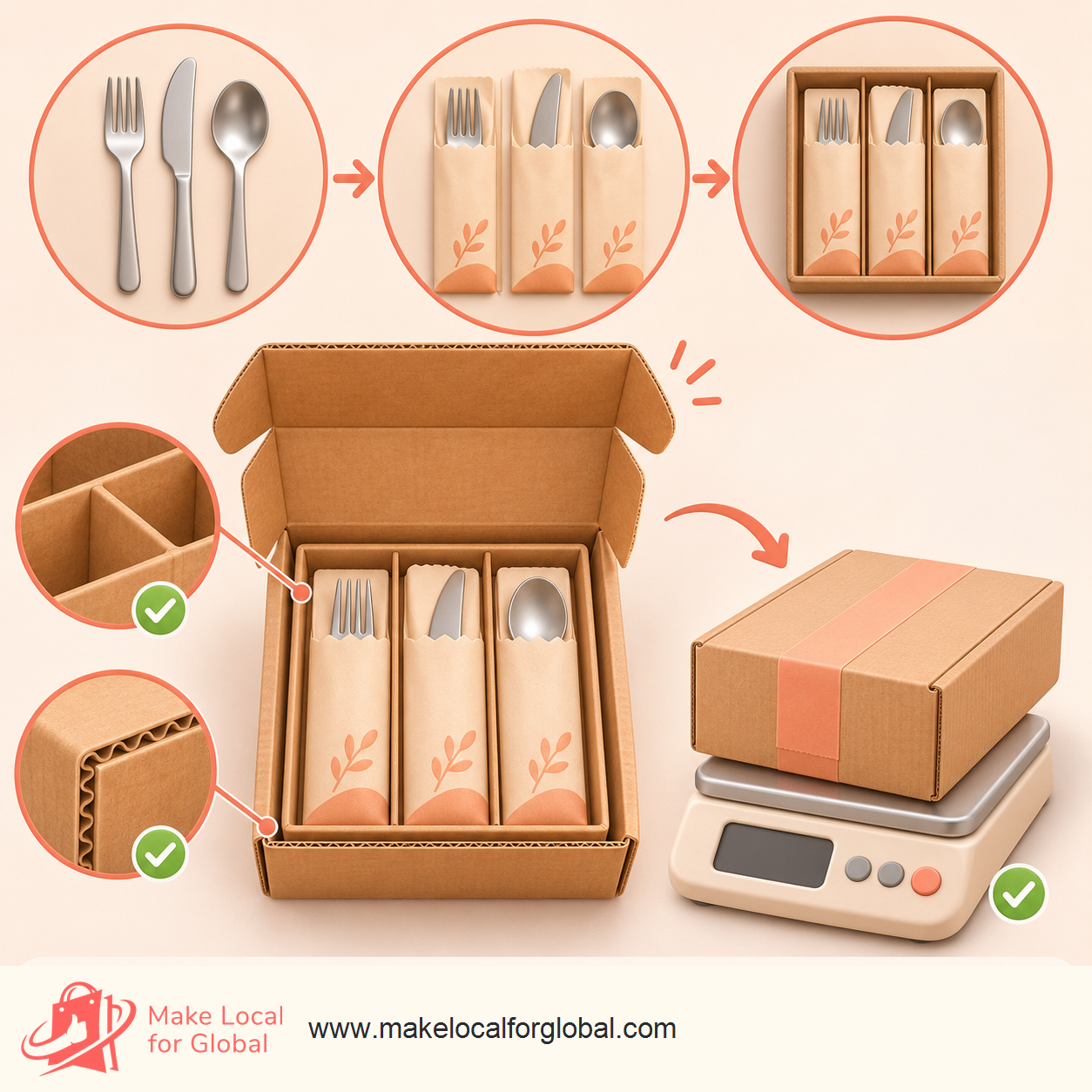
Pack one sample exactly as it would be dispatched. Close the box and turn it gently in several directions. If the contents slide, revise the insert or filler. Check whether corners crush, tape lifts, sleeves tear, the case scuffs or a knife edge approaches the carton wall. Take photographs of the open and sealed parcel. Ask a carrier or packaging specialist for advice when an item shifts, punctures or arrives damaged in tests.
Royal Mail’s guidance for fragile items recommends a strong outer box, cushioning, and dividers so items do not touch each other or the container. Flatware is not ceramic, but the same separation principle helps reduce surface abrasion and movement. Read the carrier’s current [packaging guidance](https://www.royalmail.com/help/sending/packaging-and-sending-fragile-items), then test the exact parcel and service you will use. A “fragile” label cannot substitute for suitable packaging.
Weigh and measure the completed order, including the outer carton, tape, insert and any gift packaging. Record the dimensions for each SKU. Make a postage profile that matches the actual parcel and check carrier surcharges or size bands. If the shipping price at checkout is based on an unboxed sample, the business may pay the difference on every order. Re-check the rate when packaging changes.
Write a packing checklist for fulfilment: scan the correct SKU, compare finish and set size with the order, count pieces against the pack list, inspect the case, add the care information, place the set in the tested insert, close the box, weigh and label it, then record dispatch. For a single-person operation, a checklist reduces errors when several finishes or set counts sit near one another.
Choose how you will handle returns and damaged parcels before launch. Record the order number, batch, customer report, photos where appropriate, packaging condition and resolution. A trend in scratched forks may point to the insert rather than a carrier. A trend in missing teaspoons may indicate a packing check. Keep customer information secure and follow applicable data protection requirements when retaining records.
Use a distinct stock code for each set count, material, finish and packaging version. A four-person satin set and a six-person polished set are separate products even if the silhouette is similar. Record supplier item code, batch, arrival date, units received, inspection result, cost per sellable unit and current stock. Add separate codes for gift packaging or replacements if they are sold as standalone items.
On delivery, count the cartons and inspect a sample from each carton or batch using the plan you agreed with the supplier. Record damaged or missing pieces and contact the supplier within the stated claim period. Keep photos and shipment documents. Do not mix new stock with an earlier batch until you have checked material, finish and contents against the retained sample.
Set a reorder trigger using actual sales pace and lead time. A basic estimate is average units sold per day multiplied by the number of replenishment days, plus a buffer you choose for uncertainty. For a young shop, the average may be unstable; review it frequently and keep the cash limit visible. A forecast helps you plan, but does not remove the risk of slow stock or supplier delay.
Track sell-through by variant rather than only total sales. Six-person sets may outsell the starter configuration, yet bring lower contribution if the parcel becomes more expensive. A premium finish may attract more visits and fewer purchases. Use page behaviour, questions, sales and returns together. If the product has low visits, investigate discovery. If it has many visits but few baskets, review price, photos, delivery and product clarity.
Keep a small amount of stock for replacements only if demand and supplier availability support it. A missing piece can be a service issue, but old stock may not match a newly produced batch. Label retained replacement items with batch and pattern. Tell the customer what is known about compatibility. Do not send a visually similar piece as an exact match unless you have checked the dimensions, shape and finish.
The first month should produce evidence, not a promise of sales. Set a limit for samples, content and advertising. Keep a log of what you did, what happened and what you will change. If a supplier response or sample is delayed, change the next task to something that does not depend on it.
Use a weekly review sheet with five columns: observation, evidence, cost or effect, decision, next check date. “People liked the photos” is a weak observation. “Four of ten target buyers asked whether teaspoons were included, and the current hero image does not show them” suggests a specific edit you can verify.
At the end of the month, separate what you know from what remains uncertain. You may know that a 16-piece sample arrived with marks, that the packed set weighs 1.4 kg, or that the shipping quote moves to another band. You may not know repeat-purchase rate or seasonal demand from a handful of orders. Label each conclusion accordingly and let the next stock decision reflect the evidence you have.

Do not scale the range solely on the strength of encouraging first orders. Check the margin after actual postage and fees, the rate of customer questions, the condition of delivered parcels, and whether your supplier can repeat the approved specification. Keep cash for refunds, replacement shipments and the next order. Growth is a decision to make from the records, not from a single busy day.
Using a vague piece count. A set count can mean a number of items or people served. State both, show the per-person list and confirm the pack list with the supplier.
Repeating a supplier’s claims without evidence. “Premium steel”, “dishwasher safe” and “rust proof” need support. Ask what evidence applies to the exact item and finish. Remove claims the supplier cannot substantiate.
Ordering too many variants. Each finish, size and box can add inventory, photography and minimum order costs. Start with a narrow offer. Add the option after buyer evidence shows what is missing.
Testing only one utensil. Forks, knives and spoons have different shapes, joins and handling. Inspect each type, the whole set and every packaging component.
Pricing from the supplier’s unit cost. Freight, packing, payment fees, postage, acquisition and returns change the order economics. Use a packed parcel and real rates.
Using a lifestyle photo as the only contents photo. Buyers need to count the pieces and compare their finish. Show the complete set, case and close-ups separately.
Ignoring fulfilment damage. A heavy kit can rub and shift in a carton. Test the insert, weigh and measure the finished parcel, and review damage reports by batch.
Treating a 30-day test as proof of long-term demand. Early orders are a small sample. Use the observations to improve the offer, then continue to monitor returns, repeat orders and actual contribution.
There is no single required configuration for every shop. A common place setting has a dinner fork, table knife, tablespoon and teaspoon, but supplier packs differ. State the number of people served, the pieces per person, the total item count and any serving utensils. Ask the supplier for a written pack list and verify the sample before listing it.
The terms often refer to table utensils such as forks, knives and spoons. “Flatware” appears in many product catalogues and North American retail searches; “cutlery” is common in UK shopping language. Use the term that fits your product and audience, then explain the set contents. Do not use either word to hide an unclear piece count.
Choose from verified supplier specifications and the intended buyer, not a grade number alone. Ask what the numbers refer to in the supplier’s document, what tests support the intended use and care claims, and whether the finished item has the same specification. A grade label by itself does not prove that a product will never stain or rust.
Use that claim only when the manufacturer’s care instructions and relevant evidence support it for the exact item and finish. Plating, coatings, handles and decoration can change care needs. If the verified advice says hand wash, state that plainly on the listing, in the product information and on any insert.
It depends on sample costs, minimum orders, material, finish, inbound freight, import costs, packaging, storage, shop setup and promotion. Get written quotes and calculate the cash tied up in unsold stock. The example in this guide is hypothetical, not a quote or a profit projection. Start with a spend limit that includes refunds and replacement parcels.
Consider singles when customers ask for them and the supplier can confirm the pattern and finish will remain available. Factor in separate stock codes, picking time, packaging and postage. Describe the item with measurements and a clear compatibility statement. A replacement should not be called an exact match without checking it against the named set.
Keep the pieces separated to limit scratches, contain any sharp edges and stop the contents moving. Choose an insert and outer carton sized to the packed set, then test a completed parcel. Weigh and measure it after packing for the correct postage. Follow the carrier’s current packaging advice and record damage patterns so you can improve the pack.
Request the item specification, materials and finish, care instructions, traceability details, applicable food-contact information, relevant test records and supplier identity. Ask that the documents match your product reference, batch or production version. Keep the records with purchase and shipment documents, and get expert advice if the evidence is incomplete.
Many online goods purchases carry a short cancellation window after delivery, with a further period to return after cancellation. Rules include exceptions, and faulty or misdescribed products have separate protections. Explain the applicable policy before purchase and follow current UK guidance. Do not assume a buyer loses rights merely by opening the parcel to inspect the goods.
Start with the smallest range that answers your chosen buyer’s need. One tested set size and finish can be easier to photograph, cost and replenish than ten unproven variations. You might add a larger set or gift box when customer questions, sales and supplier terms support that decision.
A useful flatware shop starts with a clear buyer and an exact inventory. Check the finish, written specification, food-contact information, cleaning guidance, sample and packed parcel before you publish strong claims. Price each order with freight, packaging, postage, fees and a sensible return allowance. Let customer questions and recorded orders guide the next range decision.
If you are setting up the shop, bring your range list, sample record and cost sheet to Make Local for Global. A practical discussion can help you map what your product pages and checkout need to communicate to a buyer.
Plan the product information, shop structure and buyer journey around the set you have tested.
PREFERRED SOURCE
Like what you’re reading? Add Make Local for Global as a preferred source on Google to see more of our articles when you search.

Build your online presence without having to figure out everything yourself.