READY TO SELL Fishing Nets ONLINE?
Get a store built for you in 5 days, plus training and support to help you start, run, and grow your Alternative business.

Choose a fishing-net niche, verify supplier samples, price the full parcel, and write product pages with accurate size, mesh and use details.

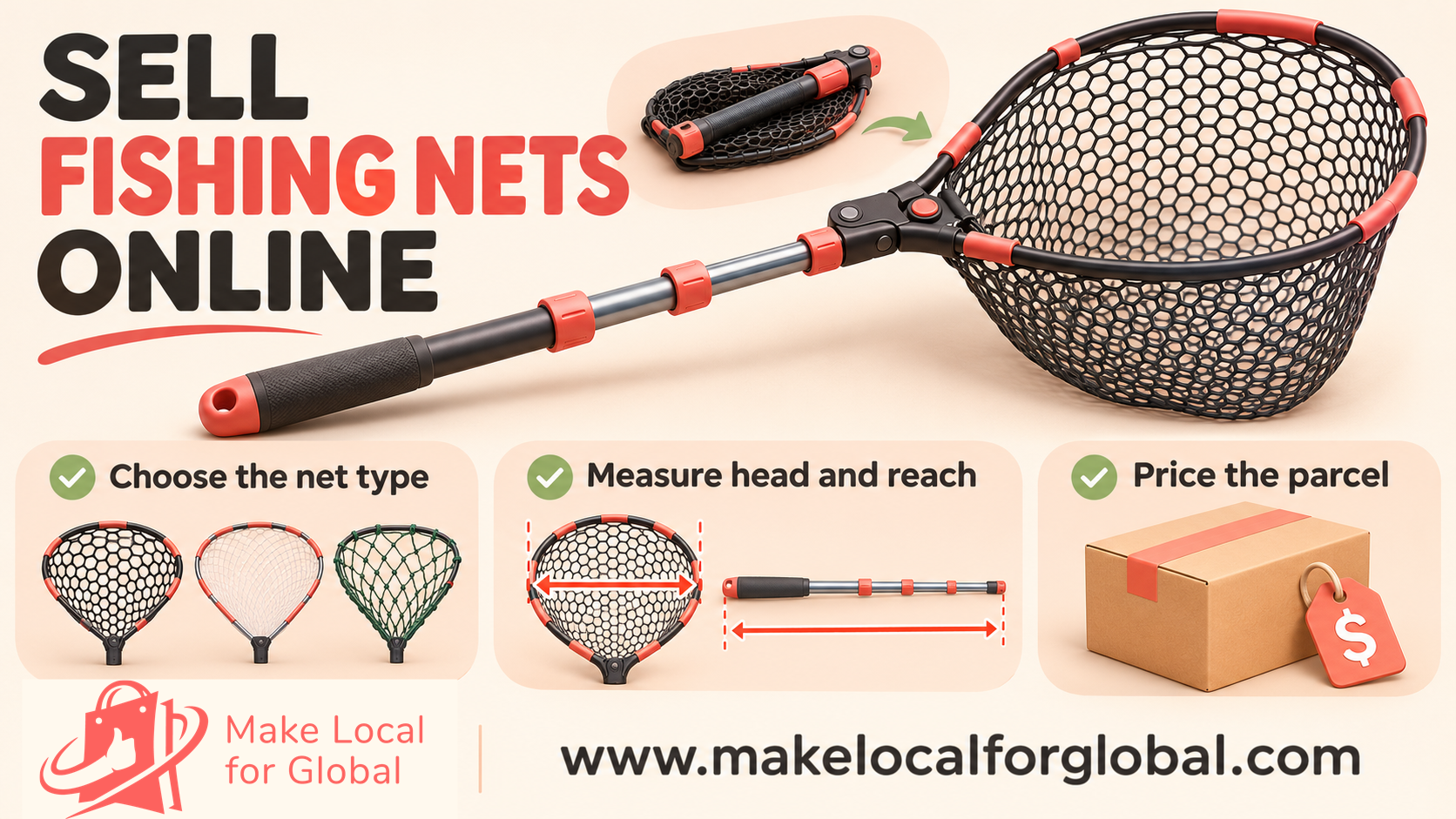
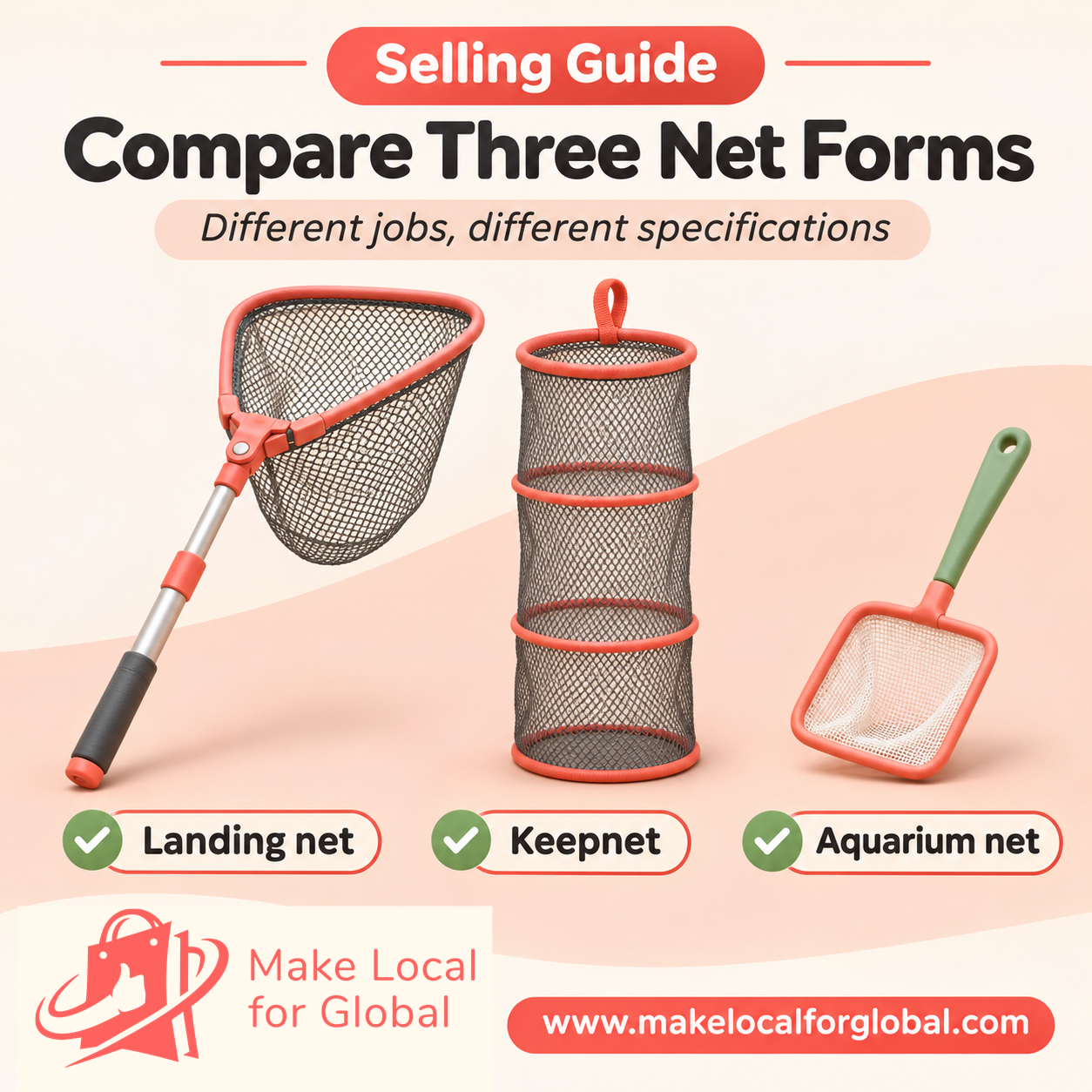
Fishing nets look simple in a product photo. A buyer still needs to know whether the net suits the fishery, the fish, the fishing method and the way it will be carried. A landing net for an angler is a very different product from a keepnet, bait net or commercial capture net. Confusing those jobs can lead to complaints, returns and misleading claims.
To sell fishing nets online, choose one buyer group first, list the exact net type and dimensions, verify its materials and construction, test the sample, and explain the intended use and local rules clearly. Start with a focused range of landing nets or keepnets for a defined style of angling. Add specialist products only when you can describe their mesh, frame, handle, care and legal limits accurately.
Use the free Ecommerce Pathfinder to compare a product idea with possible routes for an online store. It gives a starting point for research, not a sales forecast.
“Fishing net” describes several products that do not share the same buyer or product page. A person who needs a landing net to bring a hooked fish to hand has a different task from a match angler who keeps fish in a keepnet during an event. An aquarist may need a small fine-mesh dip net. A commercial operator may need a regulated net designed for a specific fishery. Do not place all of these under one vague listing and expect a dropdown to explain the difference.
Choose the starting customer by the questions they ask before purchase. The more clearly you answer those questions, the easier it becomes to select a range, take useful photographs and estimate delivery costs.
Common buyer groups include:
The first set in a shop should not try to cover every buyer. Choose a recognisable job, such as landing nets for bank-based coarse anglers, and ask a small group of target users what they need to know before ordering. If their questions keep returning to reach, transport length or hook snagging, make those attributes visible in the range comparison.
Demand research should test whether people want your exact offer, not whether fishing is popular in general. Search relevant phrases such as “knotless landing net”, “rubber mesh predator net”, “telescopic landing net handle”, “carp keepnet” and “compact fly fishing net”. These phrases signal distinct products. Do not combine them into one page just to include more keywords.
Review current marketplace listings and specialist retailer pages to record the product type, stated measurements, materials, what comes in the box, postage, delivery times and repeated customer questions. Treat a listing as a competitor's offer, not proof of its product claims or sales volume. Save dated screenshots or notes so you can revisit the comparison after suppliers change specifications.
Ask anglers which two or three problems they have with their current net. They might say the handle is awkward in a narrow swim, the mesh catches hooks, the head is too small for their target fish, or the net will not fit in their luggage. Ask about the last purchase and what they compared. This is more useful than asking whether they like your business idea.
Before ordering a carton, you can use a product page marked “coming soon” only if you state that the item is not yet available and you do not take payment for something you cannot supply. A short survey, a small paid test that follows platform rules, or a sample shown to a local club can reveal which features deserve a first order. Record actual enquiries, sign-ups, quote requests and pre-orders separately. A social “like” is weak evidence of purchase intent.
A buyer should be able to tell what the net does from its product title. The product format determines the measurements, care notes, use restrictions and delivery method. Create a separate listing for a different job or materially different construction rather than burying that change in a variation menu.
A landing net is an aid used to bring a fish to hand during rod-and-line angling. The head may be triangular, teardrop, oval or circular. A folding head saves space, and a telescopic handle can change reach, but every moving joint adds a point that needs inspection. A compact one-piece handle may suit a short river or small-water setting better than a long telescopic pole.
Measure the opening across the widest points, the net depth, the handle length when closed and extended, and the packed length. State whether the head folds and whether the handle detaches. A product photo should show its actual scale, not make a modest net look large through a close-up crop.
Mesh choices vary. Knotted nylon can be durable and inexpensive, but knots and rough edges may be less suitable for a buyer who wants a smooth contact surface. Knotless mesh avoids knots; rubber-coated or rubberised mesh can reduce hook snagging on some designs and may rinse clean more easily. These are construction details, not a promise that a particular mesh is suitable for every species or venue. Shimano's Yasei Rubber Net specification, for example, describes a rubber-coated PVC mesh and gives head dimensions and handle extension for its specific model. Use that as an example of the type of product detail buyers can compare, not as evidence about a different product.
A keepnet holds fish in water for a period permitted by the fishery or event. A keepsack serves a different, more limited purpose. These are not decorative storage bags. Buyers need accurate mesh, length, ring or frame spacing, material and care details.
In England and Wales, the national freshwater rod-fishing tackle rules list requirements for keepnets, including non-knotted and non-metallic mesh, holes smaller than 25 mm, a length above 2 metres, and limits for ring or frame spacing and circumference. Those details apply to the described angling context; local byelaws and fishery rules may add conditions. A buyer should check the current rules for the water and event before using a keepnet. State a measurement on a product only after the sample and specification confirm it.
Tell customers whether the net has a support pole, bank stick, attachment, carry bag or drying loop. A product photograph should show the full length with a measuring reference, the opening, the base and the connection points. Explain how to dry and store it between sessions. Never suggest that a keepnet can remain wet in a sealed bag or that it can be used at every venue.
Bait nets, aquarium dip nets and fine-mesh specimen nets serve different uses. The mesh aperture, head shape and handle length should reflect the intended task. Avoid vague descriptions such as “universal net”; name the intended uses and the uses that do not fit.
Commercial, shore-based and fixed capture nets need a separate compliance review. Mesh size, net length, location, species, season, vessel status, permits and byelaws can all affect whether a method is permitted. A product intended for commercial fishing should name the precise model and specification, then direct the buyer to the relevant authority or fishery manager for current rules. Do not imply that buying the net grants permission to use it.
Netting may use nylon, polyester, polyethylene, PVC-coated mesh or other yarns. Frames and handles may use aluminium, steel, fibreglass, carbon composite or plastic parts. Each choice involves a trade-off in weight, stiffness, corrosion care, cost and packed dimensions. Do not claim one material is stronger, safer for fish or more durable without a manufacturer's specification or a test you can describe.
Ask the supplier to identify each material by component: mesh, frame, joint, handle, grip, fastener, coating and carry bag. Ask whether the mesh is knotted, knotless, rubber coated or otherwise treated. Confirm whether “rubber” refers to a coating, a full elastomer mesh or a marketing description. Ask how the product should be rinsed, dried and stored, and whether cleaning products could damage the coating.
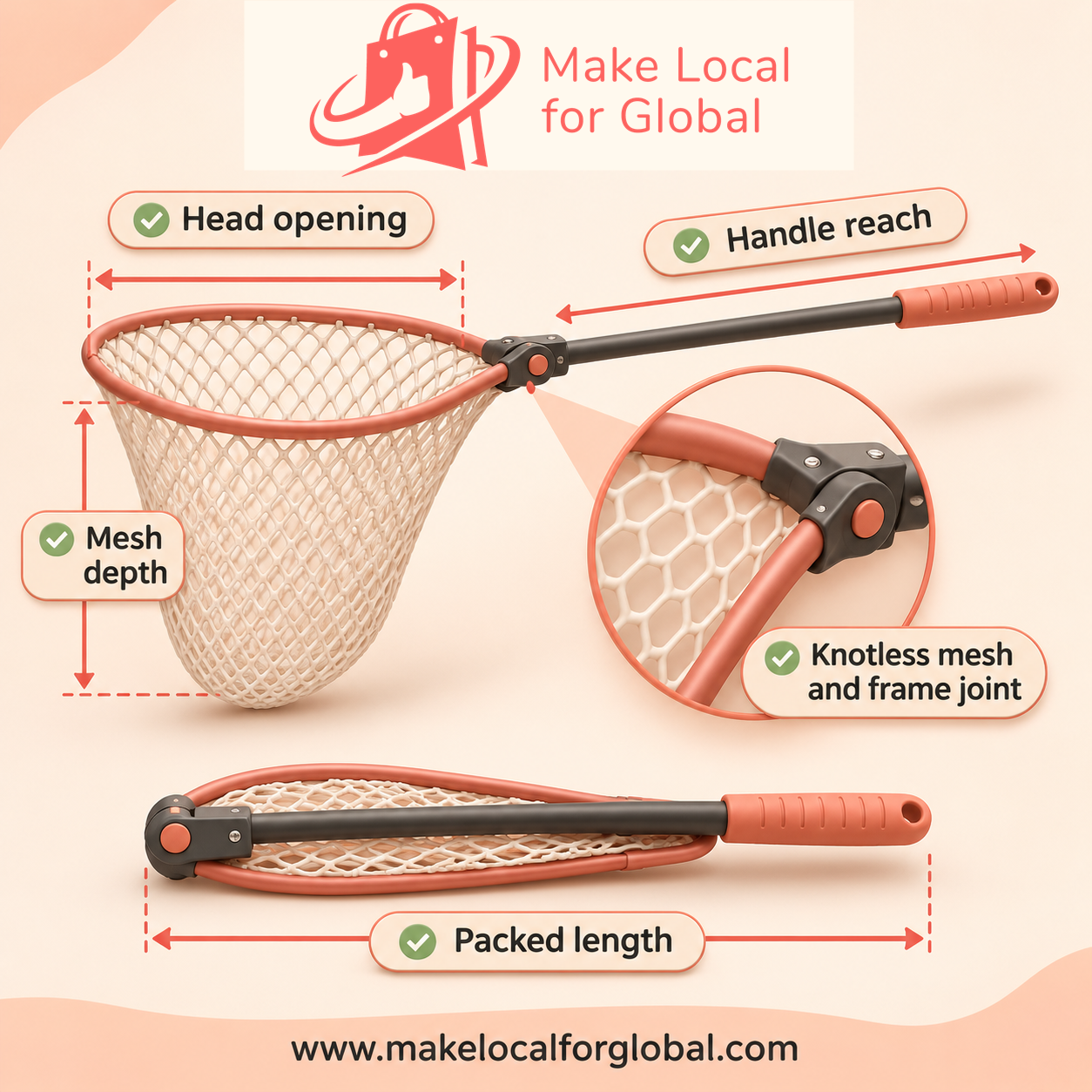
Record the sample's exact colour and finish. A dark mesh can make it harder for a buyer to see the weave in a photo. Use a neutral background, close-up detail and a scale reference. If the manufacturer changes its coating, mesh yarn or handle lock, request a new sample or written confirmation that the change does not affect the stated specification.
An opening range should make comparison easier. A small set of clear choices is more useful than ten listings where the buyer cannot see what changes between them. Begin with one primary net type and a few variants that solve real differences in size, reach, mesh or transport.
A simple landing-net range might include:
| Range role | Example offer | Buyer question to answer |
|---|---|---|
| Entry | Compact fixed-head landing net | Does the packed size and handle reach suit a short walk or small water? |
| Main | Folding head with replaceable handle | What are the head opening, depth, handle length and joint type? |
| Specialist | Larger head with long telescopic handle | What is the full extension, packed length, net depth and intended setting? |
These are range roles, not promises of demand. Choose actual products only after checking samples, supplier terms and buyer feedback. If the main offer cannot be distinguished through a concrete measurement or feature, it may not need its own SKU.
Keepnets need another comparison table: total length, opening dimensions, mesh type, mesh opening, ring spacing, frame circumference, material, carry sleeve and drying instructions. A customer should not need to infer whether a model is allowed at a venue from a photograph.
A landing net and compatible handle can be sold together when the connection fits and both items are included. A carry sleeve, replacement mesh or drying bag may make sense for travel or care. A bundle should not contain a spare part that fits only one of several handle designs without a clear compatibility note.
Check that each bundle component has a separate SKU or clear stock deduction. Photograph the full bundle laid out, then show the parts in use. State any item shown in the scene that is not included. If a handle length is selectable, give the packed and extended measurement for each option and identify whether its listed weight includes the head.
Bundles can simplify buying but can complicate returns. State whether a customer may return one unused component or must return the complete kit, subject to their legal rights. Keep the condition and process consistent with the terms shown before payment.
Use a variation selector when the products share the same basic use and differ by a clearly described measurement, colour or compatible accessory. Give each option its own stock count, product code, price, weight and image where those change. For a distinct net type, create a separate product page. A keepnet and landing net should not be two dropdown choices on one generic “fishing net” page.
Use comparison labels buyers understand: “head opening”, “net depth”, “handle length, closed”, “handle length, extended”, “packed length”, “mesh construction” and “included items”. Avoid “small, medium, large” as the only size detail. Those labels may remain as shorthand, but show measurements beside them.
Potential suppliers include UK wholesalers, fishing tackle distributors, specialist net makers and overseas manufacturers. A local distributor may provide lower minimum orders, easier communication and a domestic returns route. A direct factory can offer more control over colour or materials but may require a larger order and place more responsibility on the importer. Compare the full cost and service, not only the unit quote.
Request a written specification for every model. Ask for:
Ask the supplier to show which document confirms each claim. “Fish friendly”, “heavy duty” and “all-weather” are vague without a defined material, use condition or test. If you cannot explain what a claim means, do not put it on the page.
| Route | Benefits | Points to check |
|---|---|---|
| UK wholesaler | Lower first order may be possible, with domestic delivery and a clearer support route | Confirm current stock, model changes, certificate or test documentation and whether images match the delivered version |
| Brand distributor | Known product codes and manufacturer materials can simplify listing | Check territory, resale terms, warranty route and image permissions |
| Direct manufacturer | More choice of colours, dimensions or private-label options | Confirm minimum order, sample process, production checks, import duties, traceability and who is legally responsible in each destination |
| Small specialist maker | Distinct construction or repairable parts may set a range apart | Confirm repeatability, lead times, material continuity, capacity and spare-part supply |
Ask for a sample before you commit to a production run. Keep the purchase order, invoice, messages, specification, packaging photos and sample notes together. Assign a version to each product file. A second order should be checked against the first sample rather than assumed identical.
Get the following in writing: sample price, minimum order, payment schedule, lead time, quality tolerance, colour variation, defect replacement, freight, Incoterms where relevant, import paperwork, warranty support, order cancellation and the process for a product change. Clarify whether the quoted price includes labels, carry sleeves, replacement parts and any printing.
For private label, agree the artwork, product name, warnings, batch coding and approval sample before mass production. Ask the supplier to print a claim such as “legal in the UK” or “safe for all fish” only after the exact statement has been checked for the product and market.
If the first shipment contains a different mesh, shorter handle or altered locking joint, quarantine it. Compare it with the approved version. Do not quietly update the listing after a buyer has ordered. Update the page and photographs before taking orders for the changed product.

The sample check is a practical comparison against the product file. It is not an accredited strength test, a fish-welfare trial or proof that a capture net is lawful. Describe what you checked and avoid turning an informal handling check into a performance guarantee.
Open the net fully and inspect the mesh under good light. Look for missed loops, uneven knots, thin spots, sharp wire ends, coating bubbles, peeling, cracked sections, loose ties and seams that pull away from the frame. Compare the mesh against the written description and take clear close-ups for the record.
Run a clean soft object over the inside of the net to find rough joins or sharp edges. Do not use a live fish to find snags. For a rubber-coated design, inspect the coating near the frame seam and at folded areas. Gently flex the frame as a user would during setup, then look for coating splits or mesh separation. Record any test method and its limits.
Measure the opening and depth using a tape measure. For mesh aperture, follow the supplier's stated measurement method. Knots and mesh stretch can change a reading, so do not use an unlabelled ruler measurement as a regulatory declaration. If a buyer depends on a specific mesh dimension to use the product lawfully, ask the manufacturer how it defines the measurement and check the applicable current rule.
Fold and unfold the head using the supplied instructions. Check that the frame locks, releases and stays aligned during normal handling. Look for pinched fingers, a loose latch, sharp edges or a joint that needs force beyond what the instructions describe.
Connect the handle and head. Check thread size, ferrule fit, locking collar or clip, then remove and reconnect it several times. Extend a telescopic handle in the order shown by the maker. Confirm that sections lock without slipping in a controlled dry inspection. Do not load it over water or put a person beneath a suspended net.
Weigh the sample and compare it with the listing specification. Measure the packed length with the head folded and the handle retracted. Measure the working length and identify which measurement the supplier calls “reach”. Take photographs with a tape measure in frame. If product claims say “one-handed”, “fast-folding” or “fits a rucksack”, check that the actual sample supports the claim and explain what bag or pack size you used if you mention a fit.
Record the carton dimensions, packed weight, inner protection and any damage after ordinary parcel handling. A simple check such as moving the sealed sample through your normal packing station can reveal a carton that is too long, awkward or prone to puncture. It does not prove the parcel can survive every carrier route. Use a carrier-approved test method if you need formal packaging assurance.
After unpacking, clean and dry the sample according to the manufacturer's instructions. Check whether the net holds water, traps odour or remains wet at the seams. Photograph the result only as a care demonstration, not as a claim that every material dries at the same speed.
Create a pass/fail note for each point: product identity, dimensions, mesh, seams, locking parts, compatibility, package condition and instructions. Ask the supplier to resolve any mismatch before listing. Keep the sample until the first customer orders arrive so you can compare the shipped batch with the approved product.
Anglers need useful information about handling fish, but an online retailer should not invent welfare outcomes. Use manufacturer evidence for product construction and recognised angling guidance for general fish-handling advice. A smooth mesh may reduce snagging in some situations; it does not guarantee no damage or stress.
The Angling Trust's hot-weather advice says anglers should land fish without delay, handle them carefully, keep fish in water where possible and follow the fishery's advice. It cautions against keepnet use in hot conditions, and says anglers who use one should place it in deeper water and at right angles to water flow. That is practical guidance for users, not a certification for any net. The page can link to the advice and ask the buyer to follow the venue's rules.
Avoid claims such as “zero harm”, “safe for every species”, “prevents disease” or “guaranteed fish welfare”. Instead, name measurable construction: knotless mesh, stated mesh material, head size, net depth, handle reach and care instructions. If the maker says a coating reduces hook snagging, attribute the claim and retain the supporting document.
Explain that users should check the fishery's rules, use clean and dry equipment where required, avoid leaving a net in direct sun, and follow local guidance for handling and returning fish. State any warning the supplier provides about small parts, sharp components, entanglement, children or use near water. A net is not a toy or flotation device.
For products described as capture nets, keep the use page separate from ordinary landing-net listings. Do not include instructions that would help a reader use a net illegally or harm protected wildlife. A buyer must check the local authority, permit conditions, species, season, site and mesh requirements before use.
The product page should let a buyer determine what the net does and whether it suits their intended setting. A clear title and specification table can prevent more returns than a long paragraph of adjectives.
Product title: Folding landing net, 50 cm head, 60 cm mesh depth, 1.8 m telescopic handle
Short description: A folding-head landing net for anglers who need an extended reach and a compact packed length. Check the head opening, mesh depth and handle measurement before ordering. Follow the instructions for locking the handle and the rules of the water you fish.
This is a template, not a claim about a real model. Replace every measurement and use statement with the exact supplier specification and your sample check. Do not label it as suitable for a species when a head size only looks large enough in a photograph.
| Specification | What to display |
|---|---|
| Net type | Landing net, keepnet, keepsack, aquarium net or other defined type |
| Head opening | Widest dimensions, with the measurement points shown in a diagram |
| Net depth | Usable mesh depth from the rim, not total handle length |
| Handle length | Retracted and extended figures, with units |
| Packed length | The product's actual transport length in the supplied configuration |
| Mesh | Material, construction, coating and supplier's measurement method |
| Frame and handle | Materials and fold, lock or connection type |
| Weight | State whether it includes the head, handle and accessories |
| Included items | List each part in the box and identify optional accessories |
| Care | Rinse, dry, inspect and store instructions from the manufacturer |
| Product code | SKU or model identifier, plus batch details where available |
State units consistently. If you show centimetres and inches, calculate the conversion and check rounding. Do not round in a way that makes a handle appear longer or a mesh opening appear smaller than the measured value.
Show a front view, side view, folded view, open head, handle connection and mesh close-up. Put the product beside a tape measure or scale reference for at least one image. Use an image of the exact colour and model offered. If a fish, rod, person or boat appears in a lifestyle photograph, make sure that scene does not imply an included item or a guaranteed catch.
An illustration can compare a landing net with a keepnet or show how packed length differs from handle reach. Label the drawing as a guide and use the measured model dimensions. Do not use an illustration to suggest that capture gear is permitted on every water.
Name image files with the product and visible detail, such as folding-landing-net-handle-measurement.jpg. Use descriptive alt text that states the actual visual information, such as “Folded landing-net head beside a tape measure showing the packed handle length.” Avoid alt text that repeats the same keyword across every image.
Product page questions should cover compatibility, dimensions, use and delivery:
Give a factual answer from the product file. If the answer varies by venue or country, link to the relevant authority rather than writing a universal rule.
Netting can be light, yet long handles and rigid frames may push a parcel into a different carrier size band. Calculate the complete cost from the supplier's dispatch point to the buyer's address. Cost a bundle separately from a net-only item. A free-delivery offer still has a delivery cost that must fit into the selling price.
The following figures are illustrative only. They are not a current supplier quotation, market price or margin recommendation. Assume a VAT-registered UK retailer sells one landing-net kit for £54.99 including delivery, and can reclaim input VAT on eligible costs. Model the product's landed cost, packaging, postage, payment fee, return allowance and customer acquisition.
| Cost line | Illustrative amount | Assumption |
|---|---|---|
| Customer payment | £54.99 | Net plus included delivery, VAT-inclusive |
| Output VAT at 20% | £9.17 | £54.99 × 20 ÷ 120 |
| Sales excluding VAT | £45.82 | Rounded from £54.99 − £9.17 |
| Product and inbound freight | £18.00 | Net landed cost after any eligible VAT recovery |
| Packing materials | £1.20 | Protective tube or box and internal restraint |
| Outbound delivery | £4.50 | Example service cost for this package size |
| Payment fee | £1.07 | Example 1.5% of payment plus £0.25 |
| Returns and damage allowance | £1.50 | Planning reserve, not an observed rate |
| Customer acquisition | £6.00 | Example cost allocated to this order |
| Contribution before fixed costs | £13.55 | £45.82 − £18 − £1.20 − £4.50 − £1.07 − £1.50 − £6 |
The £13.55 is contribution before fixed costs, not net profit. It excludes website charges, storage, staff time, insurance, accounting, product photography, packaging design, discounts, taxes on business profit and any support work that exceeds the allowance. Replace the figures with supplier invoices, carrier quotes and actual campaign results. An unregistered seller calculates VAT differently. Ask an accountant about your circumstances.
Review MLFG website design services if your product pages need clear measurements, range comparisons and delivery details.
For a marketplace sale, add the current category commission, fulfilment cost, advertising and any additional return fee. Check platform rates at the time of listing. Do not apply a percentage from an old screenshot or another category. If a handle ships in an oversized carton, check dimensional pricing, remote-area surcharges, delivery restrictions and return carriage before setting a price.
At launch you may not know the return rate. Begin with a stated planning reserve and review it when the first orders produce evidence. Keep reasons separate: head too small, reach too short, incompatible handle, mesh not as expected, damaged frame, buyer chose a different use, or delivery damage. A single “return” total will not tell you what to fix.
If buyers return a net for a size misunderstanding, put that measurement closer to the price and add a scale photo. If a carrier bends a handle, change the packaging or service. If a supplier's mesh differs from the page, pause sales and correct the product file. The expense is a signal; do not bury it inside a generic contingency once you know its cause.
Long handles and wide folding heads need packaging that controls movement. Wrap a delicate joint, protect frame corners, keep mesh away from sharp fasteners and secure the handle so it cannot puncture the carton. Choose a box long enough for the packed product without excessive unused space. A flexible bag may be suitable for a compact net but may not protect a rigid frame from compression.
Measure and weigh the final parcel with all inserts, leaflet, labels and bundle parts. Record the size and weight on each SKU. A change from a one-piece handle to a telescopic model can change the box, carrier tariff and storage footprint. Update the product page and fulfilment settings after the package changes.
Use a dispatch check that confirms the selected head, handle, mesh, colour, included parts and product code. Keep a photo of the packed parcel for high-value or fragile orders. Make the damage process clear: what the customer should photograph, where to send the report, and how quickly the team responds. Keep the wording consistent with consumer rights and the carrier contract.
For returns, tell the buyer how to repack a used or wet net safely. Do not ask them to return live bait, fish or contaminated water. Follow the manufacturer's advice for cleaning. Inspect the frame, joint, mesh, coating and packaging before deciding whether the product can return to sale. A net with damaged or contaminated mesh should not be listed as new.
Check the delivery promise for remote postcodes, islands, military addresses, parcel shops and venues that cannot accept long packages. Do not announce next-day delivery when supplier stock, carrier dimensions or pick-and-pack time make that promise unreliable. Offer an estimate only after the dispatch route is known.
This section helps a retailer identify questions to resolve; it is not legal advice. The rule depends on the product, seller's role, use and destination. Keep the exact model file and check with Trading Standards, the responsible authority or a qualified adviser where the answer changes whether you can sell or describe the product.
The Office for Product Safety and Standards business guidance says consumer products supplied in Great Britain must be safe in normal or reasonably foreseeable use. It provides separate guidance for Northern Ireland, where the EU General Product Safety Regulation has applied since 13 December 2024. If you manufacture, import, distribute or sell fishing nets, identify your legal role and the rules for each market before listing.
Keep manufacturer and importer details where required, product or batch reference, product file, warnings, user instructions, complaint log and supplier contacts. Check for exposed wire ends, sharp frame parts, loose clips, choking-size accessories, pinch points and entanglement hazards. Do not treat a generic “CE” or “UKCA” logo as a substitute for identifying the rules that actually apply to this product.
Write simple storage and care directions, especially where the product can catch wildlife or create a trip or entanglement hazard. Keep nets away from children and pets. Recommend a net for them only when the item was made and tested for that use. Do not let product photography imply that a net can support a person's weight or act as rescue equipment.
If a customer reports injury, unexpected breakage or an entanglement incident, preserve the batch information and supplier record, stop dispatch of the affected stock if needed, and follow the product-safety reporting process. OPSS guidance says businesses should report safety issues to the relevant authority. Do not silently delete the complaint or keep selling a model until the cause is clear.
Fishing rules depend on the country, water, species, method, season, mesh and permission. In England, the Environment Agency guidance on fishing instruments other than rod and line says a person needs written permission to fish with nets, traps or electric fishing instruments in inland waters, with the authority limited to the site and conditions stated. That activity is distinct from using a landing net as an aid to rod-and-line fishing.
In Scotland, fishers need the relevant permission for the water, and licences may be required for methods such as nets and traps in particular work. The Scottish Government explains the permissions for recreational fishing and provides guidance on consents for nets and other methods. In Wales, buyers can check fishing permit information. In Northern Ireland, the Department of Agriculture, Environment and Rural Affairs lists fisheries legislation. A rule for one river or coast does not apply to every location. Link buyers to official guidance and direct them to the fishery owner or regulator for the exact water.
For commercial fishing, sea nets and fixed gear, fisheries authorities publish gear rules that may specify mesh, vessel, area, species and season. These rules change over time and differ between fisheries. Do not make a net listing the place where a buyer learns whether a method is lawful. State the net's actual specification and make clear that the buyer must verify current authorisation before use.
Before checkout, display the seller's identity, contact details, full price, delivery terms, returns process and product specification. Describe what the customer will receive. A headline such as “Fits all rods” or “legal everywhere” can create a false expectation if the handle connection or fishing rules vary.
The Consumer Rights Act 2015 requires goods to be as described, of satisfactory quality and fit for a particular purpose when that purpose is made known and relied upon. The Consumer Contracts Regulations 2013 set information and cancellation requirements for many distance sales. Check the current GOV.UK and legislation guidance for your business and product; do not assume a used or wet net automatically loses the buyer's rights.
When selling internationally, check the destination's product safety, chemical, labelling, customs, consumer rights and fisheries rules. An English-language page and UK delivery option do not make the product compliant in every country.
An own shop gives you room to show measurements, compatibility and care on one product page. A marketplace may put the product in front of existing shoppers but can impose fees, image requirements, title limits, return rules and restricted-item policies. Check current policy before listing. Choose a channel when its customer and fulfilment model fit your product, not simply when another seller appears there.
Keep a consistent SKU across the website, marketplace, purchase order and packing slip. Use the same core measurements and product code everywhere. If a marketplace truncates the title, keep the net type and one important size first. Do not use “fish net” as a catch-all phrase if the buyer is looking for a landing net or aquarium net.
Use topic pages to answer purchase questions: how to measure a landing net, knotless versus rubber-coated mesh, folding versus fixed frame, choosing a handle length, storing a wet net, or checking a keepnet against venue rules. Each page should answer one need and link to the relevant product. Avoid publishing spun copies with only “fishing net” replaced by another keyword.
For related stock-planning ideas, link readers to MLFG's guides on selling fishing rods online and selling fishing tackle boxes online. Keep those pages focused on their own products, then connect them with a clearly described landing-net bundle only where the items fit the same buyer and use.
For a small demand test, publish one clear product page, ask a local club or fishing group for feedback under its promotion rules, and track qualified visits, product-page scrolls, size questions, add-to-cart actions, paid orders and returns. Record the traffic source and the product variant. If customers repeatedly ask whether a product is a keepnet or landing net, the title or image may be unclear. If orders stop at delivery cost, test a smaller package or an alternative bundle before discounting the net.
Use phrases naturally in titles, product names, collection copy, image alt text and help content. A landing-net page should not compete with a separate keepnet page by using both terms in every paragraph. Organise the catalogue so each page has one main job.
Useful content topics include:
Make each article practical. Show a labelled diagram or a real product beside a measuring tape. Cite the relevant manufacturer instructions or government guidance. Write date-sensitive statements with a checked date in an internal content log, then revisit them when the responsible authority changes its rules. Do not add keyword blocks or claim that a page will rank or deliver a certain number of orders.
Email follow-up can answer delivery or size questions if the customer has consented to receive the message. Keep order updates separate from marketing subscriptions. Ask a club or fishery for permission before placing a flyer, link or affiliate code in its group.
The purpose of a short launch test is to learn whether a specific net, specification and delivery offer make sense to a defined buyer. It does not prove long-term demand. Set a maximum stock and advertising budget before ordering. Decide what evidence would cause you to continue, change the product or stop.
| Period | Work | Evidence to retain |
|---|---|---|
| Days 1-5 | Choose one buyer, one net type and the questions that buyer asks. Compare exact listings and local venue rules. | Buyer notes, search phrases, comparison table and rule links |
| Days 6-10 | Contact suppliers, request documents and order a representative sample. | Quotes, model codes, minimums, lead times and product file |
| Days 11-15 | Inspect mesh, seams, head, connection, handle, packed size and packaging. Take product photos. | Measurement sheet, sample result, close-up photos and defect log |
| Days 16-20 | Cost a direct order and one marketplace order. Get a carrier price for the packed parcel. | Fee assumptions, delivery quote, VAT model and contribution calculation |
| Days 21-25 | Write the product page, care notes, comparison chart and returns information. Ask a target buyer to find key facts. | Draft page, buyer questions, changes made and approved images |
| Days 26-30 | Publish the offer to a small relevant audience and track qualified enquiries, orders and objections. | Visits, search terms, add-to-cart, sales, delivery issues and decision |
At the end, answer four questions: which customer bought or asked a serious question, which measurement mattered, what did delivery cost in practice, and what would you change before reordering? If the sample failed a key check, pause and resolve it before taking more orders. If few buyers respond, review the audience and offer before buying a larger batch.
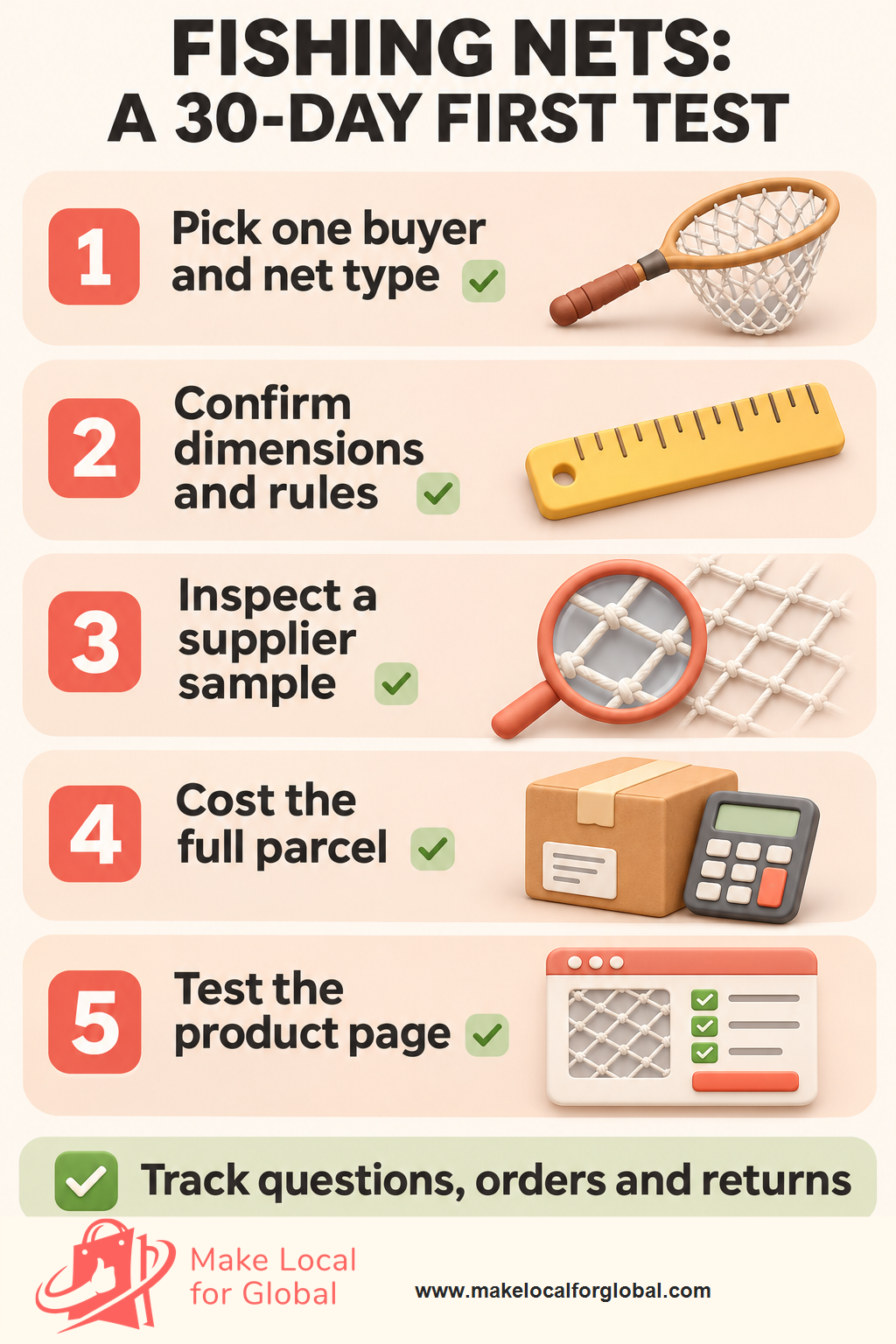
Each mistake has a practical correction: name the net type, show exact measurements, use the actual sample, source claims from records and check current local rules. A good page tells the buyer what is included and what still needs checking before use.
A landing net helps an angler bring a hooked fish to hand. A keepnet holds fish in water where the fishery and applicable rules permit it. They have different shapes, dimensions, mesh details and use limits, so list them as separate products.
Retail sale and use are separate questions. A seller should meet the product-safety and consumer-information duties for the product and destination. The customer must follow the rules and permissions for the water and method. Check current official guidance before you describe any capture net as suitable for a particular use.
An ordinary landing net used as an aid to rod-and-line fishing is different from using a net to catch fish. Rules vary by place and water. Tell buyers to check the fishery's rules and the responsible authority for their intended use.
Give the net type, head opening, mesh depth, handle length when packed and extended, weight, materials, connection type, care instructions, included parts and model code. Add photos of the head, mesh, joint, folded state and measured length.
No. Knotless describes mesh construction. Rubber mesh may describe a material or coating. A product can have one feature without the other. Use the manufacturer's exact terminology and identify the actual mesh on the sample.
There is no single answer for every water or event. England and Wales national rod-fishing guidance sets particular requirements, and local rules or fishery conditions may add others. Check current guidance and venue rules, then match the exact product specification before making a suitability statement.
Follow the manufacturer's instructions to extend and lock it, check the sections for movement, inspect the locking parts and measure both packed and full length. Do not carry out an unsafe overload test or describe an informal sample check as a certified strength result.
Use variants when they share the same job and construction, and show the dimensions, price, image, weight and stock for each one. Create separate pages for different net types or use cases. A landing net and keepnet should not be one variation selector.
It should identify the material and coating described by the maker. Ask whether the coating covers the full mesh or only parts of it, and confirm care instructions. Do not treat the phrase as proof that hooks cannot snag or that fish cannot be harmed.
Hold the affected stock and compare its model code, measurements, mesh, frame and joint with the product file. Ask the supplier to explain the change. Update the listing only after you know what changed and can support the new description.
Pack a real sample with everything in the order, then measure and weigh the finished parcel. Ask the carrier for a quote that fits those dimensions and delivery areas. Recheck the price if a longer handle, bundle or packaging change moves the parcel into a different service band.
No general statement like that is reliable. Fisheries rules depend on location, water, method, species, season and permissions. State the product dimensions accurately and direct buyers to the authority or venue for current conditions.
Start with a net type you can describe and support. Verify the sample, state the dimensions, price the complete parcel, and show buyers which parts come in the box. Keep ordinary landing nets separate from nets used for capture or fisheries work. Check rules by destination and link to the responsible authority rather than giving one broad legal promise.
If your initial test brings questions about reach, mesh or compatibility, improve those details before adding more models. If the interest is for a different use, research that buyer and product category on its own. A smaller range with accurate product pages is easier to service than a catalogue built on assumptions.
Tell MLFG what you plan to sell and where you need help with your online store.
PREFERRED SOURCE
Like what you’re reading? Add Make Local for Global as a preferred source on Google to see more of our articles when you search.

Build your online presence without having to figure out everything yourself.