READY TO SELL Fishing Rods ONLINE?
Get a store built for you in 5 days, plus training and support to help you start, run, and grow your Alternative business.

Choose a focused fishing rod range, verify the specifications and supplier, test samples, cost the finished parcel and prepare a clear UK product page and launch plan.


Fishing rods can look alike in a thumbnail, yet small differences in length, action, power, line rating, casting weight, guides and sections change who a rod suits. A useful online range helps an angler match a rod to a method and gives the seller enough evidence to stand behind each specification.
If you want to sell fishing rods online, begin with one kind of angler and a small set of rods you can inspect, explain and ship safely. This article covers product selection, sourcing, sample checks, pricing, product pages, UK selling rules and a measured first launch. It focuses on rods and related accessories sold to customers in Great Britain. Selling into Northern Ireland or another country can involve different requirements, so check the rules for each destination.
Turn verified rod details into a clear product page, with dimensions and delivery information easy to find.
The category is broad. A short lure rod for fishing from a boat, a long shore rod, a coarse fishing feeder rod and a fly rod do not serve the same customer. A shop that starts with every method, length, action, material and price point can end up with many slow-moving variants before it knows what buyers value.
Write a one-sentence opening brief before speaking with suppliers. For example: “A two-piece spinning rod for a beginner who fishes small lakes and wants a clearly marked lure rating.” The sentence names a buyer, a setting, a product type and a question a listing can answer. It is a hypothesis to test, not a promise that a large market exists.
Possible starting groups include:
Do not treat “beginner” as a product specification. One new angler might fish a small pond; another might visit a rocky coast. The rod, reel seat, line recommendation and product guidance differ. State the setting and method that a product suits, then invite customers to ask if their use case falls outside that description.
Read questions on specialist retailer listings, product reviews, angling community posts and your own enquiries. Record the exact phrases people use: “what does casting weight mean?”, “will this fit in my car?”, “is the reel included?”, “does the rod come with a case?” or “can I use braid with these guides?” Questions reveal where a product page must explain a detail.
Separate a buying signal from a casual reaction. A like on a photo shows attention; an enquiry about a marked rating, dispatch date or rod length is stronger evidence. Before ordering, show a small group three concepts with different rod types or prices. Mark concept images clearly if the products are not in stock. Ask which would suit their fishing, what information they need before paying and what price would make them pause.
Track who took part and where they came from. A dozen responses from local club members can help you improve a first product page, but it cannot prove national demand. Compare feedback with search queries, marketplace questions and competitor stock patterns. Avoid claims such as “the UK's favourite fishing rod” unless you have evidence that supports the exact wording.
Use a basic evidence sheet with columns for customer type, fishing method, rod question, product concept, response and next action. If people ask about closed length more often than colour, prioritize dimensions and shipping clarity. If the group cannot tell a lure rod from a coarse rod, improve the range names before raising the stock budget.
The Business Idea Stress Test can help structure questions about the buyer, evidence and test. Use it to make a decision easier to review; it cannot prove that a product will sell.
A first range should make choices easier, not display every model a wholesaler can supply. Start with a few distinct jobs, such as a compact spinning rod, a light feeder rod and a travel rod. Keep the rods different enough to explain. A second colour with identical performance may not add much value before you understand demand.
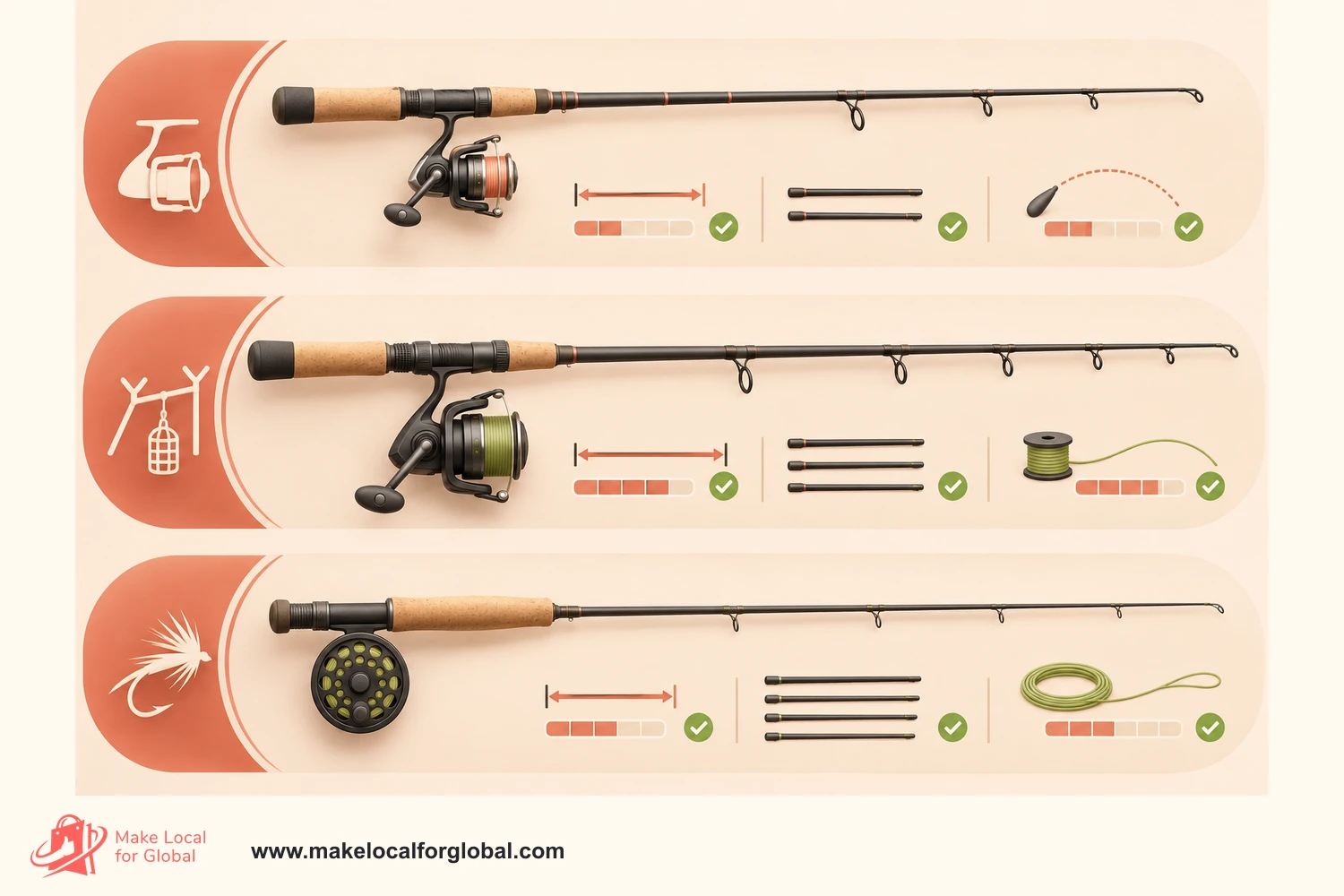
| Rod type | Customer use to describe | Product details to show |
|---|---|---|
| Spinning or lure rod | Casting lures with a reel mounted below the blank | Rod length, casting-weight range, action, sections, reel-seat type and recommended line |
| Baitcasting rod | Casting with a reel mounted above the blank | Reel-seat fit, casting-weight range, power and the intended lure method |
| Feeder or float rod | Presenting bait and detecting bites on stillwater or rivers | Method, length, casting or feeder rating, tip arrangement and included tips |
| Carp rod | Casting and playing fish on a defined carp setup | Test curve, length, number of sections, transport length and butt diameter |
| Sea or shore rod | Fishing from a beach, pier or boat | Intended setting, casting weight, length, corrosion-resistant components and packed length |
| Fly rod | Casting a fly line for a defined style of fishing | Rod length, line weight, action description, sections and tube or bag |
| Telescopic or travel rod | Carrying a rod in limited storage space | Extended and closed length, section count, locking points and supplied case |
Names can vary between makers. “Action” describes how and where a rod bends under load; “power” describes the force needed to bend it. Product labels and grading terms are not perfectly uniform across brands, so copy the maker's marked rating and explain the intended use. Shimano's rod action and power explanation sets out how those terms relate to a rod's use. Do not turn one brand's medium rating into a universal comparison.
Write down each specification as it appears on the product or supplier sheet. Common fields include:
Keep “recommended” separate from “included”. A rod shown with a reel may be sold as a blank rod only. A photo with a line spool nearby can imply that line is supplied. State what arrives in the parcel and show the product alone in at least one image.
An entry rod can reduce the cost of a first purchase, a core rod can suit the customer group you tested and a higher-priced option can add a clear feature such as more sections or a supplied tube. Each step needs a reason. “Premium” by itself does not tell a buyer why the product costs more.
Keep variants manageable. A single model with three lengths and two handle options already creates six stock combinations. Each combination needs a supplier code, stock count, product photo or clear variation note, packed dimension and return record. Start with the variants you can maintain accurately.
Build a range matrix before placing an order. Use rows for products and columns for customer, fishing method, length, closed length, sections, material, ratings, landed cost, packaging and carrier fit. A blank cell is a request for evidence, not an invitation to guess.
A rod sleeve, protective tube or a matching spare tip can complement a rod. A bundle with a reel or line needs compatibility guidance: reel-seat size, rod use, line type and rating. Do not bundle a random set of tackle just to make a basket look larger.
Test bundles as full orders. Check that the packed items fit the parcel, that no reel foot or guide presses against the blank and that the bundle price covers every item. Let the customer see the contents in a simple list. If a rod and reel are sold separately, state that near the price and near the product image.
A UK wholesaler, an authorised brand distributor, a direct manufacturer and a made-to-order arrangement have different cash, control and delivery trade-offs. A domestic wholesaler may offer a smaller first order and quicker replenishment; a direct import may give you more control over the specification and packaging, with more responsibility for checks and freight. A supplier's location alone does not establish product quality or compliance.
Ask whether the supplier is the brand owner, an authorised distributor or a reseller. Request written product specifications, model numbers, batch references, warranty terms, defect reporting steps, spare-tip availability and current lead times. Ask which parts of the listing can be used in your own store. Get permission for product photographs rather than copying images from a retailer.
Write down the answers. A message saying “high quality carbon” is not a specification. Ask for the actual material description, product code and the manufacturer's information. Do not advertise “30-tonne carbon”, a load limit or a warranty length unless you can verify that statement for the exact model.
| Route | What may suit a small seller | What to verify |
|---|---|---|
| UK wholesaler | Lower inbound complexity and access to smaller quantities | Authorisation, batch traceability, current stock and who handles warranty claims |
| UK brand distributor | Product knowledge, compatible accessories and named product support | Territory terms, minimums, image rights and stock allocation |
| Direct manufacturer | More control over a model or specification | Sample-to-production consistency, import documents, defects, lead time and importer duties |
| Private-label supplier | A distinct label or package may be possible | Written specification approval, product liability, quality records, traceability and realistic minimums |
| Pre-order or made-to-order | Less finished stock held before demand is known | Honest dispatch estimates, refund process, cancellation handling and supplier capacity |
For imports, identify who is the importer and what information goes on the rod, package or instructions. The Office for Product Safety and Standards guidance for manufacturers and importers explains that businesses remain responsible for products they place on the market and should maintain safety information and traceability. Ask a qualified adviser about your specific model and route if the supplier cannot show which requirements apply.
A photograph cannot confirm that a two-piece rod seats correctly, that each guide is aligned or that a case protects the tip. Buy or obtain the sample you intend to sell. Inspect it using a written checklist and take photos of each result. Repeat the checks when a production batch arrives.
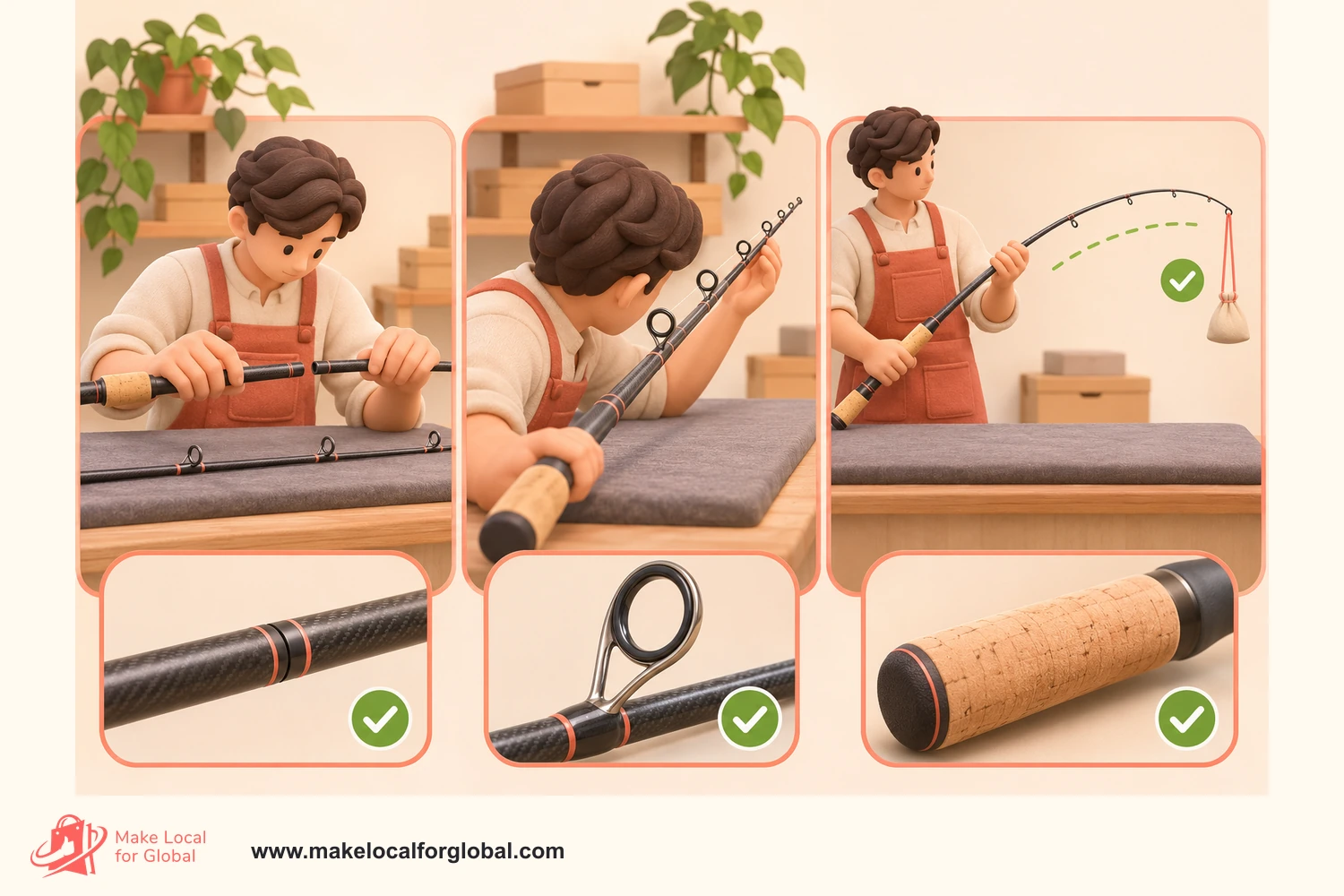
Read the blank for cracks, flattened areas, exposed fibres, uneven coating and impact marks. Look across its length under good light. A cosmetic mark may not affect use; a split, crushed area or delamination should trigger a supplier question and a hold on sale. Do not apply a heavy load to prove strength.
Join each section using the maker's method. Check that ferrules seat with the intended fit and that sections align. Do not force a joint that binds. Check for movement, grit or a gap that the maker's instructions do not describe. Photograph the joint before and after the check. If a rod has several sections, number them in your record so a replacement part can be identified.
Extend a telescopic rod section by section and confirm each lock or joint holds in its intended position. Do not yank a section open or twist it beyond the supplier's instructions. Measure the collapsed length. That measurement affects both the product promise and the parcel price.
Run a soft cotton tip or a small piece of cloth around each guide insert without pressing hard. Snagging can indicate a sharp edge or a damaged insert that may abrade line. Sight along the guides to check alignment. Confirm that guide frames are firmly attached and that wraps or finishes have no loose ends or cracks.
Check the handle for loose cork, foam tears, rough edges and residue. Fit a compatible reel only if you can do so without forcing the reel seat. Tighten the locking ring by hand; record whether the reel sits securely and whether the seat is comfortable to hold. State the compatible reel style only if the supplier has confirmed it or your test supports the claim.
Follow the supplier's care and inspection notes. If a gentle flex check is permitted, have a second person hold the rod safely and use a light, controlled load. Never jerk the blank, lift a heavy weight from the tip or force the rod into a tight curve. A dangerous overbend can damage a rod and does not represent normal fishing use.
Observe whether the sections move, whether guide wraps shift, whether the blank shows a flaw and whether the rod returns without an unusual noise or visible damage. Record the method and result. The sample test can find a visible defect; it cannot certify a rod's maximum load or replace manufacturer testing.
Count sections, tips, sleeves, tubes and paperwork against the order. Check that product identifiers match the invoice and specification sheet. Read care and assembly instructions before publishing. Make a note of any warning about high voltage, overhead power lines, water, transport or storage only if it appears in the supplier's material or is supported by the rod's use instructions.
If any check fails, stop and contact the supplier. Do not list the sample as representative stock until the mismatch is resolved. Save the supplier response with the model and batch record. A clear hold process protects customers and helps you identify affected units if the same issue appears later.
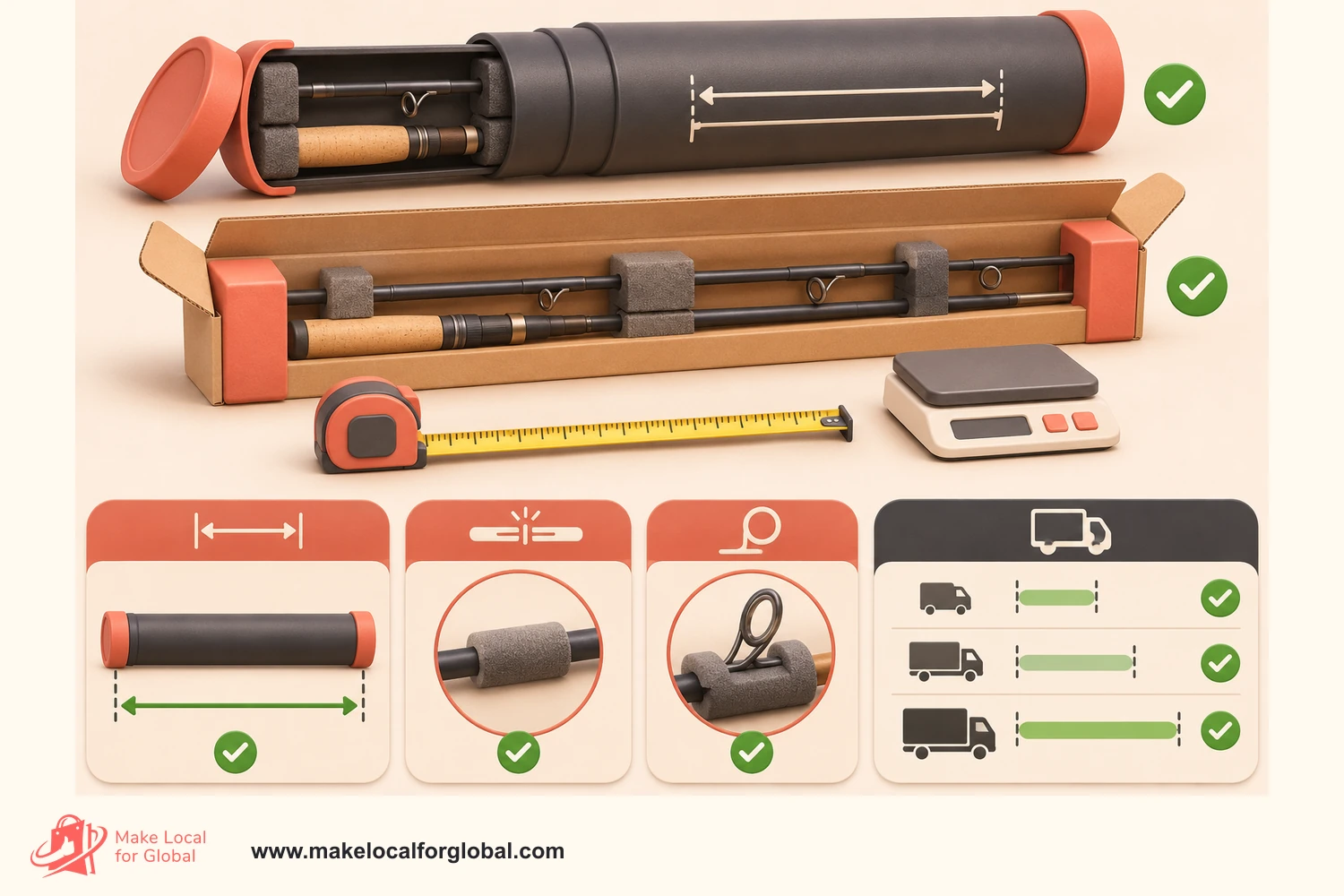
The cost of a rod does not end at the supplier invoice. Long parcels can affect carrier choice, packaging use, damage risk and the customer's willingness to pay. Measure and weigh the packed sample, not just the rod. Ask carriers for current acceptance rules by length, girth, weight, service and destination before you publish a delivery promise.
The figures below are illustrative, not a supplier quote or a forecast. This example assumes a VAT-registered seller, a £129.99 consumer price including 20% VAT, and costs shown net of recoverable VAT where applicable. VAT treatment can differ by item and sales arrangement; check the current HMRC guidance on rates and get tax advice for your business.
| Cost or calculation | Illustrative amount |
|---|---|
| Customer price including VAT | £129.99 |
| Revenue excluding 20% VAT (£129.99 ÷ 1.20) | £108.33 |
| Rod purchase cost, net assumption | £46.00 |
| Allocated inbound freight and import handling | £6.00 |
| Protective tube, end caps and outer packaging | £5.00 |
| Outbound tracked delivery allowance | £9.50 |
| Payment fee allowance, illustrative | £4.35 |
| Return, damage and replacement allowance | £5.50 |
| Customer acquisition allowance | £16.00 |
| Contribution before fixed overhead and tax | £15.98 |
Arithmetic: £108.33 revenue less £46.00, £6.00, £5.00, £9.50, £4.35, £5.50 and £16.00 equals £15.98. This is contribution before rent, software, insurance, wages, owner time, corporation or income tax and any costs omitted from the example. It is not net profit. If packaging or shipping changes the product's VAT treatment, if you are not VAT-registered, or if a cost is not recoverable, rebuild the model with the right treatment.
The £16 acquisition allowance is a planning assumption. If a £160 campaign generates ten paid orders, the simple paid media cost per order is £16 before creative, agency or setup costs. If only four of those orders are attributable to the campaign, the calculation changes. Use your own tracking and do not treat clicks as orders.
Change one input at a time. Test a higher courier charge, a replacement after transit damage, a 10% return rate, a discount code and an order with no paid advertising. See which scenarios reduce contribution below the amount your business needs. A low contribution can still be part of a valid launch test, but it should be an explicit decision with a spending limit and a review date.
Use separate rows for rod models and lengths. A 12-foot rod may need a different carton and carrier route from a 7-foot model. A package can cross a carrier threshold after protective ends are added. The current Parcelforce conditions of carriage list length and combined dimensions for specific services; check the actual service rules before booking. A parcel broker's long-parcel service page lists example length bands for some services, but carrier availability, postcode and price can change.
Do not advertise “free delivery” until the cost has a place in your margin model. The charge can be included in the product price or shown at checkout, but the customer should see the full cost before ordering.
The Wholesale and Retailer Margin Lab gives you a place to compare selling price and costs. Replace its example inputs with current supplier, packaging and courier figures.
A product page has to replace the chance to hold the rod in a shop. Show the rod at full length, then show details that help someone judge fit and build: the joint, guides, reel seat, handle, markings and case. Include a photo of the rod folded or separated into sections beside a tape measure when transport size matters. Use images of the actual model. If supplier images are the only option, check their use rights and do not show accessories that are not included.
A useful title names the rod type and the most important decision points. For example:
Use the exact supplier unit and rating. Add a plain-language note beneath it explaining what the range is meant to support, provided the manufacturer has supplied that information. Avoid stuffing every search phrase into the title.
Place a short specification panel near the buy button:
Use clear units. A customer in the UK may recognize feet and inches, yet supplier sheets may give millimetres or centimetres. Give both where you can verify the conversion and round consistently. Do not convert a supplier's product class into a rating the supplier has not provided.
Start with the use case, not a stack of adjectives: “A two-piece lure rod for casting within the stated 10–30 g range on the methods listed by the manufacturer.” Then explain the kind of customer who may prefer a shorter rod or a different rating. A limitation can improve trust if it is accurate.
Do not promise a rod will catch a specific species, cast a guaranteed distance or withstand a load that the supplier has not tested. Avoid “unbreakable”, “professional grade” or “perfect for everyone”. Keep claims about carbon content, weight and sensitivity tied to supplier documentation.
If two rods are close, write a comparison that answers a practical question:
| Choice question | Model A | Model B |
|---|---|---|
| Where might it fit? | Shorter settings or closer control, if the maker supports the use | Longer reach or storage requirement, if the published specification fits |
| How does it pack? | State the measured section length | State the measured section length |
| What must the buyer match? | The marked line or lure rating | The marked line or lure rating |
Do not fill these cells with generic claims. Use the measured products and supplier descriptions. If you cannot verify an advantage, remove the comparison.
Answer “Is the reel included?”, “What is the closed length?”, “How many sections arrive?”, “Which line or lure range is printed on this rod?”, “What case is supplied?” and “How should I report transit damage?” Place dispatch and delivery terms beside the purchase decision and repeat them in the checkout flow. A vague estimate such as “ships soon” can create avoidable questions.
Post clear close-up images and a short assembly demonstration if you can safely film the actual rod. Show how the joint fits and how the guides align. Do not flex it sharply for a dramatic video. If dimensions are shown with a measuring tape, keep the zero point visible and use the same unit stated in the text.
Your own ecommerce site gives you control over product explanations, bundles and customer support. A marketplace may bring shoppers who already search for tackle, with its own listing format, selling fees, delivery rules and return processes. A specialist retailer or local club partnership may give you feedback before you increase stock. Compare the channel's actual charges and policies before setting a price.
Create one focused listing for each meaningful rod type. Do not publish separate near-identical pages only to target singular and plural phrases. Keep one canonical product page for variants that share the same product, then use clear selectors for length, sections or ratings.
Useful customer questions can become content:
Answer only the questions you can support with maker information and a real product example. Link to the exact products that answer that question. Do not publish broad advice that contradicts a model's published rating.
For a product-line expansion, compare the selling process with adjacent categories such as camping gear. The categories differ; the shared planning task is to select a buyer, verify the product, show what arrives and cost the delivery.
Set a short test window and a budget before launch. For example, feature one rod page in an email to a permitted list, run a limited search campaign or publish a product demonstration through an account you manage. Record spend, product-page visits, add-to-baskets, paid orders, questions, cancellations and returns. Do not claim that a few days of activity prove a trend.
If customers view the page but do not add a rod to the basket, inspect price, shipping and rating clarity before changing the product. If customers add to basket and leave at delivery, revisit parcel cost and dispatch. If people ask whether a reel is included, change the listing and image order. If a rod arrives damaged, pause the affected packing method and investigate the tube, end protection and courier route.
Use the data as a decision aid, not a verdict. A low-volume test may point to a page question or a weak audience rather than a product with no demand. Write down the next test and what result would lead to a stock reorder.
Compare stock, long-parcel packaging, delivery and returns before you set a price.
Measure and weigh each rod after it is packed. The carrier sees the outer parcel, not the product in its catalogue. Record length, width, height and weight for every model. Request confirmation from the carrier or booking platform if the parcel is close to its published limit.
Use a tube or long carton that resists crushing and bending in transit. Protect the tip and butt, prevent the rod from sliding inside its package and isolate guide frames from pressure. If sections are shipped separately, wrap them so they cannot strike each other. Secure the ends without placing tape on a rod finish or guide.
Take a photo of the packed order and label before dispatch. A packing record helps you compare damage reports and refine the method. It does not replace the carrier's conditions or insurance requirements. Confirm whether the service covers the declared value, the parcel dimensions and the item type.
Offer a clear delivery estimate based on the service selected. A carrier's acceptance of one shop's 2-metre parcel does not prove that your parcel will be accepted. Measure your packed item, choose a service for its route and check current terms. Recheck limits when service conditions change.
Use a written process for a damaged rod, an incorrect model and a change-of-mind return. Ask for the order number and photos of the packaging and damage. Do not ask a customer to complete a complex claim before you explain the next step. Keep a replacement section or supplier route only if the manufacturer supports it.
For most UK online orders, customers have 14 days to tell a trader they want to cancel, followed by a further 14 days to return the goods. There are details and exceptions. The GOV.UK returns and refunds guidance explains the rules and refund timing. Write a policy that follows the rules for your product and selling route; do not use “no returns” to remove statutory rights.
Track reasons by model: damaged tip, reel-seat mismatch, unexpected closed length, rating misunderstood, parcel delay or customer no longer wants the item. A repeated reason points to a fix in the product, listing, package or service.
If you sell to consumers, provide the information required before an order is placed. GOV.UK lists business name and contact details, a description of goods, total price, payment, delivery arrangements, cancellation terms and other required information in its online and distance selling guidance. Make the information available before checkout and keep a record of the version used.
The product safety advice for businesses says a seller must not place a product on the market if they know, or should know, it is unsafe. A standard fishing rod may not need the same conformity marks as a powered or electrical product, but you should not assume no duties apply. Check the product and its supplied parts against applicable requirements. Imported products need particular attention to the identity of the importer, product records and traceability.
Keep the supplier invoice, model code, batch or lot reference, specifications, sample inspection, safety information, images and correspondence together. If a supplier cannot identify which model it sent, pause listing until you can trace stock.
A rod fishing licence concerns the person fishing, not the online seller simply selling a rod. Customers fishing for certain freshwater species with rod and line in England and Wales need the relevant licence and may need permission from the water owner; the rules differ across the UK. Link readers to the current GOV.UK rod fishing licence information if your listing or content discusses fishing permissions. Do not sell a rod as including a licence or imply that buying the equipment grants permission to fish.
For VAT, the rate depends on the product and transaction. HMRC states most goods and services use the standard rate of 20%, with exceptions. See VAT rates for goods and services and obtain current advice before publishing a tax-inclusive price or building a wholesale model. The worked example above states its VAT assumption for that reason.
This section is an operating checklist, not legal advice. Requirements can differ by product design, importer role and destination. Ask the relevant regulator or a qualified adviser about an unusual product, import route or disputed supplier claim.
“Carbon rod” does not tell the customer the length, sections, action, power, casting weight or method. Put the product's identifying ratings and the source of each statement on the page.
A medium power label from one maker may not match another maker's description. Preserve the original specification and explain what the manufacturer says it means. Do not build a cross-brand ranking from an untested assumption.
A rod can fit the angler's method and fail their car, cupboard or delivery budget. Measure the closed rod and the finished package. Show both figures when they answer different questions.
Every length and colour can create another stock and parcel record. Buy a small range, learn which questions customers ask and add variants only when the extra choice has a reason.
Ask whether images can be used on your site, marketplace and advertisements. Confirm that the image shows the model you will send. Never show a reel or case as supplied if it is not part of the order.
Include inbound freight, import costs, a protective package, carrier service, payment fee, return allowance and customer acquisition. Recalculate when a rod crosses a length band or when a carrier revises its limits.
A gentle visual inspection cannot certify maximum load, a fish weight or a distance cast. Use manufacturer test data for performance claims. Remove any unsupported claim from the title, image and copy.
Pick one buyer and fishing method. List the questions that matter before someone selects a rod. Review competitor listings for specification coverage and gaps; note date and channel, since stock and terms change. Ask a small group to compare three concepts. Save the responses and the limits of your sample.
At the end of the week, select one product direction or adjust the brief. If the audience cannot explain the difference between the concepts, simplify your range. If storage length matters, include it in the next supplier request.
Contact suppliers with the question list. Request the product code, rating information, sample terms, lead time, packaging method and defect route. Order a sample from the most promising supplier. Inspect the blank, joints, guides, handle, reel seat and included parts. Keep photos with the supplier response.
Do not move to stock ordering if the sample differs from the data sheet or if the supplier cannot explain a failed check. Resolve the mismatch, request another sample or stop.
Measure the rod and the finished parcel. Ask the carrier or booking service to confirm that the intended service accepts it. Add product, inbound freight, packaging, delivery, payment, return and acquisition costs to the model. Compare the full order contribution with the amount your business needs.
Build the product page from verified information. Add photos of the actual model, ratings, overall and closed length, number of sections, included contents, delivery estimate, returns details and a support route. Ask someone unfamiliar with the product to find the answers without your help.
Publish the first listing with a clear stock position and truthful dispatch estimate. Choose one acquisition channel and one budget. Track orders, conversion points, customer questions, delivery exceptions and returns. Review the data at the end of the test.
Reorder only after you can explain the evidence. If a sample is small, keep the next order small. If the page gets questions but no orders, test the wording, product fit and delivery charge before widening the range.
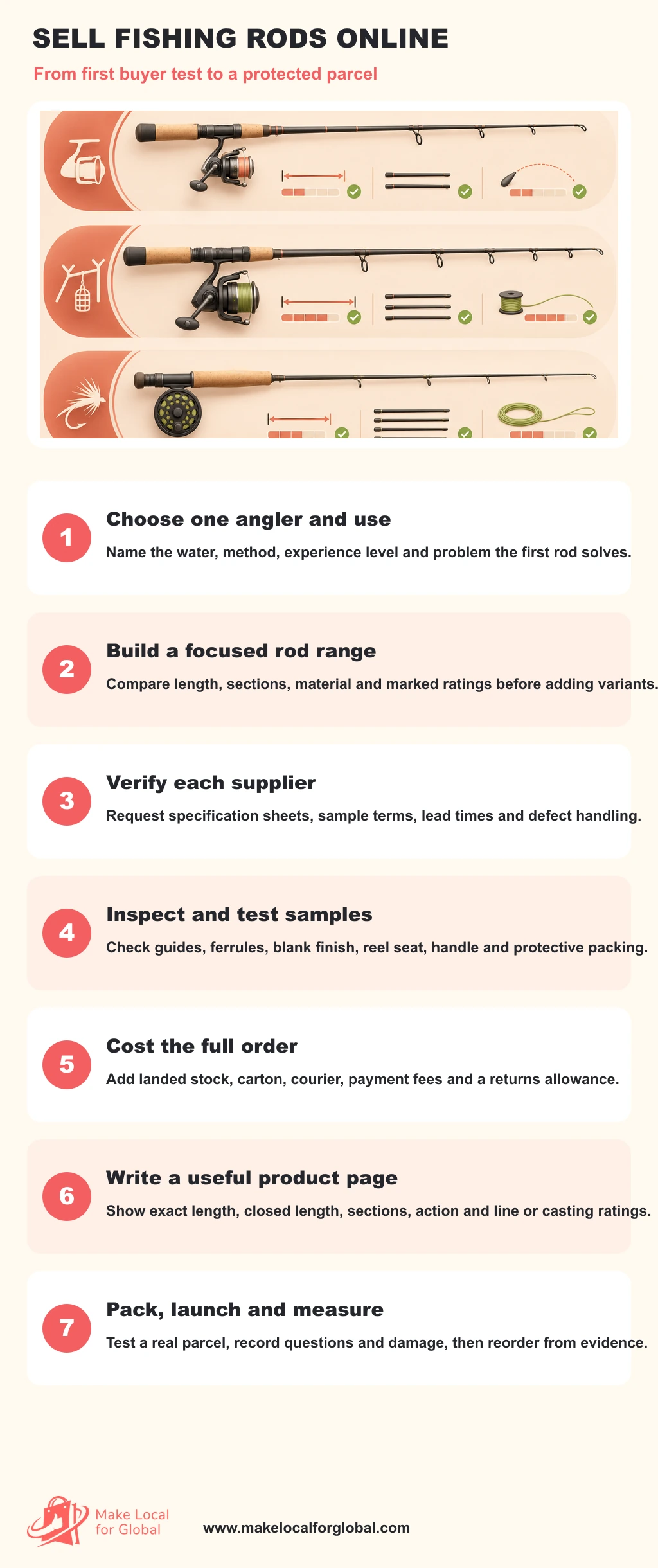
Choose the rod type that matches a customer group you can reach and a use case you can explain. A two-piece spinning rod, a feeder rod and a fly rod answer different needs; use enquiries and sample feedback to select one direction.
Ask for the exact product code, published ratings, sample terms, lead time, traceability, defect handling, packaging details and spare-part access. Compare a physical sample with the supplier's specification before listing the product.
Show the rod type, overall and packed length, sections, material description, action and power terms, marked line or casting-weight range, included items, warranty route, dispatch estimate and return information. Use photos of the exact model.
Inspect its blank, ferrules, guide alignment and inserts, handle and reel seat. Follow supplier instructions for a modest flex check; do not force a sharp bend or lift a heavy weight from the tip. Record the model and result.
Measure the packed parcel and weigh it. Protect the tip, guides, joints and butt in a rigid tube or long carton. Check the selected courier's current limits and insurance terms for the actual dimensions, service and destination.
Yes, if the listing makes it clear whether the reel is included and the image does not mislead. Use a photo of the rod alone and list every included item near the price and in the specification panel.
The rod fishing licence is for people fishing in the covered locations, not a permission automatically required to retail a rod. A customer may need a licence, local permit or water-owner permission to fish. Rules vary by place and species; direct customers to current official guidance.
Start with the selling price and subtract the right VAT treatment, stock, inbound freight, packaging, delivery, payment charges, returns and acquisition costs. The remaining contribution must still cover fixed overhead, owner time and tax; it is not the same as profit.
Only if the full delivery cost is included in the model and the service accepts the packed rod. Long parcels can cost more or have fewer carrier options. Show the total price and delivery arrangement before checkout.
Respond with clear steps, record the model and batch, ask for relevant photos and arrange a remedy that meets your legal duties and supplier terms. Review the packaging and carrier route before dispatching more orders in the same way.
Set the first quantity from your cash limit, supplier minimum, sample evidence, storage capacity and replenishment time. A short demand test cannot support a large order by itself. Keep a review point before you commit more cash.
You can assess a dropship supplier if the supplier can confirm the exact rod, stock visibility, dispatch standards, packaging, tracking, returns and product records. The customer still buys from your business, so you need to resolve service failures and product questions.
Review your buyer evidence, sample results and cost assumptions before committing more cash.
Write the one-sentence buyer brief, then ask suppliers for the specific rod data and sample needed to test it. A clear first range, a careful sample check and an accurate packed-parcel model make it easier to decide what to list and what to leave out.
PREFERRED SOURCE
Like what you’re reading? Add Make Local for Global as a preferred source on Google to see more of our articles when you search.

Build your online presence without having to figure out everything yourself.