

READY TO SELL Faux Fur Coats ONLINE?
Get a store built for you in 5 days, plus training and support to help you start, run, and grow your Alternative business.

Learn how to choose a faux fur coat niche, check suppliers and samples, build a clear size and care page, price each parcel and test demand before placing a larger order.

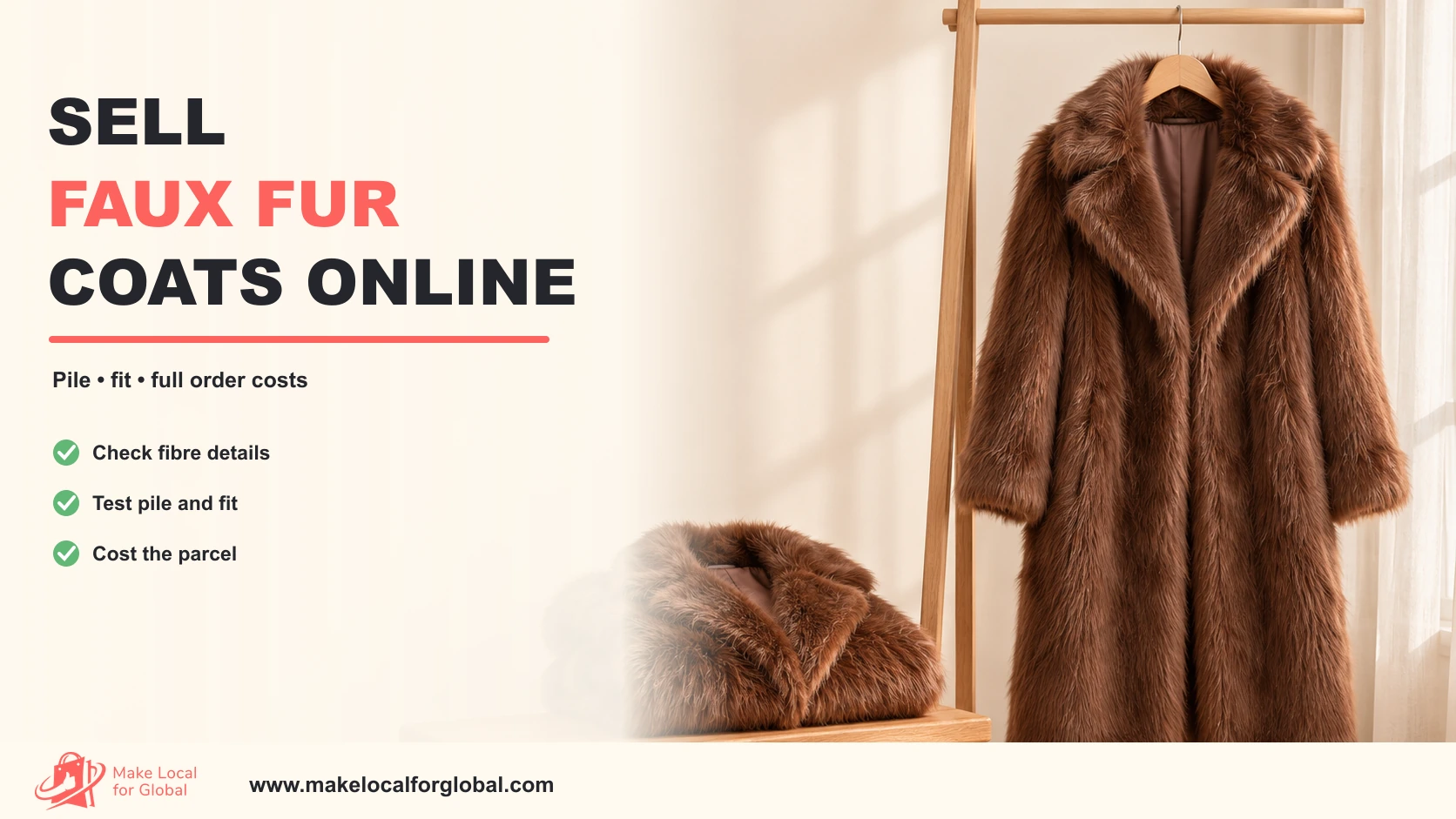
A faux fur coat business starts with proof of what the garment is made from and how it behaves after wear, brushing, storage and cleaning. A convincing product page should show the pile from close up, describe the fit with garment measurements and make the coat’s fibre content, lining and care instructions easy to find. Start with a narrow range you can inspect and explain, then add colours or silhouettes only after buyers respond. This guide shows how to sell faux fur coats online with a focused, verifiable offer.
The steps below cover product choice, sourcing, sample tests, sizing, photography, pricing, compliance, fulfilment and a 30-day launch test. The focus is faux fur outerwear for adults sold to customers in Great Britain. Selling into Northern Ireland, the EU or another market can add rules; check the requirements for each destination before listing there.
Start with a buyer, silhouette and fit promise you can explain with real sample details.
“Faux fur coat” covers several different products. A cropped jacket for a party outfit, a long relaxed coat for cold-weather layering and a lightweight collarless layer do not solve the same wardrobe need. Trying to serve every buyer with the first order can leave a small seller holding many slow-moving combinations of colour, length and size.
Start with one buyer group you can describe in a sentence. Examples include a shopper looking for a statement layer for evenings out, a customer who wants a softer-looking everyday coat over knitwear, or a vintage buyer seeking a particular silhouette. These are testable hypotheses, not claims about what all shoppers want.
Look at what people ask when they shop for outerwear. Read search suggestions, customer questions on relevant product listings, comments on your own social posts and feedback from people who fit the group. Record exact language around warmth, pile length, weight, lining, collar shape, sleeve room and care. Separate a request for a look from a requirement such as a roomy fit or machine-washable care.
Run a small evidence test before placing a large order:
Do not promise delivery dates for a product you have not secured. If you test demand through a waitlist, state that the product is being assessed and that joining the list is not a purchase.
Search volume or social visibility can suggest a question to investigate, but neither proves that a seller can profitably serve it. Check actual listings for the same type of coat, then compare the details that matter: length, pile, lining, closure, size information, price, delivery and return terms. Record the date and market when you review competitor pages; prices and stock change.
Use your own product angle as the test. For example, “short pile with a smooth lining for layering over knitwear” is more specific than “the coat everyone needs this winter”. Avoid claims about warmth or weather protection until a sample and its construction support them.
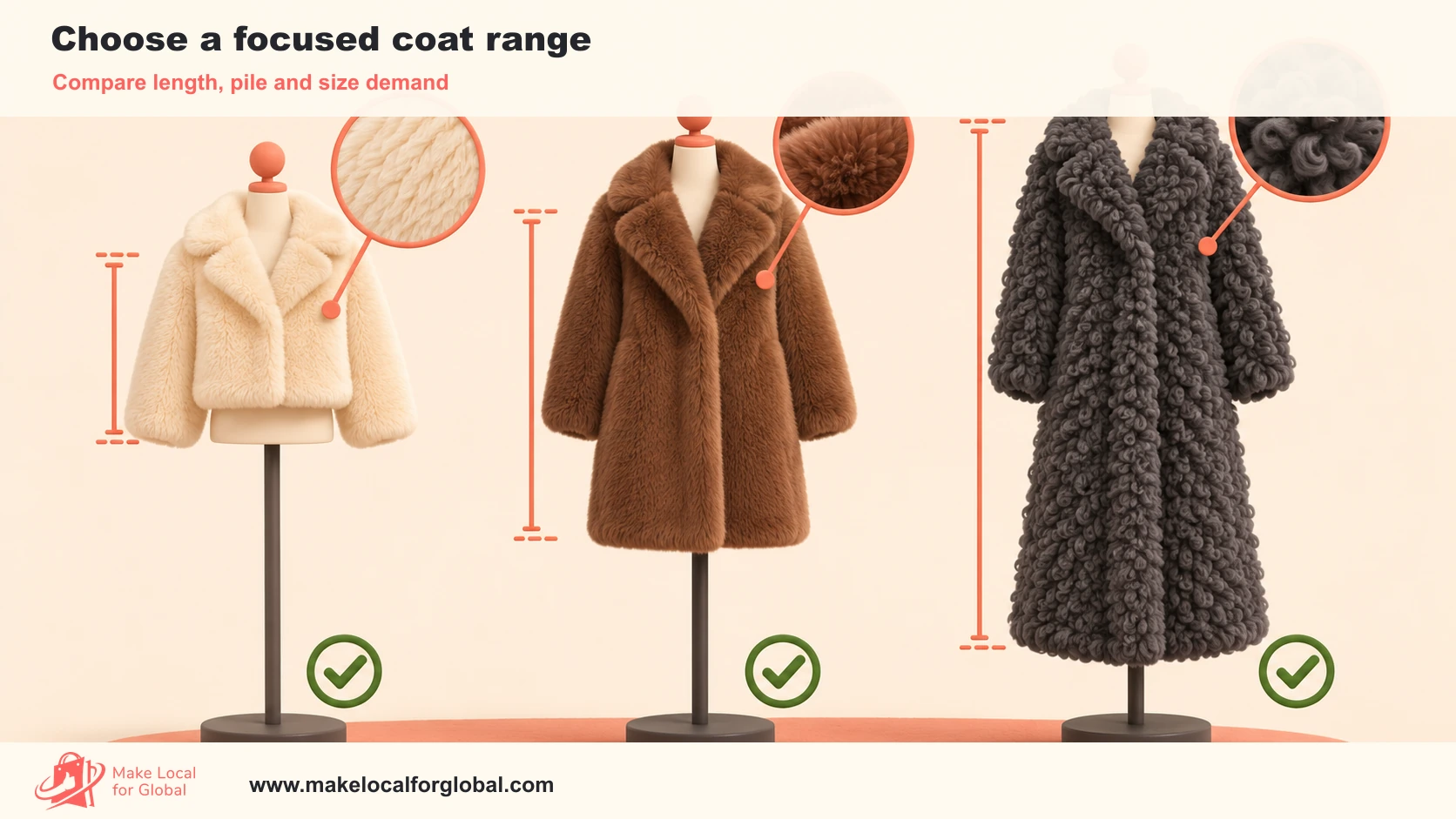
Faux fur outerwear can differ by pile, backing, shape, lining, closure and trim. Faux fur coats can share a category name without being interchangeable; a first collection should help one buyer solve one clear wardrobe problem. Three or four well-documented options can be easier to test than a broad catalogue with several unverified colours and cuts.
| Type | What a buyer notices | What to check before ordering |
|---|---|---|
| Cropped faux fur jacket | Shorter length and a strong outfit layer | Shoulder movement, sleeve length, hem position and fit over a top |
| Mid-length coat | Coverage with easier movement than a floor-length style | Coat length across sizes, lining, closure security and sitting comfort |
| Long pile coat | A visibly long, soft-looking surface | Pile shedding, brushing direction, snagging, packing volume and care |
| Short pile or plush coat | A smoother, lower-profile finish | Surface consistency, colour changes in different light and seam visibility |
| Teddy or sherpa-look jacket | A curled or looped surface rather than long strands | Whether the description matches the actual knit or pile construction |
| Collar, cuff or trim-led style | A smaller area of texture can change the look | Whether trim is detachable, how it is attached and what its materials are |
These labels describe appearance rather than a guaranteed warmth level. If the garment is intended as a warm winter coat, inspect its lining, weight and construction and describe the result accurately. Do not imply waterproofing, wind resistance or insulation from the pile alone.
A simple range structure can show shoppers the choice without making stock control unwieldy:
Use consistent measurements and a shared fit guide across these products. If the statement coat has a different pattern or material, state that; a single size chart may not describe all three accurately.
Each colour-size combination may become a separate stock-keeping unit. Calculate the number before ordering. Four styles in four colours and six sizes create 96 possible combinations. That does not mean you need to buy all 96; it shows why a new seller should test a smaller set and make the stock commitment visible. Faux fur coats with different patterns or pile densities may fit differently even when supplier size labels match.
Prioritise variants using evidence. A practical initial plan might be one silhouette, two colours, and a small set of sizes purchased in depth only where your test indicates demand. A sample or limited pre-order can test fit and colour, but disclose the terms, dispatch window and cancellation rights.
Faux fur is a visual category, not a complete fibre specification. The pile, backing, lining, interlining and trim can use different materials. A coat that looks similar to another can have a different composition and care requirement.
Request written details that identify the exact style, colour and production batch. Ask the supplier to provide:
Ask whether the details apply to the same factory, colour and fabric lot that will be used for your order. For faux fur coats, written fibre, backing and lining details help you match the product page to the sewn label. Save the answers alongside the purchase order. If a supplier cannot provide the composition or refuses to identify the exact style, pause the order and resolve that gap first.
| Route | Useful when | Main checks |
|---|---|---|
| UK or local wholesaler | You want smaller orders and shorter replenishment routes | Confirm stock is reserved, check the original label and clarify who handles defects |
| Overseas wholesaler | A ready-made style matches your test and landed cost works | Verify sample-to-bulk consistency, import terms, shipping time, duties and VAT treatment |
| Private label manufacturer | You have evidence for a specific design or fit change | Confirm development charges, pattern ownership, sample rounds and minimums in writing |
| Deadstock or small-batch maker | A limited drop fits your offer and the stock is genuinely available | Confirm quantity, repeatability, fabric records and what happens when a size sells out |
| Resale or vintage sourcing | You can assess each garment individually | Describe wear, repairs, lining, labels, condition and measurements per item |
Never assume a supplier’s sample is the same as the bulk production run. Set a pre-shipment inspection plan: check a defined sample of each colour and size, compare it with the approved sample and record defects. For a very small batch, inspect every unit before dispatch if that is practical.
Write down the full order commitment: sample charges, deposit, balance date, freight, insurance, import costs, label changes and the cost of defects or late stock. Clarify what currency is used and who pays bank transfer fees. Do not base the order on the per-piece price alone.
For private label, approve a sealed sample or a dated, signed sample reference. Record fabric swatches, measurements, colour name, hardware, lining and stitch details. If you approve a change, issue a new reference. A saved chat message that says “same as last time” is weak protection when the previous production run is unclear.
If the supplier proposes a substitute pile, backing or lining, treat it as a new product decision. Recheck the appearance, fibre details, care, price and customer-facing copy before accepting it.
A product can look convincing in a supplier photo and still feel poor in person, fit badly over clothes or arrive crushed. When comparing faux fur coats, check pile, seams, lining, closure and packed recovery on the actual sample under the conditions your customer is likely to encounter. Take notes by style and colour rather than relying on memory.
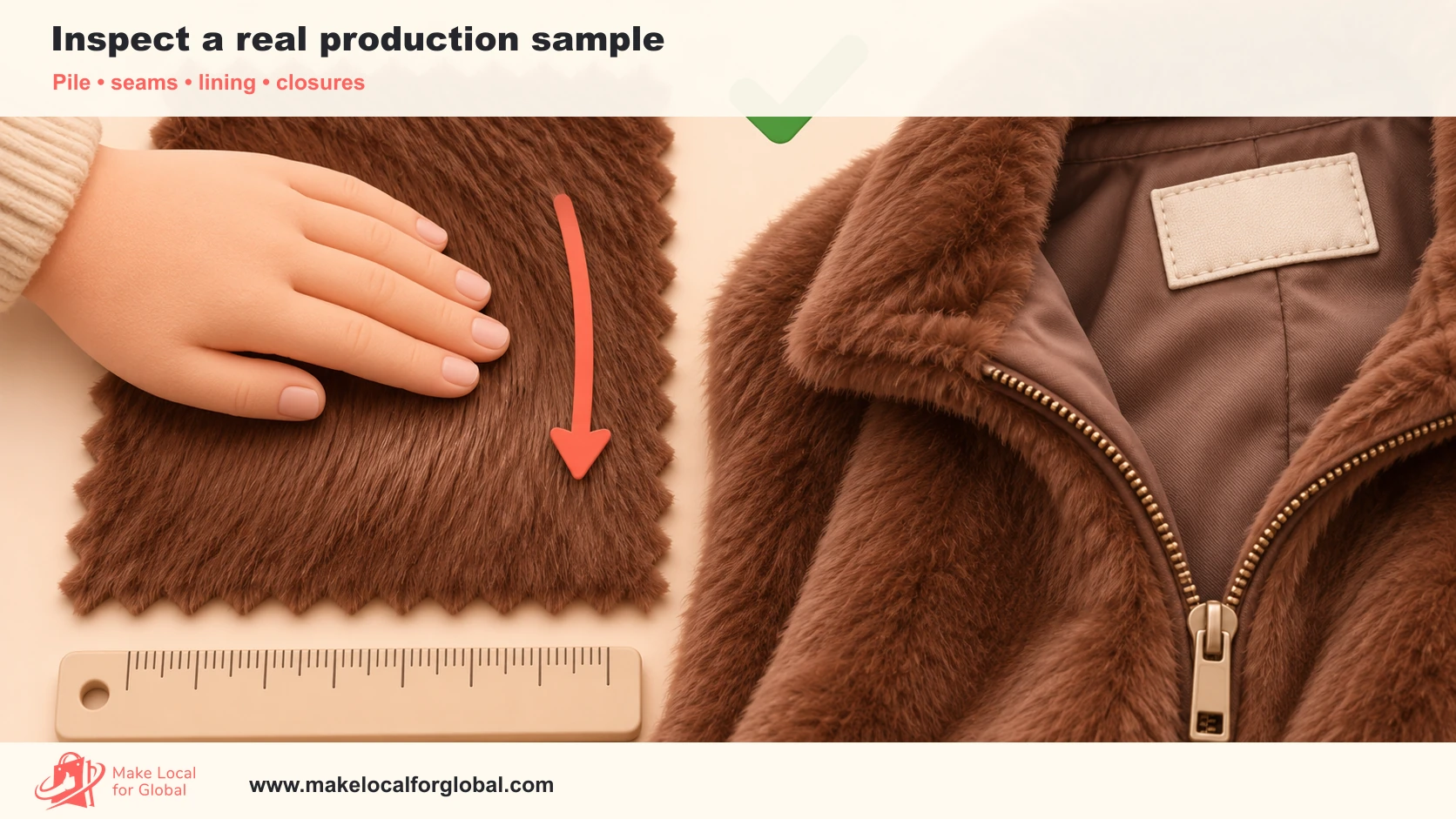
Use a repeatable check sheet:
Repeat selected checks after following the care instructions. Never invent washing directions from a supplier’s marketing copy. If you do not have reliable care guidance, request it or choose a different style.
Do not approve every size based on a single medium sample. Ask for a size set or a measurement chart with grading rules. Measure the finished garment flat, record the point measured, and compare against the supplied specification. Useful measurements include:
Test the coat on more than one body shape if your offer claims inclusive sizing. Check reach, sitting, layering and arm movement. The aim is not to grade someone’s body; it is to make sure your size descriptions help shoppers choose. Offer a clear “garment measurements” table and explain how it differs from body measurements.
Give each check a result: pass, needs clarification or fail. Attach a photo to the notes if the issue is visible. A fail means you should pause the order, request a corrected sample or choose another supplier. A second sample should be tested in the same way so you can compare it against the first.
Do not present your own screening checks as formal safety certification. Ask a qualified laboratory or competent specialist for testing advice if the product, materials or destination create a technical question you cannot answer from reliable documentation.
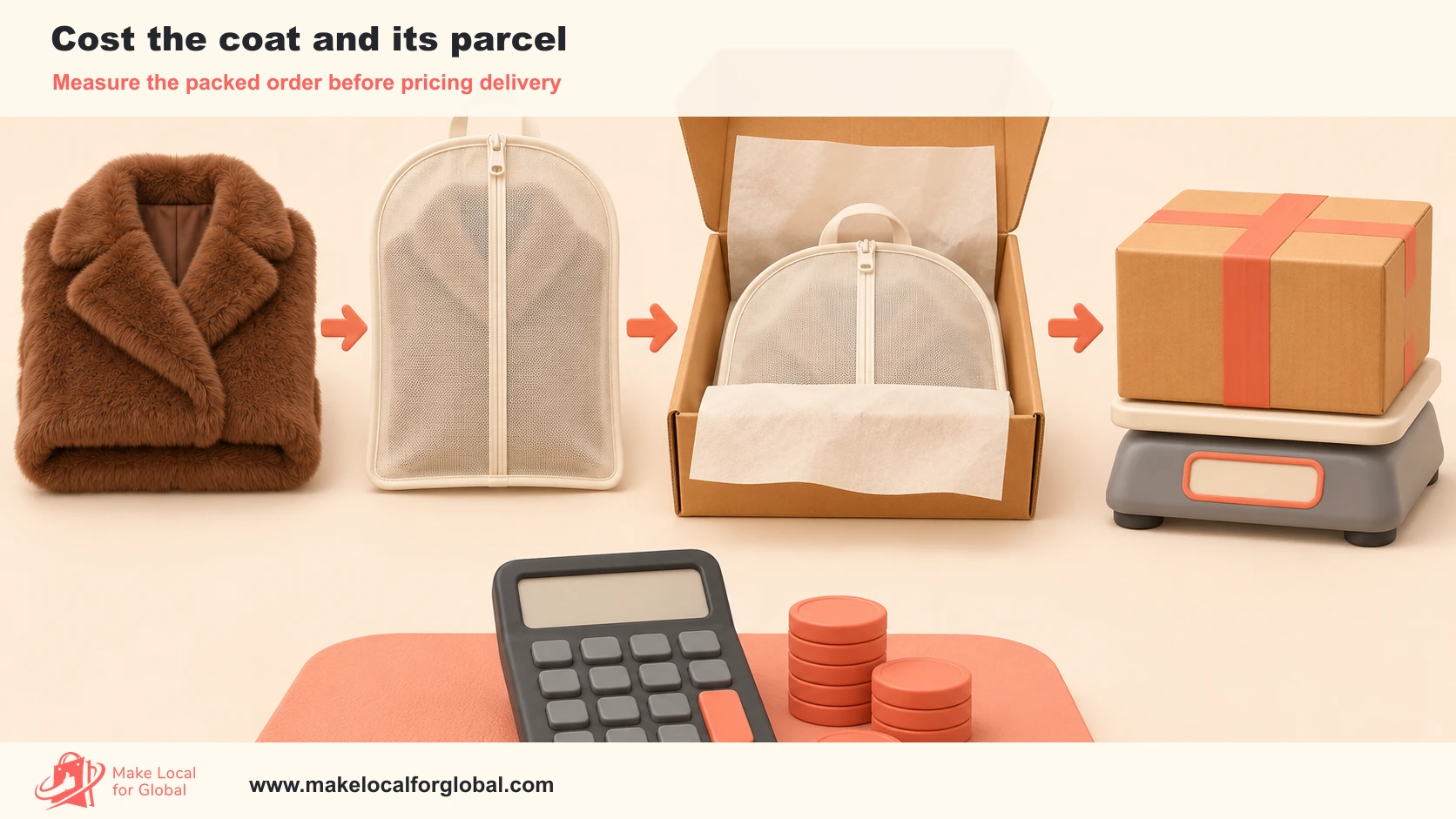
The price has to cover more than the supplier’s unit quote. Include sample and development costs where they are material, inbound freight, packaging, dispatch, payment fees, returns handling, customer acquisition, discounts and tax treatment. Faux fur coats can take more parcel space than a smooth jacket, so weigh and measure a packed sample before setting a free-delivery threshold.
The example below uses a £149 delivered customer price for one coat. It is an illustration, not a recommended market price or supplier quote. Assume the seller is not VAT registered, so the listed price is the customer payment and input VAT cannot be reclaimed. Actual costs and tax treatment vary.
| Cost for one order | Illustrative amount |
|---|---|
| Coat purchase cost | £57.00 |
| Allocated inbound freight and import handling | £7.00 |
| Protective garment packaging and mailer | £3.20 |
| Tracked outbound delivery | £5.60 |
| Payment fee allowance, 2.5% of £149 | £3.73 |
| Returns and inspection reserve | £10.50 |
| Customer acquisition cost for this order | £18.00 |
| Illustrative variable cost total | £105.03 |
| Customer payment | £149.00 |
| Contribution before fixed overhead and tax | £43.97 |
Calculation: £149.00 − £105.03 = £43.97. The £10.50 returns reserve is a planning assumption, not a known return rate. The £18 acquisition allowance is a hypothetical cost per order. Replace both with your observed results. Contribution is not net profit: it excludes rent, software, staff time, photography, professional services, income or corporation tax and other fixed costs.
If you register for VAT, rebuild the example using the treatment that applies to the products and your business. Do not treat the full gross amount as available revenue. GOV.UK says a UK business must register when taxable turnover exceeds £90,000 in a rolling 12-month period or is expected to exceed that amount in the next 30 days. Check the current VAT registration guidance and get advice if your circumstances are unclear.
Create three versions of the model:
Calculate the minimum selling price needed to cover variable costs and the contribution target. Compare that figure with comparable products only after recording the differences in fibre, lining, fit, photography, delivery and returns. If the required price is far above the market set you reviewed, revisit sourcing, product specification or the target buyer before ordering.
Model stock, freight, packaging, delivery and return costs before you commit to a range.
Online shoppers cannot touch the pile or test the sleeve room. Product pages for faux fur coats should answer the questions that determine whether the garment is right for the person: what the surface looks like, how it fits, what it is made from, how to care for it, what the parcel costs and when it will arrive.
A useful title names the garment and key distinction without filling the line with repeated search terms. For example: “Cropped Faux Fur Jacket in Oatmeal, Fully Lined” or “Long-Pile Faux Fur Coat with Hook Closure”. Only state “fully lined” or the colour if the specific product has those features.
Photograph the actual sample in good light. Include front, back, side, open lining, collar, cuffs, pockets, closure, label and close-up pile shots. Keep a consistent colour reference and add a note if screens can display colour differently. Show the coat worn over a light layer and a knit layer so buyers can judge scale and movement.
For each colour, use a photo of that colour or a clearly labelled swatch. Do not reuse a different product’s images to fill missing colour options. If a model is wearing a sample that differs from the final coat, state the difference and replace the image when production stock is checked.
State whether the coat is intended to fit close, straight or oversized. Provide garment measurements by size, the measurement method and the model’s height and garment size if a model is shown and that information is accurate. Explain whether the coat is intended for layering. Do not use vague labels such as “true to size” without a clear basis for the statement.
An example size note could say: “The sample shown is size 12. The coat measures 58 cm from pit to pit and 72 cm from shoulder to hem. Measure a coat you own in the same way and compare before ordering.” Replace those illustrative measurements with the actual sample data before publishing a product listing.
Include outer pile and backing composition, lining composition, closure, pockets, garment weight, country of origin where required or appropriate, care label directions, dispatch time and delivery price. Put key limits close to the relevant claim: if the coat is dry-clean only, make that clear before checkout. Explain whether accessories pictured are included.
Use distinct descriptive alt text for each informative product image. Describe what the image shows for a customer using a screen reader, such as “Back view of the cocoa faux fur coat showing the hem and full-length pile”. Avoid strings of search phrases or decorative brand words.
Rules depend on what you sell, where your business is established, how the coat is made and where the customer lives. The notes here are a starting point for a Great Britain seller, not a substitute for advice about a particular product or cross-border trade.
GOV.UK guidance for England, Scotland and Wales says textile labels must show fibre content, including fur and other animal parts. If a product has components with different fibre content, those contents may need to be shown separately. Manufacturers and retailers have responsibilities, so do not assume a factory label automatically satisfies your own checks. Review the UK textile labelling guidance and ask Trading Standards or a qualified adviser about the exact garment and any Northern Ireland sales.
For a synthetic faux fur coat, request the precise fibre names and percentages for the outer fabric and lining. “Faux fur” describes the look; it does not replace a fibre breakdown. Check any fur-like collar or detachable trim separately. If any component is animal-derived, describe the garment accurately; call it animal-free only when your records support that statement.
The Office for Product Safety and Standards says businesses that make, import, distribute or sell consumer products in the UK are responsible for product safety and applicable labelling. In Great Britain, the General Product Safety Regulations 2005 require products to be safe in normal or reasonably foreseeable use. Northern Ireland follows a different product-safety regime for goods covered by EU rules. Start with the current product safety advice for businesses.
Keep supplier records, purchase orders, sample notes, batch identifiers, complaints and corrective actions. A simple lot code can help you identify which units came from which production run. If an issue appears, pause affected listings, assess the risk, retain evidence and follow the relevant reporting or recall advice. Use a “tested” badge only when you hold the relevant report and can show that it covers the coat you sell.
Environmental wording such as “eco”, “planet-friendly” or “sustainable” can create a broad impression that needs evidence across the product and its life cycle. The CMA’s fashion guide to the Green Claims Code recommends precise statements about objective material properties, such as an evidenced percentage of recycled polyester, rather than broad claims. Keep the supplier proof and state the percentage clearly if you make a fibre-content claim.
Synthetic composition or a faux-fur description alone does not prove that a coat is recyclable, recycled, cruelty-free or lower-impact. Explain the specific fact you can verify, such as the fibre composition or a documented recycled-content percentage, and avoid implying that it describes the whole product when it only applies to one component.
Before the customer places an order, the online and distance selling guidance says sellers must give key information such as business contact details, a product description, total price including taxes, delivery costs and arrangements, and cancellation information. Most online buyers can tell the seller they want to cancel within 14 days after delivery, then have another 14 days to return the goods. The rules have exceptions and details, so publish clear terms and follow the full guidance.
Make the return process easy to find. Explain how to contact you, how to package a coat so its pile is protected, whether the customer pays return postage under the applicable rules and how you handle a faulty item. Do not describe ordinary statutory cancellation rights as a special offer or restrict them through a “final sale” label.
Faux fur coats can occupy more space than a smooth jacket and can arrive flattened if the package is too small. Test your packing method on the sample. Fold along seams rather than crushing the pile, protect closures from rubbing and use a breathable inner cover if the garment’s care and supplier advice support it. Avoid packing a damp or recently cleaned coat.
Measure the completed parcel, not just the coat. Compare the packed dimensions and weight with the carrier’s current service limits and prices. Some carriers price on a dimensional weight basis. Recheck the tariff before promising a fixed delivery price, especially for long coats or premium protective packaging.
Store stock clean, dry and away from direct sunlight. Keep size and colour labels visible without pressing the pile under heavy cartons. Use a simple location code and record each order’s picked size and colour. If a return arrives, check the label, wear, odour, seams and pile condition before returning the item to saleable stock.
Create a dispatch routine:
Your own store gives you control over product information, photography and the buying process. A marketplace can provide access to shoppers, but it may have listing rules, fees, delivery standards and returns expectations. Read the current seller terms for each channel and model its charges before setting your price.
Start with one primary checkout route and one or two ways to reach the buyer you selected. Examples include search-focused product pages, outfit demonstrations, email to an existing audience, local pop-ups or a small paid campaign with a set budget. Do not launch several platforms at once if you cannot keep stock counts, replies and dispatch details in sync.
Use the phrases customers actually use, such as “cropped faux fur jacket”, “long faux fur coat”, “faux fur coat size guide” or “how to care for a faux fur coat”, only where the page answers that question. Customers comparing faux fur coats may want clear information about pile, garment length, fit and care. Organise content by buying decision rather than publishing repetitive pages for every colour.
Content tests could include:
Use a small tracking sheet for visits, add-to-basket actions, checkout starts, completed orders, questions, cancellations, returns and the size or colour requested. Set one change per test. If you change price, photos, shipping and copy at once, you will not know which change mattered.
For more garment-specific planning, see MLFG’s articles on selling down jackets online and selling business suits online. For range and page ideas across apparel, the designer clothing article provides another useful reference.
Supplier images may be edited, lit differently or based on a different fabric batch. Approve a physical sample and compare colour under more than one light source. If you cannot inspect the product before buying, use a smaller first order or choose another supplier.
Words such as “luxurious” do not tell a buyer what the pile feels like, how the coat fits or how it should be cleaned. Pair any style description with facts about composition, length, lining, closure, care and measurements.
A cropped jacket and a long coat can have different grading, ease and sleeve shape. Use a chart that matches the exact garment and explain the measurements. Review size-related questions and returns after launch, then correct the chart if the evidence shows an issue.
A competitor’s visible price does not reveal its purchase cost, return rate, advertising cost or stock age. Build your own order model, state the assumptions and test whether your target price can cover them.
If the supplier says a coat contains recycled fibres or has a special treatment, ask for evidence that identifies the exact material and percentage. If the paperwork is vague or applies to another product, leave the claim out until it is resolved.
A customer can usually handle an online purchase as they would in a shop, but the returned coat may need inspection before resale. Set a process for checking pile, seams, labels, odour and packaging so damaged or altered pieces are not listed as new.
Do not scale on views alone. A useful first month gives you evidence about the product, price, fit, page and delivery promise. A decision to pause or change the range can protect cash just as much as a decision to reorder.
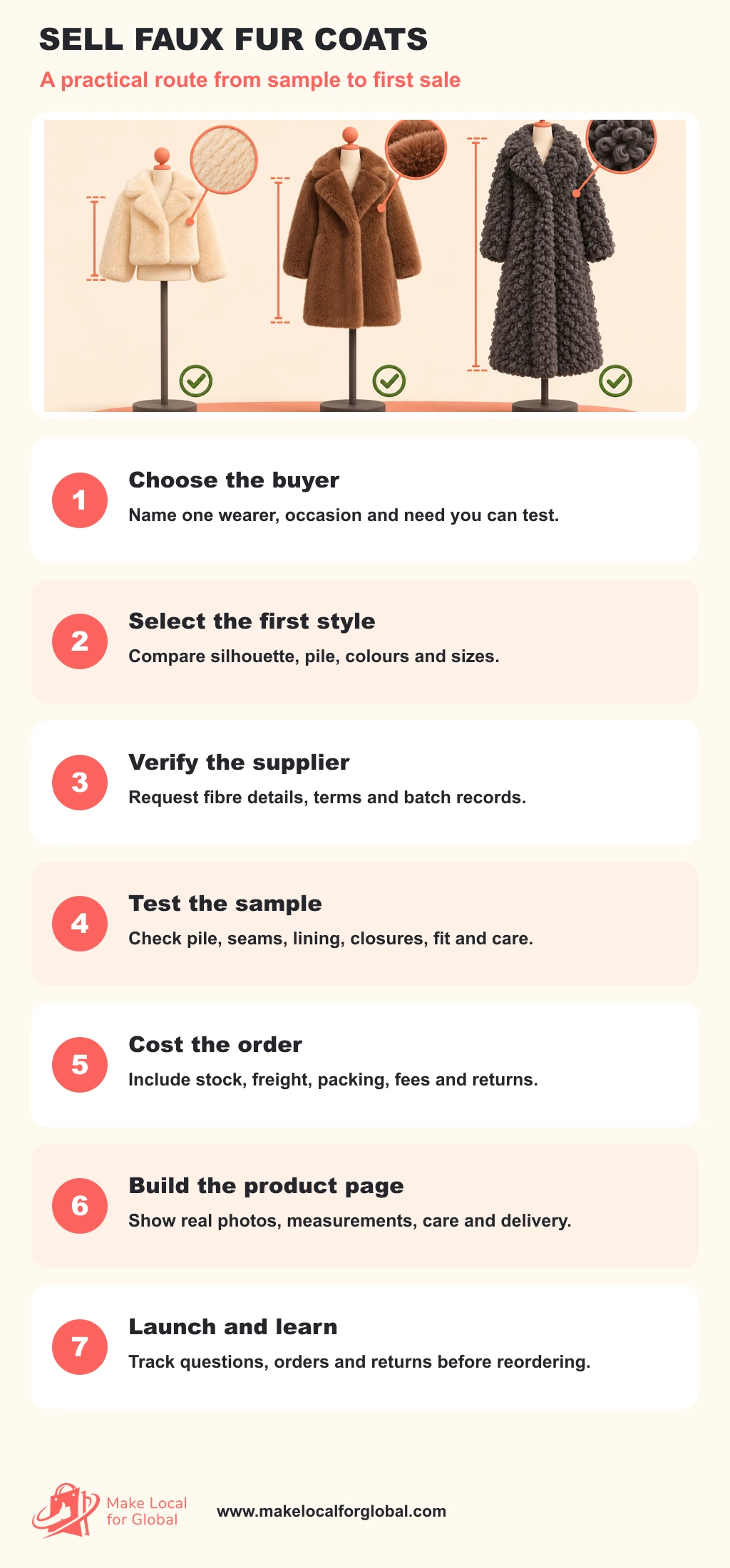
Choose one silhouette and a small set of colours or sizes that matches the buyer evidence you collected. Test a physical sample, record its fit and care details, and calculate the delivered order cost before placing a deeper order.
Check the pile for thin patches and inconsistent length, inspect the seams and lining, test the closures and wear it over more than one layer. Record transfer, shedding and pile recovery. These checks help you compare samples, but they do not replace specialist testing where a safety or technical question calls for it.
Show the actual coat from several angles and provide fibre composition, lining, garment measurements, fit notes, closure, pockets, care, delivery, total price and return information. A close-up photo helps show texture; it cannot replace written composition details.
UK textile labelling rules apply to sellers and other businesses in the supply chain. GOV.UK guidance for England, Scotland and Wales says labels must show fibre content, including fur and other animal parts. Confirm the correct label for the exact garment, including separate components, and check Northern Ireland requirements if you sell there.
Only make that claim if you can support the overall impression for the whole product and its components. A synthetic pile does not prove that every trim, lining, manufacturing stage or supplier practice meets a broad ethical claim. A precise, documented fibre description is easier to substantiate.
There is no universal quantity. Work from the minimum order, your cash limit, the number of variants, sample results and the evidence of buyer demand. A smaller order with stronger size coverage can be easier to manage than the same cash spread across many colours and cuts.
Add the garment cost, inbound freight, import charges where applicable, packaging, outbound delivery, payment fees, an evidence-based return allowance and customer acquisition cost. Compare the resulting contribution with your fixed expenses and tax position, then check whether your target buyer accepts the price.
Describe the lining, construction, fabric weight and intended layering only where the sample supports the statement. Do not infer insulation, wind protection or water resistance from the faux fur appearance. If you make a technical performance claim, keep evidence for the exact style.
Yes, if the marketplace accepts the product and you can meet its seller rules. Check current fees, product-information requirements, dispatch expectations, returns process and any restrictions before setting prices. Keep marketplace stock counts aligned with your own store.
Follow the customer’s legal rights and your published policy. Inspect the garment’s label, pile, seams, lining, closures and condition. Record the return reason; recurring feedback about shedding, colour or fit may point to a supplier or product-page issue.
The registration test depends on your taxable turnover and circumstances. GOV.UK says a UK business must register when taxable turnover exceeds £90,000 in a rolling 12-month period or is expected to exceed that amount in the next 30 days. Check the current HMRC guidance and ask an accountant if your business has cross-border or unusual VAT treatment.
Use a clearly labelled concept page, a sample-based photo shoot, a waitlist or a small batch, and record meaningful actions such as specific enquiries or paid orders. Be honest about stock status and delivery timing. Do not take payment for a product you cannot supply under the promised terms.
Review the buyer need, supplier evidence and unit economics before a larger order.
Selling faux fur coats online is a product-control task as much as a styling exercise. Verify the exact materials, test fit and finish, price the complete parcel, and show the details that a shopper cannot judge through a screen. Start with a small range and let recorded buyer behaviour guide the next order.
PREFERRED SOURCE
Like what you’re reading? Add Make Local for Global as a preferred source on Google to see more of our articles when you search.

Build your online presence without having to figure out everything yourself.