READY TO SELL Glass Beads ONLINE?
Get a store built for you in 5 days, plus training and support to help you start, run, and grow your Alternative business.

Plan a focused glass bead range, verify sizes and finishes, test a supplier sample, calculate each pack’s full cost and describe small parts clearly for UK buyers.

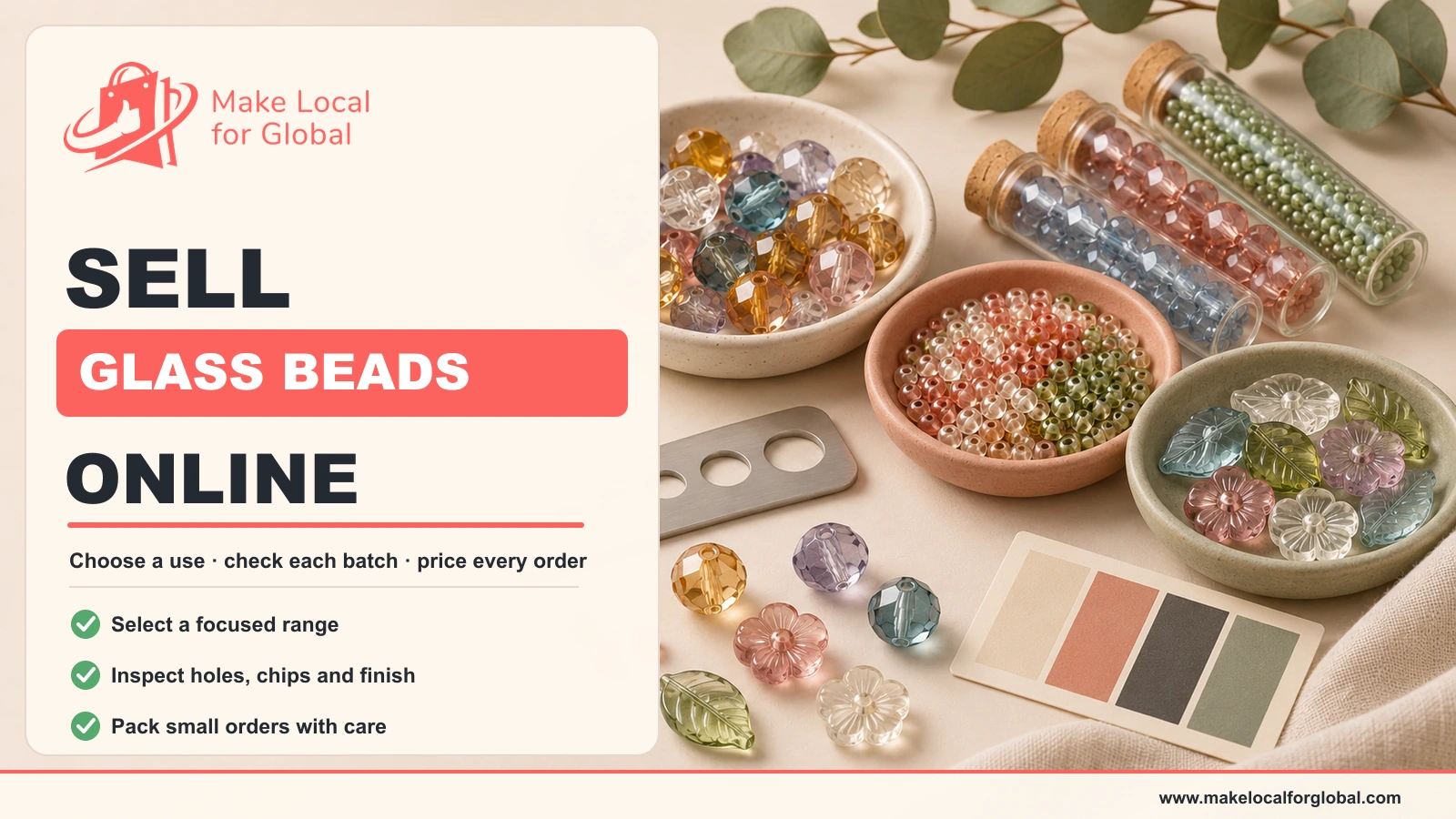
Glass beads can be sold as small project packs, colour assortments or specialist components for jewellery makers, bead weavers, embroiderers and repair shops. The seller’s work begins with choosing the buyer and use, then describing the bead accurately enough for that person to decide whether it suits a project.
A clear listing gives the shape, size, hole, finish, colour, quantity and any batch variation the supplier can confirm. A sample check catches chips, irregular holes and coating problems before a full order. Costing needs to include the beads, inbound freight, sorting, packaging, postage, fees and the time spent picking small parts.
This article covers loose glass beads and bead assortments sold as craft or jewellery-making components. Selling finished jewellery, children’s toys, fused glass pieces or lampworked art beads as finished products involves other product details. For adjacent categories, see craft supplies and fashion jewellery.
Set a buyer, compare a few related bead packs and record the costs before ordering stock.
“Crafters” is too broad to guide a first stock order. A bead weaver may care about consistent diameter, hole size and how beads sit in a row. Someone making simple bracelets may look for larger holes, a colour mix and enough pieces for one project. An embroiderer could need flat-backed beads or small rounds that lie close to fabric.
Write a short buyer description that names the project, the skill level and a likely order size. For example: “A beginner making two stretch bracelets wants a small pack of round glass beads in a calm colour family, with enough beads to finish the pair and a simple size reference.” This description gives you product questions to test before ordering.
Ask a few people who make that kind of work to compare sample packs or product-page mock-ups. Show the stated quantity, measurement, finish and colour in each option. Ask what they would use the beads for, which detail is missing, whether they would buy a sample or full pack, and what would make them choose one option over another.
Separate compliments from buying evidence. A person saying that a colour is lovely does not show whether the pack size, price or hole will suit a real project. Stronger signals include an email request for a specific colour, a paid sample order, a repeat purchase or a question about a size you plan to stock. Keep notes by sample and question so one enthusiastic response does not set the whole range.
If you test interest before stock arrives, label the page as a preview. Do not take payment until you can meet the dispatch date you promise. A pre-order needs a clear delivery estimate and cancellation information before checkout.
Glass beads are made and finished in several ways. A store might stock small seed beads for embroidery, woven beadwork or stringing; round beads in larger diameters for simple jewellery projects; faceted beads for light-catching designs; pressed shapes such as flowers or leaves; and more specialised forms such as tubes or two-hole beads.
Do not use a type name as the entire product description. A buyer needs the bead’s dimensions, the size of the hole, material details confirmed by the supplier, finish, quantity and intended use. Names such as “seed bead” or “crystal” can be used inconsistently between suppliers. Copy the supplier’s exact code and physical measurements into your product record, then state in plain English what the customer receives.
Think about the project’s construction. Small, regular beads can help a woven pattern sit evenly. A larger bead may be easier to thread with cord or elastic, though it changes the weight and look of a finished piece. Faceted beads can catch light and may rub against one another. A pressed decorative shape needs a photograph that shows its outline and hole direction.
If you sell a mix, state whether the exact bead count and colour ratio are fixed. “A 25 g mixed pack in coral, clear and sage tones” is more useful than “assorted beads”. If the supplier mixes colours by weight and the precise ratio changes from pack to pack, say that. Show an example of the variation rather than implying every customer receives the same arrangement.
A large colour catalogue can tie cash up in stock that is slow to pick and hard to photograph consistently. Start with a range a buyer can understand: for example, two bead sizes, three colour families and a single coordinated starter mix. Another seller may start with one reliable seed bead, one larger round and a useful colour palette. The right first range depends on the projects your intended customers make.
Group products around a practical need, not just a supplier spreadsheet. A “first embroidery palette” could contain a limited set of small glass beads in related colours, with a stated weight and bead size for each. A “repair pack” might group commonly used neutral shades in one larger size. A “colour study” could pair transparent and opaque beads so makers can compare them in a sample project.
Keep a product range table before ordering:
| Product option | Intended use | Details the buyer needs | First sample check |
|---|---|---|---|
| Small seed bead | Embroidery or woven work | Manufacturer code, dimensions, hole, finish and weight or count | Shape consistency, clear holes and colour variation |
| Larger round bead | Stringing or simple jewellery projects | Diameter, hole size, pack quantity and recommended cord range if verified | Smooth hole edges, chips, roundness and weight |
| Faceted bead | Light-catching designs | Bead dimensions, facet style, coating and quantity | Chipped facets, surface finish and abrasion |
| Pressed decorative shape | Themed jewellery or craft work | Length, width, thickness, hole direction and pack count | Cracks, hole placement and repeated shape |
| Mixed colour pack | A small project or palette test | Colours included, total weight or count and whether ratios can vary | Pack-to-pack consistency and photograph accuracy |
Use the first few orders to learn which options customers buy together. Add a variation only when it serves a request, supports a useful project or improves a colour collection. Every new shape, finish or colour creates another product record, photograph, stock count and quality check.
Beads can be sold by a fixed piece count, by weight, in a supplier’s original unit or as a prepared project kit. A count is easy to compare when the beads are uniform and not too small to pick accurately. Weight can suit tiny beads sold in larger quantities, though the pack will not contain a guaranteed number unless you count it. A project kit can make shopping easier, but each component and instruction needs its own checking.
Record the actual method used to fill each product. If you sell a 10 g pack, verify the scale, tare the packaging and set a procedure for repeat orders. If you sell 100 beads, count them with a suitable tray or counting tool, then check a finished pack. If the supplier packages the sealed unit, do not claim an exact piece count unless the manufacturer states it or you have checked it.
Make the unit of sale visible near the price and again in the product description. State whether the buyer receives one tube, one pouch, a set of colour mixes or multiple supplier packs. Give dimensions using millimetres and, where it helps, a common comparison object in a photograph. Do not make a customer infer pack size from a photo of several containers.
Order a sample before committing to a colour range or case quantity. Check the outside diameter and hole using a gauge or calliper suited to the bead. For a seed bead, record the manufacturer’s size code and the measured dimensions of the sample. A size notation can vary between brands; confirm the specific item’s size data instead of assuming that two suppliers use the same code for an identical measurement.
MIYUKI publishes bead data by bead type, including outer dimensions and hole diameter, and its own product pages show why the supplier’s code matters. Its FAQ notes that bead size and hole data vary by type and that small colour shifts can happen between batches of glass or coating materials. Use a supplier’s published details as a reference for that product, then inspect the batch you will actually sell. See the manufacturer’s seed bead size and count data and its glass and finish descriptions.
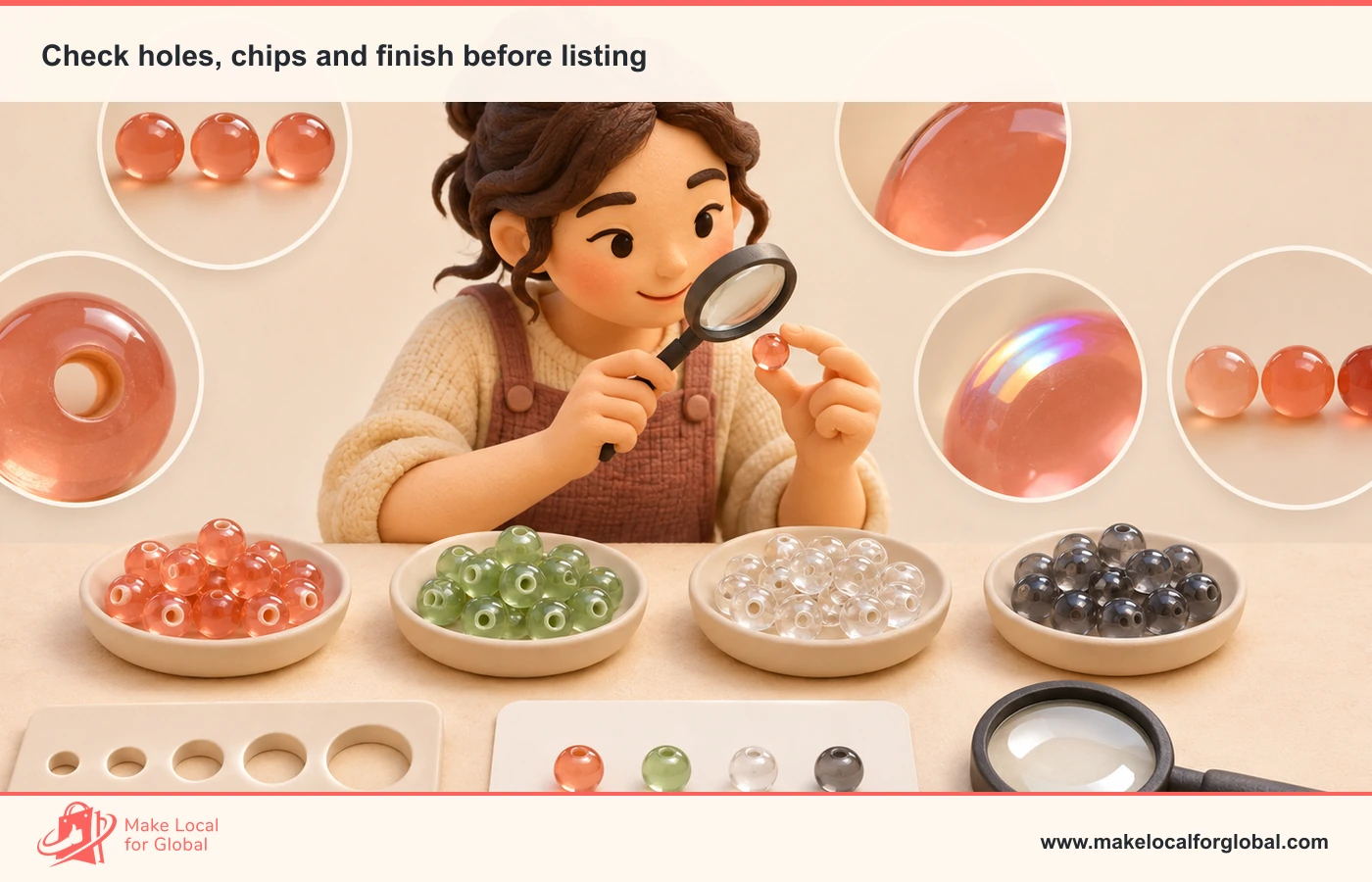
Check every sample under steady light. Look for blocked or rough holes, cracks, chips, sharp edges, uneven coatings, beads that differ noticeably in size, and unwanted residue. Roll several beads on a flat surface to see whether they are round enough for the use you plan to describe. Try threading the intended cord or needle through a small group. One bead threading successfully does not prove that every bead in a pack will work.
Use a checklist tied to each supplier and product code:
Set your acceptable defect level before checking the whole shipment. If a pack has a few irregular pieces, decide whether that quantity affects the buyer’s project and whether you need to remove them. Keep the rejected beads and photographs with the batch record. Contact the supplier with the product code, delivery date, photographs and count of defects rather than a general message saying that quality is poor.
Possible suppliers include bead manufacturers, specialist wholesalers, local craft distributors, importers and marketplaces. A low price per tube does not show the cost of receiving, checking, sorting, repacking and delivering the goods. Ask each supplier for the product code, country of origin where known, material description, measurements, hole size, finish information, unit quantity, minimum order and sample policy.
Ask how colour names and codes relate to future batches. Request written advice on whether a finish can fade, tarnish or rub, and whether the supplier has test information for the exact product. Ask about packaging units, lead times, backorders, substitutions and how a damaged or incorrect shipment is handled. A shop needs to know whether an out-of-stock colour will be replaced by a similar shade or removed from the order.
For suppliers outside the UK, ask for the full landed cost and delivery route. Include product cost, freight, insurance, customs clearance, duty where applicable, import VAT treatment, courier fees and the cost of receiving the shipment. Use HMRC’s current guidance on valuing imported goods for VAT, and check the commodity code using official HMRC guidance rather than copying a code from a marketplace listing. Keep invoices and import records with each stock batch.
Compare the exact same bead size, finish and pack amount when reviewing quotes. A supplier’s “similar” colour may use another coating or hole diameter. Record the exact code in your stock system. If you change supplier, order a new sample and compare it with your listing photographs before replacing a product without changing its description.
Ask for a small mixed order before agreeing to a case quantity. The sample can show whether pack labels, product codes and shipping paperwork make receiving work easier. If the supplier will not provide enough information to describe the bead correctly, consider a product for which you can verify more.
The supplier’s invoice is one part of stock cost. Divide freight, customs clearance and other inbound charges across the units that actually pass inspection. If a box contains 500 tubes and 12 tubes have broken packaging or defects, base the saleable unit cost on the 488 usable tubes, not the number the supplier intended to ship.
Suppose a small starter pack uses three bead types. Add the cost of the beads, small pouches, product label, picking time, outbound packaging, postage, payment fee and a realistic allowance for damage or returns. If you use an advert to bring a buyer to the page, count the cost per order rather than using the total campaign spend. The example below is illustrative, not a supplier quote.
| Illustrative order calculation | Amount |
|---|---|
| Customer payment including VAT | £18.00 |
| Net sales value before output VAT | £15.00 |
| Beads and allocated inbound freight | £4.10 |
| Sorting and packing labour | £1.20 |
| Pouches, labels and protective mailer | £0.85 |
| Postage paid by seller | £2.60 |
| Payment fee allowance | £0.65 |
| Customer acquisition allowance | £1.40 |
| Damage and return allowance | £0.45 |
| Total listed variable costs | £11.25 |
| Contribution before overhead and tax | £3.75 |
The calculation is £15.00 net sales less £11.25 of listed variable costs, leaving £3.75 contribution before overhead and tax. The example assumes a VAT-registered seller charges standard-rate VAT at 20% on a delivered physical product. Actual VAT treatment depends on the seller, product and transaction. The cost lines exclude recoverable input VAT; ask an accountant how to handle the figures for your business.
Contribution is not net profit. It does not cover website costs, storage, insurance, photography, accounting, unsold colours or the owner’s unpaid design and admin time. A low price pack may have a small contribution after fixed postage and payment charges. Compare a single pack with a multi-pack basket, but do not assume customers will buy extra units to make the calculation work.
Check a few changes to the example. If the buyer selects tracked delivery and postage increases by £1.50, contribution falls to £2.25. If the pack takes five minutes longer to sort and pack, add that time at a realistic hourly rate. If a mixed assortment requires more picking lines, cost the additional labour. Use your actual invoices and order records to revise the figures.
A customer should be able to decide whether a pack will cover the project. “Small pack” is not a unit. Provide a count or weight and explain the likely use without promising an exact project outcome that depends on the design. If the bead count varies by colour or shape, show the range and say what determines the final mix.
Offer a smaller sample pack when colour, surface or size needs checking in person. A sample can reduce uncertainty for a maker who is choosing beads for an existing project. Price the sample so that picking, packaging and postage do not make every sale a loss. You can offer a voucher toward a larger order if the economics support it, but state the terms and expiry clearly.
A larger pack can suit repeat makers, classes or small studios. State whether one pack contains a single production batch. If a bundle combines more than one batch, disclose any known colour variation and check the shades together before dispatch. Do not mix lots silently when the buyer expects a matching set.
Use a title that identifies the item and a key specification. For example, “Opaque coral glass seed beads, size code 11/0, 10 g pack” gives the visitor more information than “Pretty coral beads”. Use only a size code, material detail and finish that the supplier supports. If you add an in-house colour name, keep the supplier code in the stock record and product details where it helps repeat ordering.
List the information a customer needs before checkout:
Say whether the beads are sold as components or as a toy, kit or finished jewellery item. Avoid claiming that beads are non-toxic, hypoallergenic, child-safe, recycled, lead-free or suitable for a named use unless the supplier provides evidence for the exact batch and product. If the evidence is incomplete, keep the description limited to what you can verify.
Use short paragraphs and clear dimensions. Explain unfamiliar terms when the intended customer is new to beadwork. A photograph of the bead beside a ruler helps with scale; a photograph of the hole and finish helps with selection. Add a project photo only if it accurately depicts a possible use and does not make an unframed component look like finished jewellery.
Glass reflects light and can look unlike its photographed appearance under daylight, warm bulbs and phone screens. Use neutral, consistent lighting and photograph a sample beside a plain background. Avoid editing the hue so a transparent bead looks opaque or a muted shade becomes saturated. If you show a colour chip or digital swatch, say it is a guide and that screens may not reproduce the same shade.
Show one full pack, a close view of the hole, a handful beside a scale reference and a sample used in a simple project. Keep the bead dimensions and finish visible. If the item is a mixed pack, photograph a representative unit and explain that actual colours or ratios may vary when the supplier packs by weight.
Keep an approved reference photo with the supplier code and batch number. When new stock arrives, compare it against the image. If the shade, surface or bead size changes enough to affect the product promise, update the photograph and description before dispatching it as the same item.
Use descriptive alt text for accessibility. Describe the image, such as “coral and clear glass seed beads beside a millimetre gauge”. Do not repeat the same keyphrase across every image or use alt text to list product claims that are not visible.
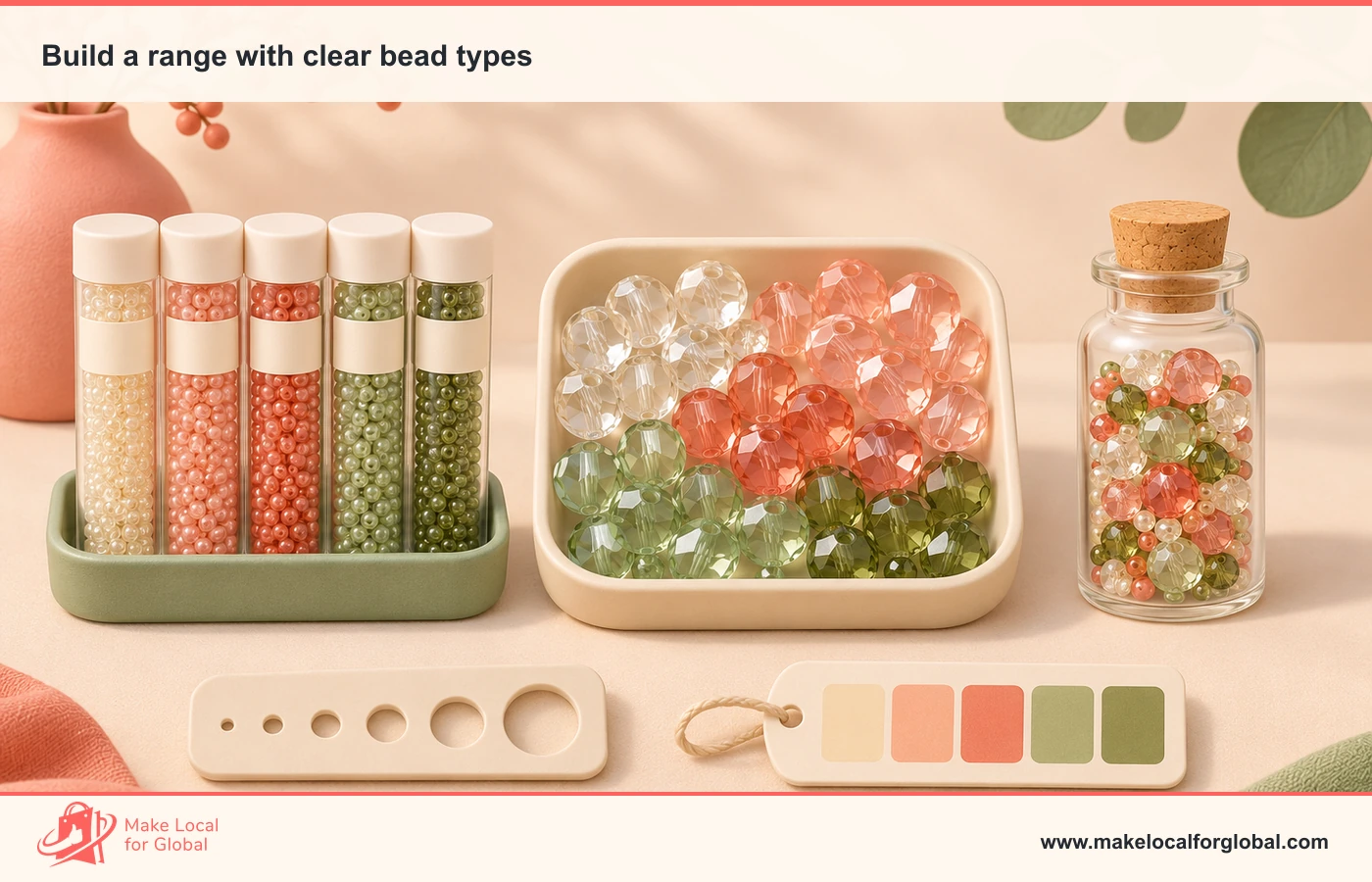
An entry pack can help a new buyer test a colour or size. A core pack can contain enough beads for a repeatable project. A premium option might combine several finishes or a curated palette, with a clear count or weight. The labels “entry”, “core” and “premium” should describe a real change in contents or service, not a higher price for the same product.
Price a bundle by counting every component, packing step and order fee. Three packs sold together may reduce postage per pack, but they still need an accurate stock count and pack label. If you sell a project mix, list the colour codes, total weight, bead sizes and any other parts included. Do not bury a cheaper pack’s unit amount inside a bundle price.
Use current supplier quotes and actual buyer response when setting price. A competitor’s listing may use other bead sizes, quantity, brand, origin, packaging or customer service. Compare the complete offer: exact specification, pack amount, delivery, returns and who handles a faulty pack.
An independent shop can give you more control over product descriptions, colour collections and repeat-customer records. You need to attract visitors and answer questions about size, finish and pack quantities. Keep filter choices simple: bead type, size, colour family, finish and price are often more helpful than a long list of supplier jargon.
A craft marketplace can put products in front of people searching for components, though its current fees, listing rules, image policies and seller obligations need checking before you rely on it. Use the marketplace’s own current documentation and record all charges. A fee that applies to delivery or advertising changes the cost per order.
Wholesale supply to a local bead shop, class or studio may produce fewer but larger orders. Provide a clean stock list with product codes, pack amounts, minimum quantity, reorder time and trade terms. Confirm whether the buyer expects barcodes, a specific label or a return process for damaged goods.
You can test more than one channel, but keep the product code and specification consistent. If one platform names a colour “dusty coral” and another calls it “salmon”, buyers may assume they are separate products. Keep one source record for measurements, supplier codes and approved photos.
Start with phrases that name the material, bead type, size, finish and use: “glass seed beads for embroidery”, “faceted glass beads for jewellery making”, “small glass beads by weight” or a verified manufacturer code. These are phrases to test in your own keyword research; they are not proof of volume or sales potential.
Write a distinct product page for each meaningful specification. A page for a 4 mm faceted bead should show its size, finish and quantity, rather than copy a seed-bead description and change one word. A colour collection page can group related shades and link to each product. Avoid making thin pages for every colour if the pages repeat the same text and do not help a buyer choose.
Use headings for useful information such as size, finish, pack contents, delivery and returns. Add a size chart only when you can keep it accurate. Include the exact supplier code in the product detail where a repeat buyer would use it. Update the page when a supplier changes specifications or a colour is discontinued.
A short demonstration can show how bead diameter changes the look of a woven row. A comparison can explain how transparent and opaque beads behave beside several thread colours. A packing video can show how a small order is separated, weighed and sealed. Use the actual stock and give a clear product link so viewers know which pack appears in the demonstration.
Try one small promotion at a time. Share a colour comparison with a local craft group if group rules allow it, send a sample to a maker whose audience matches the product, or show a project card at a class. Record visits, saved products, questions, basket additions and purchases. Views without product actions may mean the content is interesting but the offer needs clearer size, quantity or price information.
Keep any maker collaboration agreement in writing. Set the number of samples, disclosure of gifted products, usage rights for photographs, tracking link and payment terms. Do not present a paid or gifted recommendation as an independent customer review.
Map each pack to its size, colour, buyer and full order cost before adding more products.
Use a stock code that identifies bead type, size, finish and colour. Record the supplier’s item number separately from your own SKU. For a mixed palette, give the mix a separate code and list each component’s amount. A clear code helps you find the right product when an order asks for a replacement or the supplier changes its packaging.
On receipt, record the delivery date, supplier invoice, order number, package count, batch or lot information and result of the sample check. Separate saleable stock from stock that needs review. Store glass beads in sealed, labelled containers that prevent spills, dust and accidental mixing. Keep small packs away from direct sunlight if the finish may be affected, and follow supplier storage notes.
Count or weigh stock at a regular interval, especially for high-volume colours and small packs. Compare expected stock with shelf count and investigate repeated discrepancies. A few beads lost during sorting can affect the stated weight or count of every pack. If you pour beads between containers, label both the source lot and destination container.
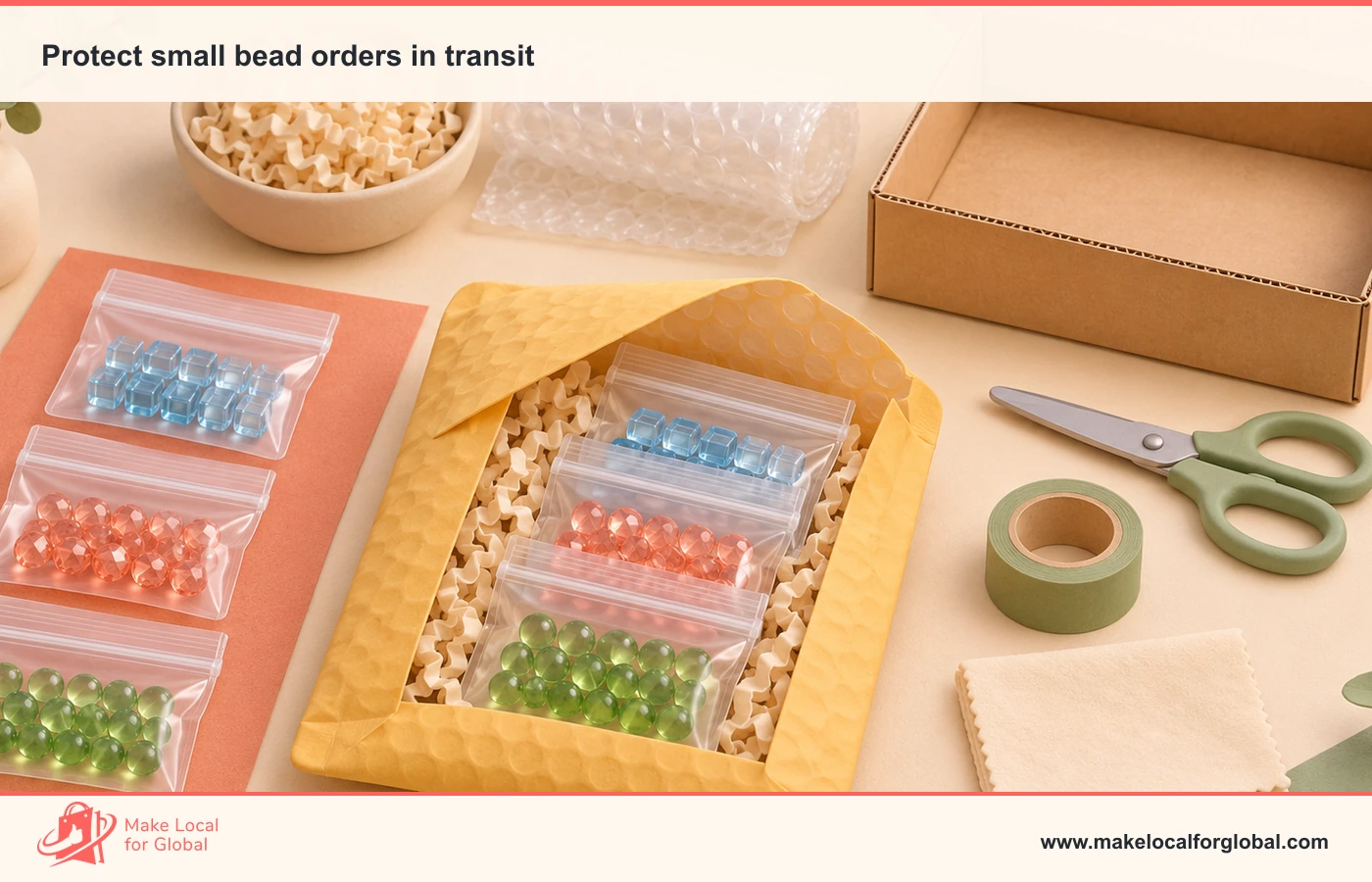
Use a pouch or tube that suits the quantity, then place it inside an outer mailer or box that can withstand ordinary sorting and handling. A glass bead pack should not open in transit or rub against another hard item until its packaging splits. Test the finished parcel by turning it, gently shaking it and checking whether the seal stays closed.
For several colours in one basket, package each group separately and label the product code or colour. Place small pouches inside a secondary bag or small carton so a damaged inner pouch does not scatter beads through the parcel. Use a mailer that protects the order without wasting space; a large box can allow small components to move and may raise postage cost.
Send a test parcel through the service you plan to use. Ask someone else to open it and report whether the pack is easy to identify, count and store. Check for split seals, crushed tubes, leaked contents, bent labels and confusing colour names. Change the packaging when the test exposes a failure.
Measure the packed order, not only the bead pouch. Confirm weight and dimensions against the carrier’s current service limits and price bands. If the buyer pays for tracked delivery, verify the selected service actually includes the tracking level you describe. Keep a photograph of a representative packed order and add postage materials to the cost sheet.
Glass bead components can pose risks when they are small, breakable, used by young children or sold as part of a toy or finished product. Do not assume that a warning on a supplier’s carton covers your own sales page or finished kit. Decide what product you are placing on the market and who it is meant for before writing safety information.
In Great Britain, the Office for Product Safety and Standards explains that the General Product Safety Regulations 2005 require consumer products to be safe in normal or reasonably foreseeable use. The GOV.UK product safety guidance for businesses says businesses that make, import, distribute or sell consumer products have responsibilities. In Northern Ireland, EU Regulation 2023/988 on general product safety applies from 13 December 2024; see the Northern Ireland business guidance.
If you assemble or sell a product as a toy, specific toy rules may apply. The Toys (Safety) Regulations guidance for Great Britain describes manufacturer duties such as a safety assessment and conformity process. Do not add toy language, age grading, safety marks or child use instructions from a template. Check the exact product and relevant legislation before marketing a bead kit for children.
If you sell a component for adult jewellery making, say so plainly and keep it away from toy imagery. Small parts warnings must reflect the product and applicable requirements. Ask a qualified product-safety adviser when the intended use, age group, material or finished-product status is unclear. This information is general business guidance, not a legal opinion.
Keep supplier declarations, test documents, invoices, batch notes and product photographs together. If a supplier cannot confirm whether a coating contains a restricted substance or how it performs, avoid making a chemical or safety claim on the listing. Escalate a suspected defect, injury or safety issue and follow the applicable product-safety reporting route for the part of the UK where you sell.
Glass type, surface coating and inner-hole finish affect appearance and use. A metallic effect may come from a coating rather than the glass itself. Some decorative finishes can wear, tarnish, fade or react to abrasion. Use supplier descriptions for the exact product, and keep a copy of technical data or written confirmation.
MIYUKI’s published finish notes describe varied effects and their care considerations. Its reference information notes that some finishes can be affected by sunlight, rubbing or cleaning methods. That advice applies to the supplier’s specified products, not automatically to every bead sold as “glass”. Ask the supplier about the product code you buy and do not promise that every finish is washable, colourfast or suitable for skin contact.
Avoid broad claims such as “premium”, “non-toxic”, “ethical”, “eco-friendly” or “safe for children” when you cannot show what they mean and provide supporting records. Use objective wording: “transparent coral finish”, “5 mm outer diameter as stated by the manufacturer” or “supplier code ABC-123” when those details are correct. State uncertainty where the batch may vary.
Before checkout, tell the buyer who is selling the beads, the main product details, full price, delivery cost and expected timing. GOV.UK’s online and distance selling guidance lists information sellers need to provide before an order and requirements for contract information after a purchase.
Online customers usually have a right to cancel within 14 days after receiving most goods, subject to exceptions. The government’s returns and refunds guidance explains cancellation, return and refund expectations. Do not publish a blanket “no returns on beads” line. Get advice on your exact product and terms if you sell a sealed hygiene-sensitive kit, personalised selection or another unusual offer.
Write a simple route for reporting a damaged or incomplete order. Ask for the order number and a photograph of the parcel and contents, reply within a stated period and explain whether you will replace or refund the item after reviewing the facts. If several packs from one batch arrive damaged or have blocked holes, pause sales from that batch until you have checked it.
Keep a record of the materials used for each order: pouches, labels, padded mailers, boxes and tape. The UK packaging extended producer responsibility rules may apply depending on the business and packaging activities. Use the current GOV.UK EPR packaging checker to review whether your business needs to report or pay. Thresholds and duties can change, so check the current guidance for your turnover and packaging volumes.
Use narrow environmental statements that you can support. A paper mailer does not prove that a parcel is recyclable everywhere. A recycled pouch claim needs evidence for the material and percentage. The Competition and Markets Authority’s Green Claims Code explains that environmental claims should be clear, accurate and supported. Save supplier documentation for a claim and state any relevant limits.
Use four weeks to check the range before expanding it. Supplier lead times may change the schedule. Keep one short note each week on what you tested and what evidence changed the next choice.
| Week | Work to complete | Evidence to keep |
|---|---|---|
| 1: Choose and test | Define one buyer, compare three sample options and record project questions | Requested sizes, preferred colours and willingness to buy a sample |
| 2: Source and inspect | Confirm supplier codes, terms and full landed cost; inspect sample packs | Measurements, defect notes, finish details and invoice assumptions |
| 3: Prepare listings | Photograph scale and hole, write exact pack details and test checkout | Listing questions, postage size, order test and price calculation |
| 4: Launch and review | Release a small range, send a modest promotion and track orders | Visits, basket adds, orders, damage, questions and contribution per order |
At the end of Week 1, drop an option that does not fit the buyer or has no clear project. In Week 2, resolve supplier questions before ordering a large quantity. In Week 3, let someone unfamiliar with the range read the product page and tell you what arrives in the pack. In Week 4, compare customer questions and order data with your original assumptions.
If buyers ask about the hole size, add a close-up and measurement. If customers like the colour but the pack is too small for the project, test another quantity. If tracked postage consumes the contribution, compare packaging, basket offers and the posted price. Change one thing at a time so you can tell what affected the result.
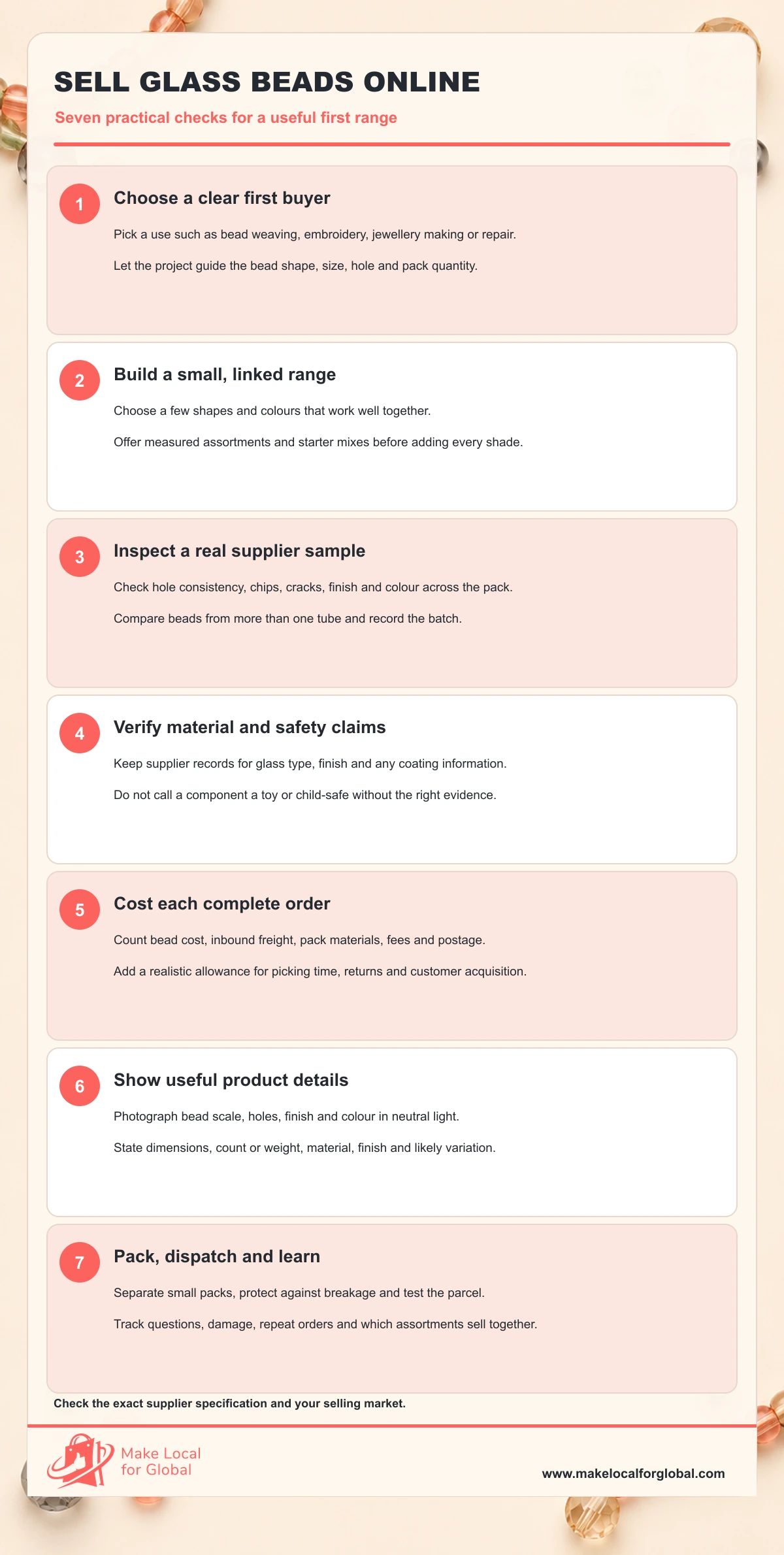
Buying every colour before checking demand. A full supplier chart can leave cash tied up in slow-moving shades. Start with a small palette and use orders and questions to decide what to add.
Listing a size code without a measurement. Suppliers may use their own codes or tolerances. Include the manufacturer code and verified dimensions that help a buyer choose.
Selling by “small pack” or “large pack”. Those words do not tell someone how many beads they will receive. State a count or net weight and explain how you fill the pack.
Photographing mixed stock as a fixed assortment. If colours or ratios shift, explain the variation and show a representative mix. Do not imply each pack is identical when it is not.
Ignoring holes and finish. A bead may look attractive in a tray and still be difficult to thread or show wear. Test holes, coating and the intended material before you make a claim.
Treating supplier wording as proof. A product title is not a test report. Keep technical documents and avoid safety or chemical claims without evidence for the product.
Pricing from the bead invoice alone. Sorting time, pouch, mailer, postage, payment fees and replacements affect each order. Use a full cost sheet and update it after the first dispatches.
Combining batches without a check. A new batch can change colour or finish. Compare it with your approved sample and update the product page if the change matters to buyers.
Using a generic returns policy. Online cancellation rules may apply to small craft components. Check current guidance and write terms that match the product and customer route.
Start with bead types that serve a defined project and can be described with verified measurements. A small range of seed beads, larger rounds or a coordinated starter mix can work if sample checks and customer feedback support it. Avoid buying many colours before you know which use attracts buyers.
Use a fixed count when you can count the pieces accurately and repeat the method. Weight can suit tiny beads sold in larger quantities. State the method clearly, check the tare weight of the packaging and avoid implying an exact count if you have not counted the pack.
State the manufacturer’s product code plus measured dimensions in millimetres when available. Include the hole diameter if the supplier confirms it. A photograph beside a ruler helps with scale but does not replace a written measurement.
No. A code can be tied to a particular manufacturer and product. Check the supplier’s dimensions and sample the actual item. Recheck the product when you change supplier or receive a new batch.
Inspect a sample for size consistency, clear holes, chips, cracks, rough edges, finish wear and colour variation. Thread representative beads with the cord or needle relevant to the stated use. Record the batch and reject count before deciding whether it can be sold.
Only make a child-safety claim after checking the exact product, intended age and legal requirements. Small parts and toy products can trigger specific obligations. If you are selling loose components for adult craft use, state that use clearly and avoid child-directed wording.
Use steady, neutral lighting and a plain background. Photograph the bead close enough to show the hole and finish, then include a separate scale reference. Avoid heavy colour editing and explain that screens may not reproduce the same shade.
Name the bead types, sizes, colours and quantity or weight in the pack. Say whether the colour ratio is fixed or may vary, and show a representative set. If the mix is sold for a project, identify any thread, findings or instructions included separately.
Seal each colour or product separately, then place the pouches inside an outer mailer or box that protects them during handling. Test the pack for leaks and measure the finished parcel. Keep labels legible and make it easy for the customer to identify each bead.
Include bead cost, inbound freight, import charges where applicable, sorting labour, pouches, labels, postage, payment or marketplace fees, customer acquisition and a damage or return allowance. The remainder after variable costs is contribution, not net profit.
Do not assume that loose beads are exempt from online cancellation rights. Most distance purchases have a statutory cancellation period, subject to defined exceptions. Check current GOV.UK guidance and get advice for a product with unusual packaging or personalisation.
Prepare a trade list with product codes, bead type, size, finish, colour, unit amount, case quantity, lead time and minimum order. Ask about shop labelling, barcode and delivery requirements before agreeing terms. Keep trade pricing separate from retail costs.
Track orders by bead code, repeat purchases, stock accuracy, customer questions, damaged packs, delivery cost, picking time and contribution after variable costs. Use those records to decide whether to add a colour, change pack quantity or remove a slow option.
Use sample checks, customer questions and order costs to choose what to adjust in the range.
PREFERRED SOURCE
Like what you’re reading? Add Make Local for Global as a preferred source on Google to see more of our articles when you search.

Build your online presence without having to figure out everything yourself.