

READY TO SELL beach blankets ONLINE?
Get a store built for you in 5 days, plus training and support to help you start, run, and grow your Alternative business.

Learn how to sell beach blankets online by choosing a buyer, checking fabrics and labels, testing samples, costing delivery and planning a small launch.


A beach blanket has to earn its place in a customer’s bag and in your stockroom. To sell beach blankets online, choose a clear use, compare a small number of fabrics, test a real sample and price the packed order before you buy a larger batch.
The product may be used for a day at the coast, a picnic in the park or a family outing. Those buyers care about different things, so start with the person and the situation rather than a long list of colours.
Use MLFG’s business tools to map your first product choices, sample checks and launch actions before ordering stock.
A solo traveller who carries a small day bag may want a blanket that folds into a compact bundle. A parent may look for room for several people and a surface that is easy to shake out. A picnic buyer could care more about a comfortable weave and a stable place for food than a beach-specific feature.
Choose one group for the first test. Ask five people in that group when they use a blanket, what they take with them, how they clean it and what has annoyed them about a current option. Write down the words they use. Those details can shape your product page and search phrases.
Begin with a small range that gives each item a reason to exist. A light roll-up, a larger woven blanket and a model with a backing can serve different use cases. Confirm the actual fabric, dimensions, weight and care details from each supplier sample before describing any feature.
| Starting option | What to compare | Possible buyer use |
|---|---|---|
| Compact roll-up | Folded size, packed weight, strap or pouch, fabric feel | A short trip where bag space matters |
| Woven cotton style | Fibre content, weave, drying after washing, hem finish | A buyer who wants a familiar textile feel |
| Large blanket with backing | Backing material, seam strength, fold size, parcel band | A family outing or picnic where extra room matters |
These are range-planning examples. Check each sample and the supplier’s specifications before you describe a product or make a performance claim.

Ask for the exact fibre composition, finished dimensions, weight, colour options, washing instructions and packaging dimensions for each model. If the blanket has separate layers, edging or a backing, ask how those components are described on the textile label.
Check the minimum order, sample charge, lead time, reorder time, batch reference and what happens when a shipment arrives with loose stitching or colour differences. Request a sample from the production route you intend to use, and save the supplier’s answers with your order record.
Do the same checks on every sample and keep a short record. The aim is to learn what the product does in ordinary use, not to prove a universal claim from one test.
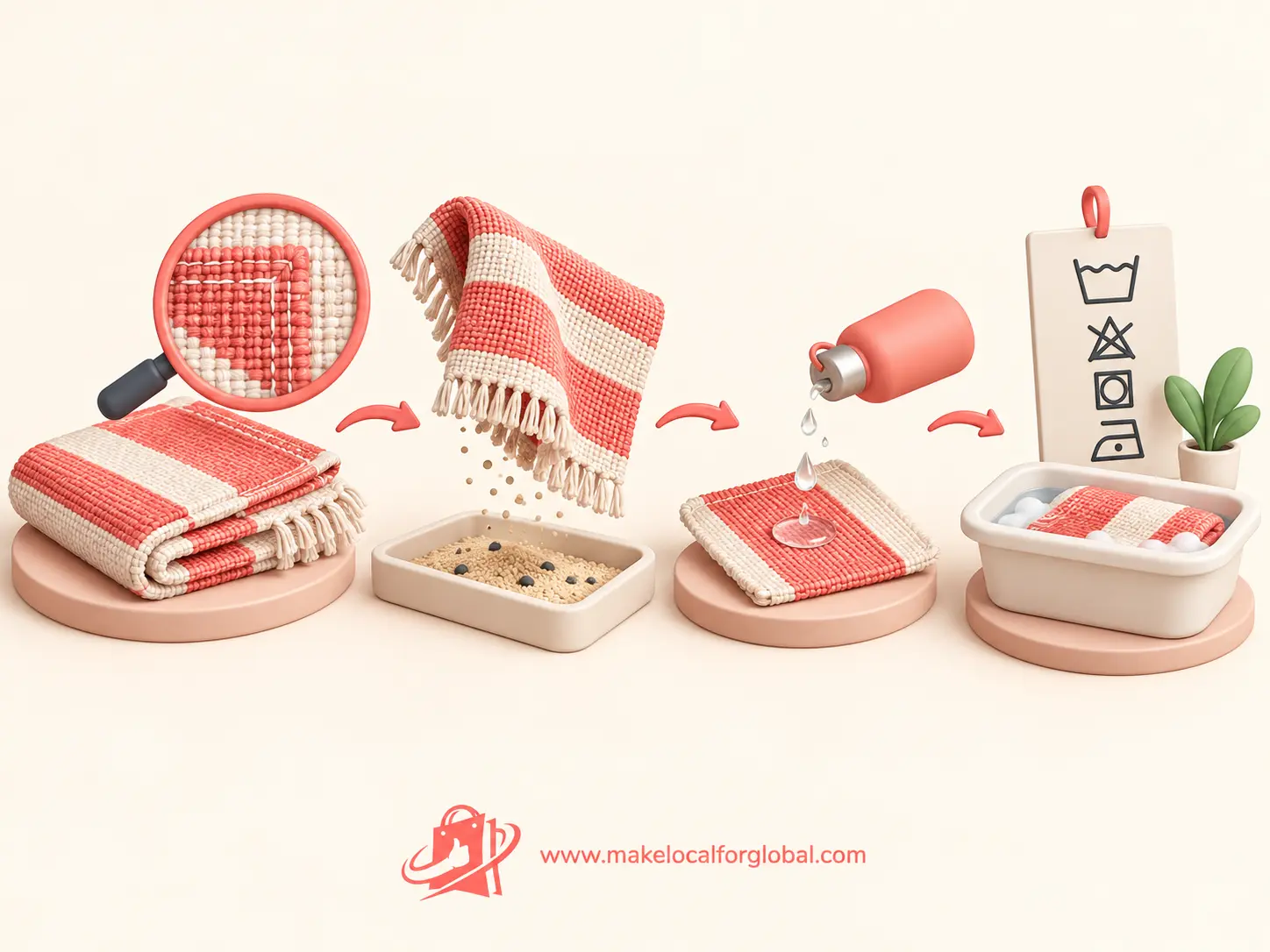
For England, Scotland and Wales, GOV.UK says textile labels must show the fibre content. If a product has components with different fibre contents, each content must be shown. Manufacturers and retailers share responsibility for following the labelling rules. Read the current GOV.UK textile labelling guidance and check the rules that apply in Northern Ireland or any export market before selling there.
If you make, import, distribute or sell consumer products in the UK, you have product safety duties. The Office for Product Safety and Standards explains record keeping, product information and traceability in its product safety advice for businesses. Keep supplier details, product references, label files and complaint records so you can identify the stock involved if a problem is reported.
Describe materials and performance in plain terms supported by the sample or documents. Use “recycled”, “organic”, “water-resistant” or “sand-resistant” only when product-specific evidence supports the wording. A broad claim can create buyer complaints if the label or real-use result says something else.
Give the buyer enough detail to judge the blanket and the parcel. A factual title might be “Large woven beach blanket, 180 × 200 cm, cotton blend” only when the measured size and fibre label match the product.
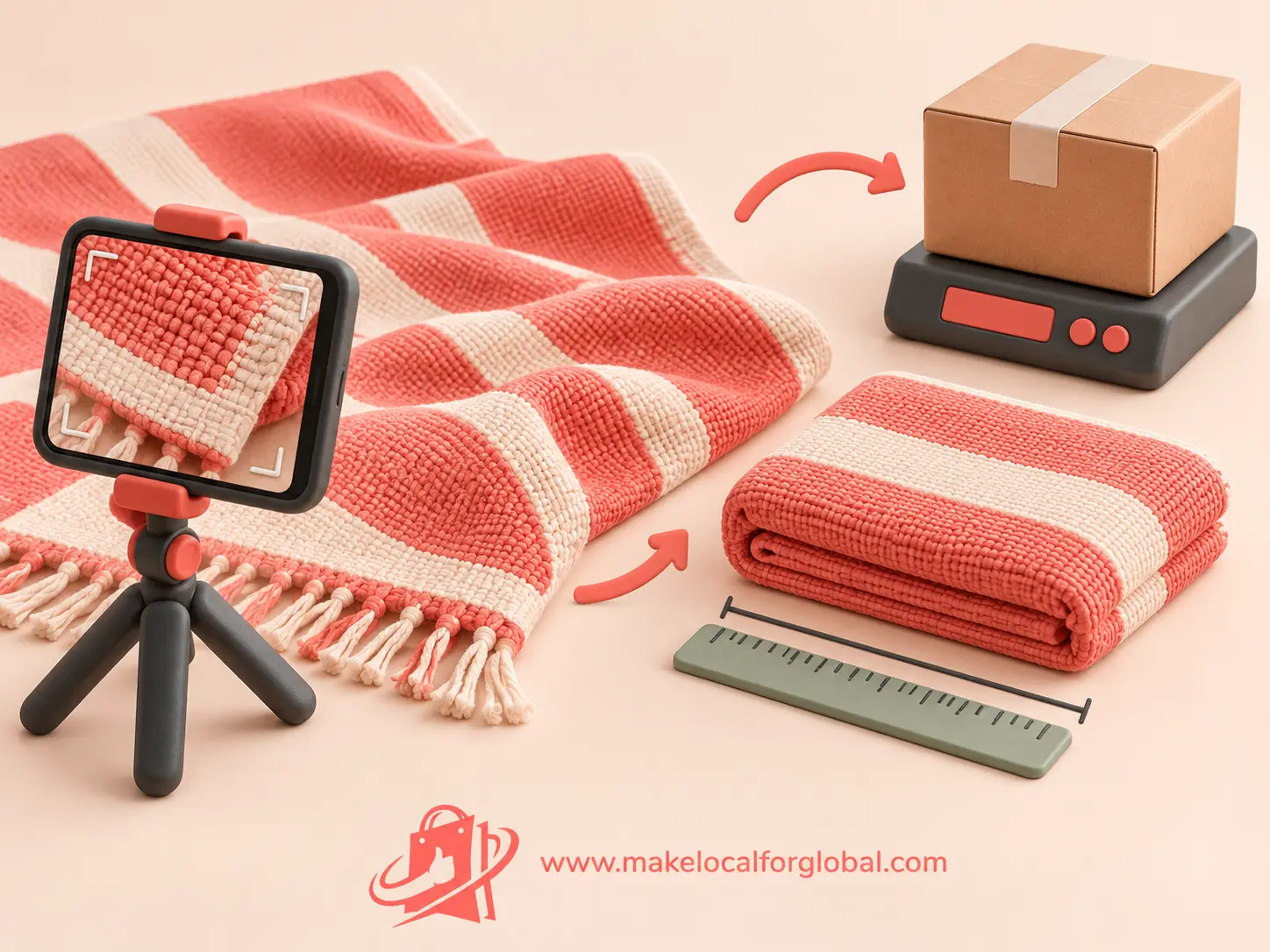
Photograph the actual sample in natural light so buyers can judge its colour and texture. Show the whole blanket, one corner, the reverse side, the label and a folded view. A simple ruler or floor measurement can clarify scale better than an oversized lifestyle scene.
For a related textile product, see our practical article on selling beach towels online. The products serve different needs, yet both benefit from clear fibre details, accurate photographs and delivery costs based on the packed item.
A blanket’s folded dimensions can move it into a different parcel band, so calculate from a packed sample. Include the supplier price, inbound freight, packaging, postage, platform and payment charges, customer acquisition and an allowance for returns or damage.
The example below uses an illustrative £34 blanket price and £3.95 delivery charge. The fee allowance is a planning figure, not a quote. Etsy’s current fee page lists transaction, payment processing, listing and possible advertising or other charges; check the live Etsy fees and taxes information for your seller account and channel.
| Illustrative order line | Amount |
|---|---|
| Blanket price paid by customer | £34.00 |
| Delivery paid by customer | £3.95 |
| Blanket from supplier | −£9.50 |
| Share of inbound freight | −£1.30 |
| Mailer and packing materials | −£1.10 |
| Parcel postage | −£3.95 |
| Marketplace and payment fee allowance | −£3.10 |
| Returns or damage allowance | −£1.20 |
| Customer acquisition allowance | −£2.00 |
| Contribution before overheads and tax | £15.80 |
Illustrative arithmetic: £37.95 received less £22.15 variable costs = £15.80 contribution. Figures are before VAT, fixed overheads, tax and owner time. The fee and acquisition amounts are assumptions, not quotes or a profit forecast. Replace them with your own channel and parcel costs.
Contribution is not net profit. Add storage, insurance, software, payment timing and the time spent packing or answering questions. If you are VAT registered, rebuild the example using the VAT treatment and recoverable input VAT that apply to your business.
Compare each blanket’s packed weight, channel fees and delivery cost before you set a price or bundle.
Start with one sales channel and a few offers that differ by use, size or fabric. A marketplace can put your product beside similar items, but fees and listing rules apply. Your own store gives you more room to explain measurements and care, but you need a plan to bring suitable visitors.
If you are weighing up the practicalities of an online shop, the MLFG page for selling beach blankets explains the store-building offer. The wider Product To Sell collection has more product-specific planning articles.
Fold the blanket dry, protect it from moisture and keep any strap or pouch with the product. Test the parcel after packing: the outer package should stay closed, the corners should not snag the fabric and the final size should match the shipping service you selected.
GOV.UK explains that online buyers usually have a 14-day period to cancel many goods after delivery, with exceptions for certain products. Read the current distance-selling guidance and provide clear business contact details, delivery information and cancellation terms before checkout. Check the rules for Northern Ireland or export destinations where your business sells.
Keep a stock record by supplier batch and save the fibre label and care details. If a customer reports a seam defect or a mismatch between the product page and the blanket received, record the issue and follow the returns process you published.
A month gives you time to hear buyer questions, test samples and compare actual parcel costs before you commit to a large order.
| Days | Action | What to record |
|---|---|---|
| 1 to 7 | Choose a buyer, speak with five people and compare three concepts. | Repeated needs, objections and preferred use. |
| 8 to 14 | Order samples, request fibre details and run the same checks. | Measurements, care results, seam issues and supplier lead times. |
| 15 to 21 | Photograph the sample, write the listing and cost the packed order. | Page questions, shipping band and contribution. |
| 22 to 30 | Test a small range on one channel and review the response. | Visits, orders, returns, delivery cost and questions. |
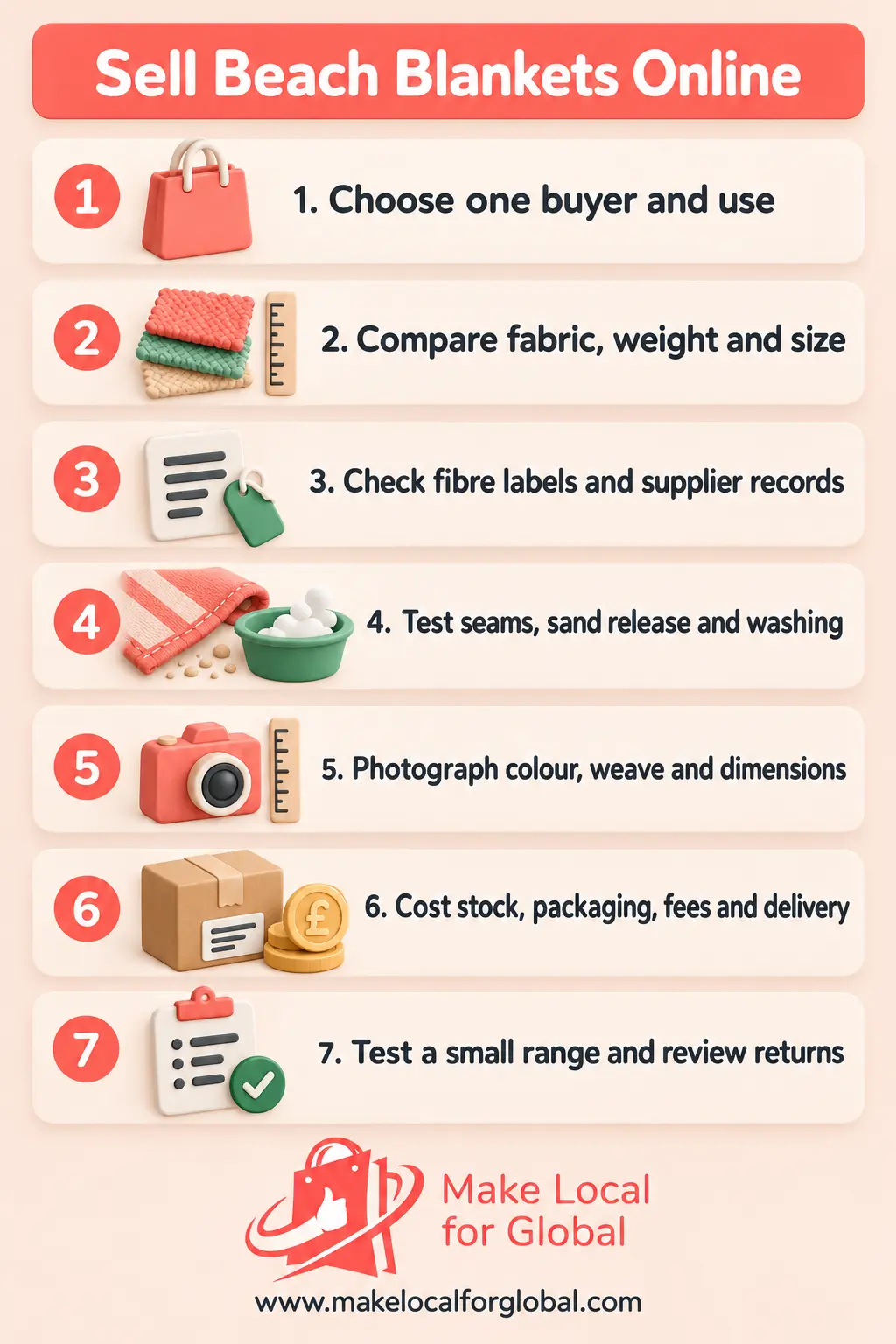
It is a portable textile used as a ground cover for the coast, picnics or outdoor seating. Products vary in fibre, weave, size, backing and included carry pieces, so a listing should describe the actual item rather than rely on the category name alone.
Check fibre composition, finished size, weight, seam quality, wash care, colour transfer, parcel dimensions and supplier traceability. Run repeat sample checks and keep evidence for any performance statement.
GOV.UK’s textile guidance for England, Scotland and Wales says labels must show fibre content, including the content of components that use different fibres. Check the current rules that apply in Northern Ireland and any other market you plan to serve.
Use a performance claim only when the supplier evidence and repeat tests support it for the exact model and use. State the test conditions and avoid wording that suggests a blanket cannot retain sand or take on water in any situation.
There is no reliable figure without your price, landed cost, platform fees, delivery, returns, marketing and overheads. The calculation above is an illustrative contribution example, not a sales or profit forecast.
Choose one buyer, request one sample and test it using the care information supplied. Add the packed parcel and selling fees to your cost sheet, then decide whether a small beach-blanket range merits a live test.
Once the fabric, product page and parcel plan are clear, explore options for a simple ecommerce presence.
PREFERRED SOURCE
Like what you’re reading? Add Make Local for Global as a preferred source on Google to see more of our articles when you search.

Build your online presence without having to figure out everything yourself.