READY TO SELL Fireproof Safes ONLINE?
Get a store built for you in 5 days, plus training and support to help you start, run, and grow your Alternative business.

Plan a fireproof-safe range with verified model evidence, clear product specifications, complete heavy-delivery pricing and a practical launch test.

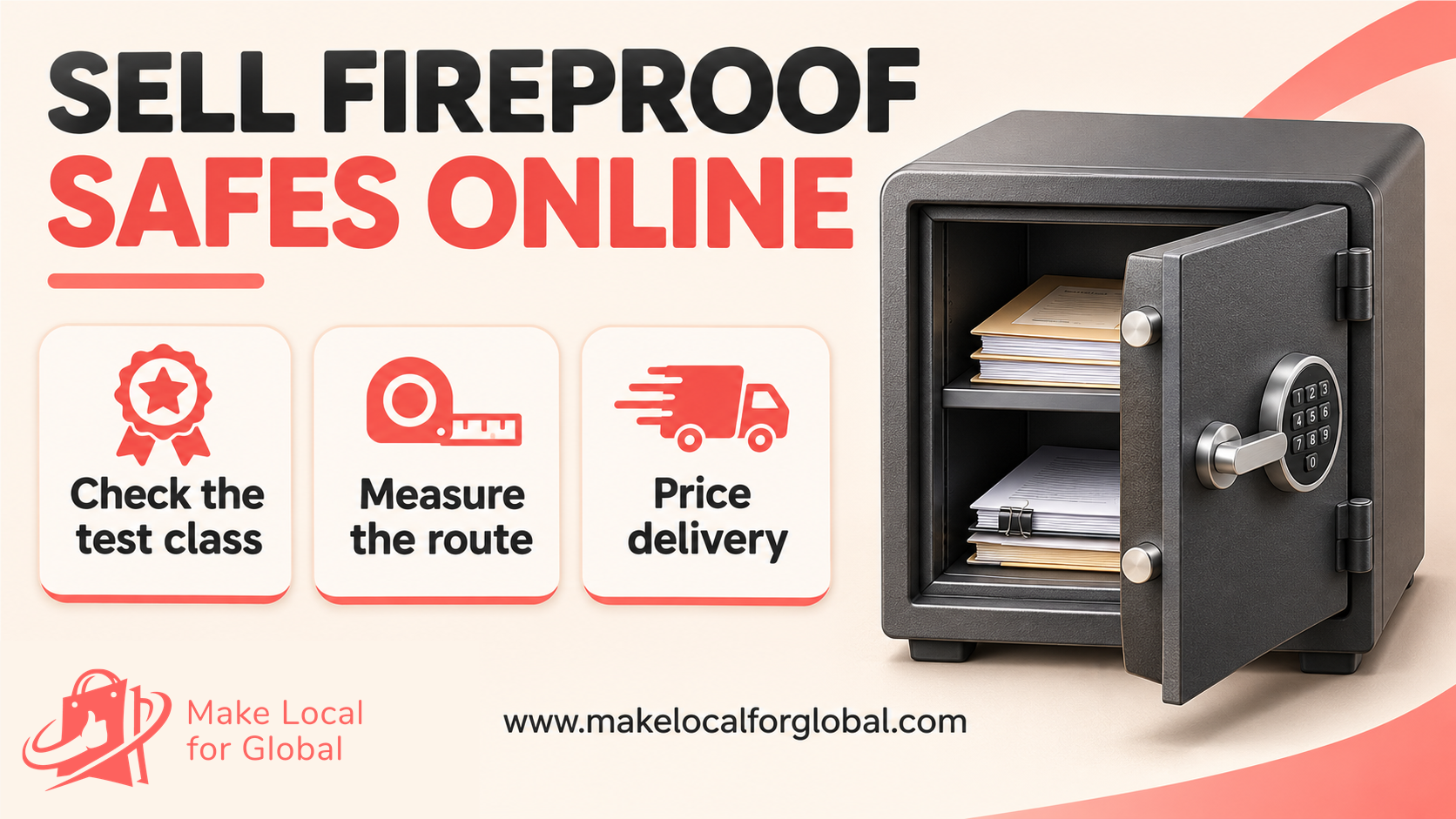
A safe is a promise about protection, and buyers often make that decision when they are worried about theft, fire or losing important records. That makes precision more useful than dramatic claims. A seller needs to distinguish a fire-resistant test rating from a burglary classification, match the safe to what the customer intends to store, and explain weight, installation and delivery before checkout.
To sell fireproof safes online, select a defined customer and storage use, verify the exact model and its certificates, write claims from the test evidence, and price the full delivered installation-ready order. A fire rating does not mean a safe is invulnerable to every fire, and a burglary grade does not make it fire resistant. Buyers need to understand the rating, the tested contents, the lock, the anchoring requirements and the service that arrives at their door.
This guide is for product planning, not a security survey or a guarantee of protection. A safe is one part of a customer's wider fire and security arrangements. For high-value, regulated or business-critical items, buyers should consult an insurer, security professional or other qualified adviser about their specific requirements.
Check the model certificate, intended contents and delivery requirements before you commit to stock.
Start with the contents and the risk the customer is trying to manage. A person keeping passports, certificates and a few household documents has a different need from a small firm storing signed contracts, backup drives, cash floats or stock records. A safe is not an interchangeable box: the test standard, internal volume, opening, shelf layout, installation, weight and delivery can all affect whether it works in the intended setting.
Ask what the product is intended to protect, where it will be installed and who needs access. Do not ask buyers to disclose the exact valuables they own. The helpful questions are about the type and approximate volume of the contents, the room, the number of authorised users, the expected access frequency and whether the customer needs fire protection, burglary resistance or both.
Some safes are designed for documents, small valuables or keys in a home office. Others are intended for business use, cash handling, controlled key storage or higher-risk valuables. The purchase journey should state the intended use in plain language and direct customers to a qualified security provider when an application falls outside the product's evidence or your expertise.
Do not present an inexpensive cabinet as equivalent to a tested high-security safe. A thicker-looking door, a digital keypad, a heavy construction or a reassuring product name do not establish a burglary resistance class. Likewise, a fire-resistant cabinet may offer very little protection against a deliberate attack. The buyer should be able to see which property has been independently tested and which features are simply product specifications.
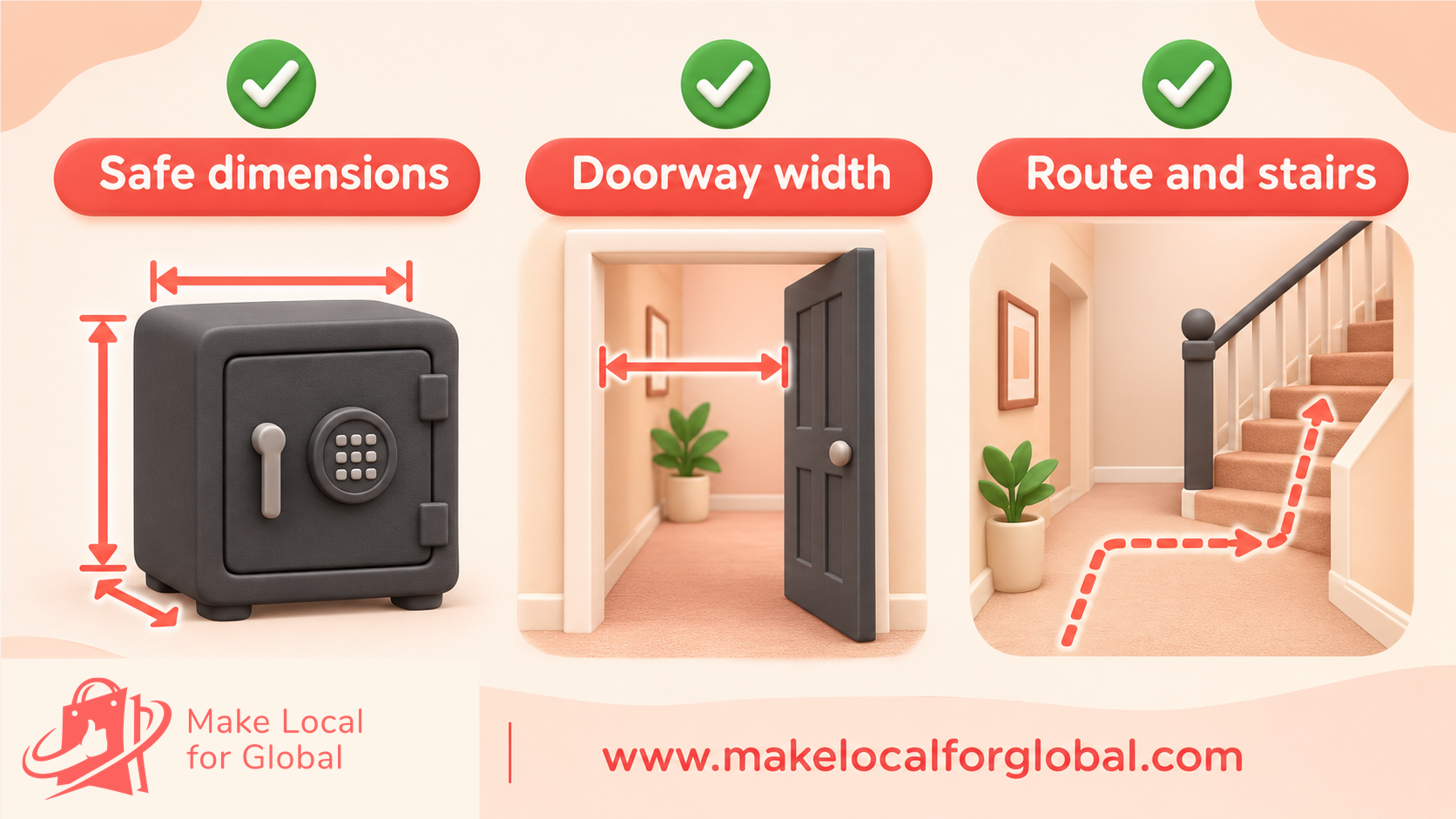
The safe may need to sit in a cupboard, under a counter, in a home office or in a commercial premises. Measure the clear opening, skirting, door swing, stairwell, corridor, lift, thresholds and floor access. Measure the intended installation space, not just the room's advertised dimensions. A safe that fits into a room on paper may be impossible to rotate through a narrow hall or lower into a fitted cabinet.
Use precise content categories such as paper files, passports, certificates, small keepsakes, cash float or backup media. Then explain what the selected test evidence covers. The words “fire safe” do not answer whether the product was tested with paper, digital media or another item. Some media can be damaged at lower temperatures or by moisture even where paper remains legible.
Do not claim a safe protects every document, digital device or valuable from every fire. The result depends on the test conditions, duration, internal temperature or humidity limits, the contents and how the safe is installed and maintained. State the model's certified class and the tested protection level, and describe practical limits in the product page's main copy.
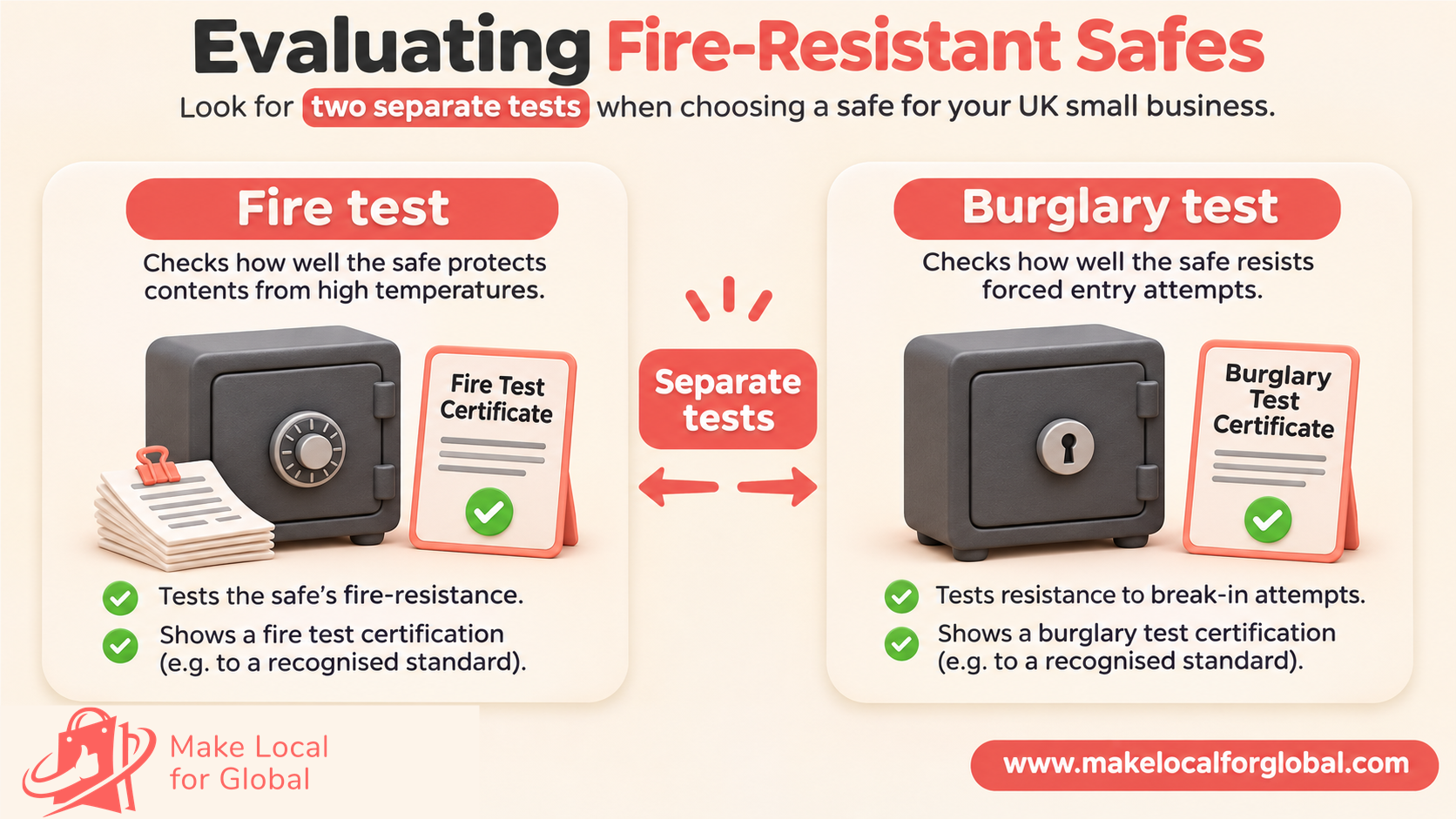
Fire-resistance and burglary-resistance standards answer different questions. An independent test report or certificate should identify the precise model or model family, the test standard, the classification, the certification holder and the conditions or limits that accompany the claim. Ask the supplier to explain any reference to a test house, product family, model variant or certificate schedule.
For light fire storage units, EN 15659 describes classifications including LFS 30 and LFS 60. Those marks refer to the fire exposure time in the test. They do not mean the safe will protect contents in every real fire for exactly that many minutes. The test includes defined procedures and temperature limits, and the result applies to the specified product construction and test class. Do not shorten the explanation into “30-minute fireproof guarantee”.
The term LFS refers to light fire storage units designed for paper media and some valuables, with limits on the temperature inside the unit. The standard notes that paper grades that lose data below 170°C are outside the relevant paper protection claim. Do not extend a paper-oriented class to USB drives, external hard drives, photographic media or other temperature-sensitive items unless the evidence covers those contents and conditions.
For data cabinets and sensitive media, EN 1047-1 covers test methods for fire-resisting data cabinets and data inserts. It uses specified fire endurance and fire shock and impact tests, with classes that reflect different protection limits. Use the supplier's exact certified classification rather than assuming that a domestic paper safe also protects data.
Burglary resistance has separate standards. BS EN 14450 covers secure cabinets for lower-risk situations than the products measured under EN 1143-1, and classifications include S1 and S2. BS EN 1143-1 concerns safes and other secure storage units tested for burglary resistance. A safe can carry a burglary classification without a fire classification, or vice versa. If both matters to a buyer, show each separately.
An insurer's required grade or cash limit depends on the customer's circumstances, policy wording, location, contents and other safeguards. An online seller should never promise that a safe will satisfy every insurer or unlock a particular cover amount. Tell customers to obtain confirmation from their insurer or broker before buying where an insurance requirement affects their decision.
Request the full certificate, not a supplier's brochure or an image of a test-lab logo. Check the exact model, size, door, lock configuration, internal fittings and installation assumptions. A certificate for one variant does not automatically cover every size in a product family. Ask how the certification scheme handles permitted construction variations and whether the certificate remains current.
Use a recognised third-party certification scheme where one is available for the product and intended claim. The ECB-S certified product directory provides examples of certified products, their standard and their listed classifications. A directory entry should still be checked against the exact product being offered; a nearby model with a similar name is not sufficient.
Keep a claim file with the document, model code, certificate number, issue or verification date, permitted wording, exclusions and supplier contact. Record who checked it and what changed when a later shipment arrives. If the manufacturer changes the body construction, door, insulation, boltwork, hinges, lock or production location, ask whether the certificate remains applicable before continuing to use the old claim.
Before placing a purchase order, ask for a product file that identifies:
If a supplier responds with “tested to the highest standards” without naming the test, model and classification, keep asking. If they cannot provide a certificate or explain the exact claim, remove that wording from the listing or choose a different product. A low unit price is not a substitute for verifiable evidence.
Wholesale resale is usually the most direct route for a new seller. You buy a completed model from a manufacturer or authorised distributor and sell it with accurate information. Confirm the supply chain, warranty route, service coverage and certificate documents before accepting the product. Verify who handles heavy-delivery damage and whether the buyer must inspect and sign at delivery.
Private label or custom manufacture can offer a distinctive appearance, size or lock configuration, but it gives the seller more responsibility to verify that the tested product is the one being sold. A badge or house brand cannot substitute for a certificate that identifies the design. Do not ask a supplier to print “fireproof” on a cabinet before confirming the test evidence and allowed claim wording.
Importing from overseas can add freight, customs, duties, local delivery, documentation and product-safety obligations. Ask who will be the importer of record, who will handle compliance information and whether the manufacturer can trace each production batch. Confirm that the electrical lock and power supply, if included, are suitable for the destination and comply with relevant product rules.
For a first range, compare the supplier's lead time and support capability as closely as the price. A safe can remain in service for many years. Buyers may need replacement keys, a lock reset, a service visit or help after a move. Choose a supplier that can provide support in the customer's country and can identify replacement parts by model and serial number.
Arrange a demonstration or representative sample before listing a model. The purpose is to verify product identity, fit, operation, documentation and delivery details. It is not to conduct a destructive attack or to reproduce a laboratory fire test. Do not drill, cut, heat or otherwise damage a certified safe to create marketing footage or an unsupported performance claim.
Match the physical sample to the certificate and supplier paperwork. Record the product code, dimensions, weight, lock type, finish, handle, hinge side, shelf arrangement, anchor holes and any accessories. Photograph the inside, front, sides, back, base, serial marking, label, packaging and included instructions. Make a note of any differences from the catalogue listing.
Open and close the door several times using the official instructions. Confirm that the boltwork engages smoothly, the handle does not scrape, the door does not catch and the lock behaves as described. A key lock, mechanical combination and electronic keypad have different use patterns. Do not assume an electronic keypad has a backup key or emergency power connection unless the exact model includes one.
Check the lock manual and power arrangement. Ask what happens when a battery is low, how the battery is replaced, whether the code remains stored, what the approved override procedure is and who can provide support. Do not test a risky override or publish a code reset procedure from guesswork. For a mechanical key model, ask about replacement keys, proof of ownership and the supplier's security process.
Measure usable interior dimensions between hinges, shelves, door pockets, bolts and the rear wall. A stated capacity in litres is not enough to tell a buyer whether a binder or document wallet will fit. Check whether shelves can be adjusted or removed, whether the interior light or door rack reduces room, and whether the safe's depth includes the handle or keypad projection.
Confirm door swing and the clearance needed to open it. Check whether the hinge can be reversed or whether the model is supplied in a fixed orientation. Do not imply that a safe can be installed in any cupboard when the opening, fixings, ventilation, floor capacity or door clearance may prevent that.
Many free-standing safes include anchor points or instructions for fixing the cabinet to a suitable structure. The standard and product instructions may specify how anchoring forms part of the security performance. Ask the manufacturer which fixing points are intended and what substrates and fixings are approved. Never claim a buyer can omit anchoring because the safe feels heavy.
Wall, floor and floor-mounted models have different installation needs. A wall safe may require building work and a suitable wall. A floor safe may depend on the installation material and the finished floor. A free-standing cabinet needs an appropriate substrate and a safe route into the property. The customer may require a qualified installer, landlord approval or a structural check before purchase.
Do not provide general drilling instructions for unknown walls or floors. A fixing method that suits concrete may not suit timber joists, hollow block, underfloor heating, a suspended floor or a rented property. Direct the buyer to the manufacturer’s instructions and an appropriately qualified installer. State clearly when installation is excluded from the price.
Inspect the corners, hinges, handle, keypad, paint finish, door seam, base, pallet and internal protection. Look for a certificate or product label that is unreadable, detached or inconsistent with the paperwork. Confirm whether the product ships with the correct shelf clips, fixing kit, keys, batteries, instructions and any documented accessories.
Record damage before moving the sample. Ask the supplier which carrier, packaging and handling method it expects for commercial shipments. Note the process for refusing a damaged delivery, photographing the pallet, reporting concealed damage and arranging replacement parts. If the product is very heavy, the delivery terms need to tell the buyer whether the carrier will unload only to a kerb, move the safe into a ground-floor room or provide a specialist installation service.
The word “fireproof” is common in customer searches, but it can overstate what a tested safe does. Use it carefully and immediately explain the actual rating, standard, contents and limits. A safer listing title might say “LFS 30 fire-resistant safe for paper documents” where that is the verified model classification. Do not imply that “30 minutes” guarantees survival through any particular house fire.
Make the product page's whole presentation agree: title, bullets, comparison chart, lifestyle photos, badge, FAQs, social post and paid advertisement. A small disclaimer at the bottom will not correct a large headline that promises unconditional protection. If a claim could reasonably lead a buyer to store valuable data or skip other precautions, revise it before publication.
The General Product Safety Regulations guidance for Great Britain explains the safety duties for consumer products in England, Scotland and Wales. The rules require products to be safe in normal or reasonably foreseeable use. The Office for Product Safety and Standards also provides advice for manufacturers and importers, including product identification, instructions, traceability and steps to take when risks are identified.
If you sell into Northern Ireland, check the current separate general product safety guidance for Northern Ireland as the route differs from Great Britain. If selling elsewhere, review each destination's product rules, language requirements, import obligations, consumer rights, delivery restrictions and certification expectations before enabling checkout.
The page's specifications and marketing statements form part of the buyer's decision. The Consumer Rights Act 2015 requires goods supplied to consumers to be of satisfactory quality and match their description. A product that is described as certified to a fire class, supplied with a particular lock or compatible with a certain installation must correspond to those statements.
Use phrases such as “tested and certified to [exact classification] under [standard], for [scope]” only when the product certificate and authorised documentation support them. Where the manufacturer uses a protection claim, keep its wording and exclusions. If you cannot verify the claim, remove it rather than treating the seller's copy as the source of truth.
Buyers need more than a hero image and a capacity figure. Give them a clear model name, intended contents, certified fire class, separate burglary class if applicable, lock type, internal dimensions, external dimensions, weight, delivery terms and installation requirements. Put the certificate scope and important limitations near the rating rather than concealing them under a generic specifications tab.
At a glance, make it clear:
Do not hide a high shipping charge until the last checkout step. A safe that weighs 50, 100 or 200 kilograms changes the purchase decision and delivery plan. Give the buyer a postcode-based delivery estimate or a clear method for confirming a quote before they add the product to their basket.
Photograph the actual model from the front, side, inside and open-door view. Include a scale reference where it helps show size, but do not use a person or household object in a misleading way. Show the keypad or dial, handle, hinge side, shelf positions, anchor points and the actual contents of the box. Label any illustrative room setting so buyers do not assume furniture or installation is included.
A dimension diagram should identify height, width and depth and show whether the handle, keypad or hinge changes the maximum projection. A separate internal diagram should note usable width, height and depth, shelf spacing and door-pocket clearance. Make units explicit. If you use both millimetres and inches, check that the conversion and rounding do not create a false fit expectation.
Use a sample photograph only when it matches the model and finish offered. Keep the interior layout and lock version current. Do not add flames, dramatic smoke or a burned paper prop to imply a guarantee. A simple diagram showing how fire rating and burglary rating differ can answer more questions than a theatrical image.
List the safe, removable shelves, fixing kit, batteries, keys, codes or instructions only if those items are included for the exact model. Explain whether the safe arrives assembled, whether the buyer must fit the handle or batteries, and whether a professional installation is included. State whether the pallet, packaging removal and room-of-choice service are part of the offer.
If the safe's actual configuration varies by finish, size or lock option, create distinct variants with their own weight, measurements, certificate details, price and delivery cost. Avoid one listing whose selection menu changes the model but leaves the test class or dimensions unchanged. A buyer should be able to tell exactly which safe they have selected before they pay.
Useful product-page questions include:
Answer factual product questions from the manufacturer or certificate. If a question involves a customer's insurance, building structure or threat model, explain that the buyer needs advice from their insurer, installer or security professional. Do not impersonate a locksmith, insurer or fire investigator.
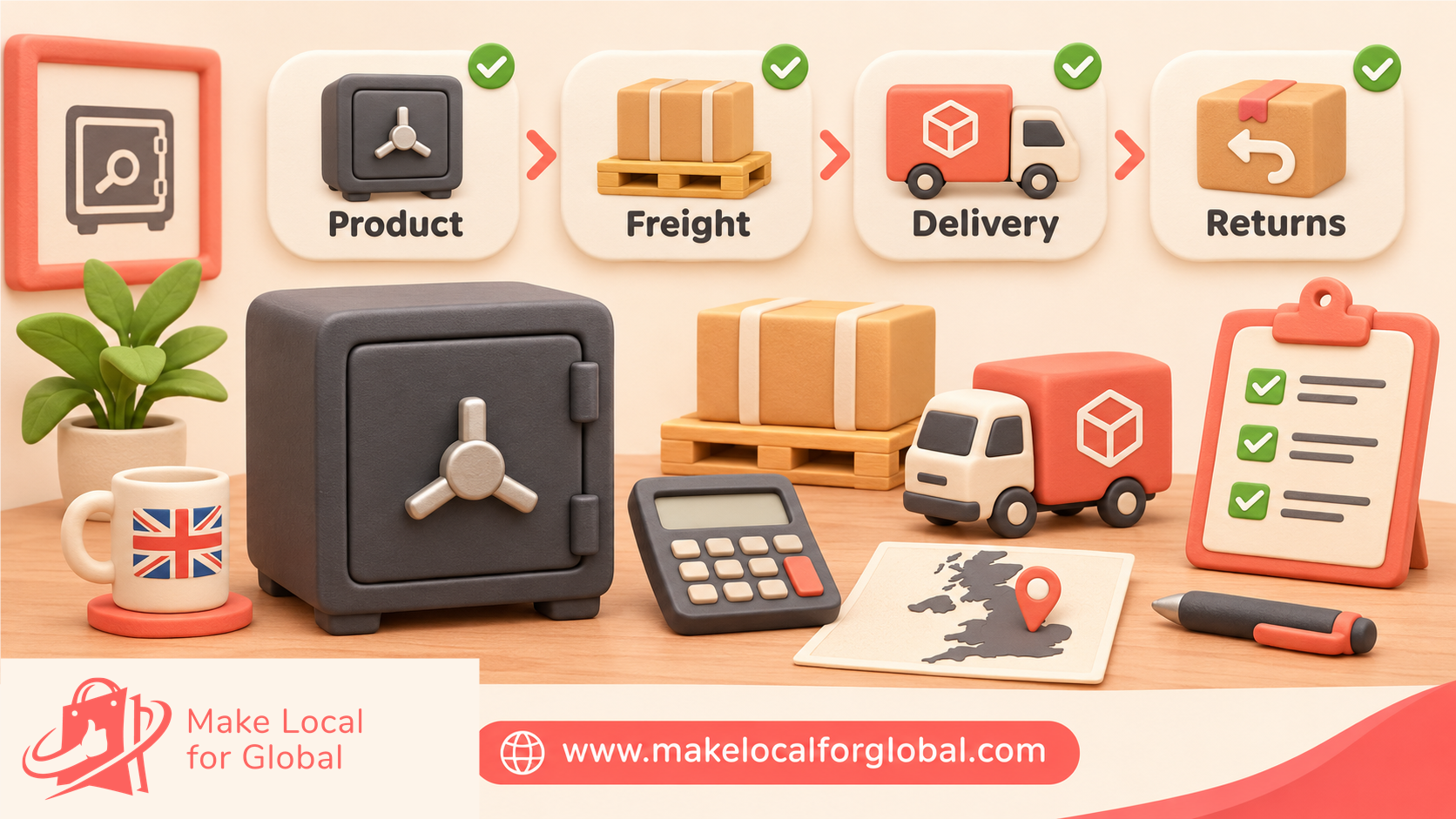
Work through freight, carrier service, access limits, returns and installation so the checkout offer matches what you can provide.
Heavy goods can look profitable on a unit-cost spreadsheet while losing money once freight, handling and failed delivery are counted. Cost the full order from supplier dock to the delivery level promised to the customer. The right comparison is not just the safe's purchase price versus the retail price.
Include the safe, inbound freight, customs or duty where relevant, pallet charges, storage space, order picking, payment fees, marketplace commissions, delivery, appointment fees, room-of-choice handling, installation labour, packaging removal, returns, damaged stock, customer support and marketing. Check whether the supplier quotes include VAT and which costs can be reclaimed if the seller is VAT-registered.
The figures below are invented only to show a calculation. They are not a market price or recommended retail price. Assume a direct online order for one compact safe at £389 including VAT, with a delivery charge of £45. Assume standard-rated VAT at 20% and a VAT-registered seller that can reclaim eligible input VAT. Replace these figures with supplier and carrier quotations for the exact postcode, weight and delivery service.
| Cost line | Illustrative calculation | Amount |
|---|---|---|
| Customer payment | £389 safe + £45 delivery | £434.00 |
| VAT in customer payment | £434 × 20 ÷ 120 | £72.33 |
| Sales excluding VAT | £434 − £72.33 | £361.67 |
| Safe purchase and inbound cost | Supplier and freight assumption, net of reclaimable VAT | £190.00 |
| Outer packaging and pallet materials | Corner protection and pallet wrap | £8.50 |
| Heavy delivery service | Carrier quotation for the model and postcode | £39.00 |
| Payment charge | Example: 2% of payment plus £0.20 | £8.88 |
| Acquisition allowance | Measured first-order marketing cost | £22.00 |
| Damage, return and support reserve | Planning assumption | £12.00 |
| Contribution before fixed costs | £361.67 − £190 − £8.50 − £39 − £8.88 − £22 − £12 | £81.29 |
The £81.29 is not net profit. It leaves out fixed platform charges, storage, insurance, staff time, installation overhead, customer-service costs not covered by the reserve and tax on business profit. An unregistered seller will model VAT differently. Check the current HMRC VAT registration guidance and ask an accountant about your situation.
Compare several order scenarios. A safe going to a ground-floor entrance may incur one service charge; a flat above a shop with steps and no lift may need a specialist team. A failed delivery can involve a second journey, storage and customer contact. A sale with installation can have a different liability and cost profile from a kerbside pallet drop.
Common delivery tiers can include kerbside delivery, threshold delivery, room-of-choice delivery and installation. Names vary by carrier, so define what each option actually includes. Does the driver unload the pallet? Is a second person included? Does the team carry the safe up steps? Are there limits on distance from the vehicle, floor level, doorway width, lift size or access time?
The site should ask for the details the carrier needs before confirming a delivery price. A postcode alone may not be enough for a heavy item. Offer a clear request process for access questions, unusual locations and installation. Do not allow an unpriced service to appear as “free delivery” if the underlying cost varies substantially by route.
Prepare an exception plan for restricted access, private roads, parking limits, narrow stairwells, no lift, timed delivery windows and islands or remote postcodes. Set out what happens if the carrier cannot complete the agreed service. Make sure the customer knows whether the safe will be left at the building entrance, on the pavement or somewhere else.
A heavy safe is expensive to return. Explain the return process accurately, including how the customer should report damage, whether the product must remain on the pallet and what happens after installation or attempted use. Do not make a “no returns” rule that conflicts with consumer rights. The relevant distance-selling rules require information before a sale, and the Consumer Contracts Regulations 2013 set out cancellation requirements and exceptions.
The right to cancel may be affected by product-specific facts and circumstances, but the seller should not assume that an installed or heavy item automatically loses cancellation rights. Explain what the customer should do and get qualified advice about any charge for diminished value, collection or specialist return transport. Keep the product description, cancellation information, warranty terms and delivery policy consistent.
Before you advertise a warranty, confirm whether it is provided by the retailer or manufacturer, how long it lasts, what it covers, what is excluded and where a service visit can be arranged. A warranty does not remove statutory consumer rights. A five-year warranty on the body does not automatically include a keypad, lock service, call-out or transport to a workshop.
Safes take up more storage space and handling capacity than small consumer products. Check pallet dimensions, stackability, floor loading, door clearance in your warehouse, lifting equipment, insurance and staff training. Use the supplier's handling instructions and never ask a worker to move a cabinet manually when the weight requires mechanical assistance or a trained team.
Record each unit's model, serial or batch reference, supplier, certificate, finish, lock type and delivery condition. Keep the chain of information from purchase order to dispatched unit. If a customer reports a lock problem, damage, loose boltwork, battery issue or failure to open, preserve the product details and refer the case through the manufacturer's support process.
Set clear rules for quarantining damaged, altered or unidentified units. Do not sell a safe after repair or modification unless the manufacturer or certification body confirms that the repair does not invalidate its certificate. Keep product photographs and delivery records with the order so you can trace a report to a particular unit and dispatch date.
Use a support workflow for lost codes, lockouts and service requests. Confirm the caller's identity and ownership according to the manufacturer's documented process. Never publish universal factory codes or ways to bypass a lock. If a buyer says the safe contains urgent medicine, legal records, business keys or another time-sensitive item, direct them to the manufacturer's authorised support or a qualified locksmith rather than attempting remote advice.
The customer may begin by searching for “fireproof safe”, a specific test class, a cash rating, a document cabinet or a model number. Use natural language across the category page, product listings, comparison content and support pages. Avoid repeating one exact phrase in every heading or targeting medical, fire or insurance claims without evidence.
A product page should sell one verified model. A category page can compare the types of fire protection, lock, capacity, size and delivery offer. An educational guide can explain why fire and burglary ratings differ, how to measure an installation space and what a delivery tier includes. Keep claims specific to the model and link related pages where it helps a buyer move forward.
Link to relevant existing guides such as selling door locks online when discussing lock and access expectations, and use the Ecommerce Pathfinder to map product, channel and fulfilment decisions. For storefront and operations support, review the MLFG business tools or contact the team with a specific launch question.
For paid search, shopping feeds or marketplace listings, use the exact rating, model, weight, dimensions and delivery terms. Do not select a fire claim from a dropdown because it attracts more clicks. Keep a screenshot or copy of the certificate and the product feed values you used when submitting a listing. Check marketplace policy and local rules for claims and restricted products.
Marketing images should demonstrate the safe and its real features. Avoid staged break-in tests, uncontrolled fire demonstrations, people trying to lift or force open the unit, and fake security seals. These can create unsafe behaviour or imply that a single informal test proves a class. Use diagrams, certificate details and verified product photography instead.
A safe range is a high-consideration purchase. Give buyers enough detail to understand fit, protection and delivery before you judge demand. Test a small set of products and use real enquiries to identify missing information. Do not buy a large range because one competitor sells many sizes or a marketplace listing has a low price.
| Period | Work to complete | Evidence to keep |
|---|---|---|
| Days 1–5 | Choose a customer and contents use; list the questions about rating, size, access and delivery. | Buyer notes, use statement and first-page questions |
| Days 6–10 | Contact suppliers, request certificates and map who handles warranty, service and installation. | Certificate files, model codes, service locations and written terms |
| Days 11–15 | Inspect a sample, verify measurements, lock operation, packaging and anchor instructions. | Sample checklist, photographs, handling notes and model record |
| Days 16–20 | Get carrier quotes for two or three postcodes and build the complete cost model. | Carrier tiers, surcharge assumptions, VAT model and contribution |
| Days 21–25 | Prepare the product page, dimension diagram, certificate summary and delivery questions. | Page draft, claims file and customer test notes |
| Days 26–30 | Show the offer to a small relevant audience; review enquiries and delivery objections. | Qualified leads, buyer questions, quote conversion and keep/change/stop decision |
Track product-page views, certificate downloads, delivery quote requests, completed orders, cancellation rates, failed delivery attempts, damage reports and contribution after fulfilment. A large number of visits with no quote requests may indicate that buyers cannot understand the delivery option. Repeated questions about a particular test class may mean that the classification needs clearer explanation. Use observations to revise one part of the offer at a time.
At the end of the test, choose whether to continue, change the range, improve delivery or stop. A small number of detailed enquiries can be useful if they identify a model, installation or service gap. Do not treat a handful of clicks as evidence that the full stock investment is safe.

No product should be presented as immune to every fire unless the evidence truly supports that absolute statement, which a test class does not establish. Use the verified standard and classification, explain the tested contents and limits, and avoid promising survival in any real-world fire.
LFS 30 is a classification used for light fire storage units under EN 15659. The number refers to the fire exposure period in the standard's test. It is not a universal 30-minute guarantee for every building fire or for every type of stored item.
Not by itself. Fire resistance and burglary resistance are tested separately. Check the certificate for a burglary classification such as one under EN 14450 or EN 1143-1, and list it separately from any fire class.
Do not promise that without confirmation for the buyer's policy and circumstances. Insurance requirements vary. Ask the customer to verify the model and installation with their insurer or broker before purchase.
Not automatically. Data media can have different temperature and humidity limits than paper. Confirm that the exact safe has a relevant data protection test and classification before making that claim.
Ask for the complete certificate and match its model, size, lock configuration and product family to the unit you intend to sell. Verify the certification body and current status through its directory or scheme. Record the document and the claim wording you are authorised to use.
Follow the manufacturer's installation instructions and the product's tested conditions. Some models have anchor points and fixing requirements that affect their security performance. The right fixing depends on the safe, substrate and site; ask a qualified installer where the instructions do not cover the buyer's situation.
Use only the manufacturer's authorised recovery or service process. The method depends on the exact model and may require proof of ownership. Do not publish a universal override or guess at a reset procedure.
Show external height, width and depth; internal usable dimensions; weight; door opening and handle projection; shelf arrangement; and the clearance needed to install and open the door. Include units and a diagram where possible.
It depends on the carrier tier. Explain whether delivery is kerbside, to the building threshold, into a room or includes installation. State access limits, appointment requirements, surcharges, packaging removal and exclusions before checkout.
Only after confirming that the repair, replacement part or modification is approved by the manufacturer and does not invalidate its certificate. Keep a record of the work and do not make a certified claim if the product's status is uncertain.
Compare the verified standard and class for the intended contents, separate burglary classification, usable size, lock, anchoring, weight, warranty, service coverage and delivery. A larger capacity or heavier door is not a substitute for comparable test evidence.
Choose a safe for a clearly defined storage need. Confirm the exact certificate, class and model, inspect a representative unit, measure the fit and write down who handles delivery, installation, service and returns. Separate fire performance from burglary resistance, and let the customer see the limits and costs before checkout.
Start with a small product range and the supplier support needed to serve it. A credible safe listing is built from model-specific evidence, usable measurements and delivery that can be fulfilled. If any of those pieces are missing, finish that work before you expand the range or increase advertising.
Define one buyer, verify one model, cost one complete delivery offer and test whether customers understand its protection and fit before you add more variants.
A clear product page can show the exact model, relevant tests, measurements, installation notes and delivery terms before the buyer checks out.
PREFERRED SOURCE
Like what you’re reading? Add Make Local for Global as a preferred source on Google to see more of our articles when you search.

Build your online presence without having to figure out everything yourself.