READY TO SELL Facial Mists ONLINE?
Get a store built for you in 5 days, plus training and support to help you start, run, and grow your Alternative business.

A practical guide to selling facial mists online: choose a clear product position, check cosmetic documentation and claims, test the pack, calculate order costs and plan a focused launch.


A facial mist can be a compact product to ship and a useful first skincare offer. The bottle still carries more decisions than its size suggests: the formula, preservation, spray pattern, packaging, claims and cosmetic paperwork all affect whether the product is fit to sell.
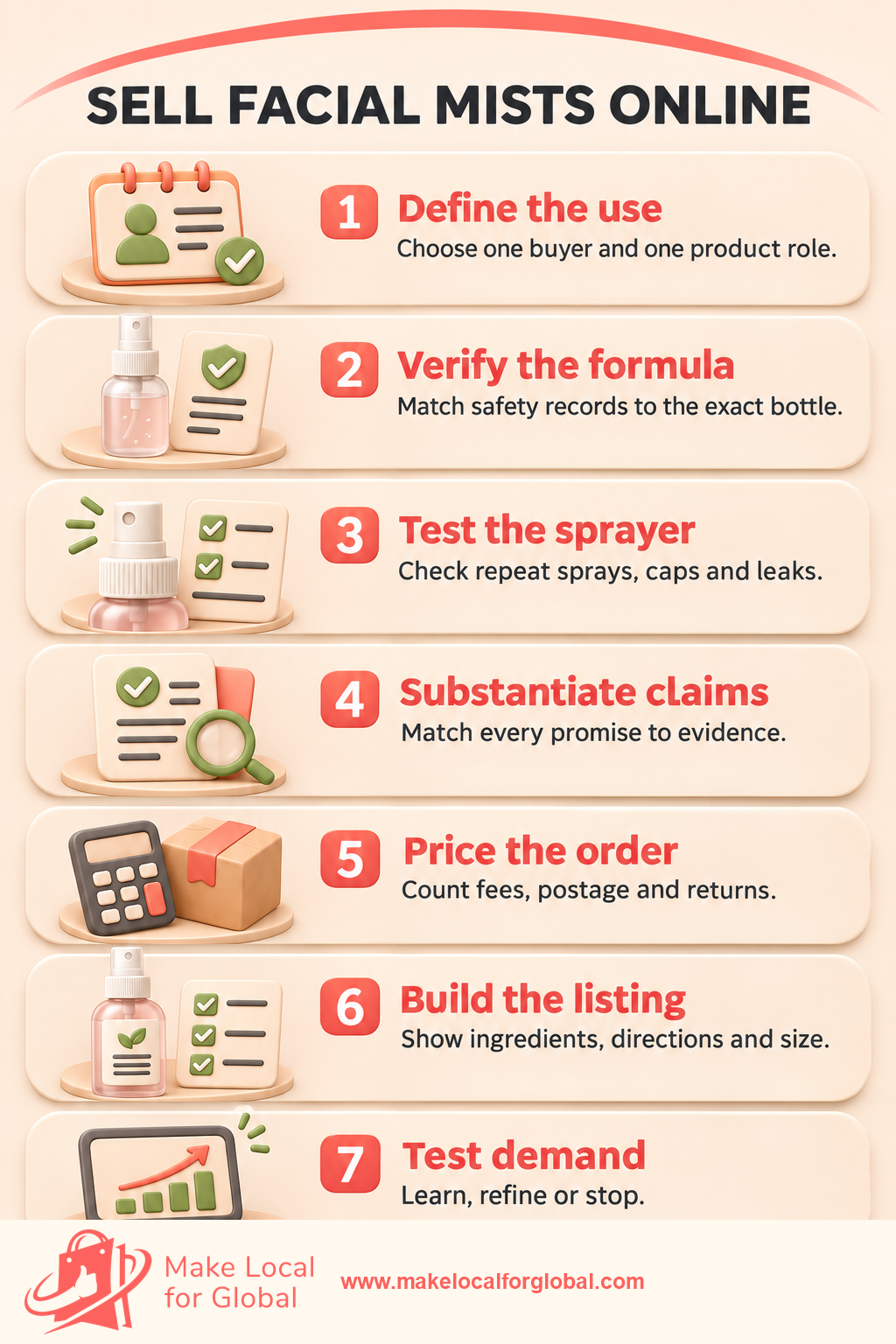
To sell facial mists online, choose a buyer and a clearly defined use, then source a formula with the right safety and product records. Test the bottle as a customer would use it, check the marketing claims against evidence, cost the complete delivered order and show buyers the ingredients and use instructions before checkout. A supplier's attractive label or popular ingredient is not a substitute for those checks.
Treat this as a product-planning exercise. It is not a skin-care recommendation or a substitute for professional regulatory advice. Cosmetic rules depend on the market, the product and the seller's role.
Use the product format, evidence and cost checks to define a clear first range.
The words “face mist”, “facial spray”, “toner mist” and “setting spray” can describe different products. Start with the use the manufacturer supports rather than choosing a name for search traffic. A facial mist is a cosmetic where it is intended for application to the face to clean, perfume, protect, keep in good condition or change appearance. The formula and marketing determine which claims buyers will understand.
An everyday refreshing spray may be described in terms of how it feels and when someone uses it. A hydrating mist may contain humectants or other ingredients, but naming an ingredient does not prove that a finished formula delivers a measurable result. A toner-style spray can be part of a cleansing routine. A makeup setting product has a different job from a simple refresh mist, and the seller should ask the maker for evidence that supports the words “sets”, “fixes” or “extends wear”.
Products can use a manual fine-mist pump, a regular trigger, a pressurised aerosol or a refill format. Those are not interchangeable packaging choices. A pump bottle has a different spray pattern, shipping profile and refill process from an aerosol. Ask the manufacturer to identify the actual dispensing system and provide instructions for use and transport.
| Product position | Buyer question to answer | Evidence to request |
|---|---|---|
| Refreshing facial spray | When and how is it intended to be used? | Directions, formula information and suitable sensory claims |
| Hydrating face mist | What does the finished product claim to do? | Product-specific evidence for each objective efficacy claim |
| Toner-style mist | Where does it fit in the routine and what follows it? | Directions, ingredient list and supported skin-feel or appearance wording |
| Makeup setting spray | Does the formula claim to help makeup wear or settle? | Relevant finished-product testing for the exact claim |
| Refill or concentrate | What bottle and dilution or refill method is approved? | Compatibility, refill instructions, stability and safety information |
Do not use one product description for all five positions. A customer searching for a light spray to use after cleansing has a different question from someone who wants makeup to last through a long event. A clear use helps a seller select a formula, a bottle and a sales message that agree with one another.
New sellers often start with a formula idea, such as rose water, aloe or a fragrance-free blend. Start with a person and a routine instead. An ingredient-led range can be difficult to explain when many products sound similar and buyers cannot see why they need each bottle.
Pick one group whose buying questions you can hear directly. These are possible starting points, not claims that every person in the group wants a mist:
Write a short profile that says what the person is trying to do, what alternatives they use now and what they need to know before buying. Avoid inventing a buyer persona with a fictional name and a neat biography. The useful detail is the purchase question.
Speak with people who resemble the intended buyer. Ask what product they use now, when they use it, what makes them choose a spray over a cream or toner, and which details they check on the label. Ask what would make them leave a product page without buying.
Avoid leading questions such as “Would you love a rosewater mist?” Ask people to compare realistic options: scent-free or scented, pump or aerosol, full size or travel size, single bottle or bundle. If you show a price, explain whether delivery is extra and whether the item is a sample concept or is already available.
Record exact language. If several people ask whether a mist can go over make-up, that is a product-page question. If they ask whether it can treat acne, that is a claim boundary to investigate, not a reason to promise treatment. If nobody can explain when they would use the spray, pause before paying a manufacturer deposit.
Use a simple page, a small product survey or direct conversations to test the use case. State which parts are real and which are still being developed. You can compare two proposed use descriptions, ask readers to select a preferred format and invite them to request a sample notice. Do not take payment for stock you cannot supply on the terms shown.
Track actions that require effort: a sample request, a wait-list sign-up, a question about ingredients, a request for a launch date or a completed order. Count how many people see the offer and how many take each action. Five detailed questions from likely buyers may teach more than a page of unqualified visits.
Use the test to make one decision. Continue with the chosen buyer, adjust the use description, ask suppliers for a different format or stop the idea. Record why you chose that step so the next sample request tests a known question.
A first collection can be a single core formula with two sizes, or two clearly distinct formulas with one size each. There is no benefit in launching a dozen scents before you know which use, claims and bottle buyers understand.
Keep one main product and add a variant only when it solves a different buyer need. A scent variation may change the target audience and allergen questions. A different bottle size changes the price per millilitre, parcel packing and expected number of uses. A new formula can bring new safety, evidence and labelling work.
Compare potential products using factors that affect the business, not just packaging colour:
A smaller bottle can give a lower first purchase price and make a trial easier. It may have more packaging per millilitre, a higher per-unit fulfilment cost and less formula per purchase. A larger bottle can improve the product-cost ratio, yet it can be less convenient to carry and may be discarded before the buyer uses it all.
Ask buyers which size they would use at home, keep in a bag or give as a gift. Ask the supplier for fill volume, headspace, bottle dimensions and the amount of product dispensed per spray. Do not translate “one hundred sprays” into a performance promise unless the supplier's test method and exact bottle version support it.
A two-mist set or a mist-and-moisturiser bundle may raise order value, but it can make the offer less clear. Set out exactly what comes in the box, whether products are full or travel size, and how each should be used. The bundle's total weight, pack dimensions, safety records and return process belong in the cost calculation.
If two products are meant to work together, do not imply a combined result unless the finished combination has appropriate support. A bundle can be presented as two individual products selected for a routine without claiming that the pair has a tested effect.
Most new sellers consider wholesale resale, private label, contract manufacture or a product they formulate themselves. Each route changes the work and the legal responsibilities.
| Route | What the seller controls | Questions to settle before commitment |
|---|---|---|
| Wholesale resale | Retail price, customer service and listing quality | Is the product already compliant for the destination market? Who is the Responsible Person? Can the supplier provide traceability and current labels? |
| Private label | Brand, presentation and often some product choices | Does applying your brand make you the Responsible Person? Who owns the formula and evidence? Which notification and safety records are complete? |
| Contract manufacture | Brief, formula development, packaging and production specification | Who approves formula changes, test scope, batch release and packaging compatibility? What does the contract say about the Product Information File and claims evidence? |
| Own formulation | Formula direction and brand | Can you fund qualified safety assessment, formulation work, testing, compliant manufacture and ongoing records before sale? |
Do not assume a manufacturer completes every regulatory task for you. Ask the supplier to identify in writing who will be the Responsible Person in the market you plan to sell into. A distributor that places a cosmetic on the market under its own brand may become the Responsible Person. A business importing a cosmetic into Great Britain may take on that role too. Review the current Great Britain cosmetic product guidance before you agree to private label or import terms.
If you intend to sell into Northern Ireland, read the separate Northern Ireland cosmetics guidance. The Responsible Person and product notification route differ from the Great Britain process. Do not assume a GB notification alone covers every UK market.
Request product-specific documents before sending a deposit. Match every document to the exact formula, shade or scent, bottle and production version you plan to sell. Ask for:
If you will be the Responsible Person, a supplier saying “we have paperwork” is not enough. Ask what is in the PIF, whether the safety assessment names the formula you are buying and whether the records are available to the competent authority. Current GB guidance says the Responsible Person must keep an English PIF, with the product safety report and other records, for ten years after the last batch is made available. A qualified safety assessor must assess the cosmetic before it reaches consumers. Review the OPSS guidance for Great Britain and obtain specialist advice where your role is uncertain.
If a supplier will not identify the Responsible Person, cannot tie documents to a formula code or cannot show the label before production, stop. A low unit quote does not make an undocumented product a suitable first range.
Order samples from the actual manufacturer and confirm they use the same formula and packaging that would go into the first commercial batch. A catalogue photo or sample from a different bottle cannot prove that the selected pump works with the chosen liquid.
Record the supplier, formula code, batch number, date received, bottle type, volume, seal and label version. Photograph every side of the packaging. Compare the label with the intended market requirements and the product documents. Flag differences before you use a sample for photography or a product page.
Inspect for leakage, cracks, loose pump collars, damaged caps, detached labels, cloudy liquid, visible particles, unusual colour changes or a scent that differs from the approved sample. These checks do not replace a safety assessment or laboratory testing. They help you spot a mismatch that should go back to the manufacturer.
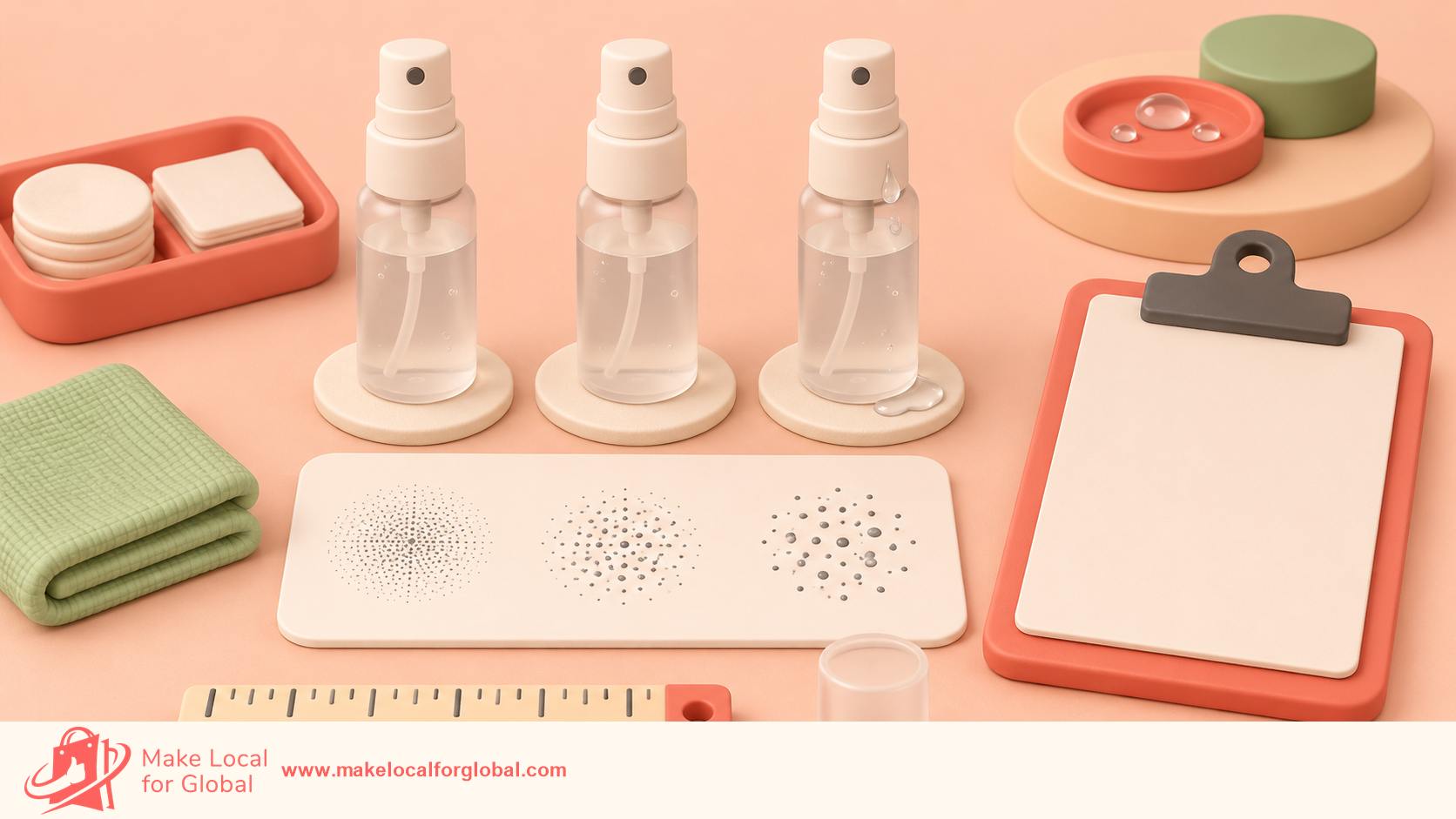
Use a clean test area and the manufacturer's instructions. Check whether the pump primes consistently, whether the first spray differs from later sprays and whether the liquid lands as a fine mist or a concentrated jet. Test the distance and angle the maker recommends. Record any pooling, dripping, splashing, residue on the bottle neck or spray that reaches the eyes unexpectedly.
Repeat the test on more than one sample. A single pleasant spray does not show that every unit in a batch will behave the same way. Ask the supplier for its pump quality checks and the acceptable variation between units. A spray pattern can shape the customer's first impression, yet a visual test cannot prove a skin benefit.
Ask the supplier how the formula behaves in contact with the bottle, dip tube, gasket, pump and cap over the intended shelf life. A product that remains clear in a short home test may not show long-term compatibility. Do not leave a sample in direct sunlight or a hot car to create a safety claim. Follow the supplier's storage conditions and request the actual stability evidence.
Check that the bottle stands securely, the cap remains in place and the label stays legible after ordinary handling. If the product has a refill, test the maker's method and confirm the refill does not introduce contamination or create a different use pattern. Do not advise buyers to reuse containers unless the manufacturer has approved that practice and supplied clear cleaning and refill instructions.
Write a pass, follow-up or reject note for each check. Send photographs and a concise list to the supplier. Hold back stock that differs from the approved sample until the responsible supplier explains the difference and confirms the right action.
Cosmetic products have product-specific safety, documentation, labelling and notification rules. The exact duties depend on whether you make, import, distribute, relabel or appoint another Responsible Person. This section is a planning checklist, not legal advice.
For products made available to consumers in England, Scotland and Wales, there must be a Responsible Person with an established UK address. That person must make sure the product is safe, maintain the Product Information File, keep claims support, make required label information clear and notify the product to OPSS before it is made available. The official GB guidance describes the roles and records.
The PIF and safety report are not paperwork to request only after a complaint. The formula, stability, microbiological information, preservatives, packaging, exposure and intended use inform the safety assessment. If you change the formula, scent, bottle or instructions, ask the Responsible Person whether the assessment, notification or label needs an update.
The Responsible Person submits the product through the Submit Cosmetic Product Notifications service. A retailer buying an existing, compliant product is not automatically responsible for every notification step, but must not treat a supplier assurance as proof. Verify the route with the Responsible Person and keep records that identify who supplied each batch.
Northern Ireland follows a separate cosmetics route under the current arrangements. The official NI technical guidance explains the Responsible Person and EU notification requirements, with a separate GB notification where the same product is sold into Great Britain under the applicable rules.
If you plan to ship into the EU or another country, check that destination's rules before listing it. The product label, Responsible Person, notification and language requirements may not match GB. A domestic supplier's claim that a product is “UK compliant” does not establish that it can be sold in every market.
UK cosmetic labels need clear product information, including the function where it is not obvious, precautions, net volume, Responsible Person details, batch identification, applicable date information and ingredients. Imported products need the country of origin. The information must be readable in English for the GB market. Use the current consumer cosmetics overview and product-specific guidance when checking the pack.
Make a label checklist for the product page and the physical bottle. Compare each element against the supplier's approved artwork. Do not create a label by copying another brand's INCI list or adding a claim the finished product has not been assessed to support. The ingredient list matters to buyers who check for known allergies. Show it clearly online where possible, even when it appears on the pack, so shoppers can make an informed choice before buying.
Record the purchase order, supplier, formula and batch codes, quantity received, label version and dates sold. Keep enough information to identify which orders received a batch if the supplier later reports a problem. Use the same batch reference in your stock record and customer-service notes.
Do not mix different batches in one pick bin without a way to identify the batch sent to each buyer. If the product changes, set up a new product record or version. A batch log makes it easier to answer a question about a particular bottle and to follow supplier instructions if an issue appears.
Map your product, channel, compliance and fulfilment questions before placing a larger order.
The product name, photos, testimonials, ingredient call-outs and social captions can all create a claim. Review them together. The ASA and CAP say marketers should hold evidence for efficacy claims before the advert appears, and the evidence should match the claim. Their beauty and cosmetics guidance explains why consumer perception comments cannot prove every objective result.
“Feels refreshing” describes a sensory experience. “Helps skin feel comfortable after cleansing” may still require a clear basis and accurate context. “Reduces redness by 40%”, “repairs the skin barrier in a week” or “prevents breakouts” are objective or medical-sounding claims that need far more than an ingredient supplier's brochure.
Ask the Responsible Person which wording is already approved and what evidence supports it. Request the full test report, the version tested, participant details, duration, method, endpoints and any limits. A result for one formula, use pattern or population may not support a claim for another. A survey saying people liked the scent cannot prove a change to the skin.
Do not say a cosmetic mist treats acne, eczema, rosacea, infection, inflammation or another disease. Do not describe it as healing or as a substitute for medical care. If you are unsure whether a phrase crosses from cosmetic to medicinal territory, leave it out until a qualified adviser has reviewed the product and copy.
Words such as “hypoallergenic”, “non-toxic”, “clean”, “chemical-free”, “safe for sensitive skin”, “dermatologist tested” and “natural” need careful definition and support. A natural ingredient can still cause a reaction. “Fragrance-free” and “unscented” can mean different things in product language; use the wording the formula and label support. Never use the presence of a well-known ingredient as proof that the full formula produces a result associated with that ingredient.
Keep a record of consent and the original customer wording before using a testimonial. Do not edit a comment so it reads like an objective clinical finding. Do not stage before-and-after photographs, retouch a skin texture or change lighting in a way that overstates the product effect. The ASA explains that image treatment can create a misleading impression of efficacy.
Build a claim file containing the exact phrase, where it appears, the source evidence, the product version and the approval date. Check product titles, search snippets, ad text, creator briefs, captions and packaging copy against that record. This prevents an unsupported phrase from reappearing in a different channel.
A useful listing lets a shopper identify the product, see what arrives and decide whether the use suits them. Avoid turning a product page into an ingredient glossary or repeating the same keyword in every heading.
A title such as “Rose-scented facial mist, 100 ml pump spray” gives a buyer the product type, scent and size. Use “hydrating”, “toning” or “setting” only when the manufacturer and evidence support that description. Keep an internal code out of the customer-facing title unless buyers need it to distinguish compatible products.
Show the net volume, spray type, fragrance description, intended use, directions, warnings, product ingredients, batch and date information where available, price, dispatch window and delivery charge. If the product is a travel-size format, show the exact volume. Do not call it “flight safe” or promise that it meets a baggage rule; tell buyers to check the current airline and airport rules for their route.
Use the manufacturer-approved instructions. State whether the customer should close their eyes, keep the spray away from the eyes or use it at a particular distance only where those directions appear on the product documentation. Do not invent directions from personal use.
Useful questions include:
If a buyer asks about a medical condition or a reaction, do not diagnose the customer. Share the approved label information and refer them to an appropriate health professional where necessary. A retailer should not promise that a cosmetic will work for every person.
Photograph the actual bottle and the box contents. Use a clean front view, a clear back-label image, a close-up of the sprayer and a scale reference beside the bottle. Show the cap, pump and any tamper evidence. A styled bathroom shelf can support the brand, but it should not replace a view of the label or imply that props are included.
Use accurate colour and lighting. Do not add condensation or a fake spray cloud that makes the packaging appear sealed or the formula look like a different colour. If you show a model using the product, follow the label directions and do not present a single person's skin as proof of a general outcome.
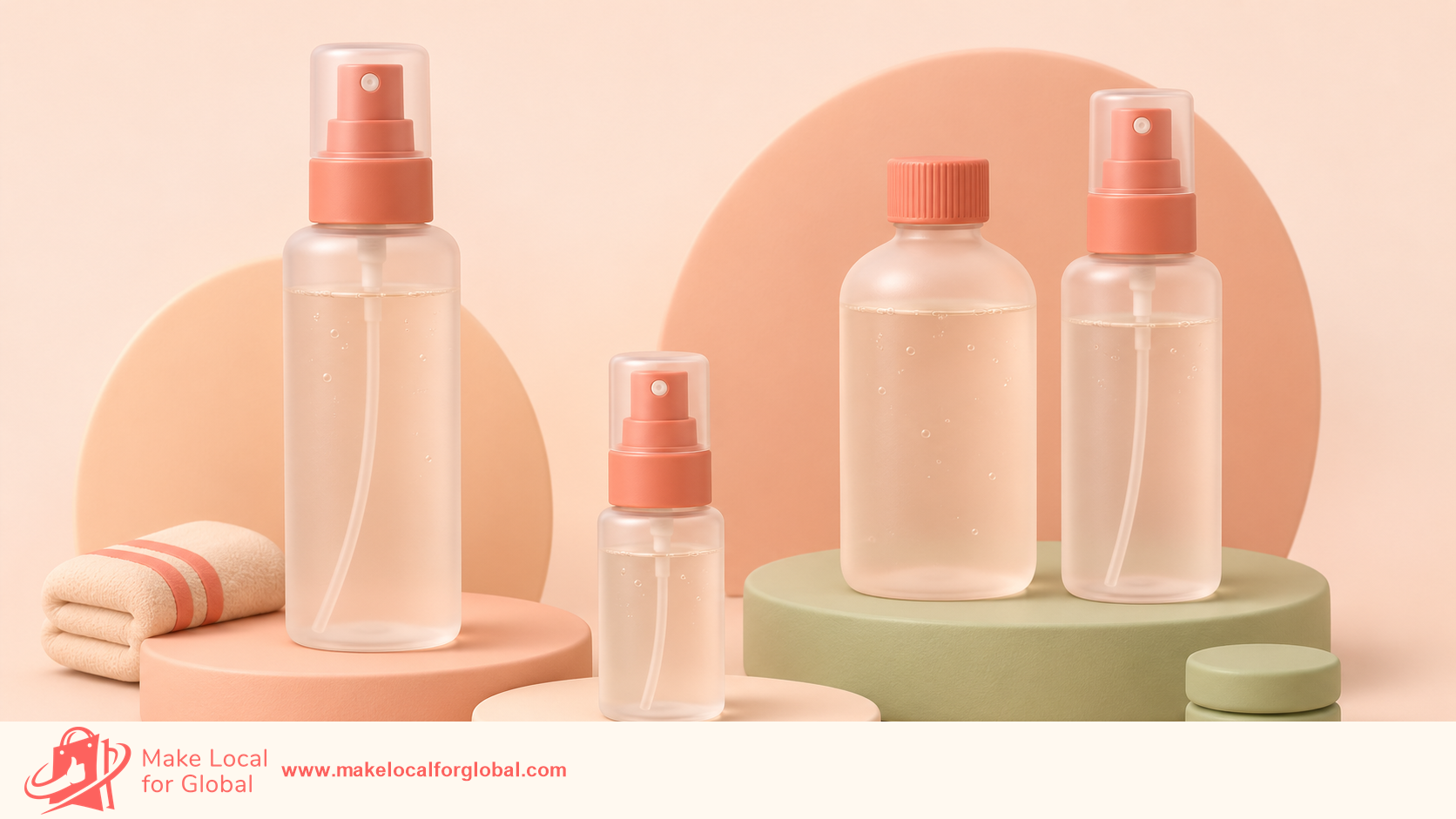
Small bottles can have a high packaging and delivery cost relative to their price. A low supplier unit cost does not show whether the order leaves enough contribution after fees, postage and customer acquisition.
Record one-time and per-order costs separately. For each size and channel, include:
Separate fixed costs from variable costs. A monthly store subscription does not change for every order, though it affects how many orders the business needs to cover it. A per-sale platform fee changes with order value. Work out both figures and include them in a break-even view.
The figures below are invented to show the method, not a market quote or recommended retail price. Assume a VAT-registered seller charges £21.00 for a facial mist and £3.00 delivery. The £24.00 customer payment includes 20% VAT. The seller uses a direct shop and models a payment fee of 2% of the payment plus 20p. The seller can reclaim VAT on qualifying costs, so the table uses costs net of reclaimable VAT. Replace every value with actual supplier, carrier and platform information.
| Cost line | Illustrative calculation | Amount |
|---|---|---|
| Customer payment | £21.00 product + £3.00 delivery | £24.00 |
| VAT included in payment | £24.00 × 20 ÷ 120 | £4.00 |
| Sales excluding VAT | £24.00 − £4.00 | £20.00 |
| Product and inbound freight | Supplier quote assumption | £5.80 |
| Packaging | Carton, seal and cushioning | £0.50 |
| Outbound carrier cost | Sample quote, net of recoverable VAT | £3.29 |
| Payment fee | £24.00 × 2% + £0.20 | £0.68 |
| Customer acquisition | Measured test assumption | £2.40 |
| Returns and damage allowance | Planning assumption | £0.60 |
| Contribution before overhead | £20.00 − £5.80 − £0.50 − £3.29 − £0.68 − £2.40 − £0.60 | £6.73 |
The £6.73 is not net profit. It leaves out fixed platform charges, storage, insurance, staff time, professional advice and tax on business profit. The example assumes a standard-rated sale and a VAT-registered seller who can reclaim the input VAT included in eligible costs. A non-registered seller will model VAT differently and may carry VAT on purchases as a cost. Check current HMRC VAT registration guidance and ask an accountant about your own treatment.
Use the same basket, delivery promise and return assumption to compare your own shop, a marketplace, social commerce and wholesale. Enter each channel's current payment and selling fees from its own documentation. Include any advertising required to find buyers there. Do not compare the shop's gross order value with a marketplace's contribution after fees.
Run a low, expected and high cost scenario for postage and returns. Test what happens if the payment provider charges a different rate, the carrier changes the small-parcel band or the customer buys two bottles. If the contribution disappears after one replacement, consider another price, supplier, carton or offer before increasing the ad budget.

A facial mist is a liquid, so the pump, cap, liner, box and transport method all matter. Test the finished parcel instead of choosing packaging from a photograph.
A manual pump bottle and a pressurised aerosol are different shipping items. Ask the manufacturer to confirm the dispensing and propellant system in writing. Check the carrier's current prohibited and restricted list for each service and destination before you enable shipping. For example, the Post Office's Royal Mail and Parcelforce item guide sets conditions for liquids and restrictions for certain aerosols. Do not use one postal rule as a promise that every carrier or international destination accepts the product.
Follow the manufacturer's and carrier's packaging instructions. Use a box that protects the pump and bottle neck. Make sure the cap cannot trigger in transit. Test a parcel containing the exact bottle, protective material, insert and outer carton that you plan to dispatch.
Place absorbent protection around a bottle where the carrier's rules or your packaging assessment call for it. Keep the bottle from moving inside the carton. A glass bottle may need breakage protection. A bottle that leaks can damage other parcels and create a poor customer experience even if the formula is safe.
Record the packed length, width, height and weight for every bundle. Get carrier quotes for the likely destinations and services. Check what happens to delivery cost when a second bottle is added. A free-delivery threshold should be based on contribution after postage rather than a round figure picked without calculation.
State the dispatch days, handling time, delivery options and exclusions clearly. Check stock and replenishment lead times before advertising a seasonal gift date. If a supplier ships directly, verify the dispatch location, tracking process, return address and packing slip. Do not call stock “local” if it is held or dispatched elsewhere.
Keep finished stock under the maker's storage conditions. Avoid windowsills, hot vehicles, damp cupboards and any location that could damage labels or packaging. Record the date received and the applicable use-by or period-after-opening information. Pick stock in a consistent first-expiry order where dates apply.
Compare the carton count, formula code, batch numbers and label version against the purchase order. Check for leaks, damaged seals, broken bottles and changes from the approved sample. Photograph problems before moving the stock into saleable inventory. Ask the Responsible Person or supplier how to handle affected units.
Do not sell units with missing or unreadable labels, unknown batches or damaged packaging. Keep quarantined products separate from saleable stock. If the supplier changes an ingredient, pump, bottle or manufacturing location, ask whether the safety and product records remain valid before placing the new version on sale.
Online buyers usually have a right to cancel within 14 days after delivery, subject to specific exceptions and the seller's information duties. The law has a limited exception for sealed goods that are unsuitable for return for health-protection or hygiene reasons once unsealed. Do not assume every face mist falls within that exception or publish “no returns” as a blanket policy. Review the product and seal with qualified advice, explain the applicable process before purchase, and follow the current consumer contracts rules and GOV.UK distance selling guidance.
Log the reason for each return, whether the safety seal remained intact, the batch, the condition and the next action. Never put an opened or uncertain bottle back into saleable stock without instructions from the Responsible Person. Keep return costs in the order model even if a product is rarely returned.
Record customer wording, order details, batch information, dates, photographs and what advice you provided. Do not dismiss a reaction as “normal” or recommend that a customer continue using the product. Follow the Responsible Person's complaint process and seek qualified advice where an adverse effect is reported.
In Great Britain, OPSS guidance describes a serious undesirable effect as one that results in outcomes such as hospitalisation, disability, congenital abnormalities, an immediate risk to life or death. Read the SUE and safeguarding notification guidance and pass reports to the Responsible Person without delay. A report does not by itself prove that a product is unsafe, but it must be recorded and handled through the appropriate route.
Search content should answer a shopper's question, not repeat “facial mist” in every heading. Choose one core product phrase for the category or product page and support it with natural wording that matches the formula and buyer.
Possible phrases include “sell facial mists online”, “facial mist product range”, “how to choose a face mist supplier” and “facial mist packaging”. Use buyer questions in page headings where they answer a real concern. Do not use “best face mist for acne” when the product is not supported for that purpose.
Write separate content only when each page has a distinct job. A product page explains a particular formula and bottle. A category page compares the range. A support page can explain how to read a cosmetic ingredient list or how to check a supplier's product records, with careful wording and official references. Link those pages together where it helps a reader take the next step.
Test one acquisition route at a time. You could show an accurate product photograph in a short video, share a routine checklist with a relevant community, offer a sample at a local event where the rules permit it or work with a creator whose audience matches the buyer. Agree on the exact wording and claims before any paid post goes live. Ask creators to disclose a commercial relationship where required and do not rely on a creator's personal experience to support an objective product claim.
Track product-page views, ingredient-list interactions, sample requests, add-to-basket actions, completed orders, delivery cost, returns and questions. A high click count with no orders may point to a weak offer, unclear claims or unexpected delivery costs. A few pre-sale messages asking for the ingredient list may show that the information is hard to find. Use the evidence to change one part of the offer at a time.
This schedule moves from product choice to a controlled sales test. The dates are work stages, not a sales forecast.
| Period | Work to complete | Evidence to keep |
|---|---|---|
| Days 1 to 5 | Interview likely buyers and record the routine, format and label questions they mention. Select one buyer group and one product position. | Interview notes, exact buyer questions and a written use statement |
| Days 6 to 10 | Contact suppliers, compare sourcing routes and request documents for the exact formula and bottle. Identify the Responsible Person and relevant market route. | Supplier replies, formula and packaging codes, order terms and compliance records |
| Days 11 to 15 | Inspect samples, test the pump, compare labels and make a packed parcel for a carrier quote. Ask the supplier about every mismatch. | Sample checklist, photos, batch code, package dimensions and carrier quote |
| Days 16 to 20 | Build a per-channel cost model, write product-page copy and prepare accurate photos. Check the copy against the approved claim evidence. | Assumptions, arithmetic, label image, page draft and claim file |
| Days 21 to 25 | Ask target buyers to review the page without coaching. Note where they stop, which information they cannot find and whether they accept the total delivered price. | Observed questions, page changes and price objections |
| Days 26 to 30 | Release a small test only after the product is ready for sale and required records are in place. Review orders, customer questions, delivery performance and contribution. | Order data, complaints, returns, batch traceability and a keep/change/stop decision |
At the end, make one written choice: place a limited replenishment order, revise the offer and test again, or stop. Tie that choice to a buyer action, supplier evidence or cost result. If no records support the next purchase, wait for better evidence instead of adding variants.
They can suit a focused skin-care shop if the seller can explain the product's use, verify its records, support the claims and pack it safely. The bottle size does not remove the work around the formula, label, spray mechanism and returns. Test buyer interest and order contribution before committing to a large minimum order.
Choose the product that fits an audience you can reach and a use the manufacturer supports. A setting spray needs evidence for setting or wear claims. A hydrating-positioned mist still needs an accurate formula description and evidence for any objective result. Compare supplier records, packaging and likely delivery cost before choosing.
Yes, but confirm who is the Responsible Person for each market before you sign. Applying your own brand or importing the cosmetic can change your responsibilities. Confirm who holds the Product Information File, what the safety assessor assessed and which notification and label apply to your exact formula.
Request the exact formula and product codes, current label artwork, safety and Product Information File responsibilities, Responsible Person details, market notification confirmation, manufacturing controls, packaging compatibility evidence, stability information and batch process. Ask for records that relate to the product version you plan to sell.
Do not make a disease-treatment claim for a cosmetic mist. Ask a qualified regulatory adviser to review any borderline wording. The product's name, ingredients, photos and testimonials can all create an implied claim, so check the entire product page and promotion.
For a cosmetic made available in Great Britain, the Responsible Person must notify the product through the relevant OPSS service before it is made available to consumers. Northern Ireland has a separate route. Confirm the Responsible Person and the applicable process before sale rather than assuming a supplier's statement covers every market.
Do not return an opened or uncertain bottle to saleable stock. Isolate it and ask the Responsible Person or supplier for instructions. Keep the return record, batch reference and seal condition. Apply consumer cancellation rules accurately and avoid a blanket “no returns” statement.
Start with revenue excluding VAT where applicable. Subtract product and inbound freight, packaging, fulfilment, delivery, payment or marketplace charges, customer acquisition and a returns allowance. The remainder is contribution before fixed costs and tax, not net profit.
Show the real bottle, front and back label, size reference, pump, cap, outer box and everything included in the order. Use accurate lighting and colour. Avoid imagery that implies an unverified skin result or an intended use the manufacturer does not support.
Describe the intended use and total delivered price to a small group of likely buyers. Ask what they use now, which details affect their choice and what they need to see before ordering. Track meaningful actions such as sample requests and purchase decisions, then use the answers to make one range or page decision.
Check the current rules for the exact formula, packaging, carrier and destination. Manual pump liquids and pressurised aerosols can have different restrictions. A carrier may accept a parcel domestically and reject it internationally. Confirm the product classification, packaging and destination requirements before enabling international checkout.
A facial mist range starts with a buyer question, not a long scent list. Select one use, request documents for the formula and bottle, inspect the sample and check each claim before it appears on a page.
Price the entire order and test the parcel. Show the buyer the product role, ingredients, label, directions and delivery details. Use customer questions and real order costs to decide what deserves a second formula or size.
Start with one supported use, a checked sample, a complete order cost and a product page that answers practical questions.
PREFERRED SOURCE
Like what you’re reading? Add Make Local for Global as a preferred source on Google to see more of our articles when you search.

Build your online presence without having to figure out everything yourself.