

READY TO SELL Foam Floor Tiles ONLINE?
Get a store built for you in 5 days, plus training and support to help you start, run, and grow your Alternative business.

Plan a foam floor tile range with sample inspections, room coverage, supplier checks and a worked cost model for bulky deliveries.

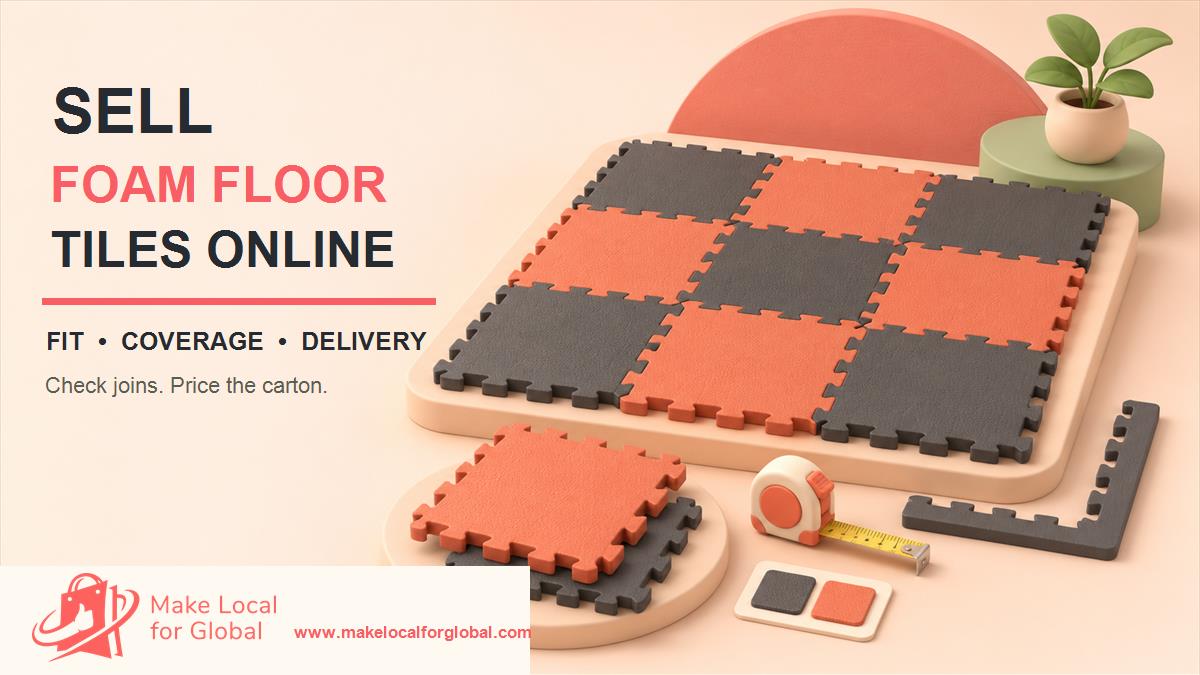
Interlocking foam floor tiles look simple in a product photo. A buyer still needs to know how many tiles cover a room, how the edges finish, whether the surface suits the planned activity and what the complete order costs to deliver. Those answers shape a useful shop more than a long list of colours.
To sell foam floor tiles online, choose one type of customer and one use first. Compare samples, check the actual coverage and parcel dimensions, and write a cost model before you order stock. Show buyers the assembled surface, the underside and the tile edges, then state what the product has and has not been tested for.
The phrase “foam floor tiles” can refer to home gym flooring, playroom tiles, martial-arts mats, workshop comfort tiles and other products. Their materials, thickness, surface and intended uses can differ. A seller should not treat one sample or one supplier document as evidence for every tile in the category.
Compare product formats, coverage, sample checks and delivery costs before you commit to a pack range.
Start by deciding who you can reach and what the tiles need to do in that setting. A broad offer that promises “flooring for everyone” makes it difficult to select the right construction, pack size and product details.
Home gym buyers may want a floor layer beneath bodyweight training, light exercise equipment or a defined workout area. They need to know whether the surface compresses under a bench or rack, whether joins stay connected during movement and whether the product maker states a permitted load or use.
Do not describe a foam tile as suitable beneath heavy equipment based only on how firm it feels in your hand. Place representative equipment on a sample only where the manufacturer permits that test. Look for lasting dents, displaced joins and a change in surface level after the load is removed. If the supplier has not given a use limit, do not invent one for the product page.
Parents may compare colour, tile count, cleanability, edge pieces and the intended age range. A tile sold or promoted as a toy, play mat or child product can bring product-specific requirements. Product classification depends on the product's design, purpose and marketing. Check the relevant guidance before making claims about a product being safe for babies, toddlers or children.
Children can pull at corners and bite or mouth small parts. Inspect whether tiles include removable decorative pieces, detachable borders or thin tabs that could tear. Get the manufacturer's written instructions on cleaning, supervision, age suitability and any limits on use. Do not add a “baby safe” label when a supplier uses it in a catalogue.
Some buyers want a soft practice surface, a textured top and a way to cover an area without gaps. The tile must match the activity and the manufacturer's instructions. A foam puzzle tile intended for light exercise should not be presented as a grappling mat or a protective fall surface without evidence for that use.
If your first audience is building a home-training corner, compare this product with fitness jump ropes. The tile pack and rope solve different needs, yet their buyers may be reached through the same local clubs or home-workout content.
Ask studio owners which details affect a purchase: grip, edge stability, firmness, surface cleaning, repeat installation or replacement availability. If their use involves impact or falls, request evidence for the specific product and activity, including any stated test method and limits. A generic “shock absorbing” phrase does not answer that question.
Workshop customers may value comfort when standing, resistance to oils or chemicals, an easy-to-clean finish and a secure edge. Those properties cannot be assumed from the word “foam”. A porous surface may not suit a spill-prone setting. A puzzle edge can shift where people repeatedly push carts or equipment across it.
If you want to test this group, ask about the floor beneath the mat, the work done on it, likely spills and whether the tiles must be removed for cleaning. Describe a mat as oil resistant, slip resistant or suitable for commercial use only when the product documentation supports that claim.
Before paying for a large minimum order, show a small group of likely buyers two or three clearly described options. Include the intended room size, tile count, thickness, surface, price and delivery charge. Ask what they would choose and what information they still need before ordering.
Record the exact questions. “How many packs cover 2.4 by 3 metres?” is a practical signal that the coverage calculator needs work. “Can the tiles sit under my treadmill?” tells you to get a clear load-use answer from the supplier before selling into that situation. A polite response such as “looks good” is weak evidence of purchase intent.
Use a simple test page or a short survey, and state clearly if the item is not yet in stock. Do not take payment for a product you cannot supply on the stated terms. Track the number of people who ask for a delivery date, request a sample or accept the offered price. Those actions can help you decide whether to ask for another sample or move on.
For a wider view of fitness products, compare this idea with selling fitness equipment online and selling foam rollers online. Those ranges have different parcel and use requirements, so use them to compare business choices rather than copy their specifications.
Suppliers use similar product names for tiles that can behave differently. Ask for a named material, tile dimensions, construction details and a current specification sheet for the exact model. Take care with claims that appear only in sales copy.
These square or rectangular pieces join through projecting tabs and recesses. They can be lifted and rearranged, which suits temporary coverage and small room layouts. The edge shape creates a visible seam and may need border strips or corner pieces for a neater perimeter.
Count the pieces that come in a pack. Check whether the quoted measurement includes the outer tabs or describes only the usable tile body. Ask for the assembled footprint of a whole pack, since multiplying nominal tile size by tile count may overstate or understate the floor area once connectors overlap.
Products may use EVA, polyethylene or another foam construction, sometimes with a laminate, printed skin or textured surface. A material abbreviation alone does not tell you the density, firmness, compression behaviour, finish or cleaning limits. Ask the supplier to identify the complete layer structure and the product version represented by any test report.
Advertise density as a quality score only if you can explain the specification and its relevance. For a seller, it is more useful to know whether the sample recovers after compression, whether joins stay fitted and whether the surface changes after the recommended cleaning routine.
Some products have a patterned, textured or reversible face. A pattern may help customers see orientation or distinguish one surface from another. It does not, by itself, prove traction, grip or suitability for wet use.
Photograph the surface close enough for the pattern to be clear. State which side faces up and whether both sides are intended for use. If a design has a directional grain, print alignment or repeated pattern, show how it looks across several joined tiles. Buyers may care about the appearance of the full floor, not just one square.
Thickness can affect feel, clearance, edge transitions and the way furniture sits. It is not a standalone measure of cushioning or protection. A thicker tile can still compress under a particular load, and two products with the same thickness can have different firmness and recovery.
Measure a sample at multiple points. Ask whether the stated thickness includes surface texture or is measured at the flat base. Keep the measurement method with your product records. If the maker supplies a tolerance, use it accurately rather than listing a single sample measurement as the guaranteed size of every tile.
Some sets include straight edge strips and corners; others sell them separately. They can change the finished footprint and the number of tiles needed along a wall. A buyer should see the quantity of each piece in the pack and whether the edges fit all sides of the tile.
Dry-fit the edge pieces around a sample area. Check whether they can connect on different sides and whether their orientation makes a clean border. Photograph a finished outside edge. A close product shot of a loose tile will not show a buyer how the border works.
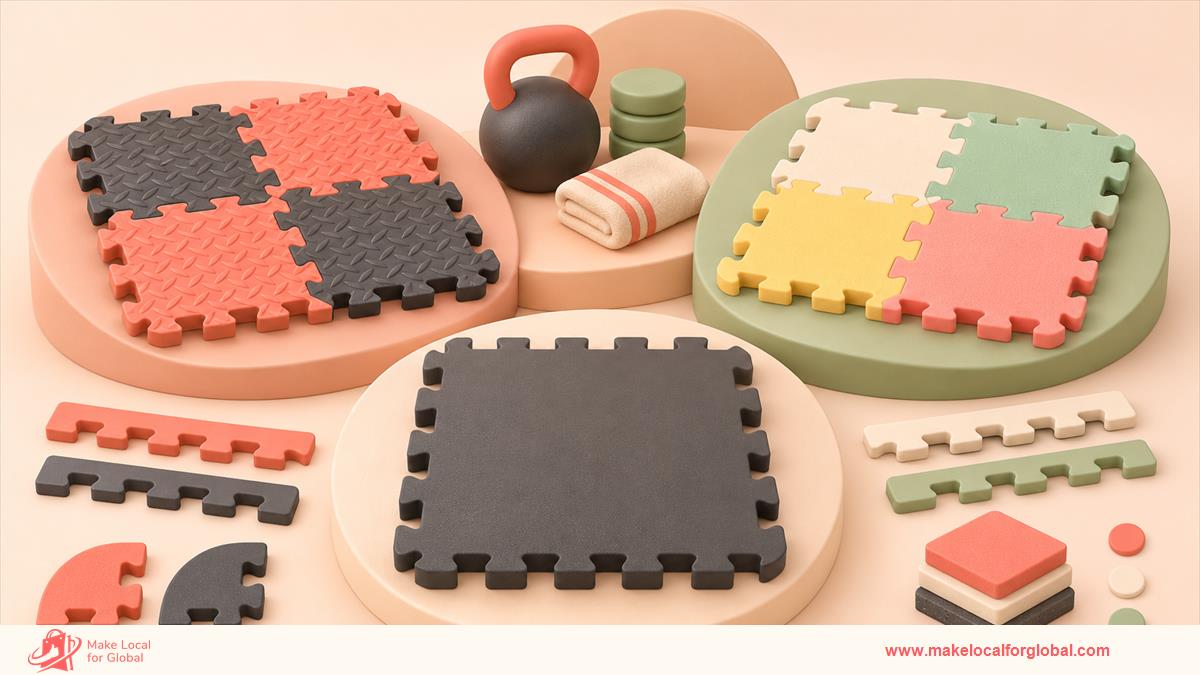
The first range should help a customer choose without forcing you to hold many similar colours or sizes. Begin with one clear use case and a few pack options you can explain. Add variants only when buyer questions or sales data support them.
For a small initial range, consider a starter pack for a defined area, a larger room pack and an add-on pack for expansion. The labels should describe approximate coverage and the number of tiles. Avoid names such as “small”, “medium” and “large” on their own, as customers cannot compare them across shops.
Work out coverage from the assembled sample. If one tile's usable area is 0.36 square metres, a pack of 12 nominally covers 4.32 square metres before allowances for room shape, cuts, borders or damaged pieces. Explain that this is a calculation, not a promise that every layout will use every square centimetre efficiently.
For a room with a recess or an irregular corner, a buyer may need extra tiles. A simple allowance can be useful, but do not tell every customer to buy an arbitrary percentage more. Describe how your coverage estimate is made and show a plan with the pack quantity. If tiles cannot be cut, say so. If the maker permits cutting, explain what tool and edge finish they recommend.
Colour can help a customer create a defined area or replace a visibly worn tile. Keep the first choices easy to restock. If colour batches vary, ask the supplier how to order matching replacement stock and whether batch differences are expected.
Test each finish under ordinary indoor light and photograph the sample beside a neutral object. Product screens vary, so state that the image is illustrative of colour where appropriate. Avoid editing the photo until the tile colour no longer resembles the sample.
Edge strips, corners, a carry bag or a cleaning accessory may add convenience. Each extra component increases packing, stock and customer-service work. A bundle only helps if the buyer needs its parts and can see what arrives.
Make a parts list for each pack. State the count of tiles, straight edges, corners and any tools or instructions. If accessories are sold separately, link them near the pack selector and show compatibility by model. A similar outline does not show that puzzle tiles from different brands connect. Check compatibility by model.
Customers may want to replace one damaged or stained tile months after purchase. Ask the supplier how long a model, colour and connector profile are expected to remain available. Do not promise future supply beyond the period the supplier confirms.
Keep model and batch details with each purchase order. If you cannot stock individual replacements, explain the minimum pack available. A clear answer reduces the chance that a customer buys a full floor and later learns that one matching tile cannot be obtained.
A photograph or supplier promise cannot show how connectors behave on a real floor. Order samples from the same product version and supplier you expect to sell. Keep notes, photographs, the purchase date and the product code with each sample.
Ask the supplier for:
Look at documents rather than accepting a supplier's “certified” message as a complete answer. A test for one model or one hazard does not establish that every claim is true. If you import products into Great Britain, your legal role may differ from that of a retailer buying from a UK wholesaler. Read the relevant product guidance and take specialist advice where the classification or evidence is unclear.
Use a repeatable inspection sheet. Record the supplier, model, batch and sample date, then check the product in this order:
Smell is not a safety test. A noticeable odour alone does not identify a chemical or prove harm. Ask the supplier for product-specific information and care instructions. If you see a strong, persistent odour or another unexplained issue, pause the listing and ask the manufacturer for a written response. Do not tell customers to air a product out as a substitute for investigating a concern.
Build a rectangular sample area and photograph every step. Confirm that a customer can tell which way each connector faces, how an edge strip is attached and whether the tiles need to sit on a clean, dry, level surface. Use the maker's instructions as the authority for installation.
Try a doorway, a corner and a short wall edge. A tile may fit the open room yet fail to create a neat border near a door. Record where a cut would be needed. Do not imply that a customer can trim the tile if the product maker has not approved that method.
If you are testing under furniture or equipment, obtain the supplier's permitted load and installation directions first. Record the object, footprint, position and time. This is not a substitute for a formal test report. It can reveal questions to send back to the maker before you sell.

A buyer needs to know the floor area they receive, not just how many tiles are inside a box. A clear calculator can cut down on avoidable messages and order mistakes.
Convert measurements to metres before multiplying. If tiles are 60 cm square, each nominal tile is 0.60 × 0.60 = 0.36 square metres. For 12 tiles, the nominal total is 12 × 0.36 = 4.32 square metres.
Check the assembled sample before publishing that figure. Interlocking tabs may overlap, and some suppliers quote dimensions that include the connectors. Ask the maker for assembled coverage if the measurement method is not clear. State whether the pack figure is approximate and how border pieces affect the result.
For a plain rectangle, multiply the room length by its width. A room 2.4 metres long and 3 metres wide has 7.2 square metres of floor. Compare the room area with the pack's assembled coverage and show the pack count needed for that layout.
The pack count is not always as simple as dividing area by tile area. Tiles may need to align from a wall or doorway, a room may have recesses, and some pieces may need trimming. A layout diagram is more helpful than an unexplained calculator result. If the design has multiple shapes, show the assumptions used to produce the estimate.
Tell the buyer whether a pack covers the whole area or leaves a small gap at the edge. For a layout that needs cuts, explain whether the tile manufacturer permits cutting and what the customer should check before using a blade. Show the likely leftover strips so the customer can decide whether the finish suits the room.
If border strips replace tile tabs, include their effect on the usable tile count. Do not count a border strip as a full tile. Give a diagram with the tile grid, border pieces and total dimensions. Label any measurement as an example layout rather than a guarantee for every room.
An added floor layer can change the height at a doorway. Ask the product maker for the intended transition and any limits. Show the finished edge from floor level, not only from above. A buyer may need to check door clearance or an adjacent floor surface before ordering.
Do not call a tile “trip safe” or state that it meets an accessibility standard without evidence for that exact claim. A seller can still provide useful factual information: the measured tile height, the edge profile, and the manufacturer's transition guidance.
Foam tiles can be light yet bulky. A courier may price by parcel dimensions, weight or both. Measure a packed sample before setting a delivery charge. A small difference in carton size can move an order into a different service band.
Pack the tiles as they will be sent. Record the outer length, width, height and scale weight, including protective packaging. Ask your carrier or fulfilment provider how it calculates the relevant service and confirm whether its size rules include the longest side or combined dimensions.
Repeat the measurement for each pack size and for a multi-pack order. Two separate cartons can cost more or less than one large parcel, depending on the service and destination. Do not estimate the shipping cost from a tile's unit weight alone.
Check whether the packed tiles can be bent or compressed without damage. Ask the maker for approved packing instructions. Avoid vacuum compression, heavy stacking or tight strapping when the supplier has not confirmed that the product tolerates that method and the sample recovers as intended.
The table below is an invented example for showing the calculation. Replace every amount with quotes from your supplier, payment provider, carrier and shop platform. It assumes a UK sale and treats the listed retail price as including VAT for the illustrative VAT calculation. A non-VAT-registered seller would model tax differently and should check current HMRC rules.
Assume a customer pays £54.00 for one room pack and standard delivery. The product purchase and inbound freight cost £19.00. The carton, label and protective materials cost £2.20. Outbound tracked delivery costs £8.40. The payment fee is modelled as 2.0% of the customer payment plus £0.20. A returns and damage allowance is set at £2.50 per order for planning.
| Cost line | Illustrative calculation | Amount |
|---|---|---|
| Customer payment | Includes delivery and VAT for this example | £54.00 |
| VAT element at 20% | £54.00 × 20 ÷ 120 | £9.00 |
| Revenue excluding VAT | £54.00 − £9.00 | £45.00 |
| Tiles and inbound freight | Supplier quote assumed | £19.00 |
| Packaging | Carton, label and protection | £2.20 |
| Outbound delivery | Measured sample carton quote | £8.40 |
| Payment fee | £54.00 × 2.0% + £0.20 | £1.28 |
| Returns and damage allowance | Planning assumption | £2.50 |
| Contribution before marketing and overhead | £45.00 − £19.00 − £2.20 − £8.40 − £1.28 − £2.50 | £11.62 |
This £11.62 is contribution after the listed variable costs, not net profit. It does not include advertising, platform subscription, staff time, storage, insurance, accounting, refunds outside the allowance, income tax or corporation tax. If the business is VAT registered, use the correct VAT treatment for each cost and sale. Ask an accountant if you are unsure how VAT applies.
If you offer free delivery, the customer still pays for it through the order price. If the carrier quote rises to £10.20 for a remote postcode, the contribution falls by £1.80. If a customer buys two packs in separate cartons, rework the delivery and packing lines instead of doubling the single-pack figure blindly.
Suppose a paid advert costs £3.50 for the order. Subtract that from the £11.62 contribution, leaving £8.12 before overhead and tax. A discount code of £5 would have a similar direct effect if it applies to that order. Use an actual measured acquisition cost where possible. Do not treat a planned marketing budget as if it guarantees a sale.
Use the model to compare pack sizes. A large pack may have a higher basket value but a less favourable shipping band. Its return cost may be higher if the parcel is damaged. Test the contribution for each carton separately and decide what information would change your choice.
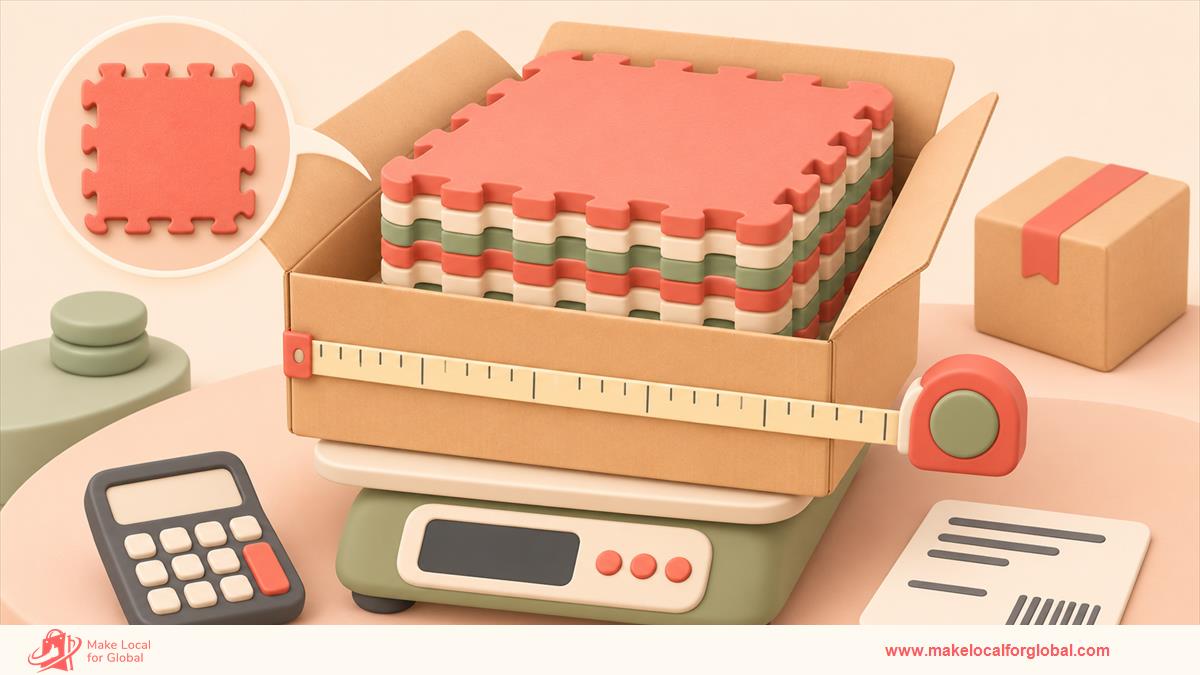
Use a real packed sample to estimate freight, then include fees, packaging, returns and marketing in the order calculation.
Floor tile orders take room in storage and in the delivery van. Plan where cartons will sit, how you will check them on arrival and how you will process a damaged or returned pack before you take orders.
Estimate the first purchase from evidence, not optimism. If you have received 20 serious enquiries for a small starter pack and none for a large studio pack, that does not prove 20 sales. It can tell you which pack to test first with a supplier quote, preorder waitlist or a modest stock order.
Set a reorder point using lead time and observed sales. Record the number of packs sold per week, supplier lead time and stock available. If replenishment takes four weeks, you may need to reorder before a pack is nearly gone. The correct buffer depends on your cash, supplier reliability and demand variation. Keep the arithmetic visible in a simple sheet.
Keep variant names consistent across the purchase order, carton label, website and inventory record. If the same colour has multiple connector versions, identify the version separately. That record helps with returns and safety enquiries.
Count the tiles, borders and corners before putting the stock away. Compare the label and batch details with the purchase order. Inspect a sample from each new delivery and record visible differences from your approved sample.
Photograph crushed cartons, torn bags, missing parts and damaged tiles. Keep supplier correspondence and agree how to handle each issue before listing affected stock. If a production change alters the size or material, review your product page and prior test evidence before you sell the new batch.
You can store and send orders yourself, use a fulfilment provider, or arrange supplier dispatch. Each route changes who handles stock checks, packing, delivery promises and customer messages.
If you pack orders yourself, test the workflow with the largest carton. Time the pick, check the exact tile count, protect the corners and measure the parcel. If a fulfilment provider handles the stock, ask how it records batches and what it does with opened or returned tiles. If a supplier dispatches to your customer, confirm its packing slip, return address, delivery tracking and response time.
Describe supplier dispatch accurately. Do not call it local stock if it is not. State a realistic delivery estimate based on the arrangement you have confirmed. Include the handling time before a carrier collects the order.
An unopened pack can still be expensive to send back. Check your return policy and the customer's legal rights. For online consumer sales in the UK, official guidance says a customer normally has 14 days from delivery to tell a seller they wish to cancel, then another 14 days to send the goods back. The seller must provide the required information before purchase and follow the applicable refund rules. Read current GOV.UK online and distance selling guidance and returns and refunds guidance.
Do not write “no returns” as a blanket condition. State the process, contact route, expected condition and how to request a return in a way that follows the rules. Keep a returns log with the pack type, reason, condition, cost to receive and resale outcome.
For opened tiles, follow the product maker's hygiene, inspection and resale guidance. A tile with a tear, contamination or missing connector may not be suitable to sell as new. Set aside uncertain returns until you have checked them. Include the average return and damage cost in the next pricing review.
Foam tiles are not one regulated product class by default. Intended use, design, marketing, material and destination market can change the applicable requirements. A tile intended as a toy or children's play product may need a different assessment from an adult exercise tile. A permanent flooring product can raise different questions from a temporary interlocking mat.
This section is a starting checklist, not legal advice. Confirm requirements for the exact product, your business role and each market before placing goods on sale.
In Great Britain, general product safety law covers products that do not have a more specific regime. The Office for Product Safety and Standards says UK businesses that make, import, distribute or sell consumer products have responsibilities for safety and labelling. The guidance says sellers need records that identify suppliers so product origins can be traced. See GOV.UK product safety advice for businesses.
If you bring products into Great Britain from outside the UK, you may be the importer and have more responsibility than a retailer buying from a domestic wholesaler. Ask the supplier for manufacturer and importer details, product identification, batch references, instructions and applicable evidence. Keep the invoice and records that connect the stock you hold to its source.
Northern Ireland has a separate set of general product safety rules. Current GOV.UK guidance says Regulation (EU) 2023/988 applies there from 13 December 2024, and the General Product Safety Regulations 2005 continue to apply in Great Britain. Check the official Great Britain guidance and Northern Ireland guidance before selling across those markets.
If the tile is designed, marketed or supplied as a toy or play product, investigate the relevant toy rules for the destination market. The GB guide to the Toys (Safety) Regulations 2011 covers business obligations. Do not assume that a “play mat” label makes a product compliant. Ask the manufacturer for the classification, risk assessment, instructions, warnings and supporting documents for the exact product.
The regulation question is about the product as placed on the market, including its use and presentation. If you change the product, package, age claim or instructions, ask whether that affects the assessment. If the seller is unsure, pause the listing and obtain qualified product compliance advice.
Use phrases such as “non-toxic”, “chemical free”, “BPA free” or “safe for babies” only when current, product-specific evidence and a valid basis support the claim. A supplier statement without a model number or test details may not support a broad promise.
For businesses producing or importing articles into Great Britain, HSE guidance describes specific UK REACH notification duties for certain candidate-list substances when thresholds are met. That is a particular duty with conditions, not a blanket certificate for every article. Read HSE guidance on substances in articles and ask a compliance specialist whether it applies to your product or business role.
Ask a supplier what material information it can provide and what test the document covers. Keep a copy of the document, its model identification and your supplier's written confirmation. Do not convert a narrow test result into claims the test did not measure.
State the intended use supported by the manufacturer. Include the surface the tiles should be installed on, cleaning steps, storage requirements and any use limits. If the product maker does not provide a clear answer, get one in writing before you publish.
Do not promise soundproofing, fall protection, heat resistance, water resistance, anti-fatigue performance or compatibility with underfloor heating without suitable product evidence. Those claims can cause a buyer to choose a tile for the wrong job.
If a buyer reports a safety issue, record the product code, batch, order date, description and any photographs. Notify the supplier and follow the relevant reporting requirements. The official product-safety guidance explains seller responsibilities and routes for reporting a risk.
A strong page lets the customer judge fit before adding a bulky pack to a basket. The title should say what the product is, the key material or format, and the pack size. Keep search phrases natural. Do not repeat one phrase in every heading.
A title such as “Charcoal interlocking foam tiles, 12-piece home gym pack” gives more information than “Premium floor mat”. Use only claims you can verify. If the tile has not been assessed for gym equipment, leave that use out of the title.
In the opening paragraph, say the tile dimensions, pack count, assembled coverage, edge-piece contents and intended use. Add a simple note about what is not included, such as an underlay or corner kit, where that applies. A clear product summary prevents the customer from mistaking a sample photo for a complete room set.
Include:
Avoid adding every field just to fill space. A missing specification is a question for the supplier, not an invitation to guess.
Use a main image with the assembled floor, loose pieces and edge finish. Add an overhead view with a dimension guide, a close photograph of the connector tabs, an edge-strip example and a photo of the packaged order. Show a real room scale so customers can understand the coverage.
Label diagrams with the actual sample measurements and pack count. Do not let an image imply that a product includes a border kit if it is sold separately. For a multi-colour layout, show the exact mix included in the pack and whether the buyer can choose each colour.
Add answers to questions you heard during demand testing. Common examples include whether all edges are finished, whether the tiles can be cut, how to order enough for a room with a doorway, and how to clean the surface. If you do not know, say that you are checking with the manufacturer rather than making a promise.
Include delivery dimensions and an honest delivery estimate. Customers may compare two products by the total cost of getting enough tiles to their home, not by the price of one pack. Show the delivery charge before the customer reaches the final payment step.
Write a category page for your core range and useful support pages for coverage, fitting, cleaning and product differences. Each page should answer a different question. A sizing page can explain how to calculate room area; a product page can then show the coverage of its particular pack.
Use phrases buyers actually use, including “interlocking foam floor tiles”, “foam gym floor tiles” or “playroom floor tiles” where each term matches the product. Do not call one tile a gym mat, children's mat and workshop floor at once just to include more keywords. Search engines and buyers need an accurate page, not a string of synonyms.
Link related products by use and fit. A gym buyer may compare a different fitness range, but should not be pushed to an unrelated product. For more ideas, see MLFG's pages on selling fitness equipment and selling fitness balls. Use internal links when they answer the next question rather than adding them as decoration.
Select a channel that gives you control over product information and a way to answer sizing questions. A marketplace may provide buyer reach but limit how you present complex pack coverage. Your own shop can support diagrams and a room calculator, but you must bring potential customers to it.
For each channel, calculate the same item price, delivery charge, fee, fulfilment cost, return assumption and acquisition cost. Include monthly subscriptions or listing costs where they apply. Do not compare a marketplace's gross sales with a direct shop's contribution after costs.
Read the current channel rules about prohibited claims, fulfilment, returns and product documentation. Those rules can change. Check them before you commit inventory or create a listing. Use the destination market and the specific product type in the policy search.
Publish one page or a few short posts that solve a real buyer problem: how to estimate pack count, what to check before placing a mat beneath equipment, or why edge pieces change the floor footprint. Use photos of your real sample and state any measurement assumptions.
Track a meaningful action such as a coverage-calculator use, a delivery quote request, a sample request or a purchase. A view count alone does not show that buyers understood the tile or accepted its total cost. Ask people who leave the page where they got stuck.
Save incoming questions by topic: coverage, door clearance, cleaning, use under equipment, colour match or delivery. If several buyers ask the same thing, revise the page or seek a supplier answer. If people abandon the order after seeing postage, review carton dimensions and the pack offer. Do not hide delivery costs to improve an initial click rate.
Ask for feedback after delivery. A customer can tell you whether the number of tiles matched the diagram, whether the edges arrived intact and whether the listing's colour was clear. Use that information to improve images and instructions. Do not publish a review without the customer's permission or change its wording to make a claim they did not make.
This plan works best with a limited first range and clear measures. The dates are a sequence of work, not a sales forecast.
Pick one use group and speak with potential buyers. Record the room types, tile count, surface needs and questions they raise. Compare those needs with supplier specifications. Request one sample from each candidate supplier and ask for material, use and safety documentation.
At the end of the week, keep only products that have a clear specification, a realistic supply route and an answer for their intended use. If a supplier cannot identify the sample or explain its material and use limits, do not build the offer around it.
Measure tile dimensions, thickness, joined coverage and packaged carton. Check connectors, borders, surface and the maker's cleaning instructions. Photograph defects and send questions to the supplier.
Build a cost sheet for each pack. Add product cost, inbound freight, package materials, carrier service, payment fee, marketplace charges, returns allowance and test marketing. Mark VAT assumptions. Compare contribution for a single pack, a multi-pack and an order to a distant postcode.
Write the product page with verified specifications, a coverage diagram, pack contents, clear uses and care directions. Create images from the sample. Confirm the dispatch method, returns address and customer-service process. Check the checkout shows total cost and delivery information before payment.
Ask a few target buyers to use the page without coaching. Note where they hesitate. If they cannot tell how many packs they need or what the edges include, fix those details before spending on advertising.
List the limited range and send a measured amount of traffic from a channel you can observe. Record visits, enquiries, orders, pack mix, shipping charges, returns and questions. Do not judge the test by one sale or one quiet week.
Compare what happened with your initial assumptions. If people ask about use beneath heavy equipment, obtain the correct evidence before expanding that claim. If the large carton reduces contribution, reconsider the pack size or delivery offer. If customers struggle to measure a room, improve the calculator and diagram.
Write one decision at the end of the test: keep the offer as it is, change one feature and test again, or stop buying stock. Make the decision from cost, product feedback and observed buyer actions.
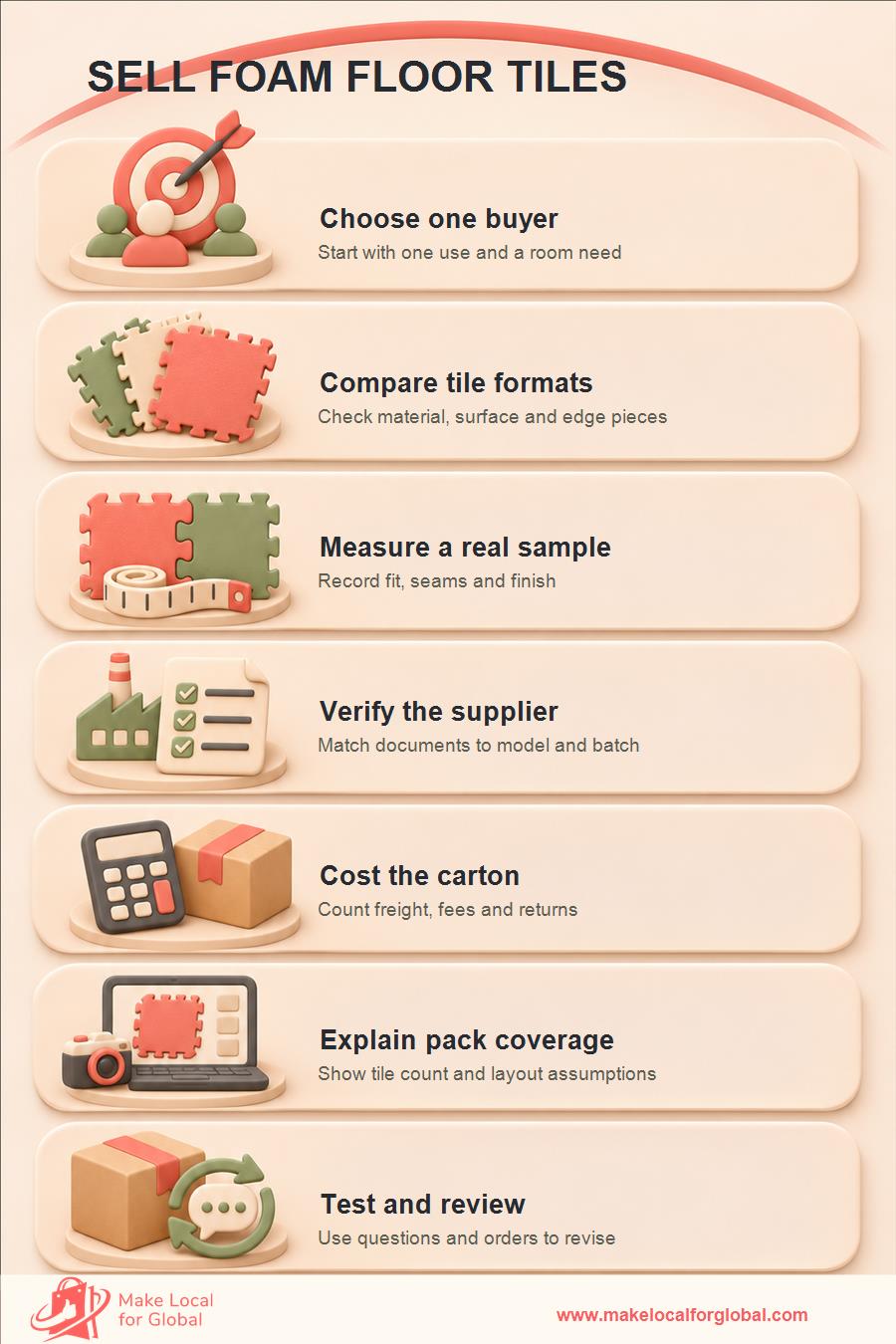
They can suit a focused store if you can explain the intended use, room coverage, parcel cost and product evidence. The bulky carton makes delivery part of the offer. Test buyer interest and contribution before placing a large stock order.
Choose the tile that fits a buyer group you can reach and a use the manufacturer supports. Compare material, surface, dimensions, connectors, edge options, pack contents and cleaning instructions. A long supplier colour list is not a reason to choose a product.
Use the usable tile dimensions and assembled coverage for the exact product. Measure the room, account for doorways and borders, then show the layout and pack count. Tell buyers whether the estimate assumes a rectangular room or allows for cuts.
Do not make a broad age or safety claim without product-specific evidence and a correct product classification. Ask the manufacturer for intended age, warnings, instructions and applicable conformity documents. Check the rules for your market before listing a child-focused product.
Only where the manufacturer supports that use and provides suitable limits or evidence. A seller's hand pressure test cannot establish an equipment load rating. Ask about compression, recovery, surface damage and floor protection for the intended equipment.
Large packs can cover more space in one purchase, but they can move into a higher delivery band and cost more to return. Measure and price each pack size. Offer a large pack only when its coverage and total delivered price make sense for your buyer.
Show the assembled area, top texture, underside, puzzle edges, border pieces, pack contents and packaged carton. Add a simple room layout with dimensions that match your sample. Make clear whether furniture, accessories or extra tiles in a styled photograph are included.
State dimensions, thickness, pack contents, assembled coverage, intended use and cleaning instructions clearly. Show the edge finish and delivery size. Track why each customer returns a pack, then fix the page or product issue that caused it.
The documents depend on the product, claims, business role and market. Ask for current records that identify the exact model and test. Check whether the tile is a toy, a general consumer product or another product category before you decide which requirements apply.
Follow the manufacturer's instructions. Claim that the product can be cut only if the maker permits it and explains the appropriate method. If cutting is permitted, show a sample edge and explain that a cut may change the finish or border fit.
Pack a real order, measure the carton and get a carrier quote for the destinations you plan to serve. Include packaging and any fulfilment charge. Review the price when a carrier changes its size bands or surcharges.
There is no reliable profit figure for every seller. Price depends on supplier cost, delivery, fees, acquisition, returns, storage and tax treatment. Calculate contribution using your own quotes, then compare the result with your fixed costs and working time.
Give buyers the tile count, measured coverage, use limits and total delivery cost they need to decide.
A useful foam tile offer begins with one buyer and a product the seller can describe accurately. Confirm the specification, calculate coverage from an assembled sample, measure the actual parcel and check that every advertised use is supported by the manufacturer.
Keep the opening range small. Make the pack contents visible, explain the room-size assumptions and include delivery before checkout. Use buyer questions and order costs to decide what to change next.
Explore the wider Product To Sell article collection for more ideas to compare before selecting the next item.
PREFERRED SOURCE
Like what you’re reading? Add Make Local for Global as a preferred source on Google to see more of our articles when you search.

Build your online presence without having to figure out everything yourself.