

READY TO SELL Foam rollers ONLINE?
Get a store built for you in 5 days, plus training and support to help you start, run, and grow your Alternative business.

Plan a foam roller range with clear size and surface differences, supplier checks, sample inspections, parcel costing and a measured UK launch.

Foam rollers look like a simple product: a cylinder with a surface and a size. For a new seller, the decisions sit in the details: who will use it, how firm it feels, whether the texture suits the buyer, how the roller is packed and whether its length changes the delivery price.
You can sell foam rollers online by choosing one clear buyer group, building a small range around verified material and size differences, checking samples, costing the packed order and writing product pages that show what the customer will receive. Start with a few models you can describe and support. Use buyer questions, delivery outcomes and order contribution to decide what to add next.
This is a practical UK seller’s plan for launching a foam roller range. It covers product choices, sourcing, sample checks, safety information, parcel costs, search pages and a 30-day test. It does not promise a health result from using a roller. Describe the product and its documented use; leave treatment advice to qualified health professionals.
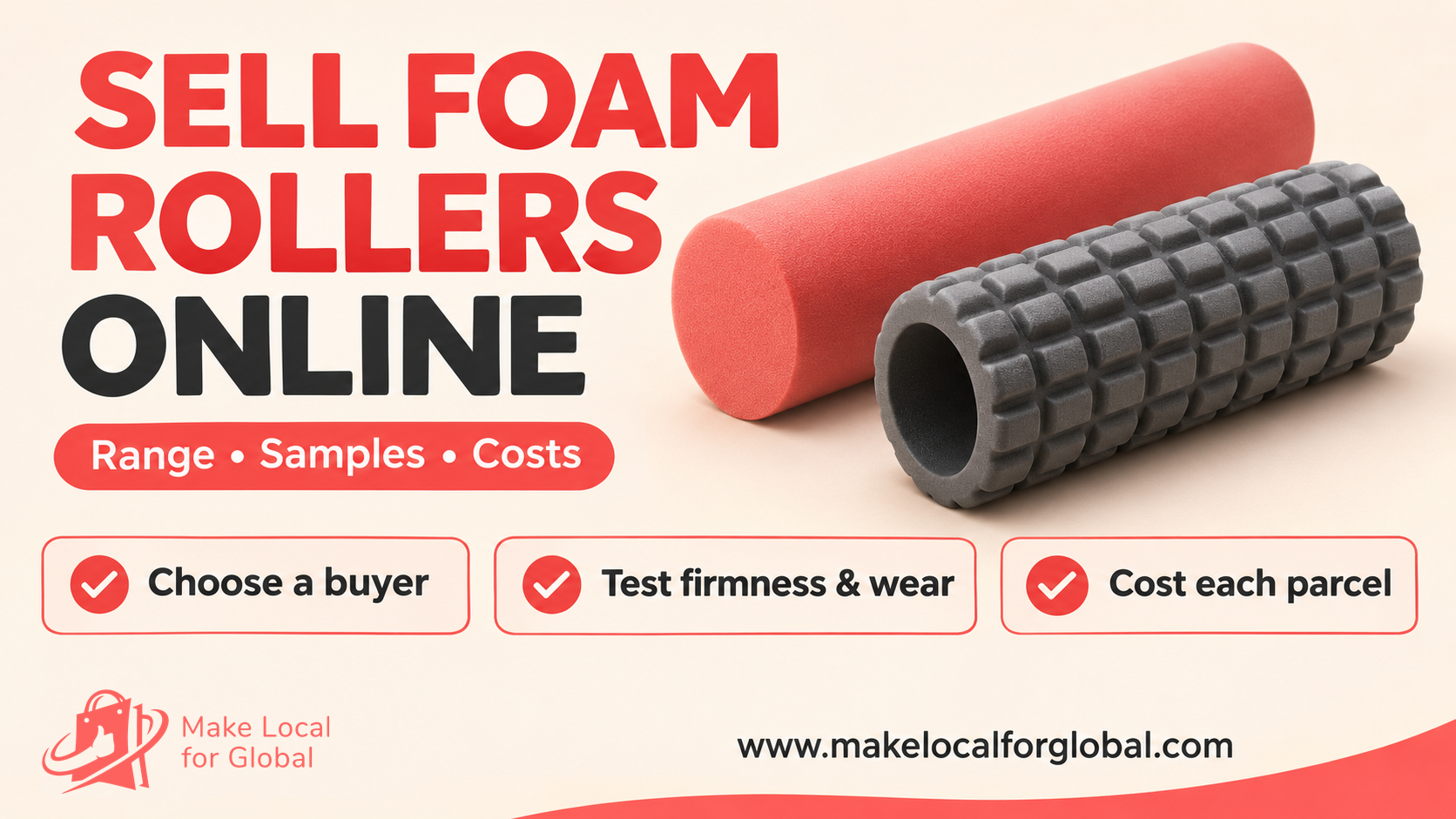
Give shoppers a clear way to compare length, surface and packed size before launch.
A foam roller can be sold to home exercisers, gym members, runners, personal trainers, Pilates teachers, physiotherapy practices or sports clubs. These groups overlap, but each may ask different questions. Someone carrying kit to a class may want a compact product and a carry strap. A studio buyer may care about wipe-clean surfaces, replacement stock and repeatable colourways. A home buyer may need dimensions and storage advice before ordering.
Choose the group you can understand and reach. Do not write “for everyone” as a substitute for a decision. A useful first profile might be: “A new home-training customer who wants one roller for general stretching sessions, does not know whether to choose a smooth or ridged surface, and needs a product that stores beside a mat.” That profile gives you questions to ask and product information to prepare.
Talk to people who may buy the product. Ask what activity they do, where they would keep the roller, how often it would travel, what size they already use and what makes a new product hard to choose. Ask what they expect a “firm” or “soft” roller to feel like. Those words have no useful meaning on a page without an explanation or a comparable sample.
Separate comments about the roller from comments about the customer’s technique or health. A product seller should not diagnose a pain problem or recommend an item as a cure. If a shopper asks whether rolling is suitable for an injury, direct them to their clinician or another qualified professional rather than making a medical promise.
Record the exact wording of repeated questions. “Will it fit in my gym bag?” points to packed length and a scale photograph. “Is the surface rough?” points to a close-up and sample description. “Can I clean it?” points to care instructions from the maker and a check on the sample. These are practical signals for your range and product page.
Use a short survey, a small sample display or conversations with local trainers to compare the questions buyers have about different formats. A reaction to a photo is weak evidence. A request for dimensions, a sample purchase or a completed order tells you more about a real buying decision.
Search current listings and public reviews. Sort observations into surface, firmness, length, diameter, care, damage, packaging, delivery and expectations. Do not copy a competitor’s claims or use a review count as proof that a product is right for your audience. Look for missing product information you can supply accurately.
Keep a simple evidence log with the phrase or question, intended buyer, competing products checked, sample needed, likely carton and the result that would justify a small stock test. This helps you separate curiosity from an order that can cover its costs.
A first range needs options that are easy to tell apart. Start with a small number of models with distinct roles, such as a standard smooth roller, a compact roller for travel and a textured model. Add a half roller, bundle or vibrating version only when a buyer group, supplier support and delivery model justify it.
Do not assume that a more textured design is “better” or that a compact model is the natural beginner option. Those are choices the customer should make from clear information. Show the shape, measurements and sample feel in a way the buyer can compare. Use the exact manufacturer specifications for each model.
Supplier listings use terms such as EVA, polyethylene and polypropylene. Some rollers combine a foam outer layer with a firmer inner structure. Ask what each layer is made from and which exact model the declaration describes. A material name alone does not tell a buyer how a finished roller feels, lasts or should be cleaned.
For a useful example of the level of detail available from a manufacturer, DFYNE lists one roller as 33 cm long, with a 45 cm circumference and an EVA and PP composition. Those specifications apply to that named product, not to every roller. You can check them on the DFYNE foam roller product description. A separate supplier guide from Algeos compares EVA and EPP roller formats; use such guides as product research, then confirm claims with the maker of the stock you intend to sell.
For each material or construction claim, ask whether it refers to the cover, the whole body or a core. Keep claims such as “high density”, “moulded” or “long lasting” only when the supplier defines them and the evidence supports the wording. Do not turn a supplier’s phrase into a guarantee of a number of years or sessions.
Measure total length and diameter. Record the shape of the ends, any hollow core, raised texture and whether the model includes a strap or case. If the manufacturer supplies a circumference rather than a diameter, do not mix those measures in a comparison table. Label each measurement plainly and use the same units across the range.
A longer roller can take more room in a parcel and on a shelf. A shorter roller may fit a gym bag, but the buyer should see its exact dimensions before checkout. The surface pattern can be difficult to judge in a full product photograph. Add a close view and explain the shape in ordinary language, such as smooth, ridged or grid-textured, when that description matches the product.

A compact opening range might use three products: a standard smooth roller, a shorter model and one textured option. The product pages need to explain how they differ and show each item at the same scale. If the supplier offers several colours but identical specifications, colour can be a variant instead of a separate product page.
A small studio might prefer case quantities and a consistent replacement route. A direct-to-consumer shop might offer one roller, a storage strap and a mat as optional add-ons. A trainer might want multiple colours for group sessions. These are different range designs; select the one your buyer evidence supports.
Set a reason for every stock keeping unit. Record who it is for, its verified distinction, expected carton, supplier minimum and replacement route. If two models perform the same role and their only difference is an unverified “premium” label, keep one until you can prove a useful distinction.
A roller with a carry strap or a small guide to product care may suit a customer who travels to classes. A roller and mat may suit a home set-up, if both products fit the same buyer and the parcel is still practical. List every included part and show what is optional.
Check the supplier’s rights for any printed exercise instructions and get permission before adding third-party content to a package. If a bundle includes a product from another maker, name the model and confirm the compatibility. Calculate the packed dimensions again: a bundle can cross a carrier’s size threshold even when its combined weight changes very little.
Possible sourcing routes include a UK wholesaler, a brand or manufacturer, an importer, a distributor or a private-label arrangement. A UK wholesaler may offer smaller quantities and simpler replenishment. Direct import can change lead time, cash tied up in stock and your obligations. Private label can make you responsible for claims and product information that a reseller might not control.
Ask suppliers to identify the exact product and tell you who is responsible for each stage. Request the registered business name, physical contact details, model identifier, material specification, carton information, batch or production record and written returns route. Check that an invoice names the same supplier you dealt with.
Request answers to these questions before paying a larger deposit:
Compare the answers across at least two viable sources where possible. Do not accept a document with no model reference, a certificate for another product or a “food grade”, “medical” or “non-toxic” statement with no supporting evidence. Where you cannot judge a document, seek advice from a competent product-safety professional or Trading Standards before placing stock on the market.
Ask how a supplier controls production between the sample and a full order. Keep the accepted sample, its packaging, supplier correspondence and photographs. Agree how the supplier will tell you about changes. A roller can look similar in a catalogue image and still use a different foam, core, surface mould or adhesive.
A sample check should make the product easier to describe and reveal issues before they are multiplied across a case. It is not a substitute for a required test or a formal safety assessment. Use a repeatable checklist for each model and keep a record that can be compared with later batches.
Photograph the unopened carton, then note its label, model and any visible damage. Open it without cutting into the product. Match each component to the packing list. Record missing inserts, crushed edges, marks, residue or a strong odour and ask the supplier whether it is expected and how they assess it.
Compare the sample with the material and dimension sheet. Use a ruler or tape measure to check length and diameter at several positions. If measurements vary, note the method and amount rather than smoothing away the result. Weigh the product and packed parcel separately. Record the scale and the units used.
“Soft”, “medium” and “firm” mean different things to different shoppers. If you use those words, explain how the models compare and base the statement on the actual products. Place samples on the same flat surface, apply the same gentle hand pressure in the same area and record your observation. Do not present this informal check as a laboratory measurement or an injury recommendation.
Check whether the product compresses visibly, whether the surface returns to its earlier shape after you release it and whether there are permanent dents after a short observation period. Follow the maker’s instructions and avoid excessive force, heat or chemicals. For more demanding durability claims, ask for test evidence or commission an appropriate test instead of relying on one sample.

Look for tears, loose material, split edges, uneven moulding, sharp flash or a rough finish that differs from the approved sample. For a hollow model, inspect the rim and inner edge. For a textured version, check whether the moulded pattern is even and whether any raised feature has a rough edge. Photograph a close-up that makes those details visible.
Read the care instructions before cleaning. If they say to wipe with a damp cloth, test only that method on a sample and allow it to dry. Do not use a disinfectant, solvent or hot water without approval from the manufacturer. Keep any result in your notes, then ask the supplier about a mismatch between the sample and its care sheet.
Check the product after the clean and dry cycle for colour transfer, tackiness, surface change or damage. Do not claim that a roller is “antimicrobial”, “non-slip” or suitable for shared studio use based on a visual inspection. Ask for the exact test or evidence behind such claims.
Create a product file for each model. Store the supplier’s invoice, specification, sample photos, label, instructions, test reports, complaint log and approval decision. Record the date and version of every document. If a safety issue appears, you need to identify which customers and batches may be affected.
Set written pass and fail points before the next sample arrives. For example: dimensions fall within the tolerance the supplier has stated; no cut, split or sharp edge is visible; the surface matches the approved sample; and the packing list is complete. Ask the supplier to define production tolerances rather than inventing a number that has no agreed meaning.
A foam roller is a consumer product. Product safety rules depend on the product, the seller’s role and the market. A simple non-electrical roller can raise different questions from a powered vibrating device or a broader stationary exercise machine. Do not copy requirements from one equipment type to another without checking the exact scope.
In Great Britain, the Office for Product Safety and Standards’ guidance on the General Product Safety Regulations 2005 explains duties for producers and distributors. The rules require consumer products to be safe in normal or reasonably foreseeable use. The guidance sets out traceability and information responsibilities for producers, and due-care duties for distributors.
Northern Ireland has a separate regime: Regulation (EU) 2023/988 on general product safety has applied there since 13 December 2024. If you serve Northern Ireland, read the current Office for Product Safety and Standards factsheet and detailed guidance. Great Britain guidance is not a substitute for the Northern Ireland rules.
Your position may differ if you make a product, use your own brand, import it, distribute it or sell it as a retailer. Confirm who is treated as the producer or importer for your arrangement. Keep records linking your units to the supplier, the model and any batch reference. Provide product information and warnings that fit the actual foreseeable use.
Do not add a UKCA or CE mark to a page or package on the basis that another item in the category carries one. Check whether a specific regulation applies and what evidence, marking or declaration that law requires. An image of a symbol does not prove a product has been assessed correctly.
A vibrating roller may include a battery, charger, motor and electronics, adding questions about electrical safety, battery handling, instructions, repairs and transport. Ask a specialist which product rules apply before sourcing one. Keep this model separate from a non-powered foam roller in your product comparisons if buyers cannot clearly see the added functions and care requirements.
This is operational guidance, not legal advice. Product rules can depend on construction, claims, territory and business role. Ask Trading Standards or a qualified product compliance adviser about the exact model when you are unsure.
Foam rollers may be light, but the parcel can be long or awkward. Price the complete customer order, not just the supplier’s unit price. Include the roller, inbound freight, duty where it applies, packing, outbound delivery, payment or marketplace fees, expected returns, damage and customer acquisition. Record which figures are supplier quotes and which are planning assumptions.
The following is an illustration for a UK seller who is not VAT registered. It is not a recommended market price or a supplier quotation. Each cost is an example amount. Assume a single roller sells for £29.50, and the supplier’s landed cost includes the product and inbound freight. The seller buys protective packaging, pays for a parcel service and reserves an amount for returns and acquisition.
| Order calculation | Illustrative amount |
|---|---|
| Customer price | £29.50 |
| Landed product and inbound freight | −£8.40 |
| Protective packaging | −£1.30 |
| Outbound parcel charge | −£4.20 |
| Payment fee example: 3% of £29.50 plus £0.20 | −£1.09 |
| Returns and damage allowance | −£1.00 |
| Advertising cost allocated to the order | −£4.00 |
| Contribution before fixed overhead and tax | £9.51 |
Illustration only. Replace every input with your own supplier, carrier, fee and returns data. Contribution is not net profit.
The calculation is £29.50 − £8.40 − £1.30 − £4.20 − £1.09 − £1.00 − £4.00 = £9.51. The example excludes storage, staff time, insurance, software, rent, accounting, financing, tax and any fixed costs. The payment charge is a planning assumption, not a provider tariff. Use the fee base and rate that apply to your channel.
If you are VAT registered, calculate sales revenue and recoverable input VAT in line with your accounting treatment; do not use a gross customer price as though all of it were revenue. UK Government guidance currently sets the registration threshold at more than £90,000 of taxable turnover, with other registration rules in some situations. Check the latest VAT threshold guidance and speak with an accountant about your position.
Take the exact roller, wrap it as a customer order and measure the finished package at its widest points. Record length, width, height and weight. Add a strap or another product to a bundle, then measure the bundle rather than assuming the single-product quote still applies.
Ask a carrier for its current parcel limits, size bands, remote-area charges, compensation, tracking and surcharge rules. A tariff may use more than scale weight. Do not rely on a generic “small parcel” estimate when the carton is long. Run the quote with realistic destination postcodes and retain the quote date.
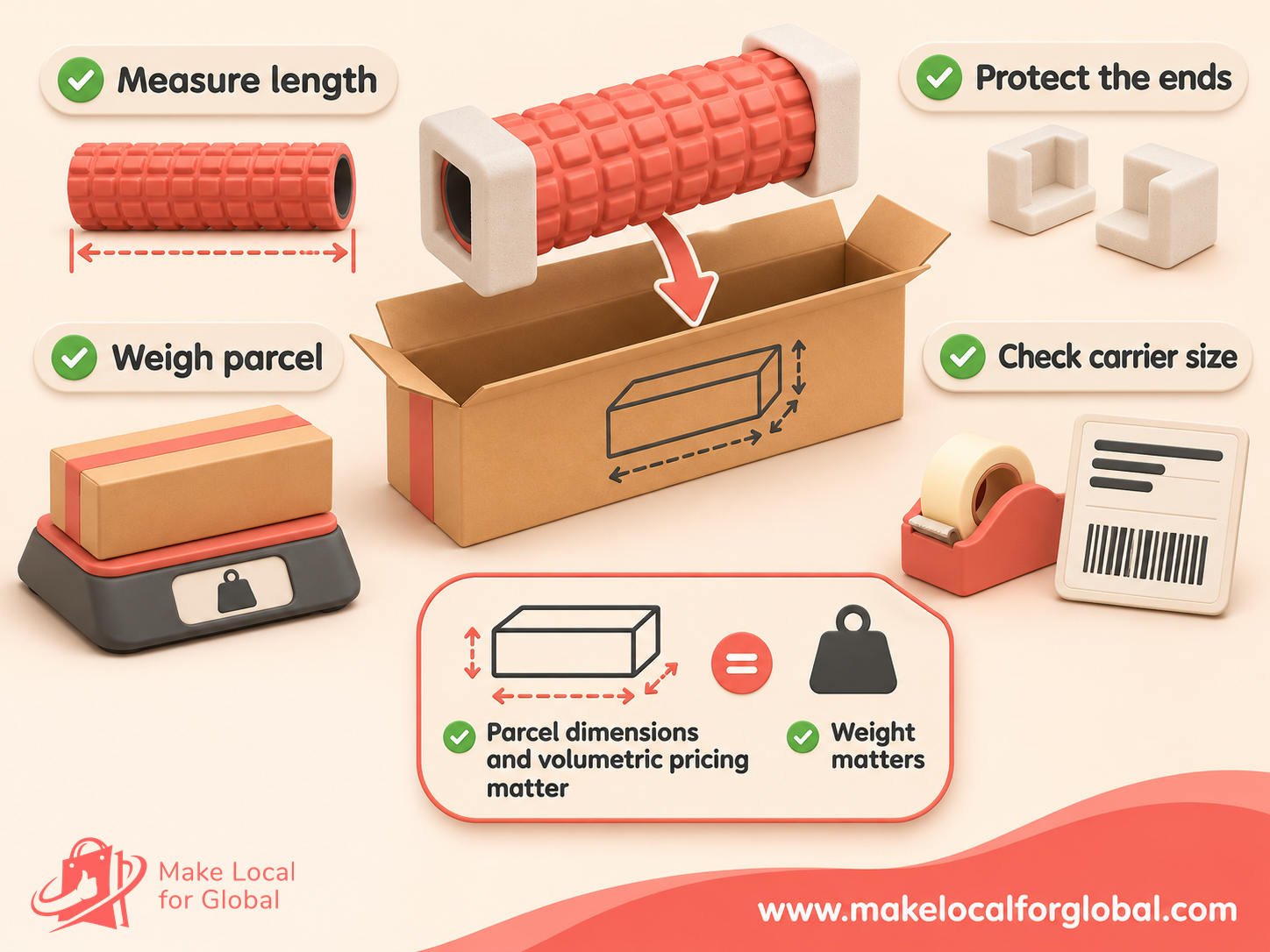
Choose packaging that stops the roller being crushed, marked or exposed to dirt in transit. A long carton can leave empty space at the ends; use protective inserts only if they hold the product in place and do not create an unnecessary size increase. Test the carton through your packing process and confirm the carrier accepts its dimensions.
Recalculate if the parcel quote is higher than expected. Options include a different carton, a local fulfilment service, collection from a studio, a bundle that shares the charge or a price that states delivery separately. The decision depends on buyers and actual quotes, not a promise that delivery is free.
Create a low, expected and high case. Change one assumption at a time: supplier price, carrier charge, advertising cost, return allowance or discount. Check how many orders cover monthly fixed costs and how much cash remains tied up in stock. If contribution disappears after one realistic delivery or return change, review the model before raising the order quantity.
Set a reordering rule in advance. You might require a set number of fulfilled orders, a maximum damage rate and a minimum contribution before replenishment. Choose values for your cash limit and selling plan. Do not treat a few social likes or a high page-view count as proof that the stock will sell.
Put stock, parcel, fees and a realistic returns allowance into the same calculation before you reorder.
A buyer cannot handle the roller through a screen. Put the facts they need beside the product: measurements, material, surface shape, what is in the package, care instructions, delivery and the contact route for a question. Make the product page specific to that model.
A clear product title could be “Grid-textured EVA foam roller, 33 cm” only if the surface, material and length are verified for that item. A category title can say “Foam rollers for home training”. Avoid strings of near-identical phrases, unverified superlatives or a health outcome. The product title describes the item; the page introduction explains which details help a buyer compare it.
Put the primary facts high on the page: length, diameter or circumference, material composition, surface type, product weight, colour, care method and included items. If the supplier does not provide a useful dimension, measure it and state that it is an approximate measurement from the sample. Do not copy another model’s specification.
Use a full product photograph, a close surface view and a size reference. Keep the camera angle consistent across related models. Include a ruler only if its markings remain clear. Do not make a short roller look full-length by cropping or placing it in perspective.
Show exactly what arrives. If the roller in the image is sold with a strap, label it as included or optional. If there is a hollow centre, photograph it. If the outer colour varies between production batches, explain the range only when the supplier confirms it.
Write alt text that identifies what is visible, such as “Coral grid-textured foam roller shown beside a measuring tape”. Use different alt text for a surface close-up, a product in its carton and a comparison graphic. Do not repeat the same search phrase in every image description.
If you describe a model as softer or firmer than another, name the comparison and the basis for the wording. A short, consistent sample comparison can explain your seller’s observation, but it is not a standard rating. Do not describe a roller as a beginner’s treatment or a therapy device before its classification and claims have been reviewed.
Copy care instructions from the exact product documents and keep their meaning intact. If they say to wipe clean with a damp cloth, use those words. Do not add “machine washable”, “safe for every cleaner” or “suitable for a clinic” without proof from the manufacturer and appropriate review.
State the dispatch estimate, delivery service, charge, coverage and parcel size where useful. Tell the customer whether a tracking link is sent. Explain who to contact if the package arrives damaged or a part is missing. Put the returns information where a shopper can find it before checkout.
Government guidance on online and distance selling covers the information a business should supply before an order and the usual cancellation period for online goods. The separate guidance on returns and refunds explains when faulty goods must be refunded. Check the current rules and exceptions for the product and transaction; do not write a “no returns” policy that takes away a customer’s rights.
Your own ecommerce site gives you control over product comparisons, instructions, cross-links and customer support. A marketplace can put a product beside existing category listings, but its current fees, image rules, safety fields and seller policies apply. A local studio or retailer can provide direct buyer feedback, though wholesale pricing and case quantities may change the margin.
Pick one primary route and one small discovery test. Do not open every channel before you have approved samples, product photographs, a returns process and a reliable way to answer questions. Review the platform’s seller requirements at launch as policies and fee schedules can change.
Research phrases a buyer may type, such as “foam roller length”, “smooth or textured foam roller”, “compact foam roller for gym bag” or “how to clean a foam roller”. Use search suggestions, customer messages and marketplace questions to find real wording. Do not assume that a phrase’s popularity means it will produce profitable orders.
Give each page a distinct job. A category page compares models. A product listing contains that model’s details. A how-to page answers an information question and links to relevant products only when the link helps. A service page tells buyers how delivery or returns work. Avoid repeating one template paragraph and changing only the product name.
Useful supporting content might explain length and diameter, show a product cleaning method from the manufacturer, compare travel size with a standard size or teach buyers to read a material label. Keep health and fitness claims factual, limited and properly reviewed. Ask a qualified professional to review clinical topics rather than writing medical advice from seller experience.
Link to related MLFG resources where they answer a natural next question. A broader guide to selling fitness equipment online covers the wider category. The articles on selling adjustable dumbbells and selling adjustable weights help a seller compare nearby strength products. A mobility store can explore the existing yoga mats ecommerce page for a related category example. Our guide to selling fitness balls online covers another fitness accessory. Place each link beside relevant advice rather than adding an unrelated list to a footer.
Set a budget and a stop point for any paid promotion. Track qualified visits, product page views, add-to-basket actions, completed orders, delivery charges, cancellations and questions. If buyers view a product but do not order, check the price, size information, shipping charge and trust details before assuming that a bigger audience is the answer.
Look at the actual contribution after advertising and delivery. A higher order value can still leave less contribution if a bundle raises postage, packaging and refund costs. Save one period’s assumptions, change one part and compare the results rather than changing price, images and audience at once.
Give a shopper the dimensions, range comparison, delivery details and support route needed to make a clear choice.
Speak with likely customers, trainers or studio owners. Record their activity, storage limits, preferred dimensions, surface questions and reasons for not ordering. Review competing pages and note which information is missing. Choose one buyer group and write the first range hypothesis in one paragraph.
Request supplier specifications, care instructions, safety information, packed dimensions, sample prices, lead times and minimum orders. Check whether the source can support the claims it makes. Decide which sample tests or specialist reviews are needed before an order can be approved.
At the end of the first week, write a short go/no-go note: target buyer, selected formats, missing evidence, expected parcel and the result that will justify ordering a small quantity.
Inspect samples using the same measurements and observations. Photograph the surface and package. Send the supplier a written list of any defect or document mismatch. Do not approve a product on appearance alone if its specifications are still unclear.
Pack one real order and obtain carrier quotes. Fill in low, expected and high cost cases with your actual supplier and channel figures. Decide the price range, contribution floor, maximum order quantity and amount of cash that can remain tied up in stock.
Write product pages from the confirmed specifications. Photograph each roller at a consistent scale. Add the care method, included items, delivery information and contact route. Draft answers to the questions that appeared in your buyer interviews.
Have a person who has not seen the product explain the differences between your models after reading the pages. Ask what they think arrives and how they would choose. Correct confusion before adding stock or launching an advertisement.
List a small quantity you can fulfil or use a preorder only when you can meet the delivery promise and explain the arrangement. Start one discovery test within your budget. Record orders, delivery time, customer questions, damage, cancellation reasons and contribution per order.
At the end of the month, choose to expand, adjust or pause. Add stock only if buyers respond, supplier quality is repeatable, delivery works and the order economics fit your target. Save the figures and the next test so the decision is based on evidence rather than a single week of interest.

A small test can reduce stock exposure, though samples, packaging, delivery and returns still cost money. Choose one or two models, verify their information and cost a packed order before placing a case quantity. Avoid spending on several colours or textures until you know which buyer and product role you are testing.
Select the model that matches a buyer need you have checked and that you can source with clear specifications. A smooth, standard size may be easier to explain than several similar textures, but your sample checks and audience conversations should guide the choice. Do not label a model as suitable for an injury or medical treatment.
“Better” depends on the buyer’s preference and intended use. A seller can show a smooth sample beside a ridged or grid surface, describe the design and state the dimensions. Avoid claiming that one surface produces a medical or performance outcome without suitable evidence and approval for that claim.
Supplier listings may describe EVA, polyethylene or polypropylene and may use more than one material in a roller. Ask the maker for the exact composition of each layer and verify it for the model you sell. A material label alone does not establish firmness, durability or a cleaning method.
Match the sample to its model documents, measure its dimensions, inspect its surface and edges, follow the care instructions and record what happens during a gentle press-and-release observation. Use a qualified test provider for claims that require formal evidence. Do not use a risky load test or claim a product is safe based on a quick visual check.
Your duties depend on whether you manufacture, import, distribute or retail the exact product, and on the sales territory. Great Britain and Northern Ireland have different general product safety regimes. Keep traceability information and product documents, check whether product-specific rules apply and ask Trading Standards or a qualified adviser if the supplier evidence is unclear.
Use supplier quotes, packed delivery, packaging, payment or marketplace fees, returns allowance, advertising and VAT treatment to set a price. The worked example above shows the arithmetic only; it is not a market-price recommendation. Check similar products for context and use real buyer response to test your offer.
Photograph and inspect samples, choose packaging that holds the roller in place, measure every parcel and show buyers the surface and scale. Include accurate care and returns information. Review the reason for each complaint so you can distinguish product quality, fulfilment damage and unmet expectations.
Choose a channel where you can meet the listing rules, provide the information buyers need and manage support. Compare its current charges and return process with your own-store costs. A marketplace can support a small discovery test; your own site can organise detailed product comparisons and related content.
Do not make an unverified treatment or injury-prevention claim. Describe the roller’s documented construction and intended use. Ask a qualified health professional and a regulatory adviser to review claims that could be understood as medical or therapeutic advice.
Give the exact model, surface, dimensions, composition, product weight, care method, included accessories, packed size, dispatch and delivery terms, returns information and support contact. Use photographs that show the shape, surface and scale. Keep claims within what the manufacturer and your own checks can support.
Foam rollers can fit a focused fitness range when shoppers can compare the actual size, surface and construction. Choose one buyer, request model-specific documents, inspect samples and test the complete parcel cost before a larger order. Use a clear product page and a support process that can handle care questions, damaged packages and product concerns.
After the first orders, look at contribution, delivery outcomes, customer questions and return reasons together. Add another roller only when it has a clear role and the supplier can repeat its quality. For a broader category view, read our guide to selling fitness equipment online, then compare the narrower decisions involved in selling adjustable dumbbells online.
If you are planning a store for a specialist fitness range, talk to Make Local for Global about your ecommerce set-up. Bring the buyer profile, sample details and order-cost assumptions so you can discuss what your product pages and fulfilment plan need to explain.
PREFERRED SOURCE
Like what you’re reading? Add Make Local for Global as a preferred source on Google to see more of our articles when you search.

Build your online presence without having to figure out everything yourself.