READY TO SELL Full-length mirrors ONLINE?
Get a store built for you in 5 days, plus training and support to help you start, run, and grow your Alternative business.

A practical plan for testing full-length mirror styles, checking mounting and packaging, pricing oversized delivery, and reducing breakage and returns.


Full-length mirrors solve a practical problem and shape how a room feels. That mix gives a small seller a clear opportunity: help people see their whole outfit, make a narrow room feel brighter, or finish a bedroom or hallway with a piece that suits its space. The challenge sits in the physical product. A mirror is heavy, fragile, often oversized, and difficult to return once it has been delivered. A listing that only shows a stylish frame misses the questions that decide whether somebody buys: how much of the body will show, where can it stand, how will it reach the room, and what happens if the glass arrives damaged?
This guide sets out a practical way to test and sell full-length mirrors online. It covers customer choice, range planning, dimensions, sample checks, product information, safety, pricing, packaging, delivery, returns, marketing and a measured first month. It focuses on mirrors intended to show most or all of a standing person. A separate guide to selling decorative mirrors online covers accent and wall decor formats more broadly. Use that guide for styling and decorative range ideas; use this one for full-body viewing, stands, mounting and bulky fulfilment.
“Anyone who wants a mirror” is too broad to guide a useful first range. Choose one buyer situation, then learn what that buyer needs from the mirror and from delivery. A renter choosing a bedroom mirror may want a freestanding design that does not need drilling. A homeowner may be willing to mount a heavier mirror securely. A dancer or gym user may value a wide, clear reflection and a stable base. A fashion shopper may care more about a slim frame and a mirror that photographs well in a dressing area. A salon or studio buyer may need a larger format, repeatable stock and straightforward trade delivery.
Write down the room, the available floor or wall space, the route through the property, and the way the mirror will be used. A hallway buyer may have a narrow wall and a small parcel access point. A bedroom buyer may want to move the mirror when redecorating. A studio buyer may keep the mirror in one place and prefer a larger reflective area. These needs point toward different shapes, widths, frame depths, fixings and shipping promises.
Speak to a few people who fit the chosen situation. Ask what they use now, what frustrates them, where the mirror sits, how they measured the space, and what would make delivery feel safe. Ask what they would check before ordering. Avoid asking only “Would you buy this?” A positive answer is cheap; a specific account of a recent purchase, a room measurement or a return is more useful. Review questions on competitor product pages, but treat them as clues rather than proof of market size.
Record the answers in a simple table. Use columns for buyer, room, mirror position, preferred format, concern, target spend and evidence. Evidence might be a recent purchase, a question repeated by several people, or a price at which a buyer has already ordered. Keep assumptions visible. If the first audience is renters, for example, “they prefer freestanding mirrors” remains an assumption until interviews, sales or search data support it.
Choose one main buyer and one adjacent buyer for the trial. Do not stock a mirror for every room and household on day one. A narrow audience makes it easier to select samples, write a relevant product page, choose images and judge enquiries. Expand only when buyers show a reason to do so. A focused launch can still offer a useful choice of heights or frames; focus comes from serving a recognisable need, not from selling a single colour forever.
Shoppers use “full-length”, “full-body”, “standing” and “dressing” mirror in overlapping ways. A product title should use words customers recognise, then the page should explain the actual reflective dimensions. The outer frame measurement and visible mirror area are different. A thick frame may add several centimetres without adding useful reflection. A mirror can be tall enough for a full-body view when positioned at a particular distance, yet too narrow for some customers to see their outfit comfortably.
Do not make an unsupported promise such as “see your entire outfit” if the usable mirror area or installation height does not support it. State the glass or reflective area separately from the full product size. Give height, width and depth in centimetres and inches if the audience commonly uses both. State whether those measurements include the frame, feet, brackets or stand. For a leaning mirror, explain the angle and floor clearance that affect the visible view. For a wall mirror, explain that the viewing result depends on the mounting height and the distance from the wall.
Think about the expected viewing distance. A narrow mirror may suit a hallway where the buyer checks a coat before leaving. A wider product can be more useful for trying on clothes or for two people sharing a dressing space. A tall mirror may look impressive in photographs but become hard to manoeuvre through a low doorway or stair turn. A short doorway measurement is not enough to establish fit; packaging dimensions and the delivery route matter too.
Use a consistent measuring convention across product variants. If one listing gives outer dimensions and another gives the reflective panel size, buyers cannot compare them. Create a measurement template with: total height, total width, depth at the widest point, reflective height, reflective width, weight, carton height, carton width and carton depth. Add the assembled footprint for floor-standing designs and the bracket spacing for wall-hung designs. For a product with optional feet or a removable stand, provide both the assembled and unassembled information.
Photograph or draw the measurement points on a simple diagram. Label each arrow. Avoid placing a height label over the reflective surface where it becomes hard to read. Include a human-scale or room-context photograph only when the scale is credible. A styled room image can inspire, but it cannot replace numbers. Use the same camera angle and scale when comparing small, medium and tall variants so a buyer can see the difference without guessing.
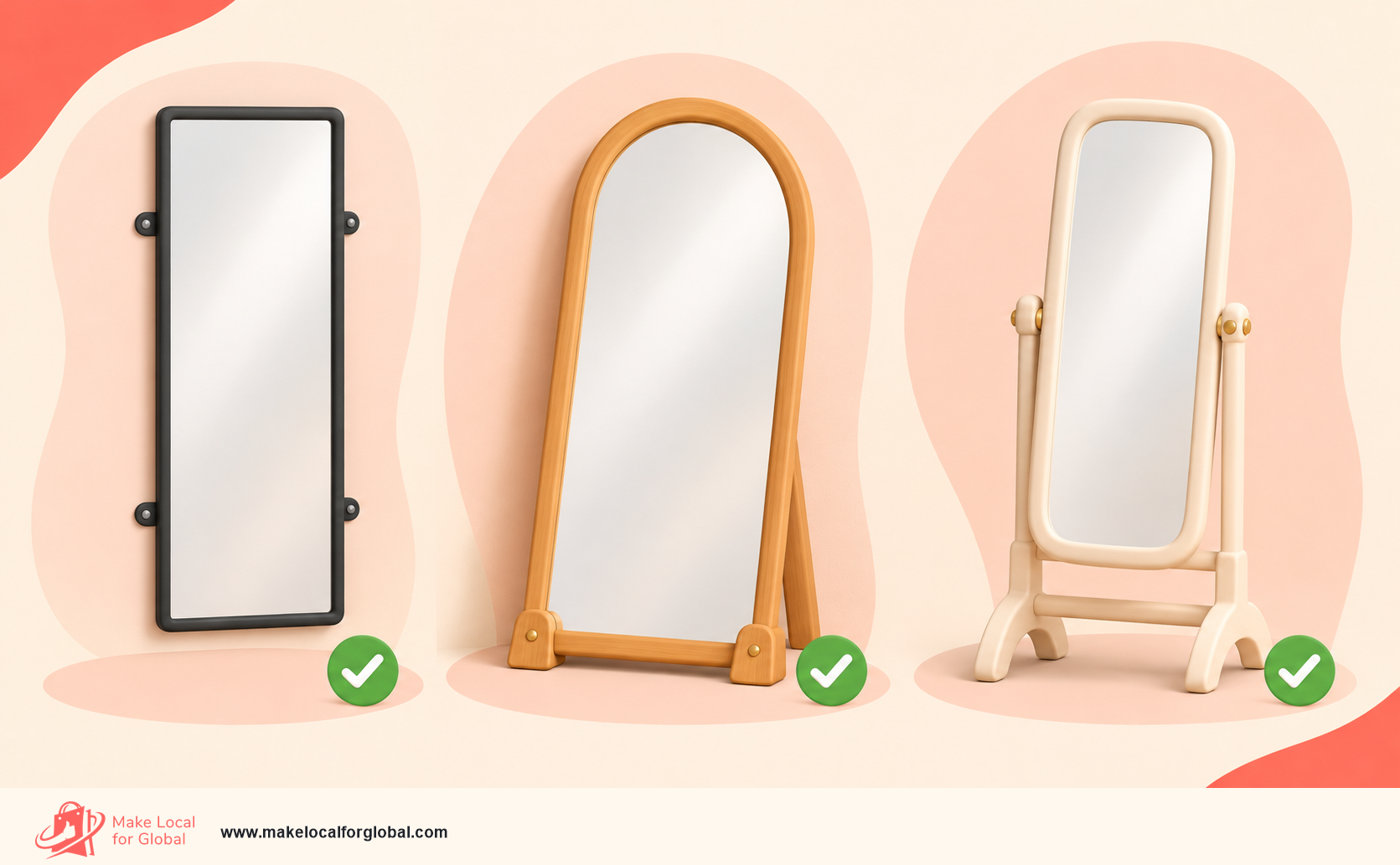
A useful opening range answers a choice customers genuinely face. It might offer three heights in the same slim black frame, a freestanding and wall-mounted option for one buyer group, or a few frame finishes in one common size. Too many combinations create inventory risk and unclear product pages. One model in six finishes and four sizes can quickly create twenty-four variants, each with its own stock position, packaging check and return exposure.
Begin with a range map. Put the buyer need in the first column, format in the second, dimensions in the third, finish in the fourth and expected price in the fifth. A “bedroom, no-drill” need might map to a freestanding arch mirror with a tested support leg. “Dressing area, fixed position” might map to a wall-mounted rectangular mirror with clear fixing instructions. “Small hallway” might map to a narrow model that can be secured to the wall. This map is more useful than choosing products solely on the strength of supplier photographs.
Compare frame material, edge finish, thickness, weight and assembly. A metal frame may suit a slim contemporary design, while a wood frame may fit a warmer interior. Materials alone do not guarantee durability or safety. Check joints, corner finishing, backboard, stand connections, brackets and protective backing. If the supplier offers different glass types or safety backing, ask for documentation and find out exactly which variant it applies to. Do not assume the sample and production model are identical.
Look for a reason behind every product in the first range. A difference in dimensions, mounting style or finish should solve a buyer choice. Avoid adding nearly identical items that compete against one another without creating a clearer offer. A small range keeps photography, packaging procurement and customer service more manageable while you learn which features matter.
Create a comparison grid and score candidate products on five dimensions: fit with the chosen buyer, reflection and finish, stability or fixing design, packed delivery feasibility, and contribution after variable costs. Give each score a short note with evidence. A supplier catalogue image can support the finish review, but it cannot prove stability or protective packaging. Those require sample inspection. Treat unanswered questions as risk, not as a zero-cost benefit.
If you plan to add a larger or heavier mirror later, document the threshold for adding it. That could be a minimum number of qualified requests, repeated search impressions with relevant clicks, or a defined number of sales on the smaller model. A threshold prevents one enthusiastic comment from turning into expensive stock. It gives you a useful point to review the range after launch.
Supplier selection for mirrors involves more than unit price. Ask how products are made, where glass and frames are sourced, which steps are inspected, how defects are handled, and whether production differs between sample and batch. Request the exact specification for the version you intend to list. Confirm dimensions, glass type, reflective coating, backing, frame material, stand, supplied fixings, carton, gross weight and country of origin. When a specification is unclear, request a drawing or written confirmation instead of filling the gap with an assumption.
Ask about minimum order quantities by model and finish, reorder quantities, production lead time, peak-period delays, payment schedule and what happens if a component changes. If you are using a supplier who ships directly to buyers, confirm whose name appears on the parcel, whether invoices or promotional material are included, what delivery slots are offered, how failed delivery is handled and who pays for a redelivery. Ask how quickly the supplier can provide tracking and evidence of dispatch.
Clarify the damage process before buying stock. Ask for the time limit for reporting transit damage, what photographs are required, whether a replacement panel or full product is supplied, who pays collection, and how credit notes are issued. Get the process in writing. A mirror can arrive with concealed damage that is not visible until the carton is opened; understand whether the carrier or supplier requires a particular inspection window. You need a process that lets your customer report a genuine problem without being passed between three companies.
Check that packaging is designed for the actual delivery method. A carton suitable for pallet freight may not survive several manual handling stages in a parcel network. Request carton dimensions and weight for the exact finished product. Ask whether the mirror is held away from carton edges, whether corners are protected, whether the face and rear are supported, and whether internal movement is limited. The supplier’s “fragile” label is not evidence that the pack has passed a realistic handling test.
Request samples of the leading options before committing to a large order. If sample costs are high, ask whether the amount can be credited against a first stock purchase. Pay for delivery of the packed sample and observe how it arrives. Where possible, receive the sample through the same carrier type and route that customers will use. A sample carried gently by hand does not prove that an oversize parcel will handle hub sorting, vehicle loading or a doorstep transfer.
Keep supplier records together: versioned specification, sample notes, price quotation, carton dimensions, delivery quote, damage terms, product images supplied by the factory and permission to use them. Mark which details are confirmed and which remain pending. If you make a change to glass, backing or stand, request an updated sample or written specification. Do not silently carry over the old approval to a changed product.
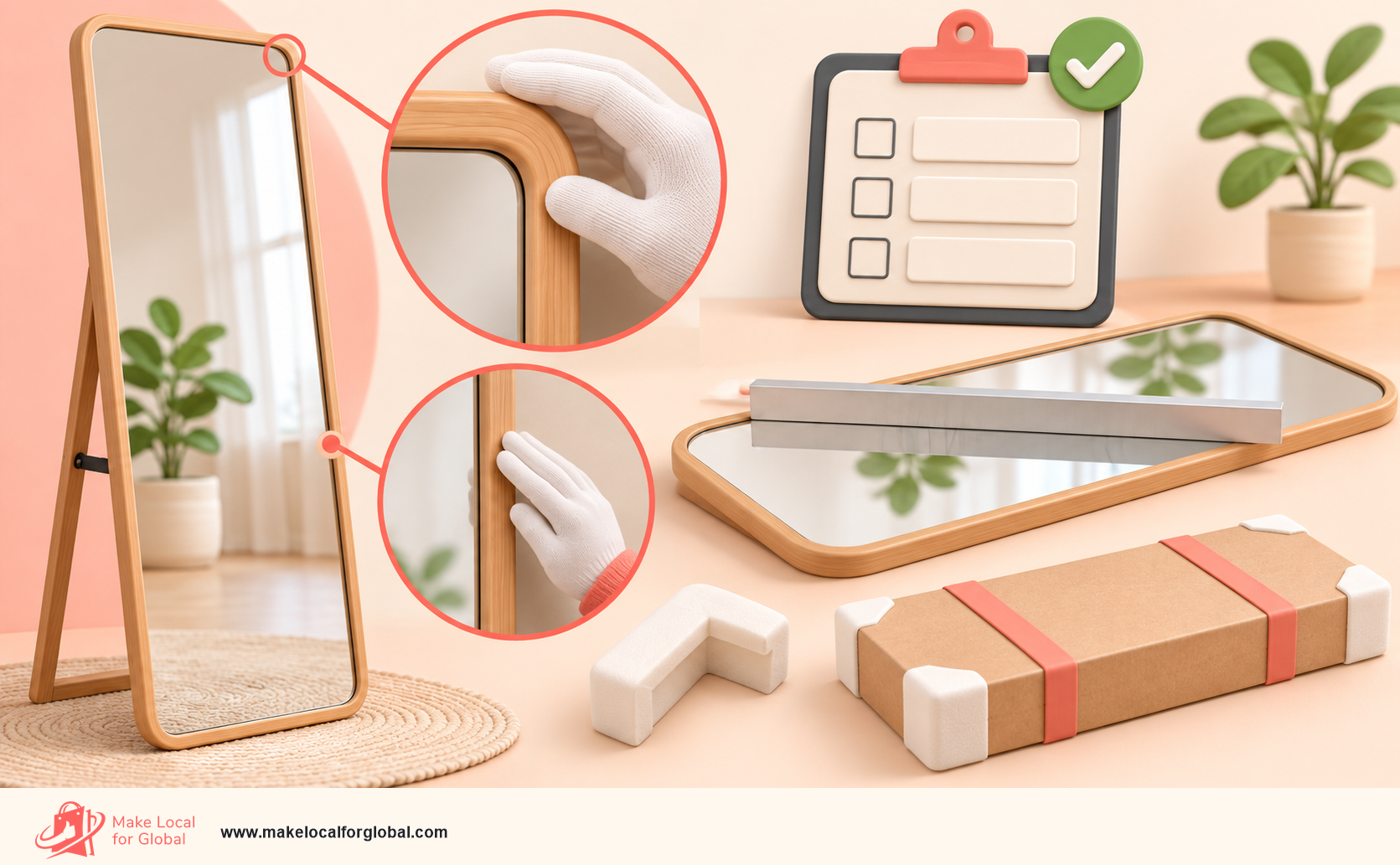
Inspect the sample in daylight and in the lighting under which a customer may use it. Stand at several distances. Look for distortion, waviness, visible marks, uneven reflection, scratches and patches that change as you move. Check across the entire panel rather than judging only the centre. Compare the reflection with a known straight edge or doorframe. Photograph anything you find and tell the supplier where it appears. A mirror can be attractive in a product photo while still showing defects that make clothing or posture look distorted.
Inspect edges and corners carefully. Look for chips, sharp points, exposed backing, uneven joins, gaps, loose trim and corners that move when touched. Do not handle chipped glass as if it were a routine cosmetic issue. Stop, isolate the sample and follow safe handling guidance. A product that arrives with edge damage can create a safety issue and a costly customer service event. Record whether protective film covers the mirror, and whether removing it reveals damage or residue.
Check the frame for twisting, dents, uneven finish, wobble and loose connections. For a freestanding mirror, assemble it according to the instructions and place it on a level floor. Test the stand’s range of movement and its locks. Apply only ordinary, controlled handling consistent with intended use; do not create a dangerous stress test. Observe whether the frame shifts when adjusted and whether a kickstand or rear support opens and closes reliably. Follow the manufacturer’s warnings and do not invite a buyer to exceed them.
For wall-mounted designs, inspect the brackets and supplied fixings. Confirm their number, position, material, fit and condition. Check the installation guide for the wall types it supports and whether the included fixings are suitable only for certain surfaces. A supplier’s generic bag of screws may not suit every wall. Product copy should tell customers when they may need wall-specific anchors or a competent installer, rather than implying a universal fixing. Take clear photographs of the rear hardware and draw bracket spacing accurately.
Open and close packaging as a customer will. Note how the mirror is held in place, how much it can move, where foam or corrugate supports its edges, and whether the pack can be opened without cutting toward glass. Keep every insert and label. Photograph each stage before removing the product. Then repack it and note where assembly or packing is difficult. If a buyer cannot safely unbox a tall mirror alone, say whether two people are recommended and design the delivery and instructions around that fact.
Use a repeatable sample sheet. Record supplier, sample date, batch or model code, measurements, weight, reflection observations, frame findings, stand or fixing findings, packaging condition, assembly time, instruction clarity and open questions. Mark each issue as pass, needs a response, or reject. Attach photos. Repeat the inspection when the production batch arrives, at least on a sampling basis appropriate to the volume and risk, and keep a record of the result.
Mirrors are everyday products, but glass, weight, falling risk, edges, stands and wall fixings deserve careful treatment. The rules that apply depend on where you sell, the product design, and the role your business plays in placing it on the market. Do not treat a generic supplier statement as legal advice. Before launch, identify whether you are the manufacturer, importer, distributor or seller for the target market and check current official guidance for that role.
For Great Britain, the government’s General Product Safety Regulations guidance explains the general framework for consumer products. Northern Ireland operates a distinct product-safety framework, with the government’s GPSR 2023/988 guidance for Northern Ireland covering relevant requirements. The details can change and specific products may be subject to other rules. Check the current official guidance for the market and product before you list or import stock. Do not assume that every mirror needs a particular conformity mark or certificate; verify what applies to the product and territory.
Keep supplier identity, product description, model or batch reference, relevant warnings and traceability records. Ask for test reports or safety documentation where relevant and verify that it matches the model you will sell. If you import a product, find out what information and actions your role requires. Store copies where staff can find them if a customer, marketplace or authority asks. Record which source and date supported a compliance decision, then review it when the product or rules change.
Write instructions for the actual product. A floor-standing mirror may need directions for opening the support leg, locking it and positioning it away from hazards. A wall-mounted product needs accurate dimensions for its bracket positions and clear advice about wall suitability. If the product is intended to be fixed to a wall to reduce tip-over risk, explain this clearly and supply the required parts or name any parts the buyer must provide. Avoid vague instructions such as “mount securely” when you can state the actual fixing arrangement and installation limits.
Product pages should explain weight, assembly, fixing requirements, recommended number of people for lifting, carton size and access considerations. State the product’s intended use and any relevant restrictions that are confirmed by the manufacturer. Do not make claims about shatter resistance, safety backing, child suitability or impact performance without evidence tied to the model. If you cannot verify a claim, remove it and ask the supplier.
Create a simple incident process. If a customer reports a crack, loose stand, sharp edge or failed fixing, record the model, batch, order, images and circumstances. Tell the customer how to stop using or secure the product safely in line with the product’s instructions. Escalate repeated or serious reports to the supplier and review whether further sales should pause while you investigate. Keep the communication factual and considerate. A quick, documented response can protect people and help you identify a product or packaging issue early.
The supplier’s unit price is only one part of the cost. For each mirror, calculate landed cost, carton and protective material, inbound freight, storage, pick and pack, payment fees, marketplace commission, delivery, redelivery allowance, damage allowance, return cost, customer service time and marketing cost. Some of these expenses vary by order; others occur before a sale. Keep them separate so you can see what changes when a carrier quote or breakage rate changes.
Build an order-level contribution model. Start with the selling price excluding VAT where applicable. Subtract the unit cost, packaging, outbound delivery, transaction fees, variable selling fees, expected damage and return costs, and any variable advertising cost. What remains is contribution toward fixed costs such as software, rent, insurance, bookkeeping and your own non-order-specific time. Contribution is not the same as profit. Add fixed overhead and tax considerations separately before deciding whether the business is viable.
Use a worked example only as a planning illustration. Suppose the price received is £180, landed product cost is £65, packaging is £12, delivery is £28, payment and selling fees are £8, and the allowance for damage, returns and customer service averages £10 per order. Contribution before advertising and fixed overhead would be £57. If paid acquisition costs £25 per order, £32 remains before overhead and tax. Change any input to your actual quote. A small change in delivery cost or damage frequency can remove the margin quickly.
Include the cost of damaged orders even if your first supplier sample arrives safely. Test several packaging arrangements and use early sales data to update the allowance. Do not price only from competitors’ list prices; they may have different scale, carrier rates, supplier terms, product quality or return handling. Compare like with like: same size, glass area, frame, mounting system, delivery service and included assembly parts.
Choose a price that reflects the full customer promise. A low price with unclear delivery, weak packaging or no damage response may create poor reviews and expensive refunds. A higher price may be credible if it pays for a better-finished mirror, clear measurements, protected delivery and responsive support. The page should explain those useful differences in concrete terms rather than using unsupported quality claims.
Test a small number of price points or bundles only if you can do so fairly and interpret the outcome. A free-delivery threshold can increase order value, but bulky items may make “free” delivery costly. A two-mirror discount may be attractive for a household or studio, yet doubles the packaging and damage exposure. Calculate the packed-order economics first. Record the price, promotion, acquisition source and fulfilment cost with each order so the test measures contribution rather than clicks alone.
For UK VAT, check the current HMRC VAT registration threshold and the rules that apply to your sales. The threshold is currently based on taxable turnover, and the relevant test and timing can matter. This is not tax advice; confirm your position with HMRC guidance or a qualified adviser. If VAT registration applies, build VAT treatment into your model and show consumer-facing prices in the way required for your channel.

Measure the fully packed carton, not just the mirror. Record length, width, depth and gross weight. Give those figures to at least two carriers who accept the dimensions and product type. Ask about volumetric pricing, oversize surcharges, remote-area fees, appointment delivery, two-person service, proof of delivery, delivery windows, failed delivery, return collection and damage claims. Check restrictions on fragile glass and whether the carrier requires a particular service or packaging standard.
Obtain a written quote for the actual postcode coverage and dimensions you expect. “Nationwide delivery from £X” may hide a surcharge for the largest size or rural areas. Ask whether a price includes VAT, fuel, remote-area fees and a second attempt. Ask if the carrier can deliver to the room or only to the external doorway. If the customer must carry a tall mirror up stairs, say so before checkout. A delivery promise that does not match the carrier’s service can create costly disputes.
Design the packaging around the mirror’s failure points. Protect corners and edges, support the face and rear, stop movement and make the carton rigid enough for the route. Ask a packaging supplier for inserts designed for the product dimensions. Use packaging that protects without adding so much volume that the carrier moves the order into a higher band. Never let price savings remove protection from the most vulnerable edges.
Run practical pack tests. Drop tests should only be designed and conducted by competent people with suitable controls; do not casually drop a heavy glass product at home. Safer initial checks include observing package compression resistance, checking internal movement after controlled handling and having the carrier or packaging provider advise on formal testing. Record the method and outcome. If a test damages the product or packing, revise the design and test again before dispatching customer orders.
Ask the carrier what evidence a damage claim requires. Take a photo of the packed carton before collection, retain dispatch scans, and give customers clear instructions to photograph external damage and the item. Do not make a customer manage an opaque process. Tell them how to report a problem and what response time to expect. Decide whether you can offer a replacement, replacement panel, refund or collection for each model. A replacement panel may be impossible if the frame or dimensions change between batches.
Plan stock locations and handling. A full-length mirror may not fit on a standard shelf or through a narrow stockroom aisle. Mark orientation, protect exposed edges, separate damaged goods and train anyone who lifts or packs the item. If you hold stock at home, check that insurance and storage arrangements cover the product and business activity. If a third-party warehouse handles fulfilment, confirm its limits for oversize fragile products and inspect its process before moving stock.
Holding a small quantity yourself can give you direct control over inspection, packaging and customer response. It ties up cash and space, and you take responsibility for the pick, pack and carrier handoff. Start with a low quantity if supplier minimums allow, then restock against real demand and lead time. Track the true cost of storage and labour; treating your own time as free hides the cost of scaling.
Supplier-direct fulfilment reduces the need to store large cartons, but it does not remove your responsibility to the buyer. Confirm that the supplier can meet your stated dispatch time, use neutral or agreed branding, provide tracking, protect the item and handle failed deliveries. Place a test order to your own address. Check the outer packaging, labels, paperwork and delivery communications. Ask what happens during stockouts and whether the supplier informs you before accepting an order for an unavailable variant.
A specialist fulfilment partner may help when order volume or handling requirements exceed your capacity. Compare inbound pallet costs, storage fees by size, pick fees, packing material, carrier rates, returns handling, inspection, damage claims and minimum monthly charges. Ask whether staff can photograph damaged arrivals and quarantine stock. Visit or request a walkthrough when possible. A low pick fee is not useful if the warehouse cannot handle the carton safely or cannot process a return promptly.
For any model, map the order journey from checkout through delivery and a potential return. Identify who sends each customer update, who responds to a missed slot, who books a replacement and where the item is inspected. Put a named person or team beside each step. Run a test order end to end, including a simulated damaged parcel enquiry. The test often reveals gaps in tracking, packaging, return labels or customer messaging before those gaps affect a real buyer.
Start the page with a specific title, a clean hero image and a short summary of who the mirror suits. Avoid repeating the same keyword in every heading. Use natural phrases customers understand: full-length mirror, full-body mirror, freestanding mirror, wall-mounted mirror, dressing mirror or bedroom mirror where each genuinely applies. The page should answer a buyer’s task rather than a search engine checklist.
Show the mirror from the front, side and rear. Include an in-room image for scale, a detail view of the frame and corners, the stand or brackets, and a packaging or assembly image where it helps a decision. Keep lighting and camera angle accurate. Do not stretch the reflection or alter dimensions in a way that misrepresents the product. Include a labelled size graphic with outer dimensions and reflective area. Use useful alternative text for images; describe what the image communicates, not a string of repeated keywords.
Put key facts near the purchase decision: total dimensions, reflective dimensions, weight, depth, frame material, colour, orientation, mounting style, included parts, assembly, dispatch estimate, delivery service, access limits and return information. State if two people should handle the item. If a wall anchor depends on the wall type, say what is included and what the customer may need. If a delivery team cannot bring it upstairs, make that visible before checkout.
Write copy that distinguishes this model from nearby choices. “Slim black frame” is useful only if the frame really is slim and black. “Freestanding” should explain whether a support leg is included and how much floor space it uses. “Shatter-resistant” needs evidence specific to the product. Make claims concrete and verifiable. A brief table can help buyers compare models, but do not force them to manage a long paragraph to find height or delivery cost.
Set out the return process in plain language. Explain how to report damage, what to do with the packaging, what the inspection process involves and how collection is arranged. Link to the store’s full terms. For UK consumers, GOV.UK’s online and distance selling guidance describes information businesses generally need to provide and cancellation rights. Check current rules for your exact product, market and sales channel, including exceptions and return-cost disclosures. Do not state that a customer loses statutory rights on the grounds that a product is fragile or made to order unless you have confirmed the legal position.
Answer common questions on the product page: Can it be wall mounted? What is the reflective area? Does the mirror arrive assembled? What type of wall is required? How is delivery booked? Can the parcel go upstairs? What should the buyer do if the carton is damaged? A useful FAQ reflects real enquiries, stays factual and avoids promises the carrier or supplier cannot meet.
Use a clean, uncluttered setting that helps a shopper understand scale. The mirror should be upright, with enough of the reflection visible to judge clarity. Include a person or familiar furniture only when the proportions are realistic. Watch for reflected clutter, windows that cause glare, lens distortion and a camera placement that hides the frame. A wide-angle lens can make a mirror look larger or narrower than it is; use a consistent position and lens across the range.
Capture useful detail: frame joins, edge finishing, feet, hinges, brackets, backboard, included fixings and finish texture. Use a plain background for a comparison image and a lifestyle scene for context. A product photo should not conceal the fact that a stand or wall hardware is not included. Label any styling item that is not supplied if a buyer might reasonably assume it comes with the mirror.
For a range page, give each variant a distinct image and clear dimensions. Do not rely on colour swatches to communicate frame differences. If a shade varies under different light, describe it carefully and show a close view. If the supplier’s photographs are used, get permission and check that they show the actual product you will fulfil. Add original photography when the sample arrives; that gives you a chance to show packaging, scale and mounting details honestly.
Create a short video only if it adds useful evidence. A slow pan can show reflection and frame details; a quick assembly clip can show how a stand opens or where brackets sit. Avoid shaky movement or bright glare. Add captions or on-screen labels so the important facts are clear without sound. Video should support the listing’s measurements and instructions, not replace them.
Name image files descriptively before upload, such as `black-arched-full-length-mirror-front.webp` or `full-length-mirror-wall-fixings.jpg`. Write alt text that describes the image’s purpose, such as “Rear view of the full-length mirror showing two wall brackets and their spacing.” If the image is purely decorative, keep the alternative text empty where the platform supports that choice. Avoid repeating the exact same alt text across every image.
Your own store gives you control over product education, customer data and the delivery journey. It means you must attract qualified visitors and explain trust, payments, shipping and returns clearly. A marketplace can provide traffic and familiar checkout, but fees, listing rules, competition and bulky-item policies vary. A social shop may help you test visual interest, but comments and likes do not prove that delivery economics work.
Choose a channel based on where the target buyer researches and how well the channel supports the product’s dimensions, delivery price and returns. Check every current policy for oversize or fragile items before listing. Confirm whether the marketplace allows the delivery service you intend to use, which tracking events it expects and what counts as valid delivery proof. Do not assume the same listing can be copied unchanged across sites; adapt shipping, copy and customer support to each one.
For a first launch, use a narrow product set and a small marketing test. Create one landing page or listing for the main buyer need. Use a simple content plan: a measurement guide, a room-planning image, a clear demonstration of freestanding versus wall-mounted formats, and a useful packaging or delivery explanation. Avoid publishing generic posts that merely repeat product descriptions. Each piece should help a buyer decide, measure, install or receive the mirror.
Use search terms naturally in the page title, headings, image descriptions and product copy. Google advises creating helpful content for people and using descriptive image context. Its people-first content guidance does not set a preferred article word count; length should fit the customer’s question. Its Google Images guidance highlights useful context and descriptive alt text. Treat these as guidance for clarity, not a reason to repeat a phrase unnaturally.
Add relevant internal links where they help the reader take a next step. A person exploring a broader decor range can read the decorative mirror selling guide. A new product seller can use the physical products launch assessment tool to review readiness. A multi-product seller can compare opportunities with the multi-product launch assessment tool. A seller concentrating on one item can assess the listing with the single-product product page assessment tool. Each link belongs next to the decision it supports; avoid placing an unhelpful link merely to increase link count.
Track performance by source and product variant. Record visits, product-page engagement, size-guide use, questions, add-to-cart, order conversion, average order value, cancellation, delivery failure, damage, return rate and contribution. Separate a traffic problem from a conversion problem and a fulfilment problem. If clicks are high but orders are low, check price, dimensions, trust and delivery. If orders arrive but damage complaints rise, pause promotion and investigate packing or handling.

Days 1 to 5: choose the buyer and interview a handful of people who fit. Review relevant search questions, competitor product pages and customer reviews. Write down repeated concerns about size, reflection, mounting, assembly and delivery. Pick one buyer need to serve first. Put each assumption in a list and decide how you will test it.
Days 6 to 10: map a small range and request supplier specifications, quotes and samples. Ask about minimums, lead times, carton dimensions, gross weight, delivery damage and return terms. Compare the packed-order cost with the expected price. Remove any model whose delivery route or contribution looks weak unless you have a clear test that justifies it.
Days 11 to 15: inspect samples and packaging. Photograph measurements and hardware. Ask the supplier to resolve open questions in writing. Finalise product page facts, handling instructions, delivery area, customer support process and return information. If product safety or market-role details remain unclear, consult current official guidance or a qualified adviser before listing.
Days 16 to 20: prepare the store page, images, comparison table and customer service replies. Run a test order through the checkout and delivery flow. Verify taxes, delivery zones, carrier service, tracking emails and stock status. Simulate a delivery delay and a damage enquiry. Fix the copy if a reasonable buyer could misunderstand size, assembly or delivery.
Days 21 to 25: launch to a limited audience. Use modest spend and a small quantity so you can inspect each order. Answer questions in a consistent way and keep a log of missing information. Do not interpret one sale as proof of a scalable business or zero sales as proof the product cannot work. Check traffic quality and buyer fit before changing price or buying more inventory.
Days 26 to 30: review evidence. Compare the initial assumptions with actual questions, orders, delivery cost, damage, returns, contribution and stock. Keep what works, change one or two items with a clear reason, and define the next test. If there is little qualified interest, revisit the buyer, message or dimensions before increasing stock. If customers buy but delivery causes issues, solve fulfilment first. If the numbers work and operations are stable, decide whether to reorder or add one adjacent variant.
This schedule can stretch if supplier lead times or sample delivery take longer. The important feature is the sequence: learn, verify, cost, prepare, launch and review. Do not compress safety checks or sample inspection to meet an arbitrary date. Use the plan as a decision framework, not a promise that a mirror business can be validated in exactly a month.
The first mistake is choosing a product from a catalogue image alone. The image says little about reflective quality, frame joints, stand stability, fixings or shipping protection. Obtain a sample and test the packed version. The second is listing outer dimensions without the reflective area. Buyers need both. The third is choosing a large mirror before checking doorway access, carton size and carrier limits. The fourth is calculating margin from unit cost and retail price while leaving delivery, damage and returns out.
Another frequent mistake is calling a mirror “safe”, “shatterproof” or suitable for a particular household without supporting evidence. Replace broad claims with verified construction details and clear use instructions. A further problem is assuming supplied fixings work on every wall. State the limits and advise customers to select suitable anchors or professional help when appropriate. Avoid recommending installation techniques outside the manufacturer’s instructions.
Some stores hide delivery charges until checkout. This can lead to abandoned baskets and customer frustration. Show the delivery method, expected timing, service limits and any surcharge before a buyer commits. If a postcode quote is needed, give a simple way to obtain it. Likewise, do not bury returns information in a long terms page. Put the practical steps near the purchase information and link to the full policy.
Over-expanding the range too early spreads cash across slow-moving dimensions and finishes. Start with a small range and add options when buyers show a specific need. A broad range can make the catalogue difficult to compare. Give each option a clear purpose and keep product names consistent.
Treating online attention as proof of demand is another trap. A popular room photo may get saves without producing profitable orders. Check the buyer’s intent, questions, cart actions, completed sales and cost to deliver. Treat early results as signals with uncertainty. Record the number of observations; ten visits and one order tell a different story from a thousand visits and one order.
Finally, poor post-sale communication can undo a good product page. Tell customers when a mirror ships, how the delivery slot works and what to do if the carton is damaged. Answer with empathy and a clear next action. Keep records so repeated damage or confusion prompts a product or process change, rather than being treated as an isolated complaint.
Use a simple weekly scorecard. Include stock on hand, orders by model, qualified visits, add-to-cart rate, conversion rate, average order value, delivery cost, damage incidents, return rate, customer service contacts, ad cost and contribution per order. Add one qualitative field for the most common customer question. A spreadsheet is enough at first if each metric has a clear definition and someone updates it consistently.
Separate performance by variant. A tall arched mirror and a narrow rectangular mirror may attract different buyers and have different carrier costs. Combining them can hide the fact that one is profitable and another is not. Use a model code on the purchase, packing slip and damage report. Where a channel does not expose source or variant details, add a consistent order note or export the data regularly.
Set review thresholds before you launch. For example, decide what damage rate would trigger a packaging review, how much contribution you need before increasing advertising, and how many orders or enquiries justify a reorder. The thresholds should reflect the business’s finances and risk, not a generic benchmark. If you have too little data to judge a rate, say so and continue a limited test rather than presenting an unstable percentage as a fact.
When changing the page, record the change and date. If you alter the image, delivery promise, price and headline simultaneously, it becomes difficult to know what affected conversion. Change one important element at a time when practical. Keep customer feedback alongside the quantitative data. A customer who cannot fit the carton through a stair turn may reveal a page gap that analytics alone will not show.
Use complaints as product research, not as evidence that all customers share one preference. A request for a wider mirror can lead to a measured test of one wider option. Several reports of loose feet should trigger a supplier and quality review before another order. A delivery complaint may point to an unclear service promise rather than a product fault. Identify the cause before spending money on a fix.
There is no single size that suits every buyer or room. State the total height and width, reflective area, depth, weight and installation method. Ask the target customers how they use the mirror and measure the space before selecting stock. For a standing view, explain how positioning and viewing distance affect what a person can see. Do not promise a full outfit view without checking the usable reflective area.
Each format solves a different problem. Freestanding mirrors may suit people who want flexibility or cannot drill, but they need floor space and a stable support. Wall mirrors preserve floor area, but the buyer must use suitable fixings and install them at an appropriate height. Test both only if your chosen audience shows demand for both formats. Explain assembly, support, fixings and installation limits clearly.
Start with a sample and inspect the actual carton. Protect corners and edges, limit movement, support the panel, and choose a carrier that accepts the size and product type. Photograph packing stages, run appropriate controlled tests, and understand the carrier’s damage-claim evidence. Track damage by model and batch. If reports repeat, review the packaging and delivery route before continuing to sell the affected version.
That can reduce storage needs, but it does not remove the need to inspect a test order or manage customer service. Confirm dispatch times, packaging, tracking, branding, stock updates, returns and damage responsibilities. Test the parcel journey to your own address. The customer still expects your business to resolve a problem even if the supplier caused it.
Start with a few products that address clear buyer choices. A small range is easier to inspect, photograph, price and stock. Add a new size, finish or format when enquiries and sales support the decision. A larger catalogue without a reason can tie up cash and make comparison harder.
Give total and reflective dimensions, depth, weight, materials, finish, mounting style, included parts, assembly details, package dimensions, delivery limits, dispatch estimate and return process. Show front, side, rear and scale images. Explain how to report damage and what to do with the carton. Make claims about glass, backing and safety only when documentation supports them.
Do not assume that one mark applies to every mirror. Requirements depend on the product, market, design and your role in the supply chain. Check current official guidance for Great Britain or Northern Ireland and ask the supplier for product-specific evidence. Seek qualified advice if the product or market position is uncertain.
You may use supplier-direct fulfilment or a fulfilment partner, subject to the channel’s terms and the supplier’s capability. Place a test order, confirm carton protection and delivery service, and agree a damage and return process in writing. Keep inventory information accurate so buyers cannot order a size that is unavailable.
Give customers a clear route to contact you and explain what photos or order details help you investigate. Tell them how to avoid handling broken glass and follow the product’s safety instructions. Coordinate replacement, refund or collection with the carrier and supplier. Record the incident by model and batch, then look for patterns before the next dispatch.
Selling full-length mirrors online can work when product choice, information and delivery fit together. The practical advantage comes from answering the difficult questions before the order: what the reflective area shows, where the mirror can stand or hang, how it moves through the customer’s home, what the packed order costs and how a damage report will be resolved.
Start with one buyer and a small range. Verify the actual sample, confirm the rules for your market, cost the packed order and run the delivery journey yourself. Publish a page that gives measurements, fixing details and delivery terms in plain language. Launch in a controlled way, then use questions, orders, breakage and contribution to choose the next step. More stock is not the goal by itself; a dependable product and delivery experience is.
PREFERRED SOURCE
Like what you’re reading? Add Make Local for Global as a preferred source on Google to see more of our articles when you search.

Build your online presence without having to figure out everything yourself.