

READY TO SELL Fitness balls ONLINE?
Get a store built for you in 5 days, plus training and support to help you start, run, and grow your Alternative business.

Learn how to sell fitness balls online with a focused range, checked samples, clear size and setup guidance, and a full delivered-order cost calculation.


A stability ball can be inexpensive to buy and awkward to sell well. Customers need to know which type they are looking at, whether the inflated diameter suits their intended use, how to set it up and what is included in the parcel. A listing that says only “fitness ball, 65 cm” leaves too many decisions unanswered.
To sell fitness balls online with a sensible first range, choose one buyer and one use, check a sample against the supplier’s written specification, show clear size and setup information, and calculate the full delivered order cost before setting a price. This article focuses on consumer exercise balls such as large stability balls, mini Pilates balls and peanut-shaped balls. Balance trainers, children’s play balls and specialist clinical equipment may follow different use, product-safety or marketing requirements, so treat them as separate categories.
The aim is not to stock every shape and colour. It is to give a defined customer enough evidence to choose the right product, receive what the listing promised and use it in line with its instructions.
Compare the practical tools and website options available as you shape your first product range and plan your online shop.
“Fitness ball” can describe several products. A large stability ball, a small soft Pilates ball, a peanut-shaped ball and a half-dome balance trainer differ in size, construction, storage and instructions. A customer looking for a compact home Pilates accessory is not comparing the same things as a buyer choosing a large ball for a general strength routine.
Begin with a buyer you can describe in one sentence. For example: “I sell a well-documented large exercise ball kit to adults who want a simple item for home workouts and stretching.” That statement gives you a clear starting point for supplier research, search terms, photographs and support information. It does not claim the item treats an injury or produces a particular health result.
“People who exercise” is too broad to guide stock. Narrow the use to something observable: a compact accessory for Pilates classes, a large ball for home movement routines, or an entry-level kit for a buyer with limited storage space. If you already speak with a gym, instructor or small fitness community, ask what details buyers struggle to compare.
Write down the questions those buyers ask. They may want to know the inflated diameter, the pump type, the surface feel, how the ball is stored, what the package contains or how long inflation takes. These questions should shape the product page and your sample checklist.
Avoid adopting medical or rehabilitation claims from a supplier listing without evidence and a clear basis for using them. If the audience is looking for clinical equipment, or the seller intends to make treatment claims, the product and marketing need a separate specialist review. A general fitness ball store can explain intended use without promising clinical outcomes.
Ask five to ten people who match the intended customer what they currently use, what they dislike about buying exercise balls and what information they need before paying. Show them two or three actual product options with realistic prices and descriptions, not a leading question such as “Would you buy my great new ball?”
Record what they choose, what makes them hesitate and whether a pump or guide changes their preference. These conversations do not prove demand, but repeated objections can reveal missing information or a range that is too complicated. If people keep asking for proof of dimensions, prioritise a measured sample and clear size guide before spending on a large order.
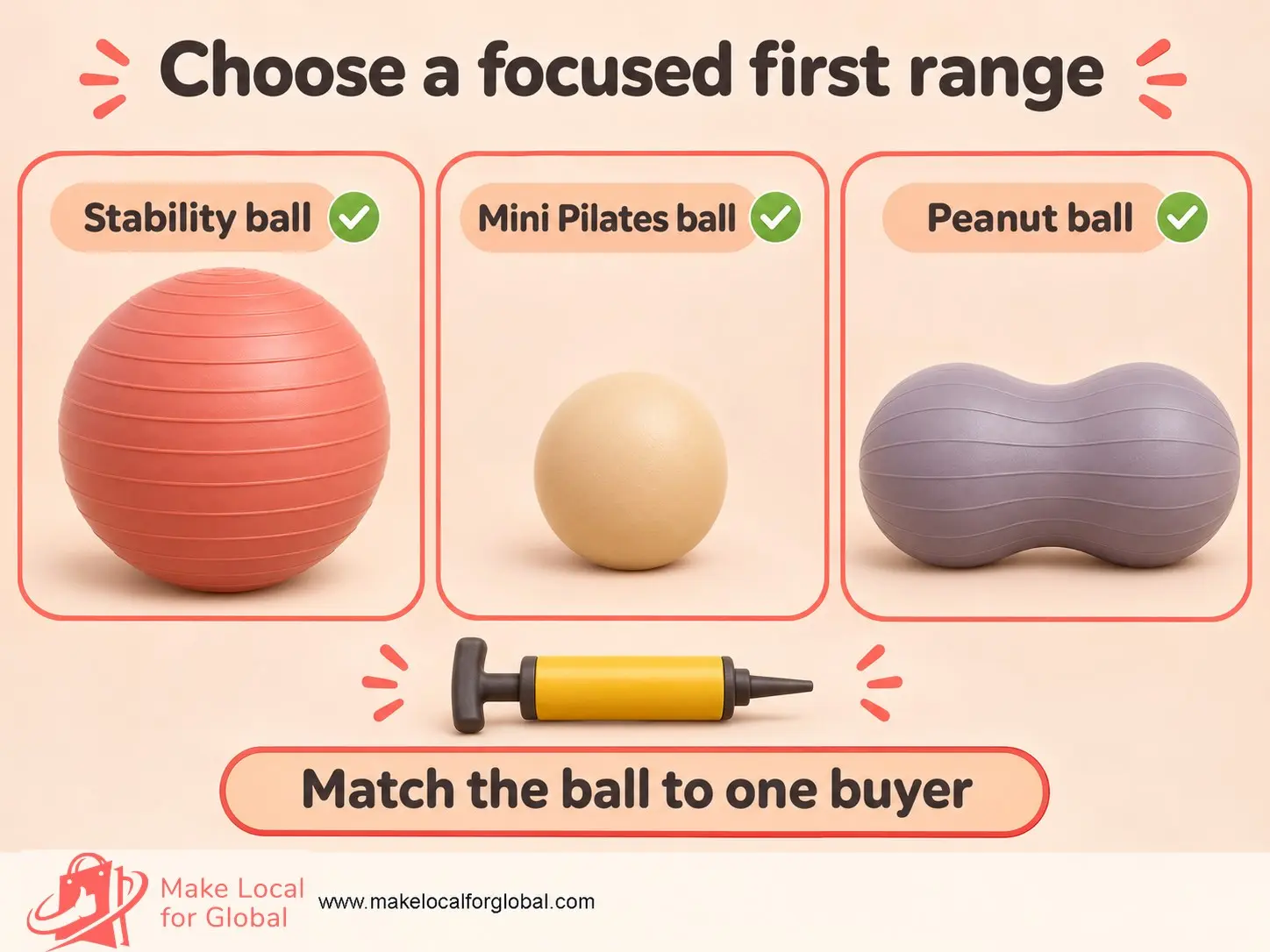
The simplest first range is usually built around one product family. Adding a stability ball, mini Pilates ball, peanut ball, wobble dome and half-dozen accessories at launch creates more supplier, packaging, photography and support work, making it harder to explain what the shop stands for.
Start with the format that best fits the buyer brief. A large stability ball has an obvious size decision and often needs an inflation method. A mini ball takes less room but may have a different valve, firmness and exercise use. A peanut ball has a different shape and may appeal to buyers who want a wider contact area, but explain the intended use from the maker’s instructions rather than assuming it suits everyone.
The manufacturer’s manual is the best source for product-specific sizing and setup. For one Decathlon gym-ball model, its guide gives maximum recommended diameters of 55 cm, 65 cm and 75 cm, with separate instructions about inflation and storage. Those figures are an example for that model, not a universal size rule for all fitness balls. Check the Decathlon gym-ball user guide and use the exact guide supplied with the product you sell.
| Product format | Questions the buyer needs answered | What to verify before listing |
|---|---|---|
| Large stability ball | What is the measured diameter when correctly inflated? Which pump is included? | Model-specific size instructions, valve fit, permitted use, storage guidance and any supported load statement |
| Mini Pilates ball | What are its inflated dimensions and surface finish? Is the pump included? | Inflation method, firmness guidance, seams, plug and intended use |
| Peanut-shaped ball | What are the dimensions and orientation? What uses does the maker describe? | Shape consistency, valve position, included accessories and exact product instructions |
| Half-dome balance trainer | Is it sold as a complete unit or with detachable accessories? | Base construction, grip, setup instructions and applicable product-specific requirements |
These are comparison prompts, not performance claims. Do not add a row to the range until you can answer its questions from the product, supplier documents and your own sample checks.
For a large ball, start with only the sizes that your supplier documents, sample checks and buyer conversations support. Confirm whether the size refers to the maximum inflated diameter, a nominal size or a size category. Ask the maker how the measurement is taken and what tolerance is allowed.
Colour can make a range feel more personal, but each additional colour may create a separate stock item and a separate risk of slow-moving inventory. Begin with one or two colours only when they serve a clear buying preference. Keep product codes and photos distinct so an order for one colour cannot be picked as another.
If you serve both home exercisers and instructors, you might use a single hero product with a simple starter kit and a multi-unit enquiry route. Do not imply that a bulk price exists until the quantities, delivery cost and discount have been calculated. Clear choices are more useful than a large menu of near-identical balls.
Search results can show what sellers are offering, but a crowded page of listings does not prove that a new store can win orders. Review the questions, photos, dimensions and bundle contents in existing offers. Note where shoppers might be confused: a size chart with no method, a pump shown but not included, a safety phrase with no supporting document, or a delivery estimate that excludes dispatch time.
Use a small evidence log with four columns: customer question, evidence found, unanswered gap and a low-cost test. If the same issue appears in customer conversations and product reviews, it may justify a clearer listing or bundle. It does not justify inventing a product benefit.
Create a simple page mock-up for one product and one kit. Show the exact contents, dimensions, price, delivery terms and the uncertainty you still need to resolve. Ask prospective buyers to compare it with one alternative. Record whether they can distinguish the two offers without you explaining them.
An email waitlist or product-interest form can help measure response, but it is not the same as a sale. If you take pre-orders, state that the item is not in stock, give a realistic dispatch date, explain how cancellation and refunds work, and keep enough funds to honour obligations. A first-time seller can avoid this complexity by collecting interest without charging until supply is confirmed.
Search suggestions and marketplace questions can provide language for a listing. Treat them as idea sources rather than proof of a health claim or market size. Phrases such as “exercise ball size guide”, “stability ball with pump” and “mini Pilates ball” can become helpful content topics when the product itself matches the search.
Before placing an order, define what would make you proceed. For example: three buyer conversations identify the same missing feature, the supplier answers the safety and specification questions, a sample passes the agreed checks, and the delivered-order calculation leaves a positive contribution at a realistic price.
Choose a pause rule too. Stop if the supplier cannot identify the manufacturer or batch, declines to provide instructions, changes the material or dimensions between sample and quotation, or cannot explain a performance claim. A low unit price does not offset the cost of a product you cannot confidently describe or support.
A domestic wholesaler may offer smaller trial quantities and shorter replenishment times, but the trade price can be higher. Importing directly can widen your choice and change unit economics, but the seller takes on more work around product records, customs, lead times and communication. A private-label order adds control over packaging and brand details, along with minimum quantities and artwork checks.
Dropshipping can reduce the need to store stock, but it does not remove responsibility for accurate listings, customer service and product safety. Ask where the item ships from, how the parcel is packed, who handles returns, what happens if a parcel is damaged and whether the supplier can keep the exact model in stock. Order a sample to your own address before sending customers to a product page.
Send the same written questions to each shortlisted supplier so quotations can be compared. Ask for the legal manufacturer name and address, the product model or SKU, the materials, the batch or traceability method, the official instructions, and test evidence that applies to the exact model being quoted.
For every size or colour, ask for a specification sheet showing dimensions, tolerances, packed dimensions and packed weight. Ask which accessories are supplied, whether the pump model is compatible with the valve, and how to replace a missing plug. If the supplier describes a ball as anti-burst, slow-deflating, non-slip or suitable for a stated user weight, ask for the test method and supporting record for that exact product.
Keep a copy of the quotation, invoice, sample photos, instructions, test documents and correspondence. Record the date and supplier contact for each file. If the delivered stock differs from the sample, pause sales and ask the supplier to explain the change before accepting the batch.
Request the minimum order quantity, sample charge, production lead time, payment schedule, shipping method, shipping dimensions and any packaging charges. Ask whether the price includes a pump, plug, instruction leaflet, branded box, outer carton and delivery to your nominated address.
If you import into the UK, identify who acts as importer of record and who arranges customs clearance. Confirm the commodity code using the product’s material, use and packaging details rather than copying a code from a similar product. The UK Trade Tariff is the official place to look up commodity codes and check duty and VAT rates. If the product or its construction is difficult to classify, use HMRC’s guidance or a qualified customs adviser.
Agree the sample checklist before it arrives. Photograph the unopened carton, outer label, product label, included accessories and instructions. Note the date, supplier, model and batch reference. This makes it easier to compare a later shipment with the item you approved.
For a large inflatable ball, follow the maker’s inflation procedure using the stated pump and plug. Measure the inflated diameter at the point and condition the instructions specify. Do not overinflate to reach a number that is not in the manual. Let the product settle only when the maker’s guide calls for that step, then measure again and record the result.
Inspect the surface under even light. Look for cuts, pinholes, uneven seams, loose material, deformed valve openings, adhesive residue, contamination or a plug that does not seat properly. These are screening checks; they are not a substitute for a competent laboratory or the supplier’s formal conformity evidence.
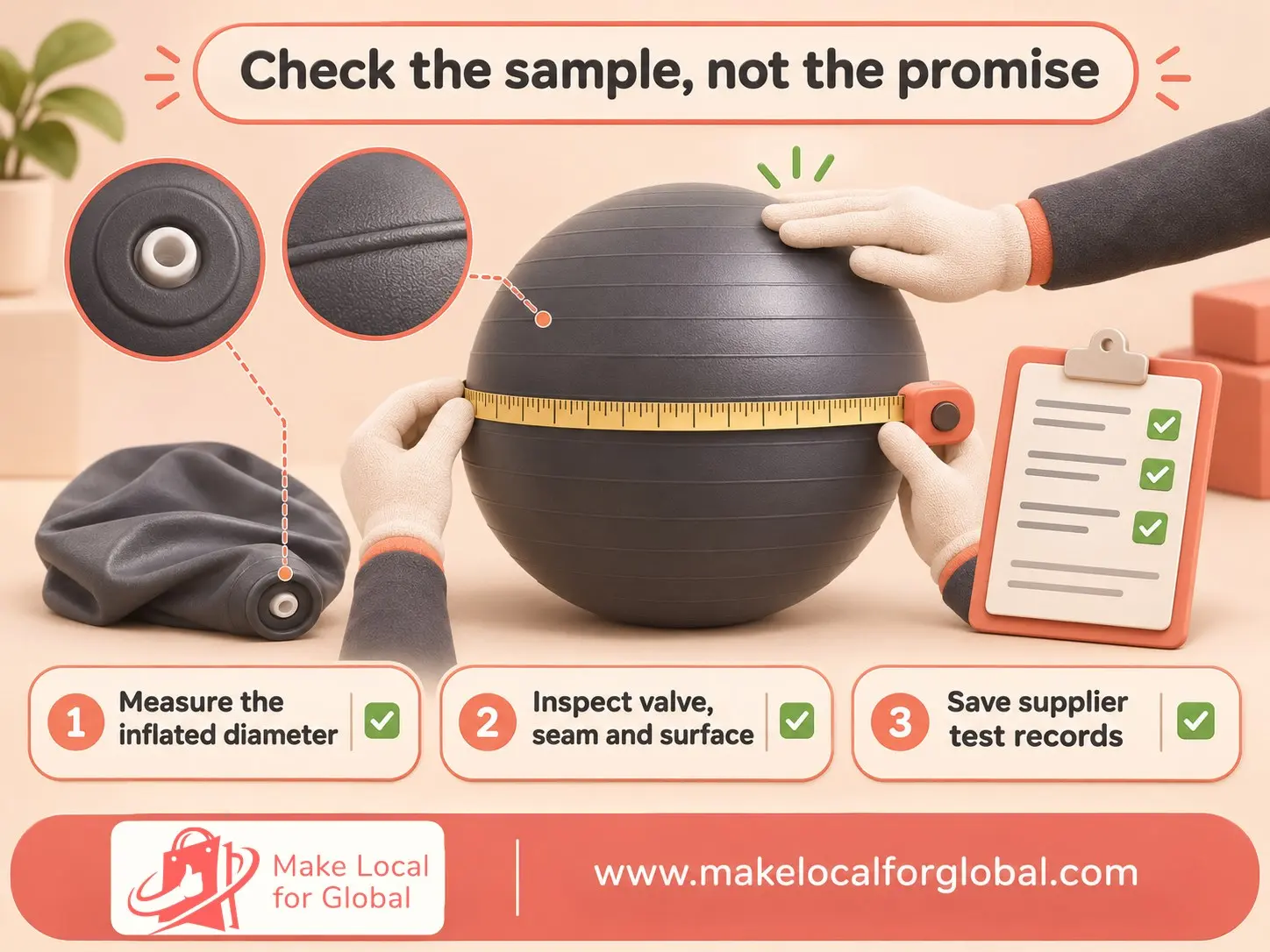
Confirm that the listed accessories are present and that the pump connector fits the valve. Read every instruction sheet and compare the language, warnings, intended use, cleaning directions, storage range and model numbers with the supplier’s documents. Do not rewrite or remove a warning merely to fit a short listing.
If the ball arrives folded or compressed, follow the product guide before deciding that it has the expected shape. Record how long setup takes, what tools are needed and whether the instructions explain each step. That observation can reveal a reason to add a setup card, but the card must repeat accurate model-specific information.
Where practical, inspect more than one sample from a supplier before a larger order. Check the same points in the same sequence and note variations. A sample that passes once does not prove every production unit will match; request the supplier’s quality-control process and agree how a defect or substitution will be handled.
Never intentionally puncture or burst a ball as a home test. Do not perform a load test by asking a person to stand or jump on the product. Use supplier or accredited test evidence for performance claims and follow the manufacturer’s intended-use instructions for any ordinary demonstration.
Size is a common reason a customer hesitates. “55 cm” can mean a maximum outside diameter, a nominal size or an item category. The listing should say which measurement your supplier gives and show how that value was verified on the sample.
For a model-specific size chart, quote the manufacturer’s guidance rather than publishing a generic height-to-ball chart as a rule. Different products can have different recommended diameters, and intended use can change the choice. A Decathlon guide, for example, lists that model’s maximum recommended diameters of 55, 65 and 75 cm; it does not establish a universal chart for every brand.
Photograph the ball after the exact inflation process in its instructions. Place a tape or measuring guide across the widest point if the maker defines the measurement that way. State whether the displayed value is a supplier specification or your sample measurement, and avoid presenting one sample as proof that every unit is identical.
If the maker gives a tolerance, state it accurately. If no tolerance is documented, ask the supplier before promising a precision that cannot be checked. Keep the product description clear about a recommended maximum diameter and the size a customer can expect in ordinary use.
Describe setup in the sequence supplied by the maker: pump type, valve or plug handling, inflation limit, any rest period, final size check and storage advice. Include the exact model’s manual in the parcel or a working link to the manufacturer’s official instructions where permitted. Do not substitute a generic video that may show a different valve or inflation procedure.
Translate technical features into plain facts supported by evidence. “Includes a hand pump and two plugs” is verifiable by checking the box. “Non-slip” needs a clear basis and context. “Anti-burst” and a maximum load claim need relevant documentation for the item being sold, not a statement copied from another supplier.
Do not state that sitting on a ball improves posture, cures back pain or is safe for every person. Explain what the maker says the product is for and advise buyers to follow their own professional guidance when their intended use involves a health condition. Keep general exercise advice separate from product specifications.
A customer who buys a large ball may need a compatible pump, spare plug or straightforward setup instructions. A bundle can make the offer easier to use, but only if the parts fit and the price still works. Put each bundle’s contents in the listing and show them together in a photograph.
Try a small three-choice structure only after each offer has a clear role:
Do not add an accessory solely to raise the order value. Every extra item adds stock, compatibility, packaging and customer-service questions. A smaller bundle that solves a real setup problem is easier to explain than a large pack of unrelated exercise products.
If the buyer wants more than one ball, show a quantity price only after checking the parcel size, shipping cost and packing method. A multi-unit order may need a different carton and different courier band. Update the calculation before promising free delivery or a bulk discount.
The product price is not the amount left to pay for overheads. Add the ball’s purchase cost, inbound transport, customs charges where applicable, packing materials, pick-and-pack time, payment or marketplace fees, outbound delivery, a returns and damage allowance, and the cost of acquiring the order.
For example, take one starter kit sold for £34.99. The assumed business is VAT-registered and treats the item as standard-rated for this worked example. The output VAT portion is £5.83, leaving £29.16 sales revenue before costs. The exact VAT treatment depends on the business and transaction, so check current HMRC guidance for your situation.
| Cost line | Illustrative amount | What to check |
|---|---|---|
| Stability ball and compatible pump | £8.50 | Supplier invoice and included accessories |
| Inbound freight allocation | £1.40 | Shipment total divided across saleable units |
| Customs duty allocation | £0.50 | Actual commodity code, origin and tariff rate |
| Protective packaging | £1.10 | Carton, void fill, tape and label |
| Pick and pack | £1.40 | Your time or fulfilment charge |
| Payment or platform fee | £1.35 | Channel’s current fee schedule and order value |
| Outbound delivery | £4.50 | Measured parcel band and service level |
| Returns and damage allowance | £1.25 | Your own history or a cautious test assumption |
| Customer acquisition | £4.00 | Campaign cost divided by attributed orders |
| Total variable costs | £24.00 | Add the lines above |
| Net sales before costs | £29.16 | £34.99 divided by 1.2 in this illustration |
| Contribution before overheads | £5.16 | £29.16 minus £24.00 |
This £5.16 is contribution, not net profit. It remains before fixed costs such as web hosting, software, insurance, accountancy, storage, photography and the seller’s own time, and before corporation or income tax. It assumes the cost figures are stated on a consistent VAT basis and excludes recoverable input VAT. A VAT-registered seller should use actual invoices and an accountant’s advice for the business’s accounting method.
If the seller is not VAT-registered, the customer-facing price is not automatically reduced by the output VAT calculation used above. Input VAT may not be recoverable, and the treatment of each cost changes. Rework the model for the actual business rather than reusing the £5.16 result.

Run the same calculation at the price customers accepted in your small test, at a modest discount and with the delivery cost one band higher. Include an order with a return or damaged carton. If contribution disappears with a small change, the offer may need a higher price, a lower acquisition cost, different packaging or a better buying price.
Keep separate cells for assumptions and actual results. The supplier quote, average delivery invoice and ad cost can change, so record the date for each input. Check platform fees from the channel’s current published schedule; do not copy an old percentage from another store.
The title should identify the product type, relevant size or variant and included pump where that information is confirmed. A title such as “65 cm exercise ball with hand pump” is clearer than “Ultimate fitness ball bundle”. Use “ultimate”, “best” or a maximum load claim only when the wording is accurate and supported.
Open with one short description of the intended buyer and the concrete contents. Then give the dimensions, material, surface, valve type, pump, plugs, colour, care, storage and exact instructions. If the box does not include a pump, say so near the price and in the order summary.
Use a clean primary image that shows the actual product and colour. Add a measured size photo, a valve close-up, the included accessories, the packaging and a photo of the inflated ball beside a familiar object for scale. Avoid adding a person or exercise pose that implies an unverified use.
Alt text should explain what the image shows, not repeat the keyword. For example: “Grey 65 cm stability ball beside the included hand pump and two valve plugs.” Use that wording only when those are the actual contents and size. Add a caption where a visual explanation helps, such as “Measure the inflated diameter using the method in the product instructions.”
Show a comparison of available sizes only when the supplier provides a model-specific chart. A “which size should I choose?” panel can ask for the buyer’s height or intended activity only when the official guide uses those factors. If you cannot provide a suitable answer, link to the manufacturer’s instructions or invite a support question before checkout.
Place key specifications near the top of the page, not several scrolls below the purchase button. Include package contents, setup requirements, who the product is designed for, any published maximum load and how that figure was tested, cleaning and storage guidance, delivery estimate, returns information and customer-service contact.
Keep claims plain and evidence-led. A buyer should be able to distinguish the maker’s published specification, your own sample measurement and an illustrative use idea. Never turn a one-sample observation into a guarantee about every item in the next batch.
An own-brand shop gives you control over product education, email capture and the customer experience. A marketplace can offer existing shopper demand but adds its own fees, listing rules and competition. A social profile can help you demonstrate setup, but it is not a replacement for a full product page with dimensions, checkout terms and support details.
Start with one primary channel and one way to bring qualified shoppers to it. If you launch on a marketplace, keep stock counts accurate and note how marketplace returns affect the cost model. If you launch on your own site, check mobile checkout, delivery pricing, order emails and payment confirmation before promoting the page.
Answer a specific question in each piece of content. Ideas include “How to measure an inflated stability ball”, “What comes in a ball and pump kit?”, “How to store a large exercise ball in a small room?” and “What to check before choosing a mini Pilates ball”. Link each answer to the matching product page without suggesting a medical outcome.
Short demonstration clips can show the exact pump connector, the measurement process and what is inside the carton. Film the product you actually sell and keep warnings and setup steps consistent with the product manual. A clearly labelled sample measurement is more useful than a dramatic claim about a ball’s strength.
For a small paid campaign, use one audience, one product page and one message at a time. Set a spending limit you can afford to lose, define a test period and track the click, add-to-cart and completed-order rates. Stop a campaign if the product page has unresolved questions or the delivered-order contribution cannot support the acquisition cost.
For more business context, see MLFG’s fitness equipment range article and foam rollers selling guide. Each covers a related product with different size, storage and fulfilment considerations.
Explore practical business apps for planning product costs and customer questions, then decide what belongs in your first launch.
An inflated ball takes up much more space than a folded ball. Ask the supplier how the product is packed and whether it may be shipped deflated. Measure the carton as it will leave your workspace, including any pump, guide, plugs and protective material. Use the courier’s actual size and weight bands to price delivery; a lightweight parcel can still be charged by its dimensions.
Keep the product away from sharp tools, rough storage surfaces and temperature conditions outside the maker’s stated range. Do not leave a ball packed under a heavy carton or assume a compressed item can be stored indefinitely. Follow supplier instructions and inspect inventory when it arrives.
Write a short packing sequence that names each item and its position. For a starter kit, that might include one ball, one compatible pump, the correct valve plug, the product guide and a protective outer carton. Add a box photo or checklist to reduce missing accessories.
Before dispatch, compare the product code and colour with the order, check that the outer carton is intact, and add a label showing the return address. Keep a record of the parcel dimensions and service used. If damage occurs, the order record helps you check whether the product, packaging or carrier process needs a change.
Give customers the business name and contact details, a product description, the full price including applicable taxes, payment methods, delivery costs and timings, cancellation information and other required pre-order details. The GOV.UK distance-selling guidance for businesses sets out information a seller must provide and explains the right to cancel for online orders.
For most online goods sales to UK consumers, the customer can tell the seller they wish to cancel within 14 days after delivery, then has a further 14 days to return the item. Read the current GOV.UK guidance on returns and refunds and check how it applies to the exact circumstances. A return policy on your site cannot remove statutory rights.
Write a practical return-handling sequence: log the request, identify the order and product code, tell the customer where to return it, inspect the returned unit, record any damage and issue the refund within the required period. Do not treat a fitness ball as hygienically exempt without a valid legal basis. A customer may handle goods to the extent allowed by consumer law; if use has reduced the item’s value, apply the current rules rather than imposing an automatic penalty.
This section is a starting point for a UK seller, not legal advice. Product requirements depend on where the item is placed on the market, who makes or imports it, its intended use and the exact claims on its label and page. Get specialist advice for a product whose intended use or classification is unclear.
In Great Britain, the Office for Product Safety and Standards explains that consumer products must be safe in normal and reasonably foreseeable use under the General Product Safety Regulations 2005 guidance. The official guidance for Northern Ireland states that the EU General Product Safety Regulation applies there from 13 December 2024. Check the rules for the market you serve rather than assuming that a GB label answers every NI requirement.
If you manufacture or import a fitness ball, gather the relevant technical information, product identification, safety assessment, labels and user instructions before offering it for sale. Keep traceability records that let you identify the source and batch of a product. If you distribute another maker’s product, verify that the required identification and instructions are present and raise a concern with the maker before listing.
The UK government’s product safety advice for businesses describes responsibilities for businesses that make, import, distribute or sell consumer products. If a product appears unsafe or non-compliant, stop supplying it during your investigation and follow the relevant reporting and recall guidance. Keep customer and supplier records so affected orders can be identified.
Do not add CE, UKCA or standards marks based only on a supplier image. First identify which product-specific rules apply to this exact ball and market, then obtain the correct declaration and technical documents from the responsible party. A mark from another model or an unrelated product is not evidence for your item.
The same evidence rule applies to environmental wording. Terms such as “eco”, “green”, “sustainable” or “recyclable” can imply a broad benefit. The CMA’s Green Claims Code says claims should be truthful, clear, supported and not omit important context. If a ball contains PVC, for example, claim that the whole product is recyclable only if the material, components and available recycling route support that statement.
If you sell to children or present a ball as a toy, determine which product rules apply before you create the listing. Adult exercise equipment and children’s toys should not be mixed into a single page by changing only the age label. Follow the applicable product-specific safety and labelling guidance for the actual design and intended use.
If you import from outside the UK, decide who will make the customs declaration, who pays charges, how the declared value is calculated and how the goods move to your address. HMRC’s importing goods into the UK step-by-step guide explains the process. The duty rate depends on commodity code, origin and other details; the UK Trade Tariff is the place to check the live rate.
The current VAT registration threshold is £90,000 of taxable turnover in a rolling 12-month period, with other rules for some businesses and transactions. Check HMRC’s current VAT registration guidance before relying on this threshold. A seller should track taxable turnover and understand whether quoted costs include recoverable input VAT, import VAT or duty.
Do not bury customs charges in a guessed unit cost. Allocate actual freight and duty across the saleable units in each shipment. If the supplier changes the declared product description, country of origin or packaging, check whether the customs treatment or documentation needs to change.
After launch, record the questions that arrive before purchase and the problems reported after delivery. Useful measures include product-page visits, add-to-cart rate, completed orders, cancellation requests, damage reports, size-related questions, returned units and the contribution per order after actual variable costs.
Look for repeated patterns rather than reacting to one unusual complaint. A series of questions about pump compatibility may call for a clearer kit photo. Repeated damage in a particular carton may call for a packaging change. A high return rate for one size may point to unclear instructions, a supplier mismatch or a size range that does not suit the intended buyer.
Keep versions of the product page and note when a change was made. This makes it easier to relate an improvement to a change in information or packaging. Do not treat a short test as proof that every buyer will respond the same way; use it to decide the next small adjustment.
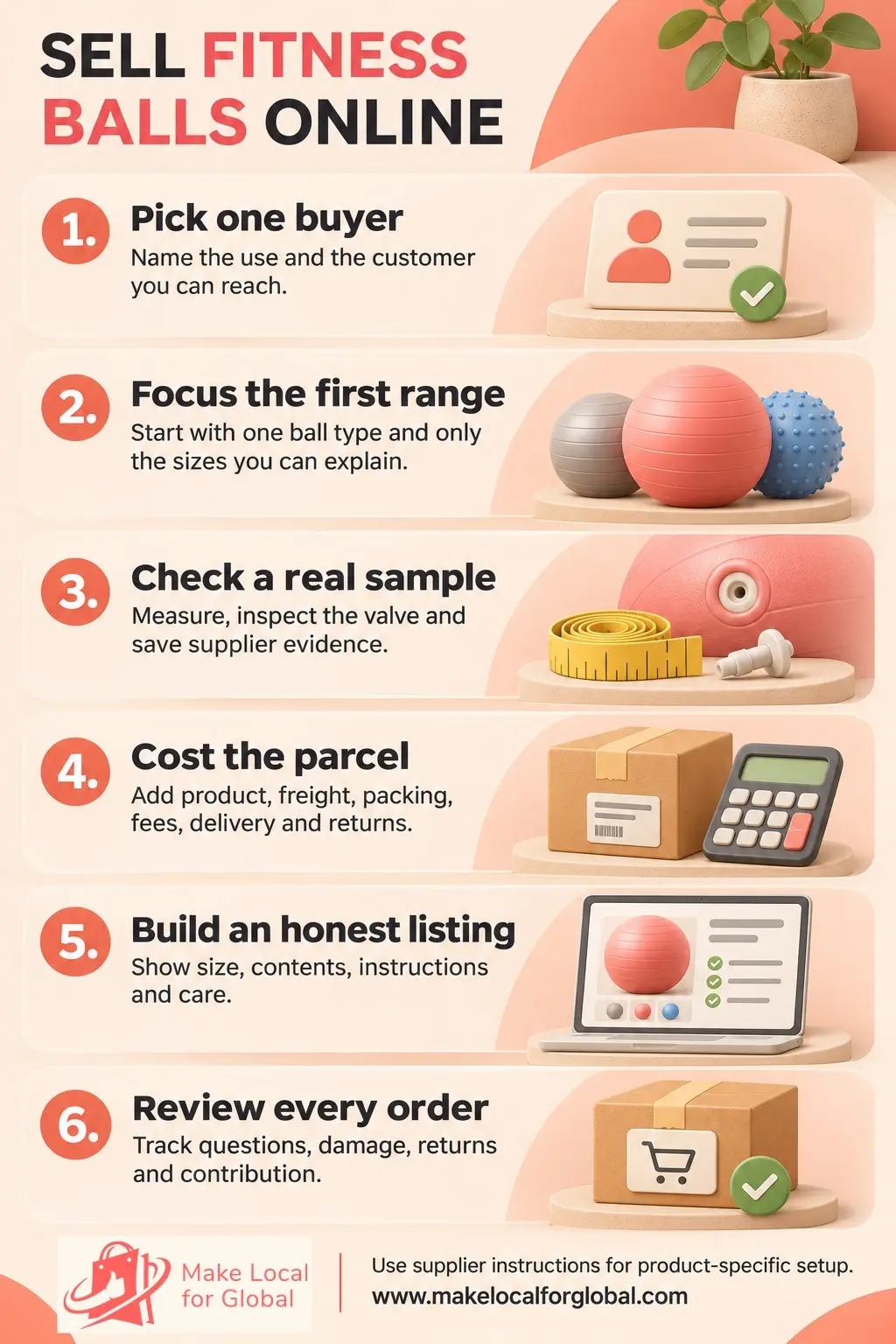
Write a one-sentence buyer brief and select one ball format. Speak with five to ten people who match that buyer. Record their questions about size, setup, contents, price and delivery. Compare two or three real products and set a pause rule for supplier or safety gaps.
Contact at least three suppliers with the same specification questions. Ask for model-specific size guidance, materials, test evidence, instructions, packed dimensions, included accessories, minimum order and lead time. Make a shortlist only when the answers are clear enough to compare.
Order a sample from the strongest supplier and one alternative where the budget allows. Follow the official setup instructions. Measure, inspect the valve and surface, check the pump fit, record the carton contents and photograph each stage.
Write down every mismatch between the sample, product page and supplier documents. Ask the supplier to resolve missing or conflicting information before placing a stock order. Do not run a destructive home test or use a customer as a test subject.
Measure the packed parcel and request real carrier costs for the intended service. Complete the per-order calculation with inbound freight, customs charges where relevant, packaging, payment fees, delivery, returns allowance and customer acquisition. Recalculate with a higher delivery band and a modest discount.
Draft one product page with the product type, model-specific dimensions, package contents, setup instructions, clear images, delivery terms and returns information. Ask a person unfamiliar with the product to use the page to answer five questions. If they cannot tell what is in the box or how size is stated, revise the page before checkout opens.
If the supplier and product checks pass, buy a small opening quantity that fits your budget and storage space. Pack a test order to check the carton, label, contents and shipping dimensions. Confirm that stock levels, checkout, order emails and customer support work on a phone.
Share a helpful size or setup answer with the first target audience. Use a small measured campaign only if the page is accurate and you have set a spending limit. Track visits, questions, orders, delivery costs, damage and returns. At day 30, decide whether to keep the range, alter the information, ask the supplier for a change or pause.
Review the website options and support available for setting up an online store around a focused product range.
They may suit a seller who can answer product-specific questions about size, setup, contents and delivery. Check demand with buyer conversations and a small offer test, then calculate the complete order cost. A low wholesale price by itself does not show whether an online range is viable.
Use the size options and recommendations from the exact manufacturer or model. Ask how its published measurement is defined, follow the stated inflation method and verify a sample. Avoid presenting one generic height chart as suitable for every ball.
A pump can make setup simpler if it is compatible with the valve and listed contents. Verify the connector on the sample, state whether the pump is included and price the kit after adding its product, packing and shipping costs.
Follow the manufacturer’s setup instructions, measure the ball using the documented method, inspect the valve, plug, seams and surface, and compare the accessories with the product page. Ask the supplier for records that support any load, anti-burst or material claim. A home inspection cannot replace formal testing.
Make the dimensions and measurement method clear, photograph the inflated product beside a scale reference, show what is in the box and provide the exact setup and care instructions. Track return reasons and change the specific part of the offer that causes repeated confusion.
Only use a performance claim that is supported by suitable evidence for the exact model and the intended market. Ask the supplier for the test method, results and product identity. Do not repeat a phrase from a generic sales sheet without checking its basis.
Businesses that supply consumer products in the UK have product-safety responsibilities. The details differ by product and by market, including Great Britain and Northern Ireland. Read current government guidance for the exact product and seek qualified advice when its classification, marking or intended use is uncertain.
Include the product, inbound freight, customs charges if applicable, packaging, handling, channel fees, outbound delivery, returns and damage allowance, and customer acquisition. Then separate contribution from fixed overheads, tax and the owner’s time.
Begin with the smallest set of formats, sizes and colours that can answer the buyer’s main need. Add a variant after you have evidence of demand and can verify its sample, instructions, stock handling and delivery cost.
Selling fitness balls online is a product-information and fulfilment task as much as a sourcing exercise. Choose one clear use, ask suppliers for records, verify the sample, show setup and size plainly, and check the full cost of the parcel. A small range with accurate evidence gives you a more useful starting point than a long catalogue of unexplained variants.
PREFERRED SOURCE
Like what you’re reading? Add Make Local for Global as a preferred source on Google to see more of our articles when you search.

Build your online presence without having to figure out everything yourself.