

READY TO SELL Fitness Jump Ropes ONLINE?
Get a store built for you in 5 days, plus training and support to help you start, run, and grow your Alternative business.

Plan a fitness jump-rope range with measured length guidance, sample checks, safety points and a worked packed-order cost model.

A skipping rope can look like a simple loop of cord with two handles. The business decisions sit in the details: what workout the rope is for, how its length adjusts, what the handle feels like after a short session, and whether a parcel-sized order leaves enough contribution after fees and delivery.
To sell fitness jump ropes online, choose one clear buyer first, build a small range around that use, inspect samples under realistic conditions, and write down the exact measurements and materials. Then price a packed order before you commit to stock. A customer should be able to tell which rope suits their use and how it will arrive from the page alone.
The UK search language includes both “skipping rope” and “jump rope”. Use both terms naturally in page copy and check the phrases that buyers use on your chosen marketplace or in your search data. Do not build a range around a keyword alone. A phrase can bring visits without helping a buyer select the right cord, handle or length.
Compare rope formats, measured length and complete packed-order costs before choosing stock.
The first task is to choose whose problem the shop will solve. A general-purpose rope, a boxing warm-up rope and a speed rope may share a basic shape. They do not make the same promise or need the same product information.
Possible buyer groups include:
These are starting hypotheses, not proof of a large market. Choose the group you can reach and understand. If you attend a boxing club, talk to beginners and coaches about the ropes they already use. If your audience is home-workout beginners, ask what confused them when they last tried to buy one.
Write down the answer to four questions before looking for a supplier:
1. Who uses the rope and where?
2. What do they find awkward about their current option?
3. Which specification could solve that problem?
4. What evidence would show that your proposed offer is worth another test?
For a boxing warm-up offer, that evidence might be several people asking for a light, easy-to-carry rope with a replaceable cord. For a home-workout offer, it might be repeated questions about how to measure a rope and whether the handle includes a length adjustment. Record what people say in their own words. A “yes, I’d buy that” answer is weaker than a question about the exact price, length, delivery date or how to order.
Do a small test before you buy cartons. Ask people in the target group to compare two honest product concepts, such as a basic adjustable rope and a cable rope with a spare cord. Show the actual intended price, delivery charge and product details. A short landing page can collect interest, but do not take payment for stock you cannot supply or present a concept as an item already in stock.
When a first test gets attention, look at the questions behind it. Several people asking “Does this fit someone my height?” points to a sizing problem to solve. Questions about replacing a snapped cord point to a parts and warranty concern. Those signals can shape the offer before you spend on inventory.
For a broader view of online fitness products, see how to sell fitness equipment online. That wider category article can help you compare the jump-rope opportunity with other equipment types before you commit to a niche.
“Jump rope” covers several designs. Suppliers may use overlapping names, so ask for a sample and a written specification rather than choosing by the product title alone.
A soft PVC or similar polymer cord is common in general fitness ranges. The cord may be easy to coil and the handle can be simple to adjust. Its suitability depends on diameter, weight, finish, the joining point and the workout a buyer expects.
Ask the supplier to state the material and measured diameter. Check whether the cord has a solid, hollow or coated construction. The term “PVC” on a listing does not tell a customer how the rope feels, how it behaves on the floor or how long a particular model lasts.
This type can suit an entry-level or general-training offer if the sample is consistent and the page makes its limits clear. Test the cord on the surfaces you intend to recommend. A light rope can be harder for some beginners to feel during rotation. Do not claim that a design suits every beginner without testing it with the target users.
Beaded designs use segments around a cord. The segments can make the rope visible and give it a different sound and feel as it moves. Buyers may choose this format for rhythm work, demonstrations or a more tactile rotation.
Inspect the bead material, spacing, end fixing and sound. Check that segments do not slide freely, crack or come loose during repeated use. A bead-count description is not enough. Photograph the segments and state the full rope length, handle size and the intended use in plain terms.
Speed ropes often use a thinner cable or wire assembly and compact handles. Some models use rotating connectors or bearing-like mechanisms. A buyer may choose them for fast rotation or specific training patterns, but the words “speed” and “double-under” are not proof of performance.
Record the rope material, outer coating, handle dimensions, connector design, adjustment method and what tools are supplied. Check the cable ends and retainers closely. A poorly finished end can fray a coating, slip from its fixing or create a sharp edge. Do not photograph the product in a way that hides those joins.
The weight may sit in the cord, in removable handle inserts, or in both places. These constructions feel different. A listing that says “weighted” without showing where the mass sits leaves a buyer guessing.
Ask for the total rope weight and, where possible, the weight of the cord and each handle separately. Check whether inserts are removable and whether the product remains secure after they are fitted. A heavier cord can make a package more costly to ship, so weigh the final parcel, not only the handles.
Do not present a weighted model as a shortcut to a health outcome. Describe its tested construction and intended training context. Keep claims about calorie burn, weight loss or medical benefit out of product copy unless you have a sound basis and have checked the rules that apply to the claim.
Ropeless models, counters and digital displays add batteries, electronics or moving components. They create different support questions: pairing or reset instructions, battery life, replacement parts, display accuracy and what happens if a component fails.
Treat this as a separate product project. Test every function, confirm the battery and packaging details, and check which product rules apply before listing it. A non-electronic rope range is simpler to validate for a first launch. Add electronics only when you have a supplier who can answer technical and after-sales questions.

Keep your comparison grounded in observable details. A simple range table can show the buyer which model fits a use without promising a performance result.
| Product format | Details to record | Useful page evidence | Risk to check before listing |
|---|---|---|---|
| Adjustable polymer rope | Cord material, diameter, usable length, handle length, adjustment range | Full rope length, adjustment close-up, handle in hand | Kinks, rough joins, slipping adjuster, inaccurate length |
| Beaded rope | Segment material, segment count, cord, full length, bead spacing | Bead close-up, full loop, segment movement | Cracked or loose segments, inconsistent finish |
| Speed cable | Cable material and coating, handle size, connector, supplied tool | Cable and connector detail, adjustment demonstration | Sharp end, fraying, loose retainer, inconsistent rotation |
| Weighted design | Total weight, weight distribution, removable inserts, included parts | Separate weights shown on a scale, handle opened only if safe | Unclear weight claim, loose insert, high parcel weight |
| Ropeless counter model | Components, battery type, functions, warranty and support | Screen, controls, battery compartment and tested use | Faulty counter, unclear battery information, extra support burden |
The table is a decision aid, not a universal ranking. One buyer may prefer a light, flexible rope that packs into a bag. Another may want a cord they can feel as it passes underfoot. Let the intended use lead the comparison.
A catalogue with every colour, length, handle, cord and accessory quickly becomes hard to manage. Each variant ties up money and creates another chance for a picking error. Start with a short range that tests one clear position.
You might begin with:
This is a planning structure, not a requirement to stock three products from day one. A one-product test can be more sensible if cash is tight. The main point is to make the choice between versions meaningful. If two listings differ only in colour, combine the colours as variants rather than implying that each is a different training tool.
Keep colour choices small at first. Choose shades that are easy to photograph accurately and that make product variants clear. If a colour affects visibility during use, describe what you have observed rather than making a broad performance claim.
Decide whether you will sell adult-only fitness products, a youth range or both. Children’s products bring different sizing, supervision, safety information and possible legal classification questions. Do not place one adult model under an “adult and kids” heading if its usable length or instructions have not been assessed for both groups.
A bundle should remove a purchase or training inconvenience. Options worth testing might include a rope with a spare cable, two ropes for a coach and a training partner, or an adjustable rope with a simple carry pouch. Add a bundle only if every included part has a verified specification and a clear cost.
Show the exact contents in the first product image or a nearby bullet list. State how many ropes, spare cords, tools, bags or instruction cards are included. A “starter kit” that hides the contents behind a lifestyle photo can lead to avoidable questions and refunds.
If a bundle contains two rope types, explain why the pair belongs together. “PVC for general practice, cable for a separate speed-work option” is more useful than “ultimate fitness set”. Avoid claims that the kit meets a training programme or coaching standard unless that is documented.
Create a variant table before you list products. Record the SKU, colour, cord type, measured length, adjustment range, handle type, accessory contents and supplier batch. Use a distinct SKU for each combination that changes what the buyer receives.
Avoid variant labels such as “small”, “medium” and “large” unless they map to a defined measurement. A buyer should see a usable rope length in centimetres or metres. If the rope can be cut to size, state the maximum usable length, the adjustment steps and whether cutting it is irreversible.
Compare the range with the product list in your fitness equipment selling plan. If a rope is your only fitness product, use the broader list to spot which accessories would create a coherent next test, not to inflate the first order.
You can source from a UK wholesaler, buy directly from a manufacturer, use a private-label arrangement, or arrange fulfilment through a third party. Each route changes how much control you have over materials, packaging, stock and product information.
A domestic wholesaler can make small orders and replenishment easier. You may have shorter transit times and a local contact for product questions. The wholesale price can be higher, and the wholesaler may not hold detailed factory test documents or offer product customisation.
Ask who manufactured the rope and who is responsible for the product information supplied to you. Request a specification sheet, user instructions, available traceability information and a current sample from the stock you will receive. A reseller’s assurances do not replace checking the goods and records yourself.
Direct sourcing can give you more choice over handle colours, rope lengths, packaging and branding. It can carry minimum order quantities, longer lead times and more responsibility for product verification. A low quoted unit price says little about the cost that reaches your door.
Ask for the minimum order quantity by variant, sample price, production lead time, deposit schedule, packaging dimensions, shipping terms and the process for defects. Clarify whether the supplier is quoting one rope, the retail box, spare parts and printed instructions. Get the quotation in writing with a date and a named contact.
If you add your own name or trademark to a product, or import it into the UK, your role may carry additional legal responsibilities. Read the current GOV.UK advice for manufacturers and importers and seek qualified advice where your role is unclear.
With dropshipping, another business stores and dispatches stock to the buyer. This reduces the stock you hold, but it does not remove your responsibility to describe the item accurately or deal with customer questions and returns. You need to know where the stock sits, how quickly the supplier dispatches it and which packaging reaches the buyer.
Order samples to your own address before listing the product. Check whether the package includes another retailer’s invoice, a foreign-language leaflet or branding that conflicts with your shop. Ask what happens when a delivery is late, a parcel is lost or a customer reports a faulty connector. Put the answers in writing.
Ask a supplier to explain a test report, not just attach a file. Match the product name, model, material, factory and test date to the rope you plan to buy. If a document describes another product, an old design or a different company’s range, it does not prove that your item is covered.
Do not treat a supplier’s “CE” or “UKCA” statement as a general quality badge. A conformity mark is relevant only where the product is in scope of rules that require it, and the responsible business needs the correct supporting evidence. Check the current UK product rules for your exact product and market before you add a mark or make a compliance claim.
An attractive sample photograph cannot tell you whether the cord kinks after storage, the adjuster grips, or both handles feel the same. Test the sample as it will be used, photographed, packed and supported.
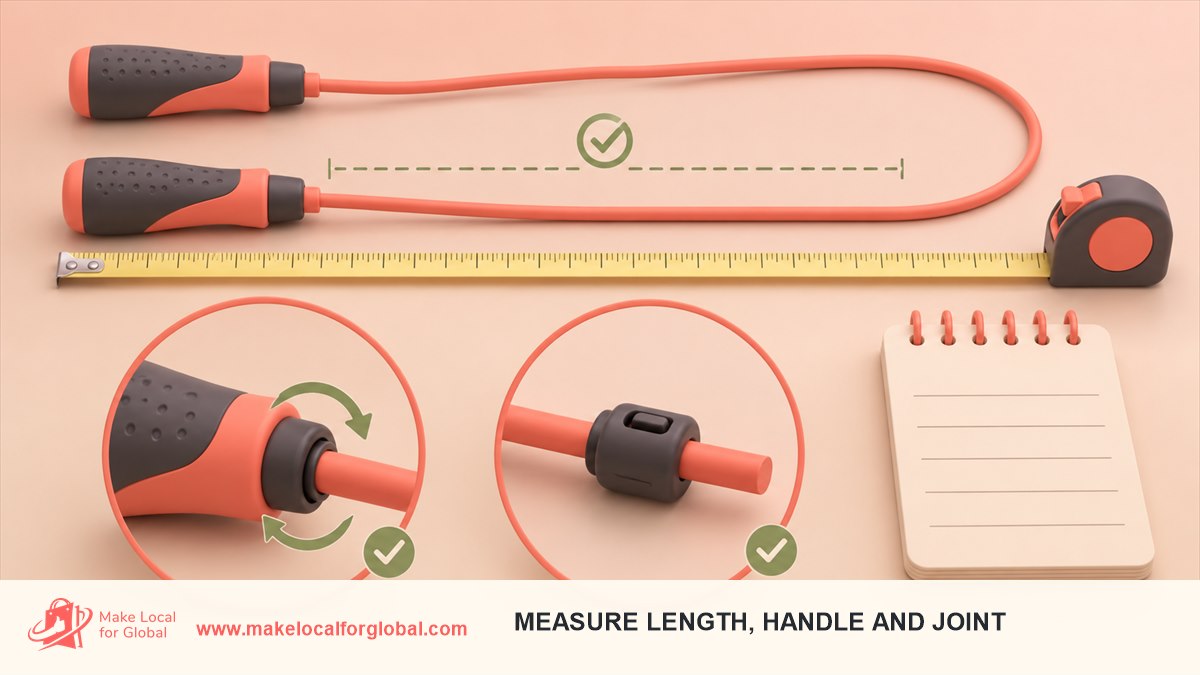
Measure the cord from the attachment point at one handle to the attachment point at the other, and record the method you used. If the supplier gives a total end-to-end measurement, note that separately. Handle length can be excluded from some measurements and included in others, so name your measurement clearly.
Test the adjustment mechanism across its full intended range. Record the shortest and longest usable length, the steps between settings and whether the user needs scissors, a screwdriver or another tool. Photograph the mechanism before and after a length change.
If the supplier recommends a body-height method for sizing, compare it with the measured product and test it with people in your intended customer group. Do not turn a traditional rule of thumb into a universal promise. A customer’s workout, skill level and preferred rope path can affect the feel of a given length.
Uncoil the rope and lay it flat. Look for permanent bends, flat spots, coating cracks, loose beads, rough seams and areas where the cord rubs against a connector. Coil it loosely, store it in the pouch or box that will reach a customer, then uncoil it again and check whether it falls into a usable shape.
Run the cord through a short controlled session on the surface you intend to recommend. Stop if the cord, handle or connector shows a defect. Note the surface, session length and what you observed. Do not claim that one sample proves long-term wear or performance across a production run.
Hold each handle with dry hands and check its finish, grip and balance. Inspect for sharp moulding edges, loose caps, exposed screws and differences between the left and right handle. If a connector rotates, turn it slowly by hand, then watch it under the intended use. Listen for grinding and check for play or sticking.
The rotating parts should remain attached to the handle and rope. Keep the sample test within safe conditions and follow the supplier’s instructions. Do not pull, bend or spin a product beyond its intended use just to create a dramatic test.
When you receive the first order, compare several units from different parts of the carton with the approved sample. Check colour, weight, dimensions, handle finish, adjustment parts, packaging and instruction sheet. Write down any differences and photograph them with the batch reference.
For later orders, keep one approved reference sample. Use it to compare new deliveries and to check whether a supplier has changed material, tool or assembly method without telling you. Your checks do not need to be elaborate. They need to be repeatable and recorded.
If a safety-related fault appears, pause sales from the affected batch while you investigate. Keep the supplier’s records, customer reports, order numbers and batch information together. The Office for Product Safety and Standards business guidance explains the need to monitor products and respond to safety concerns. For Great Britain, read the General Product Safety Regulations guidance; Northern Ireland has separate product safety guidance.
Rope length is one of the main reasons a customer hesitates. It can be difficult to choose from a photograph, and sellers sometimes use vague terms such as “one size fits most”. Replace the phrase with measured information.
For every model, state:
If several lengths suit different bodies, create a small chart based on the supplier’s documented range and your own checks. Avoid inferring exact fit for every person from height alone. Tell the customer to check the supplied method before cutting a cord.
Use a product-page image to show the rope laid out and a second image to show the adjuster. A short clip can demonstrate the adjustment step by step. Keep the video in the same sequence as the written instructions. If a buyer needs to cut the cord, show where the cut is made and the part that secures the end, using the supplier’s confirmed process.
For children’s offers, do not copy an adult size chart. Check intended age, usable length, supervision information and the product’s classification with a qualified source. The product page should display warnings that affect a purchase before checkout if the law requires them.
Use a repeatable support reply. Ask the buyer to compare their height or intended use with the supplier’s chart, confirm the product’s maximum usable length and read the adjustment instructions. If the current measurement does not fit the buyer, say so. Do not promise that every rope can be shortened or returned after alteration.
Record the questions you receive. If the same confusion appears repeatedly, change the product image, size chart or variant label. A product page should answer the question before the buyer has to email you.
Include the rope, packaging, payment fees, postage, fulfilment and a sensible returns allowance.
Your unit price from the supplier is only one line in the calculation. A rope that weighs little can still be awkward to post if the handle, packaging or parcel length pushes it into a higher delivery band. Measure a packed unit before you choose a price.
The figures below are illustrative assumptions for one sale. They are not a supplier quotation or a platform fee schedule. Replace every line with your own records before placing an order.
| Cost per order | Illustrative amount | What to include |
|---|---|---|
| Rope purchase cost | £4.80 | Supplier unit cost for the selected SKU |
| Inbound freight and import allocation | £0.90 | Share of transport and any relevant import charges |
| Retail packaging | £0.55 | Pouch, instruction card and protective mailer allocation |
| Pick, pack and handling | £1.35 | Your time or fulfilment charge |
| Customer delivery | £3.45 | Actual tracked or untracked service chosen for the parcel |
| Selling and payment fees | £3.00 | Placeholder equal to about 12% of £24.95, not a quoted platform rate |
| Returns and defect allowance | £0.75 | A planning reserve based on your own order history as it develops |
| Customer acquisition | £1.50 | Advertising or promotion cost assigned to this order |
| Estimated variable cost | £16.30 | Sum of the lines above |
| Illustrative selling price | £24.95 | Assumed customer price |
| Contribution before fixed costs and tax | £8.65 | £24.95 minus £16.30 |
The arithmetic is £4.80 + £0.90 + £0.55 + £1.35 + £3.45 + £3.00 + £0.75 + £1.50 = £16.30. At a £24.95 selling price, the example leaves £8.65 before fixed overheads, income tax and any VAT effect.
The 12% selling-fee placeholder makes the example easy to recalculate. It is not a statement about Amazon, eBay, Shopify or any other channel. Fee structures change by account, product category, payment method, fulfilment service and seller plan. Check the live fee schedule for the channel you choose, then calculate the fee from the amount on which the platform charges it.
If you are VAT registered, recalculate the sales proceeds and recoverable input VAT using your own VAT treatment. HMRC’s VAT thresholds page and VAT charging guidance explain current VAT rules. The example above is not a VAT return or tax forecast.
Before you order, stress-test the numbers. If delivery rises by £1.00, the example contribution falls to £7.65. If your actual selling and payment charges are £4.00 rather than £3.00, it falls to £7.65 again. If both happen, contribution becomes £6.65 before fixed costs and tax.
Ask whether that amount still pays for your time and leaves enough for your next reorder. If not, test a different supplier, a more compact package, a bundle with verified added value, or a higher price supported by better product evidence. Do not add a price increase to the page without checking whether buyers understand the difference in the offer.
The allowance in the example is a planning line, not a legal cap on refunds. A return can involve the product, two-way postage, processing time, platform fees and an item that can no longer be sold as new. The amount will vary with product quality, fit information and channel rules.
Track returns by reason: too long, too short, handle uncomfortable, cord damaged, listing did not match, parcel late or changed mind. Each reason points to a different next action. A fit return may call for a clearer measurement image. A repeat connector fault calls for a supplier investigation and a pause on the affected batch.
A strong listing makes a precise promise and backs it with product details. “Premium”, “pro” and “studio quality” do not tell a buyer what arrives. Use the product name, intended use and a small set of verified specifications.
Use a format such as:
Adjustable Fitness Skipping Rope, [measured length range], [cord material], [handle detail]
Replace every bracket with a verified fact. If the rope has a particular coating, handle surface or tool in the box, name it. Do not include “weighted”, “speed” or “for children” unless the model and its evidence support that wording.
Put the most useful facts near the start:
Avoid padding the description with repeated keyword variants. Use “skipping rope” and “jump rope” where they help readers understand the product, then name the actual variant. Search systems need a clear page about one product. Buyers need a clear reason to select it.
Plan a small image set for each rope:
1. A clean full-product image showing both handles and the entire cord.
2. A close-up of the handle grip and connector.
3. A measurement image with the actual length method labelled.
4. An adjustment sequence, including the tool if one is required.
5. A scale or measured comparison for the cord and handle, if useful.
6. A parcel or in-use image that sets an honest expectation of size.
Photograph the actual stock or an approved sample. If you use a sample that differs in colour, handle, connector or packaging from the shipped item, say so. Use a neutral background and enough light to show the cord texture. Add a plain ruler or measurement graphic, and double-check every number before publishing it.
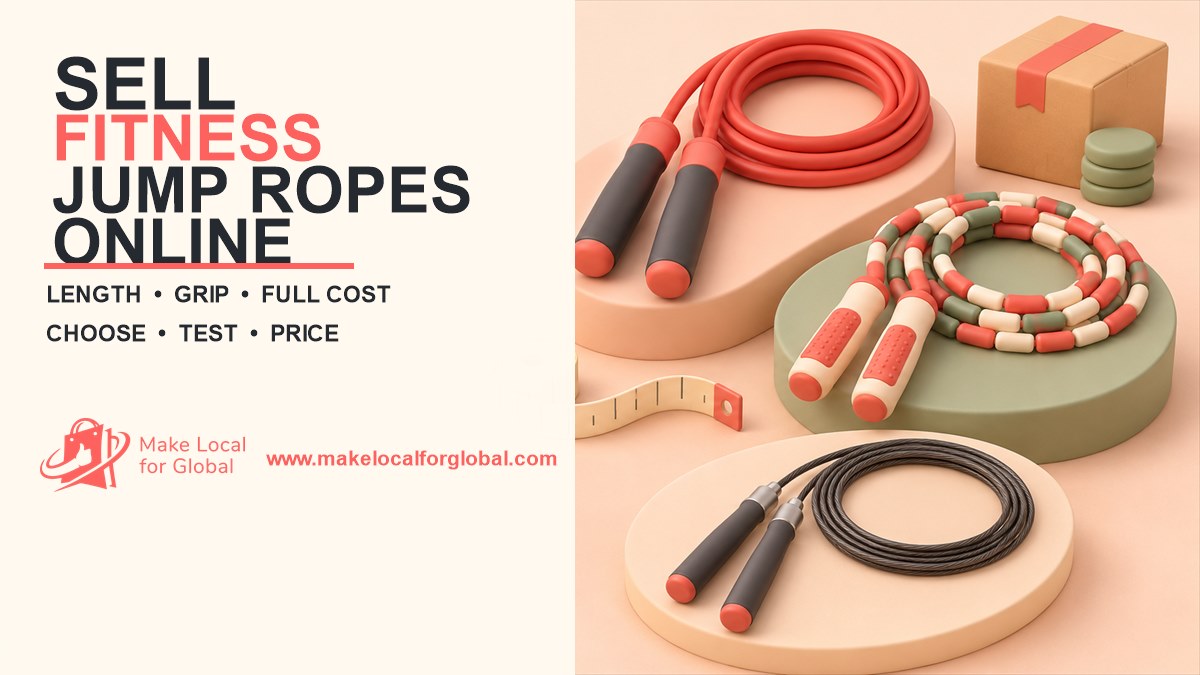
Keep the thumbnail focused on the product and a few useful decisions. A cover with “length, grip, full cost” cues can prepare a reader for the article. Avoid a long slogan, tiny labels or a generic athlete image that could represent any fitness product. The image should make jump ropes recognisable at a glance.
Use customer emails, product reviews and supplier gaps to decide which questions deserve an answer. Common areas include how to measure a rope, whether it can be shortened, what is included, whether replacement parts are available, how to coil the cord, and which surface the manufacturer recommends.
Marketplace competitors may repeat claims that lack evidence. Check the actual model and supplier instructions. If you cannot verify a claim, explain what the customer can measure or ask instead.
Product rules depend on the product, who supplies it, where it is sold and whether a special product regime applies. A fitness accessory does not automatically need a toy or conformity mark on account of having a rope. Do not guess. Check the classification and evidence for the exact model.
The Office for Product Safety and Standards says businesses that make, import, distribute or sell consumer products are responsible for product safety and relevant labelling. The rules for Great Britain and Northern Ireland differ. Read the current product safety advice for businesses and the relevant Great Britain or Northern Ireland guidance.
Keep supplier identity, product descriptions, invoices, test records, batch details, sample notes, customer complaints and corrective actions in one place. The official guidance describes traceability information and continued monitoring. If you import or place a product under your own brand, check your specific responsibilities before ordering.
Create a simple incident record. Include the product SKU and batch, date, issue reported, customer order, photographs, supplier response and action taken. If a rope or handle appears to create a safety risk, stop sales from the affected stock while you get qualified advice. Do not rely on a replacement shipment alone to close a safety concern.
A jump rope promoted for exercise by adults may be treated differently from a rope designed or intended for play by children. Great Britain’s toy rules define toys around products intended for use in play by children under 14, subject to the regulations and exclusions. If your range targets children, or your marketing makes the item look like a child’s toy, seek advice on classification and required testing before sale.
For products that fall within toy rules, warnings and instructions may have specific requirements. Some purchase-deciding warnings, including age warnings, need to be visible before an online purchase. Read the Great Britain toys safety guidance and consult the separate Northern Ireland requirements before listing for that market. Do not take a generic “not suitable for under three” line from another product and paste it onto yours.
Show intended age, supervision details and use restrictions only when they match the product assessment and supplier documentation. Never use a child model or youth tag to imply a product is suitable for children if the age range has not been assessed.
UK online sellers need to provide required business and contract information before a customer buys. That includes clear product details, total price, delivery information and how the customer can cancel. GOV.UK distance selling guidance sets out the information rules. For most online goods, customers can tell the seller they want to cancel within 14 days after delivery, then have another 14 days to send the item back; check the current returns and refunds guidance for exceptions and the full process.
Keep your returns page consistent with the product page and order confirmation. Explain the route for contacting you, the return address, how to package the rope and when a refund is due. Do not claim that an opened rope can never be returned. The customer’s statutory rights still apply, and your exact obligations depend on the circumstances.
Describe features that you can verify: cord material, weight, length adjustment, handle construction and included parts. Avoid claims such as “burns more calories”, “guarantees weight loss” or “prevents injury” unless you have proper evidence and have checked advertising rules. A product listing should not turn a workout tool into a medical device by using unsupported treatment language.
Keep a version of the supplier’s claims and the evidence you relied on. If a new production run changes the cord or handle, check whether your old copy remains accurate. A small change in materials can make the existing photographs, weight information or performance statement misleading.
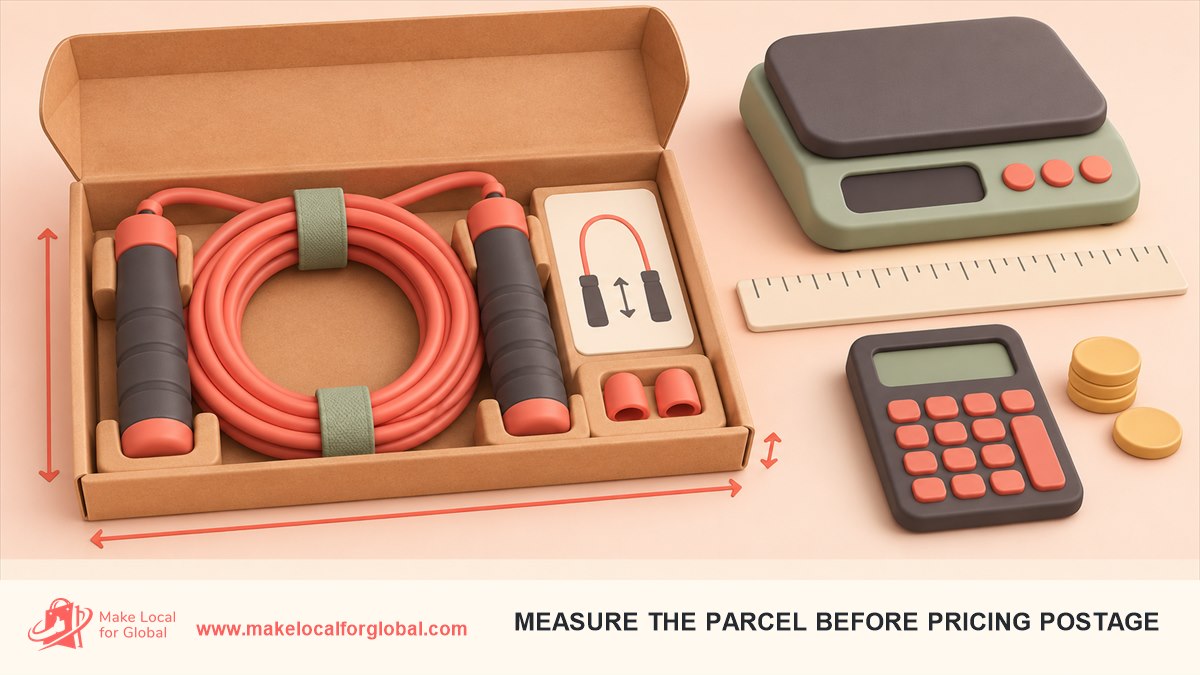
The parcel affects margin and customer experience. A jump rope can tangle with other objects, a handle can mark the cord, and an oversized box can make a low-weight item costly to send. Pack one real order before choosing the mailer.
Coil the rope loosely using the supplier’s recommended method. Keep handles from pressing into the cord. Add any spare part, instruction card and pouch, then measure the finished parcel and weigh it. Photograph the packing sequence for repeatability.
Compare two packaging options if the first box creates excess space. The smaller option still needs enough protection for the handle and connector. Ask a carrier or fulfilment provider how its size bands apply to your parcel, then use the actual postage service you plan to buy. A scale reading without parcel dimensions may not reveal the right price band.
Add an instruction card if adjustment or care is not obvious. Use short steps and diagrams. Explain how to inspect the cord before use, how to secure an adjusted end and how to store it without a tight knot. Have the safety information reviewed for the exact product and market.
For a low-volume launch, shipping each order yourself lets you see where packing time and customer questions occur. Keep ropes, spare cords and boxes in labelled bins. Record the variant and batch as you pick the order.
A fulfilment partner can help once order volume or storage becomes difficult. Before sending stock, confirm its receiving process, storage fee, pick fee, packaging choices, returns handling, dispatch cut-off and inventory reports. Ask how it identifies different rope lengths and cable types. A two-letter SKU difference is easy to miss during picking.
Dropshipping transfers the physical dispatch, not the customer relationship. Keep a test order in your own records and check the parcel presentation periodically. If your supplier cannot tell you which batch went to a customer, that gap may complicate a safety investigation.
Do not reorder from a busy weekend alone. Record orders by variant, the time from order to dispatch, supplier lead time, stockouts, returns and questions. A basic starting reorder point is:
Average units sold per week × supplier lead time in weeks + a stock buffer you can afford.
If you sell 6 units a week and replenishment takes 4 weeks, expected sales during lead time are 24 units. Add a buffer only after you consider available cash, seasonality and the risk that a design or supplier changes. This example is a planning calculation, not a prediction.
Keep the rope, connector, handle and packaging tied to a variant SKU. If a supplier substitutes a component, record the new version and reassess its product page and sample checks before mixing it with the old stock.
Your first channel should make it possible to explain the product and learn from questions. A direct online shop gives you control of the product page, email capture and the path from browsing to checkout. A marketplace can put a listing beside existing fitness products, but it brings its own fees, fulfilment rules and competition. Read the live terms for each channel before listing.
Avoid copying the same thin description to every platform. Keep one accurate specification sheet as the source, then format it to match each channel. Check that variant labels, measurements, images and returns information agree everywhere.
Useful topics for a jump-rope shop include:
Keep each post grounded in a product you have inspected. If you publish a comparison, name the measurements and method. If you show a technique, have a competent instructor review it and avoid implying that an online article replaces coaching or professional advice.
Short video can show length adjustment, connector movement and pack size. Film the same real sample that you sell. Add captions and keep each demonstration focused on one action. A quick measurement clip is more helpful than a montage that shows the rope moving too fast to inspect.
People may search for “skipping rope”, “jump rope”, “speed rope”, “weighted jump rope”, “boxing skipping rope” or “adjustable skipping rope”. These phrases describe related products but do not all mean the same thing. Match the phrase to the exact product page.
Use one clear primary term in the page title and add a natural UK variant in the description if it helps. Let headings answer real buyer questions. Avoid pasting a list of near-identical keywords into the footer or repeating them in every image alt text.
Use internal links where they help a reader move to a useful next topic. Readers comparing training equipment can visit selling boxing gloves online. A broader accessory comparison can link to selling foam rollers online. Link when the next page answers a related question, not just to increase link count.
Choose one small activity and define what result would justify repeating it. Examples include a product demonstration sent to an existing newsletter, a small paid search test for one exact rope type, a club sample day with a written feedback form, or a short post showing how the length adjuster works.
Record spend, clicks, product questions, completed orders, refunds and contribution. Decide in advance which result would count as a useful signal. For instance, if a campaign produces questions about size but no orders, improve fit information before raising the budget. If a product has views but no enquiries, compare its price, delivery charge and images with the offer buyers actually asked for.
Do not use likes, views or follower count as sales evidence. They can show that a post was seen or shared. An order or a specific price question tells you more about the offer. One order alone still does not prove a stable pattern.
For a wider product business view, see how to sell fitness equipment online. Use the MLFG business apps to explore planning tools, then choose only the tool that matches the decision you are making.
The first month should produce evidence, not a large catalogue. Set one action for each week and record what you learn.
Write a one-paragraph profile of the first buyer: what training they do, where they use a rope, how experienced they are and what they want to solve. Pick one product format and a proposed price. Speak with a small group of people who fit the profile, and show them the actual specifications you intend to sell.
Write down the questions they ask. If length is the first concern, make a measurement graphic before you create more colour options. If a buyer asks whether the cable is replaceable, get an answer from the supplier and include the spare-part cost in your model.
At the end of the week, keep the idea only if you can name the buyer, product type and first test. If you still have three unrelated audiences and no evidence about their needs, narrow the scope.
Contact suppliers with the same written question list. Compare the full delivered cost, minimum order, sample, documented specifications, lead time and defect process. Order samples from the supplier or route you are most likely to use.
Measure every sample. Test the adjustment, grip, connector and cord as described earlier. Keep notes and photographs. If two samples differ, find out whether the material or the construction changed. Do not rely on a low price to compensate for missing specifications.
At the end of the week, choose one test SKU or pause the project until the supplier can answer the unresolved points.
Write the title from verified facts. Add a measured length, adjustment range, handle detail, contents and care notes. Photograph the full rope, connector, length method and parcel. Ask one person who has not seen the supplier sheet to review the page and tell you what they expect to receive.
Pack one order using the intended mailer. Measure the dimensions and weight, check postage cost and update the pricing model. Recalculate contribution after fees, packaging, delivery, returns and promotion.
At the end of the week, fix any mismatch between the product page, supplier information, packaging and actual sample.
Launch the offer to the group you selected. Use a small test budget or an audience you can reach directly. Keep the order quantity low enough that you can handle customer questions and check every packed item.
Record product views, orders, questions, cancellations, returns, reasons for refunds and contribution per order. Check whether the buyer understood the rope type and measurements. Ask customers for specific feedback after delivery, without offering a reward that could distort the response.
At the end of the month, make one decision: continue the same offer, revise a named part or stop. If you revise length guidance, do that before adding more rope formats. If the product sells but the parcel cost erases the contribution, test a different pack or delivery offer before buying more stock.
Five rope formats can create the impression of choice while leaving you with little evidence about demand. Start with the product type that answers the clearest customer problem. Add a second type when a real buyer question points to it.
Supplier terms such as “professional”, “high speed” or “weighted” can hide missing detail. Ask for the material, dimensions, weight and product evidence. Put only verified facts on the page.
“One size fits most” shifts the sizing work to the customer. Publish the measured length, adjustment range and recommended method. If you cannot get that information from the supplier, do not guess.
A low unit cost can look attractive until you add freight, packaging, fulfilment, channel fees, postage, returns and marketing. Weigh and measure the packaged product before you set a price.
A sample tells you about that sample. Keep it as a reference, then compare incoming units against it. Record batch differences, complaints and supplier changes.
Age wording and marketing can affect product classification. Get advice before you describe an item as a toy, present it for children or reuse age warnings from another listing.
Views may reveal interest in the content, not willingness to buy the rope at your price. Track completed orders, customer questions, returns and contribution. Set your threshold for a second test before the first one ends.
Show rope length, handle details, adjustment method, care and exactly what arrives in the parcel.
It can be tested with a small range, but the business still needs verified measurements, a safe sample, accurate product pages and a cost model that includes delivery. Start with one buyer and one rope type, then use questions and orders to decide whether the offer deserves expansion.
Use both terms where they read naturally. “Skipping rope” is common UK wording, and “jump rope” is used in international fitness content. Match the main title to the product and audience, then use search suggestions and customer messages to learn which phrase fits your shop.
Choose the format that solves a clear need for the group you can reach. A basic adjustable rope may suit a general training offer, while a cable speed rope may suit customers who ask about faster rotation and replaceable parts. Test the sample and record the differences before choosing.
Publish the measured length, adjustment range and the manufacturer’s recommended measurement method. Do not promise that height alone determines fit for every user. Show how to adjust the rope and where to find the verified instructions.
Only if the supplier’s instructions allow it and the buyer has selected the correct size. Cutting can be irreversible, so do not shorten a rope by default. State the maximum usable length, tool requirements and whether a cut cord can still be secured as intended.
Do not assume that every fitness rope requires a conformity mark. Requirements depend on the product’s classification and the market. Check current rules for the exact model, especially if it is designed or marketed for children or includes electrical components.
Only after checking the product design, intended age, safety assessment and rules that apply in each UK market. A youth product may raise toy-safety questions. Keep its product page, warnings, testing and instructions separate from an adult model until you have confirmed the classification.
There is no single figure. The total depends on samples, minimum order, freight, packaging, product photography, channel fees, postage and the amount of stock you choose to hold. Build a per-order cost sheet first, then add one-off setup costs and a cash buffer for returns and reorders.
Show the rope’s measured length and adjustment range, explain the measurement method, photograph the adjuster and answer common questions near the variant selector. Track every length-related return and revise the page where a buyer could reasonably misread the information.
Include only parts that solve a real customer need and have verified fit. A spare cord, adjustment tool or pouch can help if it matches the model. State the quantity and specifications for every part, and include each item’s cost in the bundle calculation.
Compare completed orders, customer questions, cancellations, returns and contribution with the threshold you chose before launch. Likes and views show that content was seen. They do not prove that buyers accepted the product, price and delivery offer.
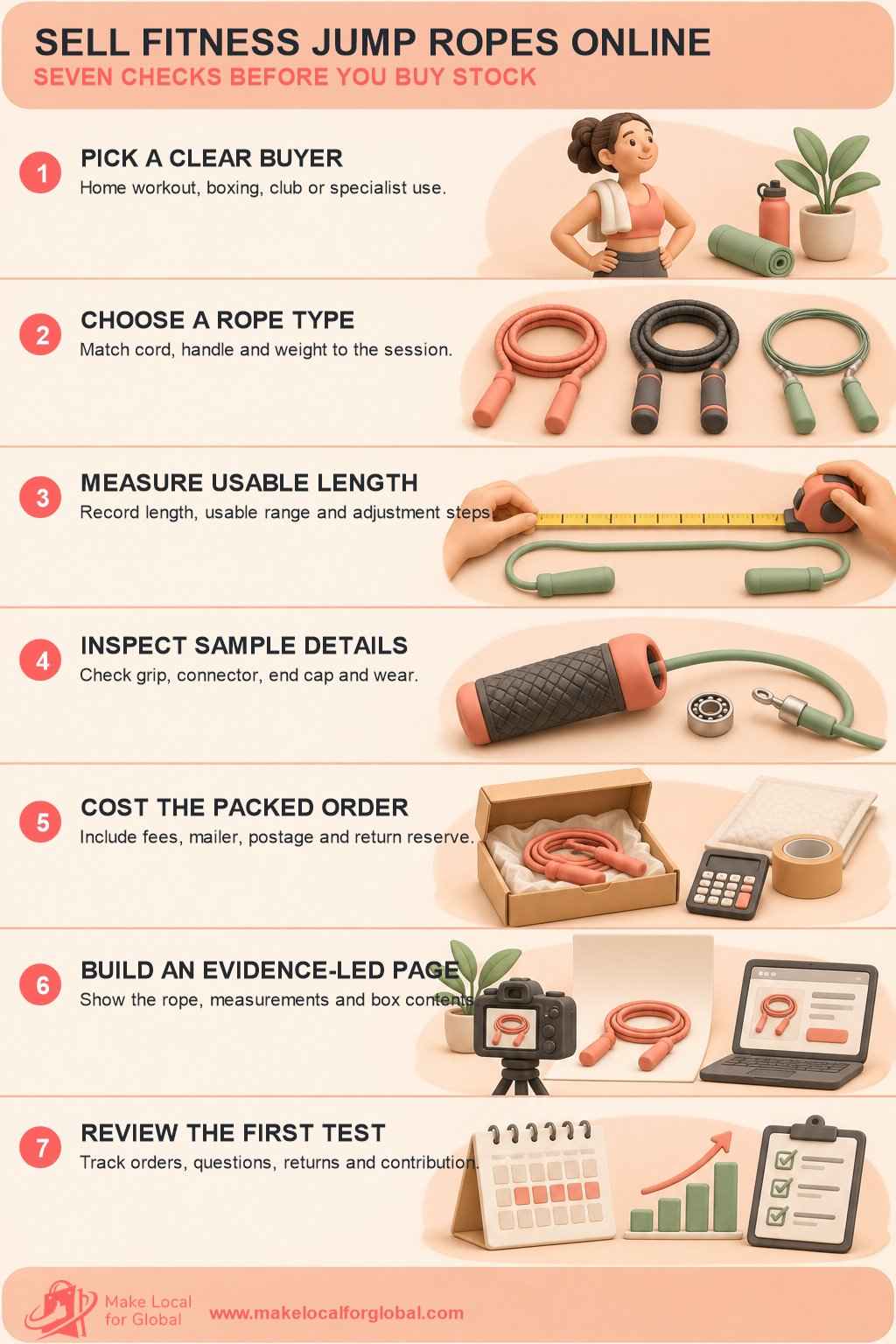
The first jump-rope offer should answer one customer need with a product you have inspected. Measure the cord, check the handle and connector, confirm how adjustment works, and price the packed order. Put those facts where a buyer can see them before checkout.
Keep the first test narrow enough to learn from it. If buyers ask about length, improve the sizing information. If a sample shows a loose retainer, stop and resolve it with the supplier. If the full-order cost does not leave a workable contribution, change the sourcing or offer before adding more stock.
When the evidence supports another step, build the next product around what the first buyers actually asked for. A clear range and reliable product information give you a better basis for an online shop than a long list of ropes chosen before you have seen a customer use one.
PREFERRED SOURCE
Like what you’re reading? Add Make Local for Global as a preferred source on Google to see more of our articles when you search.

Build your online presence without having to figure out everything yourself.