READY TO SELL glass cutting boards ONLINE?
Get a store built for you in 5 days, plus training and support to help you start, run, and grow your Alternative business.

Plan a glass cutting board range from the first buyer and supplier sample through food-contact checks, full-order pricing, product-page details and protective delivery.

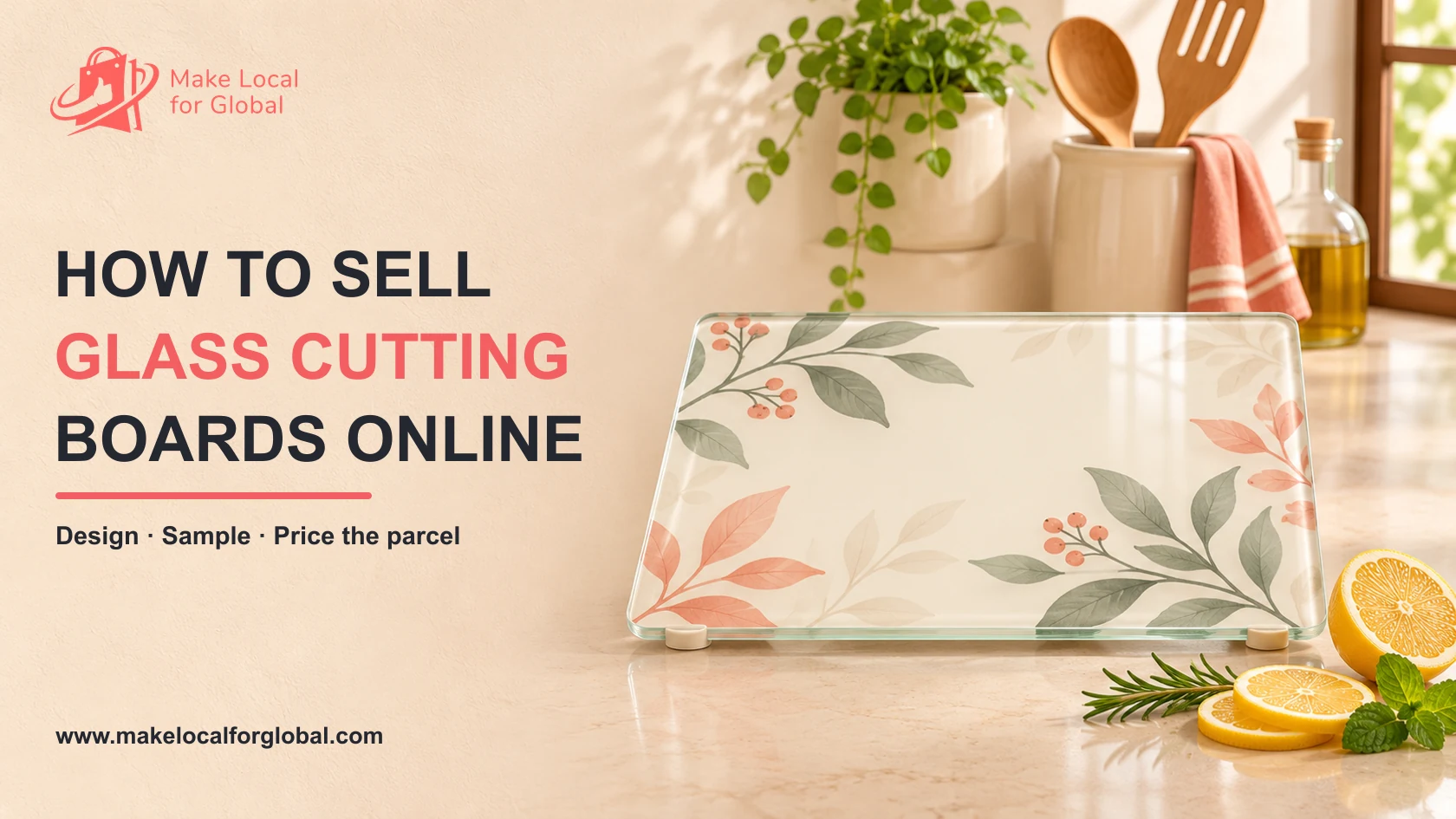
A glass cutting board can be printed with artwork, given as a housewarming gift or used as a worktop saver. The hard part for a new seller is deciding what the product is for, then showing and shipping it honestly. A decorative glass board may suit light preparation or serving, yet a hard glass surface is a poor choice for repeated heavy chopping if the buyer wants to preserve knife sharpness. Build the range around a clear use, confirm the supplier’s claims and test the finished parcel before you spend on a large batch.
This plan is for a first-time seller deciding whether to resell ready-made boards, create a small own-brand range or use print-on-demand. It covers buyer research, artwork, glass and edge checks, food-contact information, pricing, product pages, delivery, returns and a measured first month. The article uses UK examples. A rule or guidance can differ by jurisdiction, so check the regulator for the place where you make, import or sell the goods.
If you are still weighing up print-on-demand, resale or an own-brand range, the free Ecommerce Pathfinder can help you compare a few routes before you commit to supplier minimums.
“Glass cutting board” is a familiar search phrase, but it can set the wrong expectation. Some customers want a hard-wearing surface for preparing a full meal. Others want a printed glass board to protect the worktop, display near the hob, serve snacks or give as a personalised present. Those are different jobs. A seller needs to say which one the chosen model suits.
Glass is rigid and smooth. It does not have the give found in wood or many plastic boards, so regular knife work can be harder on a knife edge. A useful seller can explain this in the product description and present the board as a decorative worktop saver, light-prep surface or serving accessory only when that matches supplier documentation and sample checks. Do not hide the trade-off in order to make the listing sound stronger.
The phrase “hygienic” needs care too. A surface can be smooth and easy to wipe, but that does not make a household safe on its own. The Food Standards Agency advises using separate boards and utensils for raw meat, fish or poultry and foods ready to eat, or cleaning and disinfecting equipment thoroughly between uses. Link the product page to the maker’s care instructions and avoid claiming that a glass board prevents food poisoning.
Before you choose a design, write one sentence that names the buyer, use and limitation. For example: “A personalised glass worktop saver for a housewarming gift, with a botanical print under the glass, silicone feet and care details for light preparation and serving.” That is a testable offer. It gives you a basis for choosing the artwork, supplier, measurements, photographs and package.
A narrow first customer is easier to reach than “anyone who cooks”. Pick one use case for the first test and check whether shoppers already search or ask for it. You can later widen the range if enquiries, clicks and completed orders point to another buyer.
| Buyer to test | What they may value | Evidence to collect before ordering |
|---|---|---|
| Housewarming gift shopper | A design that suits a kitchen, gift-ready presentation and a clear size | Search suggestions, gift queries, interviews with people who recently moved |
| Personalised-gift shopper | A name, date or custom image, plus a clear preview of the print | Questions about personalisation, proof approval and delivery dates |
| Home stylist | Colour, pattern, transparency and a tidy counter display | Saves or clicks on design boards, interior-style groups and retailer feedback |
| Food-content creator | A surface for laying out ingredients or serving a finished dish | Requests for photography props, recipe styling or a matching set |
| Small gift shop or kitchen retailer | A dependable wholesale price, repeatable print and replacement process | Buyer discussions, sample reviews and packaging requirements |
These are hypotheses, not proof of demand. Talk to five to ten people who fit one group. Show a mock-up beside a real size reference and ask what they would use it for, what they would need to know before ordering and which detail feels unclear. Ask what they bought most recently for the same occasion. A polite “that looks nice” is weak evidence; a specific question about price, size, artwork or delivery gives you something to improve.
Use search suggestions and marketplace filters to collect the words people use. “Personalised glass chopping board”, “glass worktop saver”, “printed glass board” and “housewarming chopping board” may point to different intents. Record the exact phrase, the intended use and the questions on current listings. Do not create a page for every synonym. Choose one main phrase for the page, then use related wording only where it fits a real product detail.
Test interest with a product page prototype or a small landing page before you order a large batch. Show a sample image, the exact dimensions, the intended use, the care caveat and an indicative price. Invite a wait-list sign-up or collect questions. Do not take payment for a product you cannot supply on the stated terms. If you use a pre-order, state its timing, cancellation and refund arrangements clearly.
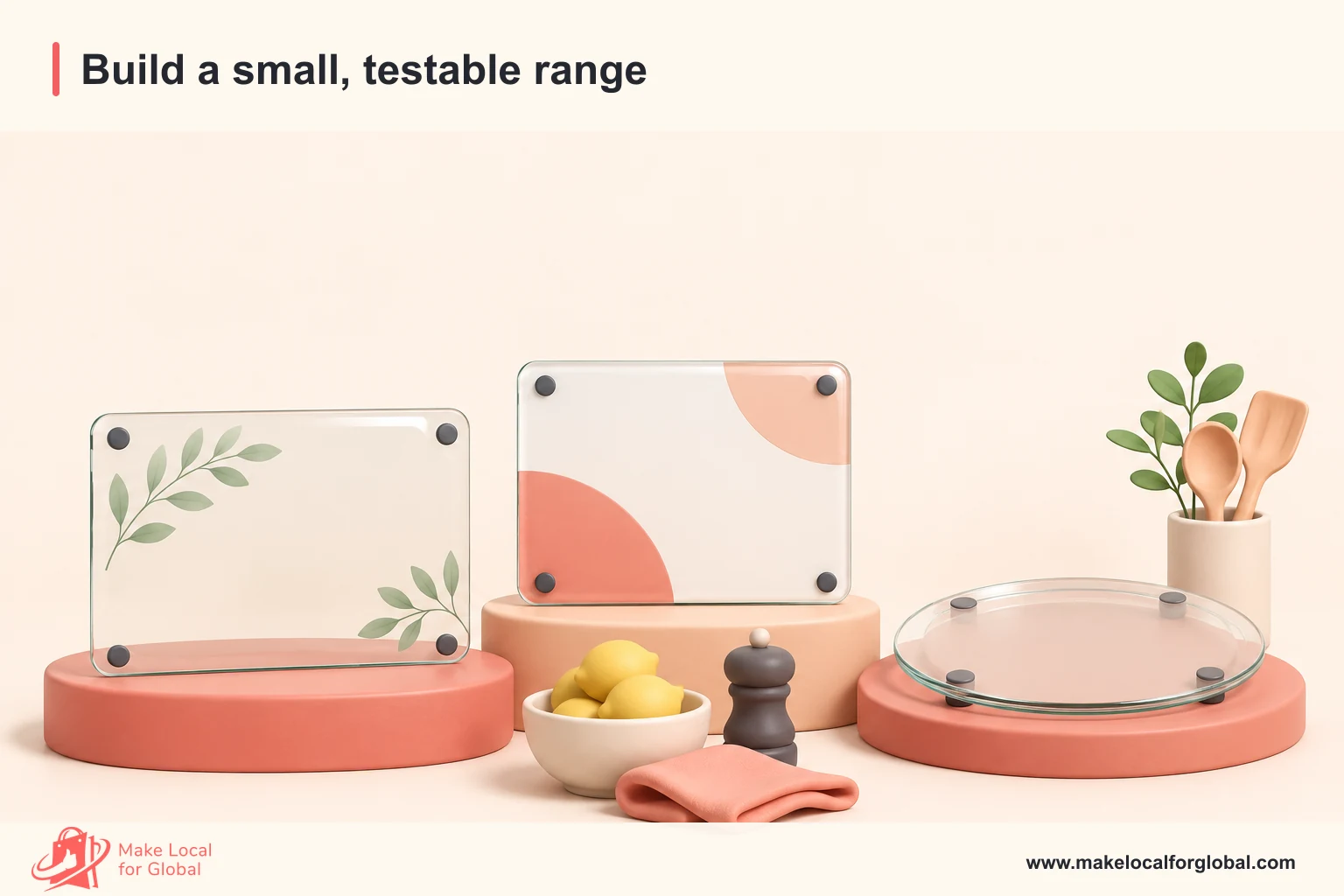
The easiest first range to manage has one clear customer, one board shape and a few related designs. Too many sizes and patterns make it harder to order samples, track stock and learn which message works. Pick a first format from the supplier’s current catalogue, then confirm that it suits your buyer and shipping plan.
Common formats include a rectangular board, a round board, a transparent or lightly tinted surface, a print beneath the glass, and a board sold as a worktop saver. Some suppliers offer one-size print-on-demand products. Others supply standard designs in cartons or accept larger custom runs. The surface finish, backing, thickness, edge treatment, feet, print method, care instructions and box will vary by model. Never assume all glass boards share the same specification.
An example from a supplier catalogue makes the comparison concrete. Prodigi’s current glass cutting-board sheet lists a rectangular 39 × 28 cm board and a circular 30 × 30 cm board, with a chinchilla ripple finish, four adhesive feet and dye-sublimation artwork printed on a white base coating. The same sheet notes that the subtle green tint of toughened glass may vary with iron content, which can make white areas in artwork look different across batches. These details come from that supplier’s range, not a universal specification. Check the current sheet and request a physical sample before you promise them to a customer.
For a first drop, choose two or three designs that belong together. One set might use a restrained botanical theme: herbs, citrus leaves and a simple line drawing. A second direction might be a custom family name or date. Keep the artwork large enough to read beneath the glass, with no tiny lettering near edges or feet. If you offer personalisation, limit the first version to one name field and one layout until the proof and order process works.
Do not make every design a different product specification. Keep dimensions, shape, print area, edge finish and feet consistent across the initial set if your supplier can support it. That makes photos, packaging tests, listings and stock counts easier to compare. Add another size only when a real buyer request or order pattern gives a reason.
Create one record for each SKU or print file. Include supplier name and item code, glass type as documented, board length and width, thickness, mass, corner radius, edge finish, print position, printable area, foot material and count, care limits, pack dimensions, carton weight, origin, current cost, production time and revision date. Add a photograph of the actual sample beside a ruler.
Record every customer-facing claim and the evidence that supports it. If a supplier states “heat resistant”, ask what temperature, contact time and intended use that phrase covers. If the board is promoted as dishwasher safe, get the maker’s cleaning instructions and test one sample as directed. Do not convert “easy to wipe” into a promise that every model tolerates a dishwasher, hot pans or repeated impact.
Three routes make sense for a small seller. Each has a different cash, quality and dispatch trade-off.
Print-on-demand. A supplier prints one item after an order arrives. This can keep unsold stock low and lets you test a few designs. You have less control over each production run, and the unit price and parcel charge may leave little room after advertising. Order samples from the exact live supplier route before selling. Review its packaging, order tracking, customer support process, replacement policy and artwork requirements.
Ready-made wholesale. You buy a supplier’s finished designs by the carton or case. The per-unit cost can be lower than an individually fulfilled item, though stock cash, storage and damage risk move to you. Ask about mixed-design cartons, minimum order quantity, lead time, batch consistency, carton count, replacement for transit damage and product traceability.
Custom or own-brand production. A manufacturer prints your art or makes a dedicated spec. You gain more control over design and brand, but tooling, setup, minimum quantities, proofing and compliance checks may raise the first commitment. Do not place a bulk order until the final artwork, colour proof, edge and foot quality, packaging and instructions have passed a sample review.
The route is part of the product. If your promise depends on a gift-ready box, a particular print shade or a fast dispatch window, the supplier must be able to meet that promise on each order. Build a one-page supplier comparison with landed cost, lead time, minimum order, sample cost, print method, packaging, returns support and the documents you have received. Keep quotations and revisions with the SKU record.
Ask which glass specification applies to the exact product code and whether the supplier can provide relevant food-contact documentation for the item and its printed surfaces. Confirm where the print sits, what coating or backing covers it, whether food may touch each face, and which cleaning products, temperatures and uses are approved. Request clear written care limits.
Ask for the board’s measured size, tolerance, thickness and weight. Ask how edges and corners are finished, how feet attach, whether replacements are available and whether each parcel uses corner protection. Request a photograph of the packaging opened and closed. Ask whether a branded invoice or insert will be included in a direct-to-customer parcel.
Ask how a damaged or misprinted item is reported, what photographs the supplier needs and who pays for the replacement. Clarify which party communicates with the customer and how long a replacement takes. Ask what happens if a print file is rejected or a colour differs from the digital proof. Keep the replies with your supplier record; a chat message alone may be difficult to find once a complaint arrives.
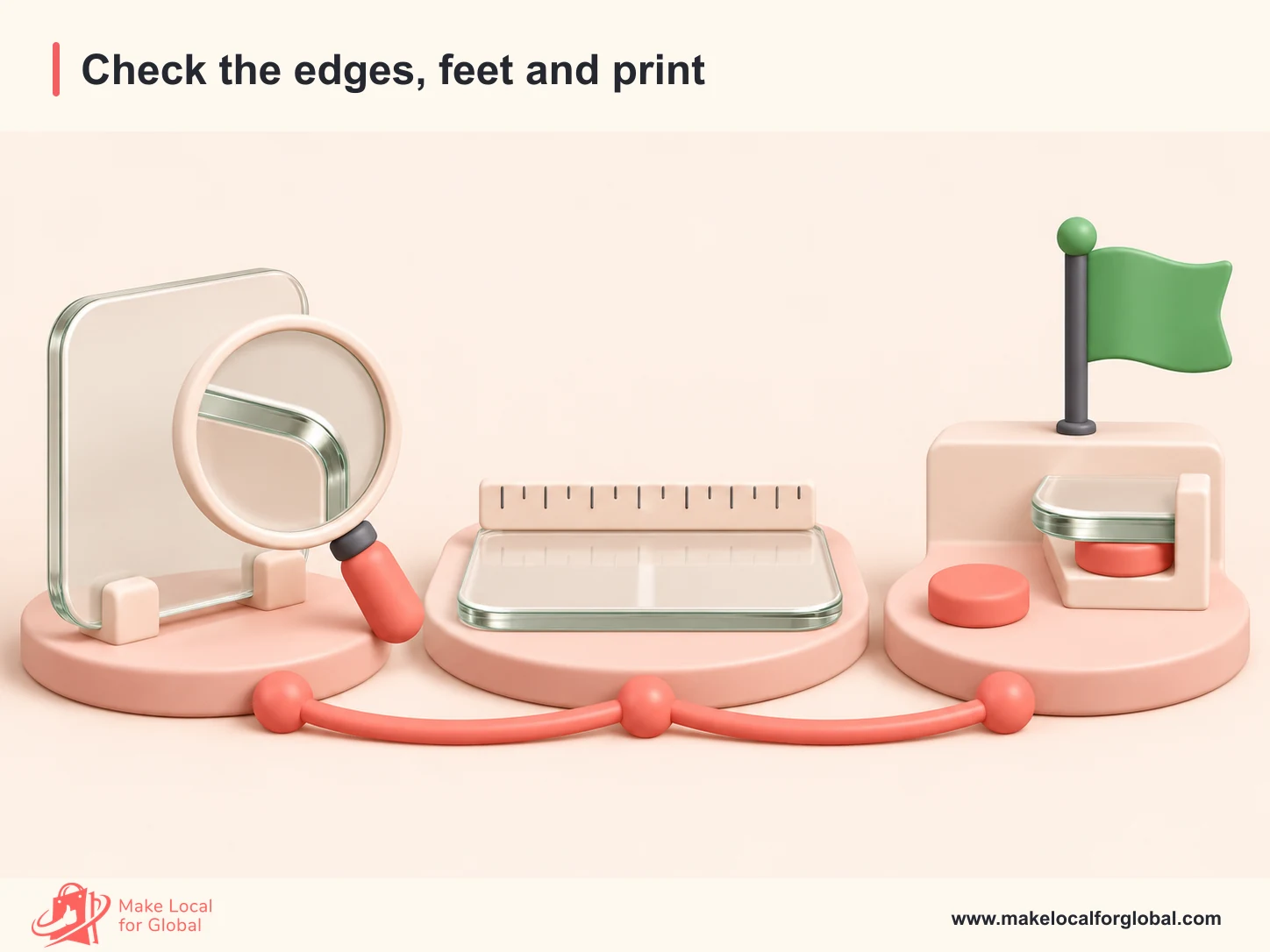
Do not judge a glass board from a digital mock-up alone. Order at least one physical sample per material and print route. If possible, order a second unit later to see whether a repeat batch looks the same. Review the board in daylight and in warm indoor light, then take the photographs you intend to use.
Use a repeatable check sheet. Record pass, fail or “needs supplier answer” for each point:
Do not improvise a high-heat test, drop test or food-contact test. Ask the supplier for its documented test method or a qualified lab where the risk calls for it. A seller inspection can find visible defects and packaging weaknesses; it cannot replace a material test or formal compliance evidence.
Describe limitations in ordinary language on the page. A smooth glass surface may wipe clean, yet the buyer still needs to wash it between tasks. The Food Standards Agency advises keeping equipment for raw foods separate from ready-to-eat foods, or thoroughly cleaning and disinfecting equipment between uses. Use that guidance to set your product copy. Do not claim that a board is “germ-free”, “antibacterial” or “safer” without evidence for the exact finished product.
A board intended to touch food is a food-contact article. Ask for written documentation covering the finished board, print, backing and any coating that might contact food. A generic certificate for raw glass or ink alone may not describe the assembled product. Ask the supplier what uses the document covers, which market it applies to, and whether the file matches the model and production batch you plan to sell.
Food Standards Scotland explains that food-contact materials include kitchenware and that the general framework in Regulation (EC) No 1935/2004 applies in Great Britain. The framework covers whether substances may transfer from material to food at harmful levels or cause an unacceptable change in food. Food-contact rules and enforcement arrangements can differ across England, Wales, Scotland and Northern Ireland. The seller must identify the market and the product’s role in the supply chain before relying on a document.
Do not present yourself as a manufacturer or importer by accident. A business that buys a finished item from a UK supplier may be a distributor; a business that brings goods into Great Britain, sells under its own name or changes a product may have further duties. The Office for Product Safety and Standards says businesses that make, import, distribute or sell consumer products share responsibility for product safety. Keep records that identify your supplier, model, batch where available, product documents and any safety complaint.
The general product-safety rules require consumer products to be safe in normal or reasonably foreseeable use. The UK guidance notes that Great Britain uses the General Product Safety Regulations 2005, while Regulation (EU) 2023/988 applies in Northern Ireland from 13 December 2024. Check the latest guidance for each market you serve. If a customer reports a crack, sharp edge, loose foot or injury, stop and investigate rather than treating it as a routine refund. Keep the affected item, order details and batch information, contact the supplier and follow the relevant reporting route if a risk is found.
Before launch, put these items in a product file:
Keep public claims within the evidence you hold. “Tempered glass” should appear only if the exact supplier item is documented that way. “Heat resistant” must include the maker’s stated limit and use, not a vague universal promise. “Dishwasher safe” belongs on the page only when the product maker confirms it for the exact model and gives the correct cleaning conditions.
A list price is not a profit figure. Calculate from the money left after VAT where relevant, product cost, inbound delivery, packaging, pick and pack, payment or marketplace charges, postage, advertising and an allowance for breakage, refunds and replacements.
The example below is illustrative, not a supplier quote. It assumes a VAT-registered seller charges the standard 20% rate on a £29.95 customer price. Current VAT guidance says the standard rate is 20% for most goods; a seller must check its registration status and the current treatment of each sale. The illustrative payment and parcel costs are invented for arithmetic only and must be replaced with your own quotations.
| Cost line | Illustrative amount | How to replace it |
|---|---|---|
| Customer price, including VAT | £29.95 | Use the price shown on your product page. |
| Sales value before 20% VAT | £24.96 | £29.95 ÷ 1.20, rounded to the nearest penny. |
| Board and print cost | £12.00 | Use the current supplier quote for the chosen model. |
| Inbound freight or fulfilment charge | £1.50 | Allocate actual freight or the print-on-demand fulfilment charge. |
| Protective pack and insert | £2.20 | Weigh the carton and record the cost of each material. |
| Parcel to customer | £4.50 | Price a packed sample with the service you plan to use. |
| Payment charge | £1.10 | Use your processor’s current fee for this basket. |
| Customer acquisition | £2.50 | Divide campaign spend by the number of first orders it produced. |
| Damage and return provision | £1.25 | Review real damage, refund and replacement costs as orders arrive. |
| Contribution before overhead and tax | £9.91 | £24.96 less the seven costs above. |
Illustration only. The £12 board figure reflects the “from £12” starting price in a Prodigi product sheet checked on 21 November 2026. Prices and specifications can change. Replace every line with a current quote. Contribution is not net profit: it excludes overheads such as software, insurance, design time, storage, accounting and income or corporation tax.
This example leaves £9.91 before fixed overhead and tax. If a campaign costs £5 per order rather than £2.50, contribution drops by £2.50. If a replacement costs £20 including postage and packaging, one damaged parcel can use the contribution from two or more successful orders. That is why a realistic breakage allowance and a parcel test belong in the price model, not in a later spreadsheet.
Make a low, expected and high scenario. Change one assumption at a time: supplier price, postage, selling price, payment fee, advertising and failure rate. The expected case should use current written quotes, not a hopeful guess. Set a minimum acceptable contribution before you advertise. If the price needed to reach it makes the offer hard to sell, simplify the pack, change the sourcing route or test a different buyer.
If you are VAT registered and the product is standard-rated, the VAT part of the checkout price is not your sales income. At £29.95 including 20% VAT, the sale value before VAT is about £24.96 and the remainder, about £4.99, is output VAT before any allowable input VAT recovery. The arithmetic in the table uses rounding, so one penny can vary between accounting systems.
If you are not VAT registered, do not use that same VAT calculation as though you owe output VAT. Yet plan for the point at which registration may apply and consider whether customers compare VAT-inclusive prices. Check the current registration threshold and VAT guidance before launch, since the rules can change. If you sell abroad, review destination VAT, customs, consumer rules and product requirements before switching on international delivery.
A glass board page has to show its measurements, artwork, care limits and delivery terms before checkout. MLFG’s website design service can help you plan a clear shop page and customer journey around your real range.
A flat board can flex, strike an edge or slide inside a carton. Pack one sample using the exact materials and method you plan to use for real orders. Photograph the layers and weigh and measure the sealed parcel. Then send the test parcel to a colleague or a second address and inspect the board and its carton on arrival. A “FRAGILE” label is not a substitute for physical protection.
Start with a rigid outer carton that fits the board without bending. Protect all four corners and keep the glass from touching the outer walls. Use a sleeve or surface protection that cannot rub print or trap grit against the glass. Fill empty space with material that holds the board in place. Add a second board only when dividers stop the two pieces contacting one another. Include a simple care and unpacking card if the supplier approves the copy.
The sample should arrive without a chip, scuff, cracked edge, loose foot or print damage. Shake the sealed box gently before posting; you should not hear or feel the board moving. Do not let the parcel depend on the board itself as a brace. If a first shipment arrives damaged, photograph the carton before opening it, save the internal packing and log the failure point. Change the pack, repeat the test and update the cost model before increasing order volume.
Royal Mail’s fragile-item guidance recommends a strong box, cushioning around the item and enough room so the item does not touch the container walls. Check the exact service’s acceptance, size, weight, compensation and claims terms before you choose it. A broad carrier guide may not describe every return service or international route. Store the service used and the tracking number with the order record.
Measure the final parcel, not only the board. A 39 × 28 cm board grows once corner guards and a rigid carton are added. That can change the available postage band, storage footprint and customer delivery cost. If the packed item is too large for your chosen service, test a different carton or carrier before the listing goes live. Do not compress protective material to force a lower quoted size.

Start with the use and the exact size. A buyer should not have to zoom into a lifestyle photo to learn whether the board is 30 cm or 50 cm across. Put the measurements in a short specification panel and show a photograph beside a familiar object or ruler. Name the shape and finish. If a transparent model has a green tint, explain that it comes from the glass and show a true-to-life photograph.
A useful page can include:
Photograph the board straight on, from a slight angle to show thickness, close up at one corner and from the underside to show the feet and print. Add one image of the product in context at a kitchen counter. If you offer a name or date, show a preview of that option and the maximum character count. Label a mock-up as a visual example if print colour, glass tint or cropping may vary.
Use concise alt text that describes each image for someone who cannot see it. “Botanical glass board with four silicone feet, viewed from above” is useful. “Best glass cutting board, buy now” is not an image description. Use the product phrase naturally in the title and first description paragraph, then let specifications and FAQs carry the related search language.
Title: Botanical glass worktop saver, 39 × 28 cm
Opening: A printed glass board with a soft botanical pattern and four fitted feet, sized to protect a kitchen worktop or serve snacks. Check the care and use notes before ordering: this hard glass surface is not intended for repeated heavy knife chopping unless the maker confirms that use for the exact model.
Keep the page specific to the actual item. If a design is not personalised, do not suggest that customers can add a name. If a board is sold as a pair, show both pieces and state each measurement. If the printed side must face down, show the correct orientation in a photo and explain it in the care note.
A seller can use an own store, a marketplace, a local gift shop or a small wholesale account. Each route has a different cost and customer relationship. An own store gives you room to explain artwork and specifications, though it needs a way for customers to find it. A marketplace can place the item beside similar searches, but seller fees, policies and competition vary. A local retailer can let buyers inspect the glass, yet will need trade terms, dependable lead times and suitable packaging.
Choose one main route for the first test. Create a product page or marketplace listing that matches its rules. Keep the stock count, shipping promise and cancellation information consistent wherever the product appears. Do not promise next-day dispatch if your print supplier works to a longer production schedule.
For search, collect real phrases from autocomplete, marketplace questions, customer interviews and site search. Group them by intent rather than writing a separate near-duplicate page for every phrase:
Check that the product actually fits each phrase before you use it. If a customer searching for a “chopping board” expects daily knife preparation, show the glass surface caveat early. A mismatch may earn a click but lead to a return or a poor review. Use product photographs, measured specifications and clear care instructions to set the right expectation.
Use a four-week test rather than assuming a design will sell. Choose two related designs, one buyer group and one main channel. Set a fixed spending limit you can afford to lose. Record the test dates, reach, visits, product-page questions, add-to-baskets, paid orders, cancellations, damage claims and the actual cost per order.
Try one piece of content at a time. A short video can show the edge, feet and print under ordinary kitchen light. A photo carousel can compare the exact board size with a dinner plate and a worktop. A gift post can show the item in its box and state the dispatch window. Link each asset to the same clear product page. Keep a note of which image or question sent someone to the page.
Set a decision rule before the test. For example: continue to a second design only if you collect a set number of qualified product-page visits and repeated questions about one use or print. Do not treat views alone as demand. If people click but leave after reading the dimensions or delivery price, change the offer or page. If they ask about personalised dates, test that feature with a proof process before building more artwork.
Change one element at a time. Keep the product and price still while you test a new lead image. Then hold the image still while you test a price or bundle. This lets you see what changed the response. Write down the result each week so the next order has a reason behind it.
Send the buyer an order confirmation with the item and design selected, any personalisation, full price, delivery charge, dispatch estimate and contact details. Keep the proof they approved. Give the customer the required pre-contract information and cancellation details in a form they can keep. GOV.UK’s distance-selling guidance says customers must be told about the right to cancel an order up to 14 days after delivery, subject to the rules and exceptions that apply. Custom-made goods can be treated differently in some circumstances; get current advice before you write a blanket “no returns on personalised items” policy.
If a parcel arrives broken, ask for photographs of the outside, label, packaging and board. Check the SKU and supplier batch, then follow the carrier claim window and supplier replacement process. Keep the buyer informed in plain language. If a defect could injure someone or indicates a repeat batch problem, pause the affected listing while you investigate. Save the record even if the customer accepts a replacement.
Track the real cost of each outcome. A £1.25 allowance in a forecast is only a starting assumption. After the first 20 orders, calculate actual damage and return costs per shipped order. If three of 20 arrive damaged, the pack needs attention before you promote the product further. If no damage arrives, keep the evidence and continue to inspect the package after supplier or carton changes.
Choose one buyer group and one use. Collect search phrases and questions. Ask a small group of likely customers which design, dimensions and care information they would need. Compare two suppliers or fulfilment routes. Request food-contact and product-safety documents for the exact board. Do not place a bulk order before the documents and sample plan are clear.
Order the sample and record the size, mass, feet, print, edges and care information. Take the sample photographs. Pack it with the chosen materials and send it through the planned carrier route. Add product, packing, shipping, payment, marketing and damage costs to the order calculator. Replace every illustrative number with a real quote.
Create one listing with a distinct buyer, clear title, measurements, artwork photos, care limits, delivery price and return process. Check the mobile view. Read the page as a shopper who has never seen the board. Remove any promise that you cannot prove. Invite a small group to review the information for clarity, not to supply a false testimonial.
Post a product demo and one use-case image. Keep the spend capped. Reply to questions and add useful answers to the page. At the end of the test, review product-page visits, enquiries, orders, customer acquisition cost, returns and breakage. Decide whether to adjust the design, alter the parcel, test a second buyer or stop. Do not reorder simply because stock appears popular in a photo.
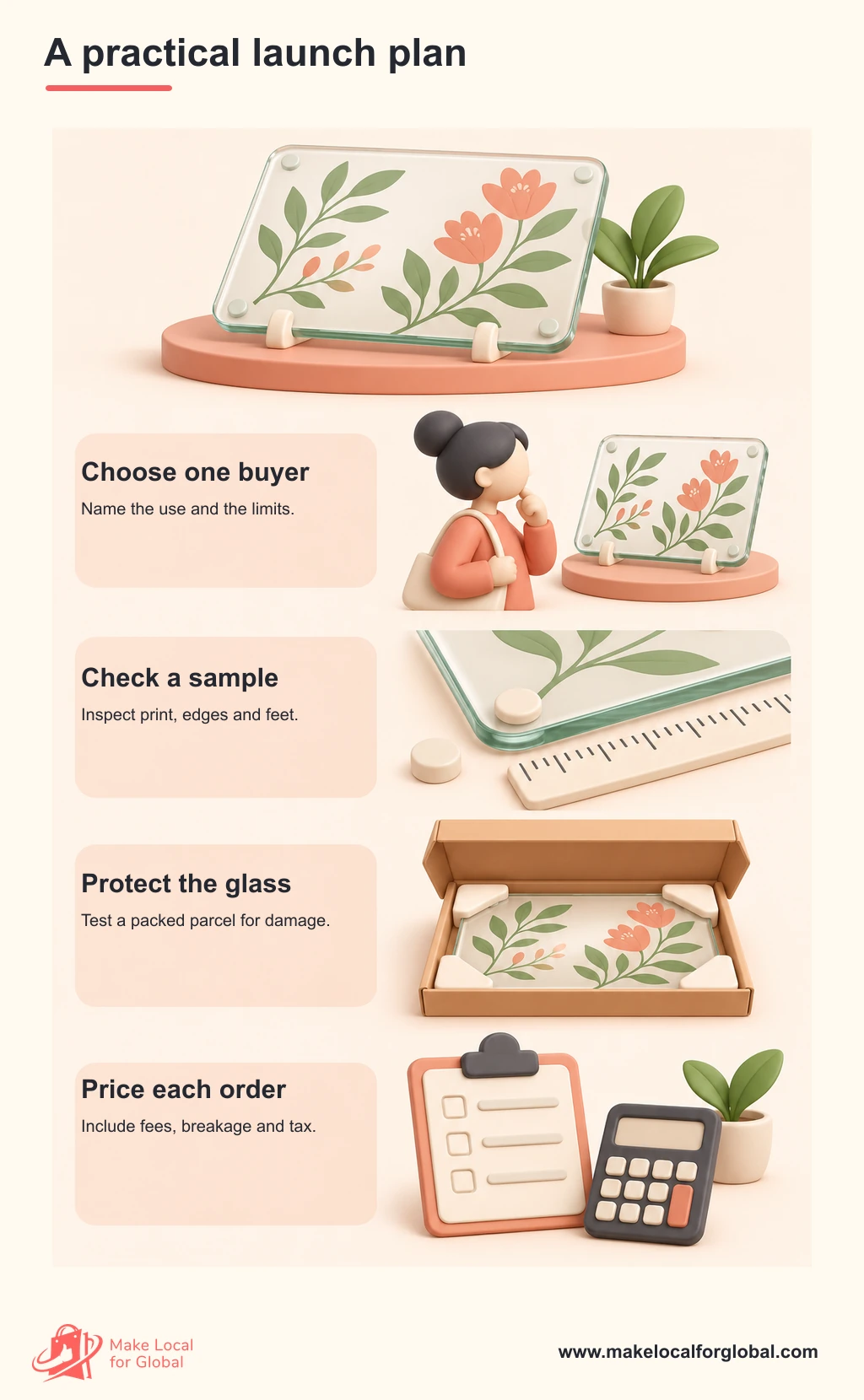
Keep the vertical checklist beside your first test. Use it to check the buyer, sample, parcel and order costs before each new design or supplier change.
Selling the word “cutting” without clarifying the use. A customer may expect a board for repeated knife work. Show the surface and care caveat where it can be seen before checkout.
Approving artwork from a screen alone. Glass tint, coating and printing can change how pale areas look. Compare the sample to the proof in natural and indoor light.
Assuming all boards share a food-contact approval. Ask for documents matching the precise board, print, coating and target market.
Testing the board but not the parcel. A perfect sample can arrive damaged if it moves inside a carton. Send one fully packed unit through the proposed route.
Pricing from a supplier’s unit price. Add the box, postage, fees, VAT where relevant, paid traffic and actual replacement cost. Contribution still needs to pay overheads and tax.
Launching many designs at once. A small set gives you clearer feedback and fewer stock and photo tasks. Add a size or personalisation step only when buyer evidence supports it.
Copying competitor claims. A marketplace listing is not compliance evidence. Use supplier documentation and regulator guidance for your product and market.
They can be a focused gift, printed kitchen accessory or worktop saver if the design and buyer fit. The category needs careful product expectations: a hard glass board may not suit repeated heavy knife chopping. Test demand, sample quality, packaging and order contribution before you commit to stock.
Glass is a hard surface with little give, so it can be harder on knife edges than many wood or plastic boards. A buyer looking for frequent chopping may prefer another material. State the intended use based on the exact product and do not make an unqualified knife-care promise.
Start with a size that suits one defined use and that your supplier can document. A small board may work for light tasks or serving; a larger board may suit a worktop cover or food layout. Show the measured dimensions beside a familiar kitchen object and check the packed size before setting a delivery price.
Some suppliers list print-on-demand glass cutting boards. Check the current model, print area, sample process, fulfilment cost, production time and packaging. Test the delivered sample yourself before selling the item, since a supplier catalogue does not prove how your design will look or how your parcel will arrive.
Artwork with clear shapes, strong contrast and enough detail to remain legible beneath the glass is easier to assess in a sample. Avoid relying on tiny text near the edge or feet. Check how pale colours and white areas appear through the glass tint and backing, then approve the physical proof.
Ask for a product specification, care instructions, food-contact information for the finished board and print, safety documentation for your target market, traceability details and packaging information. Ask the supplier to confirm that each document applies to the exact model and intended use. Keep the replies with the item record.
Use a rigid carton, edge and corner protection, cushioning, and a snug fit that prevents the board touching the outer walls. Pack and measure the finished parcel, then send a test through the carrier route you plan to use. Check the service’s current size, weight, claims and packaging rules.
Do not publish a blanket rule without checking the current consumer-contract guidance for the type of personalisation and the circumstances. Online customers normally have a cancellation right for goods, with specified exceptions such as some made-to-order or personalised goods. Faulty, damaged or misdescribed products raise separate consumer rights. Write clear terms and seek current advice if unsure.
Two or three related designs are enough for a first test. Keep the product format and buyer consistent so you can learn which image, offer or design earns qualified interest. Add a new size or audience only after the first test produces a clear reason.
Pick one customer, choose a documented board and order a sample. Check the print, edges, feet, care instructions and parcel before you write the listing. Price the full order and explain the product’s intended use in plain terms. Then run a small test and use real questions, orders, returns and damage reports to decide what should change.
If you need help planning the store page, product imagery or first selling route, contact Make Local for Global. The glass jars guide and glassware guide cover related glass products, with their own product-specific sourcing and delivery checks.
PREFERRED SOURCE
Like what you’re reading? Add Make Local for Global as a preferred source on Google to see more of our articles when you search.

Build your online presence without having to figure out everything yourself.