

READY TO SELL Decorative Trays ONLINE?
Get a store built for you in 5 days, plus training and support to help you start, run, and grow your Alternative business.

Choose a tray buyer and use, compare materials, test samples, price each order, and prepare accurate product pages and protective shipping.


A decorative tray can serve tea, hold keys, organise skincare or give a coffee table a defined centre. Those uses look similar in a product photograph, yet they call for different materials, dimensions, finishes, care instructions and safety checks. A buyer needs to know whether the item is meant for food, whether it has handles, how much it can carry and how it will look in the space where it is used.
To sell decorative trays online, start with one customer and one clear use. Choose a small range with material and size differences you can explain, order samples, test their finish and stability, calculate the complete cost of a delivered order, then photograph and describe the actual tray accurately. Expand after questions, orders and returns give you evidence about what shoppers value.
This is a practical starting point for a new seller. It does not predict demand or profit. The sample costs below are illustrative; request current supplier quotes and replace every assumption with your own records.
Test a tray idea before ordering stock
Define one buyer, one use and the evidence you need before paying for a larger batch.
“Decorative tray” covers many products. A narrow buyer description helps you choose a tray that solves a recognisable problem rather than purchasing assorted shapes and hoping a customer will find a use for them. Write a one-line offer before contacting suppliers: “I sell [type of tray] to [buyer] for [specific use], with [one useful feature].”
For example: “I sell a shallow oak-effect valet tray to renters who want a defined place for keys and a wallet beside the front door.” That statement tells you which dimensions, finish, edge and lifestyle photograph to test. It does not require the business to remain in one niche forever. It gives the first product a job you can check with real people.
An entryway tray needs enough surface area for the items the intended buyer carries in and out, plus a base that sits steadily on a narrow console. A bedside tray may need a compact footprint, rounded corners and a raised rim that keeps small items from sliding onto the floor. A coffee-table tray can need a larger surface, rigid base and handles that make it easier to lift away before using the table.
A serving tray has a different brief. The seller should state whether it is intended to hold food directly or only to carry covered dishes and drinks. A product described as food-safe, food-contact suitable or suitable for serving unwrapped food needs evidence for that intended use, not just a supplier's short message saying “food grade”. A decorative tray for candles, books or a vase should not be advertised for food contact without suitable evidence.
Other buyer tasks may include grouping toiletries on a bathroom counter, arranging perfume on a dressing table, presenting a gift hamper, keeping remotes together, or collecting plant-care tools. Each use suggests a different test: moisture resistance for bathroom use, stain behaviour for cosmetics, a stable bottom for heavy objects, or room for a planned gift set. Ask people who fit the buyer description what they currently place on the surface and what frustrates them about it.
Use questions that invite an example rather than a polite yes:
Record the words people use for the material, room, style and purpose. Search those phrases on the marketplace or search engine you plan to use. Look at the listings and reviews that actually appear, then note repeated questions about size, care, colour and packaging. Treat search results as ideas to test rather than proof that a product will sell.
Begin with one core tray and at most a few meaningful options. Three finishes of one well-tested size can be easier to explain and stock than a catalogue of unrelated round, rectangular, lidded, nesting and handled trays. Add a second size only when a buyer use calls for it and you can photograph, pack and price it properly.
| Tray format | Possible buyer job | Checks before you order | First-range trade-off |
|---|---|---|---|
| Valet or catch-all tray | Keys, wallet, glasses or small accessories | Usable interior dimensions, rim height, base stability and surface resistance | Compact item can have limited order value only when the finish or personalisation adds a real benefit |
| Coffee-table tray | Grouping books, remote controls, cups or decor | Outer and inner dimensions, lift points, base stiffness and space for intended objects | Large dimensions can raise postage and storage costs |
| Handled serving tray | Carrying dishes or drinks | Handle strength, grip, load test, balance and material evidence for stated food use | Handles add joints and failure points that need inspection |
| Nesting trays | Flexible display or storage across rooms | Fit between nested pieces, stack stability, rub marks and per-piece costs | Bundle requires clear piece count, dimensions and protected packing |
| Bathroom or vanity tray | Holding toiletries or cosmetics | Moisture response, coating, edge finish, cleaning method and product compatibility | Coatings and adhesives may need extra care instructions |
| Decorative display tray | Candles, ornaments, plants or gift arrangement | Base flatness, rim shape, colour consistency and intended load | Photos must show scale and state what is included |

Compare materials by the job and the care a buyer is willing to give the item. Wood and bamboo can have visible grain and a warm appearance, but grain varies and unsealed surfaces can respond to moisture. Metal can feel rigid and suit a modern finish, yet coating chips, sharp edges, rust and heat transfer deserve a check. Acrylic is light and easy to style in a photograph, but scratches, static and cloudy edges can affect how it looks after handling. Ceramic and stone-look pieces can feel substantial but may be heavy, breakable and expensive to post. Resin can allow colour and texture variations, but each batch needs inspection for bubbles, uneven surfaces and cure quality.
These are sample prompts, not promises about every item sold under a material name. Ask a supplier for the exact construction, coating, care limits and variations in the product you are buying. A “wood” tray may combine a veneer, engineered board, wood frame, or several materials. A “marble” appearance may be printed or resin-based. Say what the supplied product is made from rather than borrowing a more expensive material label.
For ideas on building a coherent home-accessories range, compare this plan with our guides to selling decorative mirrors online and selling decorative wall art online. They can help you think through how size, finish and room style shape a customer's choice across related products.
A simple offer ladder can help a customer choose without creating unnecessary stock. An entry tray might be a single catch-all item in one finish. The core offer could add a larger size or a second finish that solves a different room need. A gift set might pair two tested sizes or include a useful packaging option, if the tray sizes fit together and the price covers the extra handling.
Do not bundle items only to raise the order total. Each component should have a clear purpose. A bathroom pair could use a small ring tray and a larger tray for bottles, with enough space between them to avoid confusing the two. A gift set could include a tray and a care card, but only if the card gives correct information about the actual finish. A tray packaged with unrelated decor can raise damage and return risk.
Write a stock sheet that records the SKU, material, finish, outside dimensions, inside usable area, weight, handles, supplier, batch, purchase cost, packaging fit and the buyer use. Use a separate SKU for any version with a different material or size. This makes it easier to trace a finish complaint to the correct batch and to update a listing when a supplier changes a component.
Possible routes include making the tray yourself, commissioning a small maker, buying wholesale, or importing a ready-made range. Each route changes the work you do before a product is ready to list. A maker-made tray may give you control over a finish or size but need more production time. Wholesale can make repeat ordering easier but may require a case quantity and leave limited room for design changes. Importing may widen the selection, but adds lead-time, shipping, customs, supplier verification and batch-quality questions.
Do not treat a marketplace photograph or a supplier's headline price as a complete sourcing decision. Ask for one sample from the same construction and finish you expect to order. For each possible supplier, record:
Get the answers in writing. If the supplier cannot identify a coating, cannot explain an unexpected material substitution, or offers a food-contact assurance without usable documents, pause that version. A low unit price can disappear after freight, damage, inspection time and a low sell-through rate are included.
Open the package and record its condition before styling the tray. Note whether the item moves in the carton, whether an edge is exposed, whether accessories are missing and whether the product has an odour or residue that the listing did not disclose. Photograph the unboxing if a later supplier discussion may depend on the condition on arrival.
Measure the sample yourself. Record total width, length and height, then measure the usable surface inside any rim. Include handle projection when calculating shelf or parcel size. Weigh the tray without packaging and then weigh the protected parcel. A product that appears small in a catalogue can require a larger shipping carton once it is padded.
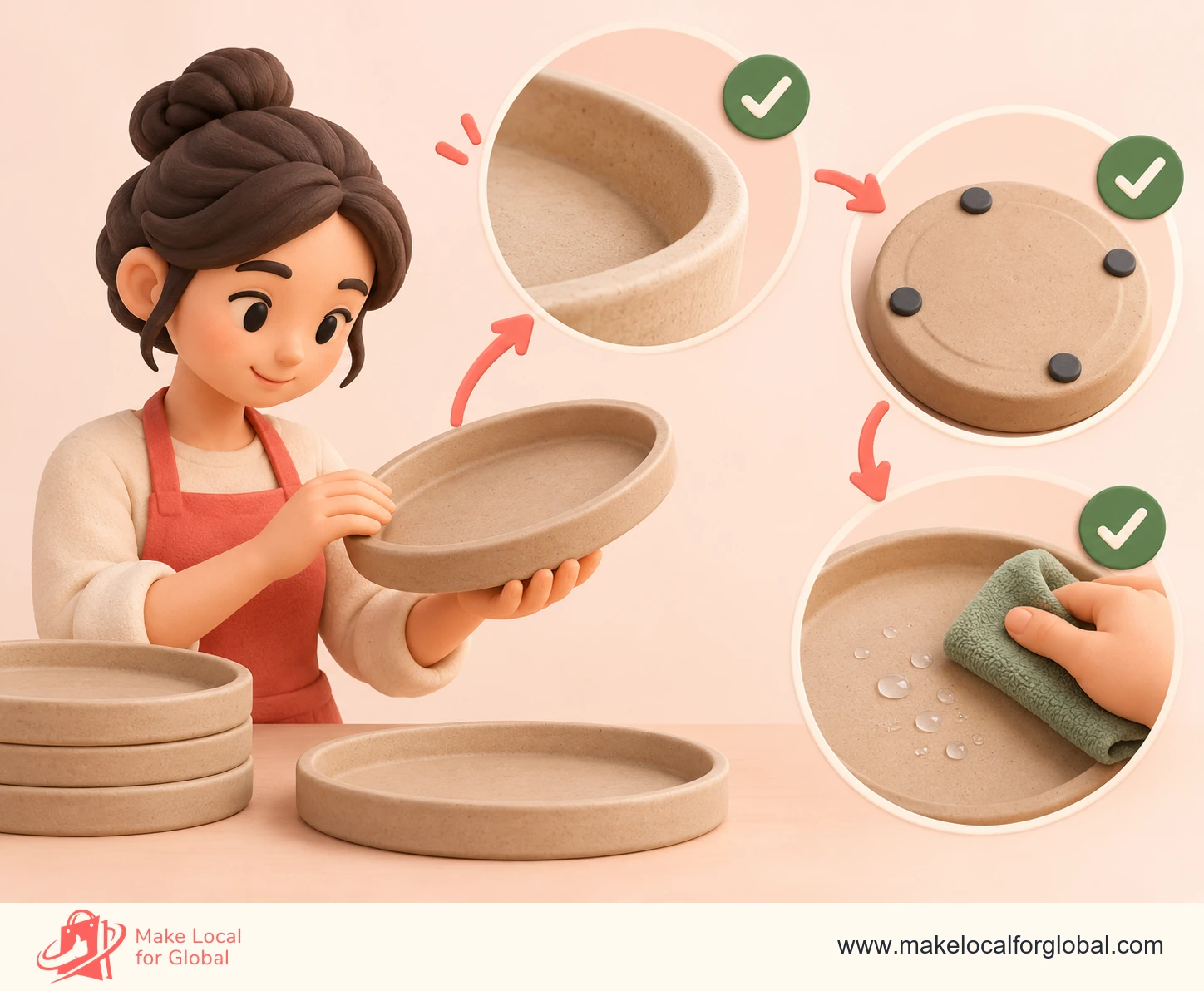
Look along every edge and corner. Run a clean cloth over the surface to spot loose fibres, sharp areas, burrs, rough joints or colour transfer. Set the tray on a flat surface and press gently at several points. It should not rock, bow or lift at a corner. Check for glue marks, chipped coatings, cracked corners, open joints, bubbles, pits, rough glazing or a finish that changes noticeably under ordinary room light.
Test the handles and fixings on a handled design. Pull and lift the empty tray, then repeat with a measured load that matches the intended use. Add weight gradually over a protected surface; do not hold a heavy load above feet or a hard floor. Observe whether handles flex, screws turn, joints creak, the tray tilts or the base bows. Record the load and test conditions. Do not convert a single informal trial into a broad “holds 20 kg” claim.
Test the finish in a way that matches the proposed instructions. If the maker says wipe clean, use a damp soft cloth on a spare sample or a small hidden area and dry it as instructed. Look for colour transfer, water marks, swelling, tackiness, coating haze or a change to the grain. Use a tray with food, hot pans, solvents or cleaning products only when the supplier's written care instructions and product evidence support that use.
For a set, check every piece. Nested trays should lift apart without jamming or scraping their visible surfaces. A stacked set should not slide or tip when placed on the surface a customer is likely to use. Record each item count, size and finish so that the listing and package insert match what ships.
Separate “decorative” from “for serving food” before you write the listing. If a tray is only for displaying objects or carrying covered plates, state that use and any relevant limits. If food is meant to touch its surface, obtain documentation for the exact material, coating, adhesive and intended conditions of use. Ask what foods, temperature, duration, cleaning and reuse the evidence covers. Keep the supplier's declarations, product specification, invoices and batch records together.
The Food Standards Agency's food contact materials regulations guidance explains that controls cover materials and articles expected to contact food or transfer constituents to it, including packaging and utensils. It lists national measures for England, Wales and Northern Ireland. Scotland has separate regulations. Check the current rules for the part of the UK where you place the product on the market and where the customer uses it. The FSA's 2026 guide to BPA in food contact materials explains that requirements can differ between Great Britain and Northern Ireland for specific material rules. It is not a general approval for a tray.
A supplier statement alone does not tell you whether a given tray is suitable for hot food, acidic food, repeated washing or a dishwasher. Ask for documentation that matches the exact item and intended contact conditions. If the product is not meant for food contact, do not imply suitability through a photograph of uncovered food or a label such as “food-safe”.
If serving food is part of your offer, our guides to selling dessert plates online and selling ceramic bowls online provide useful adjacent examples to review for material claims, care information and customer expectations.
Keep traceability information for the supplier, purchase date, item and batch. GOV.UK's food traceability guidance says traceability duties cover food-contact materials and food. It describes identifying suppliers and customers through a “one step back, one step forward” approach. Ask a qualified adviser or the relevant local authority if you are unsure what records apply to your business.
For products sold into Great Britain, review the current consumer product safety duties that fit the product, intended use and role of your business. Importers, own-brand sellers and makers may carry responsibilities that differ from a retailer reselling an established product. Keep the product specification, supplier details, checks, complaints, incident records and corrective actions. Print a safety mark or state that a formal test was passed only after an appropriate assessment and when your records support the statement.
Start from one order, not the supplier's unit price. Add product cost, inbound freight and duties where applicable, quality checks, packaging, postage, marketplace and payment fees, advertising, a return or damage allowance and any direct labour that scales with each order. Keep fixed costs such as photography, samples, equipment, subscriptions and design work in a separate monthly plan. A per-order contribution is not net profit.
Worked example: an illustrative UK marketplace order for one small decorative tray. It assumes a seller who is not VAT registered, a domestic order, an item price of £48.00, a customer-paid postage charge of £5.50 and a seller bank account in the UK. It uses Etsy's current published 6.5% transaction fee and UK payment-processing rate of 4% plus £0.20. The separate listing fee is modelled at £0.18 only as an exchange-rate placeholder for Etsy's USD $0.20 fee. VAT on platform fees, Offsite Ads, regulatory operating fees, taxes and unusual refunds are not included; use the current account statement and fee schedule before setting a live price.
| Order item | Illustrative amount | What it represents |
|---|---|---|
| Item price paid by customer | £48.00 | Tray, before postage |
| Postage paid by customer | £5.50 | The amount shown at checkout |
| Total order receipt before fees | £53.50 | Item plus postage |
| Tray purchase cost | −£16.00 | Supplier's unit price |
| Allocated inbound freight | −£3.50 | Share of freight and import cost per tray |
| Protective packaging | −£2.60 | Carton, edge protection, wrap and label |
| Actual postage label | −£4.90 | Seller's delivery charge for this parcel |
| Etsy transaction fee at 6.5% | −£3.48 | 6.5% of £53.50, rounded |
| Etsy payment processing at 4% + £0.20 | −£2.34 | 4% of £53.50 plus £0.20, rounded |
| Listing fee placeholder | −£0.18 | Approximate sterling equivalent; replace with actual |
| Damage and return allowance | −£1.60 | Planning reserve per order |
| Customer acquisition cost | −£3.00 | Illustrative blended cost for this order |
| Order contribution before fixed costs and tax | £15.90 | Not net profit |
The arithmetic is £53.50 received less £37.60 of the listed costs, leaving £15.90 before fixed costs and tax. The order has postage revenue and a postage expense, so do not subtract the label twice. The return allowance is a planning estimate; track actual damage, refunds and return postage separately. If the seller is VAT registered, the VAT treatment can change the net sales amount and input-tax recovery. Check the current HMRC rules and account for VAT with suitable bookkeeping advice.
Etsy's fee page for UK sellers sets out its listing, transaction and other fees. Its payment processing table lists UK processing at 4% plus £0.20 and notes that the fee is subject to VAT. Etsy can change its fees; use your actual invoice, currency conversion and advertising settings. Do not treat a single illustrative order as a forecast.
Create a low, expected and high case for the costs that could change. Test one lower selling price, the target price and one higher price with the same tray, photos and buyer. Compare actual visits, questions, basket activity, paid orders and contribution. A price that looks attractive but fails to cover postage, damage and customer acquisition is not a workable price.

Cost the delivered tray order
Compare stock, freight, packaging, channel fees and postage before you set a price.
Make the first line clear about what is for sale. A useful title might be “Rectangular oak-effect entryway tray, 30 × 18 cm, raised edge”. Use the actual material name, purpose and size; do not call a printed wood-look finish solid oak. Etsy's 2026 guidance on listing titles recommends stating the item and its key objective traits, keeping wording clear, and avoiding repeated keyword strings. Google similarly recommends descriptive, concise title links and warns against keyword stuffing in its title link documentation.
Write the description for a person choosing the tray, not a search engine alone. Lead with the buyer use, then say exactly what arrives. Include the external size, usable inside area, height, weight, materials, colour, finish, handle information, item count and care. Identify any parts not included in a styled photograph. State whether food can touch the surface and whether a set includes one or several pieces.
“Give keys, a wallet and loose change a defined place by the front door with this rectangular catch-all tray. The tray measures 30 × 18 × 3 cm overall, with a usable surface of 27 × 15 cm. It is made from [verified material and finish], has a raised edge and weighs [measured weight]. One tray is included; styling props are not. Wipe with a soft, slightly damp cloth and dry straight away. It is intended for dry everyday items and is not sold as a food-contact surface.”
Replace every bracket with a measured and verified detail. Do not publish a fake measurement, unverified food statement or generic care instruction. If a photo shows a phone, candle, cup or notebook for scale, make the inclusion status clear. If two finishes vary, show both samples under comparable light and describe the variation honestly.
Use specification labels that matter to a tray buyer:
Add common search language naturally in the title, first paragraph, image alt text and headings where it fits. Examples to investigate might include “entryway catch-all tray”, “coffee table tray with handles”, “bathroom counter tray”, “wood-look vanity tray” and “nesting decor trays”. Do not put all phrases into one sentence. Etsy's tag help describes using accurate, relevant tags rather than unrelated terms. Google's image SEO recommendations advise descriptive image context and standard HTML image elements; write alt text to explain the pictured item, not to repeat the target phrase.
A tray can look much larger, glossier or more uniform in a carefully styled image than it feels in person. Keep the item visible and use props only to explain scale or use. Photograph the actual stock, not a rendering that changes the colour or replaces its surface. Etsy's product photography checklist recommends planning studio, detail, scale, lifestyle and group shots, using simple backdrops and lighting that represents the product accurately.
Plan a sequence that answers buyer questions:
Use the same camera position, exposure and background for comparable finishes. Place a colour reference card beside a sample if colour accuracy matters during editing, then remove it from the final customer-facing shot. Avoid filters that make oak appear orange, brass appear gold or black appear charcoal when the product differs in daylight. If a finish naturally varies, use several samples and show a realistic range rather than selecting only the most uniform one.
For your own website, name image files descriptively before upload and write helpful alt text. A filename such as oak-effect-entryway-tray-raised-edge.webp is more informative than IMG_2034.webp. Alt text such as “Rectangular oak-effect tray with raised sides on a narrow hallway console” tells a screen-reader user what the image shows. Leave decorative accents with empty alt text if they add no information, and do not put a paragraph of keywords into the alt attribute.
Tray packaging needs to stop movement, protect corners and handles, keep the surface from rubbing against another item and fit a parcel service's size limits. A well-wrapped item inside an oversized box can still slide into a corner. A tightly packed item may transmit a drop directly to a brittle rim or handle joint.
For each SKU, record the tray's packed dimensions and total parcel weight. Measure the actual completed carton, not just a supplier's product dimensions. Compare the package with carrier size rules, quoted postage and any dimensional pricing used by the service. Price the parcel from that real data before publishing delivery rates.
Royal Mail's guidance for sending fragile items recommends a box with adequate strength and enough protective material to prevent the item moving. Apply the principle to your tray: protect corners, separate pieces in a nested set, stop handles pressing against the carton and fill voids without allowing the surface to rub. Select materials that protect the finish and suit the item weight. If a tray is not fragile but has a delicate coating, test for abrasion and pressure marks in the same way.
Pack and send a test parcel to yourself or a willing tester using the proposed service. Check the box before dispatch, record its weight and dimensions, then inspect the tray and packaging when it arrives. A single test cannot prove every parcel will arrive intact, but it can expose loose packing, shifting contents, scuffed finishes and a box that is too large. Retest after changing carton, protective insert, carrier or product design.
Build a dispatch checklist around the actual order:
Decide how you will handle stock with a minor cosmetic mark. If it is not suitable for the normal listing, separate it from saleable units rather than letting an assistant choose a tray with a hidden blemish. A lower-grade offer needs a clear description and customer consent, not a surprise in the parcel.
The listing should explain the returns route, but a policy cannot remove statutory rights. GOV.UK's returns and refunds guidance says online customers can normally notify a seller of cancellation within 14 days after receiving goods, followed by 14 days to return them. It outlines refund timing and standard delivery reimbursement. Exceptions and faulty-item rights can apply, so read the current guidance and use terms that fit your sales route.
Write short, practical care instructions that match the material and coating. “Wipe clean” does not tell a customer whether to use water, soap, a dishwasher, oil, a scourer or a dry cloth. Say what the supplier permits and what a sample test supports. If the material is sensitive to standing water or heat, state the limitation in a visible product detail rather than burying it in a care card.
Prepare answers for repeated questions: Is it food-contact suitable? How much usable surface is inside the rim? Does the set include two trays? Can a customer choose a stain or engraving? How is the handle attached? What is the delivery timeframe? What happens if an edge arrives chipped? Keep answers consistent across the product page, messages and packing card.
When a customer reports damage, ask for the order reference and relevant photos of the outer carton, inner protection and tray. Respond with the next step and a realistic timeframe. Record whether the cause was a weak product joint, insufficient padding, carrier damage or a mismatch between the description and item. Refund, replace or repair in line with the customer's rights and your platform process. Use the record to improve the product or package rather than treating each complaint as isolated.
Use a channel that matches your product and working capacity. A marketplace can put a listing in front of shoppers who are already searching, but it has rules, fees, competition and a customer relationship shaped in part by the platform. A standalone shop gives you more control over the page and customer experience, but you must bring qualified visitors to it. Local craft events or interior shops can provide in-person feedback and wholesale conversations, but add event, staffing, storage or trade-pricing work.
Choose one main channel first. Prepare one core tray listing, one or two variants and a small amount of stock. Write down the specific test question: “Will renters looking for an entryway organiser choose the 30 cm tray at £48 with these photos?” Then decide what evidence would make you keep, revise or pause the product.
For a marketplace listing, use the current fee table when setting the price and check the platform's rules on handmade, production partners, product photographs and dispatch. For a standalone store, test the checkout, delivery charge, tax settings, mobile product page, confirmation email and returns contact before directing traffic. For wholesale, calculate the retailer's margin and your minimum order quantity without assuming a consumer price covers the business-to-business order.
Build a small launch test rather than buying a large mixed range. Offer a clear use, one measured size and a tested finish. Invite people who fit the buyer description to review the product page and explain what they would receive. Run a modest, time-limited traffic test if you have a channel and budget for it. Record product page visits, questions, saves, add-to-cart events, orders, cancellations, returns, damage reports and contribution. Compare with your written target; do not judge the result by likes alone.
Use content that answers a buying doubt. A short video can show the tray's real dimensions on a console. A photo series can compare the inside surface of two sizes. A care post can explain which cleaning method the maker supports. A package video can show how a nested set is separated and protected. Each piece should lead to a page with the exact item and terms shown.
For organic search, create one useful page per distinct product range and keep the page title, visible heading and main text aligned. Do not make near-identical pages for every colour with only the colour word changed. Write supporting content around real buyer questions, such as choosing a hallway catch-all tray, measuring for a coffee-table tray, or packing ceramic decor for delivery. Link to the relevant product page and state what the page actually offers.
Review the tray launch before adding more stock
Check the buyer, offer, cost, listing and fulfilment as one launch decision.
Write the buyer statement and list three alternative ways that person currently stores or carries the same items. Speak with five to ten people who fit the description. Ask about their current surface, dimensions, material preferences and purchase objections. Note exact wording and do not treat a friendly response as a paid order.
Review competing listings on the channel you plan to use. Record the product type, size, material claims, photo sequence, stated care, delivery charge and questions visible in reviews. Do not copy a listing; use the observations to decide what your own page must explain. By day seven, choose one tray use, one sample specification and one price range to test.
Request one sample and get the full specification in writing. Measure and weigh it. Check surface, edges, base, finish, handles, joints and packaging. If the intended use includes food, obtain relevant documentation before using that claim. Record the tests, sample cost and unresolved questions.
Show the sample to a few people who fit the buyer. Ask them to place the items they would store or carry on the tray. Observe what fits without coaching. Note whether they understand the dimensions and material from the page or sample card. Revise the specification before ordering stock if the main use does not work.
Get a current quote at the quantity you could fund without risking cash needed to cover business operating costs. Calculate a full delivered order at three prices. Use the real channel fees and postage quote. Decide a maximum first order, minimum contribution and acceptable damage rate before you commit.
Pack and send a test parcel. Inspect it on arrival, then take product, detail, scale and lifestyle photographs. Write the title, product description, dimensions, material, care, food-contact statement, dispatch time and returns information. Check that every photographed prop is identified as included or excluded.
Publish the tested item on one main channel. Place a test order if the platform permits it. Ask someone unfamiliar with the product to explain what they expect to receive after reading the listing. Correct any ambiguity before paid traffic.
Track visits, questions, orders, cancellations, damage, returns and contribution for the first month. If visitors misunderstand the dimensions, improve the scale image and copy. If the parcel arrives damaged, pause dispatch for that method and fix the packing. If the product attracts attention but no orders, revisit price, buyer use and product-page clarity before buying extra variants. Keep or expand only when the evidence supports that decision.
A decorative tray is a shallow surface with raised sides, handles or a defined edge used to group, display or carry items. Some trays are purely decorative; others are intended for serving, storage or organisation. The listing should say which job the specific product is designed for.
Only make that claim when the product and its finish are supported for the stated use. If uncovered food will touch the surface, obtain documentation for the actual material, coating and contact conditions. A tray for covered dishes or decor does not automatically meet the same description as a direct food-contact product.
Choose by the buyer use, cost and care requirements rather than by appearance alone. Inspect a sample of the exact construction. Compare weight, edges, finish, water response, surface marks, shipping needs and supplier consistency before ordering.
Start with one size that fits the chosen job. Add a second only when customers need another usable surface or the first size fails a clear test. Each additional size needs separate stock, photographs, postage measurements and cost checks.
Calculate the full cost of one completed order: product, inbound freight, packaging, postage, platform and processing fees, customer acquisition, returns or damage allowance, and direct labour. Keep fixed costs separate. The amount remaining after per-order costs is contribution, not net profit.
Show the actual tray, its inside area, raised edge, material details, handles or joints, real-world scale and intended use. Keep colour representative. State which props, accessories or extra trays are not included.
Use a carton with strength suited to the parcel, protect vulnerable edges and handles, separate pieces and stop the tray moving. Send a test parcel through the planned service and inspect it before using that pack for customer orders. Keep evidence of damage and update your process when a pattern appears.
Offer personalisation only if the maker or your process can produce it consistently and the extra time, proofing, materials and error risk are priced. Show the available choices and limits. Confirm the requested spelling or design with the customer before production where appropriate.
UK online buyers usually have a cancellation period for distance sales, with rules for notifying the seller and returning goods. Faulty-item rights and exceptions can apply. Check current GOV.UK guidance and your marketplace terms before writing the returns policy.
Choose a channel that fits how you can reach buyers and manage orders. Etsy has marketplace discovery and its own fees and rules. A standalone shop gives you more control of the customer experience but requires a plan to attract visitors. Test one route before creating duplicate work across several channels.
Add a product when a real buyer request or order pattern points to a distinct use, size or finish and you can test its costs and delivery. Do not add a colour simply to make the catalogue look larger. Keep the first range easy to explain and replenish.
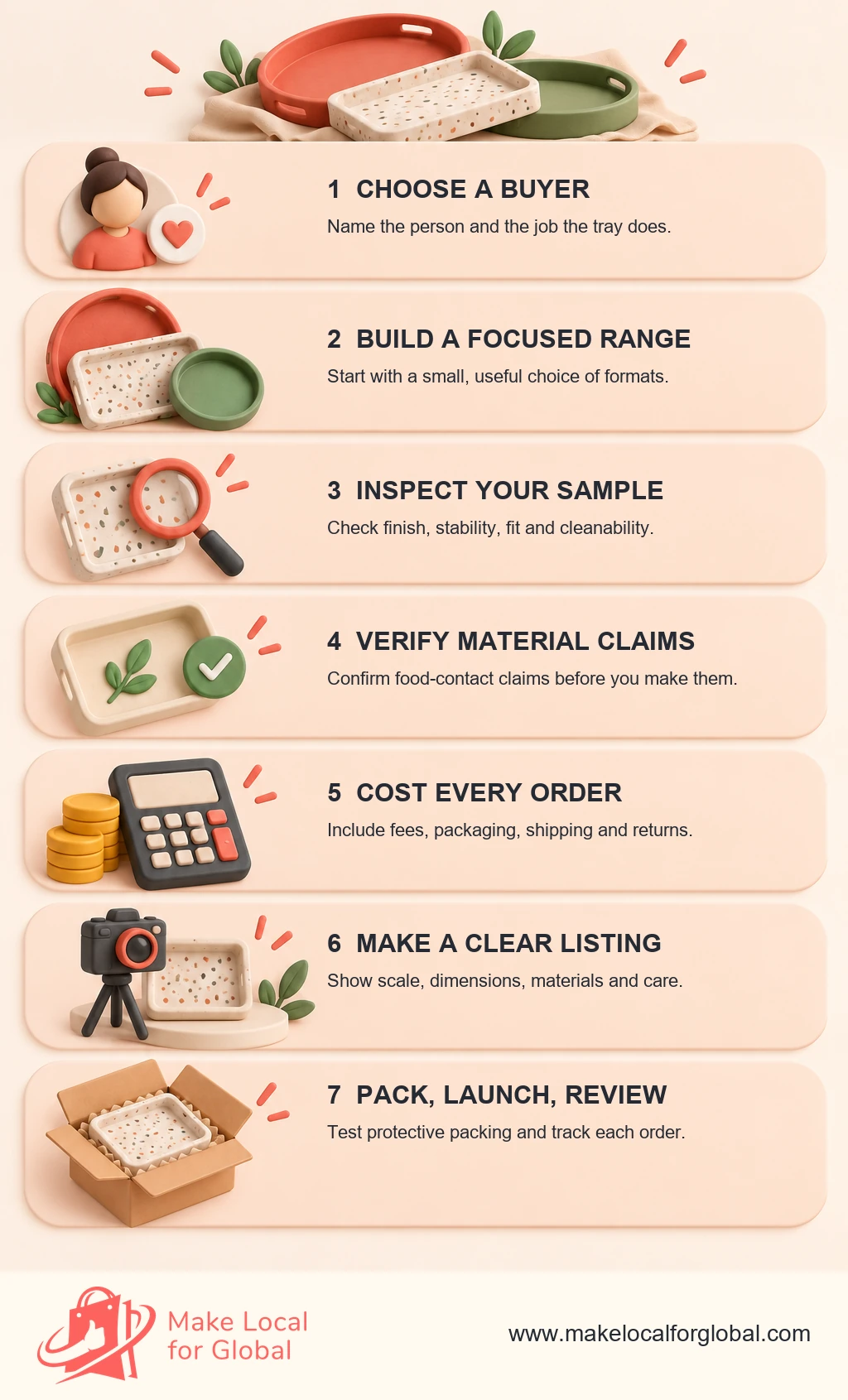
Choose one buyer and one tray job. Write a short specification, request a sample and test its size, finish, stability and packaging before placing a stock order. Use a full cost sheet and a clear product page to run a small sales test. Let customer questions, actual orders and delivery results decide whether the next range should add a size, a material or another use.
PREFERRED SOURCE
Like what you’re reading? Add Make Local for Global as a preferred source on Google to see more of our articles when you search.

Build your online presence without having to figure out everything yourself.