

READY TO SELL Fuzzy Socks ONLINE?
Get a store built for you in 5 days, plus training and support to help you start, run, and grow your Alternative business.

Plan a plush fuzzy-sock range with supplier checks, fibre and sizing guidance, sample tests, product-page advice and a worked order-cost model.


Fuzzy socks look simple on a product page: a soft pair, a colour and a size. A seller still has to decide what “fuzzy” means in a real product, which foot sizes the sock fits, how the pile holds up after washing and whether a buyer is ordering a lounge sock, a grip sock or a gift set. Those choices affect sourcing, labelling, photos, returns and the full cost of an order.
A good first range starts with one clear use. Pick a buyer who wants an extra-soft sock for home, choose two or three products that serve that buyer, test supplier samples and write down the exact fibre blend and care instructions. Then cost the packed order before setting a retail price. The article focuses on plush indoor and gift socks. Sports performance, medical compression and proven fall-prevention products need different evidence and should not be mixed into the same offer.
Use sample checks, clear sizing and complete order costs to choose a first offer you can explain with confidence.
“Fuzzy” describes how a sock looks or feels. It does not name a fibre or a single construction. A brushed polyester crew sock, a plush acrylic blend, a wool-rich bed sock and a fleece-lined slipper sock can all be sold with soft, cosy language, but they feel and behave differently. Ask the supplier for the fibre composition, knit construction and care label for the exact style and colour you plan to buy.
Start with a particular buyer routine. A person who works at a desk in a cool home may want a soft crew sock that fits inside slippers. Someone buying a present may prefer a coordinated two-pair box. A customer who wants a sock for wearing around the house may ask about grip on the sole. A buyer going out in boots may care about thickness inside footwear and how quickly the sock dries. These are different needs, so one vague “warm socks for everyone” listing can leave each buyer with unanswered questions.
Write a one-sentence buyer statement before speaking to suppliers. For example: “A person buying a small winter gift wants two soft pairs in colours that match a robe, with clear fibre and washing information.” Another could be: “A home worker wants one plush crew pair that fits inside their usual slippers without crowding the toe.” These statements are examples to test, not market findings.
Ask people who resemble the intended buyer to compare real or accurately described samples. Let them touch the fabric, see the cuff and read the labelled composition. Ask what they would use the pair for, what they would pay at the displayed price, whether they would buy one pair or a set, and what might stop the purchase. Record the exact questions. If several people ask whether the socks shed, feel tight at the cuff or fit inside footwear, treat those as product-page or sample-check tasks.
Do not count compliments as purchase evidence. A useful signal is a specific next action: a buyer chooses one style at a shown price, joins a waitlist for that exact offer or completes a paid order. Set a spending limit for samples, packaging and any advertising before starting the test. Your threshold should reflect your cash position and the supplier’s minimum order, not a generic conversion benchmark.
Indoor lounge pairs are the clearest starting point for a plush range. A thicker pile can feel soft, and it adds bulk. The buyer needs to know whether the sock fits in their normal slipper or shoe. Photograph the sock beside a familiar item and state the measured foot-size range from a sample or supplier specification.
Gift sets sell the presentation alongside the socks. Decide if the set contains two identical pairs, two colours in the same style or different lengths. Check that the packaging protects the pile and does not flatten it. Write exactly how many pairs arrive and whether a gift box, paper band or greeting card is included.
Some fuzzy socks have printed or silicone grip on the sole. Treat that as a feature requiring its own inspection and evidence. Check the placement, adhesion and care instructions on a sample, then make claims such as “non-slip”, “safe for stairs” or “prevents falls” only when suitable evidence supports the wording for the exact product. A fuzzy sock with decorative grip is still not a substitute for footwear where a person needs secure support. The anti-slip sock guide covers a different product proposition.
Do not describe a regular lounge sock as compression, circulation support, diabetic-friendly, therapeutic or fall-prevention wear based only on its appearance. These claims can lead buyers to rely on a performance the product has not shown. Keep the fuzzy-sock page centred on observable features such as pile, length, cuff, colour, composition and care.
A first range should be easy to compare. The table below describes product options a seller may encounter; names and construction vary by supplier. Verify each sample instead of assuming every product described with the same retail term is made in the same way.
| Product option | What the buyer sees | Seller checks | Common trade-off |
|---|---|---|---|
| Plush crew sock | A mid-calf shape with a soft raised surface | Cuff stretch, toe space, thickness inside a slipper and pile after washing | Easy to style, but a very thick pair can crowd footwear |
| Ankle lounge sock | A shorter cuff and compact shape | Heel position, cuff hold and whether the foot slips inside the sock | Uses less material, but may not suit buyers who want more coverage |
| Bed sock | A loose-looking, soft sock sold for rest or indoor wear | Length, cuff pressure, heat feel and clear care directions | A relaxed fit can suit lounging, but loose heels may move underfoot |
| Fleece-lined or double-layer sock | A smooth or knitted outer with a soft lining | Seam bulk, lining attachment, drying time and actual labelled fibres | Feels substantial, yet takes more room and may dry slowly |
| Gift pair or multipack | Two or more pairs grouped in a box or band | Pair count, colour matching, packaging size and set-level cost | Raises order value potential, but adds packing and stock complexity |
| Grip-detail lounge sock | A plush sock with dots or another sole treatment | Pattern coverage, adhesion after care, feel underfoot and substantiated claims | Adds a visible detail, but creates a separate quality and claims check |
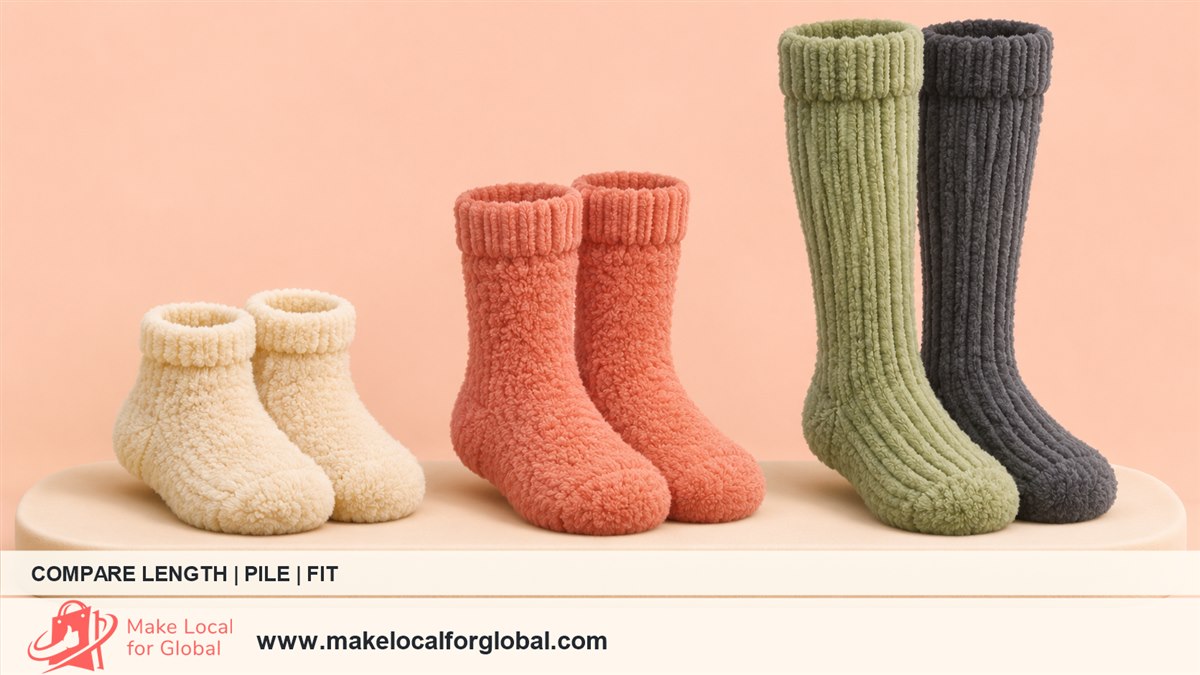
Do not open with every option. One core crew sock, one shorter or lighter alternative and a small number of colours can give shoppers a genuine comparison without creating a large stock bill. A higher-priced gift set can wait until the single-pair sample and its packaging work. Give each product a distinct reason to exist. Two near-identical pairs in different shades can be a colour choice; they are not automatically two useful product tiers.
Use an entry, core and gift option only if each has a real distinction:
These are range-planning examples, not supplier specifications. Do not call a product “premium” because it costs more. Explain the material, construction, included packaging or other observable feature that supports the price difference.
Think about colour after you select the product. Neutral shades may coordinate with existing loungewear, but coral, patterned or novelty pairs can make a gift offer easier to notice. Check each colour under daylight and indoor light. A fabric dye can appear different in a phone photograph, and a supplier’s swatch may not match the finished batch. Order a sample in each colour that will appear in the first listing.
Sock sizing is often shown as a shoe-size range, letter size or a supplier’s own code. Ask what the range measures and which market’s shoe sizing system it uses. Do not convert a supplier’s size chart from another country without checking the foot-length or shoe-size basis.
Measure a sample laid flat from heel to toe without stretching, then try it on a foot within the intended size range. If possible, test the lower, middle and upper ends of that range. Check the heel pocket position, toe seam, cuff and how the fabric feels after several minutes of wear. A highly stretchy sock might cover several sizes, but it does not fit every foot equally well.
If the supplier uses “one size”, ask for the actual foot-size range and the sample measurement. Use that information in the listing. Add a simple note such as “Measured flat heel-to-toe length: [your measurement] cm” only after you have measured the product. Never copy a placeholder into a published description.
A fuzzy fabric can compress during packing and expand after removal. Photograph the product after it has rested outside the packaging. If you sell a gift pair, check whether the box or belly band changes the way the socks sit. Include the contents and size on the outer label so a buyer can identify the gift without opening sealed packaging.
You can buy from a UK wholesaler, an importer, a knitting business, a brand owner or an overseas manufacturer. Each route changes the information available to you, minimum order, lead time, unit price, shipping cost and responsibility in the supply chain. A supplier’s low price does not show whether its product composition and sample match the delivered batch.
Request the supplier’s legal business name, address, product code, manufacturing country, minimum order, lead time, pack quantity and defect process. Ask whether the quotation includes freight, import charges, retail packaging, size labels, artwork, quality inspection and delivery to your location. Confirm whether your supplier sells a finished branded pair or a blank item you intend to label or rebrand.
Ask for the fibre composition by percentage for the exact sock, not a generic material list for the product family. If the sock has a separate lining or cuff component with a different composition, ask how the supplier treats that component on the label. Check that the sales sample, label, specification sheet and product code refer to the same construction. Save the supplier’s answer and the label image with your sample notes.
The term “fuzzy” does not tell a buyer whether the sock uses polyester, acrylic, nylon, cotton, wool or a mixture. Those fibres are not interchangeable in care or feel. If the supplier says “cashmere touch”, “bamboo feel” or “wool look”, ask for the actual fibres and percentages. A soft hand-feel is not proof of cashmere, bamboo fibre or wool content.
For sellers in England, Scotland and Wales, GOV.UK’s textile labelling guidance says the label must show the fibre content and that products with two or more components with different fibre contents must show each component’s content. The same guidance says manufacturers and retailers share responsibility for compliant labels. Check that the label on your stock matches the exact goods you will sell. If you plan to sell in Northern Ireland or another market, verify that market’s current requirements rather than assuming the GB page covers every destination.
If you import, relabel, attach your own brand or change a fibre claim, ask a qualified adviser or Trading Standards how the rules apply to your role. Keep the supplier’s documents, a copy of the final label, purchase records, product code and batch details together. Use “100%” fibre wording only when the exact product and permitted label wording support the statement.
Request washing and drying instructions for the finished product. Ask whether the supplier has tested the recommended method for the exact style, fibre blend and colour. Do not turn a supplier’s brief message into an unqualified “machine washable” or “tumble-dryer safe” claim if the care label sets a limit.
Ask how production changes are handled. A different yarn, stitch density, pile height, dye lot or elastic can alter feel and fit. Ask the supplier to tell you before changing a component and to provide an updated sample or specification. Record what you approved, then compare incoming stock with that reference.
For a new business, a wholesaler or low-minimum supplier can reduce the cash tied up in a large production run. The unit cost may be higher, and you may have fewer options for label placement or colour. A factory order can offer more control over specification and packaging, but the minimum order and the cost of correcting a mistake may be much larger. Put both offers in the same comparison sheet so the total landed order, not just one unit price, drives the decision.
A product page cannot fix an uncomfortable toe seam or a cuff that loosens after washing. Get the sample in the same construction, composition and colour you expect to sell. Record the product code, date received, supplier, sample size and any differences from the written specification.
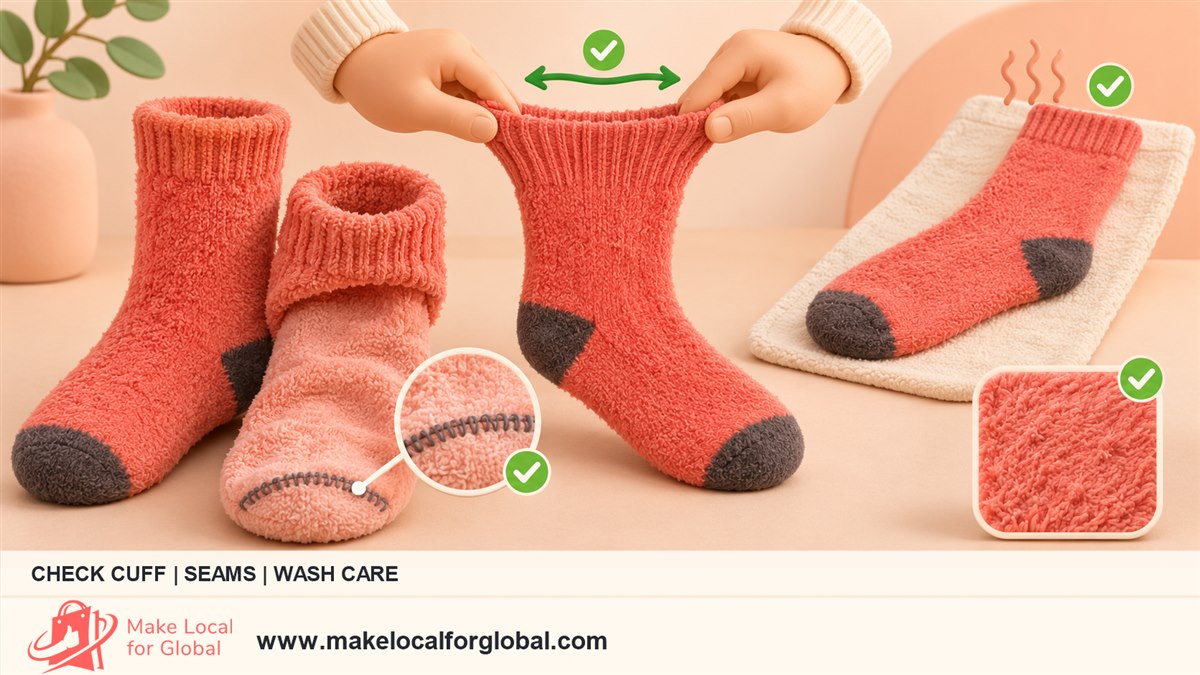
Check the cuff and leg for twisted stitches, holes, loose yarn and uneven tension. Turn one sock inside out and inspect the toe seam. Feel the seam from inside and outside, then try the pair on. Look at where the heel pocket sits, whether the toe seam crosses the toes naturally and whether the cuff folds or rolls. Compare the left and right sock. Small mismatches can become obvious when a buyer sees two pairs together.
Gently stretch the cuff and leg, then release them. Record whether they return to a similar shape without feeling harsh. Try the pair on a foot within the intended size range and walk on a clear, dry indoor surface. Note whether the heel stays in place and whether the pile makes an ordinary slipper feel tight. Claim that a sock stays up or fits a specific shoe only after checking the sample and stating the conditions.
Before washing, photograph the pair and record its flat dimensions. Follow the supplier’s care label exactly. Wash the sample in a load with similar colours, then dry it by the stated method. If the label gives more than one permitted option, test the method you expect a buyer to use most often and record which option you used.
Compare the pair before and after washing. Check length, width, cuff stretch, colour transfer, loose fibres, matting, pilling and whether the pile feels different. Inspect the toe seam and heel again. A single sample wash is a screening check, not proof of how every unit will perform after months of use. If the sock loses shape, sheds heavily or feels rough, ask the supplier to investigate and send another sample before accepting a bulk order.
For a grip-sole option, check whether the pattern remains attached after the care method. A home test cannot substantiate a safety claim or replace a relevant performance assessment. Record the surface and condition you used. If you intend to make a performance claim, obtain evidence that matches the product and the precise wording.
Use the same method for every candidate. A simple pass / investigate / reject record keeps comparisons useful:
Do not treat a single successful sample as proof that every production pair will match. Agree with the supplier how it checks incoming yarn, dimensions, stitching and labels. If the order is large enough to justify an independent inspection, include its cost in your decision before you pay a deposit.
A useful listing tells a buyer what they will receive and what wearing the pair feels like, without relying on vague superlatives. Start with the product type, size range and the feature that distinguishes it. For example: “Plush coral crew socks, UK sizes [verified range], polyester [verified percentage] and elastane [verified percentage].” Use actual values from the sample label and specifications. Replace the bracketed examples before publishing.
Add the measurements you have checked: length from heel to toe, cuff opening laid flat, sock height from heel to cuff and the foot-size range used in the sample check. State whether the measurements are approximate and describe how they were taken. If the supplier’s chart differs from your sample, resolve that mismatch before publishing the size advice.
Tell shoppers how many pairs arrive, which colours they receive, whether the set has one size or several and what packaging is included. If the images show a bow, box or gift card that is not included, say so clearly or photograph the actual contents. A product photo should not imply that the buyer receives a styling prop or accessory.
Use care information that matches the label. Say whether the socks should be washed inside out only if the supplier’s instructions support it. Explain any practical limit such as air-drying or washing with similar colours only when it appears in the approved care guidance. Avoid making a “won’t bobble”, “never sheds” or “stays soft forever” promise from a short sample check.
Create a useful sequence of images:
Use the same light and camera angle across colours. A warm filter can make cream fabric look yellow or a coral shade look red. Take one photo in natural light and compare it with the real pair before uploading the rest. If the product uses a separate lining, show that layer rather than letting the buyer infer it from the word “fleece-lined”.
The photo does not need a model to communicate every detail. If you use a person’s feet, show the sock on a foot with a clear size reference and avoid retouching the cuff, toe or pile. Keep the product texture faithful to the sample. Show silicone grip on the sole only when the exact style includes it.
A product title can combine the product type, length or feature, colour and size range, when those details help someone choose. For example: “Plush Fuzzy Crew Socks, Coral, UK Sizes [verified range]”. Use the exact composition in the details section. Do not repeat “fuzzy socks” in every sentence to chase a search phrase. Natural variants include plush lounge socks, fluffy crew socks and soft bed socks, when the product actually fits each phrase.
The category page, listing and article should each help with a different task. A product page identifies one style and answers its fit and care questions. The article helps a new seller choose a range, evaluate a supplier and work out a cost. Link them clearly if your store has both. If you need help writing distinct product titles, see how to write product titles customers understand quickly.
If buyers compare fuzzy lounge socks with other cosy products, a separate fuzzy slippers article can help you keep each listing focused. Combine socks and slippers on one product page only when you sell them together as a set.
Include the pair, packaging, fees, postage, fulfilment and a realistic allowance for returns in your working figures.
A supplier’s price per pair is only one line in an online order. Count inbound freight, duty or import costs where they apply, packaging, picking, postage, payment or marketplace fees, advertising and a realistic allowance for damaged or returned orders. Keep one-time launch costs such as photography, samples, labels and website setup separate from the per-order calculation.
The model below is illustrative. It assumes a Great Britain domestic sale by a business that is not VAT-registered, with a customer price of £24.95. It is not a market quote or a claim about likely sales. The seller must replace each figure with its own supplier quote, carrier price and platform fees. A VAT-registered seller, an overseas order or a different delivery offer needs a fresh calculation.
| Order line | Illustrative cost |
|---|---|
| Customer price for a two-pair gift set | £24.95 |
| Two sock pairs, landed at stock location | £5.80 |
| Inbound freight allocation | £0.70 |
| Paper band, tissue and gift box | £1.10 |
| Pick and pack | £1.25 |
| Outbound postage | £3.45 |
| Payment or marketplace fee allowance | £1.05 |
| Advertising allocated to the order | £3.20 |
| Returns or damage allowance | £0.90 |
| Total listed variable costs | £17.45 |
| Illustrative contribution before overhead and tax | £7.50 |
The arithmetic is £5.80 + £0.70 + £1.10 + £1.25 + £3.45 + £1.05 + £3.20 + £0.90 = £17.45. Subtracting £17.45 from £24.95 leaves £7.50 under these assumptions. That amount is contribution, not net profit.
This calculation does not include storage, insurance, accounting, platform subscriptions, website costs, photography, owner time or the cash needed to buy the stock before orders arrive. If the buyer pays delivery separately, record the delivery amount collected and the carrier charge as separate lines. If you offer free delivery, include that postage in the price model. If a gift box pushes the parcel into a higher carrier band, price that larger packed size rather than estimating from the unboxed sock.
Run at least three versions of the calculation: a normal order, a discounted first order and an order that needs replacement or return handling. A £2 voucher would reduce the example contribution from £7.50 to £5.50 if other costs stayed the same. An extra £1.20 postage cost would reduce it again. These examples help you test your own numbers; they are not recommended discount levels.
For a bundle of three pairs, include the extra product cost, any change in packaging, parcel weight, platform fees and postage. Do not assume a multi-pair bundle costs the same to ship as one pair. Pack a sample set and measure its weight and dimensions. Check the current prices and service limits on the carrier you plan to use.
Separate stock cash from per-order contribution. If a supplier requires a 100-pair minimum, calculate the deposit, balance, freight, possible duty and expected time before you can sell the stock. Estimate how much cash remains after each order is fulfilled. A product with a reasonable contribution per pair can still be a poor launch choice if the minimum quantity ties up money you need for returns, packaging or other costs.
Fuzzy socks are ordinary textile goods, but sellers still need accurate product information, safe products and a clear customer process. The GOV.UK product safety advice for businesses says businesses that make, import, distribute or sell consumer products in the UK have product-safety responsibilities, including appropriate records and labels. It notes that Great Britain uses the General Product Safety Regulations 2005 and that Regulation (EU) 2023/988 applies to Northern Ireland from 13 December 2024. Check the current rules for the market where you sell and for your role in the supply chain.
For stock sold in Great Britain, start with the General Product Safety Regulations guidance for Great Britain. For Northern Ireland, read the separate General Product Safety Regulations guidance for Northern Ireland. These are official summaries, not a substitute for advice on a specific product or import arrangement.
Keep the supplier’s business details, product code, composition statement, label, sample photographs, purchase records and batch information. If a buyer reports loose stitching, a sharp foreign object in the packaging, an unexpected reaction or another safety concern, pause sales of the affected batch as you investigate. Keep the report and speak with your supplier or the relevant authority as the rules require. Keep sales paused if a credible safety issue remains unresolved.
Online sales need accurate pre-purchase information. The GOV.UK distance-selling guidance outlines information businesses must give customers, including identity, contact details, total price, delivery and cancellation information. Make the delivery cost and dispatch estimate visible before checkout. A “ships soon” message is not a useful substitute for a realistic dispatch time.
Customers have statutory rights if goods are faulty or not as described. For many online goods purchases, buyers can tell a seller they want to cancel within 14 days of delivery and then have another 14 days to return the item; exceptions apply. The GOV.UK returns guidance describes these rules and the hygiene exception for sealed items that cannot be returned for health or hygiene reasons once opened. Do not assume ordinary socks qualify for that exception. Check the product, packaging and relevant advice before setting a returns policy, and never use a store policy to remove statutory rights.
Socks are less fragile than glass, but the way you fold and package them still affects presentation and returns. A thin mailer can crush a gift box, and an open box can collect dust or snag the pile. Test the retail pack inside the shipping mailer or carton you intend to use. Check that the band does not mark the fabric and that a buyer can identify the size and contents before opening.
Use a short fulfilment check for each order:
For a returned pair, record the reason and inspect the condition against your stated policy and the consumer rules that apply. A sizing complaint may show that the product page needs a clearer range or foot measurement. A damaged gift box may point to weak outer packaging. A repeat issue with a loose cuff or toe seam should go back to the supplier with the product code and batch record.

A marketplace gives you access to shoppers who are already browsing, but its listing rules, fees, delivery expectations and competition change by platform. Read the current fee and returns requirements before setting a price. Compare the top listings by what they actually show: size range, composition, pair count, care instructions and photographs of the sole. That review can reveal what your listing needs to explain, though it cannot prove that another seller’s sales will transfer to your shop.
A standalone store gives you more room to show the fibre label, fit measurements, care details and gift contents. You still need a plan to bring suitable visitors to the page and handle payment, customer service, postage and returns. A clear page can answer questions; it cannot guarantee that buyers arrive.
Social posts and email can demonstrate fabric texture and product contents. Show a sample being folded, the cuff being stretched gently, the label and the pair after the supplier’s wash method. A seasonal message might fit winter gifting, but the sock should still make sense as an indoor comfort product beyond one holiday period. Keep sales claims grounded in what you can show.
If the first store sells soft home products, you can cross-link the socks with a suitable fuzzy slipper range. If your shop focuses on fitness, consider a distinct athletic sock range instead of trying to position plush lounge pairs as performance gear. These links can help a shop organise related categories; they do not establish shared demand.
Track results by channel and product version. Record visits, add-to-carts, questions, completed orders, cancellations, return reasons and the order’s actual contribution. A high click count with no orders may point to confusing sizing, weak photos, an unexpected delivery charge or an offer that does not fit the buyer. Change one issue at a time so you can see which update helped.
The goal of a first month is to find out whether one accurately described range gets a response at a price that covers the complete order. It is not a promise that a fixed number of days will produce sales. Set a budget and a decision date that suit your situation.
Choose one use case, such as a two-pair gift set or a plush indoor crew pair. Review how existing retailers describe length, size and composition. Make a one-page comparison sheet with the features buyers can check and the questions you still need to ask.
Show two or three accurately described product ideas to people who fit the buyer profile. Record which one they prefer, what price they expect and what might stop them buying. Save the reasons, not only the vote count. End the week with one product hypothesis to test.
Send each supplier the same specification request: product code, fibre percentages, construction, size basis, colour options, minimum order, lead time, packaging, sample cost and delivery quote. Ask for a photo of the exact care label and confirm that it belongs to the model you are considering.
Order only the samples you can inspect properly. Record the sample cost, delivery and any import charge. If a supplier cannot identify the product covered by its composition or care information, ask for clarification before placing a stock order.
Measure the sock flat, try it within the stated size range and photograph the details a buyer will ask about. Wash and dry it according to the label, then inspect the pile, cuff, colour, seams and shape. Compare each observation with the supplier’s information.
Pack a sample gift set and measure the parcel. Replace the illustrative figures in the cost table with current supplier, packaging, fulfilment, carrier and fee prices. Draft the product page and ask someone unfamiliar with the product to find the size, composition, number of pairs and care method without your help.
Choose one channel and set a limit for stock, content and promotion. Put the accurate size, composition, pair count, care and delivery information on the page. Publish photographs of the actual sample and check the mobile view before sharing it.
During the test, record questions and completed orders separately. Note whether buyers ask about fit, washing, grip or gift packaging. Log cancellations, damaged parcels and returns with the product version. At your review date, compare the results with the decision threshold you set earlier. Continue the same offer, adjust one detail, test a different buyer or stop. Do not reorder on attention alone.
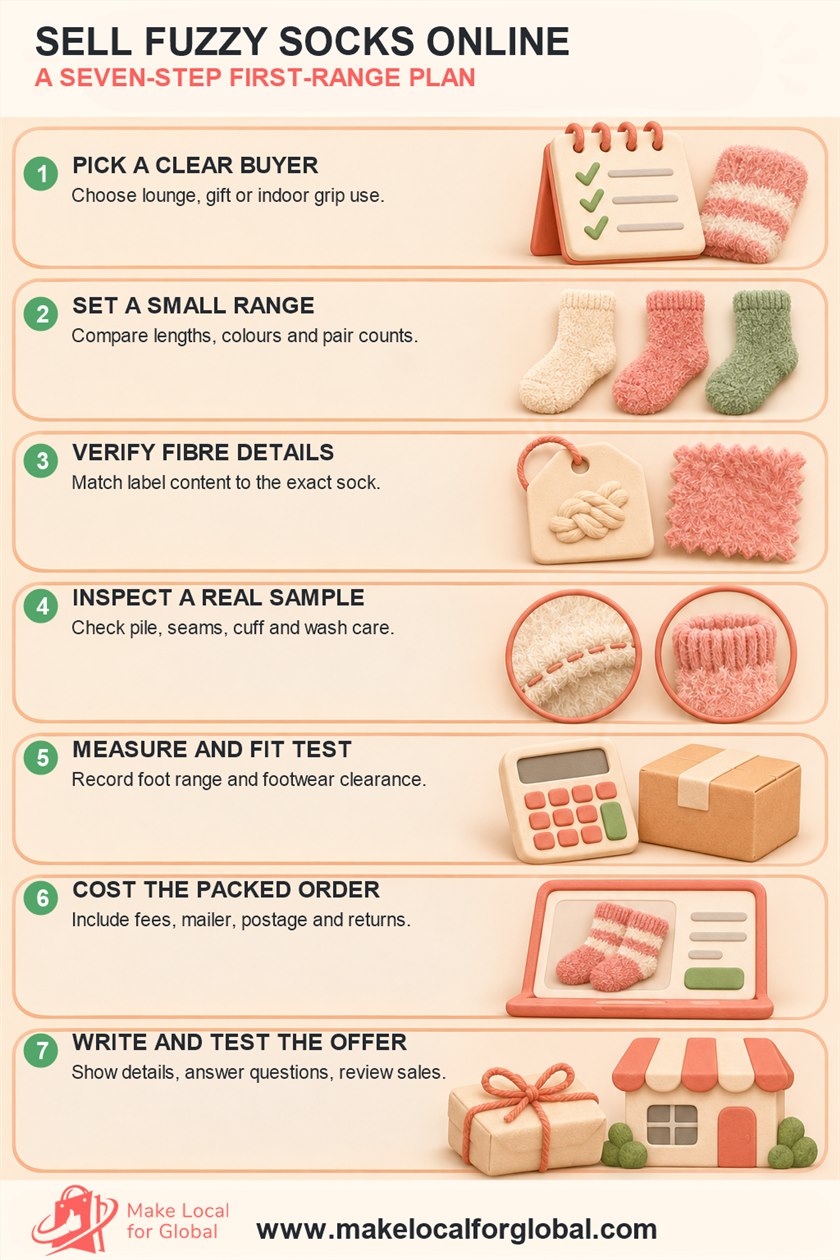
Build a listing that answers questions about fit, fibre, care, delivery and what arrives in the parcel.
No. “Fuzzy” is a description of texture or appearance. The sock may use polyester, acrylic, nylon, cotton, wool or a blend. Check the exact label and supplier specification before naming its fibre content.
Choose a small set where each style serves a clear purpose. One core crew pair and one shorter or gift option may be easier to test than many colours and lengths. The right quantity depends on the supplier’s minimum order, your budget and evidence from buyers.
Only add a grip style if your buyer has a reason to want it and the exact sample supports the feature. Check the placement and adhesion after the label’s care method. Do not promise fall prevention or safe use on a particular surface without suitable product evidence.
Ask how the supplier defines its size chart, then measure a sample and check it on feet near both ends of the stated range. Show the shoe sizing system and the actual measured dimensions where useful. Do not assume one size fits everyone.
Ask for the exact fibre percentages for the sock and any separate component that needs its own disclosure. Confirm that the documents match the product code, colour and sample. Keep the answer and label image with your order records.
Use a fibre name only when the composition and label support that term. A soft feel or a supplier phrase such as “cashmere touch” does not prove the product contains cashmere. Ask for the exact percentages and permitted wording.
Check the cuff, leg, toe seam, heel position, size range, pile, label, wash response, drying and packaging. For any grip treatment, inspect it separately and keep performance wording within the evidence you have. A sample check is not a laboratory certification or guarantee for every unit.
Do not assume so. GOV.UK describes a hygiene exception for some sealed goods that cannot be returned for health or hygiene reasons after opening, but whether it applies depends on the item and circumstances. Check the current rules and advice for your product before setting a return policy.
List the exact number of pairs, sizes, colours and packaging. Check that the box protects the pile, stays within the postage size you have priced and arrives with the gift contents shown in your photographs. State clearly if a card or other prop is not included.
Compare completed orders, customer questions, cancellations, returns and actual contribution with the threshold you set before the test. Clicks or likes alone do not tell you whether buyers accept the size, price and delivery offer. Use the evidence to keep, change or stop one product decision at a time.
A focused fuzzy-sock offer has a defined buyer, an honest description of the fibre and size, a sample that has been checked and a cost model that includes the packed delivery. Keep the launch small enough that you can answer buyer questions and compare real order results with your original plan.
Before paying for stock, match the label to the exact product, wash and inspect the sample, photograph the details and calculate the amount left after fulfilment and postage. If the sample fits the buyer routine and the cost still works after a cautious returns allowance, you have a specific first offer to test.
PREFERRED SOURCE
Like what you’re reading? Add Make Local for Global as a preferred source on Google to see more of our articles when you search.

Build your online presence without having to figure out everything yourself.