READY TO SELL Greeting Cards ONLINE?
Get a store built for you in 5 days, plus training and support to help you start, run, and grow your Alternative business.

Plan a greeting-card range, protect your artwork, test print samples, price complete orders and prepare reliable packing and delivery.

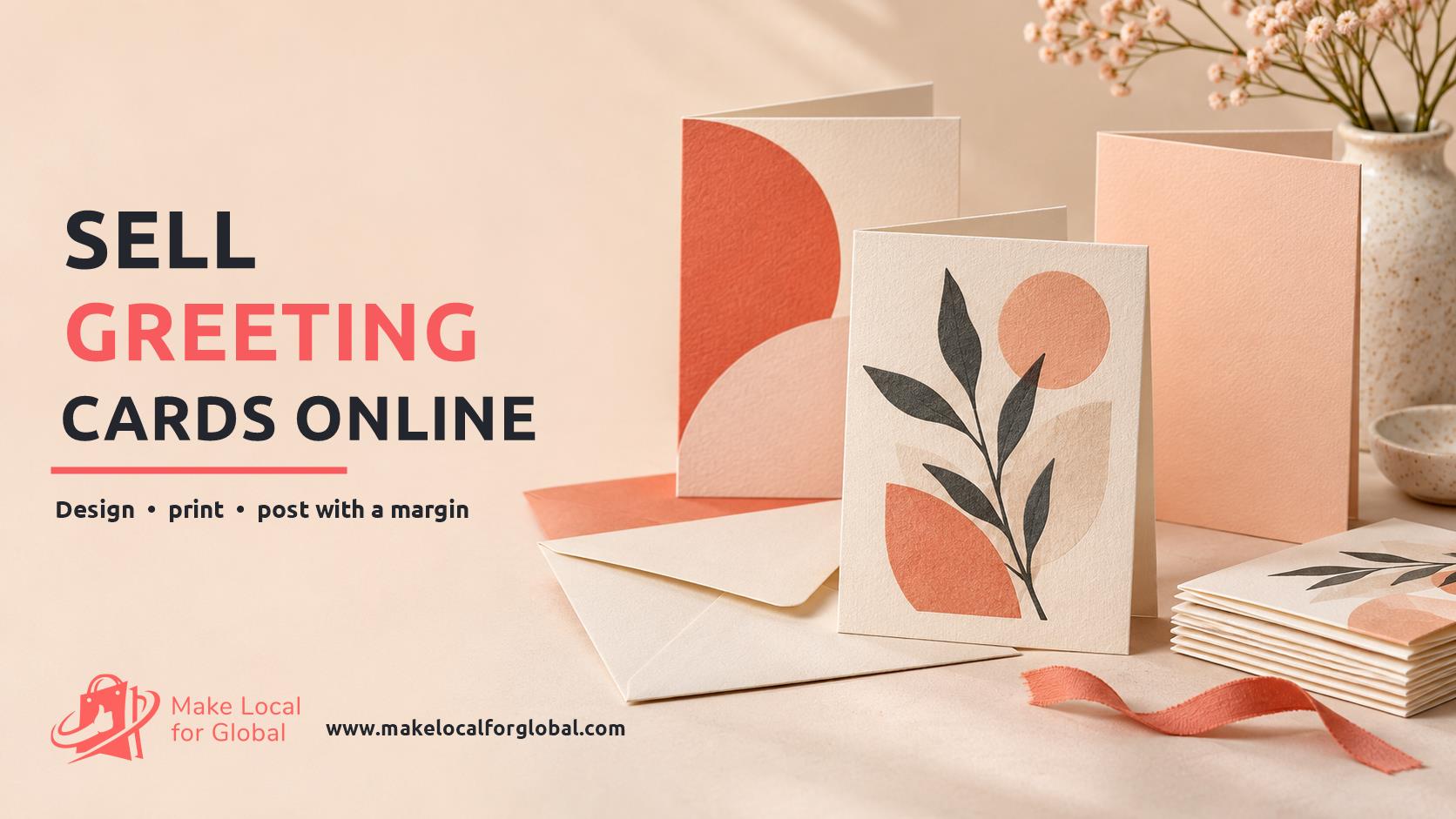
Greeting cards look simple on a screen, yet buyers judge the paper, print, message, envelope and delivery together. A design that gets attention can still lose money if it costs too much to print, needs parcel postage, or arrives with a bent corner.
You can start a greeting card business online with a small, clear range. Choose a buyer and occasion, confirm that you have the right to use every design, test printed samples, calculate the packed order cost and show customers exactly what will arrive. This guide works through those decisions for a UK seller, from first idea to launch.
The best first collection is not the one with the most designs. It is the smallest range that lets you learn which occasions, styles and prices buyers respond to, without tying up too much cash in stock.
If you are still comparing products, browse the Product To Sell library for other practical range and launch examples.
Use free MLFG ecommerce planning tools to challenge the product idea, costs and first launch steps.
People buy greeting cards for a moment: a birthday, a new home, a wedding, a thank-you, a new baby, a sympathy message or a seasonal celebration. The occasion tells you what the card needs to do. The buyer tells you how it should look, what it may say and where they are likely to find it.
Start with a group you can describe without using “everyone”. That might be people who want understated birthday cards for adult friends, relatives seeking personalised new-baby cards, or small businesses that send handwritten thank-you notes. A specific buyer makes decisions about language, size, artwork, photography and price easier.
Write a short buyer note: who buys, who receives the card, when they need it, what they want the message to say and what makes choosing difficult. A buyer may want something warm without sounding sentimental, a card that suits a colleague, or a design that does not assume a particular family structure. Those details can shape a useful collection.
Do not assume a theme has demand because you like drawing it. Ask a few likely buyers what they have bought recently, where they found it and what they could not find. Ask which of two sample designs they would choose and why. Their explanation matters more than a quick vote because it can reveal whether they value the wording, illustration, personalisation, finish or price.
Keep an evidence note. Record the date, who you spoke to in broad terms, the questions you asked and the answers. Do not treat compliments as orders. Stronger signals include a person asking for the price, joining a launch list, choosing a specific design for a known occasion or placing a paid pre-order with clear terms.
A standard folded card with an envelope is easy for buyers to understand. A flat postcard can be lighter and simpler to pack, but it offers less writing space and may feel less substantial as a gift. A mini card, boxed set, personalised card or matching card-and-tag bundle can serve a different use, but each adds production and listing details.
Decide the finished size before choosing a printer or paper. Measure the card when folded, then check the envelope size and the complete packed thickness. A design may fit one envelope but become too thick once a sleeve, backing board and protective mailer are added.
Choose whether the inside will be blank, contain a printed message or offer a personalisation field. A blank inside suits buyers who want to write their own note. A printed message can make the card ready to send, though the wording should fit the occasion and leave enough room for a signature. Personalisation can raise perceived value, yet it creates proofing and production steps.
Pick a small number of formats to start. If every design uses a different size, stock type and envelope, buying and packing becomes harder. A single format across the first collection lets you compare artwork and occasions without changing too many variables at once.
For each product, write down the finished dimensions, whether it is folded or flat, paper type and weight as stated by the supplier, print finish, inside treatment, envelope colour, protective packaging and what the buyer receives. If the paper is recycled, FSC certified, compostable or made in the UK, keep supplier evidence for the exact claim and product.
A first collection needs enough variety to test a clear idea, but not so many choices that you cannot learn from the results. A practical range could begin with a few related occasions in one recognisable style. For example, a botanical collection might include birthday, thank-you and new-home cards. A playful animal collection might focus on children’s birthdays and new baby occasions.
Keep the product range coherent. Related type, colour, illustration style and paper choices help buyers understand that the cards belong together. Coherence can help you reuse photography setups, packaging and production files. It does not mean every design should look the same. Each card still needs a distinct occasion or idea.
A useful starting range might contain:
Do not create a separate product for every wording variation before you know what buyers choose. Begin with a manageable set of designs and make the listing clear about the available message or personalisation. Add new versions when customer questions or sales show what is missing.
Think through an entry, standard and gift offer only if each has a distinct reason to exist. A single card can be the entry product. A set of several cards may suit someone who sends notes often. A gift-ready boxed set may justify a higher price through its presentation and packaging. Do not call a pack premium if the materials and finish do not support that description.
Use a simple range sheet with one row per design. Include internal code, occasion, buyer, wording, artwork file, size, paper, finish, envelope, supplier, print cost, stock quantity, listing URL and restock lead time. Add a column for design rights or licence evidence so you can check permissions later.
There are several production routes, each with different cash, control and workload trade-offs. The right route depends on the size of your test, the finish buyers expect and the cash you can risk before sales arrive.
| Route | Works well when | Watch for |
|---|---|---|
| Print at home | You need a few prototypes or very small test batches | Printer quality, ink cost, colour consistency, cutting time and equipment limits |
| Local or online short-run printer | You want control over a modest quantity and can hold stock | Minimum order, setup fees, delivery, reprint policy and storage |
| Print on demand | You want to test designs without holding much finished stock | Unit cost, dispatch time, packaging, print quality and who handles returns |
| Wholesale from another designer | You want to curate products rather than create every design | Resale permissions, wholesale terms, barcodes, stock risk and brand consistency |
A home printer can help you test layout and wording. It may not reproduce the colour or finish of a professional run. Keep home proofs separate from sale stock unless you have tested the paper, ink durability, alignment and final finish carefully.
Ask a print supplier for a sample or proof using the actual artwork, paper and finish you plan to sell. Check whether the price includes setup, trimming, folding, envelopes, packing and delivery. Ask how the printer handles misprints, damaged boxes, colour differences and reorders. Request the production time from approval to dispatch, not just the quoted print time.
Print-on-demand can reduce the cost of unsold inventory, but the price per card may leave little room after platform fees and postage. Order samples to your own address. Review print quality, packaging, delivery tracking, dispatch notifications and the process for a damaged order before selling. Check whether the supplier includes a packing slip or branding that conflicts with your customer experience.
A wholesale range can save design time, but you still need clear permission to resell the products and use the images in your listings. Ask the maker about minimum order, restock timing, damaged-stock terms, image-use rights and whether the products may be sold on the channels you plan to use.
The same sample-first approach helps with other printed products. The colouring book selling guide covers page proofs, paper choices and showing buyers what they will receive.
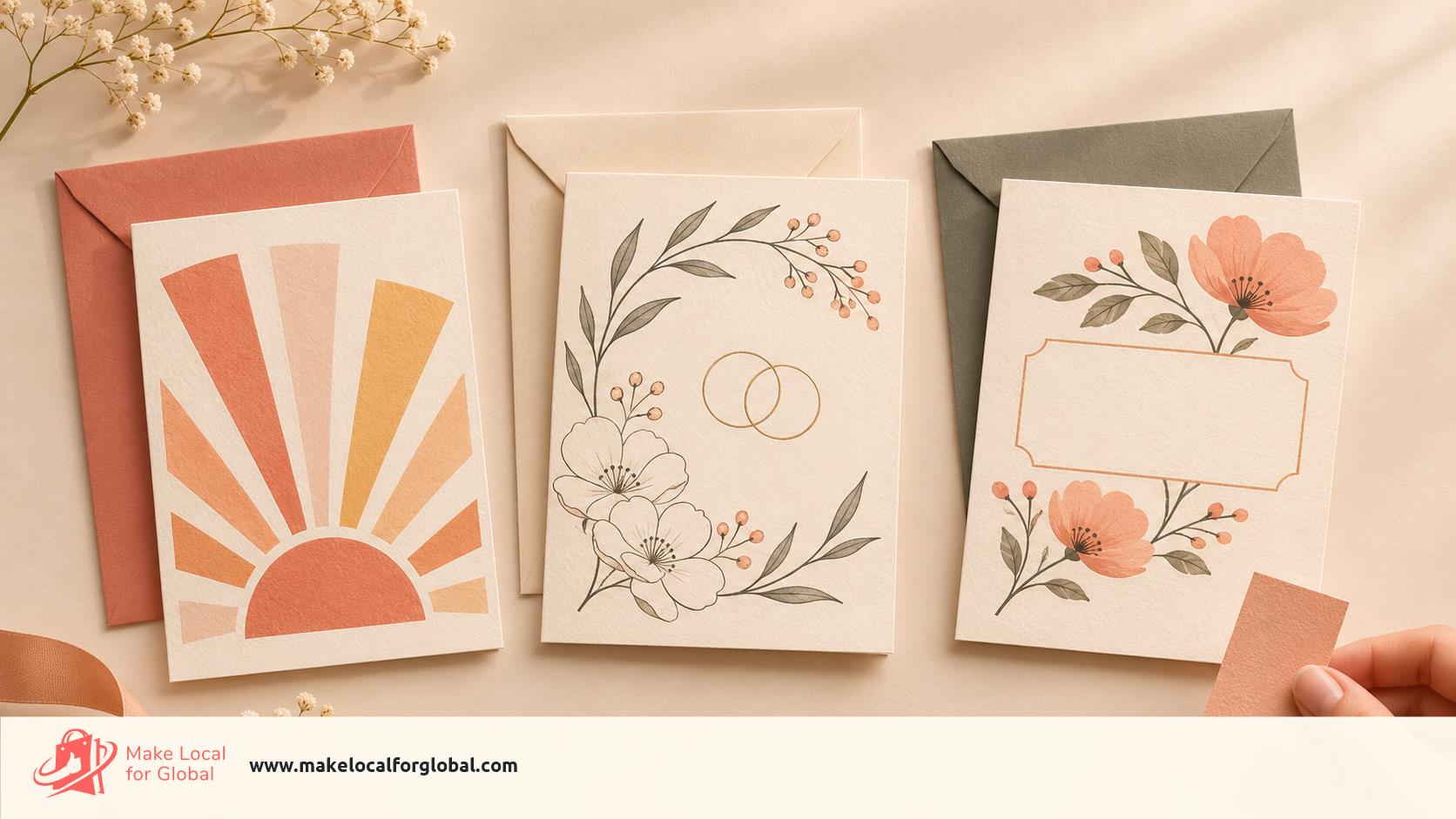
Create original artwork yourself, commission it under written terms, or buy a licence that covers the way you plan to sell. Copyright protects original artistic works in the UK automatically; there is no general registration step for copyright. The GOV.UK copyright guidance explains the main rules.
Buying a font, image, illustration or card from someone else does not automatically give you the right to reproduce it on products. Check the licence for commercial use, product resale, print quantities, attribution, modification, territory, expiry and whether you may use the asset in digital previews. If the licence is unclear, ask the rights holder before printing.
Keep a simple rights folder for each design. Store the original file, commission agreement or licence, the supplier receipt and any restrictions. If a design includes a recognisable person, brand, character, quotation, song lyric or location, check rights beyond the artwork itself. A short phrase may still be protected as part of a larger work, and a registered trade mark can create a separate issue.
Do not copy a popular card’s wording or composition and change only the colour. That can create a rights problem and makes it harder for your range to stand on its own. Use references to understand broad customer preferences, such as minimal wording or botanical line art, then develop your own original treatment.
If a customer submits a photograph or wording for personalisation, put permission and responsibility into the order process. Ask the buyer to confirm that they have permission to use the supplied material. Do not accept obviously infringing or abusive content. Set a proofing limit and tell the customer what can be changed after approval.
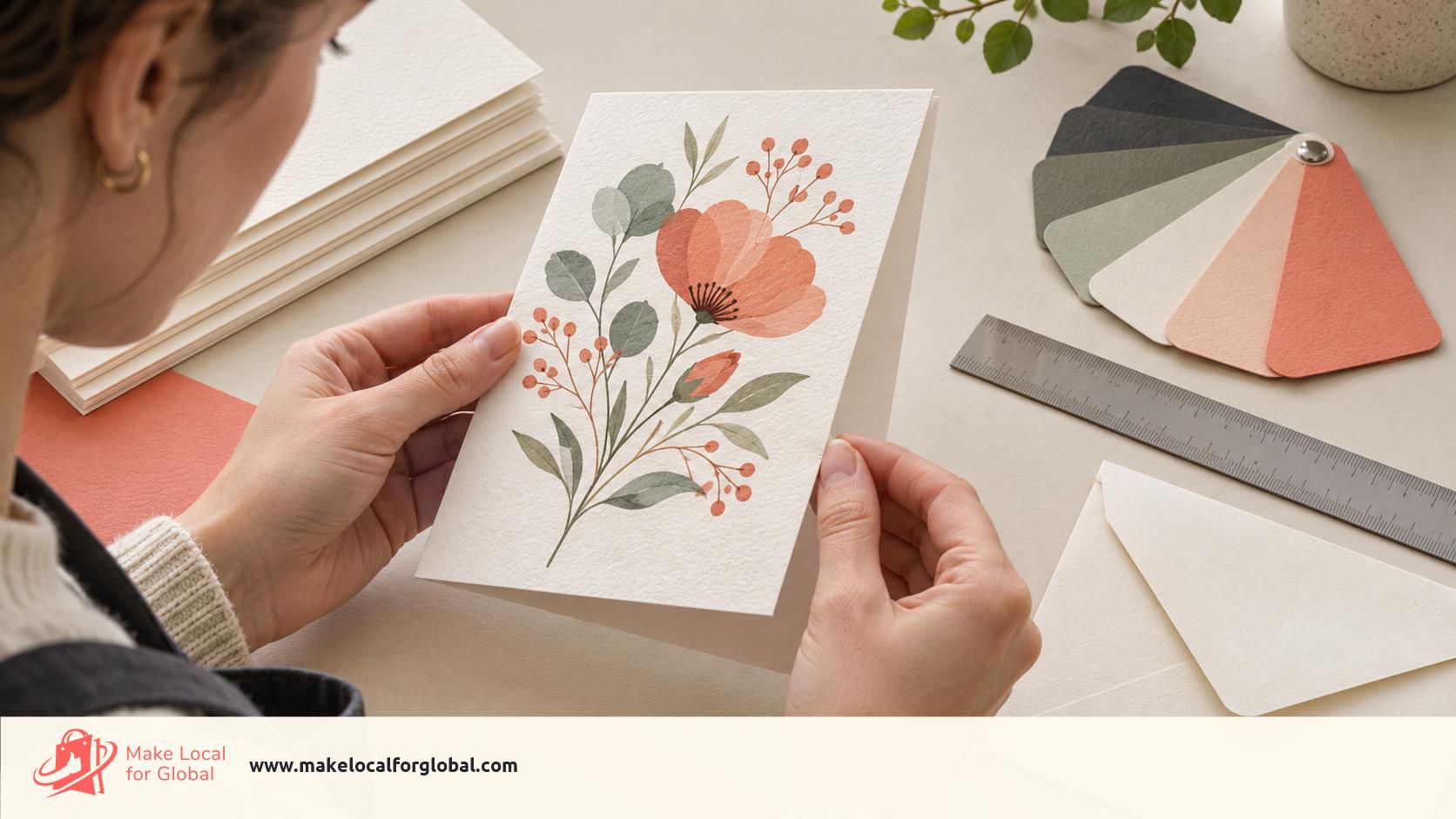
A sample is a production check, not only a chance to admire the design. Inspect it in daylight and ordinary indoor lighting. Compare the print with the approved file, and note whether the paper surface, colours, folds and envelope suit the price you plan to charge.
Check these points:
Read the card at arm’s length and at normal room light. A message that looks clear on a bright monitor may be too small or low contrast when printed. Ask two or three people who match your intended buyer to read the message and explain what occasion it suits. Do not tell them what it is meant to say before they read it.
Check colour with a real printed proof, not only a screen image. Screens display light; ink and paper reflect it. A warm monitor setting or low brightness can shift how a colour appears. Use the supplier’s stated colour profile when available, and keep a record of the approved proof and production version.
Fold and handle several samples. Look for cracking at the fold, ink transfer, scuffing and paper that feels too flimsy for the intended use. Put one sample through your full packing method and post it to yourself or a trusted tester. Check the corners and surface on arrival. A photo of an untested package will not tell you whether it survives the actual postal journey.
For personalised cards, test the full order sequence. Enter a sample name, preview the result, check line breaks and punctuation, print it, pack it and review the confirmation email. If the design has a text limit, state it in the product page and test the limit before launch.
A low print cost does not mean a profitable sale. Work out the cost of one order from the first supplier charge to delivery and the effort needed to acquire a buyer. Keep the assumptions visible and update them when a supplier or platform changes its price.
Here is an illustrative example for one folded card sold for £4.50, with a customer-paid delivery charge of £1.10. The assumed costs below are examples only. Replace them with supplier quotes and actual account fees.
| Order item | Illustrative cost |
|---|---|
| Printed card and envelope | £0.82 |
| Inbound delivery allocation per card | £0.08 |
| Protective sleeve and rigid mailer | £0.28 |
| Payment/platform fee allowance | £0.42 |
| Outbound postage | £1.10 |
| Damaged-order and refund allowance | £0.15 |
| Customer acquisition allowance | £0.60 |
| Total variable cost | £3.45 |
| Customer payment including delivery | £5.60 |
| Contribution before overheads and tax | £2.15 |
The arithmetic is £5.60 received from the customer, less £3.45 in listed variable costs, leaving £2.15 contribution. That is not net profit. It does not yet include your time, design software, equipment, insurance, accounting, business rates, website costs, tax or other fixed expenses.
The assumptions matter. The platform fee may be a percentage plus a fixed charge. A single card order can carry a larger fee per item than a five-card pack. If you absorb postage, the customer pays £4.50 and your contribution falls by £1.10 to £1.05 on these same assumptions. If you offer free delivery, build its cost into the price and show the delivery terms clearly.
A set can improve the order value, but only if the combined price covers extra cards, envelopes, packing, fees and postage. Calculate the set as its own product. Do not multiply the single-card contribution by the number of cards and assume the result is correct.
If you are VAT registered, check with an accountant how VAT applies to your products, delivery and fees. A price that includes VAT does not all belong to the business. If you are not registered, do not charge VAT as though you were. HMRC’s current VAT registration guidance explains the registration tests and responsibilities. Recheck the threshold and rules before making pricing decisions.
Add a returns and damage allowance based on your own evidence. In the first month, record damaged orders, replacement costs, refunds and the reason. A tiny percentage copied from another seller is not a reliable forecast for your paper, packaging or postal route.
Your spreadsheet should calculate price, customer-paid postage, supplier cost, packaging, transaction fee, postage, refunds or reprints, marketing cost and contribution. Keep a separate column for fixed monthly costs and the hours you spend. That gives you a clearer view of whether the work can pay you, rather than only covering the card stock.
A price needs to cover costs and match the value the buyer sees. Compare cards with a similar size, paper quality, finish, personalisation and brand position. Do not compare a handmade foil-finished card with a basic mass-produced card and expect the same cost structure.
Decide what the price includes. State whether the card comes with an envelope, protective sleeve, blank or printed inside, and whether the displayed price includes delivery. If postage is extra, show the amount before checkout. Surprise delivery costs can stop a buyer who has already chosen a card.
Try a small set of clearly named offers:
Bundle only designs buyers can use together. A birthday set with several different age-neutral designs may be useful. A mixed bundle of unrelated messages can make the pack feel like leftover stock. Show every design included in the set and state whether the buyer may choose variants.
Offer a discount only after calculating its effect on contribution. A 10% discount on a £4.50 card removes 45p from revenue. If contribution was £2.15 in the example above, the remaining amount becomes £1.70 before overheads, assuming all other costs stay the same. If a percentage payment fee also falls with the price, adjust the arithmetic, but do not assume the fee structure.
Do not call a card “luxury”, “eco-friendly” or “handmade” unless the materials, process and evidence support that description. Explain the paper, print method, finish and packaging in plain terms. Specific facts help buyers choose and keep your claims easier to check.
A product page should remove uncertainty. A buyer needs to know what the card looks like, what is included, how large it is and when it can arrive. A poetic description may add character, but it cannot replace product details.
Use a title that names the occasion and useful distinction. For example: “Botanical new home card, folded A6, blank inside” is more informative than “A little joy”. If the card is personalised, state that in the title only when the listing actually offers personalisation.
In the first paragraph, describe the artwork and occasion in natural language. Then list:
Photograph the actual printed card at a useful scale. Show the front, inside, back, envelope and one close detail of the paper finish. A hand or ruler can show size, but keep the measurement accurate. Use a neutral background and check that the photograph reflects the printed colours. If you use a digital mock-up, label it as a mock-up and include real sample photos before taking orders.
Write alternative text for meaningful images. Describe what the image shows, such as “Folded botanical new-home card beside its cream envelope.” Avoid repeating the full product title or stuffing keywords into every image description. A decorative detail image may need a shorter description if it adds little beyond the main photo.
Create separate pages for products with genuinely different occasions, messages or formats. Use variants where the design stays the same and the buyer selects one of a few clear options. Too many near-identical pages can confuse shoppers and make it harder for you to maintain stock and product information.
Use a brief FAQ on the product page to answer repeated questions: “Is the inside blank?”, “Does it come with an envelope?”, “Can I add a name?” and “When will it dispatch?” Keep answers specific to that product. If a dispatch date depends on proof approval, explain when the clock starts.
Start with the phrases a buyer uses when looking for a card: “birthday card for a gardener”, “personalised new baby card”, “minimal wedding card” or “thank-you cards for customers”. These are examples to research, not guaranteed search volumes. Compare search suggestions, customer wording and the product range before choosing target phrases.
Give every page a distinct title and description. Do not repeat the same heading across all designs with only one word changed. A title can combine occasion, style or recipient with a product fact. A description can tell the buyer what makes the card suitable and what the order includes, in a sentence that reads naturally.
Use headings to help people scan the page. Keep the main heading specific to the design, and use subheadings for details such as size, personalisation, dispatch and care where helpful. Add internal links to related occasions, sets, gift wrap or your delivery page when they help the buyer make a decision.
For a shop category, write a short introduction that explains the collection and the choices available. Do not hide the products below a long essay. Add helpful buying content below the product grid if shoppers need to compare formats, paper or personalisation.
Search engines can show different snippets from the page, and no title or description can guarantee a particular ranking or click rate. Make the page useful for the searcher first. Use original product photographs, clear descriptions, fast-loading images and a simple path from category to product to checkout.
Publish supporting content only when it answers a real question. Examples include choosing an occasion-appropriate message, the difference between flat and folded cards, how to order personalised wording and when to post a seasonal card. Link each page to the relevant cards rather than publishing thin articles just to repeat a phrase.
Your own ecommerce site gives you control over product pages, customer service and presentation, but it requires you to bring people to the shop. A marketplace may already have shoppers searching for cards, yet you must understand its fees, rules, search display, competition and customer-data limits.
You can test a marketplace and your own shop with a small set. Keep product names, stock counts and dispatch promises consistent. Use a simple stock sheet or inventory system so one sale does not leave an item available elsewhere by mistake.
Social media can show new designs and the making process, but likes do not establish purchase demand. Give each post a clear next step, such as viewing a specific card, joining a launch list or choosing between two designs. Use tracked links or a simple note to see which posts lead to product-page visits or orders.
Local shops, florists, bookshops, visitor attractions and independent gift stores may be possible wholesale customers. Ask how they buy, what pack size they need, what margin they expect and how they handle damaged stock. Prepare a short line sheet with product images, product codes, wholesale prices, minimum order, lead time and contact details.
For wholesale, calculate a different cost model. Your sale price to the retailer will be lower than the direct retail price, yet you may save per-order advertising, individual packaging and customer service. Include the cost of samples, sales visits, delivery to the shop, credit terms and unsold or returned stock where agreed.
Choose one or two channels you can operate well. Each channel needs listings, photographs, stock updates, customer responses and fulfilment. A small shop with accurate details and reliable dispatch is a better test than many channels with inconsistent information.
Greeting cards are light, but weight is only one part of postage. Measure the finished card and envelope, then add every layer you plan to use: sleeve, backing board, mailer, label and any gift packaging. Check the packed thickness and flexibility before choosing a postal service.
Royal Mail’s current letter size guide lists letter limits of 240 × 165 mm, 5 mm thick and 100 g. Its business mail guide gives large letter dimensions up to 353 × 250 × 25 mm and a weight limit up to 750 g. Confirm the current service and price before launch, since formats and prices can change.
Do not assume a rigid envelope automatically qualifies as a letter. A mailpiece that is too thick or stiff can move into another format. Measure an order at its thickest point and test the complete package, including seams and seals. Keep evidence of the intended service and the price you use in your margin calculation.
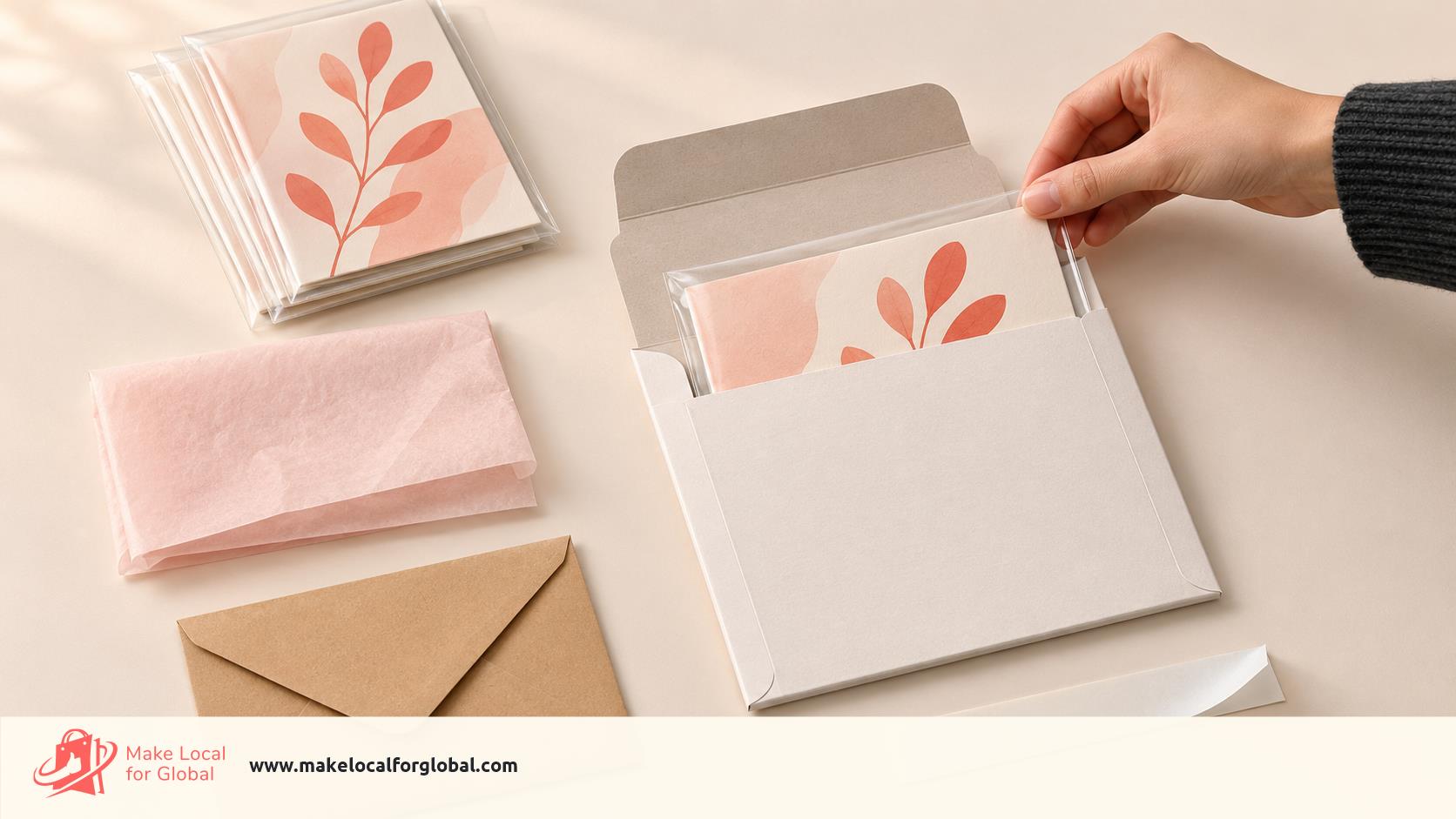
Use packaging that protects the card without creating unnecessary bulk. A clear sleeve can protect the surface from moisture; a backing board can reduce bending; a rigid mailer can protect corners. Test whether the envelope slides freely into the mailer and whether adhesive or tape can mark the printed card.
Prepare a packing sequence that reduces mistakes. Check the order details, select the exact design and envelope, inspect the card, add the insert or personalisation, protect the card, close the mailer, add the correct address and record dispatch. If you sell several similar designs, use product codes and a final visual check against the order.
Keep a few prepared packs and send them through the postal route you plan to use. Record packed size, weight, postage format, dispatch day and delivery condition. Try a busy season test well before the seasonal deadline. State the final order date only when your supplier and dispatch schedule make it realistic.
Set a dispatch promise you can meet during normal weeks and busy periods. Separate production time from delivery time. For a made-to-order card, explain whether the stated dispatch estimate starts after the buyer approves the proof.
Under UK distance-selling rules, most buyers can cancel many online purchases within 14 days after receiving them. Goods made to a consumer’s specifications or clearly personalised can fall within an exception. The Consumer Contracts Regulations set out the rules. A standard design with no custom wording should not be treated as personalised simply because it is a greeting card.
An exception to the change-of-mind cancellation period does not remove a customer’s rights when goods are faulty, damaged or not as described. The Consumer Rights Act sets out core rights for goods. Explain how customers can contact you about a misprint, damage in transit, wrong design or a personalisation error.
Set a proof approval process for personalised cards. Show the exact spelling, punctuation, line breaks and placement before printing. State how long the customer has to approve and whether a revised proof is included. Keep the approved proof with the order record, and do not make unapproved edits after sign-off.
Plan how you will handle errors. If you send the wrong card, keep a clear path for correcting the order. If a customer supplied the wrong spelling and approved the proof, your policy should explain what you can offer, but do not present it as removing statutory rights. Write in plain language and check policies with suitable legal advice when the business model or order terms are complex.
Do not promise a delivery date that depends on a carrier you do not control. State the dispatch estimate, selected delivery service and any seasonal cut-off. If you cannot guarantee arrival by a specific day, say so before checkout.
Customers may ask about paper, inks, sleeves and mailers. Describe what you know about the exact material and supplier. “The card stock is 300 gsm and the supplier identifies it as FSC certified” is more useful than a vague claim that the whole product is sustainable, if that claim is supported by the product documentation.
The Competition and Markets Authority’s Green Claims Code guidance says environmental claims should be clear, accurate and supported by evidence. A claim about one part of a card should not imply that the entire order is recyclable or has no impact.
Check the card, envelope, sleeve, adhesive, ink and mailer separately. A recyclable paper card inside a plastic sleeve does not make every part recyclable in every local collection. Tell buyers how to dispose of packaging only when you have checked the materials and relevant local guidance. Avoid terms such as “plastic-free” unless the whole product and packing arrangement meet that description.
Packaging rules can depend on the amount of packaging your business supplies and its size. Read the current GOV.UK packaging EPR guidance for small producers and check the threshold for your business rather than assuming the same rules apply to every seller.
Keep supplier certificates, product specifications, invoices and claim wording together. Recheck claims when you change printer, paper stock, envelope or packaging. A product page can be accurate today and become inaccurate after a supply change.
Birthdays and thank-you cards can sell throughout the year, but seasonal cards have a narrower window. Christmas, Valentine’s Day, Mother’s Day, Father’s Day and graduation periods can create clear deadlines. They can also leave unsold stock if you order too much or launch too late.
Start seasonal testing early enough to sample, photograph and promote the design before buyers need it. Set a final dispatch date based on supplier production, your own packing time and the postal service. Avoid treating last year’s demand, if you have no data, as a forecast for this year.
Use small print runs or a made-to-order option to limit early stock exposure. Compare the unit cost at different quantities with the value of cash tied up and the risk of unsold cards. A cheaper per-card price at a large quantity is not a saving if most of the stock remains in a box.
Track stock by design and occasion. Record opening quantity, sold units, samples, damaged items, replacements and remaining stock. This helps distinguish a card that sells from one that disappears through samples, gifts or print errors.
Set a reorder point that accounts for printer lead time and current sales, then review it weekly in a busy season. Do not reorder a design because it received compliments. Look at paid orders, repeat purchases, product-page visits and customer questions together.
Show the card in context and show the details a buyer needs. A short video can demonstrate the fold and paper. A photo carousel can show front, inside, envelope and size. A packing clip can show how a card is protected. Each piece of content should answer one question or help someone picture the product.
Write seasonal content before the buying window. A post about choosing a thank-you card can link to the relevant designs. A post about personalised cards can explain the proofing process and ordering deadline. Avoid filling a blog with generic holiday advice that could fit any shop.
Ask a small group of likely buyers to review product photos and listing details before launch. Give them a task: find a birthday card for a colleague, check if the inside is blank and tell you when it will arrive. Watch where they hesitate. Their confusion can reveal a missing photo or unclear dispatch statement.
Test one promotion at a time. For example, compare a product photo with a short making video, or test a single-card page against a clearly priced three-card set. Use the same audience and time window where possible, and record visits, add-to-basket actions, orders and questions. A few sales do not prove a lasting pattern, but they give you better evidence than likes alone.
Ask buyers how they found the shop and what occasion they were shopping for. A simple checkout question or post-purchase email can gather this information. Keep it optional and brief. Use the answers to decide what to photograph or print next.
If you offer email updates, state what people will receive and let them choose to sign up. Keep the list permission and privacy information clear. A launch list is useful when subscribers have expressed interest in the designs, not when names have been added without permission.
Organise the products, pages, photography and launch tasks before you choose a website setup.
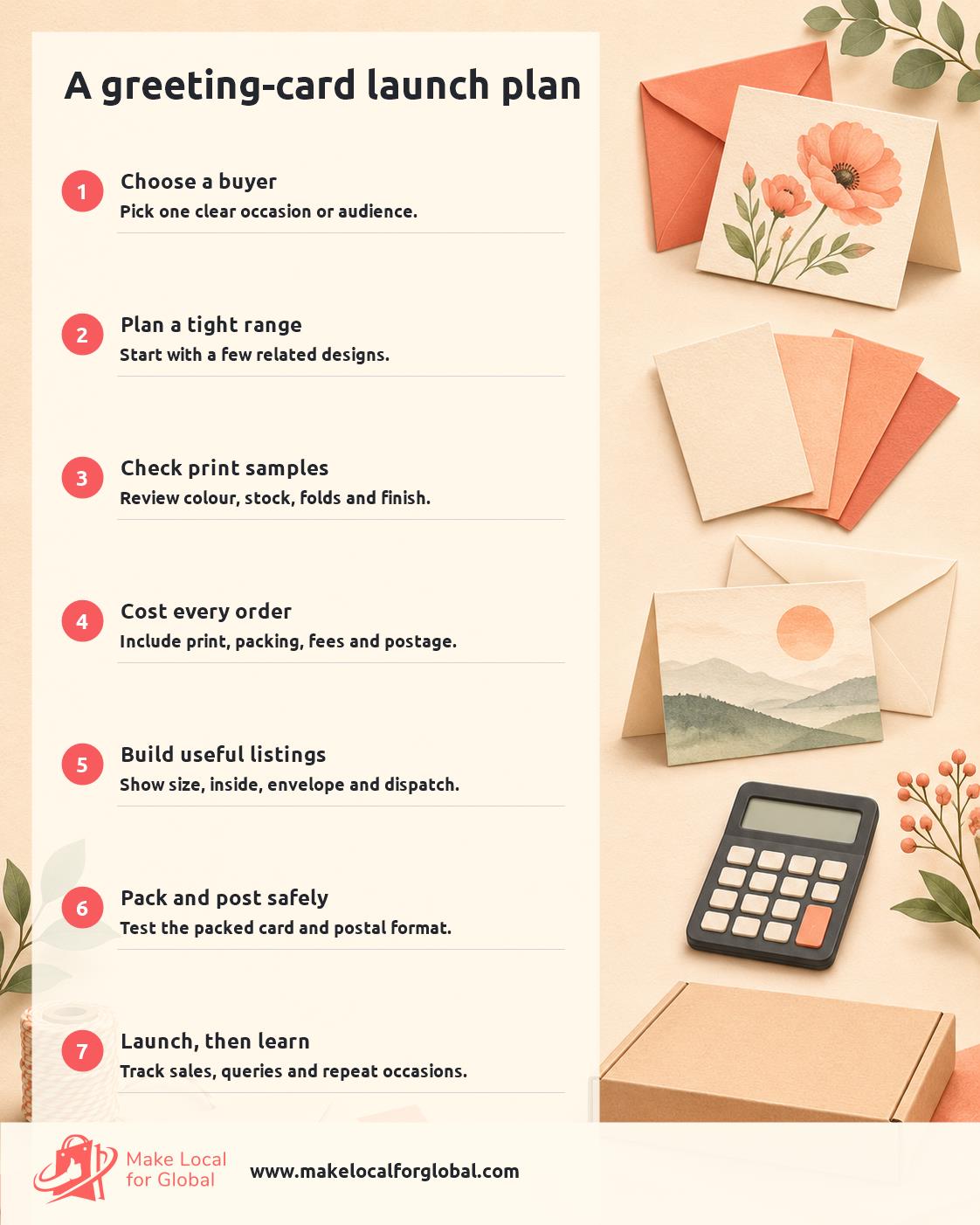
Write down the buyer, recipient, occasion and buying situation. Review cards already available in that niche and note product details, wording styles, paper, price and delivery terms. Do not copy another seller’s design or product text.
Talk to at least five likely buyers or retailers. Ask what card they bought recently, what they needed it to say, what they found difficult and whether the proposed design solves that problem. Show two or three rough concepts. Record exact reactions and questions without treating positive comments as guaranteed sales.
Choose a narrow product direction for the first print test. Set a small spending cap for samples, artwork and initial packaging. If the cash is not available for a full stock order, plan a limited preorder only if the delivery date, terms and refund process are clear.
Choose the production route and request a proof or sample. Confirm the artwork size, bleed, safe area, colour profile, paper, finish, envelope and print quantity. Check that you have written permission to use any commissioned or licensed material commercially.
Write down the sample checks before it arrives. Inspect print clarity, colour, folding, paper, wording and envelope fit. Test the full packing method and postal format with a real package. Ask a likely buyer to read the card and check whether the message fits the occasion.
Revise the artwork or supplier choice if the sample fails. Do not place a large order to recover the cost of an unsatisfactory proof. If the supplier cannot correct an issue, compare another route and recalculate cost.
Calculate the complete cost for a single card and any proposed bundle. Include the product, incoming delivery, packaging, transaction fee, outgoing postage, customer acquisition and a reasonable allowance for damage or refunds. Add fixed monthly costs separately.
Build product pages using real printed samples. Photograph the front, inside, envelope and packed format. State dimensions, paper details, finish, price, delivery, dispatch time and personalisation options. Test the mobile layout, checkout, confirmation email and stock settings.
Ask someone unfamiliar with the range to place a test order or review a non-live draft page. Can they tell what they receive, what it costs to deliver and when it should dispatch? Fix the missing information before launch.
Launch the small range and promote it to an audience likely to buy. Share product details and a specific reason to view the cards. Avoid discounts that reduce the contribution below a level you can accept.
Review the numbers every few days: page visits, add-to-basket actions, completed orders, dispatch times, questions, damaged items and customer feedback. Make a note of which designs attract interest and which convert to orders. Low traffic and low conversion point to different problems, so do not respond to both by printing more stock.
At the end of the month, decide what to change. You might revise a product photo, clarify a dispatch detail, alter a bundle, test a different occasion or stop printing a weak design. Write down the evidence for the decision and the next small experiment.
Launching with too many designs spreads attention and cash. A large range can look impressive, but it makes photography, stock control and reordering harder. Start with a set you can describe, print and track. Add the next design when buyer questions or paid orders show a gap.
Relying on screen proofs creates colour and scale surprises. A card can look bright on a monitor yet print dull, or a message can feel spacious on screen and cramped after folding. Order an actual sample and read it at normal size.
Using a standard envelope without testing the packed order can increase postage or cause damage. Check the final thickness and rigidity. Include the protective sleeve, backing and mailer in your measurements and cost.
Pricing from the card’s print cost alone misses the work and the delivery. A card sold for £4 may have much less than £4 left after payment fees, packaging, postage, marketing, returns and overheads. Keep a worked price model for singles and bundles.
Copying a trend can lead to a range with no clear point of view and rights risk. Use customer evidence to understand the need, then create original wording and artwork. Keep records of commissions, licences and supplier permissions.
Treating personalisation as a small add-on can create proofing errors and support time. Decide how buyers submit wording, what you will proof, how many revisions are included and how approval affects dispatch. Test the process before advertising it.
Making broad environmental claims without full product evidence can mislead buyers. Keep material descriptions specific and check each part of the card and packaging. Update the listing when suppliers or packaging change.
It can be, but the answer depends on your print cost, order value, postage, platform fees, marketing and time. Calculate contribution for a single card and a set using actual supplier quotes. Treat the result as a starting point, then compare it with overheads, tax and the time you spend.
There is no single start-up cost. A small test may need artwork, samples, a printer or print-on-demand account, photography and basic packaging. A larger wholesale print run costs more upfront and can reduce the unit price. List each cost before ordering, then set a cash limit for the test.
You need a reliable way to show and deliver the exact product buyers will receive. Order and inspect samples before publishing a listing. Some sellers use print-on-demand or clearly disclosed preorders, but they still need to test supplier quality, dispatch time, packing and customer communication.
Choose an occasion and audience you can describe, then test a small related range. Birthdays can serve year-round demand, but the best starting point depends on your artwork, buyer access and production costs. Ask likely buyers about real purchases and compare their reactions with paid interest.
Only when the licence covers your intended commercial use. Check product resale, print quantity, attribution, modification, territory, duration and online image use. Keep the licence and supplier evidence. Ask the rights holder when terms are unclear.
Yes, if you can collect the wording, prepare an accurate proof, get approval and deliver the right version. State character limits, proof timing, dispatch estimates and what the price includes. Customised goods can be exempt from the usual 14-day change-of-mind cancellation right under UK rules, but customers retain rights when goods are faulty or misdescribed.
It depends on the packed dimensions, thickness, weight and flexibility, not only the card size. Measure the finished package and confirm the current postal service rules. Recheck prices and limits before launch.
Test a sleeve, backing board and suitably rigid mailer with a real packed order. Send it through the postal route you intend to use and inspect for bent corners, scuffs or moisture. Keep the materials and postage cost in the margin calculation.
A marketplace may put your products in front of existing shoppers, subject to its fees and rules. Your own website gives you more control over presentation and customer journey but requires you to attract visitors. Start with the channel you can maintain and measure, then add another when order handling is reliable.
Choose a small range you can print, photograph, describe and track without tying up too much cash. A handful of related designs can help you test a clear theme. Expand when customer questions, paid orders and repeat behaviour support the next design.
A greeting-card business is easier to manage when the buyer, opening range, print route, price and dispatch promise all agree. Test the finished product before increasing stock, and use real orders and customer questions to guide your next design.
If you are planning a shop, the Website Brief Builder can organise your audience, pages, product content and launch requirements into a shareable brief. For broader support, contact Make Local for Global to discuss the store setup and help you need.
If you want a done-with-you store setup focused on greeting cards, see the MLFG greeting-card shop service.
Talk through the products, store setup and support you need for a first launch.
PREFERRED SOURCE
Like what you’re reading? Add Make Local for Global as a preferred source on Google to see more of our articles when you search.

Build your online presence without having to figure out everything yourself.