READY TO SELL coloring books ONLINE?
Get a store built for you in 5 days, plus training and support to help you start, run, and grow your Alternative business.

Choose a clear audience, protect original artwork, test print quality and price the real costs. This practical guide explains how to sell colouring books online.

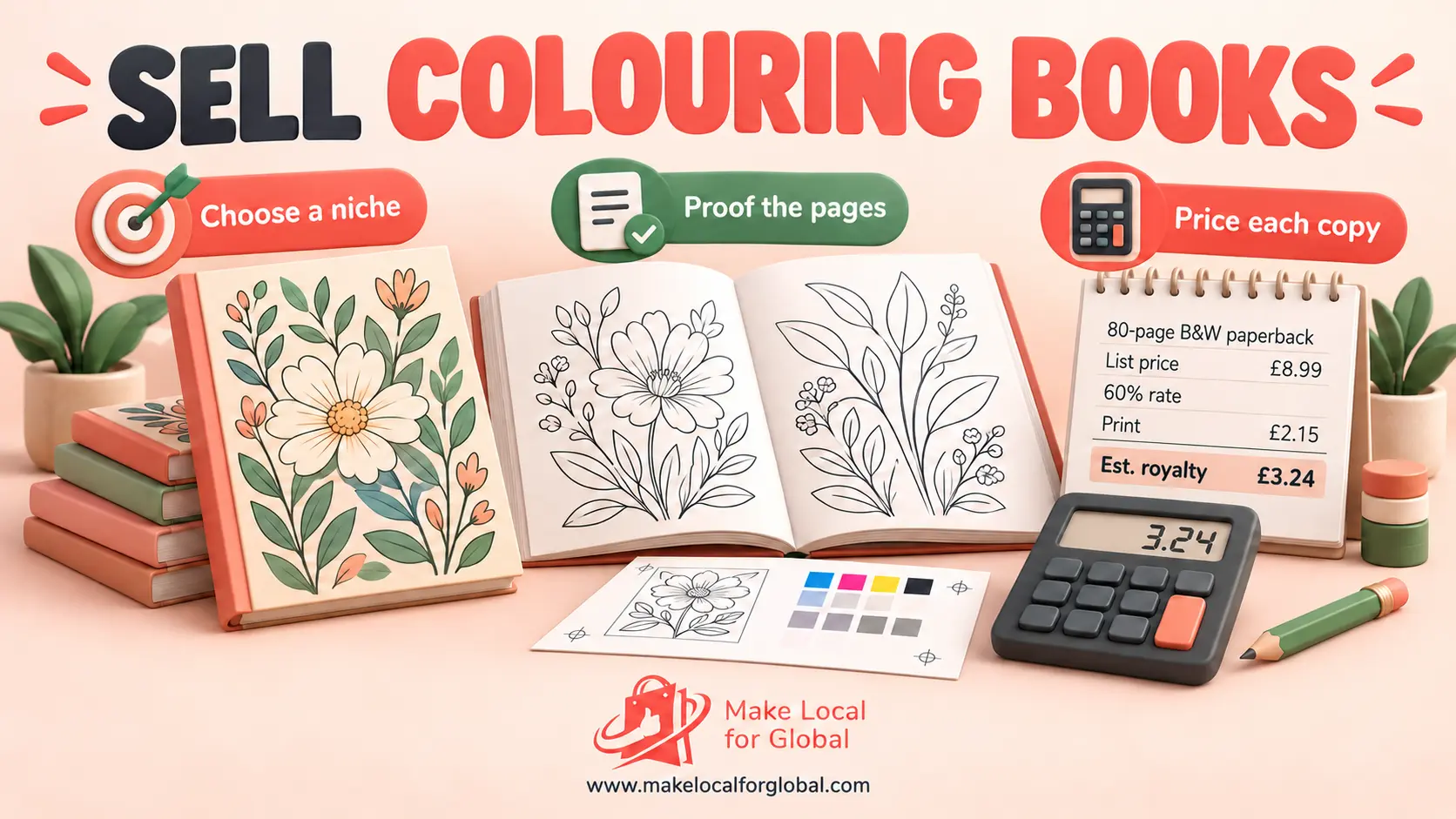
A colouring book can look like a simple product: a cover, a set of drawings and a price. The commercial work sits in the choices around it. A focused audience, original artwork, a print proof and a cost per copy help you avoid building a large catalogue before buyers show what they want.
To sell coloring books online, choose one clear theme, decide whether you will offer a printed book, a digital file or both, then test a small collection. Check every page at its final size, price the real format and show enough interior previews for a customer to know what they are buying.
Compare the audience, format and production plan before you spend weeks making pages or ordering stock.
A book for young children needs different line detail, page themes and parent-facing information from a detailed adult colouring book. A travel activity book, a nature journal and a seasonal gift title answer different buying occasions. Pick one audience and use case first, then shape the page count, size, cover and price around that decision.
Write a one-sentence product promise for yourself, such as “large, simple garden illustrations for early colourers” or “intricate British woodland plants for adult hobby artists”. Avoid claims about education, wellbeing or therapeutic outcomes unless you have suitable evidence and the wording is permitted. A clear promise gives you a practical test for every page: does it belong in this book?
| Possible buyer | What the book needs to show | Small demand test |
|---|---|---|
| Parents buying for younger children | Large shapes, simple scenes, clear age guidance and sturdy-feeling pages | Show three sample pages to parents and ask which they would choose and why |
| Adult hobby colourists | A coherent theme, varied detail, paper and binding information, and realistic previews | Share a sample spread in a relevant group and measure saves, questions or email sign-ups |
| Gift buyers | A recognisable theme, attractive cover, recipient fit and clear delivery timing | Test a gift-ready cover image and a seasonal landing page before ordering a batch |
| Teachers or activity leaders | The subject, page variety, format, quantity options and permission terms | Ask a few local groups which theme and pack size would fit their sessions |
These are audience hypotheses, not proof of demand. Record what people do, such as joining a list or asking for a sample, not only what they say they like.

A physical paperback, a printable PDF and a small-batch book each place costs and customer expectations in different places. Decide what the buyer receives before you build the listing. If you offer more than one format, give each its own clear images, price and delivery details.
| Route | What happens after an order | Main checks before launch |
|---|---|---|
| Print on demand | A provider prints and ships each paperback after purchase | Print cost, list-price threshold, proof quality, trim size, page count and royalty by marketplace |
| Digital printable | The customer downloads a PDF to print or use on a compatible device | PDF page size, file size, print instructions, personal-use terms, download delivery and cancellation wording |
| Small print run | You pay a printer for copies, store them and pack orders yourself or through a fulfilment partner | Quote at several quantities, storage, postage, damaged stock, cash tied up and reorder timing |
Print on demand can reduce the need to hold stock, but the unit print charge affects the amount left from each order. A print run may lower the cost per copy at higher quantities, though unsold copies still belong to you. A PDF avoids printing and postage on each order, but it needs clear download instructions, customer support and access controls that match your usage terms.
Amazon KDP says activity books such as colouring books do not typically count as low-content books because their pages are not simply repetitive. Check its current low-content book rules and ISBN options for your exact format. Standard print books need a format-specific ISBN; KDP offers a free ISBN for eligible paperbacks, but that ISBN can only be used on KDP. UK and Irish publishers can compare options through the Nielsen UK and Ireland ISBN Agency. An ISBN helps book trade identification and distribution; it is not proof that the art is original.
Build a set around a specific theme rather than collecting unrelated drawings. A garden book might move from seeds and tools to flowers, pollinators and harvest scenes. Vary the amount of detail so readers can choose a page that suits the time and materials they have.
Make a page checklist before illustration: subject, intended age or skill level, line thickness, open spaces, page orientation, margins, and whether the design will sit close to the binding. Use a consistent visual style, then remove pages that repeat the same composition. A short sample set lets you check whether the book feels like one product rather than a folder of clip art.
In the UK, copyright protection for qualifying original writing and artwork begins automatically when it is created. The GOV.UK copyright overview covers illustrations and photography. Keep dated working files, source sketches and agreements with any illustrator. If you commission pages, agree in writing who can reproduce, edit, license and sell the work. Do not build a book around a film character, a sports team badge, a celebrity likeness or artwork copied from another seller. A source being easy to find online does not make it free to reuse.
Marketplace rules apply alongside copyright law. Etsy’s Creativity Standards allow seller-designed digital art and original designs printed by a disclosed production partner. If you use generative tools, check the marketplace’s current disclosure rules and your commercial rights, then inspect every page for strange marks, copied-looking elements and inconsistent details. Keep the final file and a record of any licensed assets.
View the interior at actual size and print a proof using the same trim, paper and ink options as your planned edition. Check that page numbers, title pages and artwork sit inside the safe area. Inspect the binding edge for clipped details, confirm thin lines remain clear and test coloured pencils or markers on a sample sheet. If colour shows through the reverse, single-sided artwork with a blank back may suit the product, but it adds pages and print cost.
Test more than the cover. Flip through the whole proof for blank pages in the wrong place, duplicated drawings, accidental crop marks, spelling mistakes and a mismatch between the cover promise and the interior. Ask a likely buyer to try several pages without coaching. Their questions can reveal whether the line detail, page size or instructions need work.

Before making a book for children, check the age label, wording and any materials sold with it. A colouring book by itself is not automatically the same product as a toy. If you bundle crayons or market the item as a play product, review the relevant UK product-safety advice for businesses and seek specialist advice if the classification is unclear.
Price the format the buyer receives. For print, include production, delivery, platform charges, returns or replacements, advertising and any cost of holding stock. For a digital file, include illustration time, software, listing and payment charges, customer support and refunds. An amount left after direct costs is a contribution towards overheads and your time, not automatically profit.
| Example for one print-on-demand sale | Illustrative amount |
|---|---|
| 80-page large-trim paperback, black ink print cost on Amazon.co.uk | £2.15 |
| List price | £8.99 |
| Royalty rate at this UK list-price band | 60% |
| Estimated royalty before tax and other business costs: (£8.99 × 60%) − £2.15 | £3.24 |
Illustrative example based on KDP’s published UK paperback rates; check the current calculator before setting a price. It assumes an eligible 80-page large-trim black-ink paperback and an Amazon.co.uk sale at the stated list price. Print settings and marketplace affect the charge. It excludes design, advertising, income tax and business overheads. Use KDP’s current calculator and the figure shown in your title setup before setting a price.
KDP calculates paperback royalty from the list-price rate, then subtracts printing costs. Its current UK paperback table uses a 60% royalty rate at list prices of £7.99 and above; lower prices use 50%. Check the royalty table and printing-cost calculator guidance each time you update a book, since marketplace, page count, trim and ink all affect the result. Colour interiors can cost more to print than black ink, so compare a standard-colour and premium-colour proof before choosing.
For an Etsy printable, count the listing charge, transaction fee, payment processing, any UK regulatory operating fee, advertising and currency conversion where relevant. Etsy’s help pages currently list a US$0.20 listing fee and a 6.5% transaction fee on the item and postage amount, with payment processing charged separately by country. Check Etsy’s fee basics before you calculate a contribution. Do not assume a digital file has no costs just because there is no parcel.
Map your book formats, preview images, delivery details and buyer questions into a clear website brief.
A cover can attract a click, but interior previews help buyers judge line detail and page variety. Photograph or render the real book and include a few legible sample pages. State page count, finished dimensions, paper and binding where known. Show whether the art is printed on one side, whether the reverse is blank, and what the customer receives.

Use phrases people might search for only where they match the product: botanical colouring book, large-print colouring pages, woodland animal activity book or printable flower colouring sheets. Include related wording naturally in the title, first lines and image descriptions. Do not copy another publisher’s title or use a trademarked character name to attract clicks.
A good product page needs the same care as a product range. The camping gear seller article shows how product details, packing and fees connect. For ideas on showing fit and product options, see the new couch-covers selling article and the wider Product To Sell collection.
For print-on-demand, order a proof, check dispatch estimates and explain when delivery times are outside your control. For a small run, choose protective packaging, test a packed parcel and write down the reorder point. Keep a small buffer for damaged copies and customer replacements rather than treating every printed copy as saleable stock.
For a PDF, deliver the file promptly and make the link easy to find after checkout. State whether it is sized for A4, US Letter or another page size, whether it can be printed more than once and whether use is personal or commercial. Give a short print-at-home note and a contact route for a corrupt or missing file.
UK distance-selling rules differ for physical goods and instant digital downloads. For most online physical orders, a customer can notify you of cancellation within 14 days of delivery and has a further 14 days to return the item. For a download supplied immediately, GOV.UK says the customer must agree to the instant supply and acknowledge before download that the 14-day right to cancel will be lost; include the required confirmation with the contract. Read the current online-selling guidance and returns and refund rules when writing your policies.

It depends on the format and sales channel. A digital file does not use a print ISBN. Print-on-demand services set their own rules; KDP offers eligible paperbacks a free ISBN or lets a publisher use its own. Check the current format requirements before uploading.
Test the actual paper with pencils and the materials your audience may use. Single-sided pages with blank backs can reduce the risk of show-through onto another design, but they increase the page count and can raise print cost.
Check the tool’s commercial terms and the sales platform’s disclosure rules. Review every image for artefacts, copied-looking details and commercial conflicts. Do not assume a tool’s output clears third-party rights or guarantees copyright protection.
It varies with page count, trim size, ink, paper and print provider. Check the current calculator for your exact settings, then order a proof and compare it with a second print route before you choose a price.
Options include a print-on-demand book platform, a marketplace for physical or digital products, and your own online shop. Compare audience fit, fees, delivery, product rules and how much control you need over customer information before choosing.
A focused colouring book gives you a better way to learn than a broad catalogue built on guesses. Keep the page files, proof notes, rights records, cost sheet and customer questions together. When a theme attracts interest, test a second title for the same audience before adding several unrelated products.
If the product idea depends on production, delivery and detailed customer guidance, our articles on selling bed frames online and selling couch covers online show how to plan product pages and costs for different formats.
Talk through the range, store pages and first launch test with Make Local for Global.
PREFERRED SOURCE
Like what you’re reading? Add Make Local for Global as a preferred source on Google to see more of our articles when you search.