READY TO SELL Gold Jewellery ONLINE?
Get a store built for you in 5 days, plus training and support to help you start, run, and grow your Alternative business.

A UK starter plan for selling gold jewellery online: choose a focused range, verify metal and hallmark details, calculate secure order costs and give buyers clear product information.

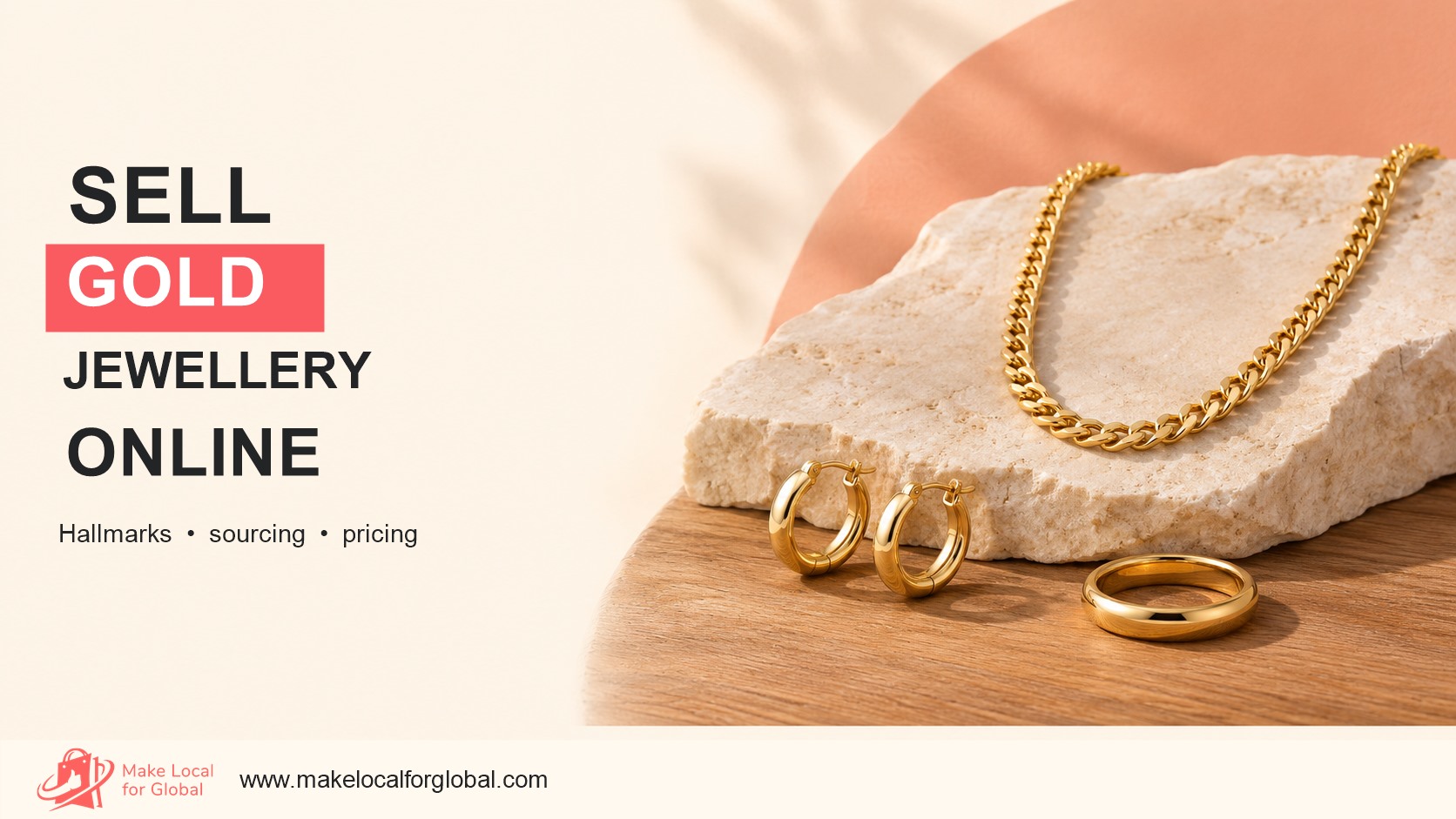
Gold jewellery carries value in its metal, design, workmanship and story. A customer cannot check the colour, weight, hallmark or clasp through a screen. A new seller must turn those details into accurate product records, clear photographs and a price that covers the item, secure delivery and the work behind each order.
This UK-focused article explains how to choose a gold jewellery niche, compare solid gold with plated items, check suppliers and hallmarking, calculate a full order cost, build useful product pages and prepare secure dispatch. It is written for a first-time online seller, not as a valuation guide or legal opinion. Confirm the rules for each product and destination market before taking orders.
Choose one buyer, one product type and a supplier who can identify the metal, fineness, hallmark and packed value. Clear evidence makes the first product page easier to build.
“Gold jewellery” can describe solid gold, gold plated silver, gold plated base metal, vintage pieces, custom work or modern designs made in a small workshop. Those options have different stock costs, product descriptions, hallmark checks and customer expectations. Pick a model before you compare suppliers.
Wholesale resale can give you ready-made stock, repeatable designs and clear delivery terms. Ask whether each piece arrives with a valid hallmark, whether the supplier will provide model-level product details and who handles repairs or defects. A low unit price is not enough if product identity or after-sales support is unclear.
Working with a goldsmith or manufacturer can give you more control over design, sizing, materials and small-batch production. It can involve development fees, sample charges, minimum runs and longer lead times. Put ownership of design files, tooling, samples, marks and packaging in writing before paying for development.
An own-brand range may help customers recognise your style. If you sell an item under your own name or trademark, check whether that changes your responsibilities under hallmarking or product-safety rules. The person or business sending an article to an Assay Office for hallmarking may need its own registered sponsor’s mark. Confirm the process with the relevant Assay Office before producing branded stock.
Pre-owned pieces can suit a specialist shop, yet each item needs an identity and condition record. Record any visible hallmark, dimensions, metal description, stone details, repairs and wear. Do not estimate a carat, maker or period from a photograph alone. If the mark is unclear or the description affects price, seek a competent appraisal or Assay Office advice.
Start with a real customer and occasion. A buyer looking for a lightweight everyday chain may care about length, clasp and skin contact. Someone choosing a wedding band may ask about fit, profile, resizing and delivery timing. A gift buyer may need gift packaging, a recipient-friendly size exchange and a card with the exact metal description.
Interview people who match the buyer you plan to serve. Ask where they have bought gold jewellery before, what they found hard to compare and what details would help them trust an online seller. Show real samples and a draft product page. Ask them to find the hallmark, check the chain length, compare two fineness levels and state which part still feels unclear.
Record the buyer’s words. A customer may search for “9ct gold chain”, “solid gold hoops” or “gold plated silver ring”. Use that language when it accurately describes your product. Do not write “solid gold” for a plated item, or present a gold-coloured surface as evidence of precious-metal content.
Test demand with a small and honest offer. You can publish a product page marked as a sample or coming soon, invite a waitlist, take feedback at a craft market or test a small quantity from a supplier. Do not take payment for stock you cannot source or dispatch in the timeframe you promise. Track enquiries, accepted prices, size questions and completed orders rather than counting compliments.
A focused collection is easier to photograph and explain than a supplier catalogue with many similar pieces. A new shop might start with one chain style, a pair of everyday hoops and one pendant. Another shop could focus on wedding bands with a narrow set of profiles and sizes. Pick a range where each item has a distinct reason to exist.
| Range role | Example gold jewellery | Detail a buyer needs |
|---|---|---|
| Entry piece | A small pendant or simple stud earrings | Exact metal description, dimensions, post or clasp details |
| Core item | A chain, hoop or everyday ring | Fineness, length or diameter, weight where known, hallmark and care |
| Gift piece | A matching pendant and chain or a boxed pair of earrings | Exact contents, gift packaging, delivery timing and size information |
| Bespoke option | A ring made to a chosen size or engraved pendant | How the order is confirmed, production time and lawful return terms |
Treat these as range roles, not fixed price tiers. A more expensive item needs clear reasons for its price, such as higher metal weight, a verified fineness, hand-finished detail, a stone with documented characteristics or included resizing. Do not call a product “investment grade” or promise future resale value. A jewellery seller is not able to predict a buyer’s future gain from a piece.
Avoid launching several almost identical chains just to fill a page. Compare the options on length, link style, clasp, metal, weight, finish and target buyer. If you cannot explain why both versions belong in the range, start with the one you can source and support more confidently.
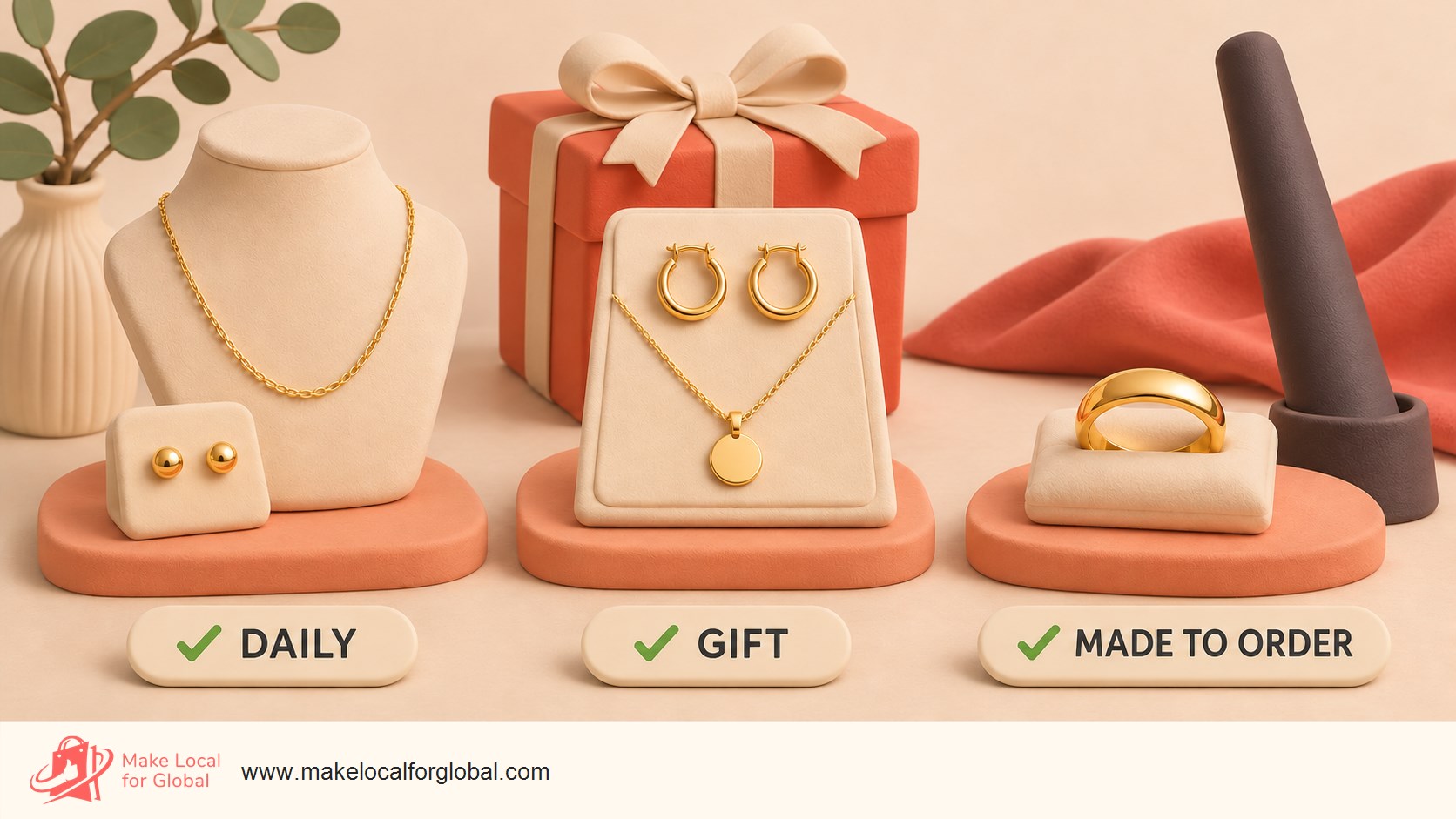
Ring sizes, chain lengths, finishes and stone colours can multiply stock positions quickly. List each variant with its own product code and supplier reference. Calculate the cash tied up in sizes or styles that may sell slowly. Ask the supplier whether it can replenish one size without making you buy a full mixed box.
For a made-to-order item, agree the size chart, measurement method, production tolerance and adjustment policy. Ask which changes count as a custom specification and how the customer approves the final size. A handwritten size copied from a message can create an expensive remake, so send a clear confirmation before the piece is made.
For ready stock, use recent order or enquiry data to decide the first size curve. If you have no sales history, buy samples across the proposed sizes and ask buyers to try them. Treat the result as an early signal, not a universal size rule. Record exchanges and returns by product and size so the next order reflects your own customers.
Write down the exact construction of every piece before you build a range. Solid gold is an alloy described by its fineness. Gold plated silver has a silver base with a gold layer. Gold plated base metal has a non-precious base and a gold surface. Gold-coloured steel, brass or other material must not be represented as gold content.
Ask the supplier for the base metal, plating process, gold fineness of the layer where relevant, thickness information, care instructions and any product-specific test evidence. Get the answer for the exact SKU. Avoid transferring details from a similar ring or from the supplier’s category page.
Use the correct description in the title, listing, packaging and receipt. The British Hallmarking Council’s guidance says gold plated silver must be described as silver and, when a gold fineness is included, the wording must say “gold plated” directly after it. The same source gives examples of misleading wording. The Act says “plated” must be at least as large as the other wording in a written description. Check both rules before approving product-page text or label artwork. Read the current UK guidance on permitted descriptions for gold plated silver and the Hallmarking Act 1973 before writing the product page.
Do not use “vermeil”, “gold filled”, “gold bonded” or “rolled gold” as a substitute for checking the definition and supporting evidence. These terms have specific construction meanings. A term a supplier uses in an overseas listing may not be suitable as a UK product description.
Gold stock can tie up more cash per item than costume jewellery. Before an opening order, compare minimum quantities, deposits, lead time, price validity, hallmarking, insurance and return terms. Ask whether a quote can change if the underlying metal price moves before production. Get a clear rule for when a deposit becomes non-refundable.
Set a test question before you spend. For example: “Will buyers choose a 9ct chain in two lengths when the page shows its hallmark, weight and clasp?” Then show a sample and a complete price, with delivery details. If buyers only respond to a low headline price but leave after insured delivery is added, your proposition or customer group may need another look.
Use a short order test with a limited selection. Track page visits, questions about fineness, clicks on size options, sales, cancellation reasons, delivery incidents and returns. Ask purchasers what gave them confidence and what information they checked first. A few orders can help you fix the page, but they do not forecast a year of sales.
Before a market stall or studio appointment, prepare a display card that names the metal description and fineness. Let visitors examine the hallmark with a loupe if it is visible. Bring a copy of the online product page and ask what would make them comfortable buying the same piece on a phone. Respect privacy when you record feedback; do not collect names or contact details without a clear reason and appropriate permission.
Gold jewellery has a higher cost of error than a low-value accessory. A missing hallmark, a wrong fineness or a plated item sold as solid gold can lead to a refund, a dispute and a damaged reputation. Compare suppliers on evidence and support before you compare the final unit cost.
Request a written specification for every item. Ask the supplier to identify:
Ask the supplier to confirm that the sample, documents and sale stock refer to the same model and version. A photo of a hallmark from another item does not verify the piece in your order. Save the product code with the image, invoice, declaration, hallmark evidence and supplier email.
If you source through a wholesaler, ask whether it can provide traceability back to the maker. If you import direct or put your own mark on a design, ask the relevant Assay Office whether you need a sponsor’s mark and how to submit the item for hallmarking. Do not assume that a factory certificate replaces the UK hallmarking process.
Inspect a sample under even light. Check the clasp, jump rings, solder joins, earring posts, backs, hinge movement, polish, stone setting and edge finish. Compare the left and right pieces in a pair. Look for a sharp edge, a loose stone, a clasp that opens under light tension, a chain link that catches or a surface that changes colour after ordinary handling.
Use a loupe to read the hallmark when the marks are small. Record what you see, but do not authenticate a fineness from a magnified photo alone. Ask the supplier or Assay Office to help if the mark is incomplete, hard to read or inconsistent with the product documents. A jeweller’s acid test or consumer tester should not replace official hallmark evidence for a retail listing.
Try the piece in the way its intended buyer would. Fasten and unfasten the clasp, thread a pendant onto the chain, check whether an earring back fits its post, and try a ring on a sizing mandrel. Weigh the item with a calibrated scale if weight appears in your product copy. Use a measurement record tied to the sample, and say whether the listed weight is an approximate sample weight or a guaranteed value for every unit.
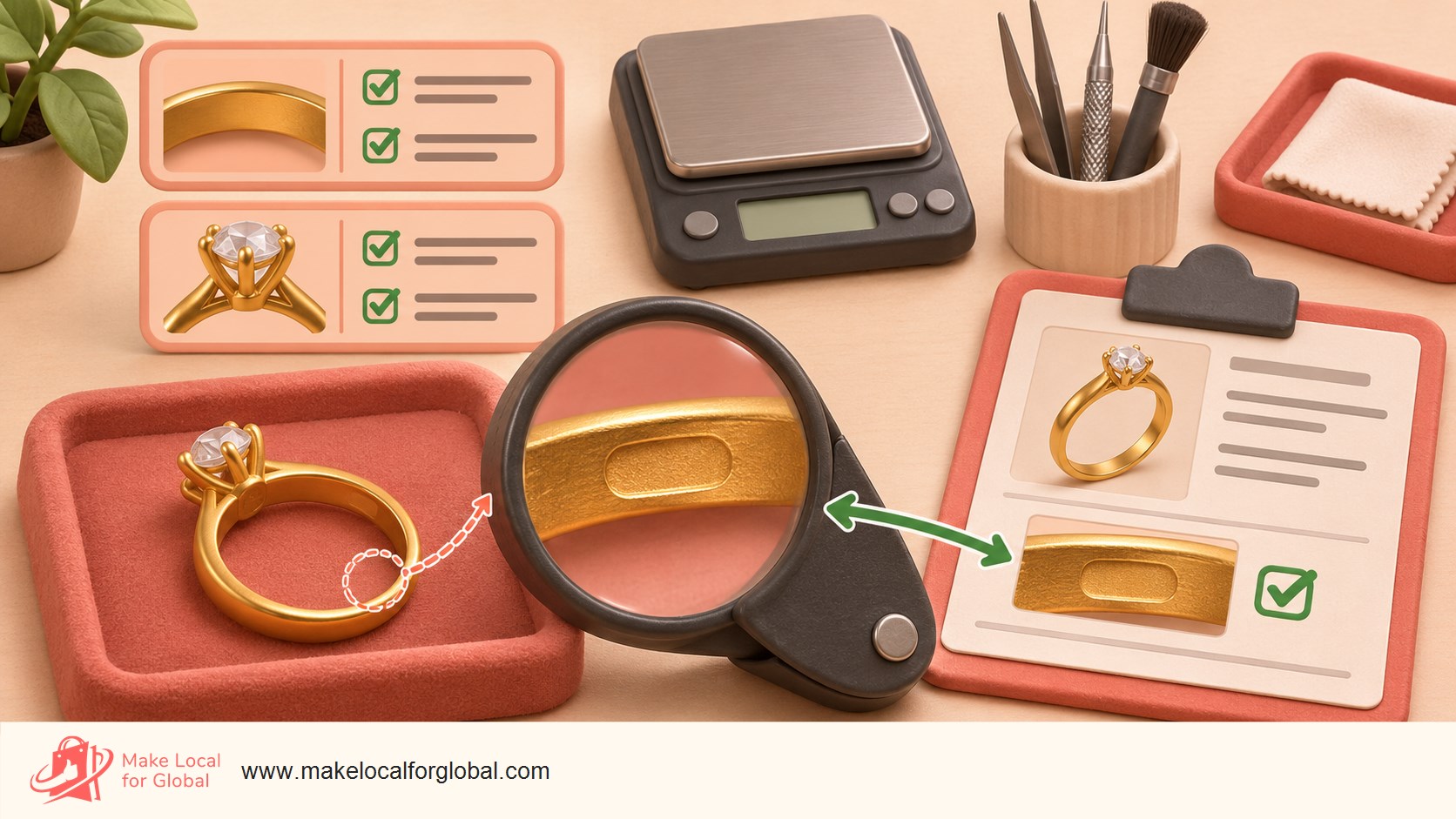
Keep tests within the manufacturer’s care instructions. Do not scratch, file or apply chemicals to sale stock to prove that it is genuine. A home test may damage the piece and can give a misleading result. Use an Assay Office for testing and hallmarking questions.
The Hallmarking Act 1973 makes it an offence in the course of business to describe or supply an unhallmarked article as being wholly or partly made of a protected precious metal, subject to exemptions. This applies to online selling. The British Hallmarking Council’s business guidance on hallmarking says online retail sites must prominently display explanatory information about hallmarks. It identifies the Dealers Notice A or the online Dealers Notice B as routes for doing this.
For gold, the general compulsory-hallmark threshold is an article weighing at least 1 gram. The threshold is not permission to use an inaccurate description on a lighter piece. Check the exact exemption and product construction with the Hallmarking guidance summary and a UK Assay Office. Some mixed-material, imported or unusual designs may need specialist advice.
A full UK hallmark has three compulsory elements: a registered sponsor’s or maker’s mark, a metal and fineness mark, and an Assay Office mark. A date letter is optional. A hallmark verifies precious-metal fineness under the relevant regime; it does not grade the design, stone, polish, workmanship, resale value or condition. Explain that distinction in your product information.
| Common gold description | Fineness mark | What the number describes |
|---|---|---|
| 9 carat / 9ct | 375 | At least 375 parts gold per 1,000 parts of alloy |
| 14 carat / 14ct | 585 | At least 585 parts gold per 1,000 parts of alloy |
| 18 carat / 18ct | 750 | At least 750 parts gold per 1,000 parts of alloy |
| 22 carat / 22ct | 916 | At least 916 parts gold per 1,000 parts of alloy |
| 24 carat / 24ct | 999 | At least 999 parts gold per 1,000 parts of alloy |
This table is a plain explanation of common descriptions, not a substitute for the official standards, full hallmark or product evidence. Check the mark on the item and use the exact description shown by its documents. Do not convert a karat figure from another market to a UK hallmark without verification.
Some articles may bear a legally recognised Convention mark rather than a UK assay-office town mark. The UK guidance explains that Convention marks from member countries may be recognised for sale in the UK. Ask the supplier to identify the hallmark type and check that it is valid for the exact piece.
Gold plated silver is not solid gold. The silver base must be part of the product description, and when a gold fineness is used, the words “gold plated” must follow it directly. The official permitted-description guidance for gold plated silver gives examples, including the form “18ct gold plated silver ring”. It says gold plated silver articles are hallmarked as silver where hallmarking applies.
Ask for the base metal, coating details and approved description before listing plated pieces. Avoid “18ct gold ring” if the article is silver with a surface layer. Do not mark a plated silver piece with a standalone gold fineness stamp that can imply it is solid gold. Keep a record of how the supplier’s wording was checked against the official rules.
When a gold plated base-metal piece is not precious metal, describe the base and coating precisely. Terms such as “bonded”, “filled” or “rolled” must match the product’s construction and the accepted description. If you cannot verify a term, use a simpler description such as “brass with gold-coloured plating” only when that accurately reflects the item.
For each stone, obtain the exact material, treatment and source description from the supplier. A photograph cannot show whether a stone is natural, synthetic, treated or imitation. If you use a grading term, ask for the grading report and check that it applies to the stone in the piece, not a similar batch.
Jewellery can sit against skin for long periods. Ask suppliers for product-specific evidence on metal composition and restricted substances where relevant, especially for posts inserted into pierced ears and parts that touch skin. Chemical rules differ between Great Britain and Northern Ireland. Read the HSE’s UK REACH overview for Great Britain and HSENI’s REACH guidance for Northern Ireland. Get qualified product-compliance advice when a piece includes nickel, lead, cadmium or another restricted substance. Do not market a piece as hypoallergenic without evidence for the exact model.
Create a folder or product record with the supplier name, invoice, item code, sample photos, metal description, fineness evidence, hallmark images, dimensions, weight, stone documents, care instructions, product page copy and return or repair terms. Note the date a document was checked and who confirmed the product details.
When a supplier changes a clasp, alloy, plating, workshop, stone source or hallmark, treat it as a new version until you compare the evidence. Pause the listing if the new version no longer matches the photos or description. Update the product file and online page before dispatching that version.
If a buyer reports a loose stone, broken clasp, irritation or a mark that does not match the description, record the item code and batch. Check other stock from the same order, contact the supplier and follow the relevant safety or consumer-protection process. Keep the affected item off sale during the investigation.
The price of gold jewellery is not the same as the value of its metal. A buyer pays for the design, alloy, stone, workmanship, service and delivery. Your cost includes the supplier price, inbound transport, hallmarking or finishing fees, insurance, packaging, payment fees, customer service, repairs, returns and marketing.
Start with a separate cost record for each item and variant. Record the supplier quote date, the period it remains valid and the price rule if the metal rate changes before production. For custom work, include design time, sample changes, setting, polishing, hallmarking and the cost of a remake if the customer’s approved size is wrong.
The figures below are illustrative only. They are not live gold prices, quotes or a margin promise. The example assumes one made-to-order bracelet sold for £339 with standard tracked delivery included. The business is not VAT registered, so the example does not include VAT calculations.
| Order line | Illustrative cost |
|---|---|
| Bracelet supplier price, including the metal and labour | £168.00 |
| Insured inbound freight per piece | £6.00 |
| Presentation box, pouch and tamper-evident outer packaging | £6.50 |
| Tracked and insured customer delivery | £12.00 |
| Payment processing | £10.00 |
| Expected returns, repair and size-adjustment allowance | £13.00 |
| Customer acquisition assigned to the order | £24.00 |
| Total variable cost | £239.50 |
| Customer payment for the order | £339.00 |
| Contribution before fixed overheads and tax | £99.50 |
The calculation is £339.00 less £239.50, leaving £99.50 before rent, insurance, software, accounting, owner time, income tax and other fixed costs. This is a contribution estimate, not net profit. A VAT-registered seller needs to recalculate sales and input costs using the tax treatment that applies to the product and business.
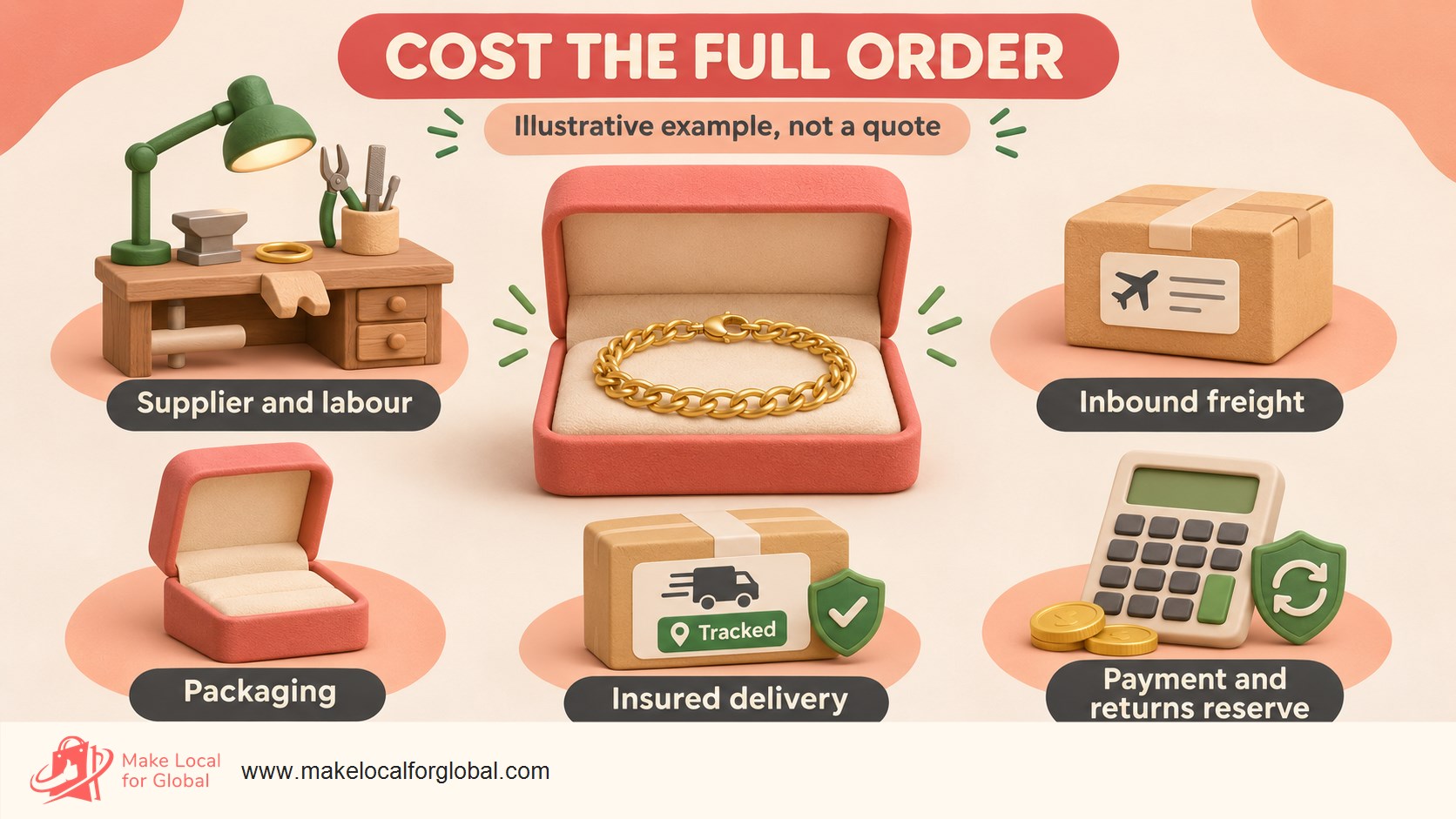
Replace each assumption with an invoice or carrier quote. If the supplier quotes in another currency, account for the exchange rate and payment charge. If a stone setting or hallmarking fee is billed by the batch, divide it using a consistent method and keep the working. Do not calculate a percentage margin from the metal content alone.
Gold costs may change between the sample quote and final production. Ask the supplier how long a quote stays open and whether the unit price changes if the metal rate, exchange rate or order date changes. Agree the trigger for a revised quote in writing. Keep the agreed customer price fixed after accepting an order. Review how your terms and applicable law handle supplier price changes before taking future orders.
Separate the cost of metal from the labour and design fee when the supplier provides those lines. That split helps you see which part changes when the metal rate moves. If a supplier provides only one price, ask for a quotation with an expiry date and the included services. Keep the chosen rate, date and invoice with the SKU record.
Use a small scenario table for each piece: expected cost, a higher supplier cost, and an order with a size change or repair. If the higher-cost scenario removes your contribution, change the design, price, supplier or delivery plan before advertising the item. Do not make the page sound like a metal-price forecast.
For a bespoke ring, price sample work, sizing, stone setting, hallmarking, final polish, insured dispatch and one likely adjustment. Decide which alterations are included and what a further change costs. State the customer approval point before manufacture. Keep screenshots or messages that record the selected size, engraving and stone.
For a gift set, include the cost of the box, card, ribbon, storage and any custom note. A presentation upgrade can add a larger parcel or more packing time. Ask a sample buyer whether the box can be stored safely and whether the item is easy to present without disturbing its certificate or care card.
Enter the supplier price, insured freight, packaging, payment fees, delivery and a realistic repair allowance. Compare a ready-made piece with a made-to-order version before placing a larger order.
Precious-metal buyers compare more than colour and price. Put the material, fineness, hallmark, dimensions, weight, stone details and delivery terms where a customer can find them. Use a specific title such as “9ct yellow-gold curb chain, 45 cm” only when each detail is correct for that SKU.
The first paragraph should identify the item and its actual construction. A product description can explain the setting, profile, finish, clasp, length, ring width and care. State whether the measurement is nominal or measured on a sample. If a stone is treated or lab-grown, use the supplier’s documented description.
Show the hallmark clearly in at least one close-up where the marks are visible and the photo represents the sold item. A hallmark image is useful product information, but it does not replace the explanatory Dealer’s Notice required for online retail sites. Link to the notice or display it prominently on the site as directed by the current hallmarking guidance.
Photograph each item against a neutral background with consistent light. Use a front view, a side view and a close-up of the hallmark, clasp, setting and stone. A hand, neck or ear can show scale when the model’s size is stated. Do not retouch out a hallmark, use a render as though it is a photo of the finished item or alter the gold tone so that different pieces look identical.
Use a plain ruler or dimension graphic in one image, then repeat the measurement in text. A chain photo cannot show whether it is 40 cm or 55 cm. A ring photographed from above does not communicate band width or profile. Show the back of a pendant if its construction, bail or mark matters to the buyer.
For matched earrings, photograph both pieces and state whether the quoted weight is for the pair or one earring. For a chain, show the clasp closed and open. For a ring, show the hallmark and profile, then put the available sizes beside the selection field. Use a clear caption that adds a useful detail rather than repeating the product name.
Add descriptive alt text to each image, such as “18ct yellow-gold pendant with the hallmark beside the rear bail”. Do not pack alt text with repeated search phrases. If a hallmark cannot be read in the photo, say what the image actually shows rather than implying the image proves its authenticity.
A well-organised specification list can include:
Use the same specification in the listing, checkout confirmation, invoice and product insert. A different title on the receipt can confuse a return or hallmark query. If a product is made to order, show which choices are personalised and when the buyer must approve them.
Make a short care guide that matches the supplier’s instructions. Describe safe storage and cleaning without promising that a finish will never wear. Gold plating can wear with use; tell the buyer what care the manufacturer recommends. Do not claim waterproofing, tarnish resistance or suitability for sensitive skin on a supplier statement alone. Use those descriptions only when evidence supports them for the exact model.
Gold jewellery can fit in a small parcel, but the item value raises the cost of a lost or damaged order. Check the carrier’s current conditions for precious metals, compensation limits, tracking, signature and insurance. Some services exclude certain valuables or set a maximum compensation. Confirm coverage before selecting a label, and retain the policy wording with the order record.
Pack each piece so it cannot move, rub against another item or be identified from the outer package. Use a fitted box or pouch inside a plain outer mailer, include the care card and order record, then test the parcel with a sample. A gift box alone may not protect a delicate chain or stone during delivery.
Measure and weigh the parcel after all packaging is included. Check that the carrier’s service accepts the destination, value and parcel size. Price domestic, remote-area and international orders separately. If you export, check the destination’s customs, tax, hallmark recognition, returns route and any documentation needed before offering shipping at checkout.
Keep proof of packing and dispatch for high-value orders. Record the item’s product code, hallmark, condition, parcel weight, tracking number and delivery confirmation. For custom items, photograph the finished piece and pack-out. Do not photograph sensitive customer data or make a dispatch proof image public.
Tell buyers when dispatch begins, what tracking they receive and how an address correction is handled. Avoid promising a delivery date that the carrier cannot support. For a gift occasion, give a conservative cut-off and state when the parcel leaves your workshop or supplier.
An ecommerce website lets you control the product page, information about hallmarks, size guidance, support and repeat-customer experience. That choice requires you to attract visitors, keep stock accurate and answer questions. A marketplace can give you an existing checkout and product discovery, but its fees, listing fields, delivery rules, returns and precious-metal policies vary. Read the current terms before you choose a channel.
A studio appointment or craft market can let a buyer see the finish and hallmark in person. It has venue, staffing and payment costs, plus stock transport and security considerations. Use in-person feedback to improve the online page. Ask before taking customer photos or using someone’s comment in marketing.
Compare channels on cost per sale, ability to show precise material details, order value, payment risk, return process and how quickly a product question receives a response. Keep enough margin for secure delivery and customer support on every channel. Avoid running a discount before you know the contribution left after the discount, fees and insured postage.
Each product page should use its own product phrase and details. A page for a 9ct chain can cover length, clasp and finish. A page for a gold plated silver ring can explain its base metal and surface layer. Do not use the same title and description for every carat, size or colour.
Write a helpful page title, short description and URL around the product a buyer is viewing. Add related terms naturally in the copy only when they describe the item. Do not call a chain “18ct” if its hallmark is 9ct. Do not attach a diamond phrase to a ring that has a different stone.
Use internal links where they help the buyer compare a related product. A customer choosing a precious-metal ring can read our diamond rings guide for ring sourcing and presentation ideas. A small workshop planning a made-to-order line can explore custom jewellery. For a contrasting material-led range, see our article on crystal jewellery. Keep each link in a relevant sentence.
Create supporting pages from buyer questions: how to measure ring size, how to read a hallmark, what “gold plated silver” means, how to care for a chain, how to choose a necklace length and what to check on a stone report. Link each answer to the product page it helps. Use original photos of your actual stock.
Track search impressions and page visits alongside questions, size selections, orders, delivery problems, returns and repairs. If people reach the page but ask whether the item is solid gold, make its material description more visible. If they add an item to the basket and leave when delivery appears, test a different shipping policy or order threshold using real carrier costs.
Publish a returns process before taking an order. Explain how to request a return, where to send the item, which packaging to keep and how to contact you. State the timeframes and refunds that apply under consumer law. Do not use a blanket “no returns on jewellery” rule.
Online customers can have a cancellation right even when a piece is not faulty. GOV.UK explains the rules for accepting returns and giving refunds and for online and distance selling. Some made-to-order or personalised products can fall within a cancellation exception, but the exact item and order matter. Check the current rules before applying an exception. Faulty or misdescribed goods have separate rights under the Consumer Rights Act 2015.
Record a returned item’s condition and hallmark before it moves back into stock. Check the clasp, setting, surface, stone and packaging against the dispatch record. Keep a damaged or altered item out of sale until you have assessed it. For an item requiring repair, agree the work and any charge with the customer in writing.
For a ring size exchange, decide whether the item is adjustable, whether the supplier can resize it and how resizing affects a hallmark or stone setting. Do not promise that every design can be resized. Explain who pays each delivery leg and whether the customer receives a replacement size or a refund under the applicable terms.
If a customer disputes the fineness or a hallmark, ask for the product code and clear photos of the marks. Compare those details with your supplier record and the item returned. Contact the Assay Office or Trading Standards for direction if the problem could affect other stock. Keep the investigation notes and any corrective action.
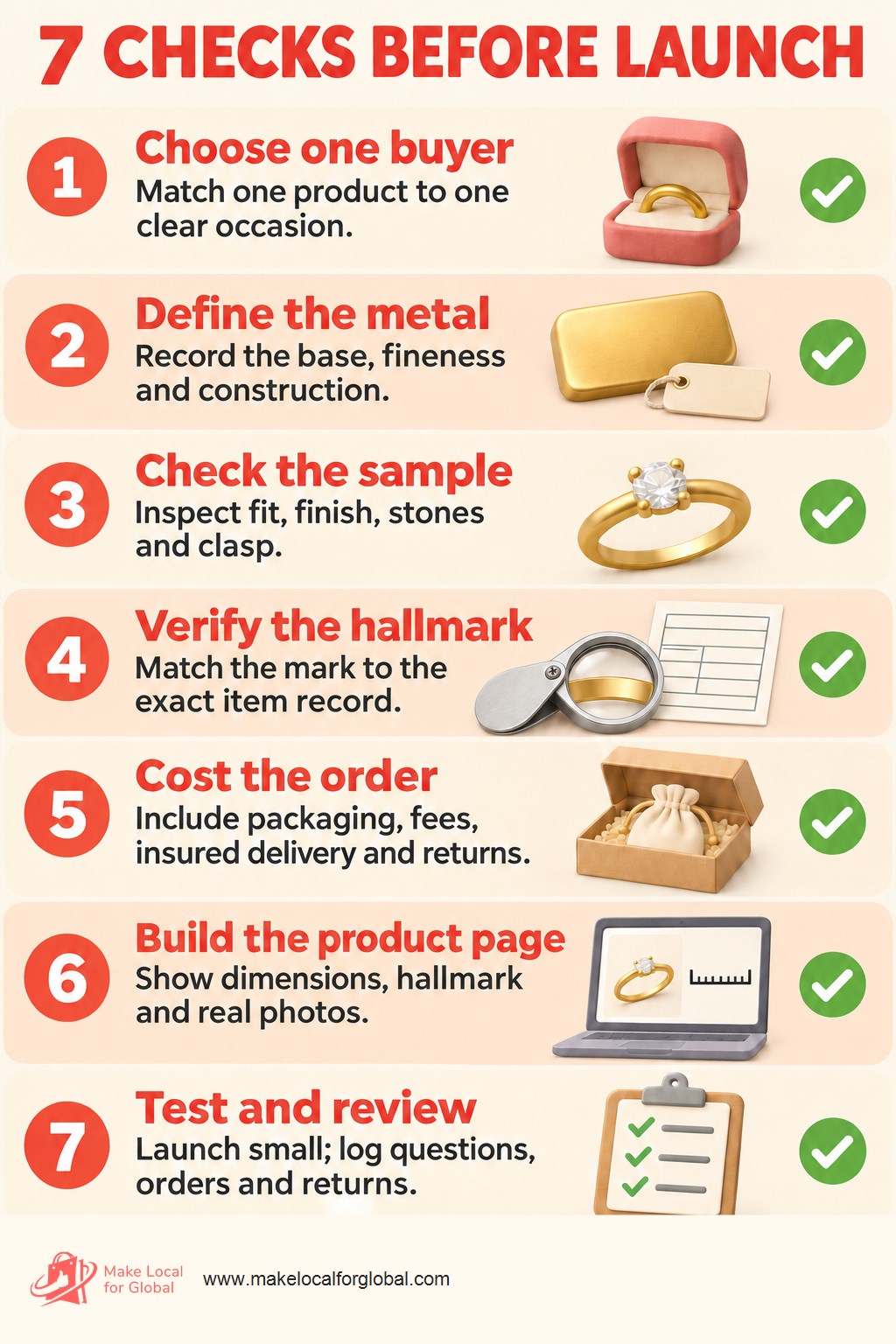
Pick a buyer, an occasion and a product type. Decide whether the first range will be solid gold, gold plated silver, ready-made or made to order. Write a one-sentence product promise that uses accurate material wording. List the parts of the offer you can prove: fineness, hallmark, dimensions, stone details, delivery and care.
Speak with potential customers and show real samples if you have them. Ask what details they compare, which price feels plausible for the specific piece and what would prevent an order. Record questions about hallmarking, ring sizes, chain length, gift wrap, delivery and returns.
Contact suppliers using the same checklist. Ask for samples, exact product codes, metal and stone evidence, minimum order, lead time, quote validity, payment terms and repair process. If a supplier makes an own-brand offer, ask the Assay Office whether you need a sponsor’s mark.
Inspect the finish, clasp, setting, hallmark, dimensions and weight. Compare each mark with the supplier’s records. Photograph the sample and save the model code. Check that product terms such as 9ct, solid gold, gold plated silver and vermeil match the evidence and UK descriptions.
Draft the Dealer’s Notice or online hallmark information required for your retail site using current Assay Office guidance. Ask a qualified product adviser about any unresolved product-safety or chemical-material question. Do not publish a fineness or stone claim that you cannot support.
Get current supplier and carrier quotes. Enter packaging, insurance, payment fees, marketing, repair allowance, expected returns and tax treatment in the cost sheet. Compare ready-made with made-to-order costs. Choose a price that leaves the contribution you need after variable costs.
Write the title, material description, size or dimension details, hallmark information, stone specification, care, dispatch time and return route. Add photos of the front, back, hallmark, clasp and on-body scale. Ask a person unfamiliar with your product to find the fineness and delivery details without help.
Publish a small number of pieces and check mobile checkout, stock levels, order confirmation and tracking. Start with a customer group that matches the range. Share an accurate product image and a useful detail about the piece rather than making a broad claim about status or future value.
Review every question, order, cancellation, size request and delivery exception. Record the reason for an exchange or repair. At the end of the month, decide whether to reorder, adjust the product page, change a size or discontinue a style. Treat a short test as evidence for another step, not proof that a large collection will sell.
A yellow surface does not prove the piece contains gold. Ask for the construction and write the base metal into the product description. Follow the approved wording for plated silver. Keep a supplier record to support the claim.
An item can carry a number or logo that resembles a fineness mark but does not form a recognised hallmark. Read the three compulsory marks and check the assay-office or Convention route. Ask a specialist when the mark is unclear.
A hallmark concerns precious-metal fineness. It does not verify stone origin, design quality, plating life, clasp strength, repairability or resale price. Keep evidence for each separate statement on the product page.
A supplier quote can expire or change with the material price. Record the date and validity, then review the cost before accepting a new production order. Do not advertise a fixed lead time or price if the supplier can revise it without notice.
A highly magnified mark is hard to understand if the customer cannot tell where it sits on the item. Add one clear full-piece photo, one location view and one close-up. Repeat the metal information in readable text beside the images.
A small box can still carry a high-value item. Check the carrier’s precious-metal cover and claims process. Cost the return route, size adjustment and repair allowance before selecting a low delivery charge.
The Hallmarking Act 1973 applies to online sellers. Gold articles that meet the relevant weight threshold and are described as gold normally need a legally recognised hallmark, subject to exemptions. The current guidance summary gives a 1 gram threshold for gold. Check the exact article and any exemption with a UK Assay Office.
A full UK hallmark has a sponsor’s or maker’s mark, a metal and fineness mark and an Assay Office mark. The fineness mark records parts of gold per thousand. A date letter can be included, but it is optional. The hallmark does not certify the stone or all details of the design.
Use a clear description that identifies the silver base and says “gold plated” when referring to the gold layer. The British Hallmarking Council’s current published guidance gives permitted examples and restrictions on standalone gold fineness marks for plated silver. Check the exact wording before listing the piece.
Choose a piece you can source, describe, photograph, hallmark-check and ship consistently. A single chain, pendant, simple hoop or a narrow wedding-band range may be easier to test than a large collection with many stones and sizes. Use actual buyer questions and supplier evidence to make the choice.
Add the supplier price, metal and labour cost, inbound freight, hallmarking, packaging, insured customer delivery, payment fees, marketing, returns and repair allowance. Use a dated quote if the supplier price can change with metal rates. Compare customer revenue with all order-level costs, then account for overhead and tax separately.
Photograph the complete item, the location of the hallmark and a clear close-up. Add the exact metal and fineness in text. Display the online Dealer’s Notice or explanatory hallmark information required by the British Hallmarking Council. A photo of a mark is product detail, not a substitute for the site information.
Some personalised or made-to-order goods can qualify for a cancellation exception, but the order details matter. Explain the production and cancellation terms before purchase, and check current guidance. Faulty or misdescribed items have separate legal rights.
Show the full piece, the clasp or setting, the hallmark, key measurements and an on-body or hand-scale view. Use consistent light to show the metal colour. State whether the shown box, chain or pendant is included.
A trustworthy gold jewellery shop makes its material descriptions precise, shows the hallmark, explains the dimensions and prices the delivery promise. Start with samples, verified documents and a small range. Keep a record for every version and use the first customer questions to improve the product page.
If you are building a specialist jewellery shop, compare the decisions in our guides to selling diamond jewellery, custom jewellery and antique jewellery. Each category brings different sourcing and product-information questions.
Keep the range small, write down every sizing or hallmark question and use the next restock to solve the issues buyers actually raise.
PREFERRED SOURCE
Like what you’re reading? Add Make Local for Global as a preferred source on Google to see more of our articles when you search.

Build your online presence without having to figure out everything yourself.