

READY TO SELL diamond jewellery ONLINE?
Get a store built for you in 5 days, plus training and support to help you start, run, and grow your Alternative business.

Plan a focused diamond-ring range, verify every stone and setting, explain UK sizing, calculate each order and protect high-value delivery.


To sell diamond rings online, you need to give buyers enough clear evidence to compare a stone, setting, metal and ring size before they pay. The listing should identify whether the diamond is natural or laboratory-grown, match the individual stone to its report and explain how the finished ring is sized, delivered and returned.
A ring is a high-value purchase with several connected decisions. A change in carat weight can alter the price and appearance; a different setting changes the profile and maintenance; a different size can require a resize or a new made-to-order piece. Build a small range around those real differences, keep the evidence with each item and cost the complete order before setting a price.
This guide is for UK sellers considering ready-to-ship, made-to-order or pre-owned diamond rings. It covers sourcing, stone reports, UK ring sizing, precious-metal hallmarks, product photography, pricing, returns and secure delivery. Rules can differ by location and transaction, so check the current guidance for the countries where your business and customers are based.
The Single Product Product Page Assessment covers evidence, pricing, delivery and mobile usability for a first listing.
“Diamond jewellery” covers several very different products. A buyer looking for an engagement ring has different questions from someone choosing small diamond studs, a wedding band or a pendant for an anniversary. Each product needs its own sizing, photographs, inventory plan and customer support.
Choose a first segment by describing the person, purchase and price band you can serve. For example, you might focus on simple lab-grown diamond studs for milestone gifts, natural diamond engagement rings with a short list of settings, or pre-owned rings with verified reports and condition grading. Avoid combining all three on one product page. Their source, price, evidence and buying questions are different.
Write a one-sentence offer before you contact suppliers: “We sell [type of item] for [buyer or occasion], with [clear proof or service] at [price range].” Replace the brackets with choices you can support. A clear promise such as “each listed stone has an independent report and a matching inscription” is useful only when you check every stone and can show the evidence. Do not use claims about ethics, origin, rarity or value without paperwork to support them.
Set a cash limit for samples, stock, reports, packaging, insurance and marketing. Diamonds can consume working capital quickly, and an unsold stone may not be easy to return to a supplier at the price you paid. Decide what must remain in cash for tax, refunds and restocking before you approve a first order.
If your first offer involves custom settings or a wider design service, compare the extra production and sizing work with a simpler ready-to-ship range. Our guide to selling custom jewellery online can help you think through customer briefs, production steps and pricing for made-to-order pieces.
Choose a buyer whose questions you can answer well. A proposal buyer may need help comparing stone shape, carat weight, ring size, setting security and a realistic delivery date. A gift buyer may value a ready-to-ship item, clear packaging photographs, a gift note and a simple exchange process. Someone shopping for everyday wear may care more about low-profile settings, comfortable posts or a pendant chain length. Sellers planning for wedding purchases can compare the buyer questions in our guide to selling bridal accessories online.
Do not treat “people who like diamonds” as a useful audience definition. Select a purchase moment and learn what the buyer needs to decide. Read search queries in Search Console if you already have traffic, review customer questions from related products, and speak with a small number of prospective buyers. Ask what they would need to see before paying, which detail feels confusing and what would stop them from trusting a new seller.
Record the answers in a short research sheet. Useful columns include the buyer’s occasion, preferred item, budget range stated by the person, unanswered concern, words they use for the stone and the evidence they expect. Keep a note that responses from a few conversations are directional feedback, not proof of broad demand.
Check search results for phrases such as “diamond stud earrings”, “lab-grown diamond engagement ring”, “pre-owned diamond ring with report” and the specific shape or metal you plan to sell. Search language differs by country. A UK product page should use British spelling in its customer-facing copy, then include a natural variant only where it reads clearly. Do not repeat every phrase in the title or headings.
Compare the questions on competing listings, not just their prices. Note whether they show the report, identify the stone as natural or laboratory-grown, give measurements and provide a return policy. A gap in their explanations can suggest a useful content angle, but it does not prove that buyers will pay for your range.
There are four common starting models. You can buy finished jewellery from a trade supplier, buy loose stones and have a setter make each piece, commission a manufacturer to make a design, or sell pre-owned pieces that you have acquired and checked. Each model changes how much control you have and where the work sits.
Finished pieces may reduce production coordination, yet you need accurate item-level records. A batch of similar rings can contain different stones, weights, reports and hallmarks. Match each item to its own listing and packing record. Never let an order-management shortcut substitute one stone for another when the photographs look alike.
Buying loose stones and commissioning settings gives you more control over the final design. It adds work around measurement, setting compatibility, resizing, repair, manufacturing lead time and responsibility for the finished piece. Agree who carries the risk if a stone is chipped during setting, who checks the ring before dispatch, what happens when the ring size is wrong, and which report belongs with the finished item.
Made-to-order production can limit finished stock, but it does not remove the need for cash planning. You may need to pay a supplier before the customer’s balance clears. Give a realistic dispatch window, explain what is made to the buyer’s specification and keep a buffer for a setting delay or a replacement stone. Do not label an item “in stock” when you have not reserved the exact stone.
Pre-owned jewellery may have an attractive story and an identifiable design, but condition, repair history and metal content need careful checks. Record missing stones, worn claws, solder repairs, scratches, replaced settings and any work completed. For high-value pieces, ask an independent professional to inspect the item before you set its description or price.
For each model, map the order from supplier to buyer: who owns the stone at every step, who insures it, where it is stored, how it is tracked and who pays if it is lost. Put the answers in writing before accepting a deposit or promising a delivery date.
Begin with evidence that costs little. Interview prospective customers, publish a simple landing page with a waitlist, share actual sample photographs with a small relevant audience, or show a tightly scoped price-and-specification concept to people who might buy it. Ask people to respond to the offer and the evidence, not just whether they like the design.
Useful observations include how many visitors inspect the product details, which ring settings they compare, which stone reports they open, what questions arrive and whether a visitor takes a meaningful next step. A positive reaction to a picture is not the same as a sale. A sign-up is not revenue, and a paid order is not proof of a profitable range if shipping and returns erase the margin.
If you accept pre-orders, state the expected delivery date, what is available, how the customer’s money is handled and what happens if the supplier cannot deliver. Confirm stock with the supplier before you advertise a stone as reserved. A deadline can help a buyer plan a gift, but an invented countdown or false scarcity damages trust.
Use a small sample order to check the supplier process and the content you can create. Ask whether the sample price is refundable against a larger order, whether the exact stone can be held and how long the hold lasts. Avoid buying several variations before you know which detail matters to the customer.
Write a stop rule in advance. For example, after a set number of interviews and a fixed test period, pause if no one can explain the value of the offer, if most questions cannot be answered from supplier paperwork, or if the contribution at your planned price is below your minimum. A clear stop rule prevents an attractive sample from becoming a costly range by default.
Create a range around one decision at a time. If you sell stud earrings, decide whether the first range is natural or laboratory-grown, then select a few stone sizes, cuts and metal choices. If you sell engagement rings, start with a limited set of settings and a manageable choice of stone shape and size. Every option you add multiplies the number of details you need to verify, photograph and support.
Separate differences that affect the product from differences that are only colour or style. A yellow-gold and white-gold version may share a design, but their metal description and hallmark evidence still need to match. A natural and laboratory-grown diamond are both diamonds, yet they are distinct product identities and should not be mixed in one ambiguous variation dropdown.
For each product, record the exact item code, stone source, natural or laboratory-grown status, shape, carat weight, measurements, colour and clarity grades where reported, cut grade where applicable, treatment details, report number, metal fineness, hallmark status, setting, size, supplier cost and lead time. Add the physical location of the item and the date it was last checked.
Consider three price positions only if you can explain the change in evidence and design. A lower-priced item might use a smaller stone or a simpler setting. A central option might offer a particular shape and finish. A higher-priced option may include a larger stone with an independent report. Do not imply that a higher price guarantees better durability, investment value or ethical sourcing.
Use bundles only when the items fit a real buying occasion. A pendant and earrings set can work for a gift range if both pieces match in metal, stone identity and documentation. Work out whether the combined price covers the packaging, gift card and potential return of only one item. Set a clear policy for a partial bundle return. Our bracelets selling guide offers another example of planning related jewellery into a focused range.
A diamond is a material; a report is evidence about a particular stone. Keep those concepts distinct. A grading report should be tied to the stone being sold, and the report number, measurements and any girdle inscription should match what you can inspect. A report is not a retail valuation or a promise that you can resell the stone for a stated amount.
For a graded natural diamond, record the laboratory, report number, issue date, shape and cutting style, carat weight, measurements, colour, clarity, cut grade where provided, polish, symmetry, fluorescence and comments about treatment. The exact fields vary by report type and stone. A colour or clarity grade from one grading system should not be presented as if a different laboratory issued it.
For a laboratory-grown diamond, state “laboratory-grown” or “lab-grown” prominently in the product title and description. Do not rely on a tiny note below a price or use an image that implies natural origin. The Gemological Institute of America explains how laboratory-grown diamonds are identified; conventional visual inspection alone may not reliably distinguish them from natural diamonds. Ask a competent gemmological laboratory or suitably qualified professional when the identity is uncertain.
Do not call cubic zirconia or moissanite “diamond”. They are different materials. If you list them, name the material in the title, first paragraph, specification table and image description. Use “untreated” for a diamond only when you have evidence for that specific stone. If a supplier report records a treatment, explain it in plain language and keep the report accessible to the buyer.
Where a report is supplied, link to the report check service run by the laboratory when one exists. Compare the report data against the stone rather than matching only the number. Keep a copy of the supplier invoice, report, parcel note and inspection record with the item’s inventory entry. If you use a lab-grown report, check the lab’s own terminology so your product page does not convert a quality assessment into a claim the report did not make.
If you cannot verify origin or treatment, stop the listing and ask the supplier for clarification. A stone tester can be a useful screen for some questions, but do not describe a basic thermal or electrical tester as proof that a diamond is natural. For a high-value piece, pay for an independent identity check before you commit your own reputation to the claim.
The four Cs are a useful vocabulary, not a substitute for showing the stone. Carat is a unit of weight. It does not describe face-up size by itself: two stones with the same carat weight can have different measurements or proportions. Give millimetre measurements when the supplier or report provides them, and use a photograph that gives buyers a sensible scale reference.
Shape describes the outline, such as round, oval, pear, emerald or princess. Cut grade is a separate assessment and depends on the report and stone type. Not every report provides an overall cut grade for every shape. Do not assign “excellent cut” yourself from a catalogue photograph or apply a round-brilliant grading scale to a non-round shape without evidence.
Colour and clarity grades can be difficult for a first-time buyer to picture. Explain the grade shown on the actual report, then add useful context such as the setting colour or the way the stone appears in daylight. Avoid presenting a grade as a visible guarantee in every lighting condition. Product photography should help a buyer see the real item, not simulate a larger or brighter stone.
Match pairs of earrings by the supplier’s stated criteria and inspect them together under consistent lighting. Record carat weight as total pair weight or per stone, whichever is correct, and label it clearly. For a three-stone ring, show whether the stated total carat weight includes side stones. These details prevent a shopper from comparing unlike specifications.
Use close-ups, side profiles, a scale reference and video where practical. Keep the original files and name them for the product and view, for example `oval-lab-grown-ring-front.jpg` and `oval-lab-grown-ring-side.jpg`. Add concise alt text that describes what the image shows. Google’s image search guidance recommends descriptive filenames and useful alt text; write for screen-reader users first and avoid repeating the keyword in every image field. If someone chooses coloured mineral jewellery instead of a diamond, our crystal jewellery seller guide covers that separate product category.
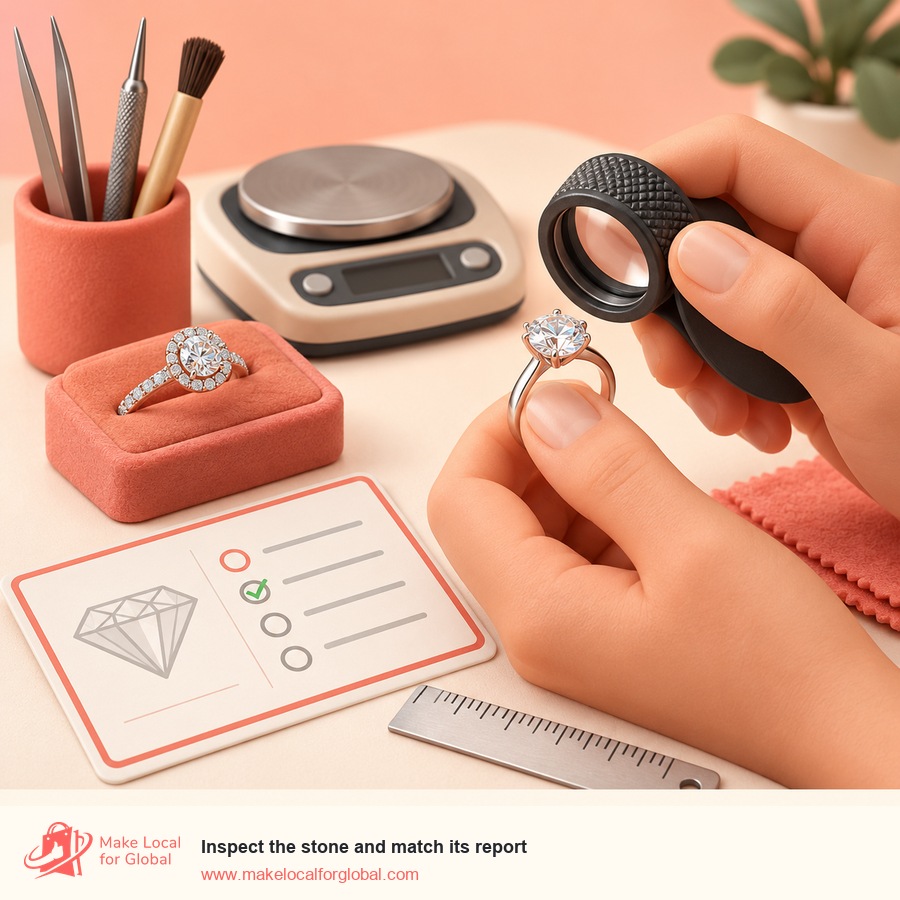
Inspect a sample before taking orders for a design. Under bright, neutral light, look at the stone from the face, side and back. Check whether it sits straight, whether its appearance matches the photographs and whether the setting has sharp edges or visible damage. Use a loupe only if you know how to inspect with it; a short inspection cannot replace a professional appraisal or laboratory test.
Look closely at claws, bezels, posts, clasps, solder joints, chain links and any moving parts. On a ring, check that the band is round, the stone is secure, the setting sits comfortably and the finished ring size matches the supplier’s record. On earrings, inspect both pieces as a pair. On a pendant, verify the chain length, clasp and bail opening.
Measure the actual item and compare it with the product page. If the supplier’s size chart is unclear, request the method used and test a sample against it. List UK ring sizes in the form buyers expect, state whether a resize is possible and give the likely cost and lead time. A ring size is not a stone measurement, and a resize can affect a setting or warranty.
Make the sizing route useful for both self-purchases and gifts. Explain whether a listing is ready-to-ship in one size, available in several sizes or made to order, and whether resizing is offered after delivery. Ask the supplier or jeweller what a resize involves for that setting and metal before quoting a fee or turnaround. Do not guess a buyer’s ring size from a photo, a partner’s height or another ring with a different fit profile; show the sizing options and give customers a way to ask before ordering.
Check the metal description, hallmark and paperwork on the finished piece. If a ring has been altered or resized, ask whether the work affects the existing hallmark or requires a new check. Do not polish away a mark or alter a piece before documenting its condition. For a pre-owned item, record wear and repairs in the listing photos and notes.
Create a pass/fail sample sheet. Include stone identity, report match, measurements, setting security, finish, fit, metal mark, packaging and photography. Photograph any defect and send the evidence to the supplier before accepting a larger shipment. A sample that fails one critical identity or safety check should not be sold on the strength of its other features.
Hallmarks relate to precious-metal content, not to the diamond itself. In UK trade, descriptions of gold, silver, platinum or palladium articles are subject to hallmarking rules above set weight limits, with exemptions. The government’s hallmarking guidance lists minimum article weights of 1 gram for gold, 7.78 grams for silver, 0.5 gram for platinum and 1 gram for palladium. Check the full guidance for mixed-metal pieces and exemptions before making a legal decision.
A full UK hallmark has a sponsor’s or maker’s mark, a metal fineness mark and an assay office mark. A date letter is optional. The fineness number identifies the proportion of precious metal in the alloy; it does not describe the diamond’s quality. Use a close-up of the actual mark where it can be photographed and retain supplier paperwork that identifies the assay office and fineness.
Do not describe a plated item as solid gold or silver. Use the material term that accurately describes the base metal and plating. Check the rules for wording and type size if you describe an unhallmarked item as plated or rolled. If a supplier tells you that a piece is exempt, ask for the metal weight and basis of the exemption in writing rather than copying a generic catalogue label.
The legal description can apply to a piece that contains a precious-metal part, including an item with a base-metal component. For a mixed-metal ring, setting or chain, the relevant threshold and mark depend on the applicable rules. A piece below the minimum weight may be exempt from compulsory hallmarking, but you still need evidence for any metal-purity claim.
Before listing an imported or pre-owned piece, check its mark and description. If the item is above the relevant threshold and lacks an accepted hallmark, speak to an Assay Office about the correct route before offering it for sale. Do not try to solve uncertainty by writing “believed to be 18ct” or “unmarked gold” as though that removes the description issue. Keep the customer-facing copy accurate and ask Trading Standards or an assay office for case-specific guidance.
Ask a supplier for its registered business details, trade references, item-level invoices, product specifications, report access and returns terms. For each stone, ask whether it is natural or laboratory-grown, whether it has been treated, how the identity was verified, whether the report number is available and whether the exact stone can be reserved for your order. Ask a setting supplier which metal alloy is used and how the finished piece is hallmarked.
Request a sample before approving a production run. Confirm the sample is representative of the manufacturing method and stone grade you will receive. Some supplier catalogues show a representative item rather than the exact piece. If so, state this distinction clearly and obtain a photograph or report for each actual stone before putting it on your site.
Put responsibility for loss, damage and delay into the trade agreement. Confirm who owns the stone during setting, shipping and inspection. Ask whether the supplier’s insurance covers your goods in its custody, whether cover extends to your return parcel and how a claim is evidenced. Do not assume that the supplier’s policy protects your customer after dispatch.
Build an item record with supplier name, order date, invoice number, amount, item code, stone report, metal details, origin documentation where offered, condition, location and next action. Restrict access to reports and buyer data to people who need it. Keep buyer names and addresses out of photos that you use for marketing. Follow the records and data protection duties that apply to your business.
Be careful with sourcing claims. “Ethically sourced”, “conflict-free”, “traceable” and “sustainable” can mean different things to buyers and do not become accurate solely on the strength of a supplier’s wording. Ask what evidence supports the exact claim, which part of the supply chain it covers and when the check was last completed. The government’s Green Claims Code checklist says claims need clear, current evidence and must not hide important limitations.
The Kimberley Process rules concern rough diamonds. The UK government explains that rough diamond imports and exports need specified certificates and routes; see its special rules for exporting rough diamonds. A polished stone or finished ring follows different customs and sanctions checks. Ask a customs specialist to confirm the rules for your source country, product form and destination before placing an international order.
The Shipping and Delivery Mini Course covers six steps, from a realistic delivery promise to full order costs, tracking and exceptions.
Price from the complete order cost, not from a supplier’s stone price plus a guessed markup. Include the stone, setting or manufacturing, inbound freight, insurance, report costs, import charges where relevant, packaging, payment processing, customer delivery, returns, resizing or repair allowance, customer acquisition and the time needed for inspection and support.
Separate fixed overhead from per-order costs. Your website subscription, photography equipment, accounting support and storage may be monthly costs. A report fee, payment charge, box and insured dispatch usually relate to a particular item or sale. Contribution after variable costs helps pay the fixed overhead; it is not net profit.
The figures below are hypothetical, not supplier quotations. Assume the ring sells for £2,500 including standard-rate VAT. The business is VAT-registered, sells a standard-rated item and all cost figures below are business costs after any input VAT that is recoverable. Use an accountant’s advice for your own transaction and any import or second-hand arrangement.
| Order calculation | Illustrative amount |
|---|---|
| Output VAT at 20% of the VAT-inclusive price | £416.67 |
| Net sales value before VAT | £2,083.33 |
| Diamond and setting | £1,500.00 |
| Insured inbound freight | £35.00 |
| Protective and gift packaging | £16.00 |
| Payment processing, example fee on £2,500 | £62.50 |
| Insured customer delivery | £35.00 |
| Return, repair and resizing allowance | £50.00 |
| Customer acquisition cost for this order | £120.00 |
| Total variable business costs | £1,818.50 |
| Contribution before fixed overhead and tax | £264.83 |
Illustrative only. Replace these figures with supplier, payment and carrier quotes.
The arithmetic is £2,083.33 net sales minus £1,818.50 variable costs, leaving £264.83 contribution. That amount still has to help cover salaries, storage, software, professional fees, finance costs and unsold stock. It is not take-home profit.
If your business is not VAT-registered, do not remove output VAT from the price in this way, but input VAT on eligible costs cannot be reclaimed through a VAT return. If you are registered, the current UK registration threshold is based on taxable turnover; check the latest HMRC threshold guidance and registration rules. Do not apply a second-hand margin scheme to precious stones or precious-metal jewellery without specialist advice. HMRC says the scheme does not cover precious metals or precious stones in its margin-scheme overview.
Before you set a price, replace every illustrative line with a written supplier or carrier quote, the actual payment provider fee and your own return experience. Model a lower conversion rate, a replacement setting and a returned item that cannot be sold as new. If the price only works when no customer returns the piece, the plan needs a different cost, price or service model.
State whether VAT is included in the displayed retail price. Tell the buyer what comes in the box, whether the grading report is original or digital, whether a chain is included, what size is supplied and how delivery is insured. If an optional upgrade changes the metal, stone or delivery window, show the new total before payment.
Do not call a diamond jewellery item an investment or promise that it will hold or grow in value. A retail price is not a future resale value. If a buyer asks for an appraisal, explain who can provide one and whether it is a separate service.
Use a title that names the item, its diamond identity and the main differentiator. For example: “0.50ct Laboratory-Grown Diamond Stud Earrings in 18ct White Gold” is more useful than “Sparkle 04”. Only include a carat figure if you say whether it applies to one stone or the pair. Give each distinct item or meaningful variation its own title.
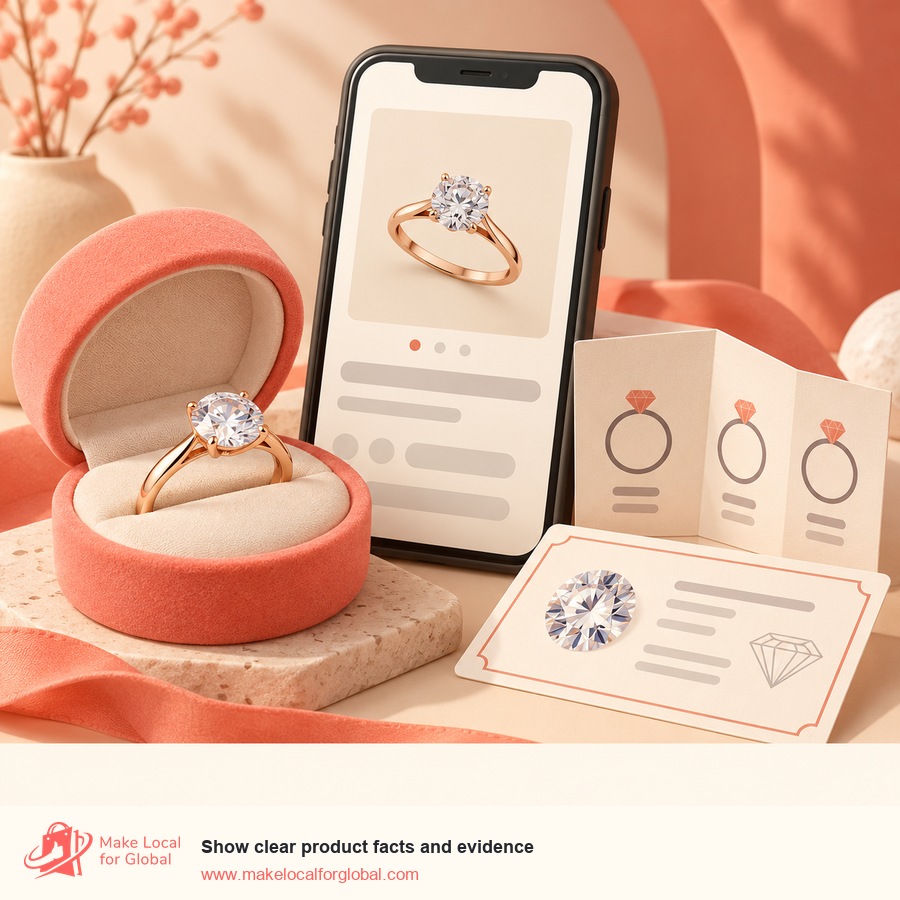
Put the core facts near the price: natural or lab-grown, stone count, total and per-stone carat weight, shape, measurements, reported grades, treatment statement, report number, metal fineness, hallmark details, size, dispatch timing, delivery cost and return route. If a field is not verified, say what is known and ask the supplier before listing. Do not replace missing evidence with a confident adjective.
Show the actual item from the front, side and back. Add a close-up of the hallmark, a scale reference and a short video under neutral lighting. If a report is visible in an image, mask customer or supplier information that should not be public. Make the phone version easy to zoom without placing the key facts in a graphic that cannot be read by a screen reader.
Add a clear description that answers: what is the stone, what is the setting, what does the buyer receive, who made or set it if you can verify that, how does sizing work, when will it dispatch, what does care involve and how does the buyer request a return or repair? Put the report beside the relevant stone and the hallmark detail beside the metal description.
Use descriptive image filenames and alt text. “Oval lab-grown diamond ring in 18ct yellow gold, front view” tells a screen-reader user more than “diamond ring best price.” Do not repeat the same alt text for each view. Captions can explain what a macro image shows, such as the setting profile or a hallmark close-up.
On actual product pages, keep structured product data, stock status, price, delivery and returns aligned with what the page visibly says. Google’s Product structured data guidance describes product markup for pages where people can buy a specific product. A general blog post about selling diamond jewellery is an editorial guide, not the product listing itself. Do not paste fabricated rating or review data into markup.
Give each product page one clear purpose. A page for a round laboratory-grown engagement ring should not compete with a general page about all diamond rings. Use the main item phrase naturally in the product title, the visible H1, a short first paragraph and useful image descriptions. Add exact specifications in a scan-friendly format instead of repeating the same phrase in every sentence.
Build supporting content around genuine buyer questions: how a grading report works, how to choose ring size, what a hallmark tells you, how natural and laboratory-grown diamonds differ, what is included in a pair of studs and how insured delivery works. Link each supporting page to the relevant items using descriptive link text. Link the product page back to the relevant sizing, report and returns information.
Use Search Console to monitor impressions, clicks, indexed pages and queries after publication. A title or description should help someone recognise the page and decide whether it answers their question. Google says search appearance is not guaranteed, even when a page meets requirements. Avoid promises of first-page placement, keyword stuffing, copied supplier descriptions and pages that swap only the product name but give the same thin advice.
For an editorial page, use a distinct title and meta description that describe the seller problem covered. The focus here is identifying stones, pricing a full order and protecting delivery. Use headings to explain those decisions, not to repeat a target phrase. Add internal links where the linked page gives a reader a useful next step.
An owned online shop gives you control over product pages, customer data and the path from search to checkout. It asks you to build trust and attract qualified traffic yourself. A marketplace can expose products to existing shoppers, but it sets its own category rules, listing requirements, payment process and fees. Read the current terms before choosing a platform; rates and high-value-item rules can change.
A physical appointment or local jeweller partnership may help a buyer inspect a stone and setting before paying. It brings appointment scheduling, display security, commission terms and stock reconciliation. If a partner lists the item, agree which photographs and descriptions are approved and who handles questions, returns, resizing and payment disputes.
Use a single inventory record as the source of truth. Mark the exact stone as reserved when a valid order arrives, remove it from other channels and check the item code again before packing. If a listing is made-to-order, do not present the stone as individually held until the supplier confirms the reservation.
Set a simple order review for high-value purchases. Confirm the stone and ring size against the order, check payment-provider alerts, use the verified delivery address and keep messages in the platform used for the sale. Follow your payment provider’s terms. Do not ask a buyer to send identity documents through an ordinary email account without a lawful, secure collection process.
Track a short weekly dashboard: visits to item pages, add-to-basket rate, completed orders, average contribution, questions per sale, returns, repair cases and stock days. If a page receives visits but no questions or orders, check whether its report, price or sizing information is missing before buying more traffic.
Use a parcel service and insurance policy that explicitly covers the full replacement value of the item and the route you sell through. Check exclusions for jewellery, precious stones, unattended delivery, international destinations and packaging. General parcel cover may cap the amount or exclude the item entirely. Get the carrier and insurer’s answer in writing before you advertise a delivery promise.
Use a small, rigid inner box that protects the setting, then a strong outer container with cushioning that prevents movement. Keep the invoice and product record separate from the jewellery box. Avoid an outer label that identifies a high-value item. Use a tamper-evident seal where your process supports it and record the seal or parcel reference in the order file.
Photograph the item and its report before packing, record its condition and capture the parcel weight. The images should show the actual order and not expose the buyer’s personal data. Use tracking and a delivery method that provides the proof your insurer requires. Confirm whether the customer must sign, whether a safe-place option is allowed and how a failed delivery is handled.
Prepare for a return before the first sale. Use a tracked, insured return route suitable for the item and explain the steps to the customer. On receipt, record the outer condition, seal, item identity, report and setting. If a returned ring has been worn, resized or altered, take clear photographs and follow consumer law before deciding the next step.
Stock packaging that can hold different ring and pendant sizes securely. Test the parcel with the box and printed documents, not an empty carton. Record actual packed dimensions and weight, since carrier pricing can depend on both. Include care instructions that avoid claiming a product is indestructible or maintenance-free.

For online sales, customers in Great Britain have a short period to cancel an order after delivery when the item is not faulty. Government guidance says they must tell you within 14 days of receipt and then have another 14 days to send the item back. You must provide required information before purchase and refund in the required period. Review the current online and distance selling rules and returns and refunds guidance before publishing your policy.
There is an exception for personalised or genuinely custom-made goods, but it only affects the change-of-mind cancellation right. It does not remove a customer’s rights if a piece is faulty, not as described or does not match the agreed specification. A standard product made after an order does not automatically qualify. Get advice on a bespoke order policy and explain the treatment of any deposit before taking payment.
State who pays return postage where the law allows you to do so, how to request a return, which packaging to use, when a refund is issued and how you handle an item that has been altered. Do not say “no returns on jewellery” as a blanket rule. A hygiene seal or custom work does not cancel statutory rights for faulty goods.
Create a separate repair process. Ask the customer to stop wearing a ring if a stone appears loose, send a photograph, and use an insured route that covers its value. Log who receives the item, its report number, the work approved, parts used and dispatch date. Tell the buyer what your warranty covers and how it sits alongside their legal rights; a warranty cannot replace those rights.
For a returned piece, verify the report and inscription again before restoring it to inventory. Record any change to the setting, size, condition or packaging. If an item was handled beyond what a buyer could do in a shop, the rules may allow a reduction for diminished value in some circumstances. Follow the current regulations and document the facts rather than applying an automatic restocking fee.
Use accurate descriptions for the stone, metal, treatments, origin claims, price, delivery and returns. UK government product-labelling guidance says claims must not mislead buyers about what a product is made of, its origin or the claims made about it. The Consumer Rights Act says goods supplied by description must match that description. Keep supporting evidence for every factual statement.
If your taxable turnover reaches the UK VAT registration threshold, you may need to register. The current HMRC VAT threshold page gives the latest figure and related rules. High-value jewellery, imports and pre-owned stock can have complex VAT treatment. The second-hand margin scheme is not available for precious stones or precious metals, so do not assume that a used diamond ring can be taxed on its margin. Ask an accountant who understands jewellery transactions.
For imported finished jewellery, check customs classification, import VAT, duty, sanctions and the evidence required by your courier. A supplier invoice that simply says “ring” may not contain enough detail for a customs declaration. Confirm the country of origin and the product’s metal and stone description with the supplier, and retain the declaration and payment records.
The Kimberley Process covers rough diamonds. It does not make every polished diamond or finished ring “conflict-free”. If you sell internationally, check the rules for the buyer’s country, shipping restrictions, tax, return address and insurance. Rules for Northern Ireland can differ from Great Britain for some trade routes. If a shipment includes a rough diamond or a high-risk origin, get specialist customs advice before buying or listing it.
Diamond buyers can feel that every grade or phrase is a test they must pass. Make the comparison practical. Explain which facts are on the report, which are your measurements and which are personal design choices. Show two or three relevant options with the stone, setting, total price, report and delivery date aligned in a table.
Use examples that show trade-offs without declaring a universal winner. A lower carat weight with a different shape can have a different face-up measurement. A higher clarity grade may not be visible to a buyer without magnification. A white-gold setting may change how a stone appears to some people. Invite the customer to view the actual piece or ask a qualified jeweller when the decision needs professional advice.
Make your support channel easy to find. Tell customers when you answer messages, what details to include and whether you can arrange a viewing. Do not pressure a buyer to place an order during their comparison of high-value items. A clear answer about dispatch, report access, returns and setting maintenance can be more helpful than a countdown banner.
Ask for product feedback after delivery, with consent and without conditioning a benefit on a positive review. Keep a record of sizing questions, report confusion, packaging damage and return reasons. Use repeated questions to improve the page. If several buyers ask whether the carat figure is per stone or total, move that explanation beside the price rather than adding another promotional paragraph.
Choose one primary phrase for this guide: “sell diamond rings online”. Keep each product page focused on its exact ring, stone, metal, size and report. A guide about diamond reports can answer grading questions, while an individual ring page serves a buyer comparing that specific item. This separation helps the site answer related searches without making every page compete for the same intent.
Map the product page to long-tail phrases a buyer might use: “0.50ct lab-grown diamond studs 18ct white gold”, “oval natural diamond ring with grading report”, or “pre-owned diamond ring UK hallmark”. Keep these phrases natural and truthful. Do not list a grade, metal or origin simply to match a query if the exact piece does not support that detail.
Write a distinct SEO title and meta description for the guide. A title such as “Sell Diamond Jewellery Online: UK Seller Guide” states the audience and subject. A description such as “Plan a diamond jewellery range, verify stones and hallmarks, price each order and protect high-value delivery with this practical UK seller guide.” gives a concise summary. These fields can influence how your result is presented, but they do not promise rankings or a particular click-through rate.
Use clear H2s and H3s that tell a reader what the section helps them decide. Add contextual links to related product guides and useful MLFG tools. Check that each link works, uses descriptive anchor text and points to a page that adds value. The site generates its own contents navigation, so the article body does not need a manual contents block.
On actual product pages, keep visible stock and price information current. Google’s merchant listing guidance supports structured data for pages where shoppers can purchase a particular product. Keep markup consistent with visible details, and validate it when your store plugin or theme changes. Do not add product offer markup to this seller education guide as if it were one item for sale.
Write the one-sentence offer and decide whether the first range is natural, laboratory-grown, pre-owned or a clearly separated combination. Talk to at least five people who match the buyer description. Ask what information they need before purchase and which evidence would build trust. Record exact questions and do not treat a compliment as purchase intent.
Shortlist suppliers and request item-level documentation, sample pricing, return terms, lead times and insurance responsibilities. Pick one representative sample. Check its report, inscription, metal marks, fit, finish and packed dimensions. Stop if a critical identity claim or hallmark question remains unresolved.
Prepare the full order-cost sheet for each candidate item. Record the actual stone and setting cost, inbound shipping, reports, taxes, payment charges, customer delivery, packaging, likely return costs and acquisition cost. Test a returned order and a delayed supplier scenario. Set a price only when contribution remains acceptable in a reasonable downside case.
Choose a small number of distinct listings. Write a specification template that captures the facts from each report and hallmark. Confirm whether each item is ready-to-ship or made-to-order and reserve the exact stone where possible. Decide how inventory will be marked sold or reserved across every channel.
Photograph actual samples under consistent neutral light. Capture the stone, profile, setting, hallmark, report, scale reference and packaging. Use separate filenames and useful alt text. Draft a product page with title, price, stone identity, dimensions, metal, report details, dispatch date, delivery, returns and care.
Test your order route from a mobile phone. Check that the page displays the correct price and stock, a customer can ask a question, checkout calculates delivery correctly and confirmation email includes the promised details. Rehearse picking, report matching, packing and insurer-approved dispatch with a sample parcel. Keep the test record.
Publish the first listings after a second person checks each stone, setting, title, price, photos and policy. Share one useful piece of content that answers a real buyer question, such as how to read a grading report or what a hallmark shows. Link it to the relevant product page with descriptive anchor text.
Review impressions, clicks, page visits, buyer questions, orders, contribution and return signals each week. If visitors stop at sizing, improve the fit guidance. If a page earns attention but no order, review trust evidence, price and shipping before increasing paid traffic. If the supplier changes a stone, freeze that listing until the record, images and report all match the replacement.
At the end of 30 days, choose one action: continue the test with the same offer, change one clearly identified feature, add one variation supported by customer questions, or pause and release cash. Write down why. That record will make the next buying decision more useful than a general feeling that the range needs more stock.

You can list a piece without a report only if your description remains accurate and you have enough evidence for every claim you make. A report can help buyers compare a high-value stone, but it does not set its sale price. If you cannot verify the stone’s identity or treatment, get an independent check before listing it.
Use “laboratory-grown diamond” or “lab-grown diamond” clearly wherever the product is introduced, including its title and the first product description. The ASA’s guidance on laboratory-grown diamond advertising says the qualifier should be clear and prominent; its 2026 ruling found that “diamond” in isolation did not make the origin clear to consumers. Avoid describing a laboratory-grown stone as a “real diamond”, and do not describe simulants such as cubic zirconia or moissanite as diamonds.
The hallmark applies to a precious-metal article or setting, not to the diamond itself. Gold, silver, platinum and palladium items above their applicable weight thresholds may need a legally recognised hallmark when described as those metals, subject to exemptions. Check the full current guidance for the exact piece.
Some genuinely personalised or custom-made goods are outside the usual change-of-mind cancellation right, but faulty or misdescribed goods still carry consumer rights. Making a standard item after an order does not automatically qualify. Get legal advice on the exact design process and explain the policy before taking payment.
Show whether the stone is natural or lab-grown, its report details, shape, weight, measurements, any grades and treatments, metal fineness, hallmark, size, exact item photographs, delivery timing and return route. Label total pair weight and per-stone weight clearly on earrings.
Use a carrier and insurance policy that confirms cover for the full value of jewellery on your route. Check item exclusions, proof-of-delivery rules and claim evidence before you sell. Pack the ring so it cannot move, use a discreet outer parcel and record the item and parcel condition.
There is no single margin that fits every stone, setting and sales channel. Calculate the net sale value, then deduct the stone, manufacturing, fees, delivery, insurance, return allowance and marketing cost. Compare the remaining contribution with fixed overhead and the cash tied up in stock.
Structured data can help Google understand an eligible product page, but a display enhancement is not guaranteed. Use it on pages that sell a specific item and make the structured price, availability, shipping and returns match the visible page. Keep this guide marked as editorial content.
If your product, pricing and dispatch plan are taking shape, contact MLFG to discuss your ecommerce website needs.
PREFERRED SOURCE
Like what you’re reading? Add Make Local for Global as a preferred source on Google to see more of our articles when you search.

Build your online presence without having to figure out everything yourself.