READY TO SELL Grill covers ONLINE?
Get a store built for you in 5 days, plus training and support to help you start, run, and grow your Alternative business.

Learn how to sell grill covers online: choose a focused range, measure fit, test materials, price delivered orders and write product pages that reduce returns.


A grill cover can look like a simple rectangle of fabric until a customer tries to put it over a barbecue with side shelves, a chimney, a rounded lid or a built-in counter. The right product needs to match a particular grill shape, resist the conditions stated by its maker and stay secure in wind. A listing that says only “heavy-duty waterproof BBQ cover” leaves a buyer guessing about nearly every practical detail.
To sell grill covers online, start with one grill type and a small set of measured sizes. Ask suppliers for material and seam details, test samples through ordinary outdoor exposure, photograph the fit, and write care and compatibility information in plain language. Build the range around accurate measurements and evidence rather than a long list of unverified performance claims.
Plan a first grill-cover offer
Use the Ecommerce Pathfinder to think through the buyer, sales route and first practical test before committing to a wide size range.
Grill owners do not all shop for the same cover. Someone with a compact kettle barbecue may need a close-fitting cover that can be removed quickly. A household with a four-burner gas grill may care about full-width coverage, side-shelf shape and straps. A kamado owner may need a cover that fits a curved ceramic body and does not drag on the ground. An outdoor kitchen may need a cover made to a supplied plan rather than a standard size.
Choose one buyer group to test first. For example, focus on owners of freestanding gas grills with two or three burners, or on compact kettle grills used in small gardens. A narrow first audience makes it easier to select sizes, write useful measurements and source samples. It does not require you to promise that one cover fits every grill from a named brand.
Talk with owners who already use a cover. Ask which part of the fit is difficult, how they secure it, what happens after rain, how often they remove it, and which details they checked before ordering. Ask what happened with the last cover they bought. A person describing a loose hem that lifts in gusts gives you a more practical clue than a broad statement that they like durable products.
Look at questions in your own enquiries, return notes, community discussions and product reviews. Record recurring problems in the buyer’s language: “the shelves stick out”, “the cover catches water”, “the size chart is confusing”, or “the fastener is hard to reach”. Treat reviews as customer feedback, not proof that every cover has the same fault. The goal is to find a problem you can test against actual product samples.
Set a decision rule before ordering stock. You could continue with a gas-grill range if owners can identify their grill dimensions, understand the proposed size chart and express interest in a specific size. If people cannot tell which measurements matter, improve the measuring guide before buying more units. A small landing page or sample listing can test interest, but a click or email signup is not the same as a completed order.
Grill covers are shaped around the equipment underneath them. Common starting points include kettle grills, rectangular gas grills, ceramic kamado grills, pellet grills, portable grills and built-in outdoor cooking stations. Each has different proportions and points where a cover may snag, pool rain or leave part of the appliance exposed.
A small range can use three clear levels:
Describe each level through practical features. Price alone does not make an option premium. State what changes: heavier fabric, a different backing, a more secure fastening method, a longer tested warranty or made-to-measure construction. If the supplier cannot confirm the feature, keep it out of the comparison.
A kettle cover may be tall and narrow, with a drawcord or hem around the base. A gas-grill cover may need a rectangular body plus allowance for shelves. A kamado cover needs a different contour around the dome and stand. A built-in cover may be a flat or fitted panel made to a customer’s measurements. Put these in separate product families if the fit method and care requirements differ.
Offer fewer sizes at first. Three well-described widths can be easier to support than twelve overlapping size names. Each size should state the cover’s own measured dimensions and explain which grill dimensions it is meant to fit. When the range includes more than one shape, show separate diagrams instead of asking a buyer to infer compatibility from a product photo.
Add accessories only when they solve a clear related problem. A storage bag may help a customer keep a removed cover clean. A repair patch might support a documented repair process. A spare drawcord or fastening strap can be useful when the design allows replacement. Avoid bundling cleaners or treatments until you understand their instructions and interaction with the material.
Sizing is one of the highest-impact parts of the offer. A cover can be beautifully photographed and still lead to a return if the width excludes the side shelves or the height is measured from the wrong point. Write a measurement protocol and use it for every sample and supplier specification.
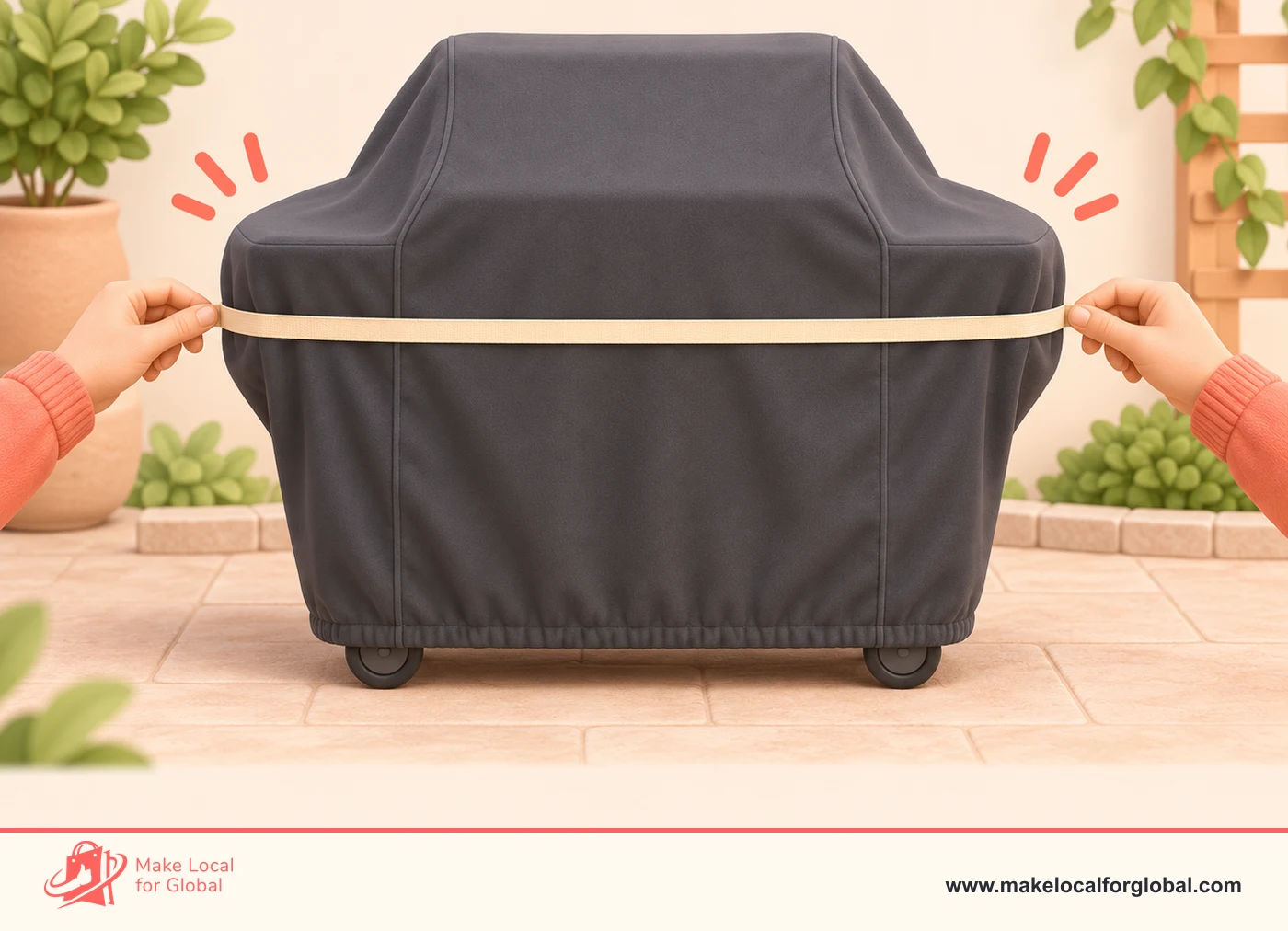
Measure the grill at its widest point, including fixed side shelves when the cover is meant to sit over them. Record depth from the frontmost to rearmost fixed point. For height, specify the starting surface and the tallest point, such as the top of a closed lid or chimney cap. Do not include removable parts in one chart and exclude them in another without saying so.
Then measure the cover itself laid flat, without stretching the fabric. Record width across the hem, depth from front to back and height from bottom edge to top seam. A shaped cover may need several measurements: body width, shelf width, dome height, chimney opening or skirt length. Label the points on a diagram so that a customer can repeat the measurement at home.
The cover normally needs some clearance. Too little makes it difficult to put on and can pull at seams. Too much can let wind balloon it or expose the grill when the cover shifts. The right ease depends on pattern, fabric stiffness, fasteners and grill geometry. Ask the supplier how the fit allowance was calculated and compare the answer with a physical sample over the grill models you intend to name.
Do not copy manufacturer grill dimensions straight into a cover size chart. The grill may have a handle, thermometer, bottle hook, shelf lip or wheel that changes the shape. A model name can change between years, and an accessory may be fitted by one owner but absent on another. If you mention a named model, verify the year and configuration, then make the measurements the primary check.
A useful size chart can say: “Measure the closed grill at its widest fixed point, including shelves. Measure from the ground to the highest point you want covered. Compare those values with the cover’s dimensions below.” Add the tested fitting clearance and diagram. Do not invent a universal clearance rule.
Create a fit record for each sample: grill brand and model, model year where known, cover size, measured cover dimensions, fit photographs, shelf position, fastening route and any part that catches. Save it with the supplier’s specification sheet. This record helps answer compatibility questions and gives a basis for changing the pattern.
Fit details matter for other products with model variations too. MLFG’s guide to selling car accessories online discusses product-specific checks that help a seller describe compatibility accurately.
The word “fabric” covers many constructions. A cover may use woven polyester, solution-dyed acrylic, a nonwoven layer, a PVC or polyurethane coating, a laminated backing, or a combination. Thickness, weave, coating, stitching and exposure all affect how the finished item behaves. GSM or denier alone does not tell a buyer how long a cover will last outdoors.
Ask suppliers to name the fibre content, fabric construction, coating or membrane, weight per area, colour-fastness evidence, water test method, seam construction and care instructions. Request the latest data sheet for the exact product you plan to buy. Ask whether the quoted specification belongs to the fabric roll, finished cover or a different product in the catalogue.
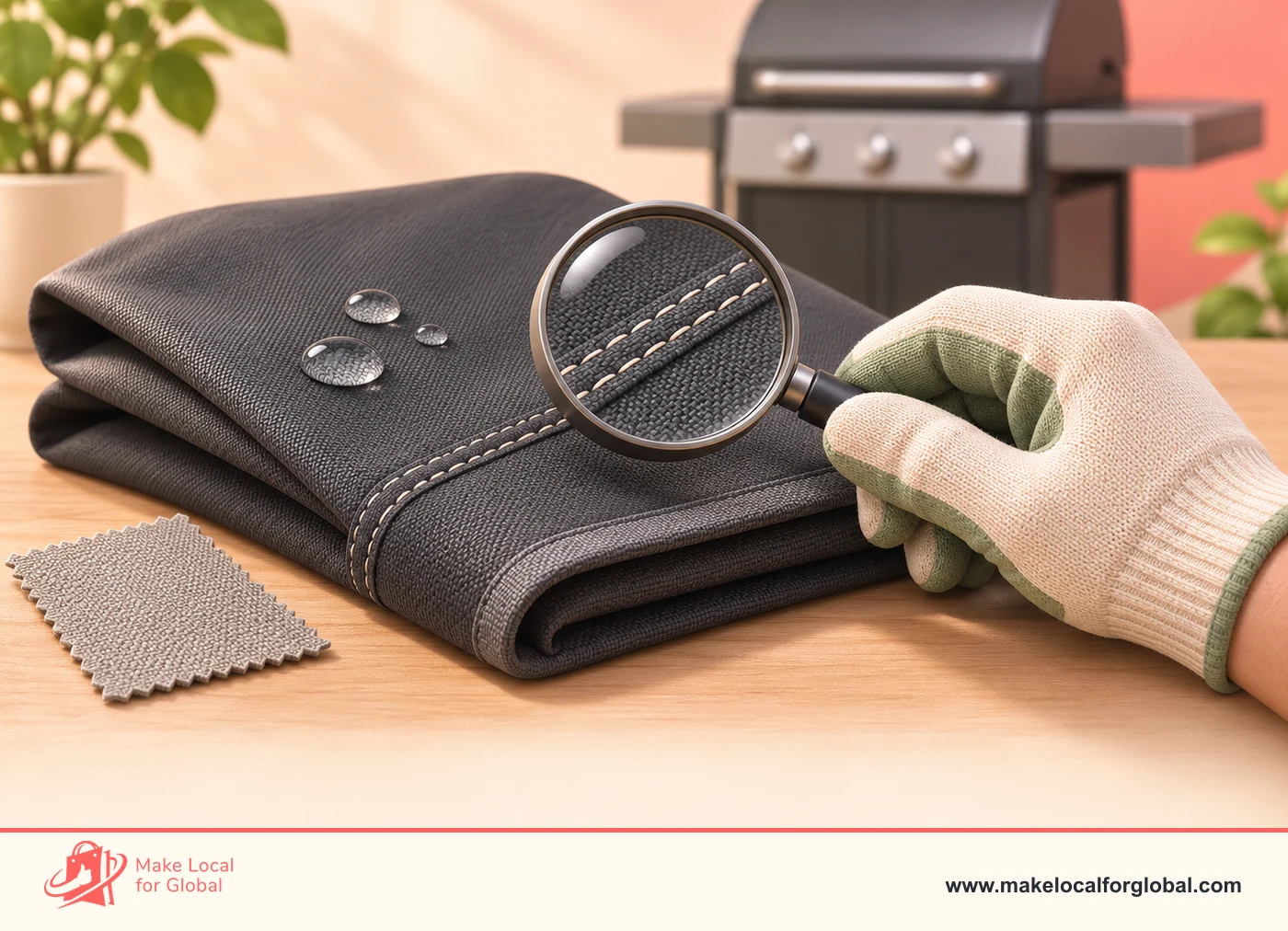
A water-repellent face can cause droplets to bead without proving that the finished cover keeps water out at seams or under prolonged pooling. Ask what test was used, what result was measured, whether seams were included and how the cover was conditioned before testing. A waterproof claim needs evidence for the assembled product, not only an adjective in a supplier message.
Check how water moves across the shape. A fitted cover with a sloping top may shed rain more readily than one with a broad, flat upper panel, yet the actual pattern determines the result. Look for seams at high points, stitched corners, vents and openings. Inspect whether water can collect in a fold or press against a seam. Record what happens in your own sample checks; do not call an indoor test proof of multi-season weather life.
Outdoor sun can fade or age materials. Request supplier evidence for UV exposure and colourfastness, including the test standard, duration and whether it measures colour, strength or both. A claim such as “UV resistant” needs a defined basis. If there is no report, use neutral wording about the material and state that outdoor life varies with exposure, storage and care.
Inspect stitching at corners, handles, vents, fastening points and any area pulled during removal. Look for skipped stitches, fraying, uneven seam allowances, coating cracks, exposed sharp edges and weak reinforcement. If a liner is bonded to the face fabric, flex a sample repeatedly, then inspect for peeling or separation. A neat product photo cannot reveal these details.
Ask whether vents are included and where they sit. Ventilation may help air move through a fitted cover, though the design must still protect the intended area from water. A vent opening can be a path for rain or dust. Check the sample after damp conditions and inspect inside surfaces for trapped moisture. Do not claim vents prevent mould or rust without evidence for the full product and its instructions.
Care instructions matter to product value. Ask whether the cover should be brushed, wiped or hand washed, which detergents are allowed, how it should dry, and whether machine washing damages the coating. Follow the grill and cover maker instructions for safe use. FCC cover instructions tell owners to wait until the grill is cold and the cover is dry before fitting it. Treat that as an example for the specified product, then confirm the guidance for the actual grill and cover you sell.

A UK wholesaler can offer smaller opening orders and shorter replenishment than a distant factory, but check its sizes, branding, warranty and documents. A direct importer may offer more control over pattern, colour and packaging, with added responsibility for customs, product records, inspection and lead times. A private-label order can build a distinct range, but it needs a tested specification, approved sample and documented change control.
Ask each supplier for the exact model or pattern code and revision date; finished cover measurements for every size; fibre, coating, lining and hardware specifications; and test reports for the supplied fabric and finished cover. Request the country of manufacture, minimum order, lead time, replenishment terms, packaging dimensions, folded weight and carton quantity. Ask for care instructions, warranty terms, batch identification and the process for reporting a safety or quality issue. Get notice of material, supplier or factory changes.
Order physical samples from the same production route you expect to use. A small swatch helps assess colour and feel, yet cannot prove fit, seam strength, packing or fastener performance. Buy or commission a full sample in the exact size and material. If the supplier changes material after approval, request another sample and record the change before placing an order.
For made-to-measure products, define the customer measurement form and the maker’s tolerance. State the measurement points, units, accepted format, required photos, production time and what happens if information is incomplete. Use a test order with a known grill before offering the service widely. A custom product creates more opportunities for error and may have different treatment under consumer cancellation rules; get advice for the terms of your sale instead of assuming a made-to-order label removes all rights.
Check what the supplier means by a warranty. Find the period, covered faults, evidence required, remedy, shipping responsibility and maintenance conditions. A commercial guarantee can add to the buyer’s legal rights but does not replace them. Do not promise a lifetime outdoors when the supplier has not offered that commitment and conditions vary.
Use a written sample checklist. Keep the same steps for each size and supplier so you can compare fairly. Photograph each sample from the same angles and record the date, weather, grill model and any change from the specification.
Start with fit. Place the cover on the grill with the lid closed and fixed shelves in the position stated by the listing. Check whether it reaches the promised points, drags on the ground, catches on corners or blocks access to a handle the customer needs. Open and close the cover several times, then fasten it as instructed. Ask another person to repeat the process using only the customer instructions; confusing instructions will create support questions.
Check fasteners. Pull drawcords evenly, open and close buckles, adjust straps and inspect whether they can be operated with ordinary gloves. Look at stitching and attachment points after repeated fitting. If the cover uses ties, test whether they stay accessible and whether their ends are likely to drag. An extreme pull test is not a substitute for a recognised test or supplier report.
Assess water behaviour in a controlled way. Confirm the sample is dry, fit it as directed and apply a repeatable amount of water across the surface using a measured spray or controlled rainfall rig. Inspect seams and the inner face after a stated period. Record puddles, leaks, wet spots and drainage. Repeat on another sample or size before making a broad claim. A short check does not predict years of exposure, so describe it as limited evidence rather than proof of a fixed service life.
Review airflow and dampness. After a wet check, remove the cover as instructed and note how long it takes to dry in the chosen conditions. Check whether moisture remains inside. If the supplier includes vents, inspect their position and construction. Grill makers often advise fitting a cover only after the grill is cold and dry; make this safety instruction clear and retain the maker’s own care guidance.
Check colour transfer and abrasion on a spare sample area, using the test method the supplier recommends. Do not rub a potentially damaging test across a saleable unit. Observe whether seams, fold lines, coating or printed areas change after repeated packing. If you want to make a colourfastness claim, ask for a recognised report rather than relying on a home rub test.
Keep a defect log. Record what failed, where it happened, whether it appeared on more than one sample, and which supplier batch was tested. Send specific photographs and measurements to the supplier. “This is normal” is not a technical answer; ask for a stated tolerance or test method, then decide whether the product suits the promise you plan to make.
A focused range can include two or three shapes and a small number of tested size steps. Name products by shape and dimensions instead of vague labels such as “medium”. A buyer searching for a kettle-grill cover should identify that shape quickly, then compare the cover measurements with their own grill.
An entry product could be a standard kettle cover for one tested diameter and height. A core product might be a gas-grill cover with space for fixed side shelves and adjustable lower fasteners. A specialist product could be a kamado cover or a made-to-measure built-in unit. Each offer needs its own photos and measurements; do not reuse a generic image of a covered rectangular grill for every shape.
Bundles can add convenience when components belong together. A storage bag can be included if it is supplied and sized for the folded cover. A second fastening strap may help only when the design supports it. A brush or cleaning product needs care, as the method may affect a coating or finish. Include every component in the cost sheet and say whether it is optional.
Choose colours from physical samples. A dark cover can show dust, pollen or lint; a pale one may show handling marks. Fabric colour in a supplier photo can differ from a sample under outdoor light. Photograph the actual stock item or identify a colour illustration. Record colour codes and approved swatches for repeat orders.
Keep a SKU structure that distinguishes shape, size and colour. An internal code might represent gas-grill, wide, charcoal. Do not use a code as the customer-facing size explanation. Connect each SKU to a product record with supplier, batch, cost, sample photos, measurements, test notes, packaging and warranty version.
The first screen should tell a buyer what the cover fits, which dimensions matter and what the parcel contains. Lead with an accurate product name such as “Gas Grill Cover for Fixed Side Shelves, 150 cm Wide”. State whether the measurement refers to the cover or the grill; those are not interchangeable.
Show the cover on a compatible grill from the front and side. Add close-ups of the lower fastening, seam, vent and material surface. Photograph the actual product without a lit grill underneath. A scene showing the cover fitted to a warm grill would mislead. Add a measurement diagram whose arrows match the written size table.
A useful product description can list grill type and tested shape; cover width, depth and height with the measurement method; compatible shelf position or protruding parts; fabric construction and substantiated performance evidence; fasteners, vents and reinforcement; parcel contents; fitting, removal, cleaning, drying and storage steps; a safety note to wait until the grill and relevant parts are cold; delivery timing, returns, warranty and support.
If tested with several grill configurations, list them in a compatibility section and include exact measurement ranges. Add a “check these points before ordering” note for handles, side tables, chimney parts, wheels and built-in counter depth. Tell buyers to contact you with dimensions if fit remains uncertain. Give a response route your team can manage.
Use search language naturally. A kettle product page may use “kettle barbecue cover” and “round grill cover”; a gas model may use “gas BBQ cover with side shelves”. Do not repeat every phrase in every heading. Create separate pages only where product type and sizing information are meaningfully different. Keep a category page that helps compare shape, measured size and care.
Write alt text that describes an image, not a string of search terms. For a diagram, explain which dimensions the arrows identify. For a product photo, name the cover and view shown. Keep decorative images from duplicating nearby text.
Calculate what one paid order contributes after variable costs. Use current supplier quotes and actual delivery prices. The figures below are an illustration, not a recommended retail price or a market claim.
| Cost item | Illustrative cost per order |
|---|---|
| Cover purchase cost | £18.00 |
| Inbound freight and duty allocation | £3.00 |
| Packaging and insert | £1.20 |
| Pick and pack | £2.00 |
| Customer delivery | £4.50 |
| Payment fee assumption: 2.5% of £42 plus £0.25 | £1.30 |
| Returns and defect allowance | £2.50 |
| Customer acquisition allowance | £4.00 |
| Illustrative variable cost | £36.50 |
| Illustrative selling price | £42.00 |
| Amount remaining before fixed costs and tax | £5.50 |
The arithmetic is £42.00 minus £36.50, leaving £5.50 before website, software, insurance, storage, accounting, owner time and tax. It is not net profit. The payment fee is an assumption; replace it with the current rate for your provider, card mix and transaction value. Delivery may vary by parcel size and zone. A cover that folds into a bulky parcel can cost more to ship than its weight suggests.
Build a landed-cost calculation for each product. Add unit cost, packaging, freight, customs charges where relevant, inspection, labelling and any duty or import VAT treatment that applies to your business. Allocate a shared shipment cost on one consistent basis, such as carton volume or unit count. Write the assumption into the workbook so it can be revised when the next invoice arrives.
Model returns separately. A fit-related return may need a refund, return postage, inspection and repacking. A cover that is dirty, damp or damaged might not suit resale as new. Track reasons by shape and size. If “too short over side shelves” appears repeatedly, a size-chart or pattern issue may be the cause; adjust the page or product before increasing advertising.
Set an affordable acquisition cost from contribution, not gross retail price. Compare paid advertising, organic search, specialist community content and partnerships using qualified orders, not likes. A product can sell well by revenue and still leave too little after shipping, fees and returns.
If VAT registered, separate VAT collected from income available for costs. HMRC VAT threshold guidance links compulsory registration to taxable turnover exceeding £90,000, subject to the detail and exceptions on the official page. Check the rule for your business and use one consistent approach to VAT in the calculation.
Build a store around accurate product information
Compare the ecommerce options for presenting dimensions, care information and a clear route for pre-purchase questions.
Grill covers can sell around seasonal use, replacement, gifting or a move to a new home. Do not assume every owner buys in spring. Use orders, search data and enquiries to see when interest appears. A small test can compare a few sizes before cash is committed to a large seasonal order.
Set a reorder point from lead time, recent sales and safety stock. If a supplier takes eight weeks and a popular size sells unpredictably, decide how much risk you can afford before setting a reorder trigger. Treat a supplier’s lead time as an estimate; record delivery dates for actual orders and revise it.
For another outdoor range example, see MLFG’s article on selling camping gear online. Compare its range and stock decisions with your own records rather than assuming both categories share the same demand pattern.
Store covers clean and dry in original packaging or a protected area. Label each SKU on the carton. Similar-looking covers in the wrong size can create an expensive exchange. Check incoming stock for damage, missing fasteners, loose stitching, label errors and changes from the approved sample.
Write a packing checklist. Confirm SKU, colour, size, fastening parts, care card and parcel label. Use a box or mailer that protects the cover without adding needless bulk. Fold it consistently and avoid sharp creases that could stress a coating. Add a paper measuring guide or QR link only after checking it points to a maintained page.
Choose a returns process before opening sales. Explain how a buyer requests a return, the condition expected, the time window and the contact route. Consumers who buy goods online usually have cancellation rights, subject to the specific rules and exceptions. GOV.UK explains information requirements for distance sellers. Do not set a policy that implies a buyer loses statutory rights just by opening a parcel or trying a clean cover over a cool grill.
Keep returns in a separate inspection area. Check for dirt, damp, odour, damage and missing parts, then record whether the product can return to new stock. Do not resell a returned cover as new if its condition or safety cannot be confirmed. An open-box option needs an accurate condition description and price.
A grill cover is not a cooking appliance, but it is used around equipment that can remain hot after cooking. Instructions should say to fit the cover only when the grill and relevant parts are cold, and to follow the barbecue maker’s instructions. Do not describe fabric as fireproof or heatproof without appropriate evidence and a specific intended use. Never present the cover as something to put on an active grill.
UK product-safety responsibilities depend on whether you make, import, distribute or retail the item and where you sell it. The Office for Product Safety and Standards says goods supplied to consumers in Great Britain need to be safe in normal or reasonably foreseeable use; businesses must keep supplier records and act on risks. Northern Ireland follows separate general product-safety rules; check current guidance for your route. Retain invoices, product specifications, supplier details, batch references, customer complaints and corrective actions.
Read the current OPSS product-safety advice for businesses and the Northern Ireland general product-safety guidance for requirements that apply to your role and destination.
If you import or sell a private-label cover, get advice on obligations for your role. Ask the manufacturer which safety information and traceability details must accompany the product. Review labels, packaging and instructions before production. A supplier’s assurance in a message does not replace documents or product checks.
Write performance claims to match evidence. “Waterproof” needs a test basis for the construction being sold. “Fits all grills” is unlikely to be defensible across shapes and accessories. “Windproof” can mislead when the product has no stated test or fastening method. Say what you know: material, dimensions, tested configurations, fastener construction and care. Keep limitations beside the claim, not hidden in general terms.
For online sales, show the seller identity, contact details, total price, delivery cost and timing, payment information, complaint route and cancellation information before checkout. GOV.UK distance-selling guidance sets out information and contract-copy requirements. Get legal advice for custom-made terms, warranty wording, international sales or a model with several fulfilment partners.
A direct shop gives space to explain measurements and compare fit. It makes you responsible for enquiries, returns, payments, delivery promises and product information. A marketplace can bring discovery and familiar checkout, but it may set image, listing, fee, customer-service and return rules. Read current policy and fee documents before calculating margin or using a marketplace brand in a compatibility claim.
A garden or outdoor-living retailer may suit a reliable range whose parcel dimensions fit its stock system. Prepare a line sheet with SKU, wholesale price, recommended retail price if used, carton quantity, delivery terms and evidence for performance statements. Calculate wholesale margin and payment timing; a price that works only for direct web orders may not support retail distribution.
For another outdoor category example, compare MLFG’s garden planters guide. Use it for ideas on organising a related range; validate grill-cover claims with your own measurements and tests.
Useful content can answer a pre-purchase question. Create a measuring video showing where to place the tape around a closed grill. Explain why cover dimensions differ from grill dimensions. Show how to route a strap under a shelf without blocking wheels. Share a care checklist that starts with the grill maker’s safety instructions. Name grill models only when exact measurements have been checked.
Keep outdoor-cooking safety visible. Never show someone fitting a cover to a hot grill or leaving it near flame. In a garden product photo, show the barbecue turned off and cool. Keep care recommendations consistent with the maker’s manual. Images should show fit and fastening, not imply unsupported heat, storm or fire protection.
Track traffic and questions separately. Record which search phrase or channel led to a visit, which size page was viewed, whether the buyer checked the measuring guide, and what reached support. Compare signals with orders, returns, defects and contribution after variable costs. A channel with fewer visits may bring customers who select the right size and keep the product.
Choose a grill type and speak with a small group of owners. Ask for model, year, accessories and dimensions. Record common fit problems and the words people use. Review current listings to see whether measurements and care details are easy to compare; competitor copy is not proof of accuracy.
Write a one-page range idea with shape, target user, sizes, fastening features and one reason to choose each option. Ask potential buyers to use a draft measuring diagram. Watch where they hesitate. Revise unclear labels before requesting production quotes.
Contact suppliers with the same specification request. Compare response completeness, lead time, minimum order, test documents, packaging and warranty terms. Request full samples in the planned material, then inspect dimensions, seams, fasteners, care labels and packaging.
Fit each cover to a suitable grill. Photograph it with shelves and accessories in the stated position. Run a limited, recorded water check and inspect drying and the inner surface. Note what the check does not prove. Ask the supplier about mismatches before approving a production version.
Calculate landed cost and contribution for every SKU. Include parcel size, fulfilment, payment fees, returns, customer acquisition and VAT treatment. Set an opening quantity your cash flow can support. Draft the listing title, fit diagram, care note, compatibility section, delivery terms and return route.
Ask someone unfamiliar with the range to choose a cover using only the listing. If they select the wrong size, find which information misled them. Correct the chart and instructions, then check them on a phone. Photograph the actual cover from angles that show shape, seam and fastening.
Publish a limited set of SKUs or take clearly described pre-orders only when you can meet stated dates and terms. Use one or two acquisition channels. Track visits, guide use, enquiries, orders, cancellations, returns and support time.
Review each early order with care. Confirm that the buyer’s grill measurements match the selected size. When a customer raises a fit issue, record the grill configuration and check whether the chart, product or instructions need revision. Use the evidence to choose whether to reorder, change the pattern, add a size or pause.
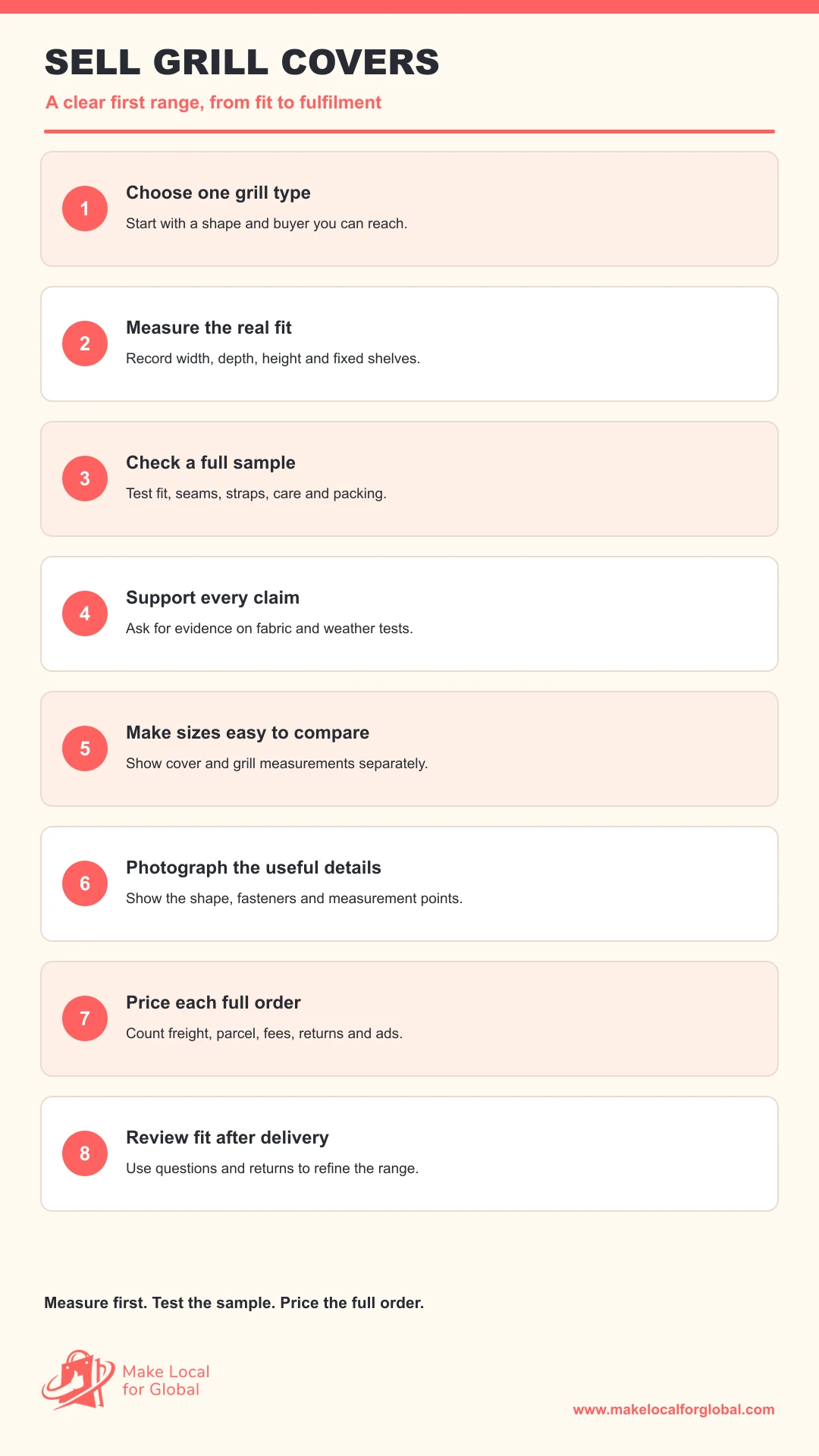
Choose one common grill shape you can source and test, then offer a small number of measured sizes. A range for compact kettle grills or freestanding gas grills can be easier to explain than a broad catalogue that claims to cover every barbecue type.
Measure the closed grill at the widest fixed point, front-to-back depth and height to the highest point that should be covered. Compare those values with the cover’s own dimensions and maker’s fit allowance. Include shelves, handles and other fixed parts when the cover is meant to sit over them.
There is no single best fabric for every climate, grill shape and price point. Compare fibre, weave, coating, seams, fasteners, test evidence and care instructions for the actual cover. Ask for documents that apply to the finished product, then check a sample.
Use that claim only when you have reliable evidence for the construction you sell, including seams and areas where water may collect. A fabric swatch test or supplier adjective alone may not establish performance of a complete fitted cover. State the test basis and conditions accurately.
Tell buyers to wait until the grill and its parts are cold, and to follow the grill maker’s instructions. Do not show a cover being fitted over a warm grill or make heat-resistance claims without specific evidence and use guidance.
Give care steps supplied for that material and cover model. Ask the manufacturer which cleaning products, washing methods and drying conditions are allowed. A method for one coating may damage another, so do not copy a generic cleaning tip.
Yes, with a reliable measurement process, production specification and customer approval route. Test a known grill first, state measurement tolerances and production times, and get advice on how consumer cancellation and return rules apply to your custom order.
State cover dimensions, compatible grill shape, tested configurations, material details, fasteners, care, safety note, parcel contents, delivery timing, returns and warranty. Add a diagram with measurement points and photos of the actual cover fitted to a suitable grill.
Make cover dimensions distinct from grill dimensions, show measurement points, explain fixed shelves and protruding parts, and give uncertain buyers a support route. Review return reasons by SKU and change the page or range when evidence points to a recurring issue.
UK businesses that make, import, distribute or retail consumer goods have product-safety responsibilities. Requirements depend on the seller’s role and where goods are sold. Keep supplier and batch records, use suitable product information and check current guidance for Great Britain and Northern Ireland.
Choose a grill type, collect real measurements and test the cover over the equipment it is meant to fit. Build the price around landed stock, parcel volume and returns, then make fit instructions easier to follow than a generic listing. A small range with substantiated claims gives you evidence to decide which size deserves the next order.
Decide what to test next
Use your sample checks, cost sheet and first customer questions to choose the next size or product detail to improve.
PREFERRED SOURCE
Like what you’re reading? Add Make Local for Global as a preferred source on Google to see more of our articles when you search.

Build your online presence without having to figure out everything yourself.