
READY TO SELL Dollhouses ONLINE?
Get a store built for you in 5 days, plus training and support to help you start, run, and grow your Alternative business.

A practical guide to selling dollhouses online: choose a buyer, check product safety, price bulky delivery and build a clear first product range.


Dollhouses can be sold as children’s toys, collector pieces, craft kits, room boxes or a mix of these. That range creates choice for a seller, yet it makes accurate age guidance, scale, assembly details and safe delivery central to the offer. A large house can arrive beautifully made and still disappoint if it does not fit the buyer’s dolls, the room available at home or the parcel service’s size limit.
To sell dollhouses online, choose one clear buyer first, compare a small set of house styles, order and inspect a sample, confirm the product’s safety paperwork for every market you plan to serve, and calculate the cost of the complete packed parcel. Then publish product pages that show real dimensions, contents, age information, assembly and delivery in plain language. Test demand with a small quantity or preorder only when you can meet the promised delivery date and legal obligations.
The strongest first range is not the largest catalogue. It is a manageable group of products with a clear reason to sit together, a practical price spread and fulfilment you can repeat. The steps below help a new seller decide whether a dollhouse business fits their budget and how to test one offer before buying a room full of stock.
Compare buyer demand, product costs and fulfilment needs before committing to stock.
“Dollhouse buyer” describes several different people with different reasons to buy. A parent may want a sturdy first house that a child can assemble or play with. A relative may be buying a birthday or Christmas gift and needs a useful delivery date, attractive presentation and a clear note on what comes in the box. A miniature collector may care more about scale, historical style, finish and compatibility with furniture they already own. A hobby maker may be looking for an unfinished shell, replacement roof, room box or kit they can personalise.
Those buyers should not be blended into a single generic listing. A child’s play house and a display model can look similar in a photograph, yet their use, age guidance, construction and safety assessment may differ. A listing that says “for all ages” without support can lead to unsafe use and customer complaints. Decide how the manufacturer classifies the item, what the intended user is, and whether your claims match the design and documentation. Wording a toy as “collectible” does not, by itself, make toy-safety rules disappear if the product is designed or intended for play by children under 14.
Write a short buyer statement before sourcing: “I am testing a compact, ready-to-play house for gift buyers who need a measured footprint and quick assembly.” Or: “I am testing a 1:12 unfinished shell for adult miniature makers who want a custom project.” These are examples, not claims about demand. The statement narrows what you should ask buyers and suppliers, which photos matter, what you must explain and what price comparisons are relevant.
Begin with conversations, not a bulk purchase. Speak with a handful of people who match the intended buyer and ask about the last dollhouse they bought, made or considered. Ask what caused them to pause, what room it had to fit, what doll size or scale they needed, whether they preferred a furnished house or an empty shell, and how they felt about self-assembly. Ask which delivery date would matter for a gift. Avoid asking only “Would you buy this?” People often say yes to a product they have not had to pay for.
Show two or three specific concepts with accurate dimensions and an indicative, clearly labelled price. Ask which details are missing and what would stop them from ordering. A compact house, a traditional painted house and an unfinished kit are useful comparisons because they differ in footprint, finish and buyer effort. Record what people choose and the reason they give. Do not describe a preference as proof of future sales; use it to decide which sample deserves the next test.
Search questions can help you understand wording buyers use. Check autocomplete and related searches for terms about dollhouse scale, assembly, wooden dollhouses, furnished dollhouses and miniature furniture. Look through marketplace reviews for recurring questions or complaints, while treating individual reviews as one buyer’s experience rather than a market-wide result. Note missing information on competing listings: room dimensions, furniture scale, materials, box size or the number of packages. This may point to a better product page, not necessarily an unmet product market.
Run a small demand test that has a clear limit. A landing page can describe one real or planned product, show an honest price range and invite a notification request. A local craft fair can test whether people understand the size and finish when they see a sample. A small online campaign can compare two factual messages, such as “ready assembled” and “fits dolls up to 15 cm”, with the same audience and spend cap. Track qualified enquiries, email sign-ups, add-to-cart behaviour, sample requests and the questions people ask. Set a threshold before the test. If the result falls short, change the audience, range or offer before committing to a larger order.
If you are still weighing up product, fulfilment and contribution margin, the Product Viability Assessment gives you a place to review those decisions before stock spend. For another product-led example, read the MLFG article on selling vintage toys online, then compare its buyer and condition checks with the requirements of a new dollhouse range.
A dollhouse range can include ready-made wooden houses, plastic play houses, fold-flat or portable houses, unfinished kits, room boxes, miniature furniture, dolls, lighting and replacement parts. Each extra family creates different stock, compatibility, safety and support work. Start with one main house type and a small number of choices a buyer can understand without a long comparison call.
Useful differences may include footprint, number of floors, room layout, finish, material, assembly level and included furniture. Record dimensions in centimetres and show which are external and which describe usable room space. A product’s overall height includes the roof and chimney; that may not tell a buyer whether it fits a shelf. Give the width, depth and height separately, and state whether those figures include a base, roof overhang or removable parts.
Scale needs special care. Collectors often use ratios such as 1:12 or 1:24, but a ratio alone can be hard for a new buyer to picture and may be used inconsistently across accessories. Publish the actual doll height, furniture measurements and any supplier’s stated scale. Test a sample doll or accessory from the intended range; do not infer compatibility from a product photo. If a house is meant for imaginative play rather than a collector scale, describe the intended figure size and show it beside a ruler or familiar object.
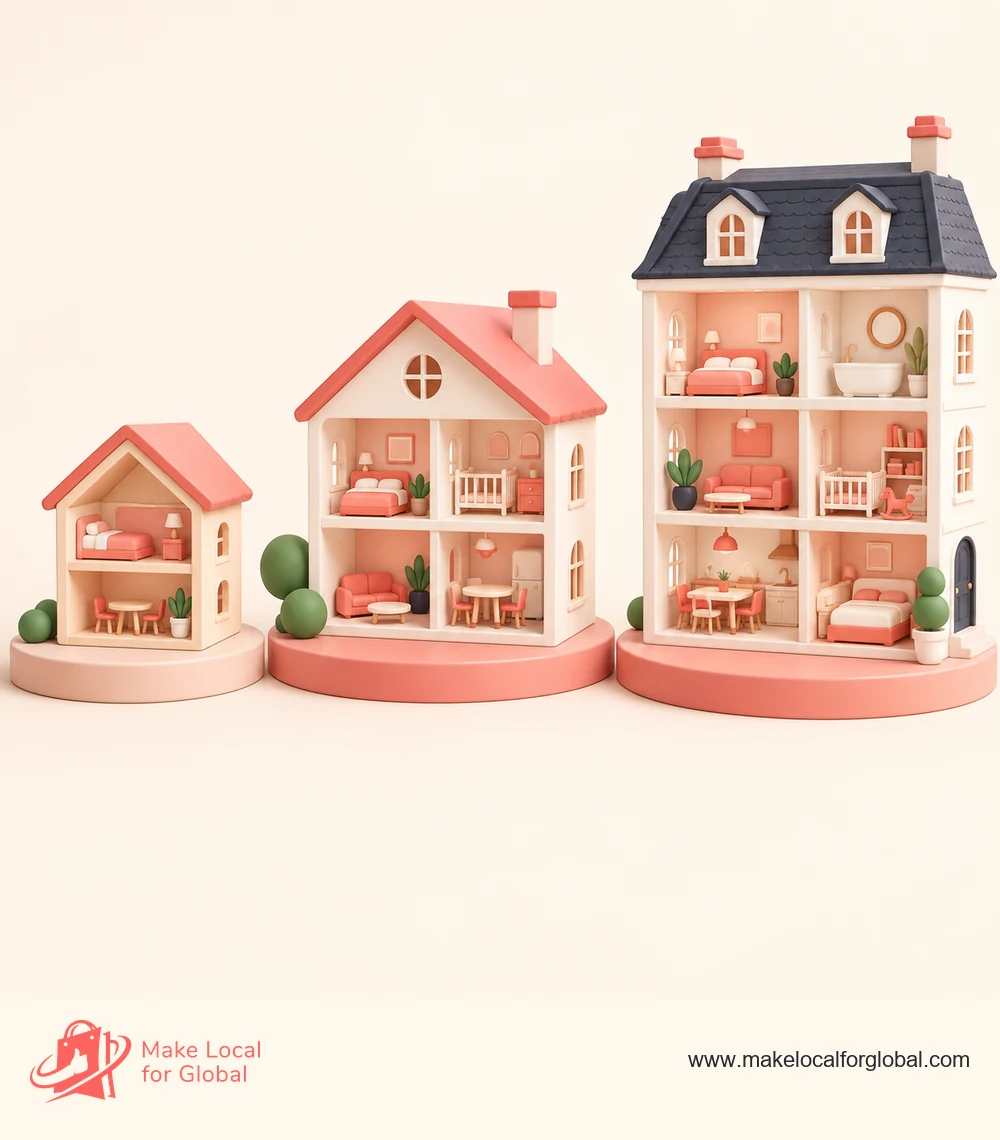
An entry offer could be an unfinished room box or a compact house with fewer pieces. A core offer could add several rooms and a fixed finish. A higher-priced offer could include more furniture, a detailed exterior or a custom colour, provided each option can be made and shipped consistently. Do not call one “premium” merely because it costs more. Describe what changes: material thickness, finish, furniture count, assembly, packaging or personalisation.
Each option should answer a distinct buyer need. A low-price kit asks the customer to spend time assembling and finishing it. A ready-assembled house may cost more to produce and take more parcel space, yet it removes that work for a gift buyer. A large furnished model raises the order value but can increase freight, storage and damage exposure. Compare the expected contribution and support effort, not just the selling price.
Accessories can extend the range without requiring a second full-size house. Potential add-ons include furniture sets, bedding, dolls, room decorations, roof tiles or paint packs. Confirm that the accessory fits the advertised scale and that the packaging gives the right safety information for its intended age group. A “house plus furniture” bundle may simplify a gift purchase, but list every included piece so the customer does not assume that the pictured lamp or doll is included when it is only a prop.
Avoid launching every finish, scale and furniture set at once. Variants can multiply into a stock problem: five house styles, three colours, two furniture packs and three scales make dozens of combinations. Some may sell slowly, and a missing roof or stair part can leave a costly item unsellable. A smaller opening range makes it easier to inspect each item, photograph it accurately and keep matching spares.
Use a simple range sheet before you place a purchase order:
| Range field | What to record | Why it helps |
|---|---|---|
| Main buyer | Parent, gift buyer, collector or maker | Sets product-page detail and sales channel |
| Intended use | Children’s play, adult display, craft kit or room box | Informs product classification and warnings |
| Size | External footprint, height and room dimensions | Helps check fit and parcel size |
| Compatibility | Doll height, furniture scale, known product references | Reduces fit questions and returns |
| Contents | House, furniture, figures, tools and instructions | Prevents assumptions from staged photos |
| Assembly | Ready made, partial assembly or kit | Sets buyer effort and fulfilment checks |
| Finish and material | Supplier’s exact material and coating data | Supports comparison and accurate claims |
| Stock decision | Sample, small batch or no order | Keeps a test within budget |
Possible sources include UK makers, toy wholesalers, specialist miniature suppliers, importers, contract manufacturers and your own workshop. There is no single sourcing route that suits every house. A local maker can be easier to visit and may offer short production runs, but the price and available finishes may limit your range. An overseas factory may quote a lower unit price or broader choice, yet shipping time, import paperwork, inspection and minimum order quantity can change the real cost. A wholesaler may have stock ready to dispatch, but you still need enough product information to make accurate listings and meet your obligations as a seller.
Request more than a catalogue photo. Ask for the exact manufacturer and model, materials and finishes, intended age range and use, product dimensions, packed dimensions and gross weight, contents list, assembly instructions, safety warnings, declaration of conformity where relevant, applicable test evidence, batch or model identification, importer details and spare-part availability. Ask which market the paperwork covers and which model or finish it names. One document for a different product or material does not prove that the item you plan to sell is covered.
Confirm the commercial terms in writing. Ask for the sample cost, minimum order quantity by style and finish, production lead time, shipping method, payment schedule, defect process, replacement-parts policy and who pays for a rework or return. For a customised or own-brand product, agree on approved drawings, materials, surface finish, packaging and a sample sign-off process. Keep the approval against a model reference so the next batch can be checked against the same standard.
Unbox the sample in the way a customer would receive it. Record the external carton dimensions, gross weight, number of packages, protective materials and how long assembly takes. Photograph the carton before opening. Note any crushed corner, broken tab, loose part, scratch, missing fastener or instruction that is difficult to follow. That first inspection tells you whether the supplier’s packing is suitable for a courier trip, not just whether the house looks good on a clean table.
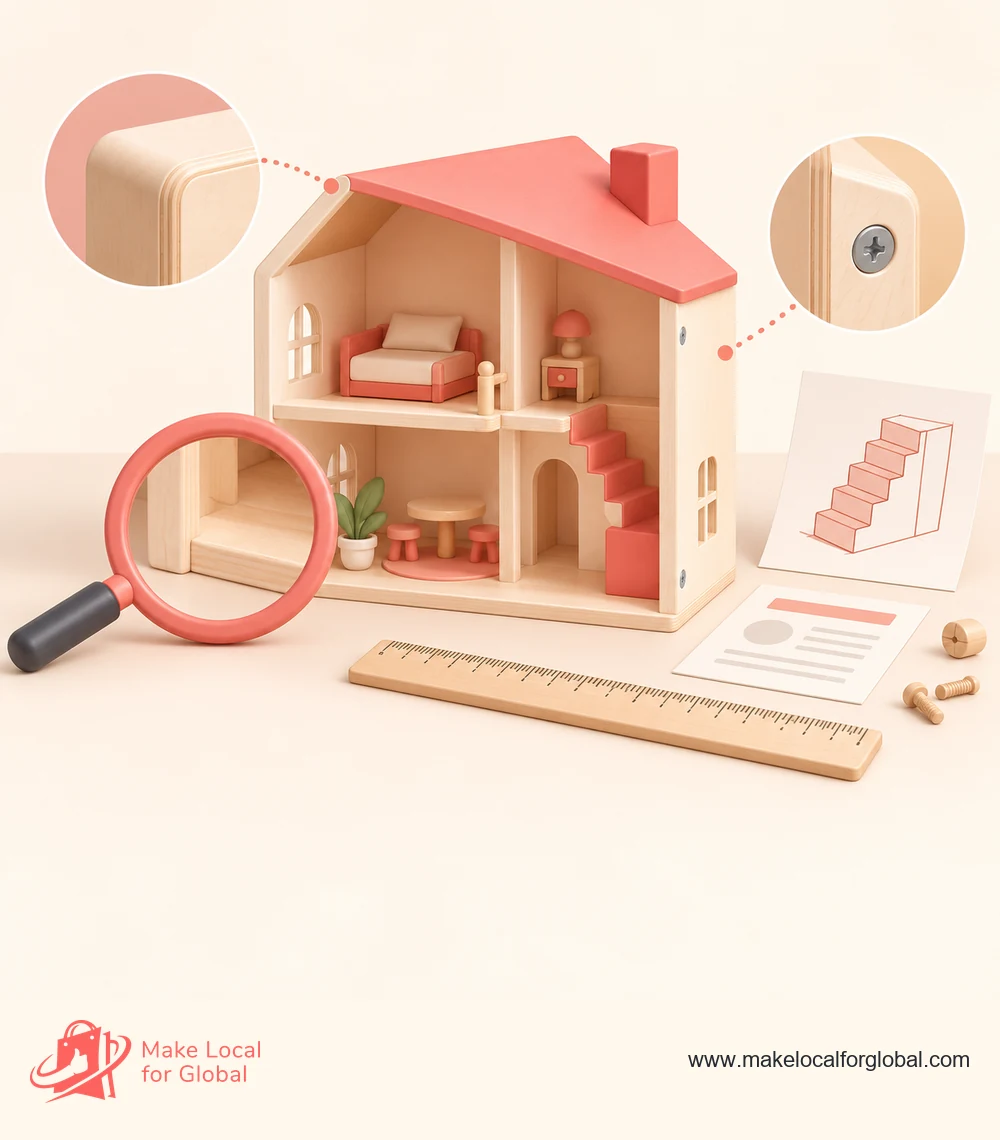
Follow the supplied assembly instructions from start to finish. Check whether the holes align, fixings are present, parts have identifying marks and the steps can be understood without guessing. Try each door, stair, balcony and removable panel through normal use. Check the fit of furniture and figures you intend to name in the listing. If the design is for children, assess the safety and durability concerns with an appropriately qualified person or test body; a seller’s visual check is not a substitute for a required safety assessment or conformity procedure.
Check the finish under strong light. Inspect edges, corners, splinters, burrs, exposed fixings, unstable rails, gaps that can trap fingers and coatings that are tacky or flaking. For painted or printed parts, ask the supplier what materials and coating were used and which product records support the claim. Keep a sample from each meaningful design or material change. When a later batch arrives, compare it with the approved sample, including shade, hole placement, parts count and packaging.
If you sell a collectable or vintage item, record its age and condition carefully, yet do not assume a vintage label removes product-safety responsibilities. Separate it from a new children’s toy in your stock system. Describe wear, repairs, missing pieces and provenance only when you have evidence. A seller who cannot verify a material or safety claim should not repeat it as fact.
Toy rules depend on the product and market. GOV.UK says the Toys (Safety) Regulations apply in Great Britain to toys designed or intended, whether exclusively or not, for play by children under 14. The rules cover general and particular hazards, warnings and the responsibilities of manufacturers, importers and distributors. Start with the official Great Britain toy-safety guidance, and get product-specific advice if you are unsure how your house should be classified.
In Great Britain, a manufacturer has responsibilities including a safety assessment, conformity assessment, technical documentation, a declaration of conformity and appropriate marking. The GOV.UK guide recognises either UKCA or CE marking for toys placed on the GB market under current rules. A UK business bringing a toy from outside the UK to the GB market may be an importer, with duties to check manufacturer compliance and provide importer identification. A distributor must take due care and check that the product information and marking are present. If you have a house made for your own brand or sell it under your name, you may fall within the manufacturer definition. Confirm your role before ordering.
Northern Ireland follows separate arrangements. Toys placed on the NI market use CE marking; UKNI marking is used with CE in the relevant case where a UK notified body has carried out the conformity assessment. UKCA alone is not the NI route. Read the separate Northern Ireland toy-safety guidance and check cross-border responsibility before listing the same SKU across GB and NI.
Do not copy a warning from a similar-looking toy. Match warnings to the manufacturer’s classification and technical documentation. Keep the exact model number, batch or type reference, supplier details, declaration, test reports, safety assessment or supplier evidence you have been given, instructions, product photos and purchase records together. Check whether every colour, material and furniture variation is covered. Ask the supplier when the documentation was prepared and what change would trigger new assessment.
Age grading deserves a clear explanation. A warning such as “not suitable for children under 36 months” is not a way to avoid a safety assessment, and a product photo is not a substitute for the warning on the packaging or instructions. Small furniture, dolls, screws, roof parts and detachable decoration can be relevant to foreseeable use. List the actual age guidance, note any choking hazard where required and state adult assembly or supervision only when that matches the product information. If a customer reports a safety issue, stop dispatching the affected model while you investigate, keep the evidence and follow the applicable reporting and recall process.
If you cannot get model-specific evidence, do not rely on a generic PDF, a marketplace seller’s claim or a visible CE logo alone. Pause the order and ask the supplier for the missing records. An accredited toy-safety testing body, product-safety adviser or trading standards service can help you decide which assessment applies. Rules change, and this article is practical information rather than legal advice. Check the current official guidance before each new product or market launch.
Large products can have a high ticket price and still leave little contribution after the order is delivered. Calculate one normal order from supplier invoice to customer doorstep. Include unit cost, inbound freight and duty where applicable, packaging, packing labour, carrier charge, marketplace or payment fees, discount, customer acquisition and a realistic allowance for returns, replacement parts and damage. Add storage and other fixed costs separately so you can see what the order contributes before overhead.
Here is an illustrative example for a VAT-registered seller. The customer pays £149 including VAT for a ready-assembled dollhouse. At the standard 20% rate, the VAT portion is £24.83 and sales revenue before output VAT is £124.17. The following cost figures are fictional and are treated as net of recoverable VAT where applicable. Actual treatment depends on the seller’s VAT position and invoices.
| Order line | Illustrative cost |
|---|---|
| Dollhouse and inbound freight allocated per unit | £43.00 |
| Protective packaging and corner supports | £7.00 |
| Carrier collection and delivery | £12.50 |
| Payment and marketplace charges | £8.70 |
| Expected returns, parts and damage allowance | £6.00 |
| Customer acquisition for this order | £10.00 |
| Total variable costs | £87.20 |
| Sales revenue before output VAT | £124.17 |
| Contribution before fixed overhead | £36.97 |
The calculation is £124.17 minus £87.20 = £36.97. Contribution is what remains to help pay fixed overheads such as insurance, software, storage, bookkeeping and time; it is not net profit. GOV.UK lists the standard VAT rate as 20% for most goods and services; see the current VAT rates. A non-VAT-registered seller cannot use the same calculation unchanged: they do not charge output VAT, and VAT on costs may be unrecoverable. Use your own tax position and supplier invoices. For marketplace sales, check the current listing, transaction, payment-processing, advertising and regulatory fees. Etsy describes separate fee types and says its transaction fee applies to the order total, including shipping and gift wrap; read Etsy’s current fees and taxes information before relying on an older spreadsheet.
Build a low, expected and high cost case. In the low case, the order uses standard packing and delivery. In the high case, the carton needs an oversize service, a second package, an extra hour of assembly or a replacement roof. A small change in outer dimensions can move the parcel into a more costly band. Measure the packed sample, weigh it, and compare the quote with the service’s actual size and weight limits. Use the carrier’s current quote for the destination, not a guess from the house’s product dimensions.
Now test the price. If the lowest plausible price leaves no room for a return, discount or paid visit to a craft fair, the range may be too costly for the chosen buyer. You can change the pack size, sell a kit rather than assembled stock, offer a local collection option, negotiate the order quantity or choose a smaller house. Do not remove protective packaging to make the arithmetic look better if that increases breakage risk.
Keep a simple margin sheet by SKU. Record the selling price, tax treatment, landed cost, real pack materials, charged postage, carrier invoice, selling fees, discount, acquisition cost and return outcome for each order. Review it after the first few parcels. A free-shipping offer is not free; build the actual postage into the price or set a clear threshold supported by your numbers. Compare contribution by product and channel, since a marketplace and your own store may have different fee and advertising costs.
Customers cannot lift a dollhouse through a screen. A product page should replace the most useful parts of that in-person inspection. Start with a descriptive product title that names the house type, material when verified, size or scale and whether it comes assembled. For example: “Three-room wooden dollhouse kit, 1:12 stated scale, 62 cm high, assembly required.” Use that format only when each detail is accurate for the SKU.
Put high-decision facts near the top: external dimensions, packed delivery dimensions where relevant, intended age or display use, assembly level, what comes in the box, doll and furniture compatibility, material and finish, dispatch estimate and delivery charge. Explain if curtains, dolls, lamps or furniture in the photographs are props. Give the number of parcels and whether the customer needs tools. If a colour or grain varies, describe the variation and show a genuine sample rather than implying every unit is identical.
Use photographs that prove the claims. Show the whole house from front, side and back; an open view of each room; a close view of joints and finish; the contents laid out; a ruler or size reference; and the packed kit if the product is self-assembly. Use the actual product and do not digitally add furniture that the buyer will not receive. Include an image of the instructions or a readable excerpt when it helps a buyer understand assembly. Descriptive image alt text should state what the image shows, such as “Open-front wooden dollhouse with three rooms beside a 30 cm ruler”, rather than repeat the target phrase on every image.
A short specification table can prevent repeat questions. Include external width, depth and height; room measurements; material; finish; weight; package count; assembly estimate from your own test; included items; care instructions; age guidance; and scale or figure compatibility. Mark unknown details as unknown and ask the supplier, rather than filling them in from another product’s page. Keep measurements consistent between the title, images, variants and delivery page.
Describe the assembly in plain steps: what the customer opens first, which parts attach, the tools needed, whether an adult should assemble it and where instructions are supplied. If the roof lifts off, say so. If the house ships flat-packed, give the number of panels and expected difficulty based on the sample. A short assembly video can show the actual version and reduce uncertainty for buyers who are not used to flat-pack products.
Make returns, delivery and customer contact easy to find before checkout. GOV.UK says online sellers need to show a description, total price, delivery costs and arrangements, payment methods, business contact details and cancellation information before an order; the online selling rules list these requirements. Product details should match the confirmation email and parcel contents. Update a listing as soon as a batch changes or a part goes out of stock.
A marketplace can offer an established search audience and a familiar checkout, but it brings listing rules, category requirements, fees and competition on similar terms. A maker marketplace may suit handmade, vintage or craft-kit stock when the products meet its current policy. Etsy’s fee page sets out listing, transaction and payment fees; check the live rate and the extra services you choose. Do not assume a marketplace product page is a permanent record of your own brand or customer relationship.
Your own online shop gives you control over product grouping, detail pages, measurement diagrams, email capture and brand presentation. It still requires a route to qualified visitors, a clear checkout, payment processing, delivery rules, customer support and product policies. A simple plan is often to keep one owned shop as the product-information base and use a small number of marketplaces or social channels for discovery, where the channel allows your item and its claims.
If you plan to make your own shop, link product pages to clear categories such as wooden houses, kits, furniture and spares. Create one helpful guide about dollhouse scales and sizes rather than copying the same text across every SKU. Add internal links between a size guide, a related product and the main category. For examples of adjacent toy markets, see MLFG’s pages on educational toys and vintage toys. Keep each page distinct so a buyer can tell which products are new, used, intended for play or meant for collecting.
For a seller who wants help with a branded store, the MLFG website design service is a possible next step. Make the comparison against the actual work you want someone else to handle: store setup, product categories, payment setup, shipping rules, training or ongoing updates. The Product To Sell category has more product-specific business planning articles.
Bring dimensions, contents, delivery options and customer questions together on a store designed for your range.
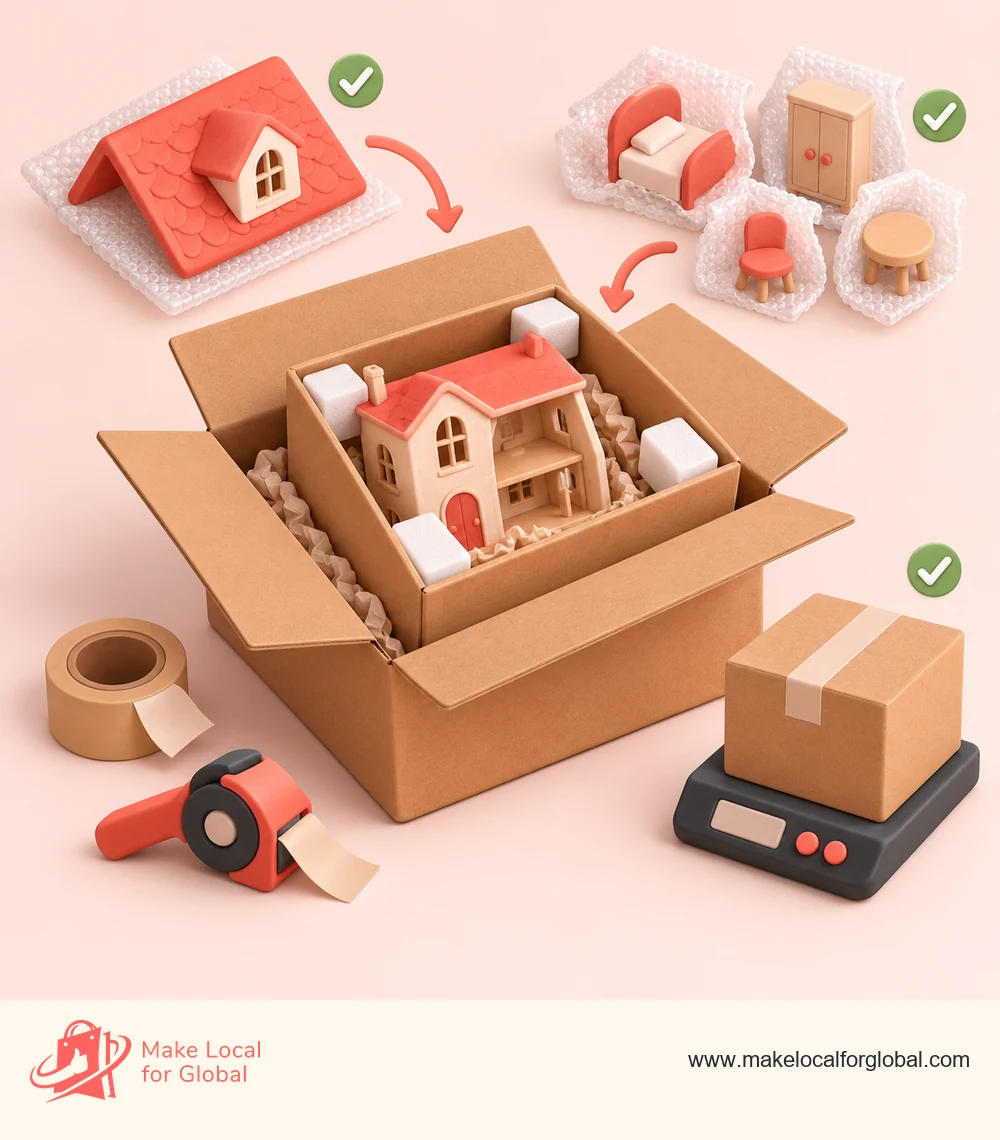
Test a parcel before promising next-day delivery or a low flat rate. A finished house can be awkward to grip, can have roof overhangs, and may contain thin rails or projecting chimneys that catch on carton walls. Separate removable furniture and fragile details if the maker’s design allows it. Protect those pieces in labelled bags or small inner boxes so a buyer can identify them during assembly. Do not wrap a painted surface in material that might mark or transfer colour.
Use a fitted inner box or supports to prevent the house moving. Protect roof corners, balconies and stair rails with shaped inserts. Fill voids so the product cannot slide, then place the inner pack inside a strong outer carton when the size and carrier guidance call for it. Put screws and small accessories in closed, labelled packets; keep them away from delicate faces and finish. Include the instructions and any required warnings where the manufacturer specifies. Choose materials that protect the item without making the parcel much larger than necessary.
Weigh and measure the parcel after packing, including every box in a multi-parcel shipment. Check each carrier’s current maximum dimensions, oversize rules, collection options, compensation limits and exclusions for fragile goods. A standard parcel service may not accept a long or unusually wide carton. Ask the carrier how it measures the package; do not price delivery from the item’s dimensions before corner protection and outer cartons are added.
Run a practical internal transit check on a sample pack. Photograph the packed state. Move and tilt the parcel gently in each direction to find loose space. If you use a controlled drop or vibration procedure, follow an appropriate written method and treat it as a screening check, not proof of compliance with a formal packaging standard. After a test, open the box and inspect the roof, doors, glazing, railings, fasteners and finish. A passing test on one sample does not guarantee that every supplier batch is packed the same way, so record the packing steps and repeat sample checks when the materials change.
Create a fulfilment checklist: confirm SKU and finish; count the contents; inspect the house; take a photo of the packed parcel; verify address and service; attach the right label; send tracking; and keep the carrier receipt. For a large house, arrange a safe storage and picking space so units do not get stacked or knocked. State an honest dispatch window and notify the customer if a delay threatens a gift date. A realistic delivery promise helps a buyer plan and gives you time to resolve a stock or carrier problem.
The customer’s statutory rights still apply to a large parcel. GOV.UK explains that distance-selling customers can normally tell the seller within 14 days of receipt that they want to cancel, and they then have another 14 days to return the item. The seller’s refund obligations include the standard delivery charge in the cases described by the rules. Read the current returns and refunds guidance and obtain advice for your particular products and terms. A return policy cannot remove rights that the law gives the customer.
State who pays for return postage where the law permits the seller to set this, and explain how a large item should be repacked. Be precise about what to do if a roof or rail arrives damaged. Ask the customer for the order number and photos of the carton and affected part, then reply with a clear next step: replacement part, repair guidance, return or refund as appropriate. Keep a log by SKU and batch. Repeated breakage in the same place can reveal a packing flaw or a supplier change.
Set aside stock for replacement parts if the manufacturer can supply them. A missing stair component may be easier to resolve with a small part than with a full house return, though the customer’s rights and choice remain in place. Do not promise a repair if the part is unavailable or if safety may be affected. Pause the listing and dispatch of a product when a credible safety issue is reported, trace affected orders from your batch records and follow the correct authority and recall procedure for your market.
Check refunds, replacement shipping and customer support time in your margin sheet. A seller can have a positive product margin before returns and lose the contribution through a single replacement shipment. Use return reasons to improve the listing: “too small” may point to unclear measurements; “not assembled” may mean assembly language is hidden; “furniture does not fit” may mean a scale statement needs correction; “roof arrived broken” may point to carton support. This feedback helps you select a better range and improve the buyer’s experience.
Use one primary search phrase naturally in the page title and opening copy, such as “wooden dollhouse kit” or “compact dollhouse for 15 cm figures”. Let the actual product decide which wording fits. A phrase like “sell dollhouses online” belongs in a seller guide, not repeated on every product listing. Include the features buyers use to distinguish choices: footprint, material, number of rooms, assembly, scale, included furniture and delivery. Avoid adding terms for a dollhouse accessory the product does not include.
Write useful image alt text to describe each product view for screen-reader users. Give every image its own description. Add a short video if it demonstrates room layout, assembly or packed contents; provide captions and avoid making the video the only place where a key specification appears. Resize product imagery for a quick page load while keeping close-ups sharp enough to inspect joinery and finish.
Write supporting pages for real questions. A scale chart can show actual figure heights against house-room measurements. An assembly article can explain tools and time from a tested model. A packing page can describe your delivery method. Link those pages back to suitable houses and from product pages to the most relevant guidance. Keep copy distinct across colours and sizes; changing only the colour name can leave search visitors unsure which variant is different.
Measure performance with questions that support a decision. Look at search terms, product-page visits, add-to-cart rate, checkout completion, delivery cost, questions per order and return reasons. Compare the same period and channel when reviewing a change. If visitors reach the page but do not add to basket, inspect product fit, price, trust details and delivery. If visitors do not reach it, review the search phrase, category links and helpful content before increasing ad spend. Search performance is a result to measure, not a promise that a particular title will rank.
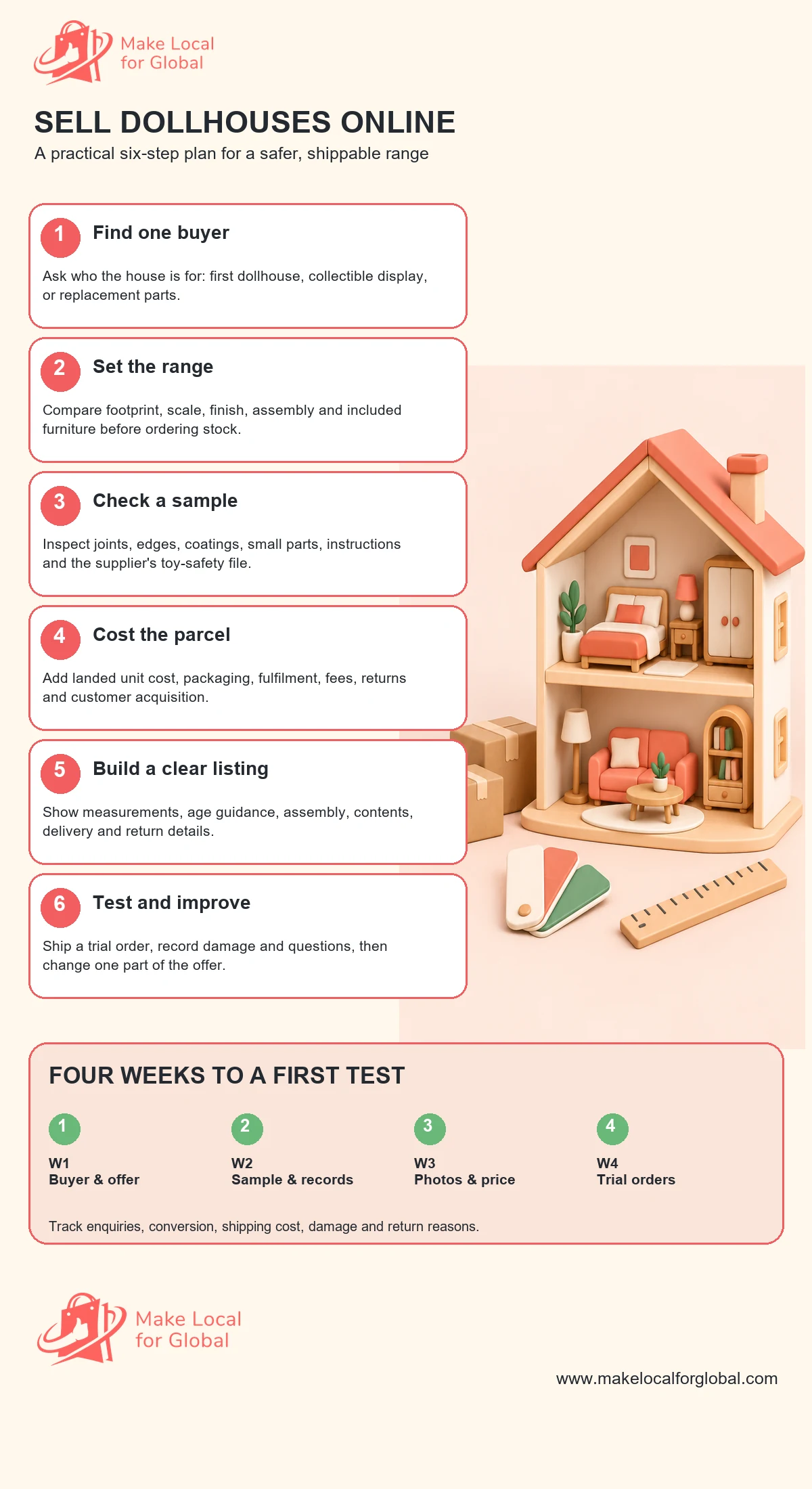
Write the buyer statement and select two or three product concepts. Interview people who match the intended buyer. Record which house they choose, what details they ask for, which price range they consider and what delivery timing they need. Search for competing listings and note how they explain scale, assembly, contents, package dimensions and age. At the end of the week, choose one concept for a sample or decide that more evidence is needed.
Request the supplier’s model-specific documents and written terms before placing a larger order. Buy one sample where possible. Measure and weigh it, assemble it, inspect finish and moving parts, record the packed size and review safety information against the intended market. Confirm the model identity in each document and photograph the sample. If required documents are missing, stop the launch work and ask the supplier or a suitable product-safety professional what needs to be resolved.
Calculate a low, expected and high delivered-order cost for the sample. Check live carrier quotes and selling fees. Decide whether the price still leaves a contribution after customer acquisition and a returns allowance. Photograph the actual house, contents, dimensions and package. Draft the title, fit facts, assembly, age guidance, delivery, returns and contact details. Ask a new reader to tell you what they think is included and what doll or room size the product suits; correct any assumption they make that the page does not support.
Publish only when you have stock, supplier timing and customer information ready. Set a small stock or advertising limit. Share the listing in a place where the intended buyer already looks, such as a maker community, craft event, relevant search page or permitted marketplace. Track views, qualified questions, orders, delivery time, parcel condition, fees and contribution. After each order, inspect the buyer’s questions and record any missing detail. At day 30, choose whether to keep the same offer, change one variable, order a limited repeat batch or stop the test. One month of feedback is useful business evidence; it is not proof that demand will stay constant.
Ordering too many styles at once. A wide catalogue ties up money in slow variations and creates more product checks. Start with a single buyer and a small set of distinct choices.
Guessing the scale. A house that looks right in a photograph can still be too small for a buyer’s dolls. Measure real figures and furniture, then publish the fit details.
Treating a supplier logo as a complete safety file. A mark or generic certificate may not identify the model, material or market. Ask for the records that match the exact product and your role in the supply chain.
Pricing before the parcel is measured. Outer cartons, supports and carrier size bands change the order cost. Price the packed sample, then revisit the calculation when the packing changes.
Showing props as included items. A staged room can make a buyer expect a doll, furniture or soft furnishing that is not in the box. Photograph the contents separately and list them.
Calling an item a collectible to sidestep toy rules. Product classification depends on design, intended use and applicable law. Get a product-specific assessment instead of relying on a label written for the listing.
Copying every variant description. Buyers need the actual differences between sizes, materials and finishes. Give each variant accurate measurements and stock status.
Treating contribution as take-home profit. The example above excludes fixed overheads and the seller’s wider tax position. Keep those amounts visible when you assess the business.
It can suit a seller who can source a well-documented product, explain fit and assembly, and deliver a large or fragile parcel at a cost buyers will accept. It may be a poor fit if your budget cannot cover samples, safe packaging, storage and likely returns. Test buyer interest and the complete order cost before you buy a large quantity.
Pick one type for one buyer. For example, a compact ready-to-play house for gift buyers, an unfinished room box for makers, or a stated-scale house for collectors. Compare sample quality, compatibility, package size and paperwork before choosing. Avoid launching multiple scales and finishes until the first offer has passed a small test.
It depends on classification and the market. Toys placed on the Great Britain market can use UKCA or CE under the current recognition rules, subject to the product meeting the applicable requirements. Northern Ireland uses CE, with CE plus UKNI in the relevant case involving a UK notified body. Read the GB guidance and NI guidance, and confirm your legal role and product-specific route with a qualified adviser.
Only use a collectible description when it truthfully reflects the product, intended user and evidence. If the design or intended use includes play by children under 14, the toy rules may apply. Listing language alone does not decide the product’s classification. Ask a competent product-safety professional to review a borderline item.
Choose the scale that matches your buyer and supplier’s documented measurements. Ratios such as 1:12 and 1:24 are commonly used by miniature sellers, but you should give actual dimensions and test real furniture or dolls with the sample. For play products, the figure’s height and the room size may be clearer to a new buyer than a scale ratio.
An assembled house saves the customer build time, but can cost more to pack, store and ship. A kit can use a smaller carton and reach makers who enjoy the process, though instructions, parts count and support matter. Compare the sample assembly time, unit cost, packed dimensions, buyer questions and contribution for each option.
Add landed stock cost, protective packing, carrier delivery, selling fees, acquisition cost and an allowance for returns and damage. If you are VAT registered, separate the VAT portion from revenue and use input VAT correctly; if you are not, your calculation differs. The worked example above shows the arithmetic, but replace every illustrative figure with your own invoices and current carrier quotes.
Measure and weigh the fully packed sample. Protect roof corners, rails and projecting details, stop the house moving inside its inner pack, secure removable pieces separately and use a suitable outer carton. Inspect the sample after a documented transit screening. Record the packing steps and repeat checks when the carton, insert or product changes.
Show external dimensions, room size, material and finish, intended use and age guidance, scale or figure fit, assembly level, exact contents, parcel details, delivery timing, price and return information. Use photographs of the actual product from several angles and a separate picture of all included items. Make any staged props clear.
Reply quickly, record the order and batch, ask for useful photos, and decide whether dispatch should pause while you investigate. Offer the suitable resolution under the customer’s rights and your policies. If the report suggests a safety risk, trace the affected units and follow the relevant authority, supplier and recall process. Keep the evidence and do not continue selling a product you cannot show is safe.
You can compare your own online shop, suitable toy or craft marketplaces, local fairs and social channels. Check the current rules and fees of each platform. A marketplace may help buyers discover a product, while your own shop can give you more control over measurement guides, related products and product education. Choose a route you can support with clear stock, dispatch and customer-service processes.
Interview likely buyers, request a sample, run a small product-interest page, show a real sample at an event or test a small compliant batch. Set a budget and a decision threshold first. Count qualified enquiries and actual orders, then compare the result with your expected contribution and fulfilment capacity before reordering.
Map the product, delivery and store details into a practical first launch plan.
PREFERRED SOURCE
Like what you’re reading? Add Make Local for Global as a preferred source on Google to see more of our articles when you search.

Build your online presence without having to figure out everything yourself.