READY TO SELL Gemstone Jewellery ONLINE?
Get a store built for you in 5 days, plus training and support to help you start, run, and grow your Alternative business.

Learn how to sell gemstone jewellery online with a focused range, verified supplier details, full-order pricing, honest product photos and a practical launch plan.


Gemstone jewellery can be a strong product line for a small shop when buyers can see exactly what they are getting. The challenge is that colour alone does not explain a stone. A seller needs dependable supply, accurate descriptions, photographs that represent the piece, and a price that covers the work behind each order.
To sell gemstone jewellery online, choose a narrow customer and product focus, buy samples before committing to stock, record the stone and metal details supplied by each vendor, and build every price from the full order cost. Start with a small group of related designs, learn which listings attract qualified questions and sales, then expand only when the numbers and fulfilment process support it.
This article is for a new seller planning finished jewellery such as pendants, earrings, rings, bracelets or necklaces that feature gemstones. The advice applies to a shop selling loose stones too, with extra care around gem identification and shipping. It does not assume that a polished stone is natural, untreated, ethically sourced or worth a particular amount. Those claims need evidence tied to the actual item.
Use MLFG’s ecommerce apps to organise your buyer, first costs and demand test before you commit to a gemstone range.
“Gemstone jewellery” covers too many different products for one first collection. A buyer shopping for an everyday sterling silver pendant has a different budget and set of questions from someone commissioning a sapphire ring or buying a one-off vintage brooch. Your first job is to pick a customer whose needs you can serve with a clear range.
Start with a short buyer statement: “I sell ___ to ___ for ___.” For example, “I sell small amethyst and moonstone pendants to people choosing a personal birthday gift.” It is only a working hypothesis. Use it to decide what to sample and what questions to ask, then adjust it when real people respond.
Speak to a dozen people who resemble the buyer you have in mind. Do not ask whether they like gemstones in general. Show three specific product concepts and ask which they would consider buying, what they would need to know first, what price range they would expect, and what would stop them ordering online.
Ask for evidence of past behaviour. Has the person bought a gemstone pendant as a gift? Did they buy from a marketplace, a local jeweller or a maker? Which details helped them decide? A stated preference is useful, yet a recent purchase tells you more than a polite “that looks lovely”.
Use existing search and marketplace results as clues, not proof of demand. Search exact phrases such as “amethyst pendant sterling silver”, “birthstone necklace personalised” and “gemstone earrings handmade UK”. Note the product formats, price bands, wording and unanswered questions. Results change by location, personalisation and time, so capture your observations with the date and do not treat visible listing counts as sales data.
Make a simple interest test before purchasing stock. Create a landing page with one collection concept, a clear price range and a sign-up form. Share it with a small group that fits your target buyer. Track visits, email sign-ups, replies and requests for a launch date. If you already make samples, photograph them and ask visitors to choose between actual options. Do not take payment for stock you cannot supply or present a mock-up as a finished product.
The Product To Sell articles can help you compare product ideas, and the jewellery selling guide covers the wider shop setup. Keep this gemstone plan focused on details that buyers need to judge a stone and a finished piece.
Choose a selling model that fits your skill, budget, time and ability to verify the product. These models have different stock risks and different responsibilities.
Finished pieces are ready to wear: a gemstone is set into a pendant, ring, bracelet, earrings or another design. You may make them yourself, commission a maker, buy finished goods from a wholesaler or resell vintage items. Each path affects the claims you can make about who designed or assembled the piece.
Finished jewellery is easier for many buyers to understand than a loose stone. They can see the setting, clasp, scale and intended use together. The seller still needs to explain the stone, metal, dimensions, treatment information, care and any variation between pieces.
Loose stones suit buyers who want to commission a ring or add a stone to a project. Listings need clear measurements, weight, shape, cutting style, colour, treatment information and whether the material is natural, laboratory-grown, imitation or reconstructed. Add a photograph beside a scale reference, then include a close view of the actual stone rather than a representative image.
Loose stones can be more difficult to describe accurately. A photograph cannot establish every gem characteristic, and a seller should not guess at origin or treatment. If buyers are likely to rely on a particular identification, obtain a suitable report from a qualified laboratory and make the report number available for checking.
Be exact about your role. “Handmade by me” should mean you made the item. If you created the design and a production partner made it, describe that arrangement plainly. If you bought finished jewellery for resale, do not call it handmade. If it is vintage, keep the evidence for its age and provenance.
Marketplace rules differ from the law. Etsy says items must be made, designed, handpicked or sourced by the seller under its Seller Policy. Its policy limits ordinary reselling and drop shipping, and its Creativity Standards define which categories fit its marketplace. Review the current wording before listing. A ready-made new gemstone necklace bought for resale may not qualify on the basis that the stones are unusual.
If you already have an amethyst-led concept, compare it with the separate amethyst jewellery selling article. A new gemstone shop should add useful range decisions and verification advice, rather than duplicate a single-stone collection page.
An opening collection should feel intentional, but remain small enough to inspect and explain. A practical test could be four to eight designs sharing one buyer, one metal family, one use case or one colour direction. This is a planning example, not a market rule. Your supplier minimums and cash limit may call for fewer pieces.
Pick a story the stock can support. Examples include low-profile everyday pendants, colourful gift earrings, birthstone pieces with documented month associations, or a small collection of vintage gemstone brooches. Avoid describing the collection as “ethical”, “rare”, “healing” or “investment grade” without evidence for the exact claim and explain its meaning.
Use an entry, core and higher-priced option only if each item offers a real reason for its price. The entry piece might have a smaller stone or simpler setting. The core piece might use a larger or more detailed design. A premium item could use a documented stone, a more involved setting or made-to-order work. Do not use three price tiers to make the middle choice look artificially attractive.
Every variation adds a stock, photography and fulfilment decision. If you offer four stones, two metal colours, three chain lengths and three gift options, that creates 72 combinations before sizes or personalisation. This can tie up money and produce errors before you know what buyers want.
Begin with a small set of choices you can photograph and fulfil reliably. You might offer one chain length with a measured extender, two metal finishes and three stones that your supplier can identify consistently. If a stone is one of a kind, list the specific piece and keep its photos, description and stock count tied to that inventory record.
Choose which products can share components. A pendant design may work with two stone shapes, or a pair of studs may use the same verified setting in a second colour. Shared components can simplify purchasing. They do not make the gemstone itself interchangeable: record which stone went into each finished piece.
Give each design a clear role. One item can test the entry price, another can test a bolder colour, and a third can test whether buyers respond to a gift-ready presentation. Keep the rest of the product page and promotion similar enough to compare results. If every variable changes at once, a sale does not tell you which decision mattered.
Choose a test period that matches your traffic. A new shop with 30 visits cannot make a reliable decision from no sales. Record the number of relevant visitors, add-to-baskets, checkout starts, orders, cancellations and product questions. If interest is low, check your reach and message before assuming the product itself has failed.

Supplier choice shapes the accuracy of your listing and the time you spend fixing problems. A low unit price is not a bargain when stones arrive in a different colour, settings tarnish quickly or the supplier cannot answer basic material questions.
You could work with a local jewellery maker, a specialist gemstone wholesaler, a manufacturer, a trade fair supplier or a verified vintage dealer. Each has a different mix of minimum order, product consistency, access to samples, lead time and documentation. Ask what changes between sample and bulk order, and what happens if goods do not match the specification.
For a small first run, a supplier who accepts a modest order and can identify each stone may be more useful than a lower price attached to a large minimum. Ask whether the listed price includes the setting, chain, findings, packaging, VAT, import costs and delivery to you. Clarify whether the product is finished, assembled to order or supplied as components.
Ask for a written description of every relevant material. For gemstone pieces, request the trade name and identification the supplier uses, whether the stone is natural or laboratory-grown, known treatments, dimensions or size range, and what evidence supports any origin claim. For metal, ask the exact material and fineness, plating or coating, and whether the finished article has been hallmarked where required.
Record supplier name, contact, date, item code, order quantity, unit cost, batch or lot, stated material, treatment information, origin documentation and delivery terms. Save invoices and specification sheets beside your stock record. A clear trail helps you answer a customer and compare a later batch against the first.
Use direct questions. “Is this stone natural or laboratory-grown?” “What treatment is known or disclosed by your supplier?” “Does the colour in this sample represent the next production batch?” “Which part of the item is sterling silver?” “What evidence supports the origin claim?” “Can you supply the same dimensions again?”
If the answer is “we have always called it natural”, that is not evidence. If a supplier says “the setting is silver colour”, do not turn that into “sterling silver”. If they cannot confirm treatment, do not describe the gem as untreated. You can decline the item, request a suitable test or use wording that accurately states what you can verify.
Treat claims about mine origin, recycled metal, fair wages, low environmental impact and healing properties with the same discipline. Ask for documents that apply to the actual supplier and product. A generic certificate or broad company statement may not support a claim for a particular gemstone or batch.
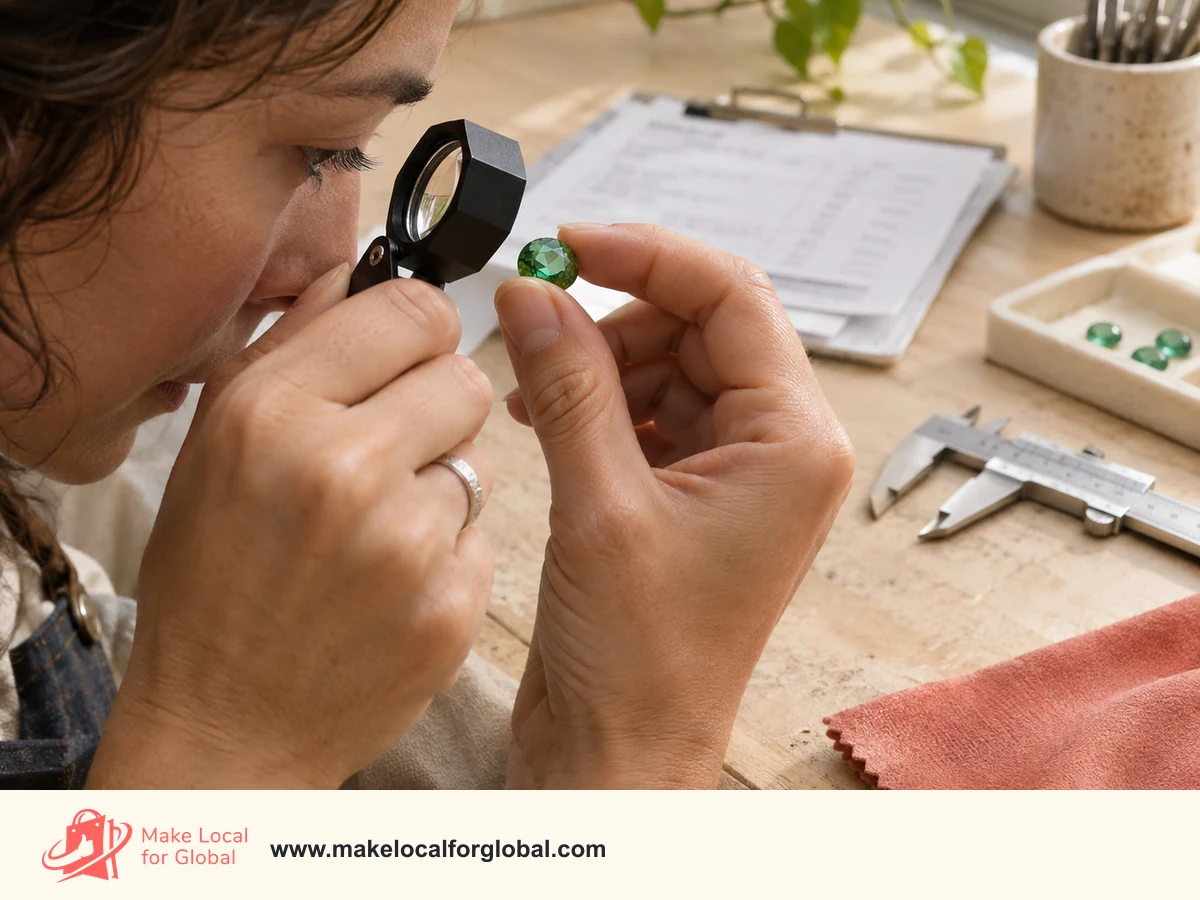
Order samples from more than one supplier if your cash plan allows it. Photograph each sample beside a neutral grey or white reference card under the same light. Compare the item in daylight and indoor light. Check the stone shape, colour, surface, setting, post, clasp, chain attachment, solder and finish. Note what you would accept before you see a problem.
Ask another person to inspect the sample using the same checklist. A second pair of eyes may catch a loose setting or sharp edge that you have stopped noticing. If you sell earrings, check left and right pairs for visible mismatch. For a ring, inspect the underside, setting security and size information. For a bracelet or necklace, check joins, extension links and clasp movement.
Place a follow-up sample order later if the first one passes. A second batch tests whether the supplier can repeat the quality. Keep the purchase order, sample photographs and agreed specification. If the new delivery varies, pause listings for affected pieces until you can describe and price them accurately.
Stone names carry buying expectations. “Natural ruby”, “lab-grown sapphire”, “simulated emerald” and “green glass” describe different materials. A buyer should not need to tell which material is present from the colour or a tiny line of text near the bottom of a product page.
Natural gemstones form in nature. Laboratory-grown stones have the same or similar chemical, physical and optical properties as their natural counterparts but are created in a controlled environment. Imitation materials resemble another gemstone in appearance but are made from a different material. Reconstructed or composite stones may combine fragments or bind material together. The exact naming depends on the material and accepted trade terminology.
Use the supplier’s exact, documented description and retain it with the batch record. Do not use “real” as a shortcut. A laboratory-grown sapphire is a real sapphire material, yet it is not a natural sapphire. “Natural” should refer to a natural stone, not merely to a stone made from mineral ingredients. If you cannot tell what the item is, delay the listing until you can verify it.
Gem treatments can change appearance, durability, care needs and value. GIA’s introduction to gem treatments explains why treatment details matter, and its coloured-stone report service describes report details such as whether a stone is natural or laboratory-grown and any detectable treatment. Those sources are explain how to read reports; they do not identify your own stock without examination.
Ask the supplier for known or disclosed treatments and instructions for cleaning, heat, light, water, cosmetics or storage. Some procedures may require specific care. Put those instructions on the product page and in the order insert where they apply. A generic “wipe clean” note does not help someone care for a treated stone.
Avoid terms such as “untreated”, “unheated”, “certified”, “rare”, “investment” or a named country of origin when you lack item-specific evidence. A report may identify a gemstone without providing an origin opinion, and an opinion may be inconclusive. Read the report itself, match its number to the stone and state what it does and does not confirm.
Do not advertise health, energy or healing effects as product facts. If you discuss a cultural or spiritual tradition, label it as a belief or tradition and avoid promises about health outcomes. Buyers need material and care details to make an informed purchase.
If your inventory contains individual stones, use the photograph of that stone. If a product is made to order from a consistent batch, disclose that the delivered stone may vary and show a realistic range of colours or inclusions. Do not use a retouched image that makes the stone appear brighter, clearer or larger than it is.
Use a neutral white balance and soft light. Take a front view, a side view, a back or setting view and a scale view. Include a close-up that shows the cut and surface. A ruler or coin can help convey scale in a supporting image, but publish the exact millimetres in the specifications. A hand can help buyers judge size, provided it does not hide the stone or distort scale.
Show natural variation without presenting it as a defect or as a desirable feature every customer will receive. If an inclusion is visible, make it clear in the listing. If each stone differs, say whether you will send the pictured item, let buyers choose a specific stone or select one from a stated range. This can reduce disputes more effectively than a long return policy.
For more detail on lighting and angles, see MLFG’s practical page on photographing jewellery for online sales. Keep the images close to the description they explain, name image files clearly and write useful alt text for accessibility. Google’s image SEO guidance recommends descriptive alt text and relevant page context. Alt text should describe the visual content, not repeat a string of search phrases.
A written receiving check turns a vague “looks fine” into a repeatable decision. The amount of inspection should fit the value, risk and size of your order. For a handful of valuable pieces, inspect every item. For low-value components in a larger batch, you may check a defined sample plus all visible defects, then increase checks if you find a mismatch.
For each piece, compare the delivered item with the purchase order: stone type and stated treatment, colour range, shape, measurements, metal, finish, chain length, clasp, weight if relevant, item count and packaging. Check for chips, loose settings, sharp edges, tarnish, scratches, bent posts, uneven pairs, weak solder and missing tags.
Do not use a home loupe or gem tester to claim a definitive identification without training and a suitable tool. A visual check can find damage or a mismatch. It cannot reliably establish every stone identity or treatment. Keep identification questions with the supplier or qualified gemmological service.
Take photographs of defects and record the batch, date, item code and remedy requested. Separate stock that needs a return or repair from stock you can sell. If a batch has a recurring problem, pause that listing and contact the supplier before sending more orders.
Try fasteners and moving parts several times. Observe whether a pendant hangs straight, whether a clasp closes securely and whether an earring post is smooth. Inspect a ring under ordinary light, not only under a bright bench lamp. If a finish rubs away after a short test, discuss the coating with the supplier and remove unsupported durability claims.
For plated items, state the base metal and plating accurately. Do not imply a plated item is solid precious metal. If you sell sterling silver or gold jewellery, confirm the material and applicable hallmark obligations before publication. “Gold tone” describes colour; it is not a claim that the piece contains gold.
Jewellery is worn against skin, so the metal safety question matters. Ask the supplier for compliance information on substances restricted in UK jewellery, including nickel release where relevant. The seller remains responsible for choosing a safe product; supplier paperwork should be checked against the exact item and its components.
A buyer cannot pick up a necklace or compare a gem in person. A clear listing should make the important details visible before the Add to basket button. Use a precise title, a short opening description, a specification list, honest photographs, care information, delivery expectations and a direct note about variation.
Write the product type, gemstone, metal and a useful design detail in natural order. For example: “Oval amethyst pendant in 925 sterling silver, 45 cm chain” is more informative than “Beautiful purple necklace for her”. Use the precious-metal fineness only when verified. Add a recipient or occasion only if it is genuinely relevant.
Avoid stacking every possible search phrase into the title. One exact product description is easier to scan and less likely to imply details that the item does not have. Use a separate description to explain the buyer’s questions, not to repeat the same keyword repeatedly.
Give buyers structured facts they can compare. Depending on the item, include:
Use “approximately” for measurements that vary, and say how you measured. Do not give carat weight for an entire finished necklace as though it were the stone weight. If you do not know the stone’s weight, leave it out and provide dimensions instead.
Describe whether the order includes the chain, gift box, polishing cloth, certificate or care card. If a report is included, name the issuing laboratory and report number, and explain the scope in plain words. Do not imply that a supplier’s card is an independent laboratory report.
State if gift wrapping costs extra, if a chain is optional, or if the photograph includes styling props that are not part of the order. Add a short sizing example. “The pendant is 18 mm high, measured from the top of the bail to the base” is clearer than “small but noticeable”.
For a personalised item, show the available choice, the character limit, how the buyer should submit it and when the item can ship. Confirm the proofing process for a bespoke engraving. Do not promise a delivery date until you have checked production and carrier time.
Start with what the item is and who might choose it. Then move to the stone and metal facts, dimensions, variation, care, packaging and delivery. Keep the most decision-useful information near the start. Write short paragraphs and use bullets for specifications.
For example: “This oval amethyst pendant is set in 925 sterling silver and supplied with a 45 cm chain. The pictured pendant is the piece you will receive. The stone measures 8 by 6 mm; its colour may look slightly different on another screen. Remove it before swimming and clean the silver with a suitable cloth.” Use this only if every detail is true of your product.
Do not use a universal paragraph and swap only the gemstone name. Amethyst, opal, turquoise, moonstone and garnet can differ in care, appearance and treatment. Write a product note from your documented supplier details.
A marketplace can introduce buyers to a new shop. Your own store offers more control over the product page, purchase path and repeat-purchase relationship. The choice depends on your budget, time, existing audience and whether the platform permits the product model you use.
Marketplaces provide an existing search and checkout environment, but you still need distinct product photos, complete descriptions, customer service and enough contribution after fees. Read the current policy and fee schedule before you calculate pricing. Etsy currently lists a 6.5% transaction fee on the order, a £0.15 listing fee and UK payment processing at 4% plus £0.20 for a sale, with other charges possible in some cases. Check Etsy’s current UK seller fee page and fee policy before launch; rates and eligibility can change.
Do not assume a marketplace permits every wholesale item. Etsy’s current Creativity Standards separate seller-made or seller-designed products from handpicked vintage and sourced craft or party supplies. New ready-made jewellery bought for resale may fall outside its permitted categories. Check the current policy for the exact product and how you represent your involvement.
An independent store takes more work to attract visitors. It gives you more control over navigation, product education, email sign-up and customer service pages. Before paying for a build, decide what the site must do: display actual inventory, take secure payment, calculate delivery, explain returns, collect product questions and track orders.
Your homepage should show the collection and explain why its details are trustworthy. A product page should link to care, shipping and returns information. A small shop can begin with a simple collection and a handful of strong listings. It does not need a complex catalogue before there is demand.
MLFG offers practical ecommerce tools on its apps page and describes its store plans on the pricing page. Compare the current offer and total cost with other routes before you choose a platform.
Social media can show how a piece catches light, how it sits on a person and how you pack it. Use those posts to send buyers to a complete product page where the material facts, price, delivery and returns are clear. Keep stock counts in one place and avoid accepting an order through a message if you cannot track payment, inventory and dispatch reliably.
Use short demonstrations: compare two stone sizes beside a ruler, explain how the setting relates to the gemstone, show a close view in daylight, or answer a real care question. Avoid making treatment or origin claims in a caption that the product page cannot support. Do not use trending content if it makes the piece look different from what the buyer receives.
The selling price must cover more than the stone and setting. Add inbound freight, import costs where relevant, packaging, carrier charges, platform and payment fees, returns or damage allowance, promotion and the time spent preparing, photographing and packing the item. Decide whether delivery is charged separately or included in the listed price, then model the customer’s full payment.
The figures below are a planning example only. They are not supplier quotes or a recommended retail price. It assumes the seller is not VAT registered, sells a £52 pendant on Etsy, charges £3.99 delivery, has no Offsite Ads charge and has not added VAT on the Etsy service fees. Check your actual account, bank and tax position before using the arithmetic.
| Cost line | Illustrative amount | How to replace it |
|---|---|---|
| Pendant, chain and inbound share | £16.00 | Supplier invoice plus inbound cost per saleable piece |
| Box and protective packing | £1.20 | Your measured material cost |
| Postage paid by seller | £3.99 | Your chosen tracked service and insurance |
| Etsy transaction fee | £3.64 | 6.5% of £55.99 item and postage total |
| Etsy payment processing | £2.44 | 4% of £55.99 plus £0.20, under this example’s assumption |
| Listing fee | £0.15 | Current UK listing fee shown by Etsy |
| Returns or damage allowance | £2.60 | Example reserve equal to 5% of the £52 item price |
| Customer acquisition allowance | £4.00 | Your actual paid promotion cost per order, if used |
| **Illustrative direct costs** | **£34.02** | Sum of the lines above |
| **Customer payment** | **£55.99** | £52 item price plus £3.99 delivery |
| **Contribution before labour and overhead** | **£21.97** | £55.99 minus £34.02 |
Illustrative planning example. Replace each amount with your own current costs and fee terms.
The £21.97 is not net profit. It does not pay for your labour, design time, photography, subscriptions, insurance, accountant, storage, income tax or any unlisted costs. If you spend 25 minutes on a made-to-order piece, assign a realistic hourly amount to that work and subtract it before deciding whether the product suits your business.
The example includes a returns reserve, not a claim that 5% of orders will be returned. Replace it with your own records once you have enough transactions. If you are VAT registered, rebuild the example using your VAT-inclusive selling price, eligible input VAT, platform fees and accounting approach. HMRC says UK VAT registration is required once taxable turnover passes £90,000 over a rolling 12-month period or is expected to pass that level in the next 30 days; check the current VAT thresholds and rules.
Compare items that match your stone type, metal, setting, dimensions, report status and seller role. A £30 plated necklace is not a direct comparison for a £300 hallmarked gold ring with a documented natural ruby. Record the differences. A marketplace search result is a current asking price, not evidence that the item sold or that the seller made a profit.
Choose a price that a target buyer can understand and that covers your real cost. If the product only works when you ignore labour, returns, payment fees or damaged stock, change the product, supplier, channel or price. Do not rely on a permanent “was £120, now £60” promotion to conceal weak margins.
For gift sets, calculate each component and the extra packing time. A pair of earrings and a pendant may sell together, but the bundle only makes sense when the total customer value is clear and the bundle price covers both pieces and the extra fulfilment steps.
Once the product, price and fulfilment route make sense, compare the setup needed to present a small jewellery collection online.
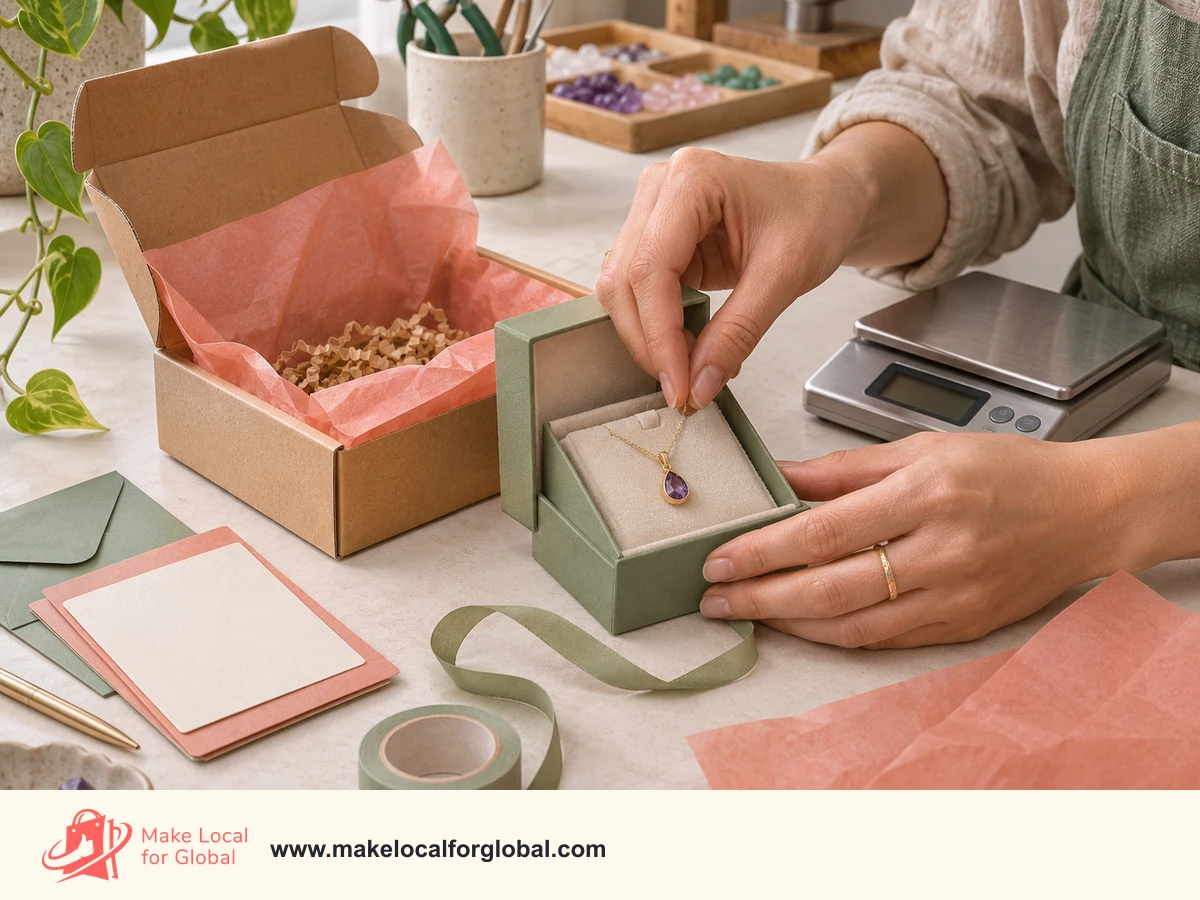
Gemstone jewellery is small, which makes it simple to pack but easy to lose if a parcel is not secure. Choose packaging that protects the setting and stone, prevents the piece moving in transit and conceals the contents from casual view. A branded box is presentation; an outer package and the delivery method protect the order.
Put one finished item into the exact box, pouch, care card and outer mailer you plan to use. Shake it gently, turn it upside down and inspect whether the piece can move or scratch. Photograph the pack before sealing. Weigh and measure the complete parcel so the displayed delivery price is based on a real package rather than a guess.
Use a tamper-evident or well-sealed outer mailer where appropriate. Keep the product invoice and order details separate from the gift presentation. For high-value items, confirm the chosen carrier’s rules for jewellery, compensation limits, tracking, signature and insurance. A “tracked” label does not automatically mean the full item value is insured.
Create a simple packing checklist: match item code to order, inspect the stone and setting, confirm chain or size, add the correct care card, protect the piece, record tracking, and mark stock dispatched. Store high-value stock securely and restrict who can access it.
Show dispatch times, delivery options, international destinations, customs charges where applicable and how a buyer can contact you. Do not promise next-day dispatch if an item must first be set or engraved. Notify the buyer when the parcel ships and share tracking through the sales platform.
For many UK online sales, consumers have a 14-day period after delivery to cancel a distance contract, with exceptions such as goods made to the consumer’s specifications or clearly personalised items. The exact treatment depends on the product and circumstances. Explain the customer’s rights accurately, publish a usable cancellation route and check the current GOV.UK online and distance selling rules. A shop policy cannot remove statutory rights for faulty or misdescribed goods.
Decide who pays return postage where the law permits you to set the policy, how returned jewellery should be packaged, how you will inspect it and how refunds are issued. Keep records of the condition and any customer communication. Do not promise that a personalised product has no returns in every circumstance; legal exceptions and rights must be checked for the actual sale.
Rules depend on where the seller is established, where the product is sold, who imports or manufactures it and what the item contains. This section is a starting checklist for a UK seller, not legal advice. Before a cross-border launch or a product involving precious metals or restricted materials, check the relevant regulator or qualified adviser.
In the UK, an article described as made wholly or partly of gold, silver, platinum or palladium may need a legally recognised hallmark once the relevant weight threshold is reached. The common thresholds are 1 gram for gold, 7.78 grams for silver, 0.5 gram for platinum and 1 gram for palladium, with rules for mixed-metal articles and exceptions. Read the British Hallmarking Council business guidance and the hallmarking summary. Do not assume a low-weight piece is exempt without checking how the law calculates the article.
Online retail sites selling precious-metal articles must prominently display explanatory hallmark information. If you sell silver or gold jewellery, check the dealer notice requirements and how the hallmark applies to the exact piece. A gold-plated base metal item should be described with its actual base metal and plating, not merely as “gold”.
Product claims need to be accurate and supported. UK product labelling guidance says labels must not mislead about what an item is made from, how it was made, where it came from or what it can do. The Competition and Markets Authority’s unfair commercial practices guidance explains that false or misleading product information can affect a buyer’s decision. Use this principle for titles, images, material claims, origin statements and customer reviews.
Jewellery must be safe in ordinary and reasonably foreseeable use. Check the official product safety advice for businesses, and ask the supplier for relevant UK compliance evidence for metal parts that contact skin. UK rules restrict certain hazardous substances and nickel release in jewellery. Keep the supplier’s test or compliance records, especially for earrings and items worn against skin. If you import goods, your obligations may differ from a retailer buying from a UK supplier.
Before checkout, show your business identity and contact details, a useful product description, the total price, delivery charges, payment method and cancellation information. Send a durable order confirmation and meet the delivery terms you offered. Read the current government guidance for the markets you serve; Northern Ireland, Great Britain and overseas orders can involve different rules.
Track turnover and import costs from the start. If you purchase stones from overseas, ask who acts as importer of record, what customs value is declared and whether duty or import VAT is due. HMRC explains how import VAT can include customs value and certain transport or insurance costs in its import VAT valuation guidance. Do not treat a supplier’s “delivered” price as a complete landed cost until you know what charges it includes.
Promotion should answer one question at a time. If a new listing has few relevant visits, work on reaching the right buyer. If visitors view the product but leave, inspect the price, photographs, delivery information and trust details. If people add the item to a basket but do not buy, check checkout friction, shipping costs and payment options.
Make a short list of phrases buyers might use, such as “amethyst pendant sterling silver”, “natural garnet ring size N”, or “blue topaz stud earrings”. The phrase should match the actual item. If you cannot prove the word “natural”, do not target it in the listing. Search results can reveal vocabulary, but do not copy another seller’s claims or descriptions.
Use one clear main phrase in the page title, product heading, URL where practical, opening description and image alt text when it accurately describes the image. Add related words where they help a buyer understand the piece. Google recommends useful, descriptive titles and images, with relevant page context; see its SEO Starter Guide. No title format guarantees a search position.
Write collection pages for a real shopper, not a search crawler. A page for amethyst pendants can explain available shapes, metal choices, treatment disclosures and care differences. A page that repeats the same four keywords without helping the buyer has little reason to exist. Link the collection to individual products and connect product pages to clear care and delivery information.
Build content from questions customers ask: How can I tell if this pendant includes a chain? What does “lab-grown” mean? How long is the necklace? Will the pictured stone be the one delivered? How should I store an opal? Does the ring have a hallmark? Use accurate answers with links to relevant product listings.
Short videos can show the actual stone in daylight and indoor light. A carousel can compare sizes beside a ruler. A written post can explain how you check a supplier batch. Each piece should help the customer make a decision; publishing every day is not a goal by itself.
Create a weekly record with visits, product-page engagement, questions, add-to-basket rate, orders, average order value, returns, delivery costs and actual contribution. Break results down by product, source and promotional spend. Use a minimum test period long enough to reach your planned audience. A tiny number of clicks is not enough to declare a design a success or failure.
When a post draws questions about gemstone treatment, add the answer to the product page. When people misunderstand chain length, put a measurement diagram beside the specifications. When a certain piece sells but takes too long to assemble, review the price or production method before accepting more orders.
Keep a stock record that connects each product to its supplier and evidence. A simple spreadsheet can hold SKU, description, stone identity, known treatment, metal, batch, landed cost, current stock, listing URL, photo filename and last inspection date. For one-of-a-kind stones, give every piece its own SKU. Do not rely on a shared product name to distinguish two stones.
Record the reason for every return, cancellation and repair. Group issues by colour mismatch, size misunderstanding, damaged setting, late delivery, gift presentation or buyer change of mind. One complaint does not prove a whole supplier batch is bad, yet repeated problems should trigger a review.
Answer questions with the same facts used in your listing. If you cannot confirm origin or treatment, say that plainly and update the listing so the same uncertainty is clear to the next buyer. If you discover a safety concern, stop selling affected stock as you speak with the supplier and the relevant authority.
Set a weekly time to reconcile orders, payments, fees, stock and refunds. Marketplace sales reports and bank deposits may not match the customer’s total payment, as fees, taxes and reserves are deducted separately. Keep invoices and records for the period required by HMRC. Ask an accountant about your situation if you are unsure how to record precious-metal stock, imports or VAT.
This plan works for a seller who has not yet committed to a large purchase. Adjust the pace if you need testing, hallmarking, custom production or supplier documents before opening.
Write the buyer statement and select one collection idea. Compare recent customer questions, marketplace listings and search phrases. Speak with potential buyers about actual designs and price ranges. Record their objections rather than asking them to endorse the idea.
Choose two or three suppliers to contact. Request written material and treatment details, sample pricing, minimum order, lead time and return terms. Build a first cost sheet with estimates clearly marked. Do not place a bulk order until the sample and compliance questions are resolved.
Order the samples that fit your budget. Photograph them under consistent light, inspect the setting and fastening, check dimensions, and record the supplier’s stated details. Compare the second supplier’s sample with your preferred option. Decline products whose description you cannot support.
Select the smallest useful opening collection. Give every item an SKU. Write the price calculation from landed cost to contribution, including fees, shipping, returns reserve, packing and your labour. If the price does not work, refine the design or the sales route before you order stock.
Write the product titles and specifications. Photograph the front, side, back, scale and packaging. State whether images show the exact piece. Add treatment, natural/lab-grown status, metal, sizes, care, delivery and returns information from your records.
Check the UK hallmark and safety requirements that apply to the products and your role in the supply chain. Make sure your shop shows business contact details, delivery terms and a returns route. Test the packing routine and record parcel weights before setting shipping rates.
Publish a small number of complete listings. Share one post that shows the actual item and one that answers a frequent buying question. Send interested visitors to the full product page. Avoid discounting before you understand the contribution per order.
At the end of the week, note relevant visits, questions, baskets, orders, fees, dispatch times, customer feedback and contribution. Choose one change for the next week. If the listing receives little relevant traffic, adjust distribution. If people ask the same question, improve the page. If orders are unprofitable or hard to fulfil, revise the product or price before adding stock.

It can be, but the outcome depends on the product cost, metal, channel fees, shipping, returns, promotion, labour and sales volume. Build a contribution calculation before ordering stock. A high retail price does not guarantee a profitable order if the stone, setting, insurance and customer acquisition cost are high.
There is no single answer for every product. A report may help with a valuable or high-risk stone, a buyer’s requested identification or a claim that affects price. Smaller fashion pieces may rely on consistent supplier records and accurate descriptions. Never call a supplier’s card an independent laboratory certificate. Match any report number to the exact stone it describes.
Check Etsy’s current Seller Policy and Creativity Standards before listing. Etsy permits specific seller-made, seller-designed, handpicked or sourced categories, and its rules restrict ordinary reselling and drop shipping. A newly purchased finished necklace may not qualify on the basis of its gemstone alone. Marketplace rules can change, so verify the current policy for your exact product and role.
Begin with a small collection you can inspect, photograph and fulfil consistently. Four to eight related designs can be a planning example, not a fixed target. Your actual starting number depends on supplier minimums, cash and whether each item is repeatable or one of a kind.
Choose the type your target buyer wants and your supplier can document. Natural and laboratory-grown stones are different product propositions. Make the distinction visible in the listing and avoid using either term without evidence. You can test demand for both later if you have the records, photographs and cash flow to manage them separately.
Give the product type, stone status, known treatments, metal and fineness, dimensions, chain or ring size, clasp, care instructions, packaging, delivery estimate and variation policy. Include clear photographs of the actual item or explain when the buyer receives one piece from a variable batch.
Not every item. The rules include metal-specific weight thresholds and other conditions. Check the current British Hallmarking Council guidance for the item’s composition and weight before describing it as precious metal. Online sellers have notice requirements too.
Show the full item, a close view of the stone, the setting or clasp, the back, scale and the packaging if it is included. Use neutral light and colour so the buyer can judge the actual item. Avoid filters that change the stone’s appearance.
Secure the pendant so it cannot rub against the stone or move inside its box. Place the box inside a protective outer mailer, use a carrier that accepts the contents, and check the current compensation and insurance limit for the item’s value. Record the final parcel dimensions and tracking details.
Only use a claim you can explain and support with evidence tied to the supplier or item. Broad labels can imply more than a supplier document proves. If the source is unknown, say so rather than making a promise.
A small gemstone collection becomes easier to manage when every piece has a buyer, a documented description, an inspected sample and a full cost calculation. Choose one range to test, photograph it honestly and keep a record of what customers ask before you commit more money to stock.
If you want help comparing your online store options, review the current MLFG ecommerce plans or contact the team with your product range, budget and launch questions.
Share your first range, budget and fulfilment plan with MLFG and discuss which website route fits the shop you want to build.
PREFERRED SOURCE
Like what you’re reading? Add Make Local for Global as a preferred source on Google to see more of our articles when you search.

Build your online presence without having to figure out everything yourself.